Address for correspondence Dr. Farooq Rahman Soomro,
Adjunct Professor, PCMD University of Karachi, Incharge Leprosy Centre, Larkana, Sindh. Pakistan
Ph # 0333 – 7566196
E-Mail: [email protected]
Original Article
New cases and types of leprosy in Interior Sindh: An
analysis of 3 years (2012-2014)
Introduction
Leprosy (Hansen’s disease) is a slowly progressive infection caused by Mycobacterium leprae that mainly affects the skin and peripheral nerves and results in disabling deformities.1
According to WHO report of 2004 there were 407,791 new cases diagnosed of leprosy.2 It continues to be an important health problem world wide.3 Its prevalence in Pakistan is estimated to be 0.05/10,000, and incidence is estimated as 0.05 and 0.3, respectively.4 The pattern of disease ranges from tuberculoid
(paucibacillary) characterized by relatively few (not more than 5) skin lesions with marked cell mediated response to lepromatous (multibacillary) form which exhibits multiple lesions and little cell mediated immunity to M. laprae.5 Nerve damage may occur early in tuberculoid form but tends to be more insidious in lepromatous leprosy.6 Acute inflammatory response to M. leprae called as leprosy reaction also occurs which can result in marked nerve damage and subsequently limb disability and deformity.7 More than one third of all lepromatous patients face the threat of permanent and progressive physical and social disability.8 One of the difficulties in properly assessing, monitoring and maintaining the leprosy problem is that enumeration of cases in many developing countries is incomplete or irregular.9 Keeping the fact in view we present an analysis of 3 years (2012 to 2014) of new Farooq Rahman Soomro*, Manzoor Ali Shaikh**, Irfan Ahmed Shaikh***, Nuzhat Seema Bhatti*, Ghulam Murtaza Pathan**
* Leprosy Centre, Larkana.
** Pathology Department, Chandka Medical College, SMBB Medical University, Larkana *** Dermatology Department, Ghulam Muhammad Mahar Medical College, SMBB Medical University, Larkana
Abstract Objective To evaluate the new cases and clinical types of leprosy in interior Sindh.
Methods Data analysis and evaluation of 3-year record of leprosy centers/clinics in Interior Sindh. Results Of total 238 new registered cases, 98 (41%) were diagnosed after a delay of 1 year. The types of disease found were tuberculoid 59 (25%), borderline tuberculoid 100 (42%), borderline 13 (5%), borderline lepromatous 53 (22%) and lepromatous lepromatous 13 (5%) cases. Multibacillary cases were 179 (75%) and paucibacillary 59 (25%).
Conclusion The 3-year analysis of Interior Sindh shows endemic regions of leprosy in Pakistan which will help in devising strategy for an effective leprosy control program.
Keywords
cases and clinical types of leprosy attended and registered at centers/ clinics of leprosy located in districts of Interior Sindh.
Methods
The data of this study were collected from leprosy centers/clinics working in districts of interior of Sindh through their District Leprosy Control Officer. The records of all new registered cases at centers were evaluated. The descriptive information was studied which included patients name, age, sex, duration, type and diagnosis of lesion. The diagnosis was clinical by cardinal signs of leprosy and supported by acid-fast bacilli in slit-skin smear or histopathologic diagnosis of biopsy specimens as recommend by WHO.3,12
Results
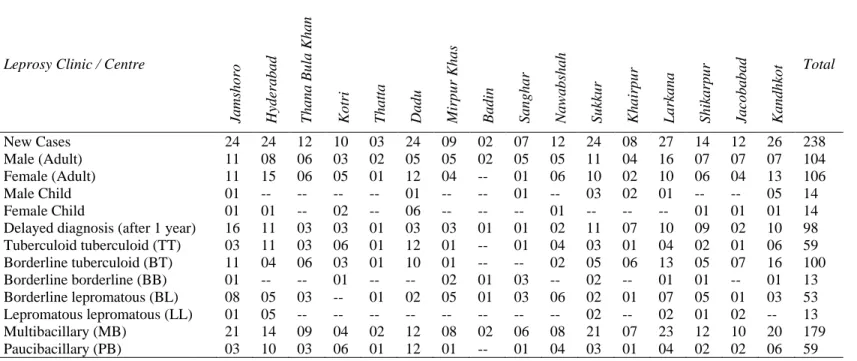
238 new cases of leprosy were registered at leprosy centers/clinics located in districts of Interior Sindh during 3 years (2012 to 2014). Out of 238 cases the adult males were 104 (44%) and adult females were 106 (44%). Among child cases males were 14 (6%) and females were 14 (6%). Out of total cases, 98 (41%) were delayed diagnosed after 1 year. Regarding types of leprosy, tuberculoid cases were 59 (25%), borderline cases were 100 (42%), borderline cases were 13 (5%), borderline lepromatous cases were 53 (22%) and lepromatous leprosy cases were 13 (5%). The multibacillary cases were 179 (75%) and paucibacillary cases were 59 (25%), as shown in Table 1. The year wise data and analysis is shown Table 2, 3 and 4, respectively.
Discussion
In any retrospective study, the researcher is at the mercy of the available record. The files of an infectious disease like leprosy might be more
complete and reliable than those of other illnesses as it is essential to have an effective leprosy control program.10,11The chain of leprosy centers/clinics spreads throughout the country including the districts of Interior Sindh and the area is considered to be one of endemic region for leprosy in Pakistan.
The early diagnosis, registration and compliance with multiple drug therapy has led to reduction of the disease.12 The centers/clinics of leprosy working in interior Sindh play an important role in diagnosis, registration and treatment of the disease, the information and record of these centers is helping in strategic plan for control of the disease in the region. In this study we had 238 patients of leprosy comprising 104 males, 106 female adult cases while 28 were children. Among these all cases, 98 were delayed diagnosed cases after 1-year period. This observation is similar to those of other studies.11,13,14 The proportion of children below 15 years was an average 12% as new cases in this study. However, the age distribution of a population plays an important role in there figures.
Table 1 New Registered cases and Types leprosy in Districts of interior Sindh during 2012 to 2014.
Leprosy Clinic / Centre
Jam
shor
o
Hyd
erab
ad
Thana
Bul
a
Kh
an
Kotri Thatt
a
Dad
u
Mi
rp
ur K
has
Ba
din
Sanghar Nawa
bshah
Su
kk
ur
Kha
ir
pur
La
rk
ana
Sh
ik
arpu
r
Jacob
abad
Kand
hko
t Total
New Cases 24 24 12 10 03 24 09 02 07 12 24 08 27 14 12 26 238
Male (Adult) 11 08 06 03 02 05 05 02 05 05 11 04 16 07 07 07 104
Female (Adult) 11 15 06 05 01 12 04 -- 01 06 10 02 10 06 04 13 106
Male Child 01 -- -- -- -- 01 -- -- 01 -- 03 02 01 -- -- 05 14
Female Child 01 01 -- 02 -- 06 -- -- -- 01 -- -- -- 01 01 01 14
Delayed diagnosis (after 1 year) 16 11 03 03 01 03 03 01 01 02 11 07 10 09 02 10 98 Tuberculoid tuberculoid (TT) 03 11 03 06 01 12 01 -- 01 04 03 01 04 02 01 06 59 Borderline tuberculoid (BT) 11 04 06 03 01 10 01 -- -- 02 05 06 13 05 07 16 100 Borderline borderline (BB) 01 -- -- 01 -- -- 02 01 03 -- 02 -- 01 01 -- 01 13 Borderline lepromatous (BL) 08 05 03 -- 01 02 05 01 03 06 02 01 07 05 01 03 53 Lepromatous lepromatous (LL) 01 05 -- -- -- -- -- -- -- -- 02 -- 02 01 02 -- 13 Multibacillary (MB) 21 14 09 04 02 12 08 02 06 08 21 07 23 12 10 20 179 Paucibacillary (PB) 03 10 03 06 01 12 01 -- 01 04 03 01 04 02 02 06 59 Table 2 New registered cases and types leprosy in districts of Interior Sindh during 2012.
Leprosy Clinic / Centre
Jam
shor
o
Hyd
erab
ad
Thana
Bul
a
Kh
an
Kotri Thatt
a
Dad
u
Mi
rp
ur K
has
Ba
din
Sanghar Nawa
bshah
Su
kk
ur
Kha
ir
pur
La
rk
ana
Sh
ik
arpu
r
Jacob
abad
Kand
hko
t Total
New Cases 12 8 4 1 1 14 2 1 -- 3 3 3 13 7 5 8 85
Male (Adult) 6 2 4 -- 1 2 1 1 -- 2 1 1 6 3 1 3 34
Female (Adult) 5 6 -- -- -- 10 1 -- -- 1 1 1 7 3 3 4 42
Male Child 1 -- -- -- -- -- -- -- -- -- 1 1 -- -- -- 1 4
Female Child -- -- -- 1 -- 2 -- -- -- -- -- -- -- 1 1 -- 5
Borderline tuberculoid (BT) 3 2 2 -- -- 5 -- -- -- -- 1 2 6 3 4 7 35 Borderline borderline (BB) 1 -- -- -- -- -- -- -- -- -- 1 -- -- -- -- -- 2 Borderline lepromatous (BL) 6 2 2 -- 1 2 1 1 -- 2 -- 1 5 3 -- -- 26 Lepromatous lepromatous (LL) -- 3 -- -- -- -- -- -- -- -- -- -- -- -- -- -- 3
Multibacillary (MB) 10 7 4 -- 1 7 1 1 -- 2 2 3 11 6 4 7 66
Paucibacillary (PB) 2 1 -- 1 -- 7 1 -- -- 1 1 -- 2 1 1 1 19
Table 3 New registered cases and types leprosy in districts of interior Sindh during 2013.
Leprosy Clinic / Centre
Jam
shor
o
Hyd
erab
ad
Thana
Bul
a
Kh
an
Kotri Thatt
a
Dad
u
Mi
rp
ur K
has
Ba
din
Sanghar Nawa
bshah
Su
kk
ur
Kha
ir
pur
La
rk
ana
Sh
ik
arpu
r
Jacob
abad
Kand
hko
t Total
New cases 5 6 2 2 1 8 2 -- 3 2 13 2 7 3 4 6 66
Male adult 2 3 -- 1 -- 3 1 -- 1 2 5 1 5 2 4 1 31
Female adult 3 3 2 1 1 2 1 -- 1 -- 06 -- 1 1 -- 3 25
Male child -- -- -- -- -- 1 -- -- 1 -- 2 1 1 -- -- 1 7
Female child -- -- -- -- -- 2 -- -- -- -- -- -- -- -- -- 1 3
Delayed diagnosis (after 1 year) 4 4 -- -- -- -- 1 -- 1 1 5 2 3 -- 4 3 28 Tuberculoid tuberculoid (TT) -- 3 -- 2 -- 3 -- -- 1 -- 1 1 2 1 -- 2 16 Borderline tuberculoid (BT) 3 -- 2 -- 1 5 -- -- -- -- 9 1 3 2 3 4 33 Borderline borderline (BB) -- -- -- -- -- -- 1 -- 1 -- 1 -- 1 -- -- -- 4 Borderline lepromatous (BL) 2 1 -- -- -- -- 1 -- 1 2 -- -- -- -- 1 -- 8 Lepromatous lepromatous (LL) -- 2 -- -- -- -- -- -- -- -- 2 -- 1 -- -- -- 5
Multibacillary (MB) 5 3 2 -- 1 5 2 -- 2 2 12 1 5 2 4 4 50
References
1. McAdam AJ, Sharpe AH. Infections Disease. In: Kumar W, Abbas AK, Fausto N, Aster J, editors. Robbins and Cotran Pathologic Basis of Disease, 8th Ed. Philadelphia: Saunders Elsevier; 2010. P. 372.
2. Global Leprosy Situation. Wkly Epidemiol Rec. 2005;80:289-95.
3. WHO, 1998. Expert Committee on Leprosy. World Health Organization Tech Rep. Ser No. 874, 1-43.
4. Marie Adelaide Leprosy Organization website for leprosy awareness available at www.male.org/pk. Accessed on May 6, 2008.
5. Bongiorno MR, Pistone G, Noto S. Tuberculoid leprosy and type I lepra reaction. Travel Med Infect Dis. 2008;6:311-4.
6. Croft RP, Nicholas PG, Steyrberg EW et al. Clinical prediction rule for nerve function impairment in leprosy patients. Lancet. 2000;355:1603-6.
7. Sabin TD, Swift TR. Leprosy. In: Aminoff
MJ, Daroff RB, editors. Encyclopedia of
the Neurological Sciences. 1st edn.
Philadelphia: Academic Press; 2003. P. 775-80.
8. Theuvent WJ, Sooras D, Baral JP et al. Mass survey of leprosy in Lalitpur District, Nepal. Int J Lepr. 1994;62:256-62.
9. WHO. Healthcare in south – East Asia. New Delhi: World Health Organization. 1989. S.E Asia Ser. 14.
10. Nosseri K, Hoonko Y. Epidemiology of leprosy in Iran. Int J Lepr. 1977;45:355-9. 11. Bijaj DR, Matlani BL, Soomro FR, Iqbal
MP. Knowledge, attitude and practices regarding leprosy among general practitioners at Hyderabad. J Coll Physicians Surg Pak. 2009;19:215-8. 12. WHO. The Final Push towards Elimination
of Leprosy. Strategic Plan 2000 – 20005 World Health Organization Geneva (2000). 13. Soomro FR, Pathan GM, Abbasi P et al. Deformity and disability index in patients of leprosy in Larkana region. J Pak Assoc Dermatol. 2008;18:29-32.