Address for correspondence Dr. Mariam Sheikh
Department of Dermatology,
Allama Iqbal Medical College, Jinnah Hospital, Lahore
E-mail: [email protected]
Original Article
Cutaneous manifestations of chronic renal
failure
Mariam Sheikh, Lamis Mahmood Malik, Muhammad Jahangir
Department of Dermatology, Allama Iqbal Medical College, Jinnah Hospital, Lahore
Abstract
Objective To determine the frequency of cutaneous lesions in patients of chronic renal failure (CRF).Methods 350 patients of CRF regardless of gender and cause, fulfilling inclusion criteria were enrolled from all the four medical units, nephrology unit and renal dialysis unit of Jinnah Hospital, Lahore. An informed consent was taken. Detailed examination and required investigations for cutaneous manifestations were carried out, noted and entered in a structured proforma.
Results Out of 350 patients evaluated, 100% had skin changes. 186 (53%) patients were males and 164 (47%) were females. The most prevalent finding was xerosis present in 309 (88.3%) patients followed by pruritus in 271 (77.4%) patients. Among nail changes, half-and-half nails were present in 267 (76.3%) and among mucosal changes, xerostomia was present in 290 (82.9%) patients.
Conclusion Chronic renal failure is associated with complex array of cutaneous manifestations caused either by disease or treatment. The commonest are xerosis, pruritus, half-and-half nails and xerostomia.
Keywords
Chronic renal failure, cutaneous manifestations, xerosis, pruritus, half-and-half nails, xerostomia.
Introduction
Chronic renal failure (CRF) is defined as the progressive loss of renal function over a period of months or years. It is one of the common conditions in our community.1 The number of
patients with CRF in Pakistan is continuously increasing with an estimated annual incidence of >100 new cases of end-stage renal disease (ESRD) per million population.2 The commonest
causes of CRF are diabetes mellitus, hypertension, glomerulonephritis and nephrolithiasis.3,4
There are various cutaneous manifestations in patients of CRF. These skin and nail changes can occur before or even after initiation of dialysis. The spectrum of cutaneous manifestations is much higher in patients on hemodialysis. Some say that skin manifestations are due to underlying pathologic process that induced renal disease, while others say that skin changes are related to severity and duration of renal failure.5
management and on hemodialysis with a view to help in early detection of chronic renal failure leading to prompt treatment and thus decreasing the morbidity and mortality associated with it.
Methods
For this cross sectional survey, patients were collected during a six month period (from 6th February to 6th August 2009) from all the four medical units, nephrology and renal dialysis unit of Jinnah Hospital, Lahore. Three hundred and fifty patients of chronic renal failure were included through non-probability, purposive sampling. Patients of chronic renal failure ranging from 30-70 years of age regardless of gender and cause of renal failure, who were on conservative management for 1 year or on hemodialysis for more than 6 months to 1 year were included. Renal transplant patients and patients on peritoneal dialysis were excluded.
After informed consent, detailed clinical history was taken and examination was performed for cutaneous changes in various grades of renal failure like xerosis, pigmentation, pruritus, pallor etc. and also due to arteriovenous fistula. Nail, hair and mucosal changes were also noted.
Necessary investigations like culture sensitivity and microscopy for recurrent infections (bacterial, fungal, viral) and onychomycosis were done to confirm some manifestations and all this was noted and entered in a structured proforma. Frequencies along with percentages of variables were calculated and analyzed using Statistical Package for Social Services (SPSS) version 12.0.
Results
The study included 350 patients of chronic renal failure; 186 (53%) were males and 164 (47%)
were females. The overall age ranged from 30-75 years with the mean age of 48.91 years (S.D+/-12.46). Maximum number of patients was in age groups between 30-39 years, followed by age group between 50-59 years and 60-69 years. 178 (50.9%) patients were on conservative management and 172 (49.1%) were on hemodialysis. Arteriovenous shunt was present in 170 (48.6%) patients. Regarding the grades of renal failure out of 350 cases, 1 (0.3%) patient had grade III, 17 (4.9%) patients had grade IV and 332 (94.9%) patients had grade V of chronic renal failure (Table 1).
Out of 350 patients of chronic renal failure, cutaneous manifestations were present in 350 (100%) cases. These cases presented with one or more skin features.
Among the cutaneous features (Table 2), xerosis was the most common seen in 309 (88.3%) patients which was generalized, most prominent on lower legs and feet, followed by generalized pruritus present in 271 (77.4%) patients. Next was pallor present in 209 (59.7%) patients. Pigmentation was seen in 204 (58.3%) patients, mostly on forehead, around digits and in some was generalized. Ecchymosis was seen in 129 (36.9%) patients mostly on forearms and legs.
Table 1 Skin changes in various grades of chronic renal failure (CRF).
Grade of CRF Total no. of patients No. of patients with ≥5 skin changes, N (%)
Grade III 1 1 (100%)
Grade IV 17 7 (41.2%)
Grade V 322 272 (81.9%)
Table 2 Cutaneous manifestations on body (n=350)
Cutaneous manifestation Number of patients Males (n=186) Females (n=164)
309 (88.3%) 155 (83.3%) 154 (93.9%)
Pruritus 271 (77.4%) 140 (75.2%) 131 (79.8%)
Pallor 209 (59.7%) 96 (51.6%) 113 (68.9%)
Pigmentation 204 (58.3%) 102 (54.8%) 102 (62.1%)
Ecchymosis 129 (36.9%) 59 (31.7%) 70 (42.6%)
Perforating disorder (Kyrle’s disease, RPC, PF, EPS)
31 (8.9%) 17 (9.1%) 14 (8.5%)
Recurrent infection
Bacterial 16 (4.6%) 11 (5.9%) 5 (3%)
Fungal 11 (3.1%) 3 (1.6%) 3 (1.8%)
Viral 7 (2.0%) 6 (3.2%) 1 (0.6%)
RPC = Reactive perforating collagenosis, PF = perforating folliculitis, EPS = elastosis perforans serpiginosa. Table 3 Cutaneous manifestations due to arteriovenous shunt (n=350).
Cutaneous manifestation Number of patients Males (n=186) Females (n=164)
Bacterial infections 4 (1.1%) 2 (1%) 2 (1.2%)
Irritant and allergic eczema 27 (7.7%) 11 (5.9%) 16 (9.7%)
Table 4 Manifestations in nails (n=350).
Cutaneous manifestations Total no. of patients Males (n=186) Females (n=164)
Half-and-half nails 267 (76.3%) 141 (75.8%) 126 (75.8%)
Koilonychia 88 (25.1%) 34 (18.2%) 54 (32.9%)
Onycholysis 67 (19.1%) 36 (19.3%) 31 (18.9%)
Subungual hyperkeratosis 49 (14%) 30 (16.1%) 19 (11.5%)
Onychomycosis 29 (8.3%) 12 (6.4%) 17 (10.3%)
Table 5 Manifestations in hair (n=350).
Cutaneous manifestation Scalp Body Face
Hypertrichosis 1 (0.3%) 2 (0.6%) 6 (1.7%)
Sparse 64 (18.3%) 147 (42%) 5 (1.4%)
Table 6 Manifestations in mucosae (n=350).
Cutaneous manifestations Total no. of patients Male (n=186) Female (n=164)
Xerostomia 290 (82.9%) 144 (77.4%) 146 (89%)
Angular cheilitis 64 (18.3%) 26 (13.9%) 38 (23.1%)
Ulcerative stomatitis 7 (2%) 4 (2.15%) 3 (1.8%)
Uremic fetor 4 (1.1%) 3 (1.6%) 1 (0.6%)
Macroglossia 1 (0.3%) 1 (0.53%) -
Among 350 patients of chronic renal failure, the most common nail change was half-and-half nails present in 267 (76.3%) patients. Other nail changes were koilonychia in 88 (25.1%), onycholysis in 67 (19.1%) involving the big toe mostly, subungual hyperkeratosis in 49 (14%)
and onychomycosis in 29 (8.3%) patients (Table 4).
Table 7 Comparison of patients on conservative management and on hemodialysis
Features Conservative management
Haemodialysis Mean age 52.54 years 45.15 years Male:female
ratio
1.5:1 0.8:1
Xerosis 82% 94%
Pruritus 78% 76%
Pigmentation 53% 63%
Pallor 48% 70%
Half-and-half nails
76% 76%
Sparse body hair 32% 51%
Xerostomia 76% 88%
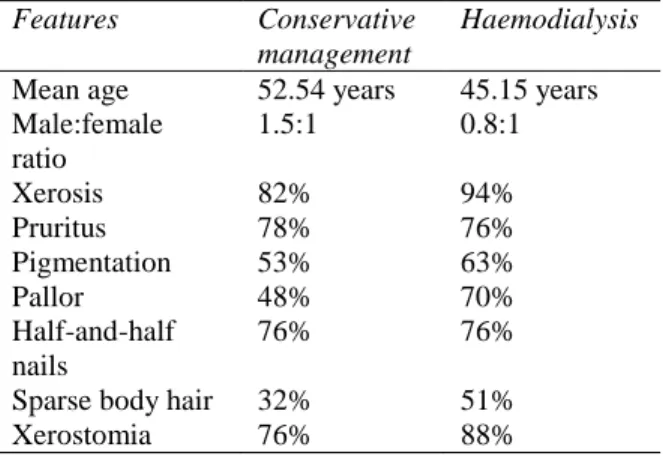
Among 350 patients of CRF, the most common mucosal change was xerostomia in 290 (82.9%) patients. This was followed by angular cheilitis in 64 (18.3%) patients. Other changes seen are shown in Table 6. Table 7 compares the changes in patients on conservative management and those on hemodialysis.
Discussion
In the present study, 350 patients of CRF were studied for the presence of cutaneous manifestations. Such a large number of patients have not been studied before to our knowledge. The largest number of patients studied as reported in medical literature was 212 by Zucker
et al.6 in 2003. An almost equal gender
distribution was seen. When compared with other similar studies, Amataya et al.7 showed
almost similar male to female ratio. However, another study carried out by Udayakumar et al.8
showed a somewhat higher risk in male patients.
Epidemiological studies have shown that CRF affects all age groups. Udayakumar et al.8
showed that most of their patients were aged between 41 and 50 years. In the present study mean age of the patients was 48.9 years with majority of patients in the age range of 30-39
years. Our results therefore were comparable to the above mentioned studies.
The frequency of cutaneous manifestations was found to be 100% in our patients of CRF. In a previous study by Udayakumar et al.8 a
frequency of 82% was reported. Another study by Nunley9 showed the frequency ranged from
50% to100%. This difference may be due to the fact that the entire cutaneous manifestations including non-specific features associated with CRF were also included rather than just specific manifestations.
Among the cutaneous manifestations on body xerosis with a non-specific generalized involvement was the most common finding (88.3%) [Table 2]. Several aetiologies can be considered. It can be a result of systemic and/or local factors like decreased sweat, sebum secretion and altered metabolism of vitamin A.10
A study carried out by Szepietowski et al.10
showed 50-85% frequency of xerosis. Another study by Udayakumar et al.8showed a frequency
of 79%.
Pruritus was the second most common finding with a frequency of 77.4%. It can be due to uraemia-related abnormalities, particularly involving calcium, phosphorus and parathyroid hormone metabolism, accumulation of uremic toxins, systemic inflammation, cutaneous xerosis, and common co-morbidities such as diabetes mellitus and viral hepatitis.11 A study by
Dyachenko et al.12 showed pruritus in patients of
hemodialysis with a frequency of 74.3%, another study by Dar et al.13 showed pruritus in
75% patients which is almost similar to our study.
Pigmentation is attributed to an increase in melanin in basal layer and in superficial dermis due to failure of kidneys to excrete poorly dialyzable beta melanocyte stimulating hormone, its intensity increases with the duration of chronic renal failure. A study by Avermaete et al.14 showed that patients had
pigmentation with a frequency of greater than 50%. These results were almost similar to our results. Another study by Amatya et al.7 showed
pallor with frequency of 20%. This was lower than our finding of 59.7%. The reason for this could be that duration of CRF in our patients was from minimum 6 months to 1 year and anemia progresses with time.
Other less common findings on body in patients of CRF included ecchymosis having frequency of 36.9% and perforating disorders with frequency of 8.9%. In a study by Hajheydari et al.15 showed ecchymosis in 29.7%. Another
study carried out by Udayakumar et al.8 showed
ecchymosis in 9% and perforating disorders like acquired perforating disorder in 4.5-17% and Kyrle’s disease in 21%. Again our results are comparable to these.
Among the skin findings found in association with arteriovenous shunt, irritant and allergic eczema was present in 7.7%, almost similar to the frequency of 8% reported by Udayakumar et al.8
Among the nail manifestations of CRF, the most common finding was half-and-half nails seen in 76.3%. Half-and-half nails are considered to be characteristic of uremia. It can involve all finger-and toenails. A study carried out by Sultan et al.16 reported a frequency of 28% of
half-and-half nails. Our patients had a greater frequency which may again be explained by the higher level of uremia in our patients.
Among other nail changes found in our study common were koilonychia (25.1%), onycholysis (19.1%) and subungual hyperkeratosis (14%). Sultan et al.16 showed almost same findings with
koilonychia (39%).
Certain hair abnormalities were also found in our study. These were sparse scalp hair in 18.3% and sparse body hair in 42%. Hajheydari et al.15
noted sparse scalp hair in 9.9% and sparse body hair in 8.9% patients. In our study relatively higher frequency was found. The reason for this difference could not be explained.
Among the mucosal changes found in our study, the most common finding was xerostomia (82.9%). It is attributed to dehydration and mouth breathing. Sultan et al.16 reported a
frequency of 35% whereas Udayakumar et al.8
showed xerostomia in 31%. Our study showed a higher frequency as compared to other studies. Again, we were unable to explain the difference.
When we compared the patients on conservative management with those on hemodialysis there was not much difference between the two groups regarding age and sex ratio (Table 7). Apart from the manifestations which are peculiar to the haemodialysis patients because of arteriovenous shunt (Table 3), the other manifestations showed some differences (Table 7). The frequency of pallor was 48% in conservative management group as compared to 70% in hemodialysis group, pigmentation was 53% in conservative group and 63% in hemodialysis group while sparse body hair in the conservative group was 32% whereas 51% in hemodialysis group.
the other manifestations between two groups may be explained on the basis of chronicity and severity of renal disease in the hemodialysis group as compared to the conservative management group.
Chronic renal failure is a significant cause of morbidity and mortality in our population. Cutaneous manifestations are an important feature of the condition. They not only add to the morbidity but can often be the initial manifestation of chronic renal failure even before other symptoms develop. Their detection at an early stage can therefore lead to early detection and treatment of the underlying condition. Also their severity can sometimes fluctuate with the severity of the disease. Hence they can be assessed to monitor the severity of the disease. It is important therefore to be aware of all possible skin, hair, nail and mucosal manifestations of chronic renal failure so as to effectively diagnose the condition and treat accordingly so as to relieve patients discomfort.
References
1. Arora P, Verrelli M. Chronic renal failure. 2010.. Available from: URL: http://emedicine.medscape.com/article/2387 98-print. Accessed on 2012 May 1.
2. Rizvi AH, Manzoor K. Causes of chronic renal failure in Pakistan. Saudi J Kidney Dis Transpl. 2002;13:376-9.
3. Barosum RS. Pathogenesis of diabetic nephropathy Part 1. Kidney Forum. 2002;2:11-22.
4. Sakhiya V, Sud K. Burden of disease and management issues (end stage renal disease in India and Pakistan). Kidney Int. 2003;63:S115-S118.
5. Lynde C, Kraft J. Skin manifestations of kidney disease. Parkhurst Exchange.
2007;15(2). Available from: http://www.parkhurstexchange.com/clinical-reviews/ct_02_vol15.
6. Zucker I, David M, Yosipovitch G et al. Prevalence and characterization of uremic pruritus in patients undergoing haemodialysis. J Am Acad Dermatol. 2003;49:842-6.
7. Amatya B, Agrwal S, Dhali T et al. Pattern of skin and nail changes in chronic renal failure in Nepal: Hospital based study. J Dermatol. 2008;35:140-4.
8. Udayakumar P, Balasubramanian S, Ramanlingam KS et al. Cutaneous manifestations in patients with chronic renal failure on haemodialysis. Indian J Dermatol Venereol Leprol. 2006;72:119-25.
9. Nunley JR. Dermatologic manifestations of renal disease. eMedicine. Available from: http://emedicine.medscape.com/article/1094 846-overview. Updated: Jan 23, 2014. 10. Szepietowski JC, Reich A, Schwartz RA.
Uraemic xerosis Nephrol Dial Transplant. 2004;19:2709-12.
11. Manenti et al. Uraemic pruritus: clinical characteristics, pathophysiology and treatment. Drugs. 2009;69:251-3.
12. Dayachenko P, Shustak A, Rozenmon D. Haemodialysis related pruritus and associated cutaneous manifestations. Inter J Dermatol. 2005;45:664-7.
13. Dar NR, Akhtar A. Clinical characteristics of uraemic pruritus in patients undergoing haemodialysis. J Coll Physicians Surg Pak. 2006;16:94-6.
14. Avermaete A, Altmeyer P, Bacharach M. Skin changes and tumors after renal transplantation. Nephron. 2002;91:188-96. 15. Hajheydari Z, Makhlough A. Cutaneous and
mucosal manifestations in patients on maintenance haemodialysis. Iran J Kid Dis. 2008;2:86-90.