ISSN: 2147-611X
www.ijemst.com
The Intergenerational Transmission of
Mathematics Attitudes
Vidal Olivares 1, Robert J. Ceglie2
1
University of Central Missouri, United States
2Queens University of Charlotte , United States
To cite this article:
Olivares, V. & Ceglie, R.J. (2020). The intergenerational transmission of mathematics
attitudes.
International Journal of Education in Mathematics, Science and Technology
(IJEMST), 8(2), 76-91.
This article may be used for research, teaching, and private study purposes.
Any substantial or systematic reproduction, redistribution, reselling, loan, sub-licensing,
systematic supply, or distribution in any form to anyone is expressly forbidden.
Authors alone are responsible for the contents of their articles. The journal owns the
copyright of the articles.
Volume 8, Number 2, 2020
The Intergenerational Transmission of Mathematics Attitudes
Vidal Olivares, Robert J. Ceglie
Article Info
Abstract
Article History
Received: 04 June 2019
Cold sweats, head shakes, and memories of hardship are the common reactions when adults are introduced to a high school mathematics teacher. These negative reactions contribute to an attitude towards mathematics that continues to permeate American society. Unfortunately, there is a growing concern that these negative attitudes may be passed from adults to susceptible youth resulting in a never-ending cycle of dislike towards mathematics. The current study aimed to investigate the ways in which students internalize the mathematics attitudes of their parents in light of mathematics capital theory. Instruments measuring self-efficacy beliefs in mathematics, as well as value placed on learning content were administered to all juniors, seniors, and their parents in a suburban school district. The survey data was analyzed to identify candidates for interviews. Interviews of eight parents and their children were conducted to explore the sources of the students‘ self-efficacy beliefs. Findings revealed that the relationship between a parent and child‘s belief systems is complex and varies according to the parent‘s level of mathematics beliefs.
Accepted: 13 September 2019
Keywords
Mathematics attitudes Parental beliefs Self-efficacy Mathematics capital
Introduction
Teenagers in the United States have performed below international averages in mathematics on the last three tests administered by the Program for International Assessments (PISA) (National Center for Education Statistics, 2015). Finding causes for lower performance has remained elusive, however evidence suggests critical factors such as socioeconomic status (SES) (Crosnoe & Schneider, 2010), parental involvement (Fan, Williams & Wolters, 2012), and competence beliefs (Bouchey & Harter, 2005) are key influences on the level of mathematical achievement. Research which explores the psychological factors influencing math achievement suggest that the influence of self-efficacy beliefs may be more important than actual skill level (Pajares & Kranzler, 1995). Early work by Bandura (1977) provided a framework to explore the power of self-efficacy on academic achievement and more contemporary researchers such as Pajares and colleagues (Schunk & Pajares, 2002) have applied this framework to mathematical learning. The importance of building strong mathematical self-efficacy in adolescents has led to research which explores how self-efficacy is supported and diminished, while examining which factors hold the most influence.
Exploring the push and pull factors for building self-efficacy, specifically in mathematical learning, has left scholars to largely focus on curriculum and instructional practices which do play considerable roles in supporting or distinguishing mathematical self-efficacy (Usher & Pajares, 2009). However, one underexamined source of self-efficacy is the investigation of the parental role and more specifically how intergenerational beliefs are manifested. Work by Bleeker and Jacobs (2004) demonstrated the significance of a mother‘s predication of a child‘s success in math. Not only did these beliefs influence the child‘s perception of math ability in subsequent years, but also impacted their future self-efficacy in potential math or science careers. Theories of self-efficacy are useful in exploring how beliefs systems are formed, but other theories provide a more in-depth focus of larger familial and cultural influences.
science‖ (2015, p. 940). Our study borrows the ―science capital‖ lens and applies it to mathematics as we explore the interplay of sources of math self-efficacy, parental support and the foundations of math capital and their influence on a cohort of high school students.
Literature Review
The importance of active and supportive parents is central to most theories which explore academic achievement (Bengtson, 2001; Guan et al., 2016). Research demonstrates that high levels of parental engagement can lead to higher levels of achievement (Melhuish, et al., 2008). On the contrary, the lack of interaction or interest in subjects can also lead to negative consequences in achievement and motivation (Jeynes, 2005). This theory particularly applies to learning in math and science which have been traditionally seen as the more challenging disciplines and thus contributes to negative perceptions (Bouchey & Harter, 2005). Unfortunately, studies have suggested that a lack of parental education and background can be negative predictors for students‘ future math and science course taking patterns in high school and college (Svoboda, Rozek, Hyde, Harackiewicz & Destin, 2016). Pioneering work by Eccles and Jacobs (1986) found that when mothers reported a lack of math success to their daughters, this led to a decline in their math achievement. These findings highlight the importance of informed and supportive parents as a positive source of capital for successful math learning. Unfortunately, there is a lack of research which explains how parent‘s personal mathematics attitudes or beliefs directly relate to the level of parental involvement, as well as the possible internalization of their mathematics beliefs by their children (Gunderson, Ramirez, Levine, & Beilock, 2012).
Cole (1985) conceptualized internalization as a situation where an individual‘s interaction with societal norms transforms their core beliefs. This concept is important as it describes a transmission of beliefs in which the child interprets his parent‘s schema and then formulates his own meaning to how it influences his own beliefs. This is a critical gap in research as a comprehensive understanding of this phenomenon has the potential to aid mathematics educators target ways to combat destructive messages perpetuated by parents and other influential figures. Additionally, despite the body of literature devoted to social cognitive theory, the predictive nature of vicarious experiences, social persuasions, and physiological states have been underrepresented and inconsistent (Usher, 2009). The power of social cognitive theory and mastery learning research provides guidelines for math educators; however, a stronger theoretical basis for how negative attitudes towards math contribute to a lower self-efficacy in mathematics is needed.
Providing parents and educators with a concrete understanding of how students arrive at their mathematics beliefs is one avenue to explore ways to increase student interest and achievement in mathematics. Given the importance that educators place on understanding students‘ background experiences, one must carefully examine how interest and achievement are valued at home. Understanding this development is vital because of the direct relationship negative self-efficacy beliefs have on academic achievement (Bouchey & Harter, 2005). Studies have shown that negative mathematics experiences (Bekdemir, 2010) and perceived maternal beliefs of one‘s ability (Bleeker & Jacobs, 2004) can affect a person‘s level of mathematics anxiety years later. Further clarification is needed to explore how this phenomenon is reproduced in future generations. Well-meaning adults may attempt to comfort struggling mathematics students by telling them that not everyone can master mathematics. However, it is unlikely that these words foster positive self-efficacy beliefs as Rattan, Good, and Dweck (2012) found that students developed lower expectations for their own mathematics abilities in these situations.
we focus on the importance of the role of family as a critical resource embedded in this framework. We have not found research that has yet applied Archer‘s framework to mathematics learning, thus we aim to pilot it as an important contribution to this field.
The transmission of attitudes from parent to child, highlight one factor when examining how sources of capital are communicated and applied across generations. In terms of math, social cognitive theory explains how cognition, behavior, and environment interact in a reciprocal manner. A key component of social cognitive theory is self-efficacy, or one‘s assessment of the beliefs held regarding the capabilities to successfully accomplish a task (Bandura, 1977). These beliefs affect whether a person will be motivated to attempt or complete a task in the face of difficulties (Schunk & Pajares, 2002). To what extent parental attitudes or beliefs influence one‘s self-efficacy in math has been under researched. While some research has examined the relationship between intergenerational self-efficacy beliefs and performance (Williams & Williams, 2010), little is known as to how these relationships exist.
Self-efficacy beliefs are known to be influenced by four different sources, (a) mastery experiences, (b) vicarious experiences, (c) social persuasions, and (d) physiological states (Bandura, 1997). Mastery experiences refer to the level of success an individual has encountered when previously attempting a given task. Vicarious experiences are observations of a behavior exhibited by others and the consequences of that behavior. The effects of vicarious experiences depend primarily on the similarities between the observer and the person being observed (Bandura, 1997). These experiences, manifested in the form of parent-child mathematically related interactions, are one facet of self-efficacy beliefs under scrutiny. The third source of self-efficacy beliefs is social persuasion which refers to the suggestion from others that one can or cannot successfully accomplish a task, as well as the feedback received during a task (Schunk & Pajares, 2002). Finally, physiological states include the emotional anxiety or physical reactions as conveyed naturally by one‘s body.
Research specific to transmission of math attitudes from parents have largely focused on exploring how math specific stereotypes are perpetuated through schooling and through parental and cultural beliefs. Research supports the belief that these two stakeholders are major influencers on student attitudes and achievement in math (Tiedemann, 2000). In an examination of nearly 600 elementary students, parents and teachers, Tiedemann (2000) found that gender stereotypes of the parents impacted their view of their child‘s ability levels in math. In a related study, Herbert and Stipek (2005) assessed over 300 elementary students and parents with the focus on the math and literacy skill. After collection of parent ratings of their child‘s math ability, this was compared to their child‘s own judgement of their math skill. The authors found that the parental rating of the child‘s competence was a strong predictor of the child‘s evaluation of their math ability.
A review of existing literature conducted by Gunderson, Ramirez, Levine and Beilock (2012) examined how parental experiences and specific math anxieties influence a child‘s attitudes toward math. They summarized that parental experiences, achievements and math anxieties negatively impact a child‘s math attitude. Furthermore, they conclude that additional research is needed that investigates the child and parental relationship and interactions to better support methods to reverse negative attitudes or beliefs concerning math. It is likely that negative math attitudes and high math anxieties by parents limits the at home opportunities to engage in math related activities in the home. Berkowitz and colleagues (2015), conducted an intervention of nearly 600 first grade students where math activities with the child and parent were encouraged. They found that these children performed better in math when compared to a control group. Collectively, these studies support the strong link between parental and child attitudes in math, however they cannot specifically explain actual achievement nor extrapolate how these attitudes arose.
Given the lack of studies which specifically examines firsthand accounts of the transmission of math attitudes, our study asked: In what ways do parental attitudes regarding mathematics influence the beliefs and attitudes adopted by their adolescent children?
Method
Study Overview
into a smaller pool where the target group is identified. The first part of this study involved the survey of parents and high school students from a mid-sized Southeastern suburban town. At the time of the study 76% of the school identified as White, 19% as African-American, and five percent Asian or Hispanic. A quarter of the school qualified for free or reduced lunch. All students enrolled in a junior or senior level mathematics course were invited to participate in the study and asked to complete the Mathematics Motivation Questionnaire (see Appendix A), an adaptation of the Science Motivation Questionnaire designed and validated by Glynn and Koballa (2006). After providing surveys to all juniors and seniors, a parent survey was sent home and it was mirror image of the student questionnaire. Of the original pool, 106 parents and their child completed and returned their surveys. Juniors comprised 38.7% (n = 41) of the student respondents, with 80.4% of their mothers completing the parent survey (n = 33). Of the 65 seniors surveyed, 76.9% of their mothers (n = 50) responded. One additional section of the parental survey listed several demographic questions as well as asking their highest level of education, current job as well as race/ethnicity information.
Data Collection
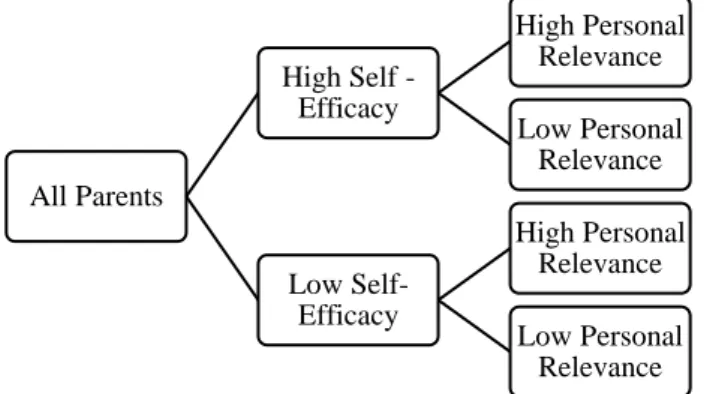
The Mathematics Motivation Questionnaire was scored using the guide provided by Glynn and Koballa (2006). This provided a single score for each participant for each of two motivation constructs, self-efficacy beliefs and personal relevance, allowing four groups to be created based on parent scores as demonstrated in Figure 1. Twenty-five parents met the criteria as scoring either high (top 25%) or low (bottom 25%) on both of the self-efficacy and personal relevance scales. Emails were sent to all 25 parents and their children to seek volunteers for the interviews and we interviewed all eight who volunteered.
Figure 1. Parent subgroups for interviews
Interviews were conducted with each participant interviewed independently. The interviews followed a semi-structured format as Spradley (1979) suggests which allowed for flexibility in both questions and follow-up to responses. Each individual interview lasted between 60 to 120 minutes. The student interview focused on math background, experiences, beliefs and values. The parent interview focused on similar topics but added questions related to the use and expressed value of math in the home (see Appendix B and C for protocol).
In order to add context and depth, one focus group was conducted at the school and this lasted 60 minutes with all participants in attendance. The researchers presented quotes and emergent themes to the group and used these to generate a discussion. The interviews and focus group were captured on a digital voice recorder and transcribed verbatim. The transcripts were member checked by giving them to each participant for comment, elaboration, or modification. All additional comments were added to their interview transcripts. Participants used this opportunity to clarify or expand on the data from their interviews. Transcription was done by interpreting the interview in a word-for-word basis, thus the basic units of information were the spoken words.
Data Analysis
The interview data was coded using the initial coding framework established by Usher (2009) and additional codes were added as necessary. These provided a ―coding framework‖ (Attride-Striling, 2001) which was rooted in the literature and theoretical framework which guided this study. This list of codes was used during the first passes through the data. However, new codes were created as data were read. After coding, the qualitative data were analyzed for emergent themes using a constant comparative method (Glaser & Strauss, 1967). Once emergent themes were identified, they were re-examined for connections in attempts to combine themes under a
All Parents
High Self -Efficacy
High Personal Relevance Low Personal
Relevance
Low Self-Efficacy
High Personal Relevance Low Personal
larger umbrella. Four parents were classified as having low-efficacy beliefs and four more with high self-efficacy beliefs. Each parent and child response was coded and sorted according to the themes. This method was repeated for each of the interviews. Finally, patterns were identified across the eight cases of parents, the eight student cases, and then the eight parent-student combinations utilizing the guidelines recommended by Lincoln and Guba (1985). Representative quotes where identified to support the various themes.
Table 1.Descriptions of the interview participants Student
Name
Gender, SES, Race, Math Course Parent Beliefs Parent Level of Education (Parent Gender) Tabby F, Low SES, Unreported, AP Calculus Low Self-efficacy
Low Personal Relevance
Some College (F)
Lauren F, Mid SES, African-American, Math IV Low Self-efficacy Low Personal Relevance
Bachelor‘s Degree (F)
Lynn F, Mid SES, White, Math III and Support Low Self-efficacy Low Personal Relevance
High School Diploma (F)
Harry
M, High SES, White, AP Calculus High Self-efficacy High Personal Relevance
Graduate Degree (F)
Libby F, High SES, White, AP Statistics High Self-efficacy High Personal Relevance
Graduate Degree (F)
Jackie F, Low SES, African-American, Math IV High Self-efficacy High Personal Relevance
Some College (F)
Katie F, Mid SES, African-American, AP Statistics
High Self-efficacy Low Personal Relevance
Bachelor‘s Degree (M)
Tori F, Mid SES, White, Math IV Low Self-efficacy High Personal Relevance
Some College (M)
Findings
Parents with Low Mathematics Attitudes
In the four cases of parents with negative mathematics attitudes, all children referenced their parent‘s beliefs. Lauren described that she was not a ‗math person.‘ She recounted how her mother told her ―we‘re just not good in math,‖ when she was having difficulty. She accepted that she struggled more in math because her mother justified her abilities as the norm for their family. Typically a good student, Lauren was ‗allowed‘ to earn a C in mathematics, ―as long as [she] passed‖ (Lauren‘s Mother). Lynn mentioned how she learned to never ask her mother for help with her homework ―because she is not good at math.‖ Even though Lynn felt that her mother influenced how she felt about mathematics, she did not blame genetics for these beliefs. Lynn noted, ―My mom makes it pretty obvious that she hates math and it has kind of rubbed off on me. I'm not blaming her for it.‖ Tori explained how her mother ―hates math and will say, ‗Don‘t ask me to help with your homework because I don‘t know it‘‖. Tori‘s case was compelling because she also discussed how her father expressed similar sentiments thus compounding the negative family attitude toward math. During the interview he suggested that heredity may have had an influence on Tori‘s abilities, as he stated that ―math is not one of her strong suits; it wasn‘t mine… I don‘t know if I passed down a bad gene or what‖ (Tori‘s Father). Like Lauren, Tori used her parents‘ beliefs to excuse her own performance when she struggled in math, emphasizing her remarks to her parents, ―if you don‘t get it, you can‘t be mad at me if I don‘t.‖
Unlike her peers, Tabby did not relate to her mother‘s negative experiences in a college remedial mathematics class. Tabby‘s mother had to retake college algebra four times and was still didn‘t pass the course. Tabby felt that her mother should know the math, ―even with the basics, it‘s difficult for her. So seeing her struggle, I can understand what‘s going on but I can‘t quite empathize because it‘s still so basic.‖ This is important considering that Tabby described math as ―a cinder block taped to [her] foot.‖ It is possible that while Tabby struggled, she knew the college algebra content, so her mother‘s attitude did not resonate.
her math experiences, she recalled ―I just couldn't grasp any of it past the basic math. I just gave up. Sometimes I would ask for help, but I did just enough to pass and get by‖ (Lynn‘s Mother). Tabby‘s mother described her frustrations in her college algebra class and feeling insecure about the number of questions she asked in class. Tabby exhibited these same traits as she rarely asked questions so that her friends would not think of her as struggling. Tori‘s father was presented with an opportunity to take a short course with a math-heavy assessment, which would lead to a promotion in his job. He was nervous because his younger coworkers were struggling, and he assumed that he was also going to have difficulty. This displays a clear similarity of math belief and anxiety in daughter and father.
These data suggest that the mathematics attitudes of parents with low self-efficacy beliefs were also similar to those of their child‘s. This was evident in conversations with both the students and their parents as all eight participants referred to their own struggles, as well as the difficulties experienced by their family member. Even though some of the students related to their parents as non-math people, they did not blame genetics for their struggles; however these students offered no other explanation for their math abilities. While the students did not actually blame their parents, they did use their parent‘s negative beliefs as justification for their own views towards math. Since none of the four students whose parents had a high sense of self-efficacy in math mentioned their parent‘s abilities, one may hypothesize that parents who have low mathematics attitudes are more likely to have children who also have low mathematics attitudes.
Parents with High Mathematics Attitudes
The key difference exhibited by the children of highly efficacious parents was that none mentioned their parent‘s ability. Instead, these students commented on the encouragement they received to persist in their mathematics classes. In addition, all four students explained that their parents frequently worked with them on math at home. This finding highlights the importance of social persuasions as the feedback and encouragement that students received contributed to the development of their self-efficacy beliefs. These beliefs directly or indirectly influence mathematics performance.
Harry explained, ―If I get frustrated [my mom] tells me, ‗You‘ve always been good at math, just give it another chance, it‘ll click.‘‖ Encouragement from his mother appeared to give him the needed boost to persist in the mathematics. The support from his parents motivated him to ask them for help instead of quitting. Katie‘s experiences were similar to Harry‘s. She recalled a time when she became frustrated in her math class and gave up. ―I went home and I asked my dad…I was blaming the teacher saying she‘s explaining it wrong, but he explained it the same way…I started going through the math problems and started asking for help.‖ In this case, the feedback from her father forced her to reevaluate her math study habits instead of placing blame on external forces.
Libby created a positive relationship with her mother because they shared similar beliefs on math, explaining that they ―agree that with math there is always a right answer.‖ This objectivity comforted them, whereas the subjectivity of courses like social studies was frustrating for them. Libby learned from her mother that in mathematics, one should continue with a problem because there is always a solution.
Despite the similarities found in the narratives of Harry, Katie and Libby, Jackie‘s experiences were different. Jackie explained that much of her stress in math came from exceedingly high expectations from her mother. When asked how she feels when she does not earn an A in math, she replied ―It made me irritated with myself because I know that if I had put in that extra thirty minutes, I could have done better.‖ Like her peers with parents with high self-efficacy, Jackie took ownership of her missteps. We position this as a positive support, as her parents pushed Jackie to perform to her highest ability. This was in contrast to what was experienced by the students whose parents had low self-efficacy beliefs, who were subsequently told that like their child, they were not good at math either.
Sources of Self-Efficacy Beliefs
Although each group of parents and students had different attitudes towards mathematics, they did share some of same sources thought to contribute to their math attitudes. Both parents and students mentioned instances of mastery experiences, social persuasions, and personal relevance. This indicates that while the two groups of students may not internalize the attitudes of their parents in the same ways, other factors work similarly in the development of the student‘s math attitude regardless of their parent‘s beliefs.
Mastery Experiences
Parents across all self-efficacy levels discussed mastery experiences as a source of their child‘s self-efficacy beliefs in mathematics. Parents believed that their child‘s previous experience in math influenced how the child would do in her current course. Parents with low self-efficacy beliefs mentioned how math was not their child‘s favorite subject. In most cases, parents were readily willing to discuss instances where their child encountered math struggles. One pattern in the parents‘ narratives was that many participants referenced tenth grade as a time when the student had a particularly difficult year in math. In this school district, students took Math II during their sophomore year which covered graphing quadratic, piecewise, exponential, and inverse functions, trigonometry, properties of circles and spheres, probability, and regression. The struggles in tenth grade were explored and participants provided rich descriptions of their difficulties.
In the case of Lauren, her mother explained that 10th grade brought ―a change in attitude, kind of like a giving up‖ (Lauren‘s Mother). This was consistent with what was expressed by Lynn‘s mother who revealed how her daughter cried and ―would beg ‗Get me out of this class. I can't make it.‘‖ (Lynn‘s Mother). The struggles these students endured in tenth grade created a sense of failure. At the time of this study, many of these students had not managed to find a positive perspective on their math experiences and this had clear implications for their self-efficacy in mathematics. Libby, who struggled with properties of circles, recalled ―There has never been a time where I felt completely lost, but anything relating to circles is my weak spot.‖ When asked what actions she took to rectify her confusion, she explained that she utilized tutors and study groups at school. Harry‘s struggles in math came during his junior year when learning logarithms. Instead of giving up, his mother noted that ―If he doesn't do as well as he would like, he would say, ‗I've got to get it fixed‘‖ (Harry‘s Mother). This ‗ownership‘ was a key difference between the two groups of students. The students whose parents had a higher sense of self-efficacy were able to navigate the increased rigor in their math courses. Because they were able to get enough extra help to master the material, these struggles did not harm their self-efficacy beliefs in mathematics. While the children of parents with low self-efficacy beliefs may have also used extra assistance, they only utilized this resource because of the urging of their parents, and it did not appear to translate into positive self-efficacy beliefs whether or not they eventually mastered the content.
Social Persuasions
The most prevalent source of self-efficacy beliefs mentioned by the parents was the role the teacher played in aiding the development of their child‘s beliefs. This was true for parents with both high and low self-efficacy for math. Libby‘s mother recalled how one of Libby‘s teachers was a ―yeller.‖ Libby would come home saying ―I just can‘t do math‖ (Libby‘s Mother). This teacher did not provide a positive environment to increase Libby‘s self-efficacy beliefs. Upon changing teachers, her attitude changed, as she realized she could be successful. This shift in attitude was credited to the support she received from her new teacher. This case illustrates how tenuous one‘s beliefs are and how they can be swayed by others, especially teachers.
In a similar way, Lynn‘s mother recounted that while her daughter had always struggled with math, Lynn had never felt that the material was impossible to learn until her sophomore year. Lynn‘s mother discussed that her daughter struggled in math despite being in extra math support classes and receiving outside assistance from teachers and tutors. She explained, ―I think a lot of her feeling like she just couldn't do it was because her teacher made her feel dumb by asking questions‖ (Lynn‘s Mother). The frustration Lynn perceived from her teacher sent the message that her questions were not valid.
―I realized that I can pass it with this math teacher, because he‘s teaching it in a way where I understand it.‖ This revelation gave her confidence to continue attending his tutoring sessions and ultimately led to improved grades. Seeing the benefit that came with extra effort also showed Lauren that giving up when struggling was not her only option. Finding success in a mathematics class seemed to promote a positive self-efficacy and forced students to adopt a more constructive stance, which aligned with better grades.
Personal Relevance
The data also revealed that the mathematics attitudes of the students was influenced the by degree to which they felt that math was applicable to their future goals. This was evident by Lauren‘s mother who mentioned that Lauren once proclaimed, ―I don‘t see the point of taking this math. I‘m never gonna use it‖ (Lauren‘s Mother). Although this attitude lasted for some time, once Lauren realized that she would actually need this knowledge in other classes. Knowing that the content was going to appear in future lessons forced Lauren to persist to master the material.
In a similar way, Lynn also attributed her improved effort as a result of a more constructive belief regarding her math ability. She realized that she ―could do better in math if [she] tried harder.‖ This realization had major implication for her future goals. When asked about her future plans, she admitted that ―It depends on the type of math it had in it. If it had what we're doing now, I could definitely do that. I have fun doing that.‖ Despite being weak in math, Lauren and Lynn understood that they had goals beyond high school requiring the math skills they were developing as seniors.
Parent and student interviews provided a rich data source for the ways in which the students used mastery experiences and social persuasions to form their self-efficacy beliefs, as well as the importance that personal relevance had on one‘s work ethic. While there was not a substantial amount of data to determine how students used vicarious experiences and physiological arousal to develop their math attitudes, both sources were mentioned. There were also a few mentions of physiological arousal by students with parents of low mathematics attitudes. These students all recounted memories of crying or feeling ‗physically ill‘, during math class or on math tests. Tabby noted that ―It‘s strange to say that a piece of paper can make me feel so nauseous.‖ It was unclear how these signals affected the students‘ math beliefs or how they were developed, however they are important factors which potentially decrease self-efficacy for math ability for some students.
The interviews with the eight parents revealed that students‘ tenth grade math class was particularly detrimental to the students‘ math attitudes. The most prevalent source of self-efficacy beliefs mentioned by the parents was the important role the teacher played in aiding the development of their child‘s beliefs. This was true for parents on both ends of the mathematics attitudes scale. It is evident that for the students in this study, parents felt that teachers were a large contributing factor to their child‘s success and math attitudes. Student interviews suggested that they form their self-efficacy beliefs using mastery experiences, social persuasion, and personal relevance. The mastery experiences echoed the accounts given by their parents, but students highlighted their parents‘ beliefs on math more than their experiences with their teachers (Figure 2). While there exists a relationship between the mathematics beliefs of students and their parents, students were hesitant to say that their math attitudes formed because of their parents. Yet, the consistency of the similarities between the parent beliefs and those of their child were too great to ignore.
Figure 2.The mediation of student attitudes towards mathematics Student
Attitudes towards
Math Teacher
Dispositions Parent‘s Experiences
Cost of Effort
Previous Experiences
in Math
Discussion
This study explored the math attitudes of parents and the ways in which their children internalized these attitudes. Findings demonstrate the complex relationship between parents‘ mathematics beliefs and those of their child. Participants reiterated the importance of mastery experiences and physiological arousal on the development of self-efficacy beliefs. The lower efficacious students cited how recent success encouraged their efforts in math and suggested potential to achieve in math. This is not surprising as Bandura‘s (1977) work suggests that self-efficacy beliefs are dynamic, especially if individuals are given a reason to reevaluate their self-perceptions. This finding does support the impact that good teachers can make by providing small successes throughout a course so that students can begin to realize that success is possible, despite previous difficulties. This finding was echoed in the parent interviews, as many parents saw that their child was doing better in math and therefore more confident than in years past.
The parents with positive math attitudes provided examples of the coping skills their children had adopted when they encountered an increase in math rigor. Strategies included asking for help from the parent, teacher, peers, or tutors. Data supports our view that parents with high self-efficacy beliefs were more supportive of their children in terms of emotional support as well as the ability to assist with math schoolwork, both attributes that were largely absent in parents with low math attitudes and self-efficacy. Students who received help from home also learned the importance of building math resilience which supports an ownership in one‘s education and contributes to positive self-efficacy. Our qualitative finding supports recent quantitative research by Mohr‐ Schroeder et al. (2017) where they found a positive correlation between parental and student attitudes toward math.
Unfortunately for students with low math attitudes who also sought math assistance, the additional help did not improve their self-efficacy beliefs. In fact, it seemed that because the students had to get a tutor, their self-efficacy beliefs were further damaged. This is alarming for educators who encourage students to seek extra help. Students must be taught that asking for help is not a sign of weakness, but instead a sign of responsibility. Findings revealed that achievement in math class had a positive effect on the struggling students‘ work habits. Students who are unable to receive math help at home may not seek assistance from their teacher or peers which leads to continued struggle and doubt in their abilities.
The collected data leads one to question how a parent‘s self-efficacy beliefs influence the course trajectory of their child. The course distribution amongst the children of parents with low mathematics abilities in this study was as follows: one student in math support, one in AP Calculus, and two in regular senior math. This distribution demonstrates the tendency for students whose parents have low mathematics attitudes to enroll in on-level or below grade level math courses. It is important to note that the one AP Calculus student admitted that the only reason she was in the class was because the alternative conflicted with orchestra. This context is necessary to show that Tabby is an exception, not the norm. For the students whose parents were on the upper end of the spectrum, the course breakdown showed that one student was in regular math while the other three students were on the accelerated level. These distributions provide one piece of evidence for the relationship between a student‘s level of math class and their parent‘s math attitudes. The better a parent‘s math attitudes are, the more likely their child will have the self-efficacy to enroll in courses above grade level. This finding is supported by a related study by Kleanthous and Williams (2013) where they found a significant relationship between high school student course taking patterns and parents dispositions toward the subject.
Returning to the theory that guided the study, it is important to recognize how the findings contribute to the literature on social cognitive theory. The results echo those of Usher (2009) as students with high self-efficacy beliefs react differently to obstacles than their less efficacious peers. Our study demonstrates the relationship between a parent‘s math attitude and that of their child, however it raises many questions. In order to increase math accessibility, teachers and parents must target their child‘s beliefs before their attitudes have had the chance to develop. This research suggests that student‘s attitudes in early high school can still be swayed, thus every attempt must be made to transform negative beliefs prior to this time. When students can see that success is not only possible, but probable, their self-efficacy beliefs will grow stronger and the cycle of negative math attitudes can be broken.
transmission of negative attitudes is perpetuated through generations. In contrast, parents who had strong positive attitudes toward math, even those who did not have a great past with their math achievement, were able to become a valuable resource for the child. This illustrates the importance of family attitudes with respect to sources of math capital. In addition, our research illustrated that for those students were not well supported by their parents, they needed to reach out for other sources of capital to support their math learning. In some cases, this was a teacher, but in other cases, in particular those with high self-efficacy, they were able to take ownership of their struggles and explore other avenues for support. This work affirms the utility of the theory of math capital as a potentially revealing framework to examine success in math disciplines. While little research has explored the key contributors to mathematics capital, Williams and Choudry (2016) support the importance of examining the origin of math capital because ―mathematical habitus initially forms through ‗mathematical‘ experiences with parents and siblings… These experiences may allow the habitus to develop with the right ‗mathematical capital‘ (p. 7).
Recommendations and Implications
Parents
Findings of the current study suggest a relationship between a parent‘s beliefs and those of his/her child. The interview data demonstrated that when parents work on math with their students at home, whether or not that math is directly related to course work, a positive disposition towards the content is fostered. This illustrates that math is more than equations in a book or arithmetic at the store. If students can identify problem solving strategies used at school as the same set of skills needed to beat a video game or figure out how to perform a skateboard trick, then they may see the math as relevant in their lives.
Another trend exposed in this study, confirming an observation by Hoover-Dempsey and Sandler (1995), was that parents‘ competence beliefs affected how much they were willing to assist their child with homework. While it is understandable that a person who struggled in the past would not feel comfortable assisting with upper level math, parents can encourage persistence and lifelong learning by being willing to discuss math class with their children. If students see that their parents are willing to face their math phobia, they may work through their own struggles instead of giving up.
We demonstrated to that parental math attitudes can be influential to their children. Social persuasions were found to be positive contributors to the self-efficacy beliefs of highly efficacious students; therefore, parents must continue to encourage all students, but especially the students who have already developed a positive math attitude. Finally, it is vital that parents who have a low math attitude shield this information from their children, as findings show that students take this information and may use it as an excuse to not work to their full potential or to avoid asking for help.
Educators
Both parents and students discussed the importance of a patient teacher on students‘ self-efficacy beliefs and their comfort level to ask for extra assistance. This needs to be a special consideration for all math educators, but especially those who teach middle grades and introductory high school math courses. Students who struggled during their sophomore year of secondary math had a damaged sense of self-efficacy two years later, despite some earning higher grades in future math courses. Given the literature demonstrating that student motivation in math declines over the course of high school (Chouinard & Roy, 2008); it is particularly important to assist students in the development of positive self-efficacy beliefs. If students come into high school with a low sense of self-efficacy, which in turn decreases their motivation to pursue a task, the students will have little chance of changing their beliefs without special effort from the teacher.
As students begin thinking about their lives after high school, they begin to understand how their efforts in previous years may have influenced their collegiate opportunities. Educators must encourage their students to continue working to overcome any deficiencies in their academic skills by forming new work habits. Students will not be able to reform their work habits without guidance, feedback, and assurance and it is not too late to change their views on mathematics. These opinions must be addressed before students leave secondary school or they will be less likely to take optional math courses in college and thus close off a wide range of potential careers paths (Navarro, Flores, & Worthington, 2007). Namely, students must be encouraged to foster their math resilience, a characteristic in students which encourages them to persevere when challenged, collaborate with other learners, realize that their math abilities are not fixed, and have the vulnerability to ask for help when they are struggling knowing that this will lead to a greater chance of success (Johnston-Wilder & Lee, 2010). Similar to Usher (2009), the current research found that physiological arousal is a source of self-efficacy beliefs in students. Lower efficacious students interpret their emotions as confirmation that mathematics is not a subject they will grasp. The interview data revealed that students with a higher sense of self-efficacy and personal relevance used these same signals to push them further, encourage them to get help, and persist. Teachers must educate their students about the sources of self-efficacy beliefs. Students need to understand the effect their beliefs have on their achievement so that they can break the cycle of negative dispositions toward math. If students do not attempt to develop a more positive mindset, their attitudes will continue to grow and be passed to future generations. Educators should help their students develop coping strategies to assist in calming students prior to math assessments and consider how their own behaviors may contribute to negative emotional states in their students. Yelling, aggressive body language, and unequal attention to students can reinforce a student‘s perception that success in math is not an achievable goal, increasing the student‘s anxiety in class.
Conclusion
Returning to the theory that guided this study, it important to recognize how the findings contribute to the literature on sources of positive attitudes for math learning. Additionally, this work supports the value of social cognitive theory and echoes the finding of Usher (2009) in that students with high self-efficacy beliefs react differently to obstacles than their less efficacious peers. The current study further reiterates the sources of self-efficacy beliefs and highlights the critical role that parents play in building or supportive positive attitudes toward math as well as supporting the accumulation of math capital. Because students in this study were considering their future plans for the following year, personal relevance beliefs were heightened and contributed to the students‘ motivation to persist in mathematics. These findings are consistent with expectancy-value theory in that as a task becomes more important, motivation increases with respect to the student‘s expectation for success. While this study demonstrates that there is a relationship between a parent‘s mathematics attitude and that of their child, additional work is needed to explore how these attitudes can be cultivated.
References
Archer, L., Dawson, E., DeWitt, J., Seakins, A., & Wong, B. (2015). ―Science capital‖: A conceptual, methodological, and empirical argument for extending bourdieusian notions of capital beyond the arts. Journal of Research in Science Teaching, 52(7), 922-948.
Archer, L., Dewitt, J., & Willis, B. (2014). Adolescent boys‘ science aspirations: Masculinity, capital and power. Journal of Research in Science Teaching, 51(1), 1–30.
Archer, L., DeWitt, J., Osborne, J., Dillon, J., Willis, B., & Wong, B. (2012). ―Balancing acts'': Elementary school girls' negotiations of femininity, achievement, and science. Science Education, 96(6), 967-989. Attride-Stirling, J. (2001). Thematic networks: an analytic tool for qualitative research. Qualitative
research, 1(3), 385-405.
Bandura, A. (1977). Self-efficacy: Toward a unifying theory of behavioral change. Psychological Review, 84, 191-219.
Bekdemir, M. (2010). The pre-service teachers‘ mathematics anxiety related to depth of negative experiences in mathematics classroom while they were students. Educational Studies in Mathematics, 75(3), 311-328. Bengtson, V. L. (2001). Beyond the Nuclear Family: The Increasing Importance of Multigenerational Bonds:
The burgess award lecture. Journal of marriage and family, 63(1), 1-16.
Berkowitz T, Schaeffer MW, Maloney EA, Peterson L, & Gregor C. (2015) Math at home adds up to achievement in school. Science, 350(6257), 196–168.
Bouchey, H.A., & Harter, S. (2005). Reflected appraisals, academic self-perceptions, and math/science performance during early adolescence. Journal of Educational Psychology, 97(4), 673-686.
Bourdieu, P. (1977). Outline of a Theory of Practice (Vol. 16). Cambridge university press.
Chouinard, R., & Roy, N. (2008). Changes in high-school students‘ competence beliefs, utility value, and achievement goals in mathematics. The British Journal of Educational Psychology, 78(1), 31-50.
Cole, M. (1985). The zone of proximal development: Where culture and cognition create each other. In J. V. Wertsch (Ed.), Culture, communication, and cognition: Vygotskian perspectives (pp. 146-161). Cambridge, The United Kingdom: Cambridge University Press.
Crosnoe, R., & Schneider, B. (2010). Social capital, information, and socioeconomic disparities in math course work. American Journal of Education, 117(1), 79-107.
Eccles, J. S., & Jacobs, J. E. (1986). Social forces shape math attitudes and performance. Signs: Journal of Women in Culture and Society, 11(2), 367-380.
Fan, W., Williams, C. M., & Wolters, C. A. (2012). Parental involvement in predicting school motivation: Similar and differential effects across ethnic groups. The Journal of Educational Research, 105(1), 21-35.
Glaser, B. G., & Strauss, A. (1967). The discovery of grounded theory: Strategies for qualitative research. Chicago, IL: Aldine.
Glynn, S.M., & Koballa, T.R. Jr., (2006). Motivation to learn in college sciences. In J.J. Mintzes & W.H. Leonard (Eds.), Handbook of college science teaching (pp. 25-32). Arlington, VA: National Science Teachers Association Press.
Guan, P., Capezio, A., Restubog, S. L. D., Read, S., Lajom, J. A. L., & Li, M. (2016). The role of traditionality in the relationships among parental support, career decision-making self-efficacy and career adaptability. Journal of Vocational Behavior, 94, 114-123.
Gunderson, E.A., Ramirez, G., Levine, S.C., & Beilock, S.L. (2012). The role of parents and teachers in the development of gender-related math attitudes, Sex Roles, 66, 153-166.
Hagedorn, L. A., & Tierney, W. G. (2002). Cultural capital and the struggle for educational equity. Increasing access to college: Extending possibilities for all students, 1-11.
Herbert, J.A., & Stipek, D.J. (2005). The emergence of gender differences in children's perceptions of their academic competence. Journal of Applied Developmental Psychology, 26(3), 276-295
Hoover-Dempsey, K. V., & Sandler, H. M. (1995). Parental involvement in children's education: Why does it make a difference?. Teachers College Record,97(2), 310-331.
Ivankova, N., Creswell, J., & Stick, S. (2006). Using mixed methods in sequential explanatory design: From theory to practice. Field Methods, 18(3), 3-20.
Jeynes, W. H. (2005). A meta-analysis of the relation of parental involvement to urban elementary school student academic achievement. Urban education, 40(3), 237-269.
Johnston-Wilder, S., & Lee, C. (2010, September). Developing mathematical resilience. Paper presented at British Educational Research Association, University of Warwick, The United Kingdom.
Jorgensen (Zevenbergen), R., Gates, P., & Roper, V. (2013). Structural Exclusion through School Mathematics: Using Bourdieu to Understand Mathematics a Social Practice. Educational Studies in Mathematics, 87(2), 221–239.
Kleanthous, I., & Williams, J. (2013). Perceived parental influence and students' dispositions to study mathematically-demanding courses in Higher Education. Research in MathematicsEducation, 15(1), 50-69.
Lincoln, Y. S., & Guba, E. G. (1985). Naturalistic Inquiry. Newbury Park, CA: Sage.
Lopez, F.G., Lent, R.W., Brown, S.D., & Gore, P.A. (1997). Role of social-cognitive expectations in high school students‘ mathematics-related interest and performance. Journal of Counseling Psychology, 44(1), 44-52.
Melhuish, E. C., Phan, M. B., Sylva, K., Sammons, P., Siraj‐ Blatchford, I., & Taggart, B. (2008). Effects of the home learning environment and preschool center experience upon literacy and numeracy development in early primary school. Journal of Social Issues, 64(1), 95-114.
Mohr-Schroeder, M. J., Jackson, C., Cavalcanti, M., Jong, C., Craig Schroeder, D., & Speler, L. G. (2017). Parents‘ Attitudes Toward Mathematics and the Influence on Their Students‘ Attitudes toward Mathematics: A Quantitative Study. School Science and Mathematics, 117(5), 214-222.
National Center for Education Statistics. (2015). Selected Findings From PISA 2015. Retrieved March 1, 2019 from https://nces.ed.gov/surveys/pisa/pisa2015/pisa2015highlights_1.asp
Navarro, R.L., Flores, L.Y., & Worthington, R.L. (2007). Mexican American middle school students‘ goal intentions in mathematics and science: A test of social cognitive career theory. Journal of Counseling Psychology, 54(3), 320-335.
Rattan, A., Good, C., & Dweck, C. (2012). ―It's ok — Not everyone can be good at math‖: Instructors with an entity theory comfort (and demotivate) students, Journal of Experimental Social Psychology, 48, 731– 737.
Schunk, D.H., & Pajares, F. (2002). The development of academic self-efficacy. In A. Wigfield & J.S. Eccles (Eds.), Development of Achievement Motivation (pp. 16-32). San Diego, CA: Academic Press.
Spradley, J. P. (1979). The ethnographic interview. New York: Holt, Rinehart and Winston.
Svoboda, R. C., Rozek, C. S., Hyde, J. S., Harackiewicz, J. M., & Destin, M. (2016). Understanding the relationship between parental education and STEM course taking through identity-based and expectancy-value theories of motivation. AERA Open, 2(3), 1-13.
Tiedemann, J. (2000). Parents' gender stereotypes and teachers' beliefs as predictors of children's concept of their mathematical ability in elementary school. Journal of Educational Psychology, 92(1), 144-151. Usher, E.L. (2009). Sources of middle school students‘ self-efficacy in mathematics: A qualitative investigation.
American Educational Research Journal, 46, 275-314.
Usher, E. L., & Pajares, F. (2009). Sources of self-efficacy in mathematics: A validation study. Contemporary Educational Psychology, 34(1), 89-101
Williams, T., & Williams, K. (2010). Self-efficacy and performance in mathematics: Reciprocal determinism in 33 nations. Journal of Educational Psychology, 102(2), 453-466.
Author Information Vidal Olivares
University of Central Missouri United States
Robert J Ceglie
Queens University of Charlotte United States
Appendix A. Student Mathematics Motivation Questionnaire – Modified from Glynn
and Koballa (2006)
Rate as: Never (1), Rarely (2), Sometimes (3), Usually (4), Always (5) 1. I find learning mathematics interesting.
2. I enjoy learning mathematics.
3. The mathematics I learn has practical value for me. 4. The mathematics I learn is relevant to my life.
5. The mathematics I learn is more important to me than the grade I receive. 6. The mathematics I learn relates to my personal goals.
7. I like mathematics that challenges me.
8. Understanding mathematics gives me a sense of accomplishment. 9. I think about how I will use the mathematics I learn.
10.I think about how the mathematics I learn will be helpful to me. 11.I am nervous about how I will do on mathematics tests. (r) 12.I worry about failing mathematics tests. (r)
13.I become anxious when it is time to take a mathematics test. (r) 14.I am confident I will do well on mathematics tests.
15.I am concerned that the other students are better in mathematics. (r) 16.I believe I can earn a grade of an A in this mathematics course. 17.I hate taking mathematics tests. (r)
18.I believe I can master the knowledge and skills in this mathematics course. 19.I make excellent grades on mathematics tests.
20.I have always been successful with mathematics. 21.Even when I study very hard, I do poorly in math. (r) 22.I got good grades in math on my last report card. 23.I do well on math assignments.
24.I do well on even the most difficult math assignments. 25.Seeing adults do well in math pushes me to do better.
26.When I see how my math teacher solves a problem, I can picture myself solving the problem in the same way.
27.Seeing kids do better than me in math pushed me to do better.
28.When I see how another student solves a math problem, I can see myself solving the problem in the same way.
29.I imagine myself working through challenging math problems successfully. 30.I compete with myself in math.
31.My math teachers have told me that I am good at learning math. 32.People have told me that I have a talent for math.
33.Adults in my family have told me what a good math student I am. 34.I have been praised for my ability in math.
35.Other students have told me that I am good at learning math.
36.My classmates like to work with me in math because they think I‘m good at it. 37.Just being in math class makes me feel stressed and nervous. (r)
38.Doing math work takes all my energy. (r)
39.I start to feel stressed out as soon as I begin my math work. (r)
40.My mind goes blank and I am unable to think clearly when doing math work. (r) 41.I get depressed when I think about learning math. (r)
Appendix B. Student Interview Protocol
Background
1. Tell me a little about your family. 2. Tell me a little bit about yourself. 3. Describe yourself as a student.
Mathematics experiences and self-efficacy
4. I want you to think about all the math classes you‘ve ever taken as well as other experiences you‘ve had involving math. First tell me about yourself as a math student.
What sort of work habits do you have in math?
If you were asked to rate your ability in math on a scale of 1 (lowest) to 10 (highest), where would you be? Why?
What do you like to do related to math outside of school?
Tell me about a time you experienced a setback in math. How did you deal with it?
Mathematics and others
5. Have you ever been recognized for your ability in math? Explain. 6. Tell me about your family and math.
What do members of your family do that involves math?
What do your parents tell you about math?
How are your siblings in math?
7. Do you talk about school much with members of your family? 8. Tell me about your friends and math.
9. Do you think the people you admire would be good at math? Why? Affective and physiological response to mathematics
10. I want to ask you to think about how math makes you feel. When you are given a math test, how does that make you feel? How do you feel when you are given a math assignment?
Sources of self-efficacy in mathematics
11. Earlier you rated your math ability on a scale of 1 to 10. How would you rate your confidence? Why? What could make your feel more confident about yourself in math?
Utility Value in mathematics
Appendix C. Parent Interview Protocol
1. Describe your child as a student.
What would you say is his/ her best subject in school? Why? What is his/ her favorite subject? Why?
What subject do you feel is your child‘s weakest? Why?
Tell me about the grades your child typically earns in school? 2. Tell me about your employment and your hobbies.
What type of job do you have?
How frequently do you need you use mathematics in your work? 3. Tell me about yourself as a student and your educational background.
What would you say was your best subject in school? What was your favorite subject?
What subject would you say was your weakest? Which was your least favorite? 4. Tell me about the grades you typically made in school.
If you were asked to rate your ability in math on a scale of 1 (lowest) to 10 (highest), where would you be? Why?
5. How often do you use math in your daily life? How are the other members of your family at math?
How often do members of the family talk about or use math?
What sorts of conversations do you have with your child about math and his/ her ability?
How often are you involved with your child and his/ her math assignments?
Are you able to help your child in math if he/ she needs help?
6. Tell me about a time when you experienced a setback in math. How did you deal with it?