Epiphany: Vol. 7, No. 1, 2014 ISSN 1840-3719
REACHING OUT: SOCIAL SUPPORT AND
MENTAL HEALTH PROBLEMS OF
BOSNIAN IMMIGRANTS IN
SWITZERLAND
Selvira Draganoviü∗∗∗∗
Abstract
A state of well being in which one realizes own potentials, can cope with every day stressors, can work productively and is able to constructively contribute to community is called mental health. Many stressful and negative events can interfere with these abilities and thus endanger someone’s mental health. Migration is one of them. With its’ pre and post phases/stages, migration represents great sources of stress and stressors. Immigrants need good personal and social resource in order to lessen down negative effects of migration on their mental health. The aim of this study is to explore presence of mental health problems in non clinical population of Bosnian immigrants (N=101, F=48, M=53) in Switzerland. It was assumed that migration stress acts negatively on immigrant’s mental health. General health questionnaire was used to test this hypothesis. Participants mean score results on total GHQ28 questionnaire were M=51.06, S.D. =14.30, its subscales on depression M=10.12 S.D.=3.75, somatic complaints M=13.04 S.D.=4.5, anxiety/insomnia M=13.34 S.D. 4.8, and social dysfunction M=14.37 S.D.=3.5. This indicates presence of mental health problems among Bosnian immigrants. At the same time, the study shows presence of social support seeking (N=83 subjects listed family and friends) as primary coping strategy used by Bosnian immigrants while dealing with difficulties and problems rather than seeking professional help (N=3 subjects listed professional help seeking). Thus, social support seeking acts positively on mental health of Bosnian immigrants.
Keywords: Mental Health; Immigrants; Bosnian Immigrants; Social Support
∗ Corresponding author: Selvira Draganoviü, PhD Candidate, Faculty of
ϮϬϬ
ƉŝƉŚĂŶLJ͗:ŽƵƌŶĂůŽĨdƌĂŶƐĚŝƐĐŝƉůŝŶĂƌLJ^ƚƵĚŝĞƐ͕sŽů͘ϳ͘EŽ͘ϭ͕;ϮϬϭϰͿΞ&ĂĐƵůƚLJŽĨƌƚƐĂŶĚ^ŽĐŝĂů^ĐŝĞŶĐĞƐ Background to the study
According to Kakar (Fernando, 2001) concept of mental health is
a term which covers different aspects and concerns such as:
absence of disabling symptoms, integration of psychological
functioning, successful leading of personal and social life, and
feeling of ethical and spiritual wellbeing. However, for our
purpose, mental health defined as the ability to think logically and
rationally, to adjust to transitions, stress, trauma and losses which
happen to everyone, in a way which allows emotional stability
and growth, suites better (Hales and Hales, 1995).
Immigrants belong to a risk group for mental health
disorders due to many pre emigrational, emigrational as well as
post emigrational factors and phases that they go through.
Acculturation phases, adjustment, immigrants’ age as well as
effects of factors such as small income, immigrants’ status, low
access to psychiatric treatment etc, are in close relation to the
emergence of mental health problems like depression, anxiety,
suicide, alcohol and drug use by immigrants. Immigrants are at
risk for mental health problems due to much pre-migration,
ϮϬϭ
ƉŝƉŚĂŶLJ͗:ŽƵƌŶĂůŽĨdƌĂŶƐĚŝƐĐŝƉůŝŶĂƌLJ^ƚƵĚŝĞƐ͕sŽů͘ϳ͘EŽ͘ϭ͕;ϮϬϭϰͿΞ&ĂĐƵůƚLJŽĨƌƚƐĂŶĚ^ŽĐŝĂů^ĐŝĞŶĐĞƐ immigrants experience. Acculturation phase, adjustment,
immigrants’ age, interrelated factors such as low income,
immigrants’ status, low access to psychiatric care etc. are related
to appearance of mental health problems such as depression,
anxiety, suicide, and alcohol and drug abuse in immigrants’
population. Immigrants are risk population especially when they
migrate with low or no prior knowledge about country they
migrate to. Their coping strategies are not always efficient and
acceptable. Coping strategies represent immigrant’s efforts,
mainly psychological and behavioural, which immigrants use,
tolerate, decrease or minimize stressful events. Lazarus and
Folkman (Horwitz and Scheid, 2006) coping strategies define as
cognitive or behavioural attempts to cope with situational
demands that someone perceives demanding or those that
overcome someone’s ability to cope. In other words, coping is
actually a process by which people try to cope with perceived
difference between demands and own resources which they assess
in a given situation. People cope with certain problems by making
certain efforts in order to adjust to a problem or change their
ϮϬϮ
ƉŝƉŚĂŶLJ͗:ŽƵƌŶĂůŽĨdƌĂŶƐĚŝƐĐŝƉůŝŶĂƌLJ^ƚƵĚŝĞƐ͕sŽů͘ϳ͘EŽ͘ϭ͕;ϮϬϭϰͿΞ&ĂĐƵůƚLJŽĨƌƚƐĂŶĚ^ŽĐŝĂů^ĐŝĞŶĐĞƐ (seeking social support for example) or ineffective (avoiding
problems) leading to problems solving or the opposite.
Effective coping strategies in a form of social support can
decrease effects of permanent stressors and act positively on
immigrants’ mental health. On contrary, ineffective coping
strategies which could appear in a form of avoidance or retreat
when different stressors appear, contribute to emergence of
mental health problems (Busse and O'Mahoney, 2000). Coping
strategies are usually divided into primary and secondary coping
strategies and problem focused and emotion focused coping
strategies. Primary coping strategies are direct measures or, overt,
problem focused behaviour directed to change of disturbing
events in stressful environment (looking for social support).
Unlike primary, secondary coping strategies are more cognitive
than behavioural and they are most often related to changing
perception and assessment of stressful situations and events. In
another words, primary coping strategies mean changing
environment so it will suite “me” and secondary, changing “me”
ϮϬϯ
ƉŝƉŚĂŶLJ͗:ŽƵƌŶĂůŽĨdƌĂŶƐĚŝƐĐŝƉůŝŶĂƌLJ^ƚƵĚŝĞƐ͕sŽů͘ϳ͘EŽ͘ϭ͕;ϮϬϭϰͿΞ&ĂĐƵůƚLJŽĨƌƚƐĂŶĚ^ŽĐŝĂů^ĐŝĞŶĐĞƐ Looking for social support contributes to adjustment and
helps individuals to easily cope with problems because persons
with social support are emotionally more stable and cope with
different environmental demands as well as with mental health
problems more easily (Horwitz and Scheid, 2006).
Social support is related to someone’s social contacts and
relations, social integration and relation inside primary group.
Social support and relations (resources) and relations with others
from where support emerges are not only basis for mental health
but also can serve as protective factors from negative effects of
different stressors. Resources or sources of coping (social support,
strong felling of control etc.) and coping strategies reduce or
diminish negative psychological effects of stress and stressors
(Horwitz and Scheid, 2006).
Horwitz and Sheid (2006) cite many studies which researched
significance of relation between mental health and social support
(Cohen and Willis, 1985; Cohen and Syme, 1985; Dean and Lin
1977; Gottlieb, 1981; Kessler et all 1985; Sarason and Sarason,
1985; Sarason, Sarason and Pierce, 1990; Turner 1983; Vaux
ϮϬϰ
ƉŝƉŚĂŶLJ͗:ŽƵƌŶĂůŽĨdƌĂŶƐĚŝƐĐŝƉůŝŶĂƌLJ^ƚƵĚŝĞƐ͕sŽů͘ϳ͘EŽ͘ϭ͕;ϮϬϭϰͿΞ&ĂĐƵůƚLJŽĨƌƚƐĂŶĚ^ŽĐŝĂů^ĐŝĞŶĐĞƐ shows great correlation with little or no support and ill mental
health in general, especially with frequent depression. Cassel and
Cobb with their research have set preliminary foundation for
hypothesis which dominates inside these researches: “social
support is important moderator in effects of life stressors on
mental health” and as such it represents significant protective
factor (Horwitz and Scheid, 2006). Ward states that social support
is related to improvement of psychological wellbeing (greater
social support, better psychological wellbeing and vice versa)
(Ward, Bochner and Furnham, 2003). Besides, sociological
studies in domain of social support suggest abating effect of
psychological problems when there is strong or just present social
support regardless if it comes from ethnic community or local
citizens (Khuo and Tsai, 1986).
Aim of this study is to explore presence and role of social support
in mental health problems in non clinical population of Bosnian
immigrants in Switzerland. It was assumed that social support has
ϮϬϱ
ƉŝƉŚĂŶLJ͗:ŽƵƌŶĂůŽĨdƌĂŶƐĚŝƐĐŝƉůŝŶĂƌLJ^ƚƵĚŝĞƐ͕sŽů͘ϳ͘EŽ͘ϭ͕;ϮϬϭϰͿΞ&ĂĐƵůƚLJŽĨƌƚƐĂŶĚ^ŽĐŝĂů^ĐŝĞŶĐĞƐ Participants and methods
Participants
Participants (N=200) were 48 female and 53 male, ages between
18 and 60, Bosnian immigrants currently residing in Switzerland.
Mean age for the total sample was 32.9±, mainly married, who
migrated to Switzerland in three periods, before the war
(1992-1995), during the war, after the war. Out of total number 129
surveys were completed and delivered to researcher. 28 of them
could be only partially used due to incomplete data (demographics
or unanswered questions. Participants were generally healthy and
were not cognitively or perceptually impaired. They were
recruited from a large Bosnian community in Switzerland.
Procedure
Participation in the study was voluntary and no compensation was
given. The survey, entitled "Mental Health," consisted of
socio-demographic questionnaire and general health questionnaire GHQ
28.
Questionnaires
Demographic questionnaire, and participants demographics: A
few independent variables stated as important predictors which act
ϮϬϲ
ƉŝƉŚĂŶLJ͗:ŽƵƌŶĂůŽĨdƌĂŶƐĚŝƐĐŝƉůŝŶĂƌLJ^ƚƵĚŝĞƐ͕sŽů͘ϳ͘EŽ͘ϭ͕;ϮϬϭϰͿΞ&ĂĐƵůƚLJŽĨƌƚƐĂŶĚ^ŽĐŝĂů^ĐŝĞŶĐĞƐ studies and report, were also included in our study: gender,
marital status, age, year of migration, immigrants status – visa
type (B visa – resident and work permit for a year –can be
prolonged, or C visa – permanent work and resident permit or CH
visa – Swiss citizenship, employment before migration, current
employment, length of residency in Switzerland.
General health questionnaire 28 (GHQ 28) (widely used for
similar purposes by, Jancz, 2000, for example).
General health questionnaire 28 (GHQ 28): For the purpose of this
research we used general health questionnaire with 28 items,
shortened version of GHQ with 60 items. General health
questionnaire 28 (GHQ 28) is a multiple choice paper pen
questionnaire. It is designed to detect current non psychotic
psychiatric disorders in general population. Questionnaire has four
subscales: Somatic complaints, anxiety and insomnia, social
dysfunction, major depression.
General health questionnaire can be administered to adolescents
or adults of any age. It is diagnostic but it can be used to detect
acute conditions (Goldberg and Hillier, 1979). Since 1972 when
ϮϬϳ
ƉŝƉŚĂŶLJ͗:ŽƵƌŶĂůŽĨdƌĂŶƐĚŝƐĐŝƉůŝŶĂƌLJ^ƚƵĚŝĞƐ͕sŽů͘ϳ͘EŽ͘ϭ͕;ϮϬϭϰͿΞ&ĂĐƵůƚLJŽĨƌƚƐĂŶĚ^ŽĐŝĂů^ĐŝĞŶĐĞƐ health questionnaire was translated to 38 world languages
(Croatian is one of them, which we used) it has been validated in
more than 50 studies. There are four versions of it at the moment
(with 60, 30, 28 and 12 items) available to psychiatrists, qualified
doctors, clinical psychologists and experienced counsellors
(Jancz, 2000). Cronbach’s (1951) alpha coefficient for internal
validity for GHQ 28 version ranges from .84 to .93 in different
studies. Goldberg and Hillier (1979) cite that test – retest
probability coefficient on 87 psychiatric cases with six months
follow up was .90 and it appears as reliable and valid assessment
technique for psychological or mental health (Jancz, 2000).
Results for general health questionnaire (GHQ 28) are gained by
adding responses on all items and summing them up. Higher score
implies more mental health problems in form of depression,
anxiety, somatic complaints or social dysfunction.
These two parts were completed with two open ended questions:
1. Who do you talk to about your problems/difficulties, 2. Who do
you seek to share or talk to when you face any kind of
ϮϬϴ
ƉŝƉŚĂŶLJ͗:ŽƵƌŶĂůŽĨdƌĂŶƐĚŝƐĐŝƉůŝŶĂƌLJ^ƚƵĚŝĞƐ͕sŽů͘ϳ͘EŽ͘ϭ͕;ϮϬϭϰͿΞ&ĂĐƵůƚLJŽĨƌƚƐĂŶĚ^ŽĐŝĂů^ĐŝĞŶĐĞƐ Analysis and categorisation of respondents’ answers to the two,
above cited open ended questions, indicate four following
categories: family and friends, professionals, myself and no one.
Results
We used General Health Questionnaire 28 in order to test
presence of mental health problems among Bosnian immigrants in
Switzerland. Results of means and standard deviations are listed
in table below.
General health questionnaire
GHQ 28 N Minimum Maximum Mean Std. Deviation
Results on somatic
complaints subscale 98 7,00 24,00 13,0408 4,51097
Results on anxiety insomnia
subscale 100 7,00 28,00 13,3400 4,88911
Results on social dysfunction
subscale 96 7,00 25,00 14,3854 3,59933
Results on depression
subscale 93 7,00 24,00 10,1290 3,75391
GHQ total results 87 28,00 91,00 51,0690 14,30547
Valid N (listwise) 78
Table 1. Mean results on GHQ and its subscales
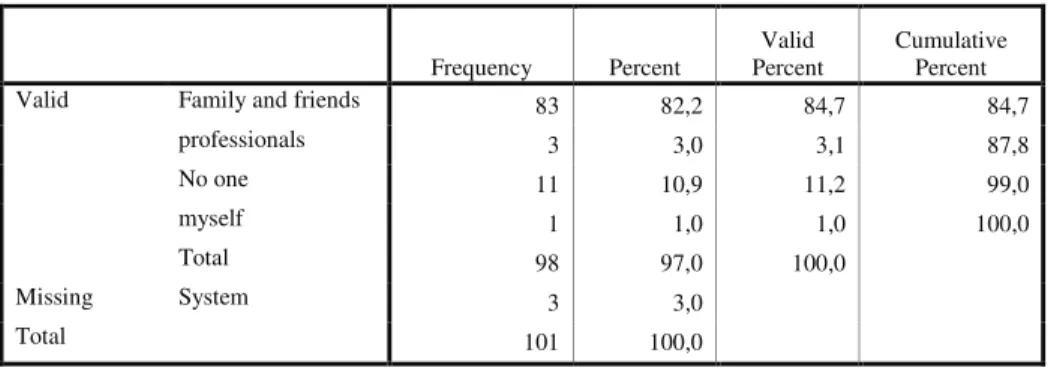
Table 2 two shows most frequently cited answers to question
“Who do talk to - share your problems with?
Frequency Percent
Valid Percent
Cumulative Percent
Valid Family and friends 83 82,2 84,7 84,7
professionals 3 3,0 3,1 87,8
No one 11 10,9 11,2 99,0
myself 1 1,0 1,0 100,0
Total 98 97,0 100,0
Missing System 3 3,0
ϮϬϵ
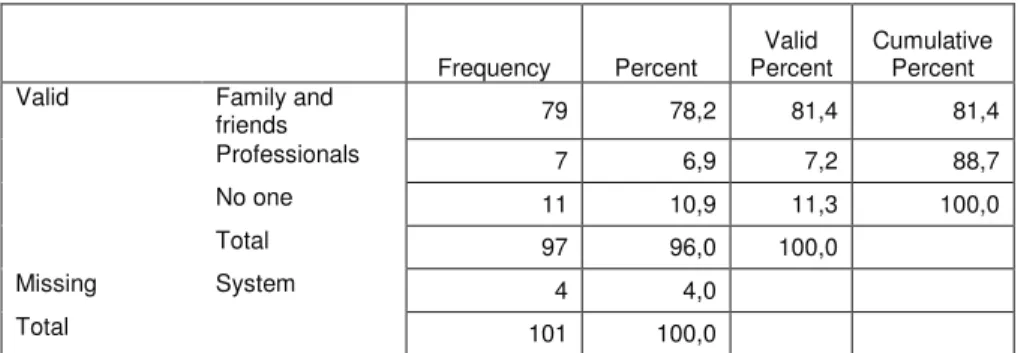
ƉŝƉŚĂŶLJ͗:ŽƵƌŶĂůŽĨdƌĂŶƐĚŝƐĐŝƉůŝŶĂƌLJ^ƚƵĚŝĞƐ͕sŽů͘ϳ͘EŽ͘ϭ͕;ϮϬϭϰͿΞ&ĂĐƵůƚLJŽĨƌƚƐĂŶĚ^ŽĐŝĂů^ĐŝĞŶĐĞƐ Table 3 shows most frequently cited answers to question “Who do
you turn to/ask/ for advice and help when faced with difficulties
and problems?
Frequency Percent
Valid Percent
Cumulative Percent
Valid Family and
friends 79 78,2 81,4 81,4
Professionals 7 6,9 7,2 88,7
No one 11 10,9 11,3 100,0
Total 97 96,0 100,0
Missing System 4 4,0
Total 101 100,0
To test the the difference for variable: talking with family and freinds, and GHQ 28 and its subscales ANOVA test of variance. Results are presented in table below.
Variable: who do you talk with about your problems/difficulties? Participants-answered
Family and friends
Variability source Sum squares df
Variance
F ratio Sig.
General health questionnaire (GHQ 28)
Between groups 3625,568 3 1208,523 7,150 ,000 Within groups 13691,208 81 169,027
Total variability 17316,776 84 GHQ-subscale somatic
complaints
Between groups 122,829 3 40,943 2,069 ,110 Within groups 1820,911 92 19,793
Total variability 1943,740 95
GHQ-subscale social dysfunction
Between groups 307,292 3 102,431 10,086 ,000
Within groups 903,826 89 10,155 Total variability 1211,118 92
GHQ-subscale anxiety and insomnia
Between groups 181,622 3 60,541 2,657 ,053 Within groups 2141,644 94 22,783
Total variability 2323,265 97
GHQ- Subscale depression
Between groups 1432,382 2 716,191 8,326 ,000 Within groups 7483,573 87 86,018
ϮϭϬ
ƉŝƉŚĂŶLJ͗:ŽƵƌŶĂůŽĨdƌĂŶƐĚŝƐĐŝƉůŝŶĂƌLJ^ƚƵĚŝĞƐ͕sŽů͘ϳ͘EŽ͘ϭ͕;ϮϬϭϰͿΞ&ĂĐƵůƚLJŽĨƌƚƐĂŶĚ^ŽĐŝĂů^ĐŝĞŶĐĞƐ Significance p < 0.05
Table 4. ANOVA variance test results for variable talking with
family and friends and GHQ, and its subscales: somatic
complaints and social disfunction. Note: Significant results are
emboldened.
Discussion
As presented in tables above, mean scores results on GHQ 28 and
it’s subscales, indicate mild presence of mental health problems
(Mean scores=51.07, s.d. 14.31). Social dysfunction scale points
to the highest mean scores results, Mean=14.3854, s.d. 3.593).
ANOVA results point significant difference on variable talking
with family and friends and general health questionnaire GHQ 28,
its’ social dysfunction and depression subscales. F-ratio is, 7.15
(with p= .000), 10.09 (p= .000), and 8.33 (p= .000) respectively.
Considering stressful effects of migration and adjustment
processes this results are not surprising. However, in answer to the
open ended questions “who do you talk to/who do you seek to talk
with when faced with problems”, most frequently cited response
was “family and friends (before professionals). This response
Ϯϭϭ
ƉŝƉŚĂŶLJ͗:ŽƵƌŶĂůŽĨdƌĂŶƐĚŝƐĐŝƉůŝŶĂƌLJ^ƚƵĚŝĞƐ͕sŽů͘ϳ͘EŽ͘ϭ͕;ϮϬϭϰͿΞ&ĂĐƵůƚLJŽĨƌƚƐĂŶĚ^ŽĐŝĂů^ĐŝĞŶĐĞƐ networking, and reaching out as coping strategy which Bosnian
immigrants use. Reaching out and seeking social support and
networking, which appears in a form of the need for
instant/immediate talk with family/friends during and after
problems (and personal distress) incessant phenomena within
Bosnian community. Stressful and problematic situations have to
be shared and discussed right away (Bosnian call this “a cup of
talk”, a talk while drinking coffee or some other drink). Such
encounters have many positive outcomes. Firstly, utmost
important for immigrant’s mental health is a strong sense of
emotional relief which follows this “cup of talk” or layman’s
therapeutic sessions (immediate sharing/discussion of problems).
Secondly, reaching out and social support seeking results in
diminishing of short and long term stressful issues and problems.
Still, sharing problems with others results in short stress relief.
Operational definition of migration in our paper is based on the
fact that migration is closely related with psycho social process of
loss and change as well as adjusting to a number of stressors. In
psychiatric terminology loss is linked to the grieving process
ϮϭϮ
ƉŝƉŚĂŶLJ͗:ŽƵƌŶĂůŽĨdƌĂŶƐĚŝƐĐŝƉůŝŶĂƌLJ^ƚƵĚŝĞƐ͕sŽů͘ϳ͘EŽ͘ϭ͕;ϮϬϭϰͿΞ&ĂĐƵůƚLJŽĨƌƚƐĂŶĚ^ŽĐŝĂů^ĐŝĞŶĐĞƐ a specific psychosocial stressor (a loss of a loved one for
example) but it is not considered as psychological disorder.
However, if grieving is severe or prolonged more than it should
be, then it belongs to the category of major depressive disorder or
adjustment disorder (First, Frances and Pincus, 1997).
This grieving process during migration is explained through seven
stages which cause anxiety and distress in immigrants: family,
friends, language, culture, homeland, loss of status, loss of contact
with ethnic group and exposure to the physical risks (Carta,
Bernal, Hardoy and Haro-Abad, 2005). Above this, researchers
consider that this emigrational grieving is
interrupted/discontinuous because sources of grieving disappear
during the contact with homeland and appear again after the
return. This is not the case with grieving for the loss of the loved
one which is continuous process (contact with a person
completely ceased due the death). Thus, host country acceptance
is of crucial importance in this case because difficulties in
showing the grief might cause many psychological problems.
The loss of contact with family and friends, loss of status,
Ϯϭϯ
ƉŝƉŚĂŶLJ͗:ŽƵƌŶĂůŽĨdƌĂŶƐĚŝƐĐŝƉůŝŶĂƌLJ^ƚƵĚŝĞƐ͕sŽů͘ϳ͘EŽ͘ϭ͕;ϮϬϭϰͿΞ&ĂĐƵůƚLJŽĨƌƚƐĂŶĚ^ŽĐŝĂů^ĐŝĞŶĐĞƐ other inevitable changes in a process of immigration could be
huge sources of anxiety, distress and stress thus endangering
immigrant’s mental health. At the same time, regardless of the
country’s politics, citizens in some countries fiercely react to
foreigners and as a result discrimination, xenophobia, racism, and
different stereotypes appear. Problems which arise as a result of
such reactions make immigrant’s adjustment difficult and may
cause adjustment disorders.
Conclusion
Even though social support is one of the coping strategies most
often used by Bosnian immigrants in Switzerland, which
according to many studies, proves to serve as mediator in
manifestation and occurrence of mental health problems, it seems
that solely it does not serve the purpose. Our results, in line with
other studies, indicate that migration stress acts negatively on
mental health of immigrants. Mean scores on GHQ 28 show that
Bosnian immigrants suffer from mild stress, depression, anxiety,
somatic complaints, insomnia and social dysfunction. ANOVA
t-test for variance also shows significant results for variable
Ϯϭϰ
ƉŝƉŚĂŶLJ͗:ŽƵƌŶĂůŽĨdƌĂŶƐĚŝƐĐŝƉůŝŶĂƌLJ^ƚƵĚŝĞƐ͕sŽů͘ϳ͘EŽ͘ϭ͕;ϮϬϭϰͿΞ&ĂĐƵůƚLJŽĨƌƚƐĂŶĚ^ŽĐŝĂů^ĐŝĞŶĐĞƐ questionnaire GHQ 28 and its social dysfunction and depression
subscales.
Family and friends are most frequently sought source of support
among Bosnian immigrants. This speaks of immigrants’ two very
important coping factors: integration and assimilation. Integration
means shaping up own identity by nurturing own traditional
values (ethnic country) and adopting cultural traditions of host
country. Assimilation is a process which contains three basic
elements: learning and adopting new reactions to the host society,
irretrievable changes related to adoption and acceptance of
cultural, historic and intellectual forms of new, host society and
finally, transformation into a full social member of a given new
society. Strong social support from family and friends of Bosnian
immigrants in Switzerland could mean strong social networking
made of members of own ethnicity what indicates confinement
inside own ethno group and weak or no integration and
assimilation.
Weak or no integration and assimilation, on the other side, means
weak acceptance by host society and adjustment to it, what in
Ϯϭϱ
ƉŝƉŚĂŶLJ͗:ŽƵƌŶĂůŽĨdƌĂŶƐĚŝƐĐŝƉůŝŶĂƌLJ^ƚƵĚŝĞƐ͕sŽů͘ϳ͘EŽ͘ϭ͕;ϮϬϭϰͿΞ&ĂĐƵůƚLJŽĨƌƚƐĂŶĚ^ŽĐŝĂů^ĐŝĞŶĐĞƐ discriminated, feeling of being a citizen of second order, feeling
of not belonging there, feeling rejected and unwanted. Perceived
discrimination is related to increased psychological distress and
pain (Furnham and Shiek, 1993, Ying, 1996). Such feelings form
solid basis for immigrants’ even greater wish to close up and
remain within own group. Members of their own
ethno-group understand one another and have the same or similar
problems. This leads to immigrants need to meet and associate
even more often and discuss their problems. In the end, although
they talk about their problems and social support as coping
strategy is strongly present, strong feelings of not belonging,
discrimination and rejection might still cause distress. Thus,
mental health problems might appear showing that immigrants are
vulnerable and at risk to develop mental health problems.
Finally, this study indicates that Bosnian immigrants turn to
mental health professional little or not at all when they face
problems or difficulties (only 10 % or participants stated that they
turn to mental health professionals when they face problems and
difficulties). This data also indicates different beliefs about mental
Ϯϭϲ
ƉŝƉŚĂŶLJ͗:ŽƵƌŶĂůŽĨdƌĂŶƐĚŝƐĐŝƉůŝŶĂƌLJ^ƚƵĚŝĞƐ͕sŽů͘ϳ͘EŽ͘ϭ͕;ϮϬϭϰͿΞ&ĂĐƵůƚLJŽĨƌƚƐĂŶĚ^ŽĐŝĂů^ĐŝĞŶĐĞƐ is typical for Bosnian citizens who turn to mental health
professional only as a last resort, when they exhaust all other ways
and means. Stigma (mental health issues are still related to “being
crazy/mad”) related to mental disorders is still present among
Bosnians, even when they live in society with different orientation
towards mental health/disorders.
References
Beck A. T., Steer R. A., Garbin M. G. 1988. “Psychometric properties of BDI: twenty-five years of evaluation.” Clinical Psychology Review.
Busse D., O'Mahoney G.P. 2000. Migration Issues in Mental Health: A
Review; 1-er Congreso Virtuale Psiquiatria, February – Mart, inter
Salud net.
Carta, M. G., Bernal, M., Hardoy, C. M. 2005. “Migration and mental health in Europe (the state of mental health in Europe working group).” Clin
Pract Epidemiol Ment Health. 2005; 1: 13.
Cohen, Kamarck and Mermelstein. 1983. “A global measure of perceived stress.”Journal of Health and social behavior; 24/4; 385 –396. Fernando S. 1995. Mental Health in a Multi Ethnic Society: a
Multi-disciplinary Handbook. Routledge, UK.
Furnham, A., Sheikh, S. 1993. “Gender, generational and social support correlates of mental health in Asian immigrants.” International
Journal of Social Psychiatry 39:22-33
Goldberg, D. P., and Hillier, V. F. 1979. “A scaled version of the General Health Questionnaire.” Psychological Medicine, 9, 139-145.
Hales, D., and Hales, R. E. 1995. Caring for the Mind: The Comprehensive
Guide to Mental Health. Bantam Books, New York
Horwitz A. V., Scheid T. L. 1999. A Handbook for the study of Mental Health:
Social Context, theories and systems. Cambridge University press,
Ϯϭϳ
ƉŝƉŚĂŶLJ͗:ŽƵƌŶĂůŽĨdƌĂŶƐĚŝƐĐŝƉůŝŶĂƌLJ^ƚƵĚŝĞƐ͕sŽů͘ϳ͘EŽ͘ϭ͕;ϮϬϭϰͿΞ&ĂĐƵůƚLJŽĨƌƚƐĂŶĚ^ŽĐŝĂů^ĐŝĞŶĐĞƐ
Jancz M. 2000. Social and psychological adjustment of first generation Polish
Immigrants to Australia. University of Sidney. Sidney.
Kuo W. H.; Tsai Y. M. 1986. “Social networking, hardiness and Immigrant's Mental health.” Journal of health and social behaviour. vol. 27; 2, 133-149.
Lazarus R., Folkman S. 1984. Stress, appraisal and coping. Springer Publishing Company, New York.
Ward C., Bachner S., Furuhan A. 2001. The psychology of culture shock.