AUSTRALIAN JOURNAL OF BASIC AND
Open Access Journal
Published BY AENSI Publication
© 2016 AENSI Publisher All rights reserved
This work is licensed under the Creative Commons Attribution International License (CC BY). http://creativecommons.org/licenses/by/4.0/
To Cite This Article: Dr.V.Arthi, Dr. S. Praveen Chakkravarthy and R. Ramya Cognitive Radio Networks. Aust. J. Basic & Appl. Sci.,
Threshold Optimization Based
Networks
1Dr.V.Arthi, 2Dr. S. Praveen Chakkravarthy and
1Department of ECE, Sri Krishna College Of 2
Department of ECE, Coimbatore Institute Of Engineering and Technology, Coimbatore 3Department of ECE, Coimbatore Institute Of Engineering and Technology, Coimbatore
Address For Correspondence:
Dr.V.Arthi, 1Department of ECE, Sri Krishna College Of Technology, Coimbatore Tel: 9944120861; E-mail: [email protected]
A R T I C L E I N F O Article history:
Received 12 February 2016 Accepted 12 March 2016 Available online 20 March 2016
Keywords:
Cognitive Radio, Energy detection, Noise uncertainty, Spectrum Sensing, Threshold.
In recent years, the rapid growth in wireless service increases the
(Razavi, B., 2010). The available spectrum is underutilized due to the static allocation of the spectrum. An efficient solution to overcome the under utilization of the spectrum band is cognitive radio technology which is defined by software defined radio (Mitola III, J., G.Q. Maguire Jr, 1999
radio, spectrum sensing is the crucial function as it involves the detection of primary user(licensed user) signal so that the secondary user(unlicensed user) can access the unused spectrum to maximize the spectrum utilization. Various spectrum sensing techniques include Energy detection, Matched filter detection and Feature
detection and so on (Yücek, T., H. Arslan, 2009
knowledge about the primary user signal, which is hard to realize practically,
different situations. Energy detection does not require prior knowledge of primary user signal. It is simple not complex compared to matched filter and feature detection, hence it is easy to implement. The performance of the energy detection scheme lies on how efficiently it detects the primary user. Energy detection method aims in increasing the detection probability and decreasing the false alarm and miss detection probability
2008). Threshold determination in the energy detection plays an important role in reducing probability of false alarm (Pf) and miss detection (Pm). If the threshold is set
thus the interference to the primary user is minimum. Low value of threshold implies that the probability of ‘spectrum occupancy’ decision is more which reduces the spectrum utilization and hence P
threshold value is high, it is difficult to find the spectrum occupancy hence the secondary user can access the channel frequently which increases the spectrum utilization thus the false alarm probability is reduced. The secondary user access can cause interference to the primary user which inturn increases the miss detection probability. Performance of energy detection degrades under low SNR and noise uncertainty environment.
AUSTRALIAN JOURNAL OF BASIC AND
APPLIED SCIENCES
ISSN:1991-8178 EISSN: 2309-8414 Journal home page: www.ajbasweb.com
rights reserved
This work is licensed under the Creative Commons Attribution International License (CC BY). http://creativecommons.org/licenses/by/4.0/
Dr.V.Arthi, Dr. S. Praveen Chakkravarthy and R. Ramya., Threshold Optimization Based on Energy Detection in Aust. J. Basic & Appl. Sci., 10(1): 586-591, 2016
Optimization Based on Energy Detection in Cognitive Radio
and 3R. Ramya
Sri Krishna College Of Technology, Coimbatore
Coimbatore Institute Of Engineering and Technology, Coimbatore Coimbatore Institute Of Engineering and Technology, Coimbatore
ishna College Of Technology, Coimbatore. mail: [email protected]
A B S T R A C T
Cognitive radio deals with the efficient management of spectrum resources. Cognitive radio technology allows the unlicensed user to access the licensed band when it is not used by the licensed users. Spectrum sensing function of cognitive radio aims to increase the detection performance by reducing false alarm and misdetection rate. Energy detection technique is adopted for spectrum sensing since it doesn't require any prior knowledge about primary user. An adaptive optimal threshold is formulated that minimizes the sensing error thereby increasing the detection performance under noise uncertainty environment.
INTRODUCTION
In recent years, the rapid growth in wireless service increases the demand for the frequency spectrum . The available spectrum is underutilized due to the static allocation of the spectrum. An efficient solution to overcome the under utilization of the spectrum band is cognitive radio technology which is
Mitola III, J., G.Q. Maguire Jr, 1999). Among various functions of cognitive radio, spectrum sensing is the crucial function as it involves the detection of primary user(licensed user) signal licensed user) can access the unused spectrum to maximize the spectrum utilization. Various spectrum sensing techniques include Energy detection, Matched filter detection and Feature
Yücek, T., H. Arslan, 2009). Matched filter detection and Feature detection requires prior knowledge about the primary user signal, which is hard to realize practically, since primary users differ in different situations. Energy detection does not require prior knowledge of primary user signal. It is simple not complex compared to matched filter and feature detection, hence it is easy to implement. The performance of the energy detection scheme lies on how efficiently it detects the primary user. Energy detection method aims
robability and decreasing the false alarm and miss detection probability
. Threshold determination in the energy detection plays an important role in reducing probability of false If the threshold is set to a low value the miss detection probability is reduced, thus the interference to the primary user is minimum. Low value of threshold implies that the probability of ‘spectrum occupancy’ decision is more which reduces the spectrum utilization and hence P
threshold value is high, it is difficult to find the spectrum occupancy hence the secondary user can access the channel frequently which increases the spectrum utilization thus the false alarm probability is reduced. The cess can cause interference to the primary user which inturn increases the miss detection probability. Performance of energy detection degrades under low SNR and noise uncertainty environment.
Based on Energy Detection in
n Cognitive Radio
Cognitive radio deals with the efficient management of spectrum resources. Cognitive radio technology allows the unlicensed user to access the licensed band when it is not rs. Spectrum sensing function of cognitive radio aims to increase the detection performance by reducing false alarm and misdetection rate. Energy detection technique is adopted for spectrum sensing since it doesn't require any user. An adaptive optimal threshold is formulated that minimizes the sensing error thereby increasing the detection performance under noise
demand for the frequency spectrum . The available spectrum is underutilized due to the static allocation of the spectrum. An efficient solution to overcome the under utilization of the spectrum band is cognitive radio technology which is . Among various functions of cognitive radio, spectrum sensing is the crucial function as it involves the detection of primary user(licensed user) signal licensed user) can access the unused spectrum to maximize the spectrum utilization. Various spectrum sensing techniques include Energy detection, Matched filter detection and Feature n and Feature detection requires prior since primary users differ in different situations. Energy detection does not require prior knowledge of primary user signal. It is simple and not complex compared to matched filter and feature detection, hence it is easy to implement. The performance of the energy detection scheme lies on how efficiently it detects the primary user. Energy detection method aims robability and decreasing the false alarm and miss detection probability (Shen, B.,
. Threshold determination in the energy detection plays an important role in reducing probability of false to a low value the miss detection probability is reduced, thus the interference to the primary user is minimum. Low value of threshold implies that the probability of ‘spectrum occupancy’ decision is more which reduces the spectrum utilization and hence Pf increases. When
II. System model:
Energy detection is the common method for the detection of unknown signals in noise.. It is also known as non-coherent detection mechanism (Chen, Y., 2010). The block diagram of energy detector is given in Figure 1.
Fig. 1: Block diagram of energy detector.
Energy detector is implemented in the cognitive radio terminal. The Energy detector measures the energy of the signal received from the primary user band. The received signal is passed through band pass filter to remove the noise and it is passed through the squaring device and Integrator. The output from the integrator is then compared to a predefined threshold in the decision device. The decision device depicts the presence or absence of primary user. If the energy of the signal is greater than the threshold value, it indicates the presence of primary user. If it is less than the threshold value, the primary user is absent, hence the secondary user can access the spectrum. Consider y(n) be the received signal at the cognitive radio terminal and x(n) be the transmitted signal at the primary nodes. We assume channel noise w(n) as Additive White Gaussian Noise (AWGN) with zero mean and unit variance and number of samples as N. Let γ be the SNR of the cognitive radio system. The general hypothesis to indicate the availability of the primary user is formulated as,
: = , = 1,2, … … ,
: = + , = 1,2, … … (1) H0
denotes the absence of primary user and the spectrum can be used by secondary user and H1 denotes the
existence of the primary user i.e the sensed band is occupied.The performance metrics of the energy detection are defined as follows.
2.1. Probability of detection (Pd):
It detects the exact status of the channel.
2.2. Probability of false alarm (Pf):
The channel is detected as occupied when the channel is vacant. It reduces the chance to access the channel when it is free
2.3. Probability of miss detection (Pm):
The channel is detected as vacant when the channel is occupied. It causes interference to primary user, as the secondary user attempts to access the channel.
The output of the integrator is called test statistics (Ts) and it is compared with the predetermined threshold λ to decide the availability of the primary user in the licensed band
= ∑ | | ≷ !" # (2) Assuming the noise variance to be fixed, according to the Central Limit Theorem the test statistics is approximated as a Gaussian distribution.
~ %&'() * , 2 *%&'() * , + 1 , 2 *+ + , + 1 (3)
where * represents the noise variance and P represents the average signal power.
Probability of detection defines the probability of detecting the presence of the primary user correctly, when the received test statistics is greater than the threshold indicating the hypothesis H1. It is determined as
-.= - > #| = 0 124356− , − 18 9: , + 1 ;< (4)
Probability of false alarm is defined as probability of detecting as the primary user is present when it is actually free under the hypothesis H0. It is given as
-== - > #| = 0 924356− 18 : ; (5)
Probability of miss detection is obtained using probability of detection as
Pm = 1-Pd = 1 − 0 12
3
Sensing error is represented by less spectral efficiency and interference to the primary user. Let > be the factor that defines the probability about the spectral occupancy and 1 − > indicates that the spectrum is free. Sensing error can be formulated as,
-?= >-@+ 1 − > -= (7)
The number of samples is also an important design parameter to achieve the requirements on detection and false alarm probabilities. From the equations of Pd and Pf by eliminating λ, the number of samples N can be estimated as, = 2A0B C-=D − 0B -. 1 + , E ,B (8)
III. Optimal threshold determination: Performance of the energy detector lies on the proper threshold set by the system since it determines the probabilities of detection, false alarm and miss detection. Fig. 2: Gaussian distribution of Test statistics Ts. From the Figure 2 it is observed that, if the received test statistics Ts fall is greater than λ it indicates that the spectrum is occupied. If it wrongly depicts as the spectrum is vacant then miss detection occurs .When Ts is less than λ, indicates the spectrum is vacant, but when the detection result wrongly occurs as ‘occupied’, then the secondary user may not attempt to use the available spectrum, results in increase in false alarm rate. It explains the occurrence of Pf and Pm with the threshold. Spectrum sensing error is defined as a combination of false alarm and miss detection probabilities. The optimal threshold which minimizes the sensing error under sensing bounds is represented as #FGH= minL H,M # -=+ - -@ (9)
under . .H= N, # = O P, N, # (10)
where equation (10) is the differential equation for an objective function z(t,x). The closed form expression for optimal detection threshold is given as #FGH= QBRSTRU6BUVW (11)
X = * − * (12)
Y = * Z − * Z (13)
[ = * Z − * Z − 2* * ln * /* (14)
Where σ0, σ1,µ0, andµ1 are considered as per the equation (3). By using #FGH, obtain Pd, Pf and Pm and it should satisfy the condition given below with the sensing bounds -.′, -=′, -@′ . -.= 0 2C3^_`Ba"D 4" 8 ; -.≥ -. ′ (15)
-== 0 23^_`4!Ba!8 ; -= ≤ -=′ (16)
-@= 1 − -. ; -@≤ -@′ (17)
Sensing error is calculated using Pf and Pm and is given as, -?= >-@+ 1 − > -= (18)
Optimal threshold #FGH , Probability of detection, misdetection and false alarm is determined using equation (11-17) with the above modified parameters as in equation (19).
By using the low-SNR approximation and the noise uncertainty effect, the required number of samples for the energy detector to achieve given Pf and Pd can be given as N.
@f =
ljmn"2op′8Bq2"
r8 sS tmn"Cou′Dv 6
wsB2jB"r8x6 (20)
SNR limit is given as
y z{f@fH= i −j (21)
A practical energy detector cannot be implemented at this SNR level, referred to as SNR limit, below which detection is not possible (Tandra, R., A. Sahai, 2005).
V. Adaptive optimal threshold determination:
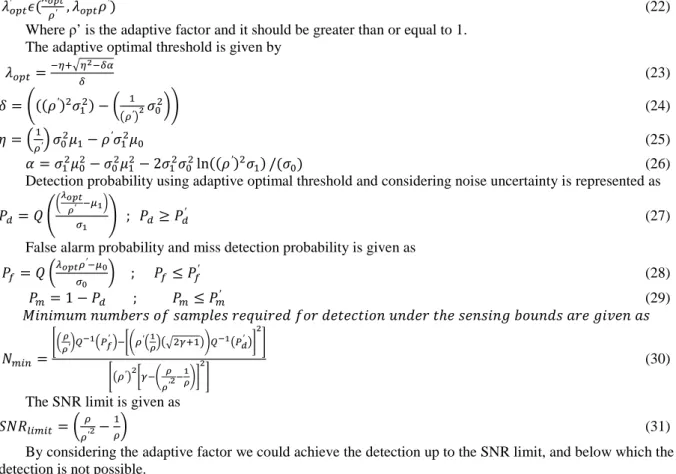
From the above analysis it is observed that, noise uncertainty may degrade the detection performance. We introduce an adaptive factor with the optimal threshold to mitigate the effect of noise uncertainty[5]. The optimal threshold is made adaptive in the interval as given below.
#FGH′ e 3^_`
j′ , #FGHi′ (22)
Where ρ’ is the adaptive factor and it should be greater than or equal to 1. The adaptive optimal threshold is given by
#FGH =BRSTRU6BUV (23)
X = q i′ * − Q
Cj′D6* Wt (24)
Y = 2j′8 * Z − i′* Z (25)
[ = * Z − * Z − 2* * ln i′ * / * (26)
Detection probability using adaptive optimal threshold and considering noise uncertainty is represented as
-.= 0 9Q
|^_` r′ Ba"W
4" ; ; -.≥ -.
′ (27)
False alarm probability and miss detection probability is given as
-== 0 Q3^_`j
′Ba!
4! W ; -= ≤ -=
′ (28)
-@= 1 − -. ; -@≤ -@′ (29)
}~ ~'•' •'€•&‚ %ƒ ‚('„)•‚ &•…•~&•† ƒ%& †•N•‡N~% • †•& Nℎ• ‚• ‚~ ‰ €%• †‚ (&• ‰~Š• (‚
@f =
‹Qrr′Wmn"2op′8Blqj′2"
r8CT sS Dtmn"Cou′Dv 6
Œ
‹Cj′D6lsBqr
r′6B
" rtv
6
Œ
(30)
The SNR limit is given as
y z{f@fH= Qjj′6−jW (31)
By considering the adaptive factor we could achieve the detection up to the SNR limit, and below which the detection is not possible.
VI. Simulation results:
For Simulation, following design parameters are considered. For modulation, Binary Phase Shift keying (BPSK) is used and the channel is considered to be Additive White Gaussian. Since we consider the sensing error, the false alarm probability is fixed as 0.1.
Figure 3 illustrates the relationship between the number of samples N and SNR Increasing the number of samples under low SNR conditions improves the detection performance, thereby decreasing the probability of error.
Figure 4 shows the effect of noise uncertainty in our proposed method. ρ defines the uncertainty factor and if it is equal to 1, the uncertainty effect is negligible and hence we could maintain the probability of error within 0.2 up to -20dB. Similarly, if we increase the uncertainty factor as 1.04, the noise uncertainty affects the detection performance, hence the SNR limit also increases below which the probability of sensing error reaches the maximum value.
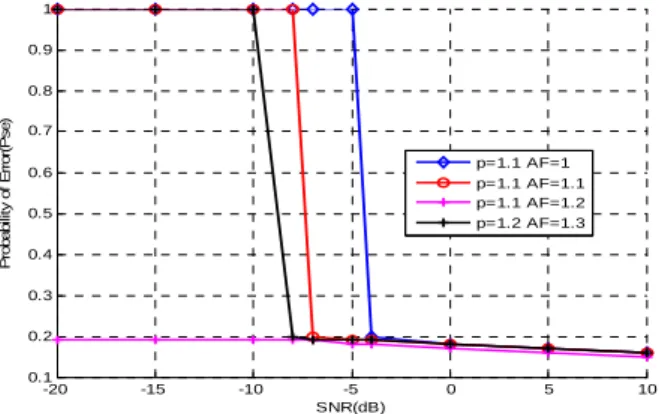
adaptive factor (AF) equals 1, implies no variations in the optimal threshold, hence noise uncertainty has its effect at SNR around -4dB, the probability of error reaches the maximum value 1 below which the detection is not possible and that defines the SNR limit. In order to overcome the uncertainty effect, the adaptive factor (AF) is increased to 1, then the SNR limit is decreased to around -7dB after which the probability of error reaches the maximum value.
Fig. 3: Probability of sensing error for SNR.
Fig. 4: Effect of noise uncertainty in probability of sensing error and SNR.
Fig. 5: Probability of error Vs SNR with different dynamic factor.
VII. Conclusion:
An optimal adaptive threshold is determined to reduce the spectrum sensing error and it is also compared with the conventional methods. Effect of noise uncertainty is studied and explained how to mitigate the uncertainty effect using adaptive factor. From the simulation results, it is observed that if noise uncertainty increases even using the adaptive factor in the proposed optimal threshold determination method we could be able to reduce the sensing error
REFERENCES
Razavi, B., 2010. Cognitive radio design challenges and techniques. Solid-State Circuits, IEEE Journal of, 45(8): 1542-1553.
-20 -15 -10 -5 0 5 10
0 0.1 0.2 0.3 0.4 0.5 0.6 0.7 0.8 0.9 1 SNR(dB) P ro b a b il it y o f E rr o r( P s e ) N=800 N=1000 N=Nmin
-20 -15 -10 -5 0 5 10
0.1 0.2 0.3 0.4 0.5 0.6 0.7 0.8 0.9 1 SNR(dB) P ro b a b ili ty o f E rr o r( P s e ) p=1 p=1.02 p=1.04 p=1.1
-20 -15 -10 -5 0 5 10
Shen, B., L. Huang, C. Zhao, Z. Zhou, K. Kwak, 2008. Energy detection based spectrum sensing for cognitive radios in noise of uncertain power. In Communications and Information Technologies, ISCIT. International Symposium on (pp: 628-633). IEEE.
Chen, Y., 2010. Improved energy detector for random signals in Gaussian noise. IEEE Transactions on Wireless Communications, 9(2): 558-563.
Mitola III, J., G.Q. Maguire Jr, 1999. Cognitive radio: making software radios more personal. Personal Communications, IEEE, 6(4): 13-18.
Nair, P.R., A.P. Vinod, A.K. Krishna, 2010. An adaptive threshold based energy detector for spectrum sensing in cognitive radios at low SNR. In Communication Systems (ICCS), 2010 IEEE International Conference on (pp: 574-578). IEEE.
Tandra, R., A. Sahai, 2005. Fundamental limits on detection in low SNR under noise uncertainty. In Wireless Networks, Communications and Mobile Computing, 2005 International Conference on, 1: 464-469. IEEE.