AUSTRALIAN JOURNAL OF BASIC AND
Open Access Journal
Published BY AENSI Publication
© 2016 AENSI Publisher All rights reserved
This work is licensed under the Creative Commons Attribution International License (CC BY).
http://creativecommons.org/licenses/by/4.0/
To Cite This Article: L.SaiRamesh, S. Sabena, K.Thangaramya and K.Kulothungan Users in Public Cloud. Aust. J. Basic & Appl. Sci.,
Trusted Multi-Owner Data Sharing among Dynamic Users in Public Cloud
1L.SaiRamesh, 2S. Sabena, 3K.Thangaramya and
1Dept. of IST, CEG, Anna University, Chennai 2
Dept. of CSE, Anna University Regional Centre, Tirunelveli 3Dept. of CSE, CEG, Anna University, Chennai
Address For Correspondence:
L.SaiRamesh, Trusted Multi-Owner Data Sharing among Dynamic Users in Public Cloud E-mail: [email protected]
A R T I C L E I N F O Article history:
Received 04 December 2015 Accepted 22 January 2016 Available online 14 February 2016
Keywords:
Data sharing, cloud computing,
encryption, signature generation
Cloud computing provides the resource sharing environment to reduce the storage overhead of local system of the system by the storage as a service. It also used to increase the throughput of the system by providing the needed application for the user from the server by platform as ser
common users in the internet will be the major issue in cloud services. It has to be answered for certain security implications.
Cloud services allow the individual or organizations to share the resources or ret
any servers that are managed by third parties in distributed environment. Some of the cloud services include online file storage, social networking sites, webmail, and online business applications. Cloud environment allows the user to shared pool of resources, including data storage space, networks, computer processing power, and specialized corporate and user applications.
Cloud computing is act as an alternative to available centralized distributed information technology due to its intrinsic resource-sharing and low
providers (CSPs) are able to deliver various services to cloud users with the help of centralized datacenters. By transfer the local database to the remote servers such as cloud servers, users can get high
reduce their investments on their local infrastructures. In this services, database service the most used services by the cloud users. However, it the secure in storing the in
question by most of the service providers. Mainly most of the servers doesn’t provide the trust to the users in their services. But the users want to save their local database for some other usage and they store
cloud database with the encrypted form. Unfortunately, design a cloud environment for efficient and secure data sharing scheme for groups is not an easy task due to the different level of user’s. In this proposed system, we provide a trusted data sharing among the multiple owners in the distributed public environment is carried out. The paper organized as start with the analysis of previous works related with this system. Next, come with the architecture which shows how the environment mak
AUSTRALIAN JOURNAL OF BASIC AND
APPLIED SCIENCES
ISSN:1991-8178 EISSN: 2309-8414 Journal home page: www.ajbasweb.com
© 2016 AENSI Publisher All rights reserved
This work is licensed under the Creative Commons Attribution International License (CC BY).
http://creativecommons.org/licenses/by/4.0/
L.SaiRamesh, S. Sabena, K.Thangaramya and K.Kulothungan., Trusted Multi-Owner Data Sharing Aust. J. Basic & Appl. Sci., 10(2): 315-319, 2016
Owner Data Sharing among Dynamic Users in Public Cloud
K.Thangaramya and 1K.Kulothungan
Dept. of IST, CEG, Anna University, Chennai
Dept. of CSE, Anna University Regional Centre, Tirunelveli Dept. of CSE, CEG, Anna University, Chennai
Owner Data Sharing among Dynamic Users in Public Cloud.
A B S T R A C T
Cloud computing provides a platform for sharing resources among group of users in an efficient and economical way. But sharing data in a multi
preserving data and identity privacy from an untrusted cloud is a challenging issue due to the frequent change of the membership. In this paper, we propose a trusted multi owner data sharing scheme for dynamic groups in the cloud. By creating random signature and broadcasting encryption techniques dynamically, any cloud user in public cloud can share data with other users. Meanwhile, the storage overhead and encryption computation cost of proposed system are independent with the number of users. In addition, we include the hash function in signature to enhance the security of proposed method
INTRODUCTION
resource sharing environment to reduce the storage overhead of local system of the system by the storage as a service. It also used to increase the throughput of the system by providing the needed application for the user from the server by platform as service. But sharing the information among the common users in the internet will be the major issue in cloud services. It has to be answered for certain security
Cloud services allow the individual or organizations to share the resources or retrieve the information from any servers that are managed by third parties in distributed environment. Some of the cloud services include online file storage, social networking sites, webmail, and online business applications. Cloud environment er to shared pool of resources, including data storage space, networks, computer processing power, and specialized corporate and user applications.
Cloud computing is act as an alternative to available centralized distributed information technology due to sharing and low-maintenance characteristics. In this environment, many cloud service providers (CSPs) are able to deliver various services to cloud users with the help of centralized datacenters. By
e remote servers such as cloud servers, users can get high
reduce their investments on their local infrastructures. In this services, database service the most used services However, it the secure in storing the information in cloud is remains the unanswered question by most of the service providers. Mainly most of the servers doesn’t provide the trust to the users in their services. But the users want to save their local database for some other usage and they store
cloud database with the encrypted form. Unfortunately, design a cloud environment for efficient and secure data sharing scheme for groups is not an easy task due to the different level of user’s. In this proposed system, we ted data sharing among the multiple owners in the distributed public environment is carried out. The paper organized as start with the analysis of previous works related with this system. Next, come with the architecture which shows how the environment make the connection between various levels and mechanisms
Owner Data Sharing among Dynamic
Owner Data Sharing among Dynamic Users in Public Cloud
resources among group of users in an efficient and economical way. But sharing data in a multi-owner manner requires preserving data and identity privacy from an untrusted cloud is a challenging issue due aper, we propose a trusted multi-owner data sharing scheme for dynamic groups in the cloud. By creating random signature and broadcasting encryption techniques dynamically, any cloud user in public age overhead and encryption computation cost of proposed system are independent with the number of users. In addition, we include the hash function in signature to enhance the security of proposed
resource sharing environment to reduce the storage overhead of local system of the system by the storage as a service. It also used to increase the throughput of the system by providing the vice. But sharing the information among the common users in the internet will be the major issue in cloud services. It has to be answered for certain security
rieve the information from any servers that are managed by third parties in distributed environment. Some of the cloud services include online file storage, social networking sites, webmail, and online business applications. Cloud environment er to shared pool of resources, including data storage space, networks, computer processing power,
used in this system with algorithm specification. Finally, conclusion is done with the help of performance analysis.
Ii. Related works:
The work proposed by M. Armbrust, et al (2010) introducing the data centres with the set of hardware and software. That really called as cloud environment by the user group. When the same service is given to all the users based on pay as-you-go manner then that environment become a public cloud which the services are sold to the various users as a storage or platform. They use the term private cloud to refer to internal data centres of a business or other organization, not made available to the general public, when they are large enough to benefit from the advantages of cloud computing that we discuss here. Thus, cloud computing is a service provider for storage and utilities with large data centres which needed by many users. People can be users or providers of SaaS, or users or providers of utility computing.
S. Kamara and K. Lauter (2010) proposed the infrastructure that provides the secure cloud storage service. They provide the infrastructure with the architecture supports cryptographic primitives to achieve the secure storage. E. Goh, et al (2003) proposed the system called SiRiUS which provide the secure file server mechanism through the network protocol. They also provide the key management and revocation of file to recover the data from out of band communication. It provides the cryptographic file system mechanism without usage of centralized server mechanism. This system may be extended with the inclusion of multi-group sharing of data using the NNL key revocation construction.
Knox, a privacy preserving auditing system proposed by B.Wang, et al (2012) for shared data among large groups in cloud environment. They use third party auditor to verify the group signatures of users. But it doesn’t provide the message authentication for each transaction. The major advantage of this system is that system cannot be overload by increase of users. A. Fiat and M. Naor (1993) introduced the system for qualitative and quantitative assessment of encryption schemes. This system is mainly designed for broadcast transmissions. The goal is to allow a central broadcast site to broadcast secure transmissions to an arbitrary set of recipients while minimizing key management related transmissions. They provide several secure schemes that allow broadcasting centres to maintain secret of users who are get privileges when compared to normal users.
Jenifer et al (2015) proposed a system for secure data storage using decentralized access control for public cloud. Digital Signature Scheme algorithm is used to generate the digital signature for the users to access the data available in cloud storage. This system contains the key distribution centre for generate a digital signature and distribute among the users in group and validate the users whenever the service provider needed. But, key encryption algorithm is not used to validate the user privileges. Another work proposed by Jenifer et al (2015) is extended with asymmetric key encryption algorithm which provides different authentication level for data owner and reader. Here, the data owner have the privilege to modify the data in cloud storage and the user who given privilege only for read. The user cant modify the data in cloud storage with their rights. But still there is a need of enhanced security for data in public storage that only approved user can read the information which encrypted by the data owner. In our proposed work, we try to enhance the security by providing the security not only modifying the data but also for read the data. So, the sensitive data which is shared among group of users in public storage is maintained securely. Lan Zhou et al (2012) described an system which supports access control mechanism based on Role-Based Access Control (RBAC). This works provides the flexible control for user controls. They proposed a Role-Based Encryption (RBE) scheme which allowed RBAC policies for the encrypted data stored in public clouds.
V. Goyal, et al (2006) developed a new cryptosystem called Key-Policy Attribute-Based Encryption (KP-ABE) for sharing an encrypted data among the user group in cloud storage. In general, cryptosystem are combination of cipher texts with sets of attributes and private keys are associated with access structures that control which cipher texts a user is able to decrypt. In this system, data owner generate a random key for encryption using KP-ABE. The group manager in this scheme is used to assign the secret key to authorized user. The authorized user can decrypt the cipher text if the data attributes satisfy the signature verification. Here, the authorized user group only shared the data between them within the cloud storage. Jinguang Han et al., (2012) proposed another work on attribute based encryption in decentralized network. In this system, no centralized key distributor is available to share the secret key among the users. This will reduce the communication cost for key generation. But, the non-authority users are easily make them to attach with the group.
their individual identity and group key to show their authorization in group activities. The user encrypt the data using the attribute key and send the cipher text with their group key signature. The receiver decrypt the cipher text with their group key and their attribute key. Its an symmetric key keying encryption technique which generates the signature with group key and their attribute key. However, user revocation is not supported in this scheme.
Based on the low maintenance character, cloud computing provides a provable solution for sharing group of user resources in cloud environment. Unfortunately, sharing data in a multi-owner scheme with preserving the data privacy in untrusted cloud environment is a challenging issue.
III Proposed System:
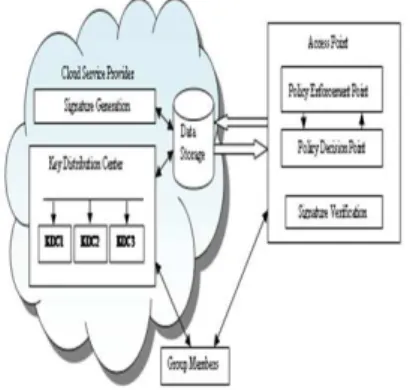
To achieve a secure data sharing in untrusted public cloud, we try to combine the group signature and dynamic broadcast encryption techniques. The group signature scheme enables the users to use data from public cloud storage and encryption helps the users to securely share their resources among the group of authorized users. Still, the computer overhead is decrease the efficiency of proposed system for dynamic broadcast encryption scheme is increased by the increase of file size. So, we try to reduce the time complexity and computation overhead by providing the key distribution centre and signature generation in the cloud service provider. Signature verification is carried out by access points to verify the user signatures.
Such a design can significantly reduce the computation over head of users to encrypt files and the cipher text size. Specially, the computation overhead of users for encryption operations and the cipher text size are remains constant. We propose a secure multi-owner data sharing scheme. It implies that any user in the group can securely share data with others by the untrusted cloud. We provide secure and privacy-preserving access control to users, which guarantees each member in a group to anonymously utilize the cloud resource in a secure manner.
Fig. 1: Secure Multi Owner Data Sharing For Dynamic Users.
The figure 1 is explained the secure multi owner data sharing for dynamic users. System initialization can
be done by creating a cloud architecture in which data owner creates an account with cloud server. Further, more users can join with data owner to share files. This is possible through making a request to data owner. During registration process users need to fill their personal information which will be evaluated by data owner to provide an approval for data access in cloud. Once, user got registered with the cloud system, he is free to access any file until life time expiry or revocation on the basis of request. Initially, Data Owner collects attributes relevant to the data file units and are encrypted, then uploaded to cloud server. Policy engine used in the system automatically runs and generates access structure of the data file. Also, generates user’s public key. Once the access structure satisfies the attributes given by the user the decrypted file can be downloaded by them.
User Registration is after successful creation of cloud setup, users need to get registered with the system through user registration process. While registering, users need to submit their personal details for completion of registration process. But, the system guarantees Identity privacy. During registration process, user got unique identity I and access structure T. This generates secret key S k for I. Data file F can be then encrypted by using I’s Public Key Pk to generate Cipher text C.
File Deletion can be performed by Data Owners, if they no longer needed that files. For file deletion, Data Owner wants to provide File Identifier along with secret key. If owner’s signature is verified successfully then cloud server positively deletes the file with specified identity.
For implementation 3 algorithms are used, details given in below.
Algorithm 1: User Registration and Key Generation:
Step 1: Perform system initialization by selecting q, g1, g2, h1 and h2. Step 2: Generate the signature
Step 3: Check registration information Step 4: Perform attribute generation Step 5: KDC sends keys to the user Step 6: User generates the key.
Algorithm 2: Signature Generation:
Algorithm: Digital Signature Standard with hashing
Step 1: Key Generation:
Step 1a: Select public key attributes.
Step 1b: Select a private key and compute the public key for user. Step 2: Signature Creation
Step 2a: Generate random signature key using hash function. Step 2b: Compute Signature using random signature key.
Algorithm 3: Signature Verification:
Step 1: Set System parameter (P, U, V, H, W) and Signature = (T1, T2, T3, c, ) Step 2: Compute the Following value.
Step 3: if c = f (M, T1,T2, T3, ) Return true Step 4: else Return false
KDC setup:
We emphasize that clouds should take a decentralized approach while distributing secret keys and attributes to users. It is also quite natural for clouds to have many KDCs in different locations in the world. The architecture is decentralized, meaning that there can be several KDCs for key management.
Since, the hash algorithm used in this work uses one way hashing, it is not possible to find the hash function and plain text from the cipher text. Here, decryption is not possible without valid signature verification. However, signature verification algorithm checks the validity of the signature to enhance the security.
Performance Analysis:
In this section, we discuss and compare the performance analysis of our proposed system when used with decentralized access control and with other existing system. the performance analysis is carried out by analyzed under various file sizes with various constraints.
Table 1: Time Performance for transaction.
File Size (kb) Upload (Signature Generation and encrypted file) (msec) Download (Signature Verification and decrypt file) (msec)
1 13 5
10 15 6.5
100 17.3 7.2
150 20 7.5
200 20.5 8
Table 1 shows the transaction time of different file sizes for upload and download the file in cloud storage. Normally, in attribute based encryption system requires more time for downloading with decryption when compared to encryption the file while uploading. This will increase the computation time and complexity in client side. In this proposed system, signature verification and decryption of file requires less time when compared to encryption while uploading because of using access points.
Table 2: Performance analysis of security level of proposed system with MD5.
File Size Security Level in %
MD5 Proposed System
1 kb 98.95 98.95
10 kb 97.62 97.66
100 kb 93.10 97.55
150 kb 92.95 97.55
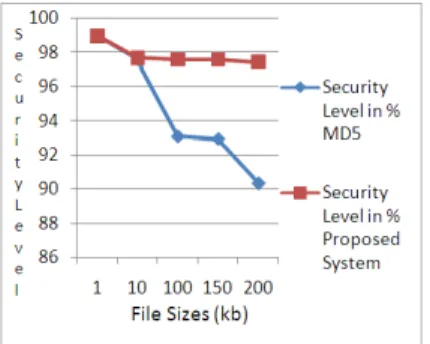
Fig. 2: Performance analysis of proposed system with the comparison of MD5.
Table 2 and Figure 2 show the security performance analysis of the proposed system using hashing with digital signature and MD5. The analysis shows that proposed system performs better than MD5 while the file size increases. At the initial stage both system provided the same security level for cloud data. Here, the experiments are carried out with the text files. In future, we extend this service for secure transmission of image or video files.
Conclusion And Future Work:
Secure data sharing scheme for dynamic groups in an untrusted cloud is proposed in this paper. In this, user share data with others in the group without revealing identity privacy to the cloud service provider. In addition, this system supports efficient user signature verification and new user joining by maintaining access points. More specially, generation of user signature can be achieved through a random key generation without updating the private keys of the remaining users. And also new users can directly decrypt files stored in the cloud by using their signature provided by KDC. Moreover, the storage overhead and the encryption computation cost are constant. Extensive analyses show that our proposed scheme satisfies the desired security requirements and guarantees efficiency as well.
REFERENCES
Armbrust, M., A. Fox, R. Griffith, A.D. Joseph, R.H. Katz, A. Konwinski, G. Lee, D.A. Patterson, A. Rabkin, I. Stoica, M. Zaharia, 2010. “A View of Cloud Computing,” Comm. ACM, 53(4): 50-58.
Kamara, S. and K. Lauter, 2010. “Cryptographic Cloud Storage,” Proc. Int’l Conf. Financial Cryptography and Data Security ( FC), 136-149.
Goh, E., H. Shacham, N. Modadugu, and D. Boneh, 2003. “Sirius: Securing Remote Untrusted Storage,” Proc. Network and Distributed Systems Security Symp. (NDSS), 131- 145.
Wang, B., B. Li, H. Li, 2012. “Knox: Privacy-Preserving Auditing for Shared Data with Large Groups in the Cloud,” Proc. 10th Int’l Conf. Applied Cryptography and Network Security, 507-525.
Jenifer Jayakumar, L., SaiRamesh, V. Pandiyaraju, S. Muthurajkumar, R. Rakesh, 2015. “Secure Data Storage in cloud using Decentralized Access control in cloud”, Proc. Advances in Natural and Applied Sciences, 192-196, 9(6).
Fiat, A. and M. Naor, 1993. “Broadcast Encryption,” Proc. Int’l Cryptology Conf. Advances in Cryptology (CRYPTO), 480-491.
Goyal, V., O. Pandey, A. Sahai, B. Waters, 2006. “AttributeBased Encryption for Fine-Grained Access Control of Encrypted Data,” Proc. ACM Conf. Computer and Comm. Security (CCS), 89-98.
Pointcheval, D. and J. Stern, 2000. “Security Arguments for Digital Signatures and Blind Signatures,” J. Cryptology, 13(3): 361-396.
Jenifer Jayakumar, L., SaiRamesh, V. Pandiyaraju, S. Muthurajkumar, R. Rakesh, “Secure Data Storage With User Revocation Using Re-Encryption Technique In Cloud”, International Journal of Applied Engineering Research, 10(72): 243 -246.
Lu, R., X. Lin, X. Liang, and X. Shen, 2010. “Secure Provenance: The Essential of Bread and Butter of Data Forensics in Cloud Computing,” Proc. ACM Symp. Information, Computer and Comm. Security, 282-292.
Jinguang han, Willy Susilo, Yi mu, and Jun yan, 2012. “Privacy -Preserving Decentralized Key-Policy Attribute-Based Encryption”, IEEE Transactions on Parallel and Distributed Systems, 23(11): 556-563.