Address for correspondence Dr. Konchok Dorjay
Dr. P N Behl, Skin Institute and School of Dermatology, Greater Kailash-1, New Delhi Ph: 08800946147
Email: [email protected]
Original Article
Study of morphological patterns and identification of
contact sensitizers of hand eczema by patch test
Introduction
The term “hand eczema” implies to an inflammation of the skin that is confined to
hands.1-3 Hand eczema is a common and
distressing condition. The point prevalence of hand eczema is around 4%, the 1-year prevalence is nearly 10%, whereas the lifetime
prevalence is around 15%.4 The incidence rate of hand eczema is estimated to be 5 cases per
thousand population.5 A high incidence rate was
associated with female sex, contact allergy,
atopic dermatitis, and wet work.4 Among all
eczemas, 20 to 35% affects hands.6-8 The
frequency of contact sensitization in hand eczema patients varies from 23 to 63%.9,10 In various Indian studies, positive patch test ranges from 30% to 82% of patients with hand eczema.11-15 Potassium dichromate & nickel are
common sensitizers.12,14-21 Hand eczema is more
common among people reporting some kind of Konchok Dorjay, Premanshu Bhushan, Asok Aggarwal, Govind Srivastava, Tasleem Arif*, Mohammad Adil*
Dr. PN Behl, Skin Institute and School of Dermatology, Greater Kailash-1, New Delhi * Jawaharlal Nehru Medical College, Aligarh Muslim University, Aligarh, India
Abstract
Background Hand eczema is a common distressing condition aggravated by a number of endogenous and exogenous factors. Various morphological patterns of hand eczema have been described.Aims To study the morphological patterns of hand eczema and identification of contact sensitizers of hand eczema by patch test.
Methods Hundred consecutive patients of hand eczema attending the outpatient department of the
institute were recruited over a period of one year from 2013-2014. All the patients were patch tested using Indian standard series.
Results Pompholyx was the most common morphological pattern seen in 25% of patients followed
by hyperkeratotic palmar eczema in 22%. Positive patch test to one or more allergen was present in 61% of patients. Nickel sulphate was found to be the most common allergens seen in 16%. This was followed by potassium dichromate, parthenium, fragrance mix in 11%, 8%, 8% respectively. The females (57%) were out-numbered by males (43%) with sex ratio of 1.32:1. Housewives (29%) were the most commonly affected.
Conclusion Patch testing is a very useful investigative procedure for allergic contact dermatitis (ACD) of hands. The Indian Standard Series is useful but insufficient. Hence, testing with vegetables and other personal care products are suggested especially in housewives along with Standard Series. Thus, a specific patch test series for hand eczema is suggested.
Key words
occupational exposure.22,23 Patch testing is an important test to find out the contact sensitizer in hand eczema.12,13,15,24
In India and Indian sub-continent, there is paucity of studies per se pertaining to morphological patterns of hand eczema and identification of contact sensitizers. This study was undertaken to assess the morphological patterns and identification of contact sensitizers in hand eczema. Hence, the present study would assume greater significance in Indian sub-continent.
Material and Methods
The study was conducted in the Skin Institute and School of Dermatology, New Delhi from 2013 to 2014. During this period, a total of 100 patients, clinically diagnosed as cases of hand eczema attending the outpatients department were recruited for this prospective observational study. An informed consent was taken from all the patients. The study was approved by the hospital ethical committee. A detailed history of each patient regarding demographic data of the patients, mode of onset, progression, duration, relation to occupation, hobbies, aggravating and relieving factors, frequency of hand washing, seasonal variation, history of atopy in patient or family, history of chronic drug intake, any drug or food allergies were recorded. Relevant investigations, routine and specific tests e.g. staining KOH and skin biopsy whenever required were carried out. The inclusion criteria were 1) patients above 18 years of age, 2) patients of both sexes and 3) clinically diagnosed cases of hand eczema. The exclusion criteria were 1) patients with eczema in other areas of the body, 2) other skin diseases like psoriasis, palmoplanter keratoderma, erythema multiforme involving the hands, 3) frank pyoderma of hand, 4) pregnant females, 5) patients on immunosuppressive drugs and 6)
patients refusing consent. The morphological
classification of hand eczema (Table 1) was
done and patch testing was performed with battery of 20 allergens approved by Contact and Occupational Dermatoses Forum of India (CODFI) comprising allergens from Indian Standard Series. Readings were taken on day 2 and day 4 and interpreted according to criteria laid down by international contact dermatitis
research group (ICDRG) (Table2).25 SPSS 19
software has been used for data analysis. The data were expressed in terms of Means, Standard
Deviation and Proportion, followed by
comparison between groups through chi-square test. A p value of less than 0.05 was considered as statistically significant.
Observation and Results
Clinically diagnosed 100 patients of hand eczema were evaluated in the present study. The mean age of the patients was 39.2411.56 years (female 38.1912.13 years; male 40.6310.74 years) with maximum number of patients belonging to age group of 20 to 39 years (53%) followed by 40 to 59 years (38%). The females (57%) were outnumbered by males (43%) with
sex ratio of 1.32:1 (Table 3). In the age group of
20 to 39 years, females (54.39%) outnumbered the males (51.16%) but, males (44.19%) were more commonly affected than females (33.33%) in age of 40 to 59 years. The mean duration of hand eczema was 2.03±2.85 years (one month to 20 years).
Table 1 Morphological patterns of hand eczema2 1. Pompholyx
2. Hyperkeratotic eczema 3. Finger tip eczema 4. Discoid eczema 5. Ring eczema
6. Recurrent focal palmar peeling 7. Apron eczema
8. Chronic acral dermatitis 9. Wear and tear dermatitis 10. Gut eczema
Table 2 Patch test grading criteria laid down by International Contact Dermatitis Research Group (ICDRG)
- No changes Negative reaction
?+ Faint erythema only Doubtful reaction
+ Palpable erythema, infiltration possibly papules Weak positive reaction ++ Erythema, infiltration, papules, vesicular Strong positive reaction +++ Erythema, infiltration, oedema, coalescing
vesicles/ulcerative
Extreme positive reaction
IR No induration Irritant reaction
Table 3 Clinico-epidemiological profile of patients
Parameters Female Male
Mean age 38.19±12.13 years 40.63±10.74 years
No. of patients 57 43
Mean duration of disease 1.84±2.23 years 2.28±3.51 years
History of atopy 13 8
Bilateral pattern 48 40
Unilateral pattern 9 3
Patch test positive 33 28
Table 4 Occupational profile of patients
Occupation Female Male Total
Driver 0 4 4
Farmer 9 8 17
House maid 4 0 4
House wife 29 0 29
Lab. Technician 0 2 2
Labourer 0 14 14
Mechanic 0 2 2
Nurse 5 0 5
Rickshaw puller 0 5 5
Shopkeeper 2 4 6
Student 7 1 8
Tailor 1 1 2
Waiter 0 2 2
Total 57 43 100
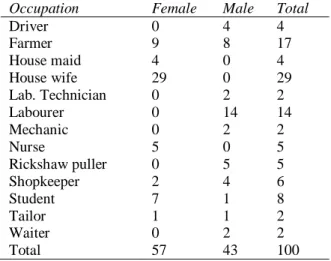
Housewives were the most commonly affected
(29%), followed by farmers (17%) (Table 4).
Among females, the most commonly affected were housewives (50.88%) and labourers formed the largest group in males (32.56%). History of atopy was present in 21% of the patients. Disease was bilateral in 88% of the patients whereas it was unilateral in 12% of the patients. Pruritus was the most common symptom which was seen in 98%, followed by scaling (83%), pain (15%), burning (5%), erythema (36%), fissuring (35%), hyperkeratotic
lesion (23%), lichenification (40%),
hyperpigmentation (15%), oozing (12%), papule (3%), papulovesicle (21%) and vesicle (10%).
Pompholyx was the most common
morphological pattern seen in 25% of patients followed by hyperkeratotic palmar eczema
(22%) (Table 5). Out of 100 patients patch
tested, 61 patients (61%) gave positive patch test results and 39% of patients were negative for
patch test (Table 5). Sensitization to single
Table 5 Patch test positivity with morphological patterns
Morphological Pattern Female Male Total Positive patch test
Chronic acral dermatitis 1 2 3 3
Discoid eczema 7 4 11 5
Fingertip eczema 5 4 9 5
Gut eczema 0 0 0 0
Hyperkeratotic palmar eczema 10 12 22 14
Patchy vesiculosquamous 5 6 11 7
Pompholyx 15 10 25 15
Recurrent focal palmar peeling 1 1 2 0
Ring eczema 3 2 5 5
Apron eczema 0 0 0 0
Wear and tear dermatitis 10 2 12 7
Total 57 43 100 66
Table 6 Allergens positivity
Allergens Female Male Total
Vaseline 0 0 0
Wool alchohols 0 0 0
Balsam of Peru 3 0 3
Formaldehyde 0 0 0
Mercaptobenzothiazole 2 1 3
Potassium dichromate 1 10 11
Nickel Sulphate 12 4 16
Cobalt sulphate 1 2 3
Colophony 1 1 2
Epoxy resin 0 0 0
Paraben mix 0 0 0
p-Phenylenediamine 4 2 6
Parthenium 3 5 8
Neomycin sulphate 1 1 2
Benzocaine 1 0 1
Chlorocresol 0 0 0
Fragrance mix 7 1 8
Thiuram mix 0 0 0
Nitrofurazone 0 0 0
Black rubber mix 0 2 2
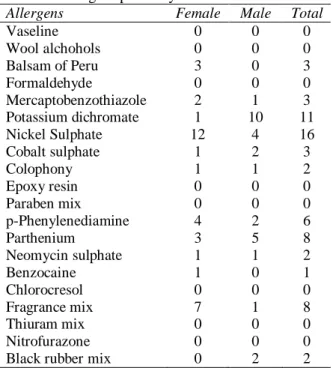
Nickel sulphate (8) was the most common sensitizer in pompholyx, followed by fragrance mix (3), p-phenylenediamine (2), balsam of Peru (1), mercaptobenzothiazole (1) and parthenium (1). In hyperkeratotic palmar eczema the most common sensitizer was potassium dichromate (6) and parthenium (6). All the patients with ring eczema showed positive reaction. Out of 5 patients 4 were positive with nickel and 1 with cobalt. In chronic acral dermatitis, all showed positive reaction i.e one each with balsam of Peru, nickel sulphate and benzocaine. None of the patients with recurrent focal palmar peeling showed positive reaction.
Discussion
An increase in the incidence of hand eczema has been seen in recent years due to increased occupational exposure to multiple chemicals. The age of the patients in this study ranged from 18 to 64 years which is in accordance with study
conducted by Laxmisha et al.14 In present study,
the maximum numbers of patients (53%) were in the age group of 20-39 years. Similar age group were also reported as most common presentation
in various other studies.13,15,26,27 Maximum
positive reaction was also found in the same age group. In this study, the reason behind the higher prevalence of hand eczema and maximum positive reaction in the age group (20-39), can be because of the fact that this particular phase of life remains more active. Therefore, it increases the chance of exposure to allergens. The mean age was 39.24 years. Similar trend
was also noted by Laxmisha et al. (39.5 years)14
and Johansen et al. (39 years).28
The sex ratio of the study was 1.32:1 with females (57%) and males (43%). Female preponderance in the study is consistent with
studies conducted by Huda et al. (1.75:1),29
In this study, among females maximum patients were housewives (50.88%). Our findings are
similar with Kishore et al.12 Likewise, Handa et
al;15 Charan et al;32 Minocha et al.33 and Sharma et al.34 also found similar findings. In males, 67.41% were unskilled workers like farmers, labourer, rickshaw pullers and waiters. This findings are higher than Kishore et al.12 and
Sharma et al.34 This might be due to more
exposure of unskilled workers to chemicals without taking much protection for hands. Overall, housewives were the most predominant occupational group in this study, followed by farmers, labourer, and students and so on. Suman et al. found most common occupation was household worker, followed by masonry, students and others.13
The duration of disease varied from one month to twenty years with mean duration of 2.03 years. History of atopy was present in 21% of patients. The present findings are higher than that reported by Skoet et al. (16.4%) representing atopy as predisposing factor for
hand eczema.18 Bilateral involvement of hands
was observed in 88% of patients and unilateral hand involvement was seen in 12% in this study. Pruritus (98%) was the most common symptom observed which is in accordance with study done by Goyal et al.27 Scaling (83%) and erythema (53%) were the most frequently encountered clinical signs. This is in accordance with study
done by Lerbaek A et al.9
The most common morphological pattern of hand eczema was pompholyx (25%). In other studies, pompholyx accounts for around 5–20% of all cases of hand eczema.35,36 Out of 25 patients, positive reaction was seen in 15 patients representing 60% among pompholyx group and 24.59% out of all patients. It was maximum for nickel sulphate (8), followed by fragrance mix (3), p-phenylenediamine (2) balsam of peru (1), parthenium (1) and
mercaptobenzothiazole (1). In a survey
involving 364 patients with pompholyx, contact sensitivity has been observed in 310 patients.37 Jain et al. found 40% sensitivity in pompholyx to one or more allergens.38 Nickel sulphate was
the most common offending allergen.38
Second most common pattern was
hyperkeratotic palmar eczema (22%). Our
finding is higher than that of Handa et al. (9%).15
This variation may be due to the fact that most of patients in this study were labourers. Hersle et al. noted that this type of eczema is most
common among middle aged man.39 In present
study 22.95% (n=14) of patients with
hyperkeratotic palmar eczema showed positive reaction. It was maximum for potassium dichromate and parthenium followed by cobalt
sulphate, nickel sulphate and
p-phenylenediamine. Minocha et al. detected contact sensitivity in 130 out of 230 patients of
hyperkeratotic palmar eczema.33
Fingertip eczema involves the palmar surface of the tips of some or all fingers. Fingertip eczema accounts for 9% of hand eczema with positive reaction seen in 8.20% (n=5). Tavadia et al. observed positive reaction to nickel, cobalt and fragrance.40 Wear and tear eczema is pattern of dermatitis which affects housewives and cleaners who frequently immerse their hands in water and detergents. In this study 12 patients belong to this category in which positive reaction was noted in 7 patients representing 11.48% among all patients. Positive reaction with fragrance mix was seen in two patients, one patient each tested positive for balsum of Peru,
mercaptobenzothiazole, nickel sulphate,
potassium dichromate and p-phenylenediamine. In a study of housewives hand eczema by Kim et
al., 37.5% showed positive patch reaction.41
eczema. In present study, out of 100 patients 11 had discoid eczema with positive reaction in 5 patients representing 45.45% among discoid eczema. The various allergens which showed
positive reaction were one each of
mercaptobenzothiazole, potassium dichromate, parthenium, neomycin sulphate, fragrance mix and black rubber mix. The commonest allergens being potassium dichromate followed by nickel, cobalt and fragrance mix.17 Khurana et al. and Fleming et al. found 50% sensitivity among
nummular eczema patients.42
Ring eczema is characterized by a patch of eczema which develops under a ring and spreads to involve the adjacent side of the middle finger and the adjacent area of the palm. In this study 5 patients presented with ring eczema with positive reaction in all patients. Four were positive for nickel sulphate and one for cobalt sulphate. Allergic contact dermatitis under rings has been observed, from nickel, gold, and palladium.43
In present study, positive patch test reaction was seen in 61%. Various other studies showed positive patch test reaction ranging from 30-82%.7,11-14,30,34 Potassium dichromate was the most common sensitizer in male and nickel sulphate was the most common sensitizer in females.
In this study, nickel sulphate (16%) was the most common sensitizer. Nickel had been the most common sensitizers in the past, perhaps due to its widespread use in jewellery, watches, bottons, zippers, rings, doorknobs, batteries, metal-cutting fluids, coins, orthopaedic plates,
keys, spectacle frames and kitchenware.44
Systemic exposure can take place from diet.44
Next common sensitizer was Potassium
dichromate seen in 11%, which is almost in
accordance with Shenoi et al. (11.3%).45 Patients
in this study had significant occupational exposure to chromates, thereby increasing the risk of contact sensitivity to chromates, which could explain the high number of positive test reactions to chromates noted by us.
Fragrance mix in this study was positive in 8% of patients which is higher than Handa S et al.
(5%).15 Most of our patients were females.
Fragrance allergy occurs predominantly in
women with facial or hand eczema.46 Exposure
is commonly through cosmetics, toiletries, food
items and other household product.47 Parthenium
dermatitis is wide spread and distressing dermatoses in India caused by air borne allergen of compositae weed, Parthenium hysterophorus. In this study, positive reaction to parthenium was seen in 8%.
Positive reaction to p-phenylenediamine was
observed in 6%. In daily life
p-phenylenediamine comes in contact easily due to its use in dyes used for socks, trousers, shoes and hairs colorants. Balsam of Peru was positive in 3% which is in accordance with findings of Handa et al. (3%)15 and Shenoi et al. (3.3%).45 With cobalt chloride positive reaction was seen in 3%, and neomycin sulphate was positive in 2%, which is similar to Meding et al. (2%)48 Mercaptobenzothiazole was positive in 3%
which is in accordance with Handa et al. (3%)15
and benzocaine was positive in only one patient which is same as noted by Handa et al. (1%).15 Black rubber mix and colophony were positive in 2% each which is in accordance with study of Handa et al. (2%).15
None of the patients subjected to patch testing had any severe complications of patch test. No patients had a flare of dermatitis or any ulceration inspite of strong grade 3 patch test reactions.
Patch testing is a very useful investigative procedure for ACD of hands. There is less literature pertaining to the association between morphological pattern and allergens from India and Indian sub-continent. Therefore, large sample sizes with multicentric studies are required to establish an inclusive conclusion pertaining to the association of clinical types and allergens. The Indian Standard Series is useful but insufficient. Hence, testing with vegetables and other personal care products are suggested especially in housewives along with Standard Series. Thus, a specific patch test series for the hands eczema as in footwear series or textile series is suggested.
References
1. Coenraads PJ. Hand eczema is common and multifactorial. J Invest Dermatol 2007;127:1568-70.
2. Jones JB. Eczema, Lichenification, Prurigo, Erythroderma. 8th ed. In Rook's Textbook of dermatology, Burns T, Breathnach S, Cox N, Griffiths C,eds London: Blackwell; 2010.pp.23.14. 2010.
3. Epstein E. Hand dermatitis: practical management and current concepts. J Am Acad Dermatol 1984;10:395-424.
4. Thyssen JP, Johansen JD, Linneberg A, Menne T. The epidemiology of hand eczema in the general population--prevalence and main findings. Contact Dermatitis 2010; 62: 75-87.
5. Meding B, Jarvholm B. Incidence of hand eczema-a population-based retrospective study. J Invest Dermatol 2004; 122: 873-7. 6. Goh CL. An epidemiological comparison
between hand eczema and non-hand eczema. Br J Dermatol 1988; 118: 797-801.
7. Toledo F, Garcia-Bravo B, Fernandez-Redondo V, De la Cuadra J, Gimenez-Arnau AM, Borrego L, et al. Patch testing in children with hand eczema. A 5-year multicentre study in Spain. Contact Dermatitis 2011; 65: 213-9.
8. Elston DM, Ahmed DD, Watsky KL, Schwarzenberger K. Hand dermatitis. J Am Acad Dermatol 2002; 47: 291-9.
9. Lerbaek A, Kyvik KO, Ravn H, Menne T, Agner T. Clinical characteristics and
consequences of hand eczema - an 8-year follow-up study of a population-based twin cohort. Contact Dermatitis 2008; 58: 210-6. 10. Diepgen TL, Andersen KE, Brandao FM,
Bruze M, Bruynzeel DP, Frosch P, et al. Hand eczema classification: a cross-sectional, multicentre study of the aetiology and morphology of hand eczema. Br J Dermatol 2009; 160: 353-8.
11. Agarwal US, Panse GG. Relevance of patch testing in hand eczema--comment. Indian J Dermatol Venereol Leprol 2010 ;76: 59-60. 12. Kishore NB, Belliappa AD, Shetty NJ,
Sukumar D, Ravi S. Hand eczema -- clinical patterns and role of patch testing. Indian J Dermatol Venereol Leprol 2005; 71: 207-8. 13. Suman M, Reddy BS. Pattern of contact
sensitivity in Indian patients with hand eczema. J Dermatol 2003; 30: 649-54. 14. Laxmisha C, Kumar S, Nath AK, Thappa
DM. Patch testing in hand eczema at a tertiary care center. Indian J Dermatol Venereol Leprol 2008; 74: 498-9.
15. Handa S, Kaur I, Gupta T, Jindal R. Hand eczema: correlation of morphologic patterns, atopy, contact sensitization and disease severity. Indian J Dermatol Venereol Leprol 2012; 78: 153-8.
16. al-Sheikh OA, Gad el-Rab MO. Allergic contact dermatitis: clinical features and profile of sensitizing allergens in Riyadh, Saudi Arabia. Int J Dermatol 1996; 35: 493-7.
17. Khurana S, Jain VK, Aggarwal K, Gupta S. Patch testing in discoid eczema. J Dermatol 2002; 29: 763-7.
18. Skoet R, Olsen J, Mathiesen B, Iversen L, Johansen JD, Agner T. A survey of occupational hand eczema in Denmark. Contact Dermatitis 2004; 51: 159-66. 19. Lantinga H, Nater JP, Coenraads PJ.
Prevalence, incidence and course of eczema on the hands and forearms in a sample of the general population. Contact Dermatitis 1984; 10: 135-9.
20. Duarte I, Terumi Nakano J, Lazzarini R. Hand eczema: evaluation of 250 patients. Am J Contact Dermat 1998; 9: 216-23. 21. Kang YC, Lee S, Ahn SK, Choi EH.
Clinical manifestations of hand eczema compared by etiologic classification and irritation reactivity to SLS. J Dermatol 2002; 29: 477-83.
23. Meding B, Jarvholm B. Hand eczema in Swedish adults - changes in prevalence between 1983 and 1996. J Invest Dermatol 2002; 118: 719-23.
24. Li LF, Wang J. Contact hypersensitivity in hand dermatitis. Contact Dermatitis 2002; 47: 206-9.
25. Wilkinson DS, Fregert S, Magnusson B, Bandmann HJ, Calnan CD, Cronin E, et al. Terminology of Contact Dermatitis. Acta Derm Venereol 1970; 50: 287-92.
26. Singhi MK, Menghani PR, Gupta LK, Kachhawa D, Bansal M. Occupational contact dermatitis among the traditional 'tie and dye' cottage industry in Western Rajasthan. Indian J Dermatol Venereol Leprol 2005; 71: 329-32.
27. Goyal S, Chaudhary H. Contact dermatitis in housewives-A clinico-etiological study in a tertiary care hospital of northern India. IJRRMS 2012; 2: 13-6.
28. Johansen JD, Hald M, Andersen BL, Laurberg G, Danielsen A, Avnstorp C, et al. Classification of hand eczema: clinical and aetiological types. Based on the guideline of the Danish Contact Dermatitis Group. Contact Dermatitis 2011; 65: 13–21.
29. Huda MM, Paul UK. Patch testing in contact dermatitis of hands and feet. Indian J Dermatol Venereol Leprol 1996; 62: 361-2. 30. Bajaj AK. Contact Dermatitis Hands. Indian
J Dermatol Venereol Leprol 1983; 49: 195-9.
31. Diepgen TL, Agner T, Aberer W, Berth-Jones J, Cambazard F, Elsner P, et al. Management of chronic hand eczema. Contact Dermatitis 2007; 57: 203-10. 32. Charan UP, Peter CV, Pulimood SA. Impact
of hand eczema severity on quality of life. Indian Dermatol Online J 2013; 4: 102-5. 33. Minocha YC, Dogra A, Sood VK. Contact
sensitivity in palmar hyperkeratotic dermatitis. Indian J Dermatol Venereol Leprol 1993; 59: 60-3.
34. Sharma KV, Kaur S. Contact Dermatitis of Hands in Chandigarh. Indian J Dermatol Venereol Leprol 1987; 53: 103--7.
35. Agrup G. Hand eczema and other dermatoses in southern Sweden. Acta Derm Venereol (Stockh) 1969; 49 (Suppl. 61).
36. Meding B, Swanbeck G. Epidemiology of different types of hand eczema in an industrial city. Acta Derm Venereol 1989; 69: 227-33.
37. Meneghini CL, Angelini G. Contact and microbial allergy in pompholyx. Contact Dennatitis 1979; 5: 46-50.
38. Jain VK, Aggarwal K, Passi S, Gupta S. Role of contact allergens in pompholyx. J Dermatol 2004; 31: 188-93.
39. Hersle K, Mobacken H. Hyperkeratotic dermatitis of the palms. Br J Dermatol 1982; 107: 195-201.
40. Tavadia S, Morton CA, Forsyth A. Latex, potato and tomato allergy in a restaurateur. Contact Dermatitis 2002; 47: 109–25. 41. Kim HJ, Yoon MS, Kim DH, Kim SC,
Hong KT. Clinical Evaluation and Patch Test with Vegetables in Housewife' s Hand Eczema. Korean J Dermatol 1988; 26: 172-8.
42. Fleming C, Parry E, Forsyth A, Kemmett D. Patch testing in discoid eczema. Contact Dermatitis 1997; 36: 261–4.
43. Sabroe RA, Sharp LA, Peachey R. Contact allergy to gold thiosulfate. Contact Dennatitis 1996; 34: 345‑8.
44. Jindal R, Sharma NL, Mahajan VK, Tegta GR. Contact sensitization in venous eczema: Preliminary results of patch testing with Indian standard series and topical medicaments. Indian J Dermatol Venereol Leprol 2009; 75: 136-41.
45. Shenoi DS, Srinivas CR, Balachandran C. Results of patch testing with a standard series of allergens at Manipal. Indian J Dermatol Venereol Leprol 1994; 60: 133-5. 46. Johansen JD. Fragrance contact allergy: a
clinical review. Am J Clin Dermatol 2003; 4: 789-98.
47. Jindal R, De D. Current best evidence from dermatology literature. Indian J Dermatol Venereol Leprol 2010; 76: 87-91.