Original Article
A randomized, double-blinded study of comparison
of 2.5 mg/L versus 3.75 mg/L of methoxsalen
concentration for bath-PUVA in psoriasis vulgaris
Introduction
Psoriasis is a multifactorial inflammatory papulosquamous disorder regulated through multiple pathways; characterized by increased turnover of keratinocytes with significant
systemic association with metabolic syndrome and cardiovascular disorders.1 In this modern era of biologicals, phototherapy is still the cornerstone for treatment of psoriasis.2 Phototherapy is administration of ultraviolet radiation as therapeutic modality. Anuradha Jindal, Bipin Bhattachan, Sathish Pai
Department of Dermatology, Venereology and Leprosy, Manipal Academy of Higher Education (MAHE), India.
Abstract
Introduction Photochemotherapy includes use of exogenous photosensitizer along with exposure to ultraviolet radiation {P- psoralen (photosensitizer) + UVA (ultraviolet radiation A)} which can be administered in form of oral or topical solution. Bath PUVA involves delivering psoralen through immersion in water containing methoxasalen (photosensitizer) followed by exposure to UVA radiation. We carried out this study in patients with psoriasis vulgaris to find the difference in response, adverse effects profile and duration of remission in patients treated with lower dose versus standard dose being used.Aim This was a prospective, randomized, double blinded study to compare the efficacy and side effects of low concentration i.e. 2.5mg/L versus standard concentration i.e. 3.75mg/L in patients suffering from psoriasis vulgaris with more than 20% body surface area involved.
Methods Total of 19 patients were included, they were divided using block randomization technique into two groups; group A and group B consisting of 9 patients and 10 patients respectively. Group A patients were exposed to low dose of psoralean (2.5 mg/L) while group B patients were given 3.75 mg/L of methoxasalen. Phototherapy sessions were done at an interval of 48-72 hours for a total of 14 sessions and PASITUL (TUL) (TUL- Trunk, upper limb and lower limb) was calculated at every 4th session. Analysis of PASITUL was done using 3 point scale for PASI and any side effects during the therapy were noted.
Results All the patients in both the groups achieved complete remission and there was no significant difference between cumulative UVA dose and duration of therapy as well. All the 19 patients irrespective of the concentration of 8-MOP (8-methoxypsoralean) achieved complete remission. 6 out of 19 patients had recurrence of psoriasis and 4 of these patients belonged to low concentration group while 2 were treated with high concentration and also remission was longer for patients in high concentration group.
Conclusion 2.5 mg/L concentration of psoralen is as efficacious as 3.75mg/L with no significant difference in terms of side effects, number of sessions and cumulative dose of UVA radiation but treatment with 3.75mg/L leads to longer duration of clinical remission as compared to 2.5 mg/L.
Key words
Address for correspondence
Dr. Anuradha Jindal , Room no. 21, 2nd Floor, Department of Dermatology, OPD Building, Kasturba Medical College, Manipal, UDUPI, Karnataka 576104.
Ph: +918296628665
Email: [email protected]
Photochemotherapy, broadband UVB, narrow band UVB, excimer laser (308 nm), UVA1 phototherapy and photodynamic therapy are various ways of administering phototherapy. Phototchemotherapy (PUVA- Phototerapy+ UVA) includes administration of exogenous photosensitizers in oral or topical form. Phototsensitisers used commonly are psoralens. Psoralens are naturally occurring tricyclic furocoumarins derived from ammi majus plant in Egypt and Psoralea corylifolia in India. Most widely used psoralen is 8-methoxypsoralen (8-MOP, methoxsalen) which is principally natural in origin derived from plants, whereas 4, 5, 8- trimethyl psoralen (TMP, trioxasalen) is synthetically prepared and is commonly used for oral PUVA. Bath PUVA is delivery of photosensitizer i.e. methoxsalen through immersion in diluted solution of same followed by exposure to UVA radiation (320-400nm).3 Bath PUVA has been used as a treatment option for variety of dermatological conditions ranging from papulosquamous disorders – psoriasis, lichen planus, pityriasis rubra pilaris, eczemas – atopic dermatitis, depigmenting disorders – vitiligo, cutaneous malignancy – cutaneous T-cell lymphoma. There are multiple factors which affect the efficacy of bath PUVA like duration of immersion in solution, duration of exposure to UVA, temperature of water used for immersion and concentration of methoxsalen used. Rujirat Vongthongsri conducted a study comparing 1mg/L of methoxsalen to 5mg/L and found that photosensitization had direct correlation with the concentration of methoxsalen.4 We attempted to compare 2.5mg/L (low concentration) versus 3.75mg/L
which is the standard concentration used for Bath PUVA and to assess the improvement, adverse effects, cumulative dose of UVA and duration of remission in respective groups.
Aim was to compare the efficacy, side effects and duration of remission of low concentration (2.5mg/L) versus standard concentration (3.75mg/L) of 8-MOP.
Materials and Methods
supine position and 10 minutes in prone position. Immediately after soaking and pat drying patients were asked to expose to UVA radiation in Waldmann PUVA 1000 unit, which was equipped with 26 UVA lamps with a radiation spectrum of 315nm to 400nm and an output of 9 mw/ cm2. They were also given UVA protective eyewear and were instructed to cover their genitalia with proper undergarments. Sessions were done at an interval of 72-96 hours and PASI (TUL) was calculated at every 4th visit till complete 16 sessions.
Any side effects occurring during the therapy were recorded. Assessment of efficacy was done on three point scales- complete remission with more than 90% reduction in PASI (TUL) score, partial remission being 50-90% reduction in PASI (TUL) and failure was assigned if there was less than 50% reduction in PASI (TUL).
Results
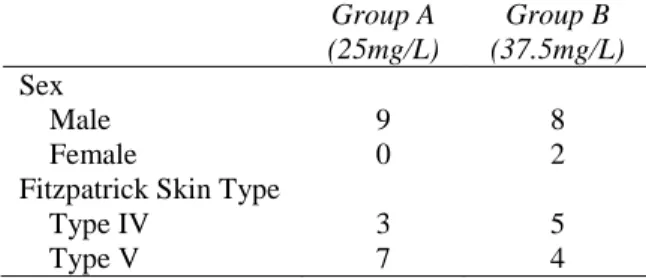
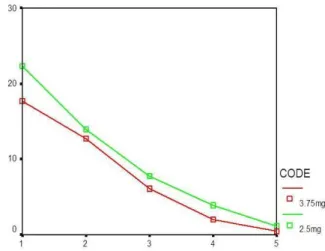
Of 19 patients included in study, 2 were females and rest were males with age ranging from 16-55 years and median age being 43.6 years. According to Fitzpatrick skin types, in Group A, 4 patients had Type IV skin and 5 were of Type V skin while in group B 3 patients had type IV skin and 7 type V skin (Table 1). Initial mean PASI (TUL) at baseline for low concentration group was 22.278 and 17.700 for group B which reduced to 1.156 for low concentration and 0.411 for high concentration after 16 sessions. Mean PASI of both high and low concentration groups were compared, same has been depicted in Table 2. There was no significant difference between the fall in PASI (TUL) between the two groups with P value=0.671. Number of sessions of phototherapy were 16 in both the groups, given over a mean duration of 54 days (50-56.5) days for Group A while 46 days (37.7-62) for group B.
Table 1 Epidemiological characteristics of group A and B patients
Group A (25mg/L) Group B (37.5mg/L) Sex Male Female 9 0 8 2 Fitzpatrick Skin Type
Type IV Type V 3 7 5 4
Table 2 Comparison of Mean PASI (TUL) score at different sittings Number of sittings (2.5mg/L)Low concentration (3.75mg/L)standard concentration Baseline (0) day
22.278 17.700
4th sittings 13.856 12.633 8th sittings 7.733 6.033 12th sittings 3.833 2.022
16th sittings 1.156 .411
Table 3 Comparison of cumulative UVA dose in both the groups
Cumulative UVA dose (J/cm2)
Group A 2.5mg/L
Group B 3.75 mg/L
Total
35.5 0 1 1
39.5 0 1 1
58.0 0 1 1
59.0 0 1 1
61.0 1 0 1
63.5 1 2 3
65.5 0 1 1
67.5 1 0 1
68.0 2 0 2
69.0 1 1 2
72.5 1 0 1
75.0 0 1 1
76.0 2 1 3
Total 9 10 19
The median cumulative UVA exposure dose was 68 (65.5-74.2) J/cm2 for low concentration group and 60.5 (53.3-70.5) J/cm2 for high concentration methoxsalen group with a P value of0.11 which was not significant. Elaboration of the same has been done in Table 3.
Figure 1 Line chart showing the mean of PASI
had partial remission or treatment failure. 6 out of 19 patients i.e. 31.5% had recurrence of psoriasis and 4 (66.6%) of these patients belonged to Group A while 2 (33.3%) were of standard concentration group (group B). Patients in group A had a mean duration of remission of 111.5 days while in group B remission lasted for longer duration i.e. 151.5 days. No adverse effects were noted in both groups.
Discussion
History of phototherapy dates back to 2000 BC when Egyptians used Ammi Majus plant for therapy. But it was a millennium later that Fahmy isolated psoralen from Ammi majus and Parish combined the use of Psoralen and UVA radiation and hence the term PUVA came into existence.5 Henselar and Melski et al established the use of PUVA in psoriasis and added a benchmark in history of treatment of psoriasis.6 Various mechanisms have been proposed through which phototherapy acts in psoriasis. Psoriasis is understood as over activity of Th1 and Th17 pathway which leads to hyperkeratosis and inflammatory response.7 Phototherapy acts by suppression of Th1 and Th17 pathway while simultaneously enhancing Th2 activity. Other mechanisms proposed are selective apoptosis of T lymphocytes in epidermis, decreased counts
and activity of Langerhan cells, decreasing the level of cyclin D1. Cyclin D1 is a cell-cycle promoter protein. It promotes the multiplication of cells leading to hyperkeratosis hence suppression of the same leads to decreased proliferation of keratinocytes. PUVA also augments the activity and levels of p53, which acts as a cell-cycle suppressor.8-10
Phototherapy has stood the test of time, multiple studies have been conducted across the world to prove the efficacy of phototherapy in psoriasis.11,12 Various studies conducted across world have shown excellent response of psoriasis to bath PUVA. Study conducted by Sankuntabhai A included 100 patients with psoriasis vulgaris, showed 92% clearance in 12 sittings with a median cumulative UVA dose of 52J/cm2.11 Similarly, Berker et al. and Tahir et al. conducted a study comparing PUVA versus UVB exposure and showed more than 85% clearance in 17 sittings on average with bath PUVA and results were superior as compared to UVB in both studies.13,14 Phototherapy can be administered through various techniques like oral PUVA, bath PUVA, PUVASOL, turban PUVA, bathsuit PUVA.15-19 Each of these method of delivery has its own significance, depending either on type of psoriasis like turban PUVA being more useful in scalp psoriasis cases or on the living conditions like bathsuit PUVA which reduces the wastage of water and also makes procedure less messier and easy.20,21 But still delivery of methoxsalen through immersion has many advantages like uniform distribution of drug, no systemic side effects without compromising the competency of the drug. But it is not helpful in case of psoriatic lesions on scalp and face. Hence, we calculated PASI for only trunk, upper and lower limbs excluding scalp and face i.e. PASI (TUL).
Figure UVA exposure in Waldmann PUVA 1000 units chamber with 26 UV lamps (315-400 nm; output – 9mw/sq. cm
Before Bath PUVA After 16 Bath PUVA
temperature of water used for immersion, duration of immersion, degree of photosensitization, concentration of methoxsalen solution as well.21-25 There is only one previous study conducted by Rujirat Vongthongsri, which
methoxsalen and also measured the plasma levels of methoxsalen immediately after immersion.4 In present study 2.5 mg/L (low concentration) of methoxsalen was compared against 3.75mg/L, as it is commonly commercially available in India as a 25 mL pack and 3.75 mg/L is the standard concentration used.
In Rujirat Vongthongsri study, the median baseline PASI (TUL ) score decreased from 11.7 to 3.3 (72%) in the 1 mg/L methoxsalen group and from 10.8 to 1.4 (87%) in the 5 mg/L methoxsalen group and the difference was not significant.4 Similarly in this study as well both low (2.5mg/L) and standard (3.75 mg/L) concentration groups showed remarkable improvement and the difference was not significant in between both the groups. The median baseline PASI (TUL) score decreased from 22.278 to 1.156 in the 2.5 mg/L methoxsalen group and decreased from 17.700 to 0.411 in the 3.75 mg/L methoxsalen group with P value of 0.62. This shows that 2.5mg/L or 3.75 mg/L did not make any significant difference in final PASI achieved.
The median cumulative UVA exposure dose was 25.4 (5.3-81.5) J/cm2 for 5 mg/L methoxsalen and 71.9(20.7-587.3) J/cm2 for 1 mg/L methoxsalen (P=.001). However in current study, there was not a significant difference in the median cumulative UVA exposure dose (68 J/cm2 for 2.5 mg/L methoxsalen and 63.5 J/cm2 for 3.75 mg/L methoxsalen).
All patients in the 5 mg/L methoxsalen group achieved a PASI (TUL) score of 90 or higher or of 75 or higher, as opposed to only 45% of the patients in the 1 mg/L methoxsalen group. In contrast, in present study both groups achieved 90% clearance after 16 treatments. This might be due to the reason that the difference in the
concentration of methoxsalen solution in our study was not as high as in Rujirat study.
Although there was no significant difference between the efficacies, cumulative dose, number of sessions or duration in both the groups but the duration of remission in both the groups was contrasting. Out of total 19 patients included in the study, 6 came with recurrence out of which 4 i.e. 66.6% belonged to low concentration group while only 2 i.e. 33.3% were from high concentration group. Even the duration of remission was significantly higher in high concentration group being 151.5 days versus 111.5 days in low concentration group. This might be due to more potent suppression of inflammatory pathways Th1, Th17 along with amassed apoptosis of T lymphocytes and decreased Langerhans cells leading to longer time to generate a required level of immune response to cause clinically evident lesions.
Rujirat et al. also compared the plasma levels of methoxsalen immediately after immersion in solution, which showed a remarkable difference with high concentration group showing a mean level of 30 ng/mL of methoxsalen in plasma while 0 in case of low concentration group with a significant P value of 0.001.4
In present study there were no adverse effects noted in both the groups; while in Rujirat et al. study4, out of 21 patients in 5 mg/L of methoxsalen, 9 developed reversible side effects and all 9 patients belonged to high concentration group i.e. 5 mg/L. 4 developed moderate phototoxicity, 2 polymorphous light eruption while 2 presented with pruritus later. This clearly states that appropriate concentration of methoxsalen plays a crucial role in deciding the benefits or harmful effect of bath PUVA.
slightly unstable psoriasis, patients in whom history of previous phototoxicity is doubtful, patients with hepatic or renal disorder. Multiple studies have shown direct correlation of photosensitization and serum levels of methoxsalen. As the serum level of methoxsalen rises photosensitizing potential also increases. But if concentration of methoxsalen is chosen judiciously bath PUVA is safe and very efficacious treatment for psoriasis.
Limitation
One of the limitations of this study was small sample size and correaltion of plasma levels of methoxsalen with clinical response could not be estimated. Study on larger scale including more number of patients should be conducted.
Conclusion
2.5 mg/L of 1% methoxsalen used for bath PUVA shows similar efficacy, no adverse effects and comparable cumulative UVA dose as 3.75 mg/L of 1% methoxsalen and did not show any significant difference while duration of remission of disease is significantly longer in patients on higher concentration (3.75 mg/L of 1% methoxsalen) as compared to lower concentration (2.5 mg/L of 1% methoxsalen).
References
1. Griffiths CE, Barker JN. Pathogenesis and clinical features of psoriasis. Lancet 2007; 370(9583): 263-71.
2. Guidelines of care for the treatment of psoriasis with phototherapy and photochemotherapy. J Am Acad Dermatol. 2010; 62(1): 114–35.
3. Pai SB, Shetty S. Guidelines for bath PUVA, bathing suit PUVA and soak PUVA. Indian J Dermatol Venereol Leprol 2015; 81: 559-67.
4. Vongthongsri R, Konschitzky R, Seeber A, Treitl C, Hönigsmann H, Tanew A. Randomized, double-blind comparison of 1
mg/L versus 5 mg/L methoxsalen bath-PUVA therapy for chronic plaque-type psoriasis. J Am Acad Dermatol. 2006; 55(4): 627-31.
5. Parrish JA, Fitzpatrick TB, Tanenbaum L, Pathak MA. Photochemotherapy of psoriasis with oral methoxsalen and longwave ultraviolet light. New Engl J Med 1974; 291: 1207‑11.
6. Melski, JW, Tanenbaum L, Parrish JA, Fitzpatrick TB, Bleich HL. Oral methoxsalen photochemo therapy for the treatment of psoriasis: A cooperative clinical trial. J Invest Dermatol 1977; 68: 328‑35. 7. Kuchekar AB, Pujari RR, Kuchekar SB,
Dhole SN and Mule PM. Psoriasis: A comprehensive review. Int J of Pharm & Life Sci 2011; 6: 857-77.
8. B.S. Tami Wong, B.A. Leon Hsu, Wilson Liao. Phototherapy in Psoriasis: A Review of Mechanisms of Action. J Cutan Med Surg 2013; 17(1): 6–12
9. Kochevar IE, Taylor CR, Krutmann J. Fundamentals of cutaneous photobiology and photoimmunology. In: Wolff K, Goldsmith LA, Katz SI, Gilchrest BA, Paller AS, Leffell DJ, editors. Fitzpatrick’s Dermatology in General Medicine. 7th ed. New York: McGraw Hill; 2008. p. 804. 10. Wong T, Hsu L, Liao W. Phototherapy in
psoriasis: A review of mechanisms of action. J Cutan Med Surg 2013; 17: 6-12. 11. Sakuntabhai A, Sharpe GR, Farr PM.
Response of psoriasis to twice weekly PUVA. Br J Dermatol 1993; 12(8): 166-71. 12. Karrer S, Eholzer C, Ackermann G,
Landthaler M, Szeimies RM. Phototherapy of psoriasis: Comparative experience of different phototherapeutic approaches. Dermatology 2001; 202: 108-15.
13. de Berker DA, Sakuntabhai A, Diffey BL, Matthews JN, Farr PM. Comparison of psoralen-UVB and psoralen-UVA photochemotherapy in the treatment of psoriasis. J Am Acad Dermatol 1997; 36(4): 577-81.
14. Berneburg M, Herzinger T, Rampf J, Hoetzenecker W, Guenova E, Meisner C, et al. Efficacy of bath psoralen plus ultraviolet A (PUVA) vs. system PUVA in psoriasis: A prospective, open, randomized, multicentre study. Br J Dermatol 2013; 169: 704-8. 15. Sridhar KS, Srinivas CR, Shenoi SD. PUVA
16. Reynolds EF. Martinadale The extra Pharmacopia, 29th ed. The Pharmaceutical Press: London; 1989. p. 920.
17. Herfst MJ, De Wolff FA. Difference in availability between two brands of 8-methoxypsoralen and its impact on the clinical response in psoriatic patients. Br J Clin Pharmacol 1982; 13: 519-22.
18. Fischer T, Alsins J. Treatment of psoriasis with trioxsalen baths and dysprosium lamps. Acta Derm Venereol 1976; 56: 383-90. 19. Pai S, Srinivas CR. Bathing suit delivery of
8-methoxy psoralen for psoriasis: A double blind, placebo-controlled study. Int J Dermatol 1994; 33: 576-8.
20. Behrens-Williams SC, Leiter U, Schiener R, Weidmann M, Peter RU, Kerscher M. The PUVA-turban as a new option of applying a dilute psoralen solution selectively to the scalp of patients with alopecia areata. J Am Acad Dermatol 2001; 44: 248-52.
21. Broniarczyk-Dyla G, Wawrzycka-Kaflik A, Dubla-Berner M, Prusinska-Bratos M.
Effects of psoralen-UV-A-Turban in alopecia areata. Skinmed 2006; 5: 64-8. 22. E. Dolezal, A. Seeber1, H. Honigsmann, A.
Tanew. Correlation between bathing time and photosensitivity in 8-methoxypsoralen (8-MOP) bath PUVA. Photodermatol Photoimmunol Photomed 2000; 16: 183–85. 23. Jansen CT. Water temperature effect in
bath-PUVA treatment. J Am Acad Dermatol 1988; 19(1): 142-3.
24. Anigbogu AN, Williams AC, Barry BW. Permeation Characteristics of 8-Methoxypsoralen Through Human Skin; Relevance to Clinical Treatment J. Pharm. Pharmacol 1996; 48(4): 357-66.