1Department of Midwifery, Faculty of Health Science, Cumhuriyet University, Sivas, Turkey, 2Department of Public Health, Faculty of Medicine, Cumhuriyet University, Sivas, Turkey
Address for correspondence: Dr. Zeliha Burcu Yurtsal, Department of Midwifery, Faculty of Health Science, Cumhuriyet University, Sivas ‑ 58140, Turkey.
E‑mail: [email protected]
Submitted: 07‑Mar‑14; Accepted: 03‑Aug‑14
needs to behave in an assertive manner. Assertiveness is necessary for effective nurse/patient communication, and it is suggested that its development may also aid the confidence of the profession as it develops.[3]
Problem solving is natural and common part of daily life. We try hard to solve all the problems of our lives. Problem solving is defined as a response given to solving in an important and difficult situation, where critical thinking is required for a solution. Problem solving skills determine a person’s ability to relation with productively.[4] According to Potter and Perry,
problem solving is defined as a life skill. Problem‑solving skills strengthen interpersonal relationships and provide new ways of thinking for the development of skills and learning.[5]
In a workplace, midwives could use problem solving and decision‑making skills with an assertive behavior which
I
ntroductIonA
s a social being, a human being is in constant contact with others to meet his/her physiological, social and emotional needs.[1] Communication skills areone of the most important elements used to successfully solve problems encountered in occupational fields where interpersonal relationships are intense. Communication skills are gaining importance increasingly in problem solving.[2]
Assertiveness is the ability to formulate and communicate one’s own thoughts, opinions and wishes in a clear, direct and non‑aggressive way. Assertiveness is an important behavior for today’s professional nurse. As nurses move away from traditional subservient roles and perceived stereotypes, it is increasingly being recognized that a nurse
Assertiveness and problem solving in midwives
Zeliha Burcu Yurtsal1, Levent Özdemir2A
bstrActBackground: Midwifery profession is required to bring solutions to problems and a midwife is expected to be an assertive person
and to develop midwifery care. This study was planned to examine the relationship between assertiveness and problem-solving skills of midwives.
Materials and Methods: This cross-sectional study was conducted with 201 midwives between July 2008 and February 2009 in
the city center of Sivas. The Rathus Assertiveness Schedule (RAS) and Problem Solving Inventory (PSI) were used to determine the level of assertiveness and problem-solving skills of midwives. Statistical methods were used as mean, standard deviation, percentage, Student’s T, ANOVA and Tukey HSD, Kruskal Wallis, Fisher Exact, Pearson Correlation and Chi-square tests and
P < 0.05.
Results: The RAS mean scores and the PSI mean scores showed statistically significant differences in terms of a midwife’s
considering herself as a member of the health team, expressing herself within the health care team, being able to say “no” when necessary, cooperating with her colleagues, taking part in problem‑solving skills training. A statistically significant negative correlation was found between the RAS and PSI scores.The RAS scores decreased while the problem-solving scores increased (r: -0451,
P < 0.01).
Conclusions: There were significant statistical differences between assertiveness levels and problem solving skills of midwives, and midwives who were assertive solved their problems better than did others. Assertiveness and problem-solving skills training will contribute to the success of the midwifery profession. Midwives able to solve problems, and display assertive behaviors will contribute to the development of midwifery profession.
Key words: Assertiveness, midwifery, midwives, problem solving inventory, problem solving, rathus assertiveness schedule
Access this article online Quick Response Code:
Website:
www.ijnmrjournal.net
DOI:
10.4103/1735-9066.170016
Original
could strengthen their communication with people to whom they give service, colleagues and other members of the healthcare team.[6] The purpose of the midwifery
profession is to establish communication both with patients and with healthy people either directly or indirectly to better servethem, and to ensure their comfort, health, happiness and safety. Therefore, one of the main objectives of midwifery education is to teach midwives how to solve problems better and how to act assertively.[7]
Midwives able to solve problems, participating in decision‑making processes actively, expressing themselves effectively and displaying assertive behaviors will contribute to the development of midwifery profession. This work was planned in order to examine the relationship between assertiveness and problem‑solving skills of midwives and to emphasize the importance of assertiveness and problem‑solving skills.
M
AterIAlsAndM
ethodsThis cross‑sectional study was conducted between July 2008 and February 2009 in the city center of Sivas, a province in Turkey. The target population of the study included 286 midwives employed in health facilities in the city center of Sivas according to the Sivas Provincial Health Directorate’s records. Of these 286 midwives, 201 (70.3%) were accessed. Necessary permission was obtained from the institution where the research to be conducted. Midwives who agreed to participate in the study and gave their informed consents after being informed about the purpose of the research were included in the study. They were ensured that their credentials would be kept confidential. This research was financially supported by the Scientific Research Committee of Cumhuriyet University, Turkey (CUBAP).
A questionnaire consisting of 3 parts was used to collect data. The questionnaires were filled in by the researcher using face‑to‑face interviews. In the first part, prepared in accordance with literature, occupational and demographic characteristics of midwives were questioned.
In the second part, the Rathus Assertiveness Schedule (RAS) was used to determine the assertiveness levels of the midwives. The RAS was developed by Rathus (1973). The scale consists of 30 items and it is used to assess the level of assertiveness.[8] The validity and reliability studies of the
Turkish version of the tool were conducted by Voltan.[4] The
test’s reliability coefficient was found to be r = 0.92. The tool can be administered to both adolescents and adults. The possible scores to be obtained from the scale range from ‑90 to +90. The choices vary between ‑3 and +3. If items 1, 2, 4, 5, 9, 11, 12, 13, 14, 15, 16, 17, 19, 23, 24, 26
and 30 are marked “‑3” or “+3”, the value of these items are reversed in scoring. The negative and positive scores are summed up separately and the difference between these two sums gives the total score. Those who receive below a total of +10 points from the tool are considered non‑assertive and those with a score above +10 points are considered assertive.
In the last part, the Problem Solving Inventory (PSI) was used to determine the level of problem‑solving skills of the midwives. The PSI was developed by Heppner and Petersen in 1982. It is used to determine the stages of problem‑solving process and people’s opinions about their own problem‑solving approaches and behaviors.[9]
The reliability and validity studies of the Turkish version of the inventory were performed by Şahin et al.[10] The
PSI aims to measure self‑confidence, and self‑control and individual approaches in problem solving. The inventory can be used to determine how an individual approaches or copes with a problem and consists of 35 items that are assessed on a Likert scale of 1‑6 by the participants. Whereas ‘‘1’’ denotes ‘‘totally agree’’, ‘‘6’’ denotes ‘‘totally disagree’’. The items contain positive and negative judgments about problem solving, and the negative judgments are later reversed while the scores are assessed. Low scores indicate effectiveness, and behaviors and attitudes in solving problems successfully. High scores indicate an inability to reach a successful solution when faced with a problem.
SPSS for Windows 14.0 statistical package program was used for the analysis of the research data. While descriptive statistical methods were used to assess mean, standard deviation and percentages, the Student’s T, ANOVA, TukeyHSD, Kruskal Wallis, Fisher Exact, Pearson Correlation and Chi‑Square tests were used to compare the data.
Ethical considerations
Necessary permission was obtained from the institution where the research to be conducted. Midwives who agreed to participate in the study and gave their informed consents after being informed about the purpose of the research were included in the study. They were ensured that their credentials would be kept confidential.
r
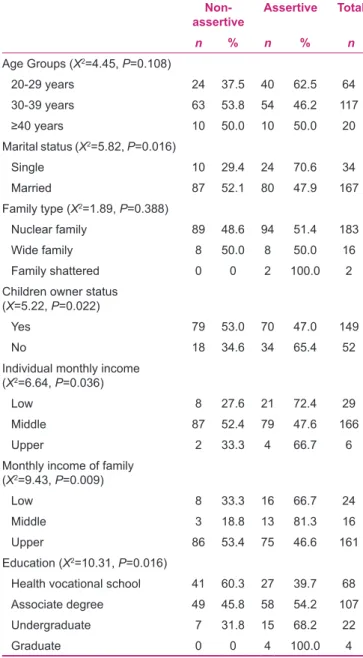
esults201 midwives were included in the study. In terms of their demographic characteristics, the assertiveness status of the midwives is given in Table 1. While the frequency of assertiveness was 46.2% in the 30‑39 age group, it was 62.5% in the 20‑29 age group (P = 0.108). The frequencies
of assertiveness in single and married women were identified as 70.6% and 47.9% respectively (P = 0.016). Forty‑seven percent of those who had at least one child, and 65.4% of those who had no children were found to be assertive (P = 0.022). Thirty‑nine point seven percent of Health Vocational School graduates and 68.2% of college graduates were identified as assertive (P = 0.016). A statistically significant relationship was detected between assertiveness, and marital status, income, having children and education [Table 1].
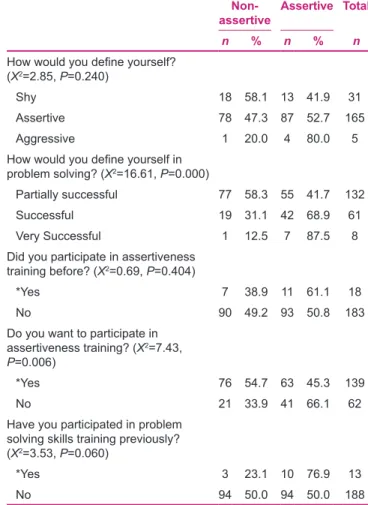
The assertiveness status of the midwives, in terms of their profession‑related characteristics, is given in Table 2. Of the midwives, 55.7% who considered themselves as members
of the healthcare team were assertive, and 25.9% who did not consider themselves so were assertive (P = 0.004). While 24.2% of the midwives who had difficulty expressing themselves within the health care team were assertive, 65.2% of the midwives who did not have difficulty expressing themselves within the health care team were assertive (P = 0.000). While 45.1% of the midwives who had difficulty saying “no” when necessary were assertive, 60.2% of the midwives who did not have difficulty saying “no” when necessary were assertive (P = 0.034).Twenty‑five percent of the midwives who could not cooperate with their colleagues and 59.2% of the midwives who could were assertive (P = 0.000).
Statistically significant relationships were identified between assertiveness and the following: Supporting educational and scientific activities of the institution where she works, considering herself as a member of the health team, expressing herself within the health care team, being able to say “no” when necessary, cooperating with her colleagues, demanding assertiveness training and problem‑solving skills training [Table 2].
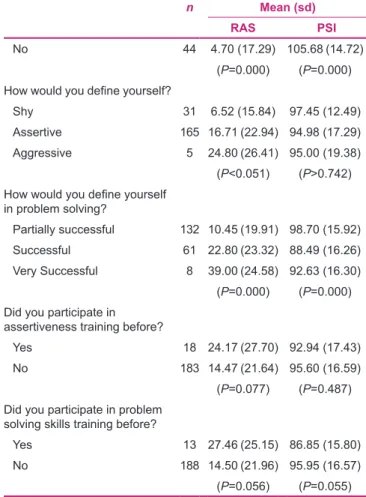
The mean RAS and PSI scores in terms of the demographic characteristics of the midwives are given in Table 3. The mean assertiveness scores received bythe midwives revealed that of the midwives, those who were single, had no children, and had a master degree were found to have higher assertiveness mean scores (P < 0.05). When the mean scores midwives obtained from the problem solving skills subscale were analyzed, those who were in the 20‑29 age group, were single, had a nuclear family, had no children, and/or had a graduate or master degree were found to have lower scores (P < 0.05), which indicates that midwives with lower scores had better problem solving skills [Table 3]. The mean scores of RAS and PSI according to occupational characteristics of midwives are given in Table 4. The RAS mean scores showed statistically significant differences in terms of marital status, having children, income, education, career choice, supporting educational and scientific activities of the institution where she works, length of employment, weekly working hours, accepting herself as a member in the health team, expressing themselves within the health care team, saying “no” when necessary, cooperating with her colleagues and taking part in problem‑solving skills. PSI mean scores showed statistically significant differences in terms of age groups, marital status, having children, education, career choice, supporting educational and scientific activities of the institution where she works, length of employment, the number of appointments to new positions, weekly working hours, considering herself Table 1: The assertiveness status of midwives according to
sociodemographic characteristics Non‑
assertive Assertive Total
n % n % n
Age Groups (X2=4.45, P=0.108)
20-29 years 24 37.5 40 62.5 64
30-39 years 63 53.8 54 46.2 117
≥40 years 10 50.0 10 50.0 20
Marital status (X2=5.82, P=0.016)
Single 10 29.4 24 70.6 34
Married 87 52.1 80 47.9 167
Family type (X2=1.89, P=0.388)
Nuclear family 89 48.6 94 51.4 183
Wide family 8 50.0 8 50.0 16
Family shattered 0 0 2 100.0 2
Children owner status (X=5.22, P=0.022)
Yes 79 53.0 70 47.0 149
No 18 34.6 34 65.4 52
Individual monthly income (X2=6.64, P=0.036)
Low 8 27.6 21 72.4 29
Middle 87 52.4 79 47.6 166
Upper 2 33.3 4 66.7 6
Monthly income of family (X2=9.43, P=0.009)
Low 8 33.3 16 66.7 24
Middle 3 18.8 13 81.3 16
Upper 86 53.4 75 46.6 161
Education (X2=10.31, P=0.016)
Health vocational school 41 60.3 27 39.7 68
Associate degree 49 45.8 58 54.2 107
Undergraduate 7 31.8 15 68.2 22
as a member of the health team, expressing herself within the health care team, being able to say “no” when necessary, cooperating with her colleagues and taking part in problem‑solving skills [Table 4].
A statistically significant negative correlation was found between the RAS and PSI scores. The RAS scores decreased while the problem‑solving scores increased (r: ‑0451,
P < 0.01).
d
IscussIonThe relationship between being assertive and age was evaluated in different studies. In her thesis, Kaplanoğlu reported that those in the 20‑29 age group were more assertive than those in the other age groups. These differences between the age groups were not statistically significant.[11] These results are consistent with those of our
study. Bal (2003) reported that the average assertiveness score increased up to the age of 40, but decreased after the age of 40.[12] In our study, mean scores of assertiveness
under age 29 were found to be higher. We detected that the assertiveness score decreased with age. Assertiveness Table 2: The assertiveness status of midwives according to
profession‑related features
Non‑
assertive Assertive Total
n % n % n
Work locations (X2=2.64, P=0.450)
Obstetrics and gynecology 40 50.0 40 50.0 80
Neonatal clinic 3 30.0 7 70.0 10
Health house 52 50.0 52 50.0 104
How many years have you been working in the profession? (X2=2.89, P=0.235)
0-10 years 36 42.9 48 57.1 84
11-20 years 57 53.8 49 46.2 106
≥21 years 4 36.4 7 63.6 11
How many years have you been working in the institution? (X2=9.16, P=0.010)
0-10 years 71 44.1 90 55.9 161
11-20 years 26 68.4 12 31.6 38
≥21 years 0 0 2 100.0 2
Working period (X2=1.48, P=0.476)
Daytime 52 46.0 61 54.0 113
Night 1 100.0 0 0 1
Guarding all day 44 50.6 43 49.4 87
Weekly working time (X2=6.01, P=0.049)
0-40 hours 50 48.1 54 51.9 104
41-50 hours 47 51.6 44 48.4 91
≥51 hours 0 0 6 100.0 6
Does your institution support in educational and scientific activities participation? (X2=9.99, P=0.002)
Yes 51 39.8 77 60.2 128
No 46 63.0 27 37.0 73
Do you define yourself as a member of the health team? (X2=8.32, P=0.004)
Yes 77 44.3 97 55.7 174
No 20 74.1 7 25.9 27
Do you have difficulties in expression yourself as a member within health team? (X2=29.75, P=0.000)
Yes 50 75.8 16 24.2 66
No 47 34.8 88 65.2 135
Do you say “No” when necessary (X2=4.51, P=0.034)
Yes 62 54.9 51 45.1 113
No 35 39.8 53 60.2 88
Do you make co-operation with colleagues? (X2=16.13, P=0.000)
Yes 64 40.8 93 59.2 157
No 33 75.0 11 25.0 44
Table 2: Contd...
Non‑
assertive Assertive Total
n % n % n
How would you define yourself? (X2=2.85, P=0.240)
Shy 18 58.1 13 41.9 31
Assertive 78 47.3 87 52.7 165
Aggressive 1 20.0 4 80.0 5
How would you define yourself in problem solving? (X2=16.61, P=0.000)
Partially successful 77 58.3 55 41.7 132
Successful 19 31.1 42 68.9 61
Very Successful 1 12.5 7 87.5 8
Did you participate in assertiveness training before? (X2=0.69, P=0.404)
*Yes 7 38.9 11 61.1 18
No 90 49.2 93 50.8 183
Do you want to participate in assertiveness training? (X2=7.43,
P=0.006)
*Yes 76 54.7 63 45.3 139
No 21 33.9 41 66.1 62
Have you participated in problem solving skills training previously? (X2=3.53, P=0.060)
*Yes 3 23.1 10 76.9 13
No 94 50.0 94 50.0 188
*They participated in undergraduate education
levels of those under age 29 were higher than were those of the midwives older than 29, which may be due to the fact that the midwives in the former group had a university education. One of the most important purposes of midwifery education is to equip students with assertiveness skills by the time they graduate from university.
In Kaplanoğlu’s study, the single midwives were reported as more assertive than the married ones.[11] In the studies
conducted by Ayaz[13] with nurses, and by Kaplanoglu[11]
andTimuçin with nurse managers, no significant relationship was determined between assertiveness and marital status. In our study, mean assertiveness scores were higher in single midwives.[14] Single midwives may be more assertive
than married ones because a single person is alone when establishing relationship and communication with others in the workplace or community, which might bring about assertiveness.
The relationship was evaluated between assertiveness and family type in many studies. As in our study, in Kaplanoğlu[11] and Yıldız’s[15] study, assertiveness scores
were found to be higher in midwives with no children. However, the differences detected in their study were not statistically significant.
In Begley and Glacken’s,[16] Kilkus’s,[17] Begley and
Brady’s[18] studies, nurses with higher educational level
were detected to be more assertive, which supports our findings. Kaplanoglu[11] determined that the assertiveness
frequency and mean scores were higher in midwives who chose the profession by their own preference. In our study, the midwives who chose the profession by their own preference were found to be more assertive. Midwifery profession is very challenging when one works in ahospital or other health clinics. Midwives who willingly perform their tasks in the health care system can be more assertive than those who do not.
Kaplanoğlu[11] and Ayaz[13] (2002) did not find a statistically
significant relationship between the length of employment and assertiveness frequency in their studies. Our findings are compatible with the findings of these researches. In Kaplanoğlu’s study, no statistical relationship was reported between the number of appointments to new positions and mean RAS scores.[11] However, nurses who
were assigned to new positions four times had higher mean RAS scores than did nurses in the other groups. Similar to this result, in our study too, as the number of appointments to new positions increased, so did the mean RAS scores. Making an effort to adapt to a new workplace and to solve new problems may have caused this result. In Kaplanoğlu’s study, the frequency of assertiveness was reported to be higher in midwives working in institutions that did not support scientific activities. Our findings related to this issue are different. Institutional support encourages midwives to attend scientific activities such as assertiveness training programs. The point here is that this sort of program improves assertiveness effectively and the one of the focuses is to develop midwifery profession with particularly assertive midwives all over the world.
Table 3: The mean scores of RAS and PSI according to sociodemographic characteristics of midwives
n Mean (sd)
RAS PSI
Age groups
20-29 64 19.83 (24.55) 90.17 (16.51)
30-39 117 13.42 (21.64) 96.74 (15.71)
≥40 year 20 12.20 (17.12) 03.85 (17.98) (P=0.106) (P=0.002) Marital status
Single 34 23.68 (27.16) 87.38 (16.12)
Married 167 13.65 (20.92) 96.98 (16.31)
(P=0.017) (P=0.002) Family type
Nuclear family 183 15.26 (22.00) 95.67 (16.82)
Wide family 16 15.75 (27.83) 91.69 (15.16)
Family shattered 2 19.50 (0.71) 96.50 (13.44) (P=0.803) (P=0.574) Children owner
Yes 149 13.01 (20.72) 98.05 (16.04)
No 52 22.0 (25.50) 87.65 (16.04)
(P=0.025) (P=0.00) Individual monthly income
Low 29 21.79 (23.93) 90.72 (16.80)
Middle 166 13.82 (21.40) 96.22 (16.61)
Upper 6 26.17 (34.31) 94.00 (15.31)
(P=0.124) (P=0.197) Monthly income of the family
Low 24 17.79 (23.97)
Middle 16 24.38 (21.15)
Upper 161 14.07 (22.10)
(P=0.86) Education
Health vocational school 68 8.57 (19.61) 100.82 (17.20) Associate degree 107 16.60 (22.48) 94.13 (14.79) Undergraduate 22 25.95 (24.26) 87.59 (18.59)
Graduate 4 38.25 (9.50) 78.00 (10.92)
(P=0.004) (P=0.002)
RAS: Rathus Assertiveness Schedule, PSI: Problem Solving Inventory, sd: Standard deviation
In her study of manager nurses, Kaplanoğlu did not find any statistically significant relationship between the mean RAS score and considering themselves as a member of the health team.[11] The RAS means were detected to be higher
in nurses who expressed themselves as not a member of the team in Kaplanoğlu’s study. Our findings related to this issue are different. Yıldız reported that 69.2% of the health personnel stated that they did not have any difficulty expressing themselves within the health care team.[15] The
frequency of assertiveness was found to be lower in persons who had difficulty in expressing themselves in the medical team.[15] Our findings are compatible with this result. Yıldız
reported that 52.5% of the health personnel had difficulty saying “no” when necessary. The frequency of assertiveness was identified as lower in those having difficulty in saying “no” when necessary.[15] This is compatible with our findings.
The RAS mean score was reported to be higher in nurses having no collaboration with colleagues in Kaplanoğlu’s study. Our findings related to this issue are different. In a study by Timuçin, 70.4% of the participants identified themselves as assertive.[14] In Bal’s study, 76.4% of the
nurses identified themselves as assertive.[12] The rate of
those who identified themselves as assertive in Ayaz’s[13]
Table 4: The mean scores of RAS and PSI according to occupational features of midwives
n Mean (sd)
RAS PSI
Did you make your own choice of profession
Yes 86 17.08 (23.71) 92.33 (16.02)
No 115 14.03 (21.27) 97.63 (16.79)
(P=0.340) (P=0.025) How many years have
you been working in the profession?
0-10 years 161 17.25 (23.07) 93.60 (16.66)
11-20 years 38 6.29 (6.67) 102.79 (14.88)
≥21 years 2 33.50 (4.95) 96.00 (11.31) (P=0.011) (P=0.014) How many times have changed
your place of work
1-3 times 157 14.58 (21.75) 96.62 (16.92)
4-6 times 41 17.68 (23.32) 89.68 (14.74)
7 and more 3 23.00 (43.31) 106.67 (4.04)
(P=0.575) (P=0.017) Weekly working time
0-40 hours 104 14.38 (21.88) 96.67 (16.74)
41-50 hours 91 15.15 (23.01) 94.82 (16.44)
≥51 hours 6 34.67 (9.95) 80.67 (11.47) (P=0.048) (P=0.043) Does your institution support
in educational and scientific activities participation?
Yes 128 18.99 (22.79) 92.40 (15.99)
No 73 8.93 (20.11) 100.55 (16.57)
(P=0.002) (P=0.001) Do you define yourself as a
member of the medical team?
Yes 174 16.36 (22.26) 93.78 (16.22)
No 27 8.74 (22.13) 105.52 (15.92)
(P=0.099) (P=0.001) Within a health team yourself
living expression difficulties do?
Yes 66 2.62 (14.38) 103.53 (14.59)
No 135 21.56 (22.93) 91.36 (16.15)
(P=0.000) (P=0.000) Do you say “No” when
necessary
Yes 113 8.85 (16.78) 97.67 (15.68)
No 88 23.67 (25.68) 92.39 (17.43)
(P=0.000) (P=0.025) Do you make co-operation with
colleagues?
Yes 157 18.32 (22.73) 92.47 (16.02)
Contd...
Table 4: Contd...
n Mean (sd)
RAS PSI
No 44 4.70 (17.29) 105.68 (14.72)
(P=0.000) (P=0.000) How would you define yourself?
Shy 31 6.52 (15.84) 97.45 (12.49)
Assertive 165 16.71 (22.94) 94.98 (17.29)
Aggressive 5 24.80 (26.41) 95.00 (19.38)
(P<0.051) (P>0.742) How would you define yourself
in problem solving?
Partially successful 132 10.45 (19.91) 98.70 (15.92)
Successful 61 22.80 (23.32) 88.49 (16.26)
Very Successful 8 39.00 (24.58) 92.63 (16.30) (P=0.000) (P=0.000) Did you participate in
assertiveness training before?
Yes 18 24.17 (27.70) 92.94 (17.43)
No 183 14.47 (21.64) 95.60 (16.59)
(P=0.077) (P=0.487) Did you participate in problem
solving skills training before?
Yes 13 27.46 (25.15) 86.85 (15.80)
No 188 14.50 (21.96) 95.95 (16.57)
(P=0.056) (P=0.055)
RAS: Rathus Assertiveness Schedule, PSI: Problem Solving Inventory, sd: Standard deviation
and Yıldız’s[15] studies was reported to be as 97.2% and
43.7% respectively. Our findings are similar to theirs. In Batmaz’s study, the RAS mean score in nurses who identified themselves as assertive was found to be higher.[19]
Similar to our findings, in Yıldız’s study, it was reported that 93.3% of the midwives did not participate in any assertiveness training previously.[15] In studies of
Kaplanoglu,[11] Yıldız[15] and Timuçin,[14] the RAS means
were found to be higher in midwives who participated in assertiveness training previously, which supports our findings.In studies conducted by Burnard, it was reported that midwives needed to be assertive, and thus assertiveness training programs could be helpful.[20]
In a study conducted with nurses (2004), the mean PSI scores were found to be higher in groups aged 31 years and over.[21] In Erdem’s study, a significant relationship was
reported between the mean PSI score and age,[22] which is
similar to our study results. A person’s problem solving skill may improve with her ages and thus she can solve problems which are even more challenging.
Nurses’ marital status was examined in terms of the mean PSI scores by Kelleci and Gölbası.[21] The presence of
high PSI scores in the married nurses’ group supports our findings. Ulupınar reported in his study that married nurses were more successful in problem solving. Unlike our results, in a study by Altıntoprak, no statistically significant relationship was determined between problem‑solving skills and marital status.[23] Marriage may contribute to
the solution of problems between partners and family relationship by affecting problem‑solving skills positively. Similar to our results, in Bahar’s study, the nurses who had a graduate degree were detected to be more effective in problem solving than those who graduated from high school.[24] In a study conducted by Erdem, no significant
relationship was found between problem‑solving skills and education level.[22] Problem solving skills could be learned
at university, which enables midwives to solve problems encountered in the workplace and thus contributes to the development of midwifery care and midwifery profession. Nurses who had 1‑7 years of professional experience were found to be most effective in solving problems in Bahar’s study.[24] Botti reported that academic ability
affects decision‑making in low complexity tasks, but as case complexity increases, domain‑specific knowledge and experience determine decision‑making skills.[25] In
Altıntoprak’s (2004) study, no significant relationship was detected between the length of employment and problem‑solving skills.[23]
Unlike our results; no significant relationship was detected between working hours and problem‑solving skills in Terzioğlu’s study.[26] This may be due to the fact that more
solutions had to be produced since more problems were encountered with the increased length of employment. In Bahar’s study, the PSI scores were reported to be higher in nurses who participated in the problem solving skills training before.[24] In a study conducted by Stevenson,
it was reported that problem‑solving skills increased in persons who participated in problem solving skills training previously.[27]
In line with our results, a significant relationship was reported between participating in problem‑solving skills training previously and PSI scores in Altıntoprak and Bahar’s studies.[23,24] In a study conducted by Gunes
and et al., it was found that the assertiveness training had positive effect on the experimental group students’ assertiveness and problem solving. Assertiveness education applied to students has a positive effect on assertiveness and interpersonal problem solving.[24,28]
In our study, a significant negative correlation was found between the PSI and RAS scores. Analysis of the scores demonstrated that the higher the scores obtained from the RAS were, the higher the assertiveness levels were. On the other hand, the lower the scores obtained from the PSI were, the better the problem‑solving skills were. Therefore, this negative correlation indicates that midwives who had higher assertiveness levels also had better problem solving skills. We could not find any data about the relationship between problem‑solving skills and assertiveness of midwives in literature in our country. The problems were defined by Town end as opportunity for developing assertive behavior in human and forming a more honest relationship between them as well as managing problems assertively.[29]
c
onclusIonIn line with the results obtained from this study our suggestions can be listed as below;
• Group meetings should be planned for midwives who do not consider themselves as a member of the health‑care team and who do not cooperate with their colleagues • Assertiveness training program should be scheduled for
midwives having difficulties in expressing themselves as a member of a health team and saying “no” when necessary within the health team
• Assertiveness and problem‑solving skills training should be provided for all midwives
• Intervention studies should be planned to improve assertiveness and problem‑solving skills of midwives.
r
eferences1. Voltan N. Rathus atilganlik envanteri geçerlik ve güvenirlik çalişmasi. Psikoloji Dergisi 1980;10:23‑5.
2. Yeşilyaprak B, Kısaç İ. Öğretmen adaylarına uygulanan atılganlık eğitimi ve sonuçları. Mesleki Eğitim Dergisi 1999;1:12‑8. 3. McCabe C, Timmins F. Teaching assertiveness to undergraduate
nursing students. Nurse Educ Pract 2003;3:30‑42.
4. Altun I. The perceived problem solving ability and values of student nurses and midwives. Nurse Educ Today 2003;23:575‑84. 5. Potter P, Pery A. Fundamentals of Nursing: Concepts, Process
and Pratice. 2nd ed. St. Louis: Mosby; 1989. p.425‑7.
6. Lindeman CA. The future of nursing education. J Nurs Educ 2000;39:5‑12.
7. Baumberger‑Henry M. Cooperative learning and case study: Does the combination improve students’ perception of problem‑solving and decision making skills?, Nurse Educ Today 2005;25:238‑46.
8. Rathus SA. A 30‑item schedule for assessing assertive behavior. Behav Ther 1973;4:398‑406.
9. Heppner PP, Petersen CH. The development and implications of a personal problem solving inventory. J Couns Psychol 1982;29:66‑75.
10. Şahin N, Şahin NH, Heppner PP. Problem çözmeİnvanteri (Problem solving invantory). In: Savaşır I, Şahin NH, editors. Bilişsel‑Davran ışçıterapilerdedeğerlendirme: Sıkkullanılanölçekler (Behaviour Valuation in Cognitive Therapy: Commonly Used Inventories). Ankara: p. 3‑85.
11. Kaplanoğlu AE. The Relationship between Nurse Manager’s
Assertiveness and Job Satisfaction. Unpublished Master’s Degree Dissertation, Faculty of Health Sciences, Division of
Nursing Management. İstanbul Turkey: Marmara University;
2006. p. 63‑7.
12. Bal U. Hastanelerde Çalışan Hemşireve DiğerBayan Sağlık
Personelinin Benlik Saygıları ve Atılganlık Düzeylerinin
İncelenmesi. Unpublished Master’s Degree Dissertation.
Psychiatric Nursing Department. İstanbul Turkey: Marmara
University, Institute of Health Sciences; 2003. p. 57‑9.
13. Ayaz Ş. The study of Self Respect and Audacity of Nurses.
Unpublished Master’s Degree Dissertation. Psychiatric Nursing
Department. İstanbul Turkey: Marmara University, Institute of
Health Sciences; 2002. p. 50‑2.
14. Timuçin A. Assertivity Level of Nursing Managers AND THE Factors that Effect it. Unpublished Master’s Degree
Dissertation. Division of Nursing Management. İstanbul,
Turkey: İstanbul University, Institute of Health Sciences; 2005. p. 62‑5.
15. Yıldız A. Self‑Esteem and Assertiveness Level of in Nurses And
Midwifes Working in Primary Health Care Services. Unpublished Master’s Degree Dissertation. Psychiatric Nursing Department.
İstanbul, Turkey: İstanbul University, Institute of Health
Sciences; 2006. p. 55‑7.
16. Begley CM, Glacken M. Irish Nursing students’ changing levels assertiveness during their pre‑registration programme. Nurse Educ Today 2004;24:501‑10.
17. Kilkus SP. Assertiveness among professional nursing. J Adv Nurs 1993;18:1324‑30.
18. Begley CM, Brady A. Irish diploma in nursing students’ first clinical allocation: The views of nurse managers. J Nurs Manag 2002;10:339‑47.
19. Batmaz M, Enc N, Pektekin C. Self‑esteem, assertiveness and decision‑making skills of critical care nurses in Istanbul. Connect Critical Care Nursing in Europe 2001;1:13‑5. 20. Burnard P. M4: Assertiveness. Part (1): Assertiveness and
nursing. Nurse Times 1992;88:1‑8.
21. Kelleci M, Gölbaşı Z. Determining the problem solving skills
and some related factors of nurses who work in a university
hospital. Cumhuriyet Üniversitesi Hemşirelik Yüksekokulu
Dergisi 2004;8:1‑8.
22. Erdem Y. Yüksekokul ve sağlik meslek lisesi mezunu
hemşirelerin problem çözme Becerileri. Yeni Tıp Dergisi
2001;18:11‑3.
23. Altıntoprak A, Abaan S. Nurses’ Perceptions of Their Problem
Solving Ability: Analysis of Self Apprasials. Hemşirelik
Yüksekokulu Dergisi 2005;12:62‑76.
24. Bahar M. The Problem Solving Skills and Creativity Levels of Manager Mursers Working in Treatment‑on‑bed Institutions.
İstanbul, Turkey: Marmara University, Institute of Health
Sciences; 2006. p. 50‑1.
25. Botti M, Reeve R. Role of knowledge and ability in student nurses’ clinical decision‑making. Nurs Health Sci 2003;5:39‑49. 26. Terzioglu F. The perceived problem‑solving ability of nurse
managers. J Nurs Manag 2006;14:340‑7.
27. Stevenson RB. Critically reflective inquiry and administrator preparation: Problems and possibilities. Educ Policy 1993;7:96‑113.
28. Günes F, Arslan C, Eliüsük A. The Impact of Assertiveness Training on Interpersonal Problem Solving Perceived Social Support and Assertiveness of University Students. Bartin Üniversitesi Egitim Fakültesi Dergisi 2014;3:456‑74.
29. Townend A. Assertiveness and Diversity. Palgrave: Macmillan; 2007. p. 57‑68.
How to cite: Yurtsal ZB, Özdemir L. Assertiveness and problem solving in midwives. Iranian J Nursing Midwifery Res 2015;20:647-54. Source of Support: This research was financially supported by the The Scientific Research Committee of Cumhuriyet University, Turkey (CUBAP).This study has been derived from a master thesis,
Conflict of Interest: The authors have declared that no conflicting interests exist.