Page 2 of 35
Abstract
Objectives: The Honduran Health Alliance (HHA), a global service learning organization, is used as a case study highlighting the ethical problems that arise during the follow-up care process for women who participate in the clinic.
Methods: We conducted 18 qualitative interviews and 1 focus group to understand follow-up care experiences.
Results: The two ethical problems identified in our analysis are: (1) miscommunication that results in confusion and worry throughout the follow-up care process and (2) providing screenings for cervical cancer that cannot be treated due to a lack of money.
Page 3 of 35
Table of Contents
Introduction ... 4
Cervical Cancer in Honduras ... 4
Global Service Learning... 6
Methods... 8
Study Setting ... 8
Recruitment and Data Collection ... 10
Analytic Techniques... 11
Results ... 12
Participant Characteristics ... 13
Confusion and worry throughout the follow-up care process ... 14
Lack of Financial Resources ... 21
Discussion ... 26
Summary ... 26
Ethical Frameworks... 27
Recommendations ... 29
Limitations ... 30
Conclusion ... 30
Acknowledgements ... 31
Page 4 of 35
A Case Study of Global Service Learning Organizations: What Happens After
You Leave?
Introduction
Cervical Cancer in Honduras
Carla, a 53-year-old woman, reflects on the impact of cervical cancer in her Honduran community: “Yes, one worries because cancer is a cruel sickness…I already have this sickness here, already advancing, and no medicine.” Cervical cancer is the most common cause of cancer death among women in developing countries, despite the fact that it is preventable (Denny, 2005). Latin America accounts for 14.6% of cervical cancer cases worldwide and 11.9% of cervical cancer deaths (Parkin et al., 2008). Honduras, the second poorest country in the
Western Hemisphere, has a particularly high burden of cervical cancer disease and death among women in the region (Price & Asgary, 2011). The age-adjusted incidence rate of cervical cancer in Honduras is 30.6/100,000, compared to a developed country such as the United States that has an incidence rate of 7.8/100,000 (Tabora et al., 2011). Approximately 14.7% of women in Honduras have the Human Papillomavirus (HPV) 16 or 18 infection, a sexually transmitted infection that can lead to genital warts or cervical cancer. HPV 16 or 18 contribute to 53.8% of invasive cervical cancers (ICO Information Centre on HPV and Cancer, 2014b).
The high levels of poverty, unstable political situation, and profound resource constraints on the Honduran health system are interrelated factors contributing towards the high incidence of cervical cancer in Honduras. Poverty is a harsh reality for many Hondurans with 51% of
Hondurans living in poverty and 24% living in extreme poverty1. The poor and extreme poor are
overwhelmingly concentrated in rural areas with the rural poor accounting for 74% of the poor
1 Using data from the Encuesta Nacional de Condiciones de Vida 2004, two poverty lines were calculated. The
Page 5 of 35 and 86% of the extreme poor nationally (Bank, 2006). Honduras is fraught with violence, with the highest murder rate in the world of 90.4 homicides per 100,000 people in Honduras in 2012 largely due to gang violence (United Nations Office on Drugs and Crime, 2013). Politically, Honduras is marked by instability and has endured a number of military coups over the last decade, the most recent in 2009. In response to these pressing problems, Honduran domestic policy has been concentrated on gang violence, political corruption, poverty, and unemployment, with health and the health system remaining a low priority (Johnson, 2010). The result is a health system constrained by limited resources. The World Health Organization (WHO)
Page 6 of 35 Although cytology studies are performed, they are typically done by faith-based programs on medical missions or short-term international agencies that are deficient in good record keeping and follow-up (Price & Asgary, 2011).
Global Service Learning
In response to the unmet health needs in low resource countries such as Honduras and students growing interest in global health opportunities there has been a prolific growth of short-term global health organizations in recent decades. Mirroring this trend has been the growth of global service learning in medical education (Parsi & List, 2008). Students in medical
professions are pursuing experiences in developing countries and academic institutions are prioritizing such experiences (Shaywitz & Ausiello, 2002) (Pinto & Upshur, 2009). Rekart claims that this trend is driven by “an awareness of global health, both out of a sense of
beneficence and self-interest” (Rekart, 2003). In response to this trend, Pinto et al. assert “Such trends are encouraging, but in many ways this movement has proceeded without adequate discussion of the ethics of such work.”
The benefits of global service learning have been proffered by Edward O’Neil who argues they achieve solidarity between students and the most vulnerable populations. For example, O’Neil cites the work of “Gustavo Gutierrez, the father of liberation theology, [who] once advised people to forget the ‘head trip’ of studying the problems of the poor and take a ‘foot trip’ to work among them.”(O’Neil, 2006) Global service learning opportunities grant medical students the opportunity to work alongside disadvantaged communities. These operations benefit medical students as they have the opportunity to develop clinical skills for themselves as physicians in training and report increased skills and confidence, enhanced
Page 7 of 35 2007), (Bissonette & Routé, 1994), (Haq et al., 2000). Students who engage in service learning are more likely to enter primary care medicine, obtain a public health degree and practice medicine among poor and ethnic minorities pointing to the long-term benefits of these trips to society (Drain et al., 2007), (Miller, Corey, Lallinger, & Durack, 1995), (Ramsey, Haq, Gjerde, & Rothenberg, 2004). Presumably global service learning opportunities are fulfilling an unmet health need in the populations they intend to serve, however the benefits to the community being served are not well documented in the literature. In fact, one paper that outlines the benefits and risks of global service learning opportunities only describes benefits accrued by the medical students and concludes: “We hear repeatedly about the transformative effect it has on our students. One of the challenges we face is how to make such transformative experiences more lasting and more sustainable for the places that students visit (Parsi & List, 2008).” Another paper on the topic states: “little is known about the benefits and unintended consequences of global health training experiences to host institutions (Crump, Sugarman, & the Working Group on Ethics Guidelines for Global Health Training (WEIGHT), 2010).”
The motivating factors for students to participate in global service learning are often the same factors that contribute to the negative consequences--global service learning opportunities focus on serving vulnerable populations whose health is threatened or groups who are
Page 8 of 35 example, trainees may be given the opportunity to perform medical tasks or procedures at a level well above their current skill level. Other significant concerns are related to the sustainability of such programs (Jesus, 2010). Pinto et al. suggests that within many societies, clinical and research work has the potential to become a continuation of racist, imperial, or colonial
relationships (Pinto & Upshur, 2009). Additionally, global service learning organizations may fail to provide adequate follow-up care for the populations they serve. This suggests additional research is needed to examine the benefits and disadvantages of global service learning
organizations to the host countries.
The Honduran Health Alliance (HHA) is a global service learning organization that has provided cervical cancer screenings in Honduras for the last 11 years. In this paper, the HHA will be used as a case study highlighting the ethical problems that arise during the follow-up care process for women who the HHA diagnosed with an abnormal pap result. For this study we used a qualitative approach to explore the ethical problems women experienced seeking follow-up care in the context of this low resource country. The purpose of this study is to consider the ethical implications of the HHA providing cervical cancer screenings in Honduras.
Methods
Study Setting
The study was conducted in July 2014 in conjunction with the HHA, a student-led global service learning organization based out of the University Of North Carolina (UNC) at Chapel Hill, School of Medicine. The HHA has provided cervical cancer screenings in Honduras for the last 11 years. The HHA partners with a cooperative in Honduras known as Comunidades Unidas
Page 9 of 35 organizing the trip each year. The HHA seeks to reduce the burden of cervical cancer in 7 rural communities in southern Honduras by providing an annual reproductive health clinic and health education program. The HHA clinic operates for one week and is staffed by approximately 14 UNC medical students and 2 attending physicians and offers reproductive services including pap smears, urinalysis, treatment for sexually transmitted infections (STIs) and family planning. Women receive a pap smear on an annual basis if they have had a previous abnormal pap smear and every two years if their previous pap smear was normal. The HHA sends the list of women and who need follow-up care with their diagnosis and the service they need directly to
Ashonplafa. The HHA pays for follow- up care for women who have an abnormal pap smear result to receive additional care at Ashonplafa, for procedures such as pap smears, biopsies, colonoscopies and cryotherapy; however, the HHA does not have the resources to pay for more advanced care in a hospital setting for women diagnosed with cervical cancer who need
chemotherapy or a hysterectomy as they are funded by students fundraising efforts. The HHA also provides health education in the form of charlas or “chats” on family planning, STIs, and domestic violence.
The secondary purpose of the HHA is to provide an enriching educational opportunity for rising 2nd and 4th year UNC medical students in a culturally diverse and underserved setting. The
rising 2nd year medical students prepare for the trip by engaging in a semester-long class which
includes lectures and training on essential medical knowledge, a professional training on
Page 10 of 35 of students participating in the trip are proficient in Spanish, however, some years a few
individuals with limited Spanish capabilities participate.
Recruitment and Data Collection
To gather the individual, community and institutional perspectives of cervical cancer care in Honduras, three samples were recruited: women who had attended the HHA clinic;
community leaders who specialize in giving health advice and support in the region, called health promoters; and medical employees of Ashonplafa and the Hospital del Sur. Clinic participants were women 18 years and older living in rural Honduras in the Choluteca
Department who had attended the HHA clinic and been referred for follow-up for an abnormal pap smear in the last 3 years. Approximately 50 women who attended the HHA clinic or charlas
Page 11 of 35
Analytic Techniques
Data analysis was informed by Maxwell and Miller’s theory of qualitative analysis that describes similarity and contiguity-based relationships in data analysis (Maxwell & Miller, 2008). Similarity relationships involve comparison of similarities and differences to define categories and code data and is referred to as a categorizing strategy. Contiguity relationships involve identifying connections between parts of text rather than focusing on similarities and differences and is referred to as a connecting strategy. We integrated these two approaches in our data analysis.
In the first step of data analysis we immersed ourselves in the data by reading the transcripts multiple times to identify preliminary questions and emerging themes (Dey, 2003), (Erickson, 1986). Employing connecting strategies, we wrote narrative summaries of each participant’s follow-up care process. Additionally, we wrote analytic memos about themes identified from the key informant interviews and the focus group. We then employed
categorizing strategies by developing thematic codes within all the interviews (Gibbs, 2008). Codes were developed deductively from interview guides and inductively from the narrative summaries. To compare codes at the three main potential stages of the follow-up process—the HHA clinic, Ashonplafa, and the Hospital del Sur we created matrices for each participant. Our last step was to write memos on the most salient themes to make connections between the key informant interviews, focus group, and individual interviews.
Page 12 of 35 (Wong & Poon, 2010). Pseudonyms are used in the results section to protect the identities of participants.
Results
In this section we seek to understand the ethical problems that have occurred during the follow-up care process for women who received abnormal pap results from the HHA. We first present a summary of the characteristics of women diagnosed with abnormal results. We then present the two ethical problems identified in our analysis: (1) miscommunication that results in confusion and worry throughout the follow-up care process and (2) providing screenings for cervical cancer that cannot be treated due to a lack of money.
Table 1: Characteristics of women diagnosed with abnormal results (n=18)
Name Age Number of children
Number of times visiting HHA clinic
Diagnosis as described by participants
Year of Diagnosis Care received at Ashonplafa as described by participants Care received at the Hospital del Sur as described by participants Ana
Cristina
48 6 6 Infection 2013 Chemotherapy Not referred
Mercedez 52 4 6 CIN 1*
(twice)
2008 & 2013
Biopsy and cryotherapy (twice)
Not referred
Noemi 45 4 1 Cervical
cancer
2013 Pap smear and referral
Cone biopsy
Sara 28 1 1 Infection 2013 Biopsy and
cryotherapy
Not referred
Gabriela 55 4 1 Cyst on the
cervix
2013
Operation-unsure specifically what
Not referred
Andrea 59 2 1 Infection 2013 Pap smear and
medication
Not referred
Juana 69 7 10 “something
bad inside on fire”
2009
Operation-unsure specifically what
Page 13 of 35
Consuelo 41 1 1 Infection 2013 None Not referred
Adalira 28 3 4 HPV** 2011 Biopsy and
medications
Not referred
Lolita 29 3 2 CIN 1* 2013 Biopsy and pap
smear
Not referred
Esperanza 41 5 1 Severe
infection
2013 Biopsy and treatment
Not referred
Maricela 48 10 1 Tumor 2013 Biopsy and
referral
Cone biopsy
Mariana 49 5 2 Infection 2013 Pap smear and
medicine
Not referred
Carla 53 12 2 Severe
infection
2013 None Not referred
Elena 48 7 6 HPV** 2013 Biopsy,
colposcopy, and
cryotherapy
Not referred
Reyna 26 1 1 Lump on
cervix
2013 Pap smear Not referred
Soledad 53 4 2 Severe
infection
2012 Medicine Not referred
Dani 40 9 2 Invasive
cervical cancer
2013 Referral to hospital
Biopsy
*Cervical intraepithelial neoplasia (CIN) 1 is the premalignant transformation and abnormal growth of squamous cells on the surface of the cervix. CIN 1 is usually caused by certain types of human papillomavirus. It is not cancer and usually goes away on its own without treatment.
(National Cancer Institute at the National Institutes of Health, n.d.)
** HPV is virus that can cause abnormal tissue growth such as warts and other changes to cells. Infection for a long time with some types of HPV can cause cervical cancer. (National Cancer Institute at the National Institutes of Health, n.d.)
Participant Characteristics
Page 14 of 35 reported only once or twice include: HPV, CIN 1, “cyst on the cervix”, “lump on cervix,”
“something bad inside on fire,” tumor, and cervical cancer. Fifteen out of eighteen women travelled to Ashonplafa and received care. One woman travelled to Ashonplafa, but received only a prescription for a medicine that she could not afford. Another travelled to Ashonplafa, received no care, but was directly referred to the hospital. Only one woman never made the trip to Ashonplafa or anywhere else for needed follow-up care. Three of the eighteen women received care at the Hospital del Sur.
Confusion and worry throughout the follow-up care process
The first ethical problem we identified is that there is miscommunication throughout the HHA follow-up care process resulting in confusion and worry for women who received
abnormal results. The specific areas of the follow-up care process that emerged as particularly confusing to women were the role of the health promoter, the diagnosis and the follow-up care process. The confusion related to the role of the health promoter was due to miscommunication between the HHA and health promoters and unrealistic expectations that the HHA had of the head health promoter. The confusion related to the diagnosis and follow-up care was due to poor explanations by the HHA team. The confusion often caused women to worry. Because cervical cancer has been the cause of death of many women within these communities, any uncertaint y about a diagnosis related to a Pap smear was worrisome due to the fear that it could be cancer. Conversely, worry was described positively as an essential sentiment for increasing care-seeking behavior among women.
Confusion
Page 15 of 35 of Honduras, this typically includes waking with the sun rise and then spending the morning preparing breakfast for family members, making tortillas, sweeping the floors and preparing lunch. The afternoon is filled with more cleaning, resting briefly in the heat of the afternoon and then preparing dinner. Reyna lives with her partner of five years and explains that she has four children, three living and one that she decided to abort. Her children are 12, 7 and 2 1/2 years old. She found out about the HHA clinic from her mother-in- law in 2013 and decided to visit the clinic because she “wanted to know what she really has.” She travelled to the clinic with a group of women from her community on a public bus. At the clinic she received a pap smear, a breast exam and pills for family planning. She described the treatment she received as good and the care from the doctors as pleasant.
A week after the clinic, two medical students from the HHA travelled to her community and delivered her Pap smear results. All women who had attended the HHA clinic waited outside the “Centro de Oración,” a central meeting space in their communities and each women
entered one at time to receive their results from the students in privacy. When Reyna’s turn came she was told that her results were “normal”, but that she had a lump on her cervix and so she needed to go to Ashonplafa for a biopsy. Reyna was told by the students that she would need to get a biopsy on a regular basis for this lump to continuously confirm that it was negative. The two HHA students told Reyna to get in touch with the health promoter from her community who would assist her with the process and give her the “pasaje” or money needed to cover the costs
of transportation to Ashonplafa. Reyna said she didn’t know the health promoter they were telling her to contact. She did eventually receive the “pasaje” from the health promoter, but the
Page 16 of 35 community that also needed follow-up care, made the several hour trip by public bus to the bus station in the center of Choluteca and then took a taxi from the bus station to Ashonplafa. Reyna described feeling unsupported and wished the head health promoter would be “responsible”:
Yes, she gave money, yes, but didn’t accompany, didn’t accompany us. There are a lot of women that need a biopsy, she doesn’t go with them. She doesn’t call to ask how they are doing, how the follow-up is going, come to see…nothing.
Reyna is one of many women who expressed confusion regarding the role of the health promoter.
There is one regionally elected head health promoter who the HHA relies on for helping women from each of the 7 rural communities access the follow-up care they need. The head health promoter assumes this role on a volunteer basis and is not compensated for her efforts. The HHA depends on the head health promoter to deliver the “pasaje” to the women who need
follow-up care. The HHA also expects that the head health promoter will accompany each woman to Ashonplafa for follow-up care, but no formal agreement with the head health promoter has been made regarding this duty. Nonetheless, the HHA communicates to women who need follow-up care that the head health promoter will assist them with their follow-up care process. The interviews revealed that only some of the women received the “pasaje” and of those who
received the “pasaje,” the head health promoter only accompanied a few of those women to
Ashonplafa and she accompanied nobody to the hospital. The focus group discussion further elucidated the miscommunication between the HHA and the health promoters and how this led to confusion among women. One of the health promoters at the meeting noted that one of the main problems was that the budget given to the head health promoter for the “pasaje” did not include
Page 17 of 35 to women or to accompany women to Ashonplafa or the hospital. As the group talked
passionately about how to care for one particular woman with cervical cancer, the head health promoter said, “If she dies, I am responsible.” At least in a 1.5 hour focus group setting, the head health promoter seemed to care deeply for the women in the region. However, as a woman living in poverty herself and not receiving money from the HHA to cover the “pasaje” she was constrained by financial limitations from travelling to all 7 rural communities and accompanying women to Ashonplafa. The result of these unrealistic expectations of the head health promoter is confusion among women. Furthermore, since the HHA is a short-term trip they leave directly after delivering the results and so there is nobody from the HHA group in Honduras for women to contact for clarification.
Despite feeling unsupported by the head health promoter, Reyna arrived at Ashonplafa for her biopsy, but once again expressed confusion about the process. At Ashonplafa they told her that she needed another pap smear, a confusing message since she had been told by the HHA she would need a biopsy. Reyna said many times throughout this interview that she was not actually sure what procedure was performed on her at Ashonplafa: “I don’t know what happened, because I didn’t feel that they took part of my cervix or anything, so I don’t know what they did to me.”
When asked how she felt about her follow-up process she said:
Page 18 of 35 Reyna reiterated in the interview that she liked the care that she received at the HHA clinic and that the process of receiving the results and diagnosis from the HHA was a positive experience. Reyna did not feel good about the care she received from Ashonplafa because she did not understand what happened and it conflicted with the care she was told by the HHA that she would receive. This disconnect between what Reyna was told she would receive at Ashonplafa and what she actually received was the crux of her confusion at this point in the follow-up care process. At the end of the interview, Reyna began to question the Pap smear results she received from the HHA: “So I don’t know…if it was a lie that the Alliance [HHA] told me....the
lump…they [Ashonplafa] didn’t do anything with it.” At the time of this interview this had not been clarified for Reyna and she was still confused about the lump on her cervix. This confusion ultimately led Reyna to distrust the health promoter, the HHA, and Ashonplafa, which resulted in a negative follow-up care experience.
Reyna was not the only woman interviewed who expressed confusion about her
diagnosis. For example, Juana, a 69 year old woman, did not know what her diagnosis was when asked and described it as “something bad inside on fire.” Juana also explained that she does not know what care she received at Ashonplafa, but that it was some type of operation. The result of the HHA’s poor communication about the role of the health promoter, diagnoses and the follow-up care they should expect to receive at Ashonplafa was confusion among women.
Worry
Worry was expressed when an element of the diagnosis or follow-up care process was confusing. Carla never received the “pasaje” from the health promoter and spent a portion of her
Page 19 of 35 onto her stomach right above her ovaries to try and quell the pain. Carla began to share how this caused her to worry: “Yes because one worries right? As this sickness, what is it?” Carla was not just worried about herself, but also got visibly upset when she mentioned a friend in her
community getting cancer treatment in Tegucigalpa, Honduras. She then described why she was so worried about cancer: “Yes, one worries because cancer is a cruel sickness…I already have this sickness here, already advancing, and no medicine.” Knowledge of a friend from her community who was receiving treatment for cervical cancer influenced this feeling of worry. We, along with Carla, didn’t actually know the severity of her situation because she wasn’t given any more information about it and never made it to Ashonplafa to speak to a physician.
However, Carla spent a year of her life worrying about whatever sickness she had without an answer to confirm or repudiate her fears. Carla’s worry was derived from confusion throughout her follow- up process, specifically not having contact with the head health promoter or receiving the “pasaje.”
Elena is a 48-year-old woman who visited the HHA clinic in 2013 at the urging of her daughter as she was feeling pain in her stomach and began to get her period multiple times a month. She was diagnosed by the HHA with HPV and referred to Ashonplafa. Elena had positive words to say about the HHA: “I like the treatment you offer. Thanks to God that you keep coming. God care for you on your journey. It is a huge gift. Look, I am so thankful because I would not know what I had.” Despite having only positive things to say about the HHA, Elena described the worry she felt when she first received these results from the HHA as she believed her diagnosis to be more severe than it actually was: “I cried during the night and as she
Page 20 of 35 that after she received care at Ashonplafa she no longer worried about her diagnosis because she received confirmation from Ashonplafa that she did not have cervical cancer and was not going to die. Confusion related to her understanding of her diagnosis caused Elena to worry
disproportionately to the severity of her diagnosis.
Worry about cervical cancer was not always due to confusion throughout the follow-up care process, but due to the fact that diagnoses of pre-cancer or cancer are worrisome in
themselves. Lolita, a 29 year old woman who travelled to Ashonplafa found out that she had CIN 1, a mild dysplasia that can be cleared by the immune response. This knowledge that her
condition was not life threatening did not prevent her from worrying: “I always worry until I get a pap smear again that tells me that it’s not, that tells me whether I have a severe infection. If…I’m going to have cancer because I have CIN 1.” Lolita’s story serves to illustrate the fact that worrying about cervical cancer is not always due to confusion throughout the follow-up care process, but because women fear developing cancer. This fear of cervical cancer is most likely derived from the many stories women hear of friends and acquaintances dying from cervical cancer as they were unable to access care.
Page 21 of 35 problems, but she really just didn’t worry about it.” Several members of the group agreed to this statement and specifically the idea that this women didn’t worry enough about her health and as a result had advanced stage cervical cancer. The assertion that worry is an important impetus for women to seek care was expressed by many individuals, but this notion does not hold true for all of the women interviewed. In Elena, Juana, and Lolita’s cases described above, their worry of developing cervical cancer motivated them to seek care. However, this was not true for Carla who worried a lot about her unknown diagnosis, but never sought care at Ashonplafa due to confusion throughout the process and never receiving the “pasaje.” Even though Carla
experienced worry it was not enough to overcome the barriers she faced in accessing follow-up care. Worry negatively affected many women’s follow-up care experiences and in many instances it could have been prevented by clearer communication on the part of the HHA. In other instances the worry came from a place of harsh reality: women in Honduras die from cervical cancer.
Confusion and worry are interrelated consequences of the follow- up care process for women who received abnormal pap smears. Confusion leads to a worry among women, leading to a negative follow-up care experience for women. Ethically these unintended consequences of the HHA program need to be considered in terms of whether the benefits of the program are outweighing these consequences of worry and confusion.
Lack of Financial Resources
Page 22 of 35 follow-up care, especially for more advanced care, all women interviewed cited limited financial resources as the main barrier to follow- up care whether they were diagnosed with an infection or cervical cancer. While the key informants at Ashonplafa and the Hospital del Sur recognized the financial barriers women face, they posited that lack of education about cervical cancer and prevention is the main barrier to follow-up care.
Consuelo is a 41-year-old woman who described a confusing follow-up care process and lack of money as the biggest barrier to care. Consuelo visited the HHA for the first time in 2013 at the urging of a friend who wanted her to take care of her health. Consuelo received a Pap smear and a diagnosis of “infection” from the HHA clinic and was referred to Ashonplafa. She was told the HHA would cover the cost of her follow-up care. She made the trip to Ashonplafa, but was not given anything at Ashonplafa because the HHA funds had run out. She was
prescribed a medicine that cost 350 Lempiras ($16.54) and explained, “I did not buy it because I am poor, I am poor.” Consuelo re-iterated many times throughout the interview that her poverty was the reason she did not receive follow-up care at Ashonplafa: “They [Ashonplafa] didn’t give me anything, no because, I am poor…we are poor here.” Consuelo suggested that the biggest barrier to follow-up care for women in Honduras is money and this was reflected in her
experience as lack of financial resources was her main barrier to receiving care at Ashonplafa.
Page 23 of 35 smear, but Noemi paid for her care and transportation after that point. Noemi says she had to pay for everything she needed at the Hospital del Sur including a blood test, electrocardiogram, radiography, needles, ice, gloves for the physicians, and food and transportation to and from the hospital. The total cost of her care was 4000 lempiras ($188 US dollars). At the hospital, Noemi said they performed an operation and removed the “piece” that was causing her harm. Noemi explained that she did not have this money and so her daughter called family and friends to ask for donations, which covered the bill. Six months after the operation, Noemi said that she still felt a lot of pain and had to travel every 3 months back to the hospital for regular check-ups. Despite the fact that she actually received care and managed to cover the cost of the care, Noemi still maintained that the lack of financial resources is the biggest barrier to care for women in Honduras and continues to be a problem for her as she has to scrounge up money for the “pasaje” back to the hospital every 3 months.
Dani is a 40 year-old woman who lives with her partner of 25 years and 8 children. Dani was diagnosed by the HHA in 2013 with cervical cancer. The HHA referred her to Ashonplafa for follow-up care. Dani travelled to Ashonplafa, but was told when she arrived that there were no more funds left from the HHA to cover the cost of her care. Dani then travelled to the Hospital del Sur and received a biopsy for “free as a gift from a doctor” at the hospital. The doctor gave her a piece of paper that said she has invasive cervical cancer and a referral to a gynecologist at the Hospital del Sur. Dani said: “I already have this illness, what can I do? The doctor gave me a referral to a gynecologist in Choluteca, but I don’t have money, and I have not gone.” At the time of the interview Dani was pregnant with her 9th child and expressed desire to
Page 24 of 35 biggest challenge in accessing treatment in Honduras, especially by women with diagnoses of cervical cancer.
The key informants at Ashonplafa and the Hospital del Sur did not recognize the financial barriers described by women. Rather they suggested the challenges women face in accessing care are not due to the costs of the health services their institutions offer, but the costs women incur in trying to access care. The key informant at Ashonplafa is an obstetrician gynecologist (OB/GYN) who characterized her organization as “an institution where they try to collaborate with each individual on price, cost and quality.” The OB/GYN stated that what makes it difficult to provide services to clients is not the costs of the services they offer, but all the other additional costs that clients incur in the process. She said “remember that for this procedure [Pap smear] they have to pay the ‘pasaje’ for the taxi and bus and sometimes they come with children, food
Page 25 of 35 women. The nurses went on to explain how this referral to Tegucigalpa ultimately leads to
women stopping care “…the woman would have to leave her kids with who? Therefore she makes the decision to abandon treatment. Therefore the majority of those that we have that die from cancer is because they abandon treatment.” While the key informants clearly recognized the financial barriers that women face in accessing cervical cancer treatment if they are referred to Tegucigalpa, they ultimately suggested that women make a decision to “abandon treatment” due to a number of factors.
This viewpoint of women ultimately having a decision in the process was reinforced by the key informant’s notion that lack of education is the biggest barrier to cervical cancer
treatment in Honduras. The OB/GYN stated that in order to improve cervical cancer care in Honduras, education, specifically teaching patients how to prevent cervical cancer is critical. She explained: “Educating patients in sexual education and general education, you know? And explaining to patients that the Pap smear is a way of preventing everything. The key informants at the Hospital del Sur also espoused the belief that women need education to dispel myths about pap smears. They explained the myth that is particularly problematic is that women think men will be performing the Pap smear and so they don’t come. The focus on education to a question about cervical cancer treatment reinforced the idea that the key informants believe that the costs of the services at their respective organizations are not the biggest barriers to care, rather it is a women’s lack of knowledge about prevention and accessing care. Thus, if women were educated they would make the decision to seek care or would not be in the position where they need to seek care because they would not have gotten cancer in the first place.
Page 26 of 35 contrasting perspectives are perhaps explained by the fact that the women and key informants are coming from decidedly different places in Honduras. Most of the women live in poverty in rural areas which means that the cost of any medical care is challenging. The key informants,
however, live and work in urban Choluteca, and, as educated individuals, are among the wealthy in Honduras. The implications of this disconnect is a misunderstanding of the reality that the costs of services at Ashonplafa and the Hospital del Sur are in fact a huge barrier for women accessing care. Furthermore, the key informants are perhaps unaware of the confusing and worrisome follow- up care processes that women have experienced before they even arrive at their institutions for care. The ramifications of this misunderstanding is that many women struggled to access treatment or they did not receive necessary follow-up care. It is essential that in the context of a health care system that is not equipped to care for low-income individuals, service-learning organizations such as the HHA consider effectiveness of their services in relation to accessible follow-up care.
Discussion
Summary
In this study, we aimed to understand the follow-up care experiences of women who were diagnosed with an abnormal Pap smear result by the HHA. We found that the follow-up care process is not straightforward and results in two ethical problems that should be considered. The first ethical problem is miscommunication which results in women becoming confused and worried throughout the follow-up care process. Women were confused about the role of the health promoter and the level of support they should receive from her, especially when they didn’t receive the “pasaje”. Additionally, women expressed confusion about their diagnoses and
Page 27 of 35 believed that worry is an important emotion for women to feel as it encourages care-seeking behavior. The second ethical problem is screening for cervical cancer given that it cannot be treated because the patient cannot afford the follow-up care costs. Women described financial resources as critical to improving access to cervical cancer treatment in Honduras, while lack of education was cited as the biggest barrier to improving access to cervical cancer treatment among the key informants. The follow- up care process of a global service learning organization in the context of a country with a health care system not equipped to provide affordable care presents many challenges for low-income women.
Ethical Frameworks
James Childress and Thomas Beauchamp suggest four foundational principles of bioethics that should be considered in the context of medical care. The four principles include: autonomy, or the right of a person to govern himself or herself; non-maleficence or the absence of intent to do wrong; beneficence or seeking best interest of patients; and justice, which
addresses the questions of distribution of scarce healthcare resources (Lawrence, 2007). Applying the principles of bioethics to the findings from this study, specifically the
miscommunication that results in women’s experiences of confusion and worry, illuminates the multiple and varied moral problems in HHA’s program and informs recommendations for next steps. Non-maleficence is of particular relevance to this study as it requires the HHA to avoid harm to the patients. Conducting a risk-benefit analysis to consider whether the benefits of the HHA screening program outweigh the emotional confusion and distress that women experience as a result of the program is necessary.
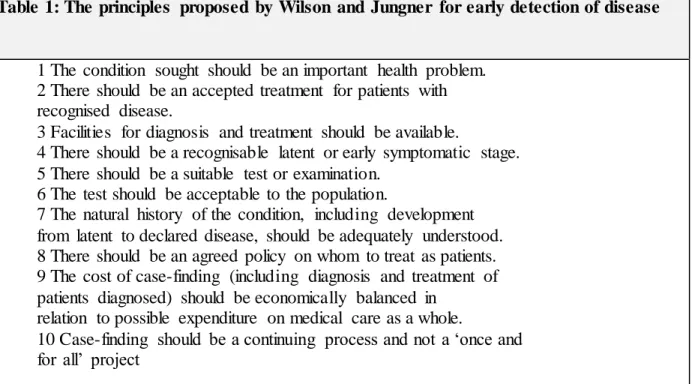
Page 28 of 35 “in theory, screening is an admirable method of combating disease…[but] in practice, there are snags (Wilson & Jungner, 1968).” These “snags” that they identified were related to providing treatment for those diagnosed with previously undetected disease and avoiding harms to those who need no further treatment. As such, Wilson and Jungner proposed a set of principles (Table 1) to guide the decision of when it would be appropriate to screen.
Table 1: The principles proposed by Wilson and Jungner for early detection of disease
1 The condition sought should be an important health problem. 2 There should be an accepted treatment for patients with recognised disease.
3 Facilities for diagnosis and treatment should be available.
4 There should be a recognisable latent or early symptomatic stage. 5 There should be a suitable test or examination.
6 The test should be acceptable to the population.
7 The natural history of the condition, including development from latent to declared disease, should be adequately understood. 8 There should be an agreed policy on whom to treat as patients. 9 The cost of case-finding (including diagnosis and treatment of patients diagnosed) should be economically balanced in
relation to possible expenditure on medical care as a whole.
10 Case-finding should be a continuing process and not a ‘once and for all’ project
Page 29 of 35 treatment should be available.” While facilities for treatment such as Ashonplafa and the
Hospital del Sur are available for women, they are often not accessible due to financial barriers to accessing care discussed above. These principles are reiterated by other screening principles that have since followed, specifically the mandate that effective treatment should be available for patients diagnosed with a positive testing for a disease (Mant & Fowler, 1990).
Recommendations
Future steps for the HHA will be to address the unintended burden of miscommunication which results in confusion and worry and, if they cannot be addressed, to question whether these unintended burdens outweigh the benefits of the program. Confusion could be diminished by improving communication with the health promoters and women regarding the role of the health promoter. Specifically, the HHA should not set the expectation among women that the health promoter will accompany her to Ashonplafa; alternatively other health promoters should be asked if they would be willing participate in assisting women access follow- up care to reduce the burden of work for the head health promoter from travelling to all 7 communities.
Additionally, “pasaje” should be included to cover the transportation costs of the health
Page 30 of 35 To address the ethical dilemma of providing a screening test for a condition that cannot be treated because a patient cannot afford it, the HHA should seek creative solutions to expand community partnerships. An obvious answer to this ethical dilemma is that the HHA raise additional funds to cover the cost of treatment for women who are diagnosed with cervical cancer and need treatment at the Hospital del Sur or the Hospital in Tegucigalpa. However, as a student-run organization that is largely financed through student fundraising efforts, covering the costs of cervical cancer treatment for all women may not be a realistic solution. Furthermore, each year the number of women seeking care at the clinic grows beyond the capacity of the organization and with this increase in women, comes an increase in women who have never received a Pap smear and so more cases of precancerous cells and cervical cancer are detected yearly. Thus if the HHA was going to expand to cover costs of the treatment of all women they detect with cervical cancer this may become impossible. Future research should be directed at identifying potential community partners to transform the HHA into a more sustainable and community-based organization.
Limitations
This study has several limitations. First, the interviewers were affiliated with the HHA and so the participants interviewed may have been more likely to understate any dissatisfaction they had with the HHA or the follow-up care process. Although our study was in a single location, the situations we describe here occur commonly in other settings, including other Latin American countries. Thus we believe the key themes could be applicable to other settings and short-term service learning organizations.
Conclusion
Page 31 of 35 short-term service learning organizations need to ensure that communication is clear to minimize unintended consequences such as worry and confusion during the follow-up care process. Populations often served by service learning organizations are vulnerable groups living in poverty and so assuming that they will be able to finance the costs of their follow-up care in the context of a health system that does not provide affordable care is unrealistic and ethically problematic. Thus, it is essential that short-term service learning organizations such as the HHA identify solutions to prevent the ethical problems of miscommunication and providing screening without treatment. In an effort to address these ethical problems, community partners should be identified to help with the follow- up care process and provide treatment for health problems diagnosed during screenings.
Acknowledgements
We would like to thank the study participants for sharing their time and stories with us. I would like to acknowledge Kendra Madding, co-public health leader for the HHA, for her vision in designing and conducting the research; Clare Barrington, MPH, PhD, and public health advisor of the HHA for her guidance in developing the research study and expertise in analyzing the qualitative data; and Diane Rowley, MD, MPH for her guidance on the ethics of service-learning organizations and continued support throughout this entire process.
References
Bank, T. W. (2006). Main report (No. 35622) (pp. 1–194). The World Bank. Retrieved from http://documents.worldbank.org/curated/en/2006/06/6944441/honduras-poverty-assessment-attaining-poverty-reduction- vol-1-2-main-report
Page 32 of 35 Crump, J. A., Sugarman, J., & the Working Group on Ethics Guidelines for Global Health
Training (WEIGHT). (2010). Ethics and Best Practice Guidelines for Training Experiences in Global Health. American Journal of Tropical Medicine and Hygiene,
83(6), 1178–1182. doi:10.4269/ajtmh.2010.10-0527
Denny, L. (2005). REVIEW: The prevention of cervical cancer in developing countries. BJOG: An International Journal of Obstetrics & Gynaecology, 112(9), 1204–1212.
Dey, I. (2003). Qualitative data analysis: A user friendly guide for social scientists. Routledge. Retrieved from
http://books.google.com/books?hl=en&lr=&id=1OKIAgAAQBAJ&oi=fnd&pg=PP1&dq =Dey,+1.+(1993).+Qualitative+data+analysis:+ A+user+friendly+guide+for+&ots=rR83I ShT4F&sig=7loewMmCUy_L2Q3RXAZLzzlZLA0
Drain, P. K., Primack, A., Hunt, D. D., Fawzi, W. W., Holmes, K. K., & Gardner, P. (2007). Global health in medical education: a call for more training and opportunities. Academic Medicine: Journal of the Association of American Medical Colleges, 82(3), 226–230. doi:10.1097/ACM.0b013e3180305cf9
Erickson, F. (1986). Qualitative methods of inquiry. Third Handbook of Research on Teaching, 23–41.
Gibbs, G. R. (2008). Analysing qualitative data. Sage. Retrieved from
Page 33 of 35 Haq, C., Rothenberg, D., Gjerde, C., Bobula, J., Wilson, C., Bickley, L., Cardelle, A., Joseph, A.
(2000). New world views: preparing physicians in training for global health work.
FAMILY MEDICINE-KANSAS CITY-, 32(8), 566–572.
ICO Information Centre on HPV and Cancer. (2014a). Honduras: Human Papillomavirus and Related Cancers, Fact Sheet 2013. Retrieved from
http://www.hpvcentre.net/statistics/reports/HND_FS.pdf
ICO Information Centre on HPV and Cancer. (2014b). Honduras: Human Papillomavirus and Related Cancers, Fact Sheet 2014. Retrieved from
http://www.hpvcentre.net/statistics/reports/HND_FS.pdf
ICO Information Centre on HPV and Cancer. (2014c). Nicaragua, Human Papillomavirus and Related Cancers, Fact Sheet 2014. Retrieved from
http://www.hpvcentre.net/statistics/reports/NIC_FS.pdf
Jesus, J. E. (2010). Ethical challenges and considerations of short-term international medical initiatives: an excursion to Ghana as a case study. Annals of Emergency Medicine, 55(1), 17–22. doi:10.1016/j.annemergmed.2009.07.014
Johnson, C. (2010). Framing and the politics of public health: an examination of competing health narratives in Honduras. Global Public Health, 5(1), 1–14.
Lawrence, D. (2007). The Four Principles of Biomedical Ethics: A Foundation for Current Bioethical Debate. Journal of Chiropractic Humanities. Retrieved from
http://archive.journalchirohumanities.com/Vol%2014/JChiroprHumanit2007v14_34-40.pdf
Page 34 of 35 Maxwell, J. A., & Miller, B. A. (2008). Categorizing and connecting strategies in qualitative data
analysis. Handbook of Emergent Methods, 461–477.
Miller, W., Corey, R., Lallinger, G., & Durack, D. (1995). International Health and Internal Medicine Residency Training: The Duke University Experience.
National Cancer Institute at the National Institutes of Health. (n.d.). NCI Dictionary of Cancer Terms. Retrieved from http://www.cancer.gov/dic tionary?cdrid=543118
O’Neil, E. (2006). The “Ethical Imperative” of global health service. The Virtual Mentor: VM,
8(12), 846–850. doi:10.1001/virtualmentor.2006.8.12.msoc1-0612
Parkin, D. M., Almonte, M., Bruni, L., Clifford, G., Curado, M.-P., & Piñeros, M. (2008). Burden and trends of type-specific human papillomavirus infections and related diseases in the Latin America and Caribbean region. Vaccine, 26, L1–L15.
Parsi, K., & List, J. (2008). Preparing medical students for the world: service learning and global health justice. The Medscape Journal of Medicine, 10(11), 268.
Pinto, A. D., & Upshur, R. E. G. (2009). Global health ethics for students. Developing World Bioethics, 9(1), 1–10. doi:10.1111/j.1471-8847.2007.00209.x
Price, J., & Asgary, R. (2011). Women’s health disparities in Honduras: indicators and determinants. Journal of Women’s Health, 20(12), 1931–1937.
Ramsey, A. H., Haq, C., Gjerde, C. L., & Rothenberg, D. (2004). Career influence of an
international health experience during medical school. Family Medicine, 36(6), 412–416. Rekart, M. L. (2003). International health: five reasons why Canadians should get involved.
Canadian Journal of Public Health, (94), 258–259.
Page 35 of 35 Tabora, N., Bulnes, R., Toro, L. A., Claros, J. M., Massuger, L. F., Quint, W. G., Melchers, W.J.,
Ferrera, A. (2011). Human papillomavirus infection in Honduran women with cervical intraepithelial neoplasia or cervical cancer. Journal of Lower Genital Tract Disease,
15(1), 48–53.
United Nations Office on Drugs and Crime. (2013). Global Study on Homicide. Retrieved from http://www.unodc.org/documents/gsh/pdfs/2014_GLOBAL_HOMICIDE_BOOK_web.p df
Wilson, J. M. ., & Jungner, G. (1968). Principles and practice of screening for disease (No. 34). Geneva, Switzerland. Retrieved from http://whqlibdoc.who.int/php/WHO_PHP_34.pdf Wong, J. P.-H., & Poon, M. K.-L. (2010). Bringing translation out of the shadows: translation as
an issue of methodological significance in cross-cultural qualitative research. Journal of Transcultural Nursing: Official Journal of the Transcultural Nursing Society /
Transcultural Nursing Society, 21(2), 151–158. doi:10.1177/1043659609357637 World Health Organization. (2006). Country Cooperation Strategy at a glance. Retrieved from