Monetary and Fiscal Policy Interaction:
The Current Consensus Assignment in
the light of Recent Developments
1Tatiana Kirsanova
2Campbell Leith
3Simon Wren-Lewis
4Abstract
The last few years papers have begun to analyse optimal monetary and fiscal policy in models incorporating nominal rigidities where social welfare is
derived from the utility of agents. This paper examines whether this analysis provides support for the consensus assignment, where monetary policy controls demand and inflation, and fiscal policy controls government debt. We argue that the basic structure of New Keynesian models implies that monetary policy dominates fiscal policy as a means of controlling inflation. No similar dominance appears to operate for fiscal policy and debt, if debt has to return to its initial level after shocks.
1
This paper benefited greatly from discussions with Chris Allsopp, Matt Canzoneri, Willem Buiter, Eric Leeper, Chris Sims, Ron Smith, Alan Sutherland, David Vines and Martin Weale, as well as the helpful comments of a referee. None should be implicated in the views
expressed here. Leith and Wren-Lewis are grateful to the ESRC Grant No. RES-062-23-1436 for financial assistance.
2
Department of Economics, University of Exeter
3
Department of Political Economy, University of Glasgow
4
The last few years have seen the convergence of two, previously distinct, literatures that examine issues of optimal monetary and fiscal policy. Firstly, following Rotemberg and Woodford (1997), there has been an extensive New Keynesian analysis of optimal monetary policy in sticky-price economies based on social welfare functions derived directly from consumers‟ utility – Woodford (2003) is an excellent reference point for this approach. Initially, this literature only considered fiscal policy as a convenient device to render the steady-state of the model economy efficient, where production subsidies are financed through lump-sum taxes, but Benigno and Woodford (2003) assumed more realistically that government purchases could only be financed through borrowing or levying distortionary taxes. A second literature emerged from the analysis of monetary and fiscal policy in flexible price economies using a dynamic optimal taxation approach, where key papers include Lucas and Stokey (1983) and Chari et al (1991). This approach was extended, firstly to an imperfectly competitive environment in Schmitt-Grohe and Uribe (2004a) and then to a sticky price economy in Schmitt-Grohe and Uribe (2004b). As a result the two literatures merged and now contain the common features of a micro-founded analysis of jointly optimal monetary and fiscal policy in economies featuring nominal inertia, tax and imperfect competition distortions.
The consensus assignment from the title refers to the idea that monetary policy (in a closed economy, or a small open economy with flexible exchange rates)5 should normally focus on business cycle stabilisation and inflation control, while fiscal policy (at the macro level) should focus on the control of government debt or deficits. This conventional assignment leaves open the possibility of using fiscal policy in situations where monetary policy is constrained in some way, either by design (such as a monetary union member subject to asymmetric shocks) or misfortune (where interest rates hit a zero lower bound). It is a consensus only if it applies to situations in which monetary policy is unconstrained in its ability to stabilise the business cycle.
5
Two country models involving flexible rates allow strategic interactions between national policy makers. There is a large literature that examines these (examples include Dixit and Lambertini, 2003b, Lombardo and Sutherland, 2004, and Pappa, 2004), and we do not discuss this here.
This paper asks whether the merged literatures considered above have implications for this consensus assignment, and the justifications for it.
There are additional reasons for revisiting this consensus assignment, the first of which is provided by James Meade himself. Meade was the most senior author and driving force behind Weale et al (1989), which argued for a quite different assignment when cost-push pressures were not strong, such that fiscal policy targeted nominal income and monetary policy national wealth. As Vines (2007) suggests, there are clear links between nominal income targeting and flexible inflation targeting on the one hand, and national wealth and government debt on the other. The main departure from today‟s consensus, therefore, is in reversing the (now) conventional monetary-fiscal assignment. This paper will not attempt to analyse why Meade chose this particular policy regime. However, at the time of publication their suggestion was not seen as outlandish, which illustrates that what is now conventional has not always been so.6 It might be possible, therefore, that new developments represented by the contemporary literature could change any consensus.
A second additional reason for revisiting the conventional assignment is that occasionally policy makers depart from it, by attempting to justify fiscal action by reference to the state of the business cycle, even in situations where monetary policy is unconstrained. Perhaps the most notorious recent example relates to the tax cuts implemented in the early years of this decade by the Bush administration in the US. This at least suggests that the consensus assignment is not firmly entrenched amongst all policy makers.
Textbook discussions of the consensus assignment tend to offer a variety of justifications for it. Many, such as concerns about deficit bias or implementation lags, involve considerations outside basic macroeconomic theory. While we would not want to dispute their importance, they do provoke the following hypothetical question: in a world where such institutional
6 It may be tempting to guess that Meade‟s choice reflected an old fashioned Keynesian view
of the world. However, as Vines (2007) notes, the model used in Weale et al (1989) embodied a good deal of what we now regard as the microfoundations of macroeconomics, although of course it does predate the derivation of social welfare from representative agent utility
highlighted above. An influential, if controversial, global proposal published around that time – Williamson and Miller (1987) – also had fiscal policy targeting internal balance – see Currie and Wren-Lewis (1989) for an evaluation.
problems were absent, would fiscal policy have equal claims to monetary policy as a stabilisation device? One purely macroeconomic theory that is often used as an argument against fiscal countercyclical policy is Ricardian equivalence, but it is hardly definitive, as it only relates to the income effects of tax changes, and does not prevent other aspects of fiscal policy being effective (see Wren-Lewis, 2000, for example). One of the main arguments of this paper is that the literature convergence noted above has revealed an additional argument for the conventional assignment that is very much internal to that analysis.
The structure of this paper is as follows. Section 1 investigates the characterisation of optimal monetary and fiscal policy in sticky price economies and assesses the extent to which the consensus assignment can mimic such a jointly optimal policy. Whether the fiscal policy instrument is taxation or government spending, we find that there is strong support for the conventional assignment. We suggest that this is because monetary policy has some inherent advantages over fiscal policy as a demand management tool, which become clear when social welfare is computed using measures derived from agents‟ utility. However, the section ends by noting how some forms of fiscal policy might complement monetary policy to the extent that they can influence relative prices rather than aggregate demand or when they can directly offset distortionary shocks.
Section 2 considers the impact of monetary policy on debt. A result derived by a number of papers involved in the current literature is that, under full monetary-fiscal optimisation with commitment, steady state debt follows a random walk. The cost of servicing any long run change in debt must be met by moving fiscal instruments. As a result, there is very little for monetary policy to do, and so an assignment that excludes it from debt control will involve trivial costs compared to full monetary-fiscal optimisation. Once again, the literature referred to above adds to the case for the consensus assignment. However, we note one important caveat to this argument, which is that it need not apply to cases where there is an absence of a commitment technology. If policy is constrained to be time consistent, the purely macroeconomic case for the conventional assignment is less clear. There is a final concluding section.
1. Fiscal Policy and Business Cycle Stabilisation
Before considering recent analysis of sticky price economies, it is helpful to recall results from the flexible price analysis of optimal monetary and fiscal policy. In their seminal paper, Chari et al (1991) re-examine the tax smoothing analysis of Barro (1979) in a general equilibrium context where the returns on government debt are endogenous. It finds that in a non-monetary model variant optimal tax rates are essentially constant, so government debt is used as a shock absorber over the business cycle. State contingent returns to debt ensure that the government budget constraint is satisfied while allowing for deficits in recessions and surpluses in booms. The tax smoothing result of Barro (1979) re-emerges if the government can only issue real non-state contingent debt, in which case tax rates follow a random walk in response to new information about the government‟s finances.
When they consider a monetary version of their economy, using the cash-credit goods model of Lucas and Stokey (1983), they find it is optimal to follow the Friedman rule: nominal interest rates are zero and expected deflation is equal to the real rate of interest. This rule prevents a distortionary inflation tax on cash goods relative to credit goods. Actual inflation deviates from expected inflation in response to shocks, making the real returns from nominal non-state contingent government debt mimic those from the state-contingent debt of the non-monetary economy. Inflation is highly volatile, as it serves to negate the fiscal consequences of shocks, and there is no significant movement in tax rates.
These issues were reconsidered in a sticky price setting by Schmitt Grohe and Uribe (henceforth SGU) (2004b). In deriving the Ramsey policy, they find that, even for moderate degrees of price stickiness, the optimal rate of inflation is close to zero and surprise inflation is not used as a device to stabilise the real value of nominal debt. Instead, we obtain near random walk behaviour in tax rates and government debt. The costs of inflation arising from
nominal inertia easily over-ride the use of surprise inflation as a fiscal financing device.7
Benigno and Woodford (2003) (henceforth BW) obtain similar results in a linear-quadratic framework. BW also utilise the framework to obtain a description of optimal policy in terms of targeting rules for monetary and fiscal policy, where these rules are relationships between endogenous variables (known as „target criteria‟) which the policy maker adjusts their instruments to achieve. However, since monetary and fiscal policy instruments affect the endogenous variables within each target criterion the policy assignment is not obvious.
BW consider a set of rules which capture the essence of the consensus assignment. The central bank is charged with maximising social welfare through its adjustment of interest rates, taking as given the evolution of government debt (i.e. ignoring the fiscal repercussions of monetary policy), while the fiscal authority maximises social welfare taking the evolution of output as given (which is implicitly assumed to be under the control of the monetary authority). The solution to these constrained policy problems replicates the optimal targeting rules which emerge when monetary and fiscal policy are chosen jointly by a benevolent policy maker. In other words, in a simple sticky-price production economy, something similar to the consensus policy assignment can replicate the jointly optimal monetary and fiscal policy in their analysis.
SGU (2007) consider a more elaborate model that includes capital and money as assets. Income taxes are the fiscal policy instrument, and the shocks hitting the economy come from innovations to either productivity or government spending. The point of reference in SGU (2007) is the Ramsey optimal allocation, which again has the property that inflation is very close to zero throughout and debt and taxes follow a random walk. This is compared to various solutions implied by sets of simple policy rules. Although a variety of rules are considered, a very simple set-up where interest rates respond to inflation, and taxes respond to debt, appears to do at least as well as others. (For clarity and economy, let us call the rule relating a fiscal instrument to
7
deviations in debt a „fiscal feedback‟ rule.) If interest rates respond fairly aggressively to excess inflation, and taxes respond only mildly to changes in debt, then the welfare loss of following these rules compared to the Ramsey allocation are only in the order of 0.003% of steady state consumption. In this sense, assigning monetary policy to inflation stabilisation, and fiscal policy to debt stabilisation, appears to be virtually costless.8
SGU (2007) undertake a large number of robustness checks. For example, they find that rules that include interest rate smoothing do not significantly improve on rules without. Although they include money in their main model, this does not seem to be important for their key results. One element that does seem to be important is that interest rates do not respond strongly to excess output. As their focus is on simple implementable rules, where policy instruments only respond to potentially observable data, their definition of excess output relates output to its steady state level. As BW among others note, the welfare relevant measure of the output gap should account for the distortions in output due to nominal inertia, tax and imperfect competition distortions. Even in an undistorted economy, following a productivity shock, the level of output under flexible prices will change compared to its steady state value. By making the policy rule attempt to stabilise output towards its steady state level following a temporary improvement in supply, large reductions in welfare may follow.9 Whether monetary policy rules that utilise the welfare relevant measure of the output gap should be considered as being „simple implementable rules‟ is debatable, but since the size of the losses from following a rule which ignored output were small relative to the Ramsey policy, adopting alternative output measures is likely to generate small gains in their case.
An important feature of the analysis discussed above was the common assumption that the fiscal policy instrument was a distortionary tax. Since the
on tax smoothing in a small open economy.
8
The welfare loss in comparing simple rules with the Ramsey allocation involves the sum of two elements: the cost of restricting policy to a simple linear rule, and the cost of any assignment (i.e. excluding some variables or shocks from the rule). As the sum is small in SGU, so we can conclude that each individually is also small.
9
If the Taylor rule contains a sizeable term in output deviations from steady state, then this has the effect of making productivity shocks act more like cost push shocks. As cost-push shocks involve costs whatever monetary policy does, it follows that this form of Taylor rule may be costly.
economies modelled in these papers contain infinitely lived consumers who smooth consumption, tax policy operates through supply side effects, leaving monetary policy to impact on the demand side. In this context it might not be surprising that fiscal policy has little role to play in helping to stabilise demand. This feature could be relaxed by assuming that some consumers do not have access to credit markets, such that they are forced to consume their current income in a traditional Keynesian manner (see, for example, Gali et al (2007)). As a result changing tax rates will affect his group of consumers‟ disposable income and allow tax policy to affect aggregate demand. However, Horvath (2009) demonstrates that adding such consumers to the BW model considered above, generates a policy problem which is isomorphic to that considered in BW, implying that BW‟s version of the consensus assignment will still mimic the jointly optimal policy in this setting.
An alternative means of modelling fiscal policy that allows it to impact on demand is to have government spending as the policy instrument. Government spending feeds directly into aggregate demand and can therefore potentially complement monetary policy in demand stabilisation. The model in Kirsanova and Wren-Lewis (2007) – hereafter KWL – uses government spending as a fiscal instrument, and looks at simple fiscal feedback rules as well as optimal policy. Monetary policy, in contrast, is always optimal, where a commitment mechanism is assumed to allow time inconsistent policies. As a result, the conventional assignment implicit in KWL differs from that in SGU, because in the former monetary policy can potentially react to debt. The economy is hit by cost-push shocks, and the value of welfare is computed for alternative values of fiscal feedback. As a reference point, the fully optimal monetary-fiscal policy (i.e. where fiscal and monetary policy are jointly determined to maximise social welfare) is also computed.10
The analysis finds that provided the degree of fiscal feedback from debt to spending is neither too slow nor too fast, the loss to welfare of consigning fiscal policy to debt control is very small, at 0.002% of steady state
10
If the objectives of both monetary and fiscal policy makers are identical, formal co-operation may be unnecessary: see Dixit, A. and Lambertini, L (2003b).
consumption.11 Therefore this interpretation of the conventional assignment also appears to involve few costs compared to full optimisation. There are also reasons for thinking that this result would still obtain in this model even if monetary policy were somehow prevented from responding to debt, which we discuss below.
While KWL use numerical calculations of social welfare to assess policy rules for government spending, analytic results for optimal policy are derived for a simple closed economy in Eser (2006), and for a more complex open or closed economy in Eser et al (2009). Eser et al (2009) shows that following any type of shock it is optimal to keep government spending at the level that would be chosen by a social planner in a flex-price economy (its „natural‟ level). In other words, the government spending gap (the difference between actual spending and its natural level) should be zero, and that monetary policy alone should be used as a business cycle stabilisation tool.
To see intuitively where this result comes from consider first the case of a technology or preference shock in a simple model where the only nominal inertia is in price setting. If the hypothetical flex price economy is efficient, then the goal of policy is to reproduce the real interest rate that would occur in that economy following the shock (i.e. the natural rate of interest). If monetary policy is unconstrained, it can set nominal interest rates to achieve this, and the welfare cost of the shock will be zero. To put the same point another way, monetary policy can ensure that the shock does not influence the price level, and so the sticky price distortion is avoided. Monetary policy rather than fiscal policy is the obvious tool to use here, and because monetary policy can completely offset the shock, fiscal policy plays no stabilisation role.
Now consider the same economy subject to a cost-push shock. In this case monetary policy cannot completely offset the shock, so it might be thought that a potential role for fiscal policy could arise. The aim of policy in this case is to obtain the optimal trade-off between reducing inflation and keeping the output gap small. But in this case monetary policy continues to dominate fiscal policy, if fiscal policy is in the form of changes in government
11
If fiscal feedback is too slow, then monetary policy may become passive, a possibility which is discussed below. If feedback is too fast, welfare may deteriorate: see Leith and Wren-Lewis (2000, 2006) and Ferrero (2006) for example.
spending. Higher real interest rates not only reduce consumption, and therefore aggregate demand and inflation, but they also increase labour supply, as workers reduce their leisure alongside lower consumption of goods. This further reduces inflation. In contrast, changes in government spending only influence demand. So changing government spending can do nothing to improve this inflation/output gap trade-off. On the other hand, if government spending does change, we move away from the optimal provision of public goods, which has direct welfare costs. So the optimal government spending gap is zero.
The reasons for not using government spending as an instrument for stabilising the business cycle are therefore intrinsic to the basic New Keynesian model, and we have no need to invoke implementation lags, or political economy concerns, to get this result. Although the analysis uses a model involving an infinitely lived consumer, Ricardian Equivalence is not central to this argument. What is central is that a measure of welfare is used that is derived from, and reflects, agents preferences between consumption and leisure, together with a recognition that changes in fiscal policy - unlike monetary policy - have direct resource costs. In this sense, the convergence of New Keynesian analysis with the dynamic optimal taxation literature has been essential in establishing this result.12
How robust this analysis is to adding additional distortions into the model remains to be seen. Eser et al (2009) note that it would not apply if the baseline featured a distorted steady state or other distortions which affect the labour market such as habits externalities in consumption/labour supply.13 The result that the government spending gap should be zero also only holds
12
To restate, it is not our intention to suggest that this argument against countercyclical fiscal policy is in any way more important than other arguments that are outside the model. Wren-Lewis, 2003, for examples notes that the importance that economists attach to political economy concerns may be reflected in their general support for automatic stabilisers, even when they do not favour discretionary fiscal action. In addition, these alternative arguments against discretionary fiscal policy will still apply in circumstances where monetary policy is constrained, or is simply not available, such as in a monetary union for example. (Kirsanova et al, 2007, provide one such assessment that attempts to mitigate some of these political economy concerns.)
13
Adam and Billi (2006) provide an interesting analysis, where both fiscal and monetary policy is subject to inflation bias. These issues may also be important for monetary/fiscal interactions in monetary unions: see Beetsma, R and Bovenberg, A.L. (2003), and Dixit, A. and Lambertini, L (2003b) for example.
exactly when the model ignores government debt. Once government debt is added to the model, a non-zero government spending gap is required to finance any fiscal repercussions of shocks or policy responses. However, Eser et al (2009) argue that in this case government spending is not being used to stabilise demand, and so in this sense the conventional assignment remains optimal.
The results we have examined so far therefore provide strong support for one half of the conventional assignment, which is that when monetary policy is unconstrained, fiscal policy should focus on stabilising government debt. If government spending is the fiscal instrument, then the results in KWL and Eser et al suggest it has little or no role to play in stabilising output or inflation in simple models that focus on the nominal inertia distortion. If a distortionary tax is the fiscal instrument, so fiscal policy has supply side effects, the results in BW and SGU (2007) suggest a similar result. However, we end this section by noting an important qualification to this conclusion.
Leith and Wren-Lewis (2007a) look at an open economy version of a model that is similar to KWL, but with the crucial addition of nominal inertia in wage setting. In this case both prices and nominal wages are set according to Calvo contracts. The paper looks at optimum policy (under either discretion or commitment) for various shocks with or without fiscal policy as an instrument. In the absence of wage inertia, monetary policy is able to eliminate most of the impact of a technology shock – the only costs arise from the impact of interest rates on debt. However, with wage inertia this is no longer the case. The reason is that under flexible prices a technology shock will imply a change in real wages. When nominal inertia only occurs in price setting, monetary policy can ensure that prices do not change, but real wages can move through flexible variations in nominal wages. Once nominal wages are also sticky, with only monetary policy as an instrument the technology shock is bound to generate either wage or price inflation, either of which will be costly. We cannot escape the nominal inertia externality.
If we then allow the policy maker to move production and income taxes as well as government spending as additional instruments, then we can once again eliminate the impact of the technology shock. Table 1 below is taken from Leith and Wren-Lewis (2007a). The first column and second row show
welfare costs with only monetary policy operating, while the final column shows costs with taxes free to move in a stabilising direction. In this case, therefore, any assignment that precluded the use of fiscal policy for short run stabilisation would be inefficient. However, it is instructive to note that it is the two tax rates that are useful in this case, and not government spending. The reason is that both tax rates influence real wages, and can therefore offset the distortion caused by wage inertia. Government spending, on the other hand, impacts directly on demand, and here monetary policy is more efficient for the reasons noted earlier.
Table 1 – Costs of Technology Shock in a Small Open Economy with Alternative Fiscal Instruments and Commitment14
No Taxes Income Tax Sales Tax Both Taxes Government
Spending
Included 2.95 2.91 0.88 0
Excluded 2.95 2.91 0.88 0
This result is interesting in its own right, but also suggests two general points. First, in models based on a New Keynesian Phillips curve for price setting (coming from Calvo contracts for prices, for example), monetary policy minimises inflation by moving private sector demand so as to minimise the gap between actual marginal costs and what costs would be under flexible prices. In simple models this gap is equivalent to minimising the output gap. This works because all prices that are sticky are equally sticky, and aggregate relative prices can change without encountering the nominal inertia distortion. If these conditions do not hold, then fiscal policy could be useful if it can influence the relevant relative prices. While wage inertia and income/sales taxes are an obvious example of this, there may be others, such as allowing different degrees of nominal inertia between traded and non-traded goods coupled with taxes on domestic sales like VAT.
Second, if fiscal policy is capable of influencing relative prices that may be distorted because of nominal inertia, it may also be useful at offsetting distortionary shocks that impact on those relative prices. In effect, we are looking for taxes that operate on the same margin as the distortion. Our discussion so far has focused on one distortion: the externality produced by nominal inertia. However, the problem of short term stabilisation can encompass responding to all manner of shocks, some of which may be distortionary. The most obvious example is cost-push shocks. BW eliminates cost-push shocks through offsetting changes to tax rates. This is another potential contribution that fiscal policy can make, because cost-push shocks cannot be eliminated by monetary policy (because they influence the relationship between the output gap and inflation in the Phillips curve). In both these cases, fiscal policy is useful not because it can influence aggregate demand, but through its impact on key relative prices.
14
The numbers relate to a 1% standard deviation technology shock as a proportion of steady state consumption divided by the variance of the shock.
2. Monetary Policy and Debt
What we term the conventional or consensus assignment allocates monetary policy to the control of the output gap and inflation, and fiscal policy to the control of government debt. The previous section, like most of the literature, has focused on the use or otherwise of fiscal policy in influencing the output gap and inflation. However there is a second part to the consensus assignment, which is that monetary policy should not play any role in stabilising government debt. In the SGU (2004b) and BW papers discussed above a mild amount of nominal inertia was sufficient to prevent the use of inflation surprises as a fiscal financing device. However nominal inertia also means that monetary policy can affect the debt service costs of government debt.
A useful starting point is Leeper‟s (1991) characterisation of active/passive monetary/fiscal policy regimes. One possible policy combination is where an „active‟ monetary policy which satisfies the Taylor principle needs to be supported by a fiscal rule which adjusts fiscal instruments in response to debt disequilibrium to ensure equilibrium determinacy. Such a policy combination is in line with the consensus assignment considered here. To many the economic logic behind this aspect of the consensus assignment may appear self-evident. Interest rate movements are required to stabilise inflation following shocks, so any attempt to use them to also stabilise debt is bound to detract from their effectiveness in stabilising inflation.
However, an alternative combination, which also supports determinacy of the rational expectations equilibrium, is where fiscal policy does not seek to stabilise debt, and where a „passive‟ monetary policy which fails to follow the Taylor principle serves to stabilise otherwise unstable debt dynamics. It is possible for monetary policy to both control inflation and debt by exploiting the forward looking nature of consumption and price decisions. We can illustrate this most clearly by looking at optimal monetary policy when monetary policy
has to control debt, because there is no fiscal feedback.
The following example is taken from KWL. They examine what optimal monetary policy would do following a positive cost-push shock if neither
spending nor taxes react to debt. Figure 1 compares this optimal monetary policy (dotted line) with a simple fixed nominal interest rate rule (solid line), which also generates a determinate solution.15 Optimal monetary policy initially cuts interest rates substantially, but subsequently raises them above initial levels. As real interest rates fall substantially at first, we can roughly describe this monetary policy as „passive‟, in the sense of Leeper (1991). The inflationary shock reduces debt, and the initial cut in interest rates reduces it much further. This gives policy scope to subsequently raise interest rates without generating a positive debt interest spiral.
But why does this passive monetary policy stabilise inflation? Inflation responds to expected future demand, and demand responds to expected
future interest rates, so delaying deflation is effective. In contrast the dynamics of the debt process are inherently backward looking. So optimal policy exploits the forward-looking nature of private sector decision making, and thereby controls both debt and inflation.
15
The validity of equilibria where no fiscal feedback occurs and monetary policy is passive has been questioned in the debate over the Fiscal Theory of the Price Level (FTPL). (Chadha and Nolan (2002) discuss how the FTPL fits in to earlier discussions of monetary fiscal interactions.) In a technical sense the solutions shown in Figure 1 are entirely standard, and some of the charges levelled at the FTPL just do not apply. For example, the determination of prices uses the standard Calvo formulation, although Leith, Warren and Wren-Lewis (2003) show that FTPL type results can occur even in entirely backward looking models.
The main criticism of the FTPL in Buiter (2002) is that the government‟s intertemporal budget constraint will not be satisfied for all paths of prices. Buiter argues that this „denies the singlemost important defining characteristic of a market economy: hard budget constraints based on clearly defined property rights, backed up with default penalties in case of non-observance‟. Buiter suggests instead that government debt would be revalued/discounted by the private sector, which would ensure that the intertemporal budget constraint held while keeping the aggregate price level indeterminate.
A key question to ask is under what conditions is it appropriate to assume that discounting of debt occurs? It could be argued that discounting would occur under the constant interest rate policy because the intertemporal budget constraint would not be
satisfied for non-solution price paths. It is far from clear that this criticism can be applied to the alternative shown in Figure 1 where monetary policy optimises, because here the monetary authority is implicitly committed to achieving stability as long as the economy is controllable.
Fig 1 Optimal and fixed interest rate policies compared following a cost-push shock, using the model from Kirsanova and Wren-Lewis (2007)
Could monetary policy therefore play a useful role in stabilising debt, without necessarily sacrificing its ability to control inflation, even when fiscal feedback is positive? The analysis in SGU (2007) suggested a negative answer: a policy based on optimal simple rules that denied this possibility came very close to replicating the Ramsey policy. However, the reason for this result may depend crucially on a property of government debt under an optimal commitment policy. In SGU (2007), KWL and also in the earlier studies of SGU (2004b) and BW, the optimal response of debt to a shock with fiscal consequences is for debt to follow a unit root process. This is a straightforward extension of the tax smoothing argument discussed earlier, and applies more generally for variables that enter a convex objective function. With discounting it is less costly to change a fiscal instrument by a small amount permanently than by a large amount temporarily to eliminate the impact of any shock on debt.
This means that optimal policy largely accommodates any shocks to debt. Of course any change to the long run level of debt has to be financed.
Crucially, however, this cannot be achieved by changing interest rates, because real interest rates are tied to the rate of time preference in the long run. So a permanently higher (say) debt stock has to be financed by either higher taxes or lower government expenditure. Furthermore, as BW show for taxes and Leith and Wren-Lewis (2007b) show for government spending, it is optimal to move fiscal instruments to this new level within one period. The net result is that there is very little left for interest rates to do by way of controlling debt.
While optimal policy implies that debt follows a unit root process, a fiscal feedback rule that contains a fairly small coefficient on deviations in debt can come close to replicating this random walk result, as the results in SGU (2007) and KWL show. Thus the consensus assignment is close to optimal policy not because of any comparative advantage that fiscal instruments have in controlling debt, but because there is very little by way of short term debt control required when debt is stabilised very gradually.
It would be misleading, however, to leave matters there. The optimality of random walk steady state debt or gradual fiscal adjustment depends critically on the assumption that policy makers have access to a commitment technology. Leith and Wren-Lewis (2007b) look at a very simple closed economy model, with many similarities to BW and KWL. When examining optimal fiscal and monetary policy under commitment, they focus on the initial response of instruments. They show that although shocks to debt are largely accommodated, there is some small attempt in the initial period to reduce the eventual change in debt, using either fiscal or monetary policy instruments. While this attempt is quantitatively small, it does imply that the optimal policy underpinning the random walk result is time inconsistent. Leith and Wren-Lewis (2007b) go on to show that optimal policy under discretion will involve debt returning to its initial, pre-shock level. Under discretion, therefore, debt no longer follows a random walk. Moreover, the adjustment of debt under the time-consistent policy is generally quite aggressive.
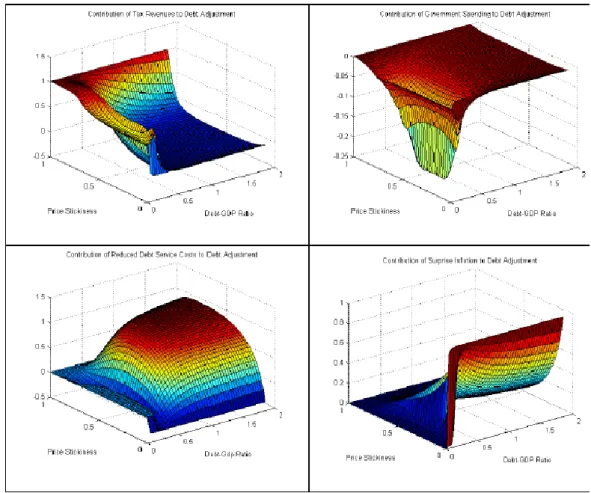
If any shock to debt has to be completely undone, then which policy instrument is used to do this becomes a more important question.16 Leith and Wren-Lewis (2007b) show that for debt levels that are moderate or large, the most effective (i.e. social welfare maximising, subject to the constraint that policy be time consistent) instrument is interest rates. The figures below are taken from that paper. The key figure is the bottom left, which shows the contribution of changes in interest rates to debt adjustment under different degrees of nominal inertia and initial debt levels. Once debt exceeds about 50% of GDP, interest rates are the main mechanism used to return debt to its original level under optimal discretionary policy, unless prices are near flexible and we return to the use of inflation surprises discussed above.
16
There are other reasons for being interested in cases where debt does return to its initial level after a temporary shock, besides the possibility that a commitment technology does not exist. Debt or deficit targets exist in a number of countries (most notably in the Eurozone, but also in the U.K.), perhaps to guard against non-benevolent behaviour by fiscal policy makers.
Fig 2 – The contribution of alternative instruments to debt adjustment under discretion.
This result suggests that there may be cases where it is optimal to use monetary policy to help stabilise debt. Whereas there are clear macroeconomic reasons for assigning monetary policy to short term stabilisation, as outlined in the previous section, there appear to be no similar reasons for assigning fiscal policy alone to short term debt control. Just as costs associated with moving fiscal instruments penalised the use of fiscal policy to correct the distortion caused by nominal inertia and deviations from the natural real interest rate, they also mean that using these same instruments to alter the level of debt quickly is also costly (as the random walk result shows). Using monetary policy to change the level of debt as well as control inflation is possible if behaviour is forward looking, but it is also likely to be costly because it implies deviations from the natural level of real interest
rates. However we now have costs associated with using both fiscal and monetary instruments, so comparative advantage is no longer clear a priori.
Probably all that we can conclude at this stage is that further research on this issue would be productive. For example, the impact of the maturity structure of debt will be important, and the common, but unrealistic, assumption that all debt is in the form of one-period bonds may give misleading quantitative results. In addition, government bonds may provide transaction services, as in Canzoneri and Diba (2005). It is also unclear how costly any restriction on monetary policy might be when debt no longer follows a random walk.
Whatever the result of this additional analysis, some recent research can be used to suggest a compelling political economy case for maintaining this part of the consensus assignment. All the analysis surveyed so far has assumed fiscal policy makers are benevolent. In practice we have good reasons for doubting this assumption. The deficit bias literature (see Alesina and Tabellini, 1990, and Von Hagen and Harden, 1995) has focused on reasons why governments may fail to control debt. 17
A government that fails to control debt will put pressure on the monetary authorities, either to monetise the debt directly, or to behave in a passive manner, along the lines shown in Figure 1.18 KWL note that the case considered in Figure 1, where there is no fiscal feedback and monetary policy is passive, produces the worst outcome for social welfare following a cost-push shock. Furthermore, Chung et al (2007) show that the anticipation of such regime changes may affect current macroeconomic volatility even if current policy rules remain unchanged. For these reasons, such non-benevolent fiscal behaviour needs to be discouraged, and the consensus assignment can be seen as one means of doing so.
17
There are a large number of papers that look at games between monetary and fiscal policy makers where the objectives of each differ (e.g. Dixit and Lambertini, 2003a).
18
Chadha and Nolan (2002) provide a nice exposition of the relationship between the unpleasant monetarist arithmetic of Sargent and Wallace and the FTPL.
3. Summary and Conclusion
The consensus assignment suggests that monetary policy, if it is unconstrained by zero bound or other concerns, should look after business cycle stabilisation and inflation control, and fiscal policy should focus on the control of government debt or deficits. Compared to a fully optimal monetary-fiscal regime, monetary-fiscal policy is restricted to only focus on debt, and monetary policy is restricted not to respond to debt. Research on monetary and fiscal policy interactions has been dominated in the last 5-10 years by the convergence of two, previously distinct literatures: studies of dynamic optimal taxation and New Keynesian analysis. This paper has examined what this new research implies for the consensus assignment.
The paper looked at various analyses of monetary and fiscal policy in sticky price economies which imply that the costs of excluding fiscal policy from business cycle stabilisation are very small. Large differences across the models used, particularly in terms of the instruments employed and shocks considered rule out many explanations for this result. Instead, we argue that the basic structure of New Keynesian models implies that monetary policy dominates fiscal policy as a means of controlling inflation. This is the case even when monetary policy cannot eliminate the inflationary consequence of shocks, following cost push shocks for example. As a result, justifications of this aspect of the conventional assignment do not need to appeal to political economy or institutional constraints on fiscal actions.
At first sight the new literature also suggests that the costs of preventing monetary policy from reacting to debt are small. However this may be predicated on a particular feature of this literature, which is that under commitment it is optimal to let debt follow a random walk, or adjust debt very gradually. As shocks to debt are largely accommodated in this case, there is very little scope for monetary policy to control debt. However, there are a number of reasons for also looking at cases where debt is required to return to its pre-shock level more aggressively, which would be a feature of the time consistent policy for example. In that situation, and if initial levels of debt are high, it may be that changes in interest rates are an efficient method of
controlling debt. Monetary policy can both influence debt and stabilise inflation by exploiting the forward looking nature of consumption and pricing behaviour. In this case, debt stabilisation biases or political economy concerns related to deficit bias may be critical in justifying this half of the consensus assignment.
References
Adam, K. & Billi, R.M. (2006). 'Monetary conservatism and fiscal policy', working paper no. 663, European Central Bank.
Alesina, A. and Guido, T. (1990) 'A Positive Theory of Fiscal Deficits and Government Debt', Review of Economic Studies, vol. 57, pp. 403-14. Barro, R.J. (1979) 'On the Determination of the Public Debt', Journal of Political Economy, vol. 87(5), pp. 940-7
Beetsma, R and Bovenberg, A.L. (2003), 'Inflation Targets and Debt
Accumulation in a Monetary Union', European Journal of Political Economy, Vol.19(1), pp.1-15.
Benigno, G and De Paoli, B (2009), 'On the International Dimension of Fiscal Policy', discussion paper no.0905, Centre for Economic Performance, London School of Economics.
Benigno, P. and Woodford, M. (2003), 'Optimal Monetary and Fiscal Policy: A Linear-Quadratic Approach', NBER Macroeconomic Annual, MIT Press. Buiter, W. (2002), 'The Fiscal Theory of the Price Level: A Critique', Economic Journal, vol. 112, pp. 459-480.
Canzoneri, M. and Diba, B. (2005), 'Interest rate rules and price determinacy: The role of transactions services of bonds', Journal of Monetary Economics, vol. 52, pp. 329-343 .
Chadha, J. and Nolan, C. (2002), 'On the Interaction of Monetary and Fiscal Policy', in Dynamic Macroeconomic Analysis - Theory and Policy in General Equilibrium, ed(s) Altug, S., Chadha, J. and Nolan, C., Cambridge, Cambridge University Press.
Chung, H., Davig, T., and Leeper, E. M. (2007). 'Monetary and Fiscal Policy Switching', Journal of Money, Credit and Banking, vol. 39(4), pp. 809-842. Currie, D. and Wren-Lewis, S. (1989), 'Evaluating blueprints for the conduct of international macropolicy', American Economic Review, vol. 79, pp. 264-269. Dixit, A. and Lambertini, L (2003a), 'Interactions of Commitment and
Discretion in Monetary and Fiscal Policies', American Economic Review, vol. 93, pp. 1522-1542.
Dixit, A and Lambertini, L (2003b), 'Symbiosis of monetary and fiscal policies in a monetary union', Journal of International Economics, vol. 60, pp. 235-249. Ellison, M. and Rankin, N. (2007), 'Optimal Monetary Policy When Lump-Sum Taxes Are Unavailable: A Reconsideration of the Outcomes Under
Commitment and Discretion', Journal of Economic Dynamics and Control, vol. 31, pp. 219-243.
Eser, F. (2006), ‟Fiscal Stabilisation in a New Keynesian Model‟, mimeo, University of Oxford..
Eser, F., Leith, C. and Wren-Lewis, S. (2009), „When is Monetary Policy All we Need?‟, discussion paper, Oxford University Economics Department. Ferrero, A. (2006), 'Fiscal and Monetary Rules for a Currency Union', working paper no. 502, European Central Bank.
Galí, J., López-Salido, J.D. and Vallés, J., (2007). 'Understanding the Effects of Government Spending on Consumption', Journal of the European
Economic Association, vol. 5 (1), pp. 227-270.
Horvath, M. (2009), “The Effect of Government Spending Shocks on Consumption Under Optimal Stabilisation”, European Economic Review, forthcoming.
Kirsanova, T. and Wren-Lewis, S. (2007), 'Optimal Fiscal Feedback on Debt in an Economy with Nominal Rigidities', working paper, Federal Reserve Bank of Atlanta.
Kirsanova, T., Satchi, M., Vines, D. and Wren-Lewis, S. (2007), 'Optimal Fiscal Policy Rules in a Monetary Union', Journal of Money, Credit and Banking, vol. 39, pp. 1759-1784.
Leeper, E. M. (1991), 'Equilibria under Active and Passive Fiscal Policies',
Journal of Monetary Economics, vol. 27, pp. 129-147.
Leith, C. and Wren-Lewis, S (2000), 'Interactions Between Monetary and Fiscal Policy Rules', Economic Journal, vol. 110, pp. 93-108.
Leith, C. and Wren-Lewis, S. (2006), 'Compatability Between Monetary and Fiscal Policy under EMU', European Economic Review, vol. 50, pp. 1529-1556.
Leith, C. and Wren-Lewis, S. (2007a), 'Counter-Cyclical Fiscal Policy: Which Instrument is Best?', mimeo, Glasgow University.
Leith, C. and Wren-Lewis, S. (2007b), 'Fiscal Sustainability in a New
Keynesian Model', working paper no. 310, Economics Department, University of Oxford.
Leith, C., Warren, P. and Wren-Lewis, S. (2003), 'Fiscal Policy, Interest Rate Shocks and Prices', Economic Modelling, vol. 20, pp. 361-384.
Lombardo, G. and Sutherland, A. (2004), 'Monetary and Fiscal Interactions in Open Economies', Journal of Macroeconomics, vol. 26(2), pp. 319-347.
Lucas, R. E. and Stokey, N., (1983), 'Optimal Fiscal and Monetary Policy in an Economy without Capital', Journal of Monetary Economics,
vol. 12, pp. 55-93.
Pappa, E. (2004) 'Do the ECB and the Fed really need to Cooperate? Optimal Monetary Policy in a Two-Country World', Journal of Monetary Economics, vol. 51, pp. 753-779.
Rotemberg, J. and Woodford, M. (1997), 'An optimisation-based econometric framework for the evaluation of monetary policy', in NBER Macroeconomic Annual, MIT Press.
Schmitt-Grohe, S. and Uribe, M. (2004a), 'Optimal fiscal and monetary policy under imperfect competition', Journal of Macroeconomics, vol. 26, pp. 183-209.
Schmitt-Grohe, S. and Uribe, M. (2004b), 'Optimal Fiscal and Monetary Policy Under Sticky Prices', Journal of Economic Theory, vol. 114(2), pp. 198-230. Schmitt-Grohe, S. and Uribe, M. (2007), 'Optimal Simple And Implementable Monetary and Fiscal Rules', Journal of Monetary Economics, vol. 54, pp.1702-1725.
Vines, D. (2007) 'James Meade' in the New Palgrave Dictionary of Economics, Macmillan.
Von Hagen, J. and Harden, I. (1995) 'Budget Processes and Commitment to Fiscal Discipline', European Economic Review vol. 39(3), pp. 771-779. Weale, M., Blake, A., Christodoulakis, N., Meade, J. and Vines, D., (1989),
Macroeconomic Policy: Inflation, Wealth and the Exchange Rate, London, Unwin Hyman.
Williamson, J. and Miller, M. (1987), Target Zones and Indicators: A Blueprint for the International Coordination of Economic Policy, Washington D.C., USA, Institute for International Economics.
Woodford, M. (2003), Interest and Prices: Foundations of a Theory of Monetary Policy, Princeton University Press.
Wren-Lewis, S. (2000), 'The Limits to Discretionary Fiscal Stabilisation Policy',
Oxford Review of Economic Policy, vol. 16, pp. 92-105.
Wren-Lewis, S. (2003), 'The compatibility between monetary and fiscal policies in EMU: a perspective from the Fiscal Theory of the Price Level', in
Monetary And Fiscal Policies In EMU: Interactions And Coordination, ed. Buti, M., Cambridge University Press.