Original Article
Comparison of Effects of a Herbal Toothpaste with Crest Complete
Toothpaste on Streptococcus Mutans and Lactobacillus of Saliva
and Plaque Index: A Randomized Clinical Trial
M. Biria 1, S. Mohtavipour 2,G. Eslami 3, A. Akbarzadeh Baghban 4.1 Associate Professor, Dental Research Center, Research Institute of Dental Science, School of Dentistry, Shahid Beheshti University of Medical Sciences, Tehran, Iran
2 Assistant Professor, Department of Pedodontics, School of Dentistry, Guilan University of Medical Sciences, Rasht, Iran 3 Professor, Department of Microbiology, Medical School, Shahid Beheshti University of Medical Sciences, Shahid Beheshti, Tehran, Iran
4 Professor, Proteomics Research Center, School of Rehabilitation, Shahid Beheshti University of Medical Sciences, Tehran, Iran
Corresponding author: S. Mohtavipour, Assistant Professor, Department of Pedodontics, School of Dentistry, Guilan University of Medical Sciences, Rasht, Iran
Received: 21 Oct 2016 Accepted: 19 Dec 2016
Abstract
Background and Aim: In recent years, beneficial effects of herbal hygienic products and toothpastes have significantly been emphasized. This study sought to assess the effects of Masdent toothpaste which contains Pistacia Lentiscus (PL) extract on plaque index and Streptococcus mutans(SM) and Lactobacillus (LB) count in saliva.
Materials and Methods: This study was conducted on 60 students aged 18-20 years. Participants were asked to brush their teeth twice a day for four weeks with the assigned toothpaste, Masdent toothpaste which contains PL extract in the case group and Crest toothpaste in the control group. Plaque index was recorded at the onset and end of the study, and salivary samples were taken for SM and LB colony count. Mann-Whitney, independent t- and Wilcoxon tests were used for data analysis. P<0.05 was considered statistically significant.
Results: Number of SM and LB colonies significantly decreased in both groups(P<0.01) at the end of the study. However, the difference in SM and LB colonies between the two groups was not significant (PMutans=0.108, PLactobacili=0.796). The reduction in plaque
index after using the toothpastes was significant in both groups (P<0.001). This reduction was not statistically different between two groups (P=0.85).
Conclusion: Use of herbal toothpaste containing PL extract and Crest toothpaste had similar effects and both significantly decreased SM and LB salivary counts as well as the plaque index.
Key Words: Toothpastes, Streptococcus Mutans, Lactobacillus, Pistacia, Saliva, Dental Plaque Index, Mastic Resin
Cite this article as: Biria M, Mohtavipour S, Eslami G, Akbarzadeh Baghban A. Comparison of Effects of a Herbal Toothpaste with Crest Complete Toothpaste on Streptococcus Mutans and Lactobacillus of Saliva and Plaque Index: A Randomized Clinical Trial. J Islam Dent Assoc Iran. 2017; 29(1):29-35. DOI: 10.30699/jidai.29.1.29
Introduction
Dental bacterial plaque is the primary etiologic factor for the development of caries, gingivitis, and adhesion of microorganisms to tooth surfaces or gingival tissues; it is the first step for the development of oro-dental diseases [1].
Streptococcus mutans (SM) and Lactobacillus (LB) are the main bacteria involved in tooth decay and decalcification [2]. Despite the effectiveness of mechanical plaque control methods, some periodontal patients or those suffering from systemic conditions need some additional oral
hygiene measures to remove the plaque. Chemical plaque control methods are sometimes used for better plaque removal [3], and many researchers are trying to find a chemical plaque removal agents that can be used alongside the mechanical plaque removal methods [4]. Recently, herbal toothpastes have gained popularity, and their efficacy for improving oral and dental health has been confirmed [5]. Many herbal products have antibacterial properties and can decrease the formation and growth of cariogenic bacterial plaque and prevent their acid production [5]. Mastic gum is a resin which is exuded by the leaves and trunk of the Pistacia Lentiscus (PL) tree. This tree grows in the Mediterranean region and particularly in North West of Iran. This extract has antibacterial, anti-inflammatory and wound healing properties [6,7].
Aksoy et al. [6] in 2006 reported a significant reduction of SM in the saliva of individuals who chewed mastic gum compared to the control group that munched paraffin. According to the results of Jacob George et al. [4] in 2009, a significant reduction in the gingival index and plaque index was observed following the use of herbal Colgate toothpaste. Biria et al. [8] in 2014 reported that 3-week use of mastic gum, xylitol-containing mastic gum, and probiotic mastic gum led to a significant reduction of SM count in saliva. According to their results, the LB in the saliva did not significantly decrease after 3-weeks; however, probiotic mastic gum caused a significant reduction of colony number of salivary LB [8]. Mohire et al. [9] in 2010, showed that chitosan-based polyherbal toothpaste had antimicrobial effects on oral pathogens and it could decrease the plaque index by 70.47% and microbial count by 85.29%.
At present, several products have been produced containing mastic gum including pure mastic chewing gums, xylitol-containing mastic chewing gums and herbal toothpastes containing PL extract. Since the latter is a new product recently introduced to the market, no study has evaluated the effects of PL extract containing toothpaste on cariogenic bacteria and its efficacy on plaque removal. This study sought to assess the effects of Masdent toothpaste, which contains PL extract, on the colony number of SM and LB in saliva as well as the plaque index. The Masdent toothpaste is a
Japanese production and the mastic extract in this toothpaste is from Iran.
Materials and Methods
In this single-blind, parallel design clinical trial, samples were collected using convenience non-probability sampling method. Participants were randomly allocated to each experimental groups using randomized permuted block design. The number of participants was calculated considering α=0.05, a test power of 80%, and effect size=0.5 using PASS11. The number of the candidate in each group was calculated to be 26; however, in order to increase the accuracy of the study, 30 individuals participated in each group, 60 in total. The study design was approved by the Ethics Committee of Shahid Beheshti University and registered in IRCT website (#IRCT201304157910N3). Design and objectives of the study were thoroughly explained to participants and written informed consent was obtained. A total of 60 dental students at Shahid Beheshti University, in the range of 18-20 years of age, who met the inclusion criteria were enrolled. The inclusion criteria were as follows: No periodontal pocket deeper than 3mm, No systemic diseases,
No oral mucosal allergy to the toothpaste,
No consumption of antibiotics, anti-inflammatory drugs or mastic gum products in the past one month,
Daily tooth brushing with fluoride-containing toothpaste,
No unrestored carious teeth,
Have no history of smoking or xerostomia, No use of orthodontic appliances.
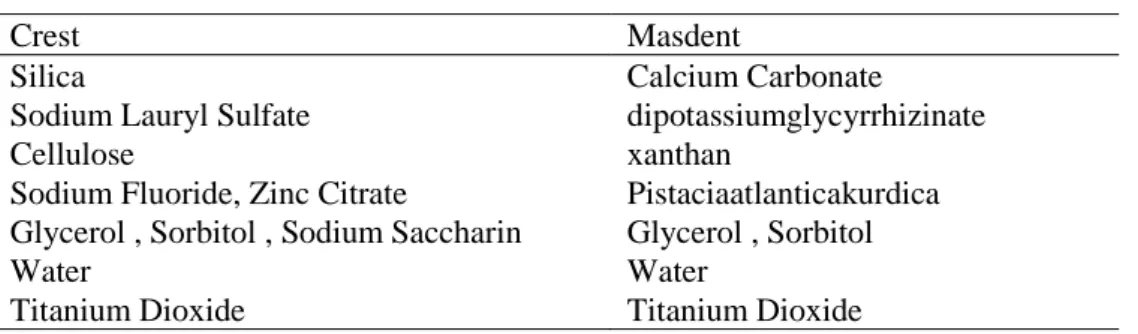
Participants were then randomly assigned to two groups in a parallel design. Group 1 (test group) used Masdent toothpaste, containing PL extract (Masdent, Japan), and group 2 (control) used Crest Complete (Crest, Germany) toothpaste 1(Table 1). At the onset of the study, salivary samples were obtained before participant having their breakfast. One hour before sampling, participants were asked to brush their teeth with the toothbrush without using any toothpaste, and then drink a glass of water. In order to obtain non-stimulatory salivary samples, the subjects were placed in seated position and asked to hold their saliva for 5
Table 1. Ingredients of Masdent and Crest toothpastes
Crest Masdent
Silica Calcium Carbonate
Sodium Lauryl Sulfate dipotassiumglycyrrhizinate
Cellulose xanthan
Sodium Fluoride, Zinc Citrate Pistaciaatlanticakurdica Glycerol , Sorbitol , Sodium Saccharin Glycerol , Sorbitol
Water Water
Titanium Dioxide Titanium Dioxide
minutes. The examiner then suctioned 2ml of saliva at the vestibular depth using a 2cc disposable syringe (Mina Sorang, Iran) and transferred it into a sterile microtube. Each specimen was coded and directly transferred to the Microbiology Laboratory of Shahid Beheshti University and diluted to 1:10 ratio. Mitissalivarius agar (MSA) culture medium was prepared to culture SM, and Lactobacillus was cultured in MRS-Agar (MRS-A). Standard 0.05 loop was used to inoculate culture media with each saliva specimens in a checkered fashion. The specific code for each sample was written on the respective culture media dish. MSA plates were incubated (Memert, Germany) at 37°C and 5% CO2 for 24-48
hours, while MRS-A plates were stored in a conventional incubator at 37°C for the same period. Gram-stained slides were prepared from both groups of culture and bacteria were also observed microscopically (6). Microbial colonies were counted using a colony counter (Biotec, Germany). Since the specimens had been diluted in 1:10 ratio, the obtained colony count values were multiplied by 10. Based on their quantity, colonies were scored as follows:
CFU=0: Zero score CFU<104: Score 1
104CFU<5×10⁴: Score 2
5×10⁴CFU105: Score 3
CFU≥105: Score 4
After salivary sampling, the examiner revealed the supragingival plaque using plaque indicator (GC, Japan). Plaque indicator gel was applied to the buccal and lingual surfaces of all teeth except for the third molars using a microbrush, and subsequently, the subjects were asked to rinse their mouth with water. The examiner evaluated the
stained tooth surfaces and scored the amount of plaque using Turesky Index. Buccal and lingual surfaces of all teeth except for third molars were assessed and scored regarding the amount of plaque. The mean plaque index for each subject was calculated by summing up all scores divided by the total number of scores (2).
Plaque index scoring according to the Turesky index was as follows:
0: Absence of plaque
1: Scattered plaque points in cervical margin 2: A thin continuous layer of plaque (up to 1mm) in cervical margin
3: A layer of plaque with more than 1mm width covering less than 1/3 of crown
4: Plaque covering between 1/3 and 2/3 of crown 5: Plaque covering more than 2/3 of crown
Each participant was then given a medium-bristle adult size Oral-B (Oral-B, Ireland) toothbrush, non-fluoride dental floss (Orkid, Iran), and allocated toothpaste, Masdent for the test and Crest for the control groups. Oral hygiene instructions were given to all participants on a model and the participants were asked to brush their teeth with the assigned toothpaste with the Bass technique for 2 min twice a day (in the morning after breakfast and at night before bedtime) for four weeks and floss their teeth before bedtime. Also, participants were requested to refrain from using any other oral hygiene products namely mouth rinses, fluoride products, and mastic-based chewing gums. After four weeks, salivary samples were collected, and plaque index recorded again, as the beginning of the study.
The Kolmogorov-Smirnov test was used to determine normal distribution of data. The Levene’s test was used for evaluating the equality
of variances and Mann Whitney and independent t-tests for the comparison of the two groups. The Wilcoxon test utilized for the intragroup comparison and analysis of covariance for the assessment of plaque index data. Type 1 error was considered as 0.05 and level of significance was set at P<0.05.
Results
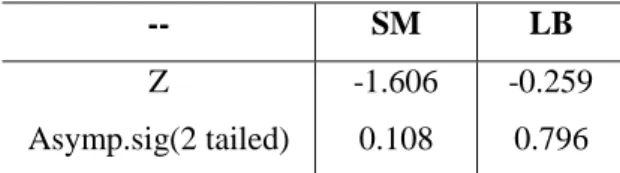
The participants were 34 girls and 26 boys, in the range of 18-20 years. Mann Whitney U test showed that SM and LB colony counts were similar (P=0.098 and P=P=0.453, respectively) in both groups at the baseline. Wilcoxon test demonstrated that after using the toothpaste, SM and LB colonies significantly decreased in test and control groups (P=0.000) (Table2) however, these reductions were comparable (P=0.108 for SM and P=0.796 for LB) between two groups (Table 3).
Table 2. Wilcoxon test to evaluate the reduction of SM, LB in each group before and after the use of toothpastes
Group SM 2
SM 1
LB 2 LB 1
CrestZ
Asymp. sig.(2tailed)
3.621- 0.000
3.481- 0.000 MasdentZ
Asymp. sig.(2tailed)
3.702- 0.000
3.972- 0.000
Table 3. Mann-Whitney test to comparison the SM, LB colony counts after intervention between two groups
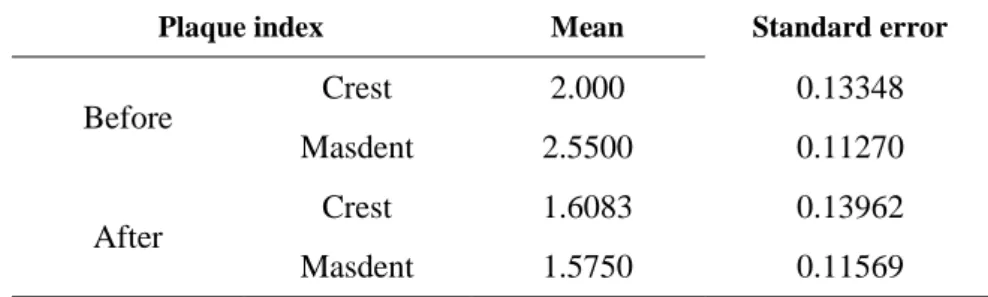
Crest toothpaste was capable of plaque reduction by 0.4 unit, whereas this rate was approximately 1 unit for Masdent toothpaste (Table 4). Independent t-test showed a significant difference in baseline plaque index between the two groups (P<0.003, Table5).
Therefore, analysis of covariance (ANCOVA) was employed for the comparison of plaque index after the intervention. After adjusting the baseline for the plaque index, ANCOVA revealed that the difference between the two groups after the intervention was not significant (P=0.85). Paired t-test demonstrated that the plaque index significantly reduced after using toothpastes in both groups (P<0.01 for Crest and P<0.001 for Masdent); however, this reduction was greater in Masdent group.
Discussion
Increased tendency to use herbal products, decreased the popularity of synthetic materials, the resistance of human pathogenic microorganisms due to the extensive use of commercial antimicrobial agents, and unwanted side effects of antibiotics have persuaded researchers to seek new antimicrobial agents from different sources like medicinal plants.
Herbal extracts have been suggested as more favorable substitutes for antimicrobial chemical products [10]. Results of the present study showed that Masdent toothpaste, containing PL extract, had similar efficacy to the Crest regarding the reduction of SM and LB colonies. The decrease in SM (P<0.01) and LB (P<0.01) colony counts in both groups was statistically significant. The plaque index reduction was also significant in Crest (P<0.01) and Masdent (P<0.001) group. Although this decline seemed more prominent in the Masdent group, the difference was not statistically significant (P=0.85).
Considering the significant effect of carious lesions on salivary colony count (SM and LB), all subjects were clinically examined for tooth decay using a dental mirror and explorer and those with tooth caries were excluded from the study. Moreover, oral hygiene measures were matched, and subjects were requested to refrain from using any other oral hygiene products containing fluoride in order to eliminate the confounding variables as much as possible. Another measure which was taken to match the oral environment among participants was the time of sampling at baseline and after the intervention; the former was taken in the morning one hour after brushing (without toothpaste) and drinking a glass of water. Since the lasting effect of
-- SM LB
Z
Asymp.sig(2 tailed)
-1.606 0.108
-0.259 0.796
Table 4. The mean plaque index in the two groups before and after the intervention
Table 5. The results of t-test for the comparison of plaque index before and after the intervention in the two groups
-- T test
t Sig
Comparison of Plaque index before the intervention between two groups -3.148 0.003
Comparison of Plaque index after the intervention between two groups 0.184 0.855
Masdenttoothpaste has not been determined, to avoid the possible carryover effect, the crossover design was eschewed, and a parallel model was used. Significant reduction in SM and LB colony counts after using toothpaste indicated the positive impact of both toothpastes in decreasing these microorganisms. It should be noted that participants were bound to follow regular oral hygiene during the study period may be another influential factor in this respect.
We applied narrow eligibility criteria in this study so the homogeneity of the samples was increased and the results were not affected by the confounding variables. This process made the study harder however, it led to more comparable results while the external validity of the research slightly reduced.
Mohrie et al. [9], in 2010 evaluated the effects of chitosan-based polyherbal toothpaste on plaque reduction and dental pathogens; they reported a decrease in dental pathogens in case and control groups [9]. Their findings were similar to results of the present study. In our research, PL containing toothpaste caused a reduction in the number of SM and LB colonies which was comparable to the results of the control group. Crest toothpaste is free of PL but contains fluoride and other compounds
which could decrease dental pathogens. These findings are in agreement with the results of several studies which have reported the reduction in the number of SM and LB colonies as the result of using PL extract and PL-containing chewing gum [2,6,7,11]. Results of the Biria et al. [8] study showed a 3-week use of mastic gum significantly decreased salivary SM colonies.
Sharifi et al. [12] in 2012 studied different components of PL extract regarding their antimicrobial property. They demonstrated that the α-pinene which present in mastic gum has antimicrobial properties and can be incorporated into hygienic products. Also, the resin part of mastic gum has antimicrobial activity against Gram-positive and Gram-negative bacteria [12]. According to our results, a significant reduction in plaque index was observed during the 4-week study period in both groups (P<0.01 in Crest and P<0.001 in Masdent groups). Although the plaque index reduction seemed higher in the Masdent group, after adjusting the effect of the baseline, the difference was not statistically significant (P=0.85).
One of the possible reasons for significant plaque reduction in both groups during the study period might be regular oral health measures of
Plaque index Mean Standard error
Before Crest 2.000 0.13348 Masdent 2.5500 0.11270 After Crest 1.6083 0.13962 Masdent 1.5750 0.11569
participants, which is in agreement with the findings of Mohire et al. [9].
Takahashi et al. [7] in 2003, evaluated the anti-plaque properties of mastic chewing gum and stated that mastic chewing gum is beneficial for decreasing plaque accumulation on tooth surfaces. The difference in abrasive contents of different toothpaste might be one of the reasons for differences in plaque index reduction. The abrasive material in Masdent is calcium carbonate, which is one of the most efficient and cost-effective abrasive for toothpaste. Since calcium ions are not compatible with fluoride ions, the use of calcium carbonate in toothpaste limits the amount of soluble fluoride. Therefore, at present, silica- based abrasives are commonly used in fluoride-containing toothpastes like Crest. These abrasives mechanically clean the teeth and are chemically inactive, therefore, do not interact with other ingredients of toothpaste [13].
Since Masdent does not contain fluoride component, calcium carbonate is used as an abrasive substance in its ingredient, which could be more effective and result in better plaque index. Both silica and calcium carbonate are safe abrasives for incorporation into toothpastes. They help remove stains and plaques from the tooth surfaces with no adverse effect on the enamel [13]. Sharifi et al. [12] in 2012 evaluated the antimicrobial activity of the mastic gum. They isolated high molecular weight polymer of cis-1, 4-poly-β-myrcenes, and their antimicrobial effect was attributed to the presence of functional groups, high molecular weight, and their solubility. Due to the solubility of these polymers, aldehydes and ketones would be released which could interfere with bacterial surfaces [12]. This phenomenon might be another reason for the further reduction of plaque index in the Masdent group. However, the exact mechanism of plaque reduction by mastic gum has yet to be fully understood, and further studies are required in this respect [7].
Conclusion
- Use of Masdent and Crest toothpastes for four weeks resulted in a significant reduction in SM and LB colony counts in saliva; however, no significant differences existed between the two groups in this regard.
- Use of Masdent and Crest toothpastes for four weeks caused a significant reduction in plaque index. This reduction appeared to be greater in Masdent. However, the differences was not significant.
Acknowledgment
This study was part of a post-graduate thesis by Dr. Saiedeh Mohtavipour under the supervision of Dr. Mina Biria and Dr. Gita Eslami at Shahid Beheshti School of Dentistry. This research project was approved and funded by the Shahid Beheshti Dental Research Center. The authors would like to thank the personnel of the Microbiology Department of Shahid Beheshti Medical School for their sincere cooperation in the conduction of this study.
References
1. Sano H, Shibasaki K, Matsukubo T, Takaesu Y. Effect of chitosan rinsing on reduction of dental plaque formation. Bull Tokyo Dent Coll. 2003 Feb;44(1):9-16.
2. Aksoy A, Duran N, Toroglu S, Koksal F. Short-term effect of mastic gum on salivary concentrations of cariogenic bacteria in orthodontic patients. Angle Orthod. 2007 Jan;77 (1):124-8.
3. Dean JA, Avery DR, Mc Donald RE. Dentistry for the child and adolescent. Mosby-Elsevier, 2011; chapter 11:205-21.
4. George J, Hegde S, Rajesh KS, Kumar A. The efficacy of a herbal-based toothpaste in the control of plaque and gingivitis: a clinico-biochemical study. Indian J Dent Res. 2009 Oct-Dec;20(4):480-2.
5. Wu-Yuan CD, Green L, Birch WX. In vitro screening of Chinese medicinal toothpastes: their effects on growth and plaque formation of mutans streptococci. Caries Res. 1990;24(3):198-202.
6. Aksoy A, Duran N, Koksal F. In vitro and in vivo antimicrobial Effect of mastic chewing gum against streptococcus mutans and mutans Streptococci. Arch Oral Biol. 2006 Jun;51(6):476-81.
7. Takahashi K, Fukazawa M, Motohira H, Ochiai K, Nishikawa H, Miyata T. A pilot study on anti plaque effects of mastic chewing gum in the oral
cavity. J Periodontol. 2003 Apr;74(4):501-5. 8. Biria M, Eslami G, Taghipour E, Akbarzadeh A. Effects of Three Mastic Gums on the Number of Mutans Streptococci, Lactobacilli and PH of the Saliva J Dent (Tehran). 2014 Nov; 11(6):672-9.
9. Mohire NC, Yadav AV. Chitosan-based polyherbal toothpaste: as novel oral hygiene product. Indian J Dent Res. 2010 Jul-Sep;21(3): 380-4.
10. U. B. Owhe-Ureghe, D. A. Ehwarieme and D. O. Eboh. Antimicrobial activity of garlic and lime on isolates of extracted carious teeth. African Journal of Biotechnology. 2010 May;9(21):3163-
3166.
11. Sharifi M, Hazell S. GC-MS Analysis and Antimicrobial activity of the essential oil of the trunk exudates from Pistacia atlantica kurdica. J Pharm Sci & Res. 2011;3(8):1364-7. 12. Sharifi MS, Ebrahimi D, Hibbert DB, Hook J, Hazell SL. Bio-Activity of Natural Polymers from the Genus Pistacia: A Validated Model for their Antimicrobial Action. Glob J Health Sci. 2012 Jan; 4(1):149–161.
13. Harris NO, Godoy FG, Nielsen C. Primary Preventive Dentistry. Pearson Education Limited, 2009;chapter 9:144-51& chaper3:35-42.