Traditional Birth Attendant Education in Fondwa, Haiti Program and Evaluation Plan
By
Katherine Wiegert
A Master’s Paper submitted to the faculty of the University of North Carolina at Chapel Hill
in partial fulfillment of the requirements for the degree of Master of Public Health in
the Public Health Leadership Program.
Chapel Hill 2011
_________________________________ Advisor:
_________________________________
Date
_________________________________
Second Reader:
_________________________________
2
Table of Contents
Introduction... 3
Systematic Review ... 6
Introduction. ... 6
Methods... 7
Summary of Comparable Programs ... 8
Analysis ... 17
Conclusion... 19
Program Plan... 20
Overview... 20
Program Context... 20
Theoretical Basis... 25
Goals and Objectives... 28
Implementation... 29
Strategies for Sustainability ... 32
Evaluation Plan... 35
Rationale for Evaluation ... 35
Approach to the Evaluation ... 37
Evaluation Study Design... 37
Evaluation Methods ... 39
Evaluation Planning Tables ... 40
Dissemination Plan... 44
Discussion... 46
Acknowledgements... 49
References ... 50
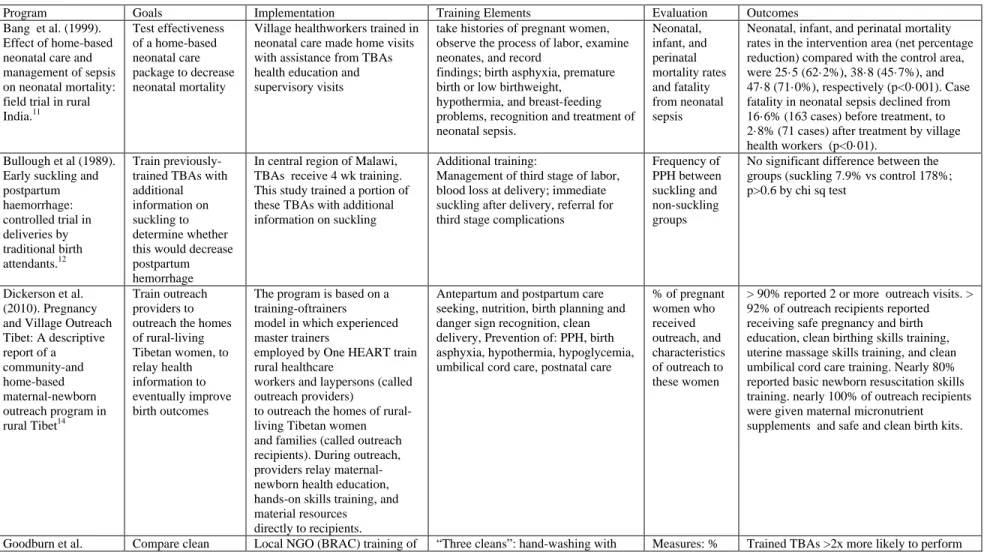
Appendix ... 52 Table 1 Programs included in Systematic Review
3
INTRODUCTION
Haiti has the highest maternal mortality ratio in the Western Hemisphere, estimated at 300 deaths per 100,000 live births.1 Though Haiti’s mortality data are difficult to assess due to missing and inaccurate death reports, the burden of suffering due to maternal mortality in Haiti is estimated to be great; 1/93 women die of pregnancy or childbirth related complication in Haiti, compared to 1/2900 in Europe and 1/140 worldwide.1
In a systematic review of studies of maternal mortality by the WHO, severe bleeding, hypertensive diseases, obstructed labor, abortions, and sepsis were the dominant causes of maternal mortality in Latin America and the Caribbean.2 Eighty percent of cases cluster around labor, delivery, and first 24-48 hrs postpartum. Most life-threatening obstetric complications cannot be predicted or prevented in the antenatal time period, therefore the entire population of pregnant women is at risk.3 For example, at least two thirds of post partum hemorrhages occur in the absence of any risk factors.4 Approximately 15% of pregnant women will need emergency obstetric care (EOC) to manage life threatening complications to the mother and child.5 The access to these services is what may determine the outcome of a complication.6
4 Family Health Ministries, a non-governmental organization (NGO) based in Durham, NC, has been working in Haiti in the cities of Port-Au-Prince, Leogane, and the area of Fondwa in the Leogane Commune for over 10 years. The NGO began its work with cervical cancer screening and prevention, and has since expanded its programs to include nutrition, education, and other women’s health issues. FHM conducted focus groups with women in the area of Leogane and Fondwa, Haiti in 2009, and discovered reducing infant and maternal mortality was of high priority to these communities. They consequently developed plans for a Safe Motherhood Initiative, the goal of which is to reduce maternal and infant mortality and morbidity in the Leogane Commune by 1) building a referral research and health center and by 2) improving outcomes in home deliveries. The second part of this goal will be partially addressed by evaluating ways that TBAs might be able to participate in improving rural birth practices. This TBA evaluation / education program will take place in the Communal Section of Fondwa, part of the Leogane Commune. Fondwa is a mountainous region in southern Haiti, home to
approximately 8,000 inhabitants and is in the referral area for Leogane.
5 Evaluation of the program will take place at several levels. We will assess how well the TBAs learn and retain information through identical tests given before and after the program. Additionally, we will gather survey data from women in the community to determine mortality rates and rates of indicators of mortality to discover whether or not the program has had a positive impact. We will also conduct focus groups with the TBAs and community members to determine how to improve the program. The TBAs will also be asked to report on the outcomes of the births they attend to form a birth registry.
The first section of this paper is a systematic review of the literature that identifies TBA training programs that are similar to our Haitian TBA educational program. This section attempts to describe lessons learned from the strengths and weaknesses of each study. The second section describes the program plan, providing an overview, the program context, the Health Belief Model theoretical basis for the program, and details goals, objectives and plans for
6
SYSTEMATIC REVIEW
Introduction
The purpose of this systematic review of the literature is to recognize programs that are similar to our TBA education program in Haiti, with the purpose of learning from these programs to improve our own. Comparable programs should incorporate the elements that are essential to the Haitian TBA program, which include:
1) Population: traditional birth attendants (TBAs) or lay healthworkers in developing countries
2) Intervention: educating traditional birth attendants or lay healthworkers in safe birth practices to improve birth outcomes
3) Outcome: improving skills, reducing maternal and neonatal morbidity and mortality 4) Focus on preventing 5 main causes of maternal mortality: hemorrhage, obstructed
labor, infection, complications from abortion, and preeclampsia and on preventing causes of neonatal mortality: sepsis, asphyxia and tetanus.
5) Comparable intervention and control groups for evaluation purposes
Programs that are identified as comparable to the TBA education program in Haiti will be analyzed, and strengths and weaknesses discussed. The conclusion to this analysis will discuss incorporating lessons learned into our Haitian TBA education program to improve its
7
Methods
Research Question: I searched to literature with the following question in mind: What can be learned from previous and existing TBA education programs that share central elements with our program? Programs must contain elements 1, 2, 3, and 5 above to be considered for review. At least one part of element 4 should be the focus of the program.
Search Strategy: I conducted a search of the PubMed database to identify articles describing similar programs. The search ((("Midwifery"[Mesh]) AND ("Developing
Countries"[Mesh] OR "Rural Health Services"[Mesh])) AND "Education"[Mesh] identified 212 articles. Hand searches through Cochrane review articles were also conducted. Inclusion criteria to further narrow the search were:
1) The article is in English.
2) The article is available in full text format.
3) The article describes a program that has been, or is currently, implemented and is not solely a case study or a pilot study.
4) The program shares central elements with the Haitian TBA education program, including elements 1, 2, 3, and 5, and at least one part of element 4.
8 before/after design) as described in element 5. Any articles that did not include a description of the training were excluded.
After inclusion criteria 1) English, and 2) full text were used, 57 articles remained. Abstract review narrowed the search to 6, and after full text review, 3 articles remained from the original PubMed search. An additional 2 articles were identified through hand searches, for a total of 5 studies that met inclusion criteria. These studies are summarized and analyzed below, and also are presented in Table 1 (Appendix).
Summary of Comparable Programs
Bang, et al. (1999). Management of neonatal sepsis in India
This program addresses the problem of high neonatal mortality in rural areas of India.11 The group identified a lack of attention to neonatal sepsis, which is a major cause of death in the neonatal period, especially when hospitalization rates are low. The study was completed in 39 intervention and 47 control villages in Gadchiroli, an extremely underdeveloped district where roads, communications, education, and health services are poor. SEARCH (Society for
9 was the most common cause of death for neonates in the first year of the study, so early detection and treatment became the focus of home-based neonatal care. The management of sepsis
included: advising parents to hospitalize the child, and if the parents were unwilling, antibiotic treatment for the child at home. Recording of births and child deaths was conducted during 1993–98 by an independent set of workers in the intervention and the control areas.
The primary outcome was the effect of intervention (trained village health workers attending to neonates) on neonatal mortality rate; the secondary outcome measures were the infant and perinatal mortality rates. Neonatal, infant, and perinatal mortality rates in the
intervention area (net percentage reduction) compared with the control area, were 25.5 (62.2%), 38.8 (45.7%), and 47.8 (71.0%), respectively (p<0·001). Case fatality in neonatal sepsis declined from 16.6% before treatment, to 2.8% after treatment by village health workers (p<0·01). The number of deaths averted by the interventions was a total of 51 deaths. One death was averted for every 18 neonates receiving care.
A strength of this program and study was their use of intervention and control groups. Though the groups were not randomized due to feasibility reasons, the groups were similar in sociodemographic data and mortality rates. This design made it possible to directly compare the groups and draw some definitive results. One strength of this program, which is an aspect that could be applied to the Haitian TBA education program, is the third stage training of mothers and grandmothers on care and nutrition during pregnancy, initiating early and exclusive breast feeding, prevention of infection, etc. Another strength is the simplicity of the intervention. The diagnosis and management plans are easy to understand, and therefore are more easily
10 Some weaknesses of this program were the necessary qualifications of the village health workers. The necessary attributes were literacy, village residency, acceptance by the community, and willingness to visit the home at the time of labor and in the neonatal period. Replicating all of these aspects, especially the literacy component, is not possible in the Haitian TBA study, as almost all of our identified TBAs are illiterate. Another weakness is the lack of quality control measures for the training period for the village health workers, and as such it is difficult to determine the differences in knowledge and skills before and after training.
Bullough, et al. (1989). Early Suckling and Postpartum Hemorrhage in Malawi
This study’s goal was to investigate reducing postpartum hemorrhage (PPH) with additional training for previously trained TBAs.12 The strategy for reducing PPH was to train TBAs in the practice of putting the baby to the breast immediately after delivery, as suckling stimulates uterine contractions in lactating women. There had been no previous trial on the effectiveness of this approach for reducing PPH, and this method was already being advocated without proof of its efficacy.
The study took place in the central region of Malawi, where about half of all deliveries occur outside of the hospital. Some of these births are attended by TBAs who had received a 4-week training, including instruction in carrying out normal deliveries and recognition of risk factors during antenatal care and in labor.
Researchers based randomization into intervention and control groups on TBA. All TBAs participated in a 2-day refresher course. The TBAs randomized to the intervention group
11 4) referral for third stage complications for bleeding and retained placenta. The record collection form contained drawings to represent the information required. Researchers made follow-up visits to the TBAs’ homes at every 4 or 5 weeks to assess their performance, reinforce teaching, and collect data forms. As most of the TBAs had no formal education, quality control
mechanisms were put in place, consisting of a community midwife not involved in the research project visiting with each TBA. She asked about the methods used to collect blood for
measurement and tested the TBA on measurement of blood loss.
The results from this study show the frequency of PPH did not differ significantly between the groups (suckling 167 [7.9%] vs control 178 [8.4%]; p > 0.6; 95% confidence interval suckling minus control = - 2.1 % to + 1.2%).
A strength of this program was the inclusion of illiterate and innumerate TBAs. Low levels of literacy are common worldwide, so this makes this program more applicable to other countries as well. The authors documented careful teaching in measurement methods for the TBAs. Another strength was the prevention of reporting bias. The study coordinators took pains to ensure that the TBAs would not distort results; i.e. they were not told that the methods they were being taught would result in decreased PPH. An additional strength was the inclusion of follow-up visits to the TBAs homes, as it is essential for the program leaders to give continuing support to the trainees in the form of resources and additional teaching. We will attempt to do something similar in our study by having the TBAs come to one central location to meet for follow-up, resources, and instruction.
12 failed to produce results or the fact that the methods taught do not in actuality produce these results. In fact, this study has been cited as a reference that suckling does not prevent PPH.13 Another weakness was that maternal mortality was not the endpoint, though PPH is one of the main causes of maternal death. There was only 1 maternal death from hemorrhage of the 4385 pregnancies in the study.
We learn from this study that it is important to be sure interventions actually produce the desired results before investing precious resources in an education program focused on these interventions. Our study likely will not include early suckling as a way of preventing PPH, though it is encouraged as a way to promote early bonding between mother and infant.
Dickerson et al. (2010). Pregnancy and Village Outreach Tibet
The Pregnancy and Village Outreach Tibet (PAVOT) program is a community- and home-based maternal-newborn outreach in rural Tibet.14 The program was developed to provide health-related services to pregnant women in rural Tibet who are at risk of having an unattended home birth. In rural Tibet, local health systems are weak, and healthcare access is difficult due to economic and cultural factors, compounded by rugged geography and poor transportation.
13 information on antepartum and postpartum care seeking, nutrition, birth planning and danger sign recognition, clean delivery, umbilical cord care, postnatal care and prevention of PPH, birth asphyxia, hypothermia, and hypoglycemia. They also provided maternal micronutrient
supplements and safe and clean birth kits.
The PAVOT program differs significantly from the Haitian TBA education program in that the trainees are outreach providers that relay information to the communities and do not directly participate in the birth process. In the course of the program it may be possible that those receiving information in the communities are the laypersons who regularly attend births, but this information was not possible to ascertain from the study, and was likely not measured. More than 960 pregnant women received outreach visits, with 92% of outreach recipients reporting receiving safe pregnancy and birth education, clean birthing skills training, uterine massage skills training, and clean umbilical cord care training. Nearly 80% reported basic newborn resuscitation skills training, and nearly 100% were given micronutrient supplements and birth kits. Most women (88.1%) reported that they received uterine massage after labor. Nearly all (96.9%) reported that a safe and clean birth kit was used during delivery. Nearly 95% of newborns were reported to have been dried and stimulated immediately after birth. More than half (58.5%) reported breast-feeding the infant within the first hour after birth, whereas about one-fourth (22.8%) reported initiation of breast-feeding after 24 hours.
14 our TBA program, which perhaps could be performed by the TBAs themselves. The strength of the overall report is the demonstrated feasibility of implementing such a program in rural areas such as Tibet.
One weakness to this study is that it did not report mortality data. Intermediate outcomes were reported, not all of which have definitive evidence for reducing mortality (i.e. antepartum and postpartum healthcare visits). Another drawback to this study was that it not as useful as expected to our study because the main focus is on training the women, not on educating the TBAs. The training program for the outreach providers did not have any assessment that was reported, so it is difficult to know how well the providers understood their training. Quality assurance data came from the outreach recipients, the rural Tibetan women, who may have been biased or unknowledgeable of the components of the study. Reporting of health-related behavior, such as clean births, was not confirmed by observation.
Goodburn et al. (2000). Training Traditional birth attendants in clean delivery does not prevent postpartum infection
The goal of this study was to compare postpartum infection rates of deliveries conducted by trained TBAs vs. those conducted by untrained TBAs. The study took place in rural
Bangladesh, in an area in which the Bangladesh Rural Advancement Committee (BRAC) had trained TBAs in the “three cleans” (hand-washing with soap, clean cord care, clean surface). The outcome measure was postpartum genital tract infection diagnosed by a symptom complex of 2 out of 3 of: foul smelling discharge, fever, lower abdominal pain.
15 at the delivery. The mothers and relatives were also asked to identify the status of the birth attendant. If claimed to be a TBA, her training status was checked. The mothers or relatives who were present at the delivery reported symptoms, and follow up visits were made at 2, 6, and 12 weeks postpartum by lay health workers who recorded details of symptoms and did a brief physical exam. The mothers also provided data on whether or not the birth had been “clean”.
Trained TBAs were more than twice as likely as the untrained TBAs to perform a “clean” delivery. There were no significant differences between the two groups regarding manipulation of the baby during delivery, but the trained TBAs were significantly more likely to insert their hands into the mother’s vagina, the practice of which is associated with high rates of infection. Moreover, it was demonstrated that only 45% of trained TBAs were practicing clean deliveries, which could be considered disappointing considering that the BRAC training is carefully conducted and follow up is the norm. There was no demonstrated relationship between the training status of the TBA and maternal infection. The results also suggested that the most potent risk factor for postpartum infection is likely to be a pre-existing reproductive tract infection (RTI). Also, practicing a’ clean’ delivery by these standards might not in fact prevent infection when every surface is contaminated.
16 The authors drew many conclusions from these results such as training for TBAs might not be as effective as once thought, but I have difficulty drawing any conclusions from this study due to possible biases and confounding factors.
Jokhio et al. (2005). TBAs and Perinatal and Maternal Mortality in Pakistan
The study’s focus was determining if the training program for TBAs in a rural district of Pakistan was effective in reducing maternal and perinatal mortality. The study was a cluster randomized design, with 7 villages (talukas) randomized into intervention and control groups. The intervention was training the TBAs in 3 of the 7 talukas by obstetricians and female paramedics. The training program consisted of three days and involved the use of picture cards containing advice on antepartum, intrapartum, and postpartum care; how to conduct a clean delivery; use of disposable delivery kit; when to refer women for emergency obstetrical care; and care of the newborn. They are supported by Lady Health Workers, women who are trained with 3-6 months of primary care and family planning knowledge who are based at primary health centers. Outreach clinics were organized in the areas of the intervention. In control clusters, the Lady Health Workers enrolled and followed up on all pregnant women in their catchment area in the course of their normal monthly home visits. The TBAs received no extra training, and there were no outreach clinics, as per “usual care”.
17 hemorrhage as a complication of pregnancy. Women in the intervention group were more likely than those in the control group to be referred to emergency obstetrical care for treatment. The overall conclusions from this study were that the use of trained TBAs was associated with significantly reduced perinatal mortality, but a non-significant reduction in maternal mortality.
Some strengths of this study include the integration of the TBAs with the existing health programs to improve birth outcomes. The technique of connecting TBAs with health systems has demonstrated to be effective in the past; however, it becomes a confounding factor and makes drawing conclusions about the efficacy of TBA training difficult. Another strength of the study was the study design. Control groups and randomization, combined with the large size of the study, make drawing more definitive conclusions possible. However, as the authors mention in their discussion, the study was still not powered enough to detect a significant decrease in maternal mortality. Of all those reviewed, this program is probably the most like the Haitian TBA education program, so much can be learned from the process. Unfortunately, this training program only lasted three days, compared to the four week program in our study. Also, they did not describe any measures to assure that the TBAs had learned the material well before sending them to actual deliveries, which will be a major component of our program.
Analysis
18 births.14 For this reason it is very difficult to draw conclusions about which program is most effective, and even if training TBAs is effective at all.
The one training element that was present in all programs was prevention of infection. Some mentioned the “three cleans” (hand-washing, clean cord care, clean surface), but not all. Our program will also include a clean delivery section, and will hopefully be more effective than the intervention described in Goodburn et al.16
One problematic aspect of a few of these studies is that they do not fully describe the program components, which makes it difficult to analyze the successes of each program due to specific interventions, such as cleanliness. For example, in the Goodburn et al. study, there was concern over the trained TBAs practicing the unsafe behavior of inserting their hands into the vagina during childbirth.16 A description of the training program would be helpful in this case to determine if some part of the curriculum was misinforming the TBAs. Additionally, the length of the training programs varied widely, from 3 days to gradual training over years. This makes it difficult to predict the effect of our 4-week education program.
Few studies described any measures taken to assure that the TBAs actually effectively learned what they were being taught. In our program, assessment of knowledge and skills will be a large component of the initial stages of the program. This step is essential in assessing the effectiveness of the teaching of the program content.
19 effectiveness data. Our current plan does not include a cost effectiveness assessment, but it would be a good addition at a later date.
Evaluation differed in each study. All used control groups, which is a step toward good study design. Our study will use a pre- and post-test design, where the TBAs serve as their own controls before and after training. Consistent training and evaluation methods must be
implemented, or we may never answer the question of whether TBA training is effective.
Conclusion
Many of these studies draw contradictory conclusions about TBA training and birth outcomes. Though the outcomes differ, lessons may still be learned from the individual studies. One lesson is the importance of implementing evidence-based interventions. As in the cases of suckling for PPH prevention12 and maternal infection rates16 it may not be cost effective to put much time and effort into training TBAs in an intervention that has no demonstrated ability to achieve anticipated results.
Another lesson that can be gleaned from these studies is the importance of avoiding reporting bias. Many studies relied on the mothers or the TBAs themselves to report on birth outcomes, which could introduce significant bias and make results unreliable. At the moment we have not identified who will gather results on maternal and neonatal morbidity and mortality in the community in general, but hopefully we will be able to find an impartial third party to do the data collection. Finally, it is clear that, to achieve any meaningful conclusions, the study must be designed well, with a control group, and large enough numbers of participants to detect a
20
PROGRAM PLAN
Program Overview
Family Health Ministries (FHM) conducted focus groups in the area of Leogane and Fondwa, Haiti in 2009 and discovered reducing infant and maternal mortality was of high priority to the communities. In response to this need, FHM is developing a Safe Motherhood program with the goal of reducing maternal and neonatal mortality; this includes building a hospital in Leogane and educating TBAs in the Fondwa area in safer birth practices. The education program curriculum for the TBAs instructs on these basic topics: 1) cleanliness, 2) pre-eclampsia, 3) fetal heart rate, 4) fetal position, 5) neonatal resuscitation, 6) hemorrhage, 7) clean cord care, 8) newborn assessment, 9)post partum infection, 10) maternal tetanus
vaccination, and 11) birth registry development.
We will train an identified community leader to co-teach the program, and collectively teach the program to TBAs for 4 weeks. We will administer pre- and post-tests to the TBAs to determine their improvement in knowledge and skills. We will also gather baseline data on maternal and neonatal morbidity and mortality in Fondwa by conducting surveys of randomly selected households. Additionally, we will map surveyed houses and houses of trained TBAs using GPS technology, to later compare outcomes in a clustered design. The TBAs will also be required to report birth registry data, including births and deaths of mothers and neonates, to the community leader.
Program Context
21 UNICEF, the World Bank and the United Nations Population Fund, was launched at a
conference in Nairobi with the goal of reducing the number of maternal deaths by half by the year 2000. The United Nations Millennium Development Goals (MDGs), which outline a global action plan to achieve anti-poverty goals, evidenced commitment to women’s health by setting the target of MDG 5 as reducing the maternal mortality ratio by 75% from 1990 to 2015.17 These aims have proven more difficult to attain than initially anticipated, and MDG 5 is the goal
towards which the least progress has been made.17 Since 1990, the number of women dying due to complications of pregnancy and childbirth has only decreased by approximately 34% (2008).1 As previously mentioned, the women who carry the greatest burden in the Western Hemisphere are the women of rural Haiti.5
The WHO method of determining deaths attributed to childbirth and pregnancy in Haiti is calculated using national survey data in a multilevel regression model to adjust for
underreporting and misclassification.1 Reporting the trends using the maternal mortality ratio (MMR) as opposed to the maternal mortality rate (number of deaths per 100,000 childbearing women) removes the effect of total fertility rate, which has been declining in Haiti from 5.02 in 2005 to 3.17 estimated in 2010.18 Haiti has experienced a decline in maternal mortality since 1990, from an MMR of 670 in 1990 to an MMR of 300 (lower estimate 180, upper estimate 520) in 2008. This translates to a drop in mortality by 55%, and an annual decline of 4.4%, which is closer to being on track for the MDG goals than the global rate of 2.3%1. Still, the MMR of 300 stands in stark contrast to that of the rest of Latin America and the Caribbean, which averages an MMR of 85.1
22 specifies the most common causes of maternal mortality in Haiti are: hypertension/eclampsia, hemorrhage, anemia, infection, obstructed labor and complications of abortions. The
government’s plan takes its goal for reducing maternal mortality from MDG 5.19
Additionally, there are many non-governmental organizations (NGOs) in Haiti that have proposed solutions for reducing maternal mortality. Two of the more prominent institutions are discussed here. USAID’s program uses a strategy with three main focuses: deliver a basic package of health care services, provide support to the government of Haiti to increase its capacity to carry out the executive function of managing a national health care system, and mobilize private sector partners to improve the health sector in Haiti.20 The World Health Organization’s Free Obstetric Care project emphasizes payment to health facilities for pregnancy, birth and postpartum services; refunds to pregnant women of transport costs; and payment to traditional birth attendants who accompany pregnant women to the health institutions for birth.21
Political Environment
In the commune of Leogane, where the TBA education program will be implemented, the environment is very favorable towards the initiation of this program. As previously mentioned, before program planning began, focus groups of women in the Leogane Commune identified maternal and child health as priorities. When representatives of FHM met with the TBAs, their response to the suggestion of partnering with them was universally positive.
23 beneficial, for sake of healthcare coverage, and detrimental due to lack of coordination.22 The large cadre of NGOs provides critical services such as healthcare, education, and job creation. The reality of the political climate is such that Haitians look to NGOs rather than to the
government to provide their basic public services. FHM is a trusted NGO that has been providing public health, primary care, and women and children’s health services in the community for over 10 years.
Consistency with local, state, and national priorities
As mentioned previously, the community of Leogane itself identified maternal mortality as a priority. Reducing maternal mortality is also a national priority, as expressed in the “Plan Stratégique National pour la Réforme du Secteur de la Santé.” This plan is based on the goal 5 of the Millennium Development Goals, to reduce the maternal mortality ratio by 75% from 1990 to 2015. 17
Acceptability to providers and recipients
Local providers, the TBAs, unanimously approved the plans for a training program. They were especially enthusiastic about obtaining greater access to health care, education, and
24 not been documented. At this time, the program will service a mostly homogenous population of poor, rural, Haitian women.
Possible financial resources
The TBAs will be compensated with meals during training sessions. Those who
successfully complete the program will receive a certificate of participation and a kit containing: gloves, soap, blood pressure cuff, urine test strips, fetoscope, self-inflating bag-and-mask, cord tape, tape measure, baby scale, thermometer, bulb syringes, maternity sanitary pads, gauze pads, and cotton caps, all of which will require significant financial resources. A local leader, serving as a program coordinator, will be compensated with a salary as well. Airfare and
accommodations for trainers and evaluators will also be included in program costs.
Currently FHM is applying for a grant from the Bill and Melinda Gates Foundation. Additionally, travel scholarships from Duke University are being sought.
Technical feasibility
Adequately trained researchers from FHM will be available at the initiation of the education program, after which we will utilize a train-the-trainers model to provide in-country trainers for TBAs. These researchers will initially be responsible for most aspects of the
program, from gathering the birth kit supplies to evaluation, but these responsibilities will ideally be transferred to the community leaders.
25 these differences has been an issue in even large investigations.15 Intermediate outcomes, such as rates of infection and postpartum hemorrhage may be more feasible to measure in the short-term, and will be measured through community surveys.
Stakeholders
In addition to the women who will benefit from this program, the following stakeholders will serve an integral part of the program. FHM’s staff and in-country project coordinator are charged with developing and maintaining the quality of the program. Additional FHM research team members will be trained in conducting the evaluations of the TBAs, which will be an essential part of quality assurance. Community leaders also will invest time in promoting the program. The TBAs themselves are the most critical stakeholders of all, because the success of the program depends on their understanding of and performance after training.
Theoretical Basis
26 Perceived Susceptibility
The TBAs have a varying knowledge of the reasons for maternal and neonatal mortality. Most certainly know that mortality is possible during childbirth, but the extent to which it is known to be caused by biological and preventable causes is uncertain among TBAs. For
example, among some who practice voodoo, there is superstition about having too much ‘light’ on the subject, and midwives perform complete deliveries and umbilical cord cutting underneath a sheet.23 The TBAs may completely lack knowledge of some fatal conditions. It is essential that the trainers realize this and are able to provide basic education on the causes of maternal
mortality.
Perceived Severity
TBAs are much more likely to take action to prevent pregnancy complications if they believe the consequences of these complications are severe. TBAs likely are familiar with the consequences of mortality in a family, but may not be completely familiar with consequences of morbidity, such as a vaginal fistula, and may not connect certain conditions with risk of
mortality. The educational curriculum should include information about possible consequences of these complications. We would hope that, though the consequences are not direct to the TBAs, they would feel obligated to prevent these consequences in the women in their community with whom they work.
Perceived Benefits
27 TBAs will perceive benefits to their community as a great enough impetus to change their
behavior. Additionally, TBAs with good birth records will be more highly respected and their services requested in the community.
Perceived Barriers
Perceived barriers among TBAs include lack of resources, lack or difficulty of
transportation in emergency settings, and lack of knowledge about a disease or risk of disease. The barrier of lack of resources will be addressed by giving TBAs who pass the course a safe delivery kit, to be resupplied when needed. The lack and difficulty of transportation is beginning to be addressed with FHM improvements in the community, such as new roads, but the best solution to this problem will come in a later stage of the project with the construction of a maternity hospital in Leogane equipped with an associated ambulance & all terrain vehicles.
Cues to Action
This construct refers to prompts that remind or encourage participants to take the recommended action. Strategies to activate the TBAs readiness will be practiced in the skills portion of the education sessions, so that when they are presented with a potentially life-threatening situation, they will respond appropriately.
Self-Efficacy
28 plan refresher courses after 1 year of practice, which will increase knowledge and confidence of the TBAs.
Goals and Objectives
Goal:
To reduce maternal and infant morbidity and mortality in the Leogane Commune.
Short term objectives:
By June 2011, the one chosen community leader will have completed the train the trainers program to be able to co-teach the curriculum.
By July 2011, at least 95% of TBAs will have completed the 4-week education program and be skills and knowledge competent at the 80% level.
By July 2012, birth registry and outcome data will be collected by the TBAs and effectiveness evaluation will be complete.
By August 2012, the FHM research team members in charge of evaluations will have completed evaluations on 100% of trained TBAs at 6 weeks, 6 mo, and 1 year post-education.
Long term objectives:
Within three years, the trained TBAs will have demonstrated competence at an 80% level after a refresher course.
Within three years, the referral rate from trained TBAs will be approximately 10% Within three years, the postpartum infection rate will be <1%
Within five years, the case fatality rate will by <1% for mothers and neonates in Fondwa Within five years, the original Haitian trainer will have trained an additional 3 trainers to begin TBA education programs in surrounding communities in the Leogane Commune
Logic Model
29
Implementation
The Family Health Ministries TBA education program is designed to give the TBAs of the Fondwa, Haiti knowledge and skills to safely deliver pregnancies. The ultimate goal of this program is to reduce maternal and neonatal mortality throughout Leogane, and, if successful, to expand this success to surrounding communities. The program will begin in the summer of 2011, and hopefully achieve sustainability and continue indefinitely. The overarching goal of FHM’s interventions in Leogane is to increase women’s access to and utilization of birth attendants with skills and knowledge of complications of labor, whether in the home or in a hospital.
Activities
Curriculum development
The curriculum for the FHM TBA education program will be unique in that it will be the first to teach TBAs to perform skills that are normally reserved for skilled birth attendants at an emergency obstetric care facility. Additionally, many of the TBAs are illiterate and innumerate, necessitating a curriculum that will accommodate with visual and verbal instruction. For these reasons, we will need to combine aspects of several programs. Our first step will be to
collaborate with any NGOs in Haiti who have established TBA education programs. The NGO with an education program known to us at the moment is Partners in Health. We will contact this group to hopefully take advantage of their experience in and knowledge of training TBAs.
Two established programs for training home birth attendants are the American College of Nurse Midwives curriculum and the Helping Babies Breathe curriculum. We will take aspects from these curricula to make a comprehensive TBA training program.
30 rate; 4) fetal position, breech birth, and shoulder dystocia; 5) neonatal resuscitation; 6) post partum hemorrhage; 7) umbilical cord care; 8) newborn/infant assessment; 9)post partum infection; 10) maternal tetanus vaccination; and 11) birth registry data.
Recruiting TBAs and recipients
Inclusion criteria for the TBAs will include women or men who currently work as TBAs for childbearing families in Fondwa, a part of the Leogane Commune. TBAs were recruited through word of mouth by a local Haitian nurse. Pregnant women (recipients) will be identified through surveys of the community every 3 months.
Education Program
The identified TBAs will participate in a 4 week education program co-taught by an identified community leader and the program developer. Training will be appropriate for the literacy level of the TBAs. TBAs who successfully complete the training will receive a safe delivery kit. Quality assurance measures include testing each TBA with a pre-test before
beginning the education program and a post-test after completion. This test will be repeated at 6 weeks, 6 months, and one year post training. “Passing grade” will be 80%. FHM research team members will administer these oral tests. Continuing education: the TBAs will be invited back yearly for a refresher course and pre-and post-tests. At this point the TBAs will receive
replacement supplies for their safe delivery kits.
31 A local leader will be identified by the in-country staff to be the co-leader for the TBA education program. A program leader from the US team will train the local leader in the essentials in a one-week program to familiarize her with the material and how to present it.
If this program is deemed successful at improving birth outcomes, the next step is to disseminate the program’s strategy through a train-the-trainers model. At this time the local leader identified in the first step will be able to conduct a one week education program similar to the one she received before beginning the program. Prior to initiating this train-the trainers segment of the program, the initial local trainer will be evaluated in a TBA session to assess her preparedness to train additional trainers. Additional trainers will be identified by the local staff, and can be healthcare providers or TBAs.
Resources
Resources required for the function of this program include human, physical, and financial. Human resources required are an in-country program coordinator, a local leader, and the US staff working on applications and program assessment. Physical resources needed include safe delivery kits (to include: gloves, soap, blood pressure cuff, urine test strips, fetoscope, self-inflating bag-and-mask, cord tape, tape measure, baby scale, thermometer, bulb syringes, maternity sanitary pads, gauze pads and cotton caps), and education materials such as paper and printer, writing utensils, body models, and projector system. Financial resources required include plane fare for program leaders, salaries for the staff, compensation for TBA meals and for
interpreters, and a salary for the local leader from FHM.
Budget
See table 2 (appendix) for an estimated budget for the initial 13 mo of the program.
Timeline
32
Strategies for Sustainability
The FHM TBA education program is expected to maintain moderate sustainability. As FHM continues its work in the Leogane Commune, including hospital construction, the
education program can be expected to continue due to its modest use of resources and utilization of local staff. Important aspects of sustainability that must be considered to ensure that this program continues to function over time include a long-term vision and sustainability plan, results orientation, strategic funding, broad based community support, adaptability, and strong internal systems.
Vision
The overarching goal of the TBA education program is to make available trained TBAs to childbearing households until all births are taking place in a care facility. The construction of a nearby hospital is underway, but even after construction is completed, travel is so difficult and resources are so limited in this region that many women will continue to deliver at home. Therefore a reliable and continuing education program will be necessary in the area for some time. Continuing the train-the-trainers model will help quickly multiply the number of trained TBAs to cover more of the population and to develop a network of relationships between the TBAs and the new health center.
Results Orientation
33 Strategic Financing
FHM has some consistent financial backers in the United States, but sustaining this program may require additional resources. We will reapply to the Gates Grant, as well as search out additional non-profit organizations and international donors to keep the program funded.
Broad-based Community Support
In this area the program will excel, because the community has identified maternal mortality as one of their top priorities and almost all of the participants and staff for the program will be local. Still, it will be essential to monitor the community support and utilization of the program as it continues to grow.
Adaptability to Changing Conditions
FHM as a whole has already demonstrated its flexibility and adaptability to changing conditions in the months after the earthquake of Jan, 2010. For a few months, the organization changed from providing healthcare and preventative services to providing earthquake relief. Funding and staff utilization are very fluid, so changes to the system can be accomplished quickly. The program will need to be able to adapt to changes based on the results from the evaluation of the program, with the goal of improved quality of education and birth outcomes.
Internal Systems
35
EVALUATION PLAN
Rationale for the Evaluation
In evaluating this TBA education program we would like to determine its primary effectiveness in both educating TBAs and eventually improving birth outcomes, determine its ability to reach the target population in Fondwa, assess its acceptance and adoption by the community, evaluate its consistency and cost of implementation, and assess the maintenance of changes in the TBAs’ knowledge and skill over time. These evaluations will take place in a stepwise fashion over many years.
The primary evaluators in assessing the efficacy of the education curriculum will be the midwife who is the principal research investigator and myself. We determined that an internal evaluator would be appropriate at this stage of the investigation, due to the complex and very fluid nature of the program at this stage. We do see some of the problems with this approach, such as the potential for bias and the issues associated with the cultural barrier,25 but we feel that the need for an internal evaluator outweighs these problems. We did investigate the option of an external evaluator—a preferably Haitian medical professional who would have time to invest in learning the intricacies of the program and the exact skills needed for evaluation--but no person such as this is forthcoming. Later in the life of the program we hope to transfer some of the evaluation duties to an external evaluator.
36 to assess the efficacy of the education program. For example, the evaluators will need to know the proper technique for determining the position of the fetus, and additionally be able to actually determine the position themselves through the gold standard of fetal ultrasound. We are currently in the process of acquiring the skills to accurately evaluate the TBAs. For the second part of the evaluation, evaluators will need to know how to assess for maternal and neonatal mortality and morbidity. This involves skills in implementing a survey, the exact type depending on the method chosen to determine morbidity and mortality. Throughout the evaluation process, the evaluators must have the skills of adaptability and cultural sensitivity.
The key stakeholders in this program are the FHM staff and investigators, the community and community leaders, the funders, and the TBAs themselves. Key questions from the FHM staff are: what did the TBAs learn from the program, was what the matriculation rate, which activities were delivered and were they delivered as planned, how the program can be improved, and were there any unintended outcomes. Community leaders will ask: how many women were reached by the trained TBAs, how did participants find out about the services, and how did the project impact the community. The funders will ask: does the program work, how were funds used and were they used effectively, and how can the program be improved. The TBAs will ask: did the education improve their birth outcomes, are they satisfied with the program, and what parts of the program worked well and what parts didn’t work well. All stakeholders will be interested in knowing whether or not the program reduces mortality and improves the health status of the community.
37 bias. The use of internal evaluators might also be suspect for introducing bias in the results. Additionally, assessing maternal and neonatal mortality is a very difficult process, and it is likely we will go through several methods of collecting this data before settling on the best approach.
Approach to the Evaluation
As the overarching goal of this program is to reduce maternal and neonatal mortality in Fondwa, the principal focus of the evaluation will be to determine if this TBA educational program has contributed to a reduction in mortality. All evaluations that take place for this project should keep this focus. Each step leading to this goal, even each education session, also needs to be evaluated, so each step may be adjusted for better efficacy in working toward reduced mortality rates.
Evaluation Design
In evaluating the Haitian TBA education program we will use Kirkpatrick’s Four Levels of Training Evaluation structure as a model.26 To accomplish this, we will use two recognized evaluation designs: one group pre- and post-test, and the other prospective cohort study.
One group pre- and post-test
38 One benefit of using the pre-and post-test design is that data can easily be analyzed for indications of the amount of change in participants. This allows for comparisons at the individual as well as population level. The outcome of whether or not the participants improved is easy to understand and to calculate with pre-and post-test data. Disadvantages of using this design in this setting are that, because of the low literacy levels of the TBAs, these tests will have to be
scripted and verbally administered, which may be very difficult. This will increase the time and resources devoted to each test. There is also risk of a testing effect, in which the process of being involved in providing the pre-test data affects the post-test data,27 though we do not anticipate this will be a problem in our situation. One risk that we are wary of is instrumentation, in which differences in collecting the pre- vs. post-test data may account for differences in the outcomes. We are aware of this and have taken steps to ensure that this is not a problem (e.g. same
evaluators, same exact test used for both).
Two-group prospective cohort study
We will use the prospective cohort study to determine whether the TBA education program is effective in producing the results that we desire, i.e. decreasing neonatal and maternal mortality. This step is essential in program evaluation to determine whether the program is effective in producing impact in our main long term objective in decreasing mortality. In order to determine impact, we will compare the trends in mortality in regions without the intervention to the trends in mortality in the regions with the intervention. Utilizing unblinded,
39 Advantages to the prospective cohort study are that data can be collected on key variables from members of the groups before the beginning of the intervention and after exposure to the program. Also, the design allows comparison between two groups, instead of simply before-and– after. Disadvantages to this design are the extended follow up period, which is especially
difficult in unstable living environments, and the cost of time and resources associated with an intense and prolonged study.
Evaluation Methods
In evaluating this program we will attempt to assess all four components in the Kirkpatrick’s Four Levels of Training Evaluation.26 We will address: reaction, learning, behavior, and results.
Reaction to the TBA training program will be assessed by questioning the TBAs in a focus-group setting about if they enjoyed the training and if they considered it relevant and a good use of their time. We will also seek feedback on how to improve the course for the future. This will take place in qualitative interviews several weeks after the initial education sessions to get feedback on whether the training program was applicable to the TBAs’ work environments.
Learning of the TBAs in the program will be assessed through pre-and post-tests to determine whether they increased knowledge and skills in delivery practices. The pre-and post-tests will be conducted through both quantitative and qualitative data collection. This will allow us to determine whether the trainees learned what we intended to teach them.
We will assess behavior changes of the TBAs by speaking to the women of the
40 questions what the birth practices of the trained TBAs are like out in the community setting, and whether the women of the community are satisfied with their behavior.
Results of the training will be assessed through the prospective cohort study. We will survey the randomly selected houses of the community to determine the initial maternal and neonatal mortality rate of the area, and to determine the rates of several indicators. While doing this we will GPS map the homes, and compare their location to the location of the service of the trained TBAs. After one year we will repeat the survey and compare the mortality and indicator data in areas that are serviced by the trained TBAs vs. areas that are not. We do not expect the mortality data to show improvement very quickly, but as the years progress we expect a decrease in the areas serviced by the trained TBAs.
Evaluation Planning Tables
Short Term Objective #1
By June 2011, the one chosen community leader will have completed the train the trainers program to be able to co-teach the curriculum.
Evaluation Question Participant Evaluation Method
Have the program director and community leader completed the training? If no, why not?
Community leader and program director
Open-ended interviews
How much time did it take for the leader to learn and be able to teach the program, and was it the proper amount of time?
Community leader and program director
Open-ended interviews
Was the train-the-trainers method effective?
Community leader and program director
Open-ended interviews
Is the community leader able to correctly co-teach the program?
Community leader Observation of teaching skills
Did anything unexpected happen?
Community leader and program director
Open-ended interviews
41 By July 2011, at least 95% of TBAs will have completed the 4-week training program and be skills and knowledge competent at the 80% level.
Evaluation Question Participant Evaluation Method
Did 95% of TBAs complete the training after 4 weeks? If no, why not?
TBAs, trainers Document review
What knowledge and skills have the TBAs learned in the program compared to their baseline?
TBAs, evaluators Pre-and post-tests
Did the trainees like and enjoy the training?
TBAs Open-ended interview
How appropriate was the length of the training?
TBAs, trainers Open-ended interview How understandable was the
information presented to illiterate and innumerate TBAs?
TBAs Open-ended interview
Did anything unexpected happen during the training?
TBAs, trainers Open-ended interview Were the TBAs satisfied with
the program?
TBAs Open-ended interview
Were the trainers satisfied with the program?
Trainers Open-ended interview
How can the program be improved?
TBAs, trainers Open-ended interview
Short Term Objective #3
By July 2012, birth registry and outcome data will be collected by the TBAs and effectiveness evaluation will be complete.
Evaluation Question Participant Evaluation Method
Did the TBAs collect birth registry and outcome data by 2012?
TBAs Document review
How well was the data collected?
TBAs, evaluators Document review, open ended interview
Is the evaluation of these outcome data complete?
Evaluators Document review
How many women were reached by the TBAs?
TBAs, women of community Document review Are women of the community
satisfied with the TBA training and outcomes?
42 How may this data collection
process be improved?
TBAs, evaluators Open-ended interview
Short term objective #4
By August 2012, the FHM research team members in charge of evaluations will have completed evaluations on 100% of trained TBAs at 6 weeks, 6 mo, and 1 year post-education.
Evaluation Question Participant Evaluation Method
Were the evaluations completed on time?
TBAs, evaluators Document review What percentage of the
trained TBAs were evaluated?
Evaluators Document review
Were the evaluations successful in assessing the change in knowledge and skill level of the TBAs?
TBAs, evaluators Focus groups, document review
Were the evaluations
completed in a time- and cost-effective manner?
Evaluators Document review, budgetary
review
Long term objective #1
Within three years, the trained TBAs will have demonstrated competence at an 80% level after a refresher course
Evaluation Question Participant Evaluation Method
Was a refresher course
completed within three years? If no, why not?
TBAs, trainers Open-ended interviews
What was the competency level of TBAs before and after the refresher course?
TBAs, evaluators Pre- and post-tests
How well did the community leader teach the refresher course?
Community leader, TBAs Observation, open-ended interviews
How effective was the
refresher course in improving birth outcomes?
TBAs, evaluators, community women
Open-ended interviews, Document review
Long term objective #2
Within three years, the referral rate from trained TBAs will be approximately 10%
Evaluation Question Participant Evaluation Method
43 trained TBAs at 3 years?
Why or why not are TBAs referring?
TBAs Open-ended interview
How successful are the referrals? (ie are women accepted at the referral center, ease of travel, time to
treatment)
TBAs, women of the community, referral centers
Open-ended interview, document review
Do referrals improve birth outcomes?
TBAs, women, evaluator Document review
Long term objective #3
Within three years, the postpartum infection rate will be <1%
Evaluation Question Participant Evaluation Method
What is the postpartum infection rate within 3 years for mothers and neonates in Fondwa?
Community mothers, evaluators
Document review of community surveys
How has this changed from baseline?
Community mothers, evaluators
Document review of community surveys Why has the postpartum
infection rate changed, if at all?
Community mothers, evaluators, TBAs
Open-ended interview
Did the postpartum infection rate lead to maternal or neonatal deaths?
Evaluators Document review
How was this data collected, and was it effective?
TBAs, evaluators Open-ended interview
Long term objective #4
Within five years, the case fatality rate will be <1% for mothers and neonates in Fondwa
Evaluation Question Participant Evaluation Method
What is the case fatality rate after 5 years for mothers and neonates in Fondwa?
Community mothers, evaluators
Document review of community surveys How has this changed from
baseline?
Community mothers, evaluators
Document review of community surveys Why has the case fatality rate
changed, if at all?
Community mothers, evaluators, TBAs
Open-ended interview How was this data collected,
and was it effective?
TBAs, evaluators Open-ended interview
44 Within five years, the original Haitian trainer will have trained an additional 3 trainers to begin TBA education programs in surrounding communities in the Leogane Commune
Evaluation Question Participant Evaluation Method
Has the original trainer trained additional trainers? How many?
Original trainer, new trainers, program leaders
Open-ended interview
How have these additional trainers been trained?
Original trainer, new trainers, program leaders
Open-ended interview How well have the new
trainers learned the curriculum?
New trainers, program leaders, evaluators
Observation, pre-and post-tests
Dissemination Plan
Dissemination of the results of our program evaluation is essential for 1) improving the program itself, and 2) improving the broader knowledge base from which other similar programs can draw. The many stakeholders in the program have an interest its continued success and we will respond by sharing all of the evaluation results with them.
45 and focus groups, in which we will hope to get directed feedback. We will also write and submit an article to an international obstetrics journal detailing the program and its effectiveness.
Eventually, our plan is to analyze mortality data in areas with the program compared to those without. This information will help us assess whether the program is successful in
46
DISCUSSION
The maternal mortality crisis continues in many countries around the world despite increasing worldwide attention to the problem. The situation in Haiti remains the worst of all its neighbors, and though it has seen modest reductions in its MMR in the last few years, it is not near achieving the MDG goal of 75% reduction of MMR by 2015.17 We know severe bleeding, hypertensive diseases, obstructed labor, abortions, and sepsis are the five most common causes of maternal mortality in Latin America and the Caribbean,2 and that most instances of maternal mortality cannot be predicted or prevented prenatally.3 Also, the prohibitive nature of the terrain and cost of travel prevent many Haitian women from seeking care at a hospital, even during complicated labor. For these reasons, we believe that this educational program for the TBAs of Fondwa, which focuses on safe delivery, emergency care and referrals, will positively impact maternal and neonatal mortality rates and increase awareness of safe delivery practices in the community.
The literature review was very useful to review strengths and weaknesses of other similar programs. One lesson learned from the systematic review was the importance of planning a program with evaluation in mind. It is very difficult to keep programs rigorous enough for evaluation if it is not built into the program plan. This involves setting goals and measureable objectives early in the planning stages of the program. We did look at several ways to evaluate the program early in development, which will allow us to draw stronger conclusions than if we had added on an evaluation plan as an afterthought. Another lesson learned, however, was the difficulty of assessing for maternal mortality. For example, one study with thousands of
47 outcomes, we learned to be flexible and reasonable in our expectations for this relatively small study.
Additionally, one helpful suggestion from the literature review was that community education could be provided by the TBAs. If we find motivated TBAs who are interested in teaching laypeople about pregnancy and birth, this could be very beneficial to the acceptance of the program in the community, and will contribute to improving the health of the community.
If our education program is successful, it will be the first program of its kind among TBAs. The subject matter is much more complex and training period longer than what was presented in the reports of other training programs. This program also has the potential to be cost-effective and sustainable, once it is transferred to the Haitian community leaders. The collaboration between the funders of FHM and local leaders is a step toward sustainability. If the program shows success, we plan to spread the program’s influence by expanding the train-the-trainers program to other sites.
Future suggestions for the program include greater collaboration with the other NGOs in the country that train TBAs, educating the TBAs in registering births with the governmental birth certificate (contributing to better reporting of births and deaths for national data), and training the TBAs in educating the community members about safe pregnancies and births. Eventually, we hope that the program can be completely Haitian-run, with support from a stronger local infrastructure.
There is potential for great progress in maternal health in Haiti, and we are hopeful that this program will improve maternal and neonatal birth outcomes in the area of Fondwa.
48 strong direction the program will have a well grounded beginning. Considering the
49
Acknowledgements
This program plan is based on a plan formulated by Marnie Cooper-Priest (CPM) and developed further by a research team from FHM, to which I contributed. I wish to thank Marnie for her collaboration and friendship. I also want to thank Dr. David Walmer, who served as my research
mentor this last year, for his guidance in developing this project and for helping me with this paper. Other contributing members of the FHM research team are Nicole Tinfo, Rachel Peragallo, Elizabeth Livingston, and Lauren Knelson. Thank you all very much! I am also greatly indebted to Diane Calleson and Pam Dickens for their help and guidance in developing
50 References
1. WHO. Trends in maternal mortality: 1990 to 2008: estimates developed by WHO, UNICEF, UNFPA. Geneva, Switzerland2010.
2. Khan KS, Wojdyla D, Say L, Gülmezoglu AM, Van Look PFA. WHO analysis of causes of maternal death: a systematic review. The Lancet. 2006;367(9516):1066-1074.
3. Campbell OMR, Graham WJ. Strategies for reducing maternal mortality: getting on with what works. The Lancet. 2006;368(9543):1284-1299.
4. Stanton C, Blanc AK, Croft T, Choi Y. Skilled care at birth in the developing world: Progress to date and strategies for expanding coverage Journal of Biosocial Science. 2007;39(01):109-120.
5. Barnes-Josiah D, Myntti C, Augustin A. The 'three delays' as a framework for examining maternal mortality in Haiti. Soc Sci Med. 1998;46:981 - 993.
6. Maine D, Rosenfield A. The Safe Motherhood Initiative: why has it stalled? Am J Public Health. April 1, 1999 1999;89(4):480-482.
7. UNICEF. At a glance: Haiti. 2010;
8. Chatterjee P. Haiti's forgotten emergency. The Lancet. 2008;372(9639):615-618.
9. Gage AJ, Calixte MG. Effects of the Physical Accessibility of Maternal Health Services on Their Use in Rural Haiti. Population Studies. 2006;60(3):271-288.
10. Sibley LM, Sipe TA, Brown CM, Diallo MM, McNatt K, Habarta N. Traditional birth attendant training for improving health behaviours and pregnancy outcomes. Cochrane Database Syst Rev. 2007(3):CD005460.
11. Bang AT, Bang RA, Baitule SB, Reddy MH, Deshmukh MD. Effect of home-based neonatal care and management of sepsis on neonatal mortality: field trial in rural India. The Lancet. 1999;354(9194):1955-1961.
12. Bullough CW, Msuku R, Karonde L. EARLY SUCKLING AND POSTPARTUM HAEMORRHAGE: CONTROLLED TRIAL IN DELIVERIES BY TRADITIONAL BIRTH ATTENDANTS. The Lancet. 1989;334(8662):522-525.
13. Smith J. Management of the Third Stage of Labor. 2010;
14. Dickerson T, Crookston, B, Simonsen, Sheng, X, Samen, A, Nkoy, F. Pregnancy and Village Outreach Tibet: A Descriptive Report of a Community- and Home-Based Maternal-Newborn Outreach Program in Rural Tibet. J Perinat Neonat Nurs. 2010;24(2):113-125.
15. Jokhio AH, Winter HR, Cheng KK. An Intervention Involving Traditional Birth Attendants and Perinatal and Maternal Mortality in Pakistan. New England Journal of Medicine. 2005;352(20):2091-2099.
16. Goodburn EA, Chowdhury M, Gazi R, Marshall T, Graham W. Training traditional birth attendants in clean delivery does not prevent postpartum infection. Health Policy and Planning. December 1, 2000 2000;15(4):394-399.
17. Rasch V. Maternal Death and the Millennium Development Goals. Dan Med Bull. 2007;54:167-169.
18. CIA. Central America and Caribbean: Haiti. The World Factbook. 2010.
19. Plan Stratégique National pour la Réforme du Secteur de la Santé 2005-2010.
51
21. WHO. Free ostetric care in Haiti. 2010.
22. Kristoff MP, Liz. Haiti: A Republic of NGOs? United States Institute of Peace Peace Brief. 2010;23(April 26, 2010).
23. Allman S. Childbearing and the Training of Traditional Birth Attendants in Rural Haiti. Medical Anthropology Quarterly. 1986;17(2):40-43.
24. Anderson F, Morton S, Naik S, Gebrian B. Maternal Mortality and the Consequences on Infant and Child Survival in Rural Haiti. Maternal and Child Health Journal.
2007;11(4):395-401.
25. W.K. Kellogg Foundation. Evaluation Handbook, Jan 2004.
26. Chapman A. Kirkpatrick's learning and training evaluation theory. Donald L
Kirkpatrick's training evaluation model - the four levels of learning evaluation 2009; 4/13/11.