
Generic Universal Forgery Attack
on Iterative Hash-based MACs
Thomas Peyrin and Lei Wang
Division of Mathematical Sciences, School of Physical and Mathematical Sciences, Nanyang Technological University, Singapore
[email protected] [email protected]
Abstract. In this article, we study the security of iterative hash-basedMACs, such asHMAC orNMAC, with regards to universal forgery attacks. Leveraging recent advances in the analysis of functional graphs built from the iteration ofHMACorNMAC, we exhibit the very first generic universal forgery attack against hash-basedMACs. In particular, our work implies that the universal forgery resistance of ann-bit outputHMACconstruction is not 2n queries as long believed by the community. The techniques we introduce extend the previous functional graphs-based attacks that only took in account the cycle structure or the collision probability: we show that one can extract much more meaningful secret information by also analyzing the distance of a node from the cycle of its component in the functional graph.
Key words:HMAC,NMAC, hash function, universal forgery
1
Introduction
A message authentication code (MAC) is a crucial symmetric-key cryptographic primitive, which provides both authenticity and integrity for messages. It takes ak-bit secret keyKand an arbitrary long messageM as inputs, and produces ann-bit tag. In the classical scenario, the sender sends both a message M and a tag T =MAC(K, M) to the receiver, where the secret key K is shared between the sender and the receiver prior to the communication. Then, the receiver computes another tag valueT0 =MAC(K, M) using her own key K, and matches T0 to the received T. If a match occurs, the receiver is ensured thatM was indeed sent by the sender and has not been tampered with by a third party.
There are several ways to build aMACfrom other symmetric-key cryptographic primitives, but a very popular approach is to use a hash function. In particular, a well-known example isHMAC[2], designed by Bellare, Canetti and Krawczyk in 1996.HMAChas been internationally standardized by ANSI, IETF, ISO and NIST, and is widely implemented in various worldwide security protocols such as SSL, TLS, IPSec, etc.
Being cryptographic objects,MACs should satisfy various security requirements and the classical notions are key recovery resistance and unforgeability:
• Key recovery resistance: it should be practically infeasible for an adversary to recover the value of the secret key.
• Unforgeability: it should be practically infeasible for an adversary to generate a message and tag pair (M, T) such thatT is a valid tag forM and such thatM has not been queried toMAC previously by the adversary.
In the case of an ideal MAC, the attacker should not be able to recover the key in less than 2k
computations, nor to forge a validMACin less than 2n computations. Depending on the control of
the attacker over the message, one discriminates between two types of forgery attacks: existential forgery and universal forgery attack. In the former case, the attacker can fully choose the message
practice. Yet, because this security notion is easier to break, most published attacks onMACs concern existential forgery.
Moreover, cryptographers have also proposed a few extra security notions with respect to dis-tinguishing games such as disdis-tinguishing-R and disdis-tinguishing-H [13]. The goal of a disdis-tinguishing- distinguishing-R attack is to distinguish a MAC scheme from a monolithic random oracle, while the goal of a distinguishing-H attack is to distinguish hash function-basedMACs (resp. block cipher and operat-ing mode-basedMACs) instantiated with either a known dedicated compression function (resp. a dedicated block cipher) or a random function (resp. a random block cipher). While these distin-guishers provide better understanding of the security margin, the impact to the practical security of aMACscheme would be rather limited.
Given the importance ofHMACin practice, it is only natural that many researchers have analyzed the security of this algorithm and of hash-basedMACs in general. On one hand, cryptographers are devoted to find reduction-based security proofs to provide lower security bound. Usually aMACbased on a hash function with al-bit internal state is proven secure up to the bound O(2l/2). Examples include security proofs forHMAC,NMAC andSandwich-MAC [2, 1, 26]. Namely, it is guaranteed that no generic attack succeeds with a complexity below the security boundO(2l/2) (whenl ≤2n) in the single-key model.
On the other hand, cryptographers are also continuously searching for generic attacks to get upper security bound for hash-basedMACs, since the gap between the 2l/2 lower bound and the best known generic attacks is still very large for several security properties. The cases of existential forgery and distinguishing-R attacks are tight: in [18], Preneel and van Oorschot proposed generic distinguishing-R and existential forgery attacks with a complexity ofO(2l/2) computations. Their methods are based on the generation of internal collisions which are detectable on theMACoutput due to the length extension property of the inner iterated hash function (one can generate an existential forgery by simply looking for an internal collision in the hash chain and then, given any pair of messages using this internal collision as prefix, it is easy to forge the tag for one message by querying the other message to the tag oracle).
In [17] Peyrinet al.utilized the cycle property ofHMACin the related-key model to distinguish it from a random mapping and eventually described generic distinguishing-R attack with a complex-ity of onlyO(2n/2) computations (note that these related-key attacks do not contradict theO(2l/2) security proof which was provided in the single-key model only). A similar weakness was indepen-dently pointed out by Dodiset al.in the context of indifferentiabiity of HMAC [5]. One year after, leveraging the ideas of cycle detection in functional graphs from [17], Leurent et al. [15] showed that, contrary to the community belief, there exists a generic distinguishing-H attack requiring only
O(2l/2) computations on iterative hash-basedMACs in the single-key model. All security bounds on iterative hash-basedMACs are therefore tight, except the case of universal forgery for which the best generic attack still requires 2n computations and it remains unknown exactly where the security
lies between 2n and min{2l/2,2n} computations.
Besides generic attacks, cryptanalysts also evaluatedMACs based on (standardized) dedicated hash functions, mainly by exploiting some weakness of the compression function [3, 13, 8, 24, 20, 21, 14, 25, 27, 23, 10, 9]. The details of such attacks will be omitted in the rest of this article, since we deal with generic attacks irrespective to the specifications of the internal compression function.
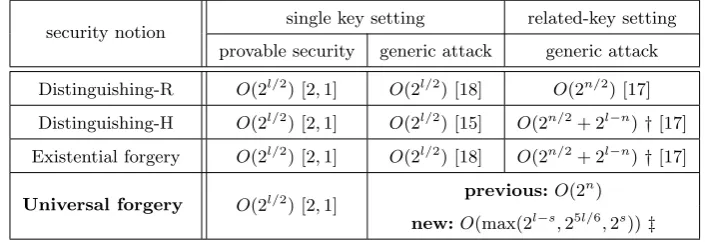
Our contribution.In this article, we describe the first generic universal forgery attack on iterative hash-based MACs, requiring less then 2n computations. More precisely, our attack complexity is
O(max(2l−s,25l/6,2s)), where 2s represents the block length of the challenge message. In other
words, for reasonable message sizes, the complexity directly decreases along with an increase ofs, up to a message size of 2l/6 where the complexity hits a plateau at 25l/6computations. Previously known attacks and proven bounds are summarized in Table 1 and we emphasize that this is the first generic universal forgery attack onHMAC in the single key model (except the trivial 2n brute
Table 1.We summarize the security state ofHMAC (withn≤l≤2n) including previous results and our universal forgery attacks. Notation max() is to choose the largest value.
security notion single key setting related-key setting provable security generic attack generic attack
Distinguishing-R O(2l/2) [2, 1] O(2l/2) [18] O(2n/2) [17] Distinguishing-H O(2l/2) [2, 1] O(2l/2) [15] O(2n/2+ 2l−n)†[17]
Existential forgery O(2l/2) [2, 1] O(2l/2) [18] O(2n/2+ 2l−n)†[17]
Universal forgery O(2l/2) [2, 1] previous:O(2
n
)
new:O(max(2l−s,25l/6,2s))‡
†: the attacks have complexity advantage withn < l <2n;
‡: 2sis the blocks length of the challenge message. The attack has complexity advantage withn≤l <6n/5.
a 2133.3(resp. 2106.7) computations security with regards to universal forgery attacks, while it was long believed that the full 2160 (resp. 2128) was holding for this strong security property.
Moreover, our techniques are novel as they show that one can extract much more meaningful secret information than by just analyzing the cycle structure or the collision probability of the functional graphs of theMACalgorithm, as was done previously [17, 15]. Indeed, the distance of a node from the cycle of its components in the functional graph is a very valuable information to know for an attacker, and we expect even more complex types of information to be exploitable by attackers against iterative hash-basedMACs.
2
Description of
NMAC
and
HMAC
A hash function H maps arbitrarily long messages to an n-bit digest. It is usually built by iterating a fixed input length compression functionf, which maps inputs ofl+bbits to outputs of
lbits (note thatl≥n). In details,Hfirst pads an input messageM to be a multiple ofbbits, then splits it into blocks of b bitsm0||m1|| · · · ||ms−1, and calls the compression function f iteratively to process these blocks. Finally,H might use a finalization functiongthat mapsl bits tonbits in order to produce the hash digest.
x0=IV xi+1=f(xi, mi) hashdigest=g(xs)
Each of the chaining variablesxi arel bits long, andIV (initial value) is a public constant.
NMACalgorithm [2] keys a hash functionHby replacing the publicIV with a secret keyK, which is denoted as HK. It then uses two l-bit secret keys Kin and Kout referred to as the inner and
the outer keys respectively, and makes two calls to the hash functionH.NMACis simply defined to process an input messageM as:
NMAC(Kout, Kin, M) =HKout(HKin(M)).
The keyed hash functionsHKinandHKout are referred to as the inner and the outer hash functions respectively.
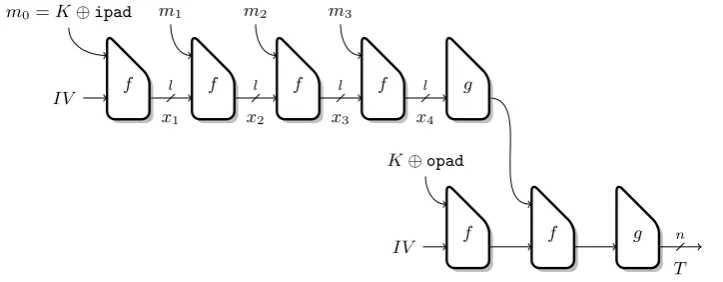
HMACalgorithm [2] is a single-key variant ofNMAC, depicted in Figure 1. It derivesKinandKout
from the single secret keyKas:
Kin=f(IV, K⊕ipad) Kout=f(IV, K⊕opad)
whereipadandopadare two distinct public constants. HMACis then simply defined to process an input messageM as:
wherek denotes the concatenation operation. It is interesting to note that HMAC can use any key size. If the keyKis shorter thanbbits, then it is padded with0bits to reach the sizebof an entire message block. Otherwise, if the keyK is longer than b bits, then it is hashed and then padded with0bits: K←H(K)k0b−n.
IV m0=K⊕ipad
f
l
m1
x1
f
l
m2
x2
f
l
m3
x3 x4
l
f g
IV K⊕opad
f f g n
T
Fig. 1.HMACwith an iterated hash function with compression functionf, and output functiong.
For simplicity, in the rest of this article we will describe the attacks based on the utilization of theHMAC algorithm. However, we emphasize that our methods apply similarly to hash-basedMACs such asNMAC[2],Sandwich-MAC[26], etc.
3
Previous functional-graph-based attacks for
HMAC
Our universal forgery attack is based on recent advances in hash-based MACs cryptanalysis [17, 15] and in this section we quickly recall these methods and explain how we extend them. First of all, we need to introduce the notion of functional graph and the various properties that can be observed from it.
The functional graphGf of a functionf :{0,1}l→ {0,1}lis simply the directed graph in which
the vertices (or nodes) are all the values in{0,1}land where the directed edges are the iterations
off (i.e. a directed edge from a vertexa to a vertex b exists ifff(a) =b). The functional graph of a function is composed of one or several components, each having its own internal cycle. For example, we give in Figure 2 from the Appendix a representation of the functional graph ofSHA-3 reduced to 8-bit input/output.
For a random function, the functional graph will possess several statistical properties that have been extensively studied. For example, it is to be noted that with high probability the functional graph of a random function will have a logarithmic number of components and among them there is one giant component that covers most of the nodes. In addition, this giant component will contain a giant tree in which are present about a third of the nodes ofGf. Theorems 1 and 2 state these
remarks in a more formal way.
Theorem 1 ([6, Th. 2]).The expectations of the number of components, number of cyclic nodes (a node belonging to the cycle of its component), number of terminal nodes (a node without a preimage), and number of image nodes (a node with a preimage) in a random mapping of sizeN
have the asymptotic forms, asN → ∞:
(i) #Components: 12logN
(ii) #Cyclic nodes: pπN/2
(iii) #Terminal nodes:e−1N
(iv) #Image nodes:(1−e−1)N
length ofx and is denoted µ(x). Finally, the rho-length of xis denoted ρ(x) and represents the length of the non repeating trajectory ofx: ρ(x) =λ(x) +µ(x).
Theorem 2 ([6, Th. 3]).Seen from a random node in a random mapping of size N, the expec-tations of the tail length, cycle length, rho length, tree size, component size, and predecessors size have the following asymptotic forms:
(i) Tail length (λ):pπN/8 (ii) Cycle length (µ):pπN/8 (iii) Rho length (ρ=λ+µ):pπN/2
(iv) Tree size:N/3
(v) Component size:2N/3 (vi) Predecessors size:pπN/8
Moreover, the asymptotic expectations of the giant component and its giant tree have been provided in [7].
Theorem 3 ([7, VII.14]).In a random mapping of sizeN, the largest tree and the largest com-ponent have expectations asymptotic, respectively, of0.48∗N and0.7582∗N.
Knowing all these statistical properties for the functional graph of a random function, Peyrinet al.[17] studied the successive iterations ofHMAC with a fixed small message block for two related-keysKandK=K⊕ipad⊕opad. Thanks to a small weakness ofHMACin the related-key setting, they observed that the two corresponding functional graphs are exactly the same (while ideally they should look like the functional graphs of two independent random functions) and this can be detected on the output of HMAC by measuring the cycle lengths. They used this property to derive generic distinguishing-R, distinguishing-H and existential forgery attacks in the related-key setting.
Later, Leurentet al.[15] extended the scope of cycle detection by providing a single-key utiliza-tion of this technique. Namely, they show how to craft two special long messages (mainly composed of identical message blocks), both following two separate cycle loops in the functional graph of the internal compression function. This trick allows the two messages to collide after the last processed message block, but also to have the same length (and thus the processing of the final padding block would not reintroduce differences). Such a collision can therefore be detected on the out-put ofHMAC, and they use this special information leakage (information is leaked on the unknown internal compression function used) to derive a generic distinguishing-H attack in the single-key setting. They also provide another attack that can trade extra complexity cost for smaller message size, and in which the property scrutinized is the probability distribution of the collisions in the functional graph.
From a high-level perspective, these two previous works mainly considered as distinguishing properties the cycle nodes or the collisions distribution in a functional graph. In this article, we consider a functional graph property which seems not trivial to exploit: the height λ of a tail node, i.e. the distance of a node from the cycle of its component. While not trivial and likely to be costly, the potential outcome of analyzing such a property is that if one can extract this information leakage from theHMACoutput, he would get direct information on a particular node of the computation. The attack can therefore be much sharper (the size of the cycle is not a powerful property as it represents a footprint equivalent for all the nodes of the component, while the height of a node is much more discriminating), and that is the reason why it eventually allows us to derive a generic universal forgery attack in the classical single-key setting.
4
General description of the universal forgery attack
LetMt=m1km2k. . .kms be the target message to forge given by the challenger to the adversary
(we start the counting fromm1since the first message blockm0 to be processed by the inner hash function call ism0 = K⊕ipad). In order to forge the tag value corresponding to this message, we will construct a different messageMt0 which will collide withMtin the inner hash function of
HMAC, namelyHKin(M
0
t) =HKin(Mt), and this directly leads to colliding tags on the output of the HMAC:T =HKout(HKin(M
0
t)) =HKout(HKin(Mt)). Then, by simply querying theHMAC valueT of
Constructing such a message Mt0 is in fact equivalent to finding a second preimage of Mt on
the keyed hash function HKin. While second preimage attacks have been published on public iterative hash functions [12], unfortunately they cannot be applied to a keyed hash function as they depend on the knowledge of the intermediate hash values when processing Mt. However, in
our situation the intermediate hash values forHKin(Mt) are hidden since only the tag is given as output and sinceKinis unknown to the adversary, and so he will not be able to guess them. We
will overcome this issue by proposing a novel approach to recover some intermediate hash value
xi from the computation ofHKin(Mt). We stress that this is different from and much harder than previous so-called internal state recovery in [15], which recovers some internal state of a message completely chosen by the adversary himself. Note that oncexiis recovered, we get to know all the
next intermediate hash values by simply computingxi+1 =f(xi, mi),. . .,xs+1 =f(xs, ms) since
H is an iterative hash function. Once these intermediate hash values are known, we can apply the previous second preimage attacks [12] in order to findMt0.
In order to recover one value from the set of the intermediate chaining valuesX={x1, x2, . . . ,
xs+1}ofHKin(M), we choose offline 2
l/svaluesY ={y
1, y2, . . . , y2l/s}, and one can see that with a good probability one element yj of Y will collide with an element in X. We need to filter out
thisyj value and this seems not easy since there is no previously published suitable property on
the intermediate hash values ofHMACthat the adversary can detect on the output.
One may consider using internal collisions, which are detectable by searching for colliding tags due to the length extension property: finding a message pair (m, m0) forxi such thatf(xi, m) =
f(xi, m0) by queryingHMAConline and then using this pair to determine ifyj =xiholds by checking
offline iff(yj, m) =f(yj, m0) holds. However, note that with this naive method only a singlexican
be tested at a time (since otherxi0 withi06=iare very likely not to collide with the message pair
(m, m0)) and we will therefore have to repeat this procedure for each value of X independently. Thus, this attack fails as we would end up testing 2lpairs and reaching a too high complexity.
Overall, it is essential to find a new property on the intermediate hash values ofHMACsuch that it can be detected by the adversary and such that it can be exploited to match a value ofY to all the values inX simultaneously. In our attack, we will use a novel property, yet unexploited: the heightλ(xi) of each xi of X in the functional graph offV, wherefV stands for the compression
function with the message block fixed to a value V; fV(·) = f(·, V). In the rest of this article,
without loss of generality, we will letV be the message block only composed of zero bits and we denotef[0](·) =f(·,[0]) the corresponding compression function.
4.1 The height property of a node in a functional graph
In the functional graph of a random mapping on a finite set of sizeN, it is easy to see that each nodexhas a unique path connecting it with a cycle node, and we denoted the length of this path the height λ(x) of x (or tail length). Obviously, for cycle nodes, we have λ = 0. The set of all nodes with the same heightλis usually called theλ-thstratum of the functional graph and we denote it as Sλ. Researchers have carried out extensive studies on the distribution of Sλ as
N→ ∞. In particular, Harris proved that the mean value ofS0is p
πN/2 [11], which is consistent with Theorem 1 as the number of the cycle nodes. After that, Mutafchiev [16] proved the following theorem as an extension of Harris’s result.
Theorem 4 ([16, Lemma 2]).If N → ∞andλ=o(√N), the mean value of the λ-th stratum
Sλ is
p
πN/2.
Note that Mutafchiev’s result is no longer true forλ=O(√N) and, for interested readers, we refer to [19] for the limit distribution ofSλ withλ=O(
√
N).
Interestingly, if the largest component is removed from the functional graph, then the remaining components also form a functional graph of a random mapping on a finite set of size (1−0.7582)∗
N = 0.2418∗N (since Theorem 3 tells us that the largest component has an expected number of nodes of 0.7582∗N). Thus we get the following corollary.
Corollary 1. If N → ∞ and λ=o(√N), the mean value of the λ-th stratum Sλ in the largest
component is0.64√N =pπN/2−p
Now we move back to discuss about the height distribution in the functional graphGf[0] off[0]. From Corollary 1, we can deduce that ifl → ∞ and λ = o(2l/2), the mean value of S
λ in the
largest component off[0] is 0.64∗2l/2. In order to illustrate the notion ofλ=o(2l/2) more clearly, we rewrite the corollary into the following equivalent one.
Corollary 2. Let δ(l) be any function such that δ(l) → ∞ as l → ∞. There exists a positive valuel0 such that for anyl > l0, the mean value ofλ-th stratumSλ with 0≤λ≤2l/2/δ(l)in the
largest component is0.64∗2l/2.
Next, we will utilize Corollary 2 to prove the lower bound on the number of distinct height values of the intermediate chaining values inX, which we will use in order to evaluate the attack complexity. Denote the set of all the nodes with a heightλ∈[0,2l/2/δ(l)] asN0, which covers in
total 0.64∗2l/δ(l) nodes. Thus, a random node belongs toN0with a probability 0.64/δ(l). Moreover, from Corollary 2, for a random node inN0, its height is uniformly distributed in [0,2l/2/δ(l)]. From these properties of N0, we get that 0.64∗s/δ(l) elements in X belong to N0. Moreover, there is no collision on the height among these elements with an overwhelming probability if s 2l/4 holds. Note that in our forgery attack, we will set s to be at most 2l/6 (see Section 5.1 for the details). Overall, the lower bound on the number of distinct height values inX is 0.64∗s/δ(l). It is important and interesting to note that from Corollary 2, ifl becomes very large,δ(l) will become negligible compared to exponential-order computations 2Ω(l), e.g.,δ(l) = log(l).
On the other hand, we performed experiments to evaluate the expected number of the distinct height values inX. More precisely, we usedSHA-256compression function for small values ofl. We prepend0256−l to a l-bit value x, then compute y=SHA-256(0256−lkx), and finally output the l
LSBs ofy. Withl≤30, we generated random pairs and checked if their heights collide or not in the functional graph ofl-bit truncated SHA-256compression function. The experimental results show that a pair of random values has a colliding height with a probability of around 2−l/2. Moreover, it is matched with a rough probability estimation as follows. Letxandx0 be two randomly chosenl-bit values. Supposexandx0have the same height, then it implies that afteriiterations off
[0](denoted asfi
[0]), either one of the following two cases occurs. One isf
i
[0](x) =f
i
[0](x
0), which has a probability
of roughly 2−lfor eachiconditioned onf[0]i−1(x)6=f[0]i−1(x0). The other one is thatf[0]i (x)6=f[0]i (x0) and bothfi
[0](x) andf
i
[0](x
0) enter the component cycle simultaneously, which has a probability of
roughly (pπ/2∗2−l/2)2 =π/2∗2−l for each i, since the number of cycle nodes is p
π/2∗2l/2. Note that Theorem 2 proved the expected tail length ispπ/8∗2l/2. Thus, if neither of the two cases occurs up topπ/8∗2l/2 iterations, we get thatfi(x) andfi0(x0) enter the component cycle
with differentiandi0, namelyxandx0have different heights. So the total probability of randomly chosenxandx0 having the same height is at most 2−l∗p
π/8∗2l/2+π/2∗2−l∗p
π/8∗2l/2≈2−l/2. Overall, we make a natural, conservative and confident conjecture as follows (note thatsis at most 2l/6 in our attacks. See Section 5.1 for the details).
Conjecture 1. Withs≤2l/6, there is only a negligible probability that a collision exists among the heights ofsrandom values in a functional graph of al-bit random mapping.
In the rest of the paper, we will describe our attacks based on the Conjecture 1, namely the heights of the intermediate hash values inX are distinct. However, if only taking in account the proven lower bound 0.64∗s/δ(l) of the number of the distinct heights inX, the number of offline nodes should be increased byδ(l)/0.64 times, and the attack complexity is increased by a factor of
O(δ(l)). Note that O(δ(l)) is negligible compared to 2O(l), and thus it has very limited influence to the complexity for largel.
4.2 Deducing online the height of a few unknown intermediate hash values
We now explain how to deduce the heightλ(xi) of a node xi in the functional graphGf[0] off[0]. We start by finding the cycle length of the largest component ofGf[0], and we denote it byL. This
for theMACcomputation of two messagesM1 andM2:
M1=m1km2k. . .kmi−1k[0]2 l/2+L
k[1]k[0]2l/2
M2=m1km2k. . .kmi−1k[0]2 l/2
k[1]k[0]2l/2+L
where [0]j represents j consecutive zero-bit message blocks, and we check if the two tags collide.
It is important to note that if the intermediate hash valuexi is located in the largest component
of Gf[0] and has a height λ(xi) no larger than 2
l/2, then the intermediate hash value after pro-cessingm1km2k. . .kmi−1k[0]2
l/2
is in the cycle of the largest component. Also, the intermediate hash values after processingm1km2k. . .kmi−1k[0]2
l/2
k[1] andm1km2k. . .kmi−1k[0]2 l/2+L
k[1] will be equal (and we denote it by x) since in the latter we just make an extra cycle walk before processing the message block [1]. Under a similar reasoning, if x is also in the largest compo-nent1 and has a height λ(x) no larger than 2l/2, we get that the intermediate hash values after processing m1km2k. . .kmi−1k[0]2
l/2+L
k [1]k[0]2l/2
and m1km2k. . .kmi−1k[0]2 l/2
k[1]k[0]2l/2+L
are equal. Moreover, since M1 and M2 have the same block length, we get a collision on the inner hash function, which directly extends to a collision on the output tag. From the functional graph properties of a random function given in Sections 3 and 4.1, a randomly chosen node will be lo-cated in the largest component ofGf[0] with a probability of about 0.7582 and will have a height
no larger than 2l/2with a probability roughly 0.5. Thus,M
1andM2will collide with a probability (0.7582∗0.5)2= 0.14.
In order to recover the heightλ(xi) of one nodexi in the functional graphGf[0] off[0], we will
test log(l) message pairs obtained from (M1, M2) by changing the block [1] to other values. If (at least) one of these pairs collides, we can deduce that with overwhelming probability2 x
i is in the
largest component, and has a heightλ(xi) of at most 2l/2. Otherwise, we give up on recovering the
heightλ(xi) ofxi, and move to find the heightλ(xi+1) of the next intermediate hash valuexi+1. In the former situation, we can start to search for the exact node height λ(xi) ofxi in Gf[0],
and we will accomplish this task thanks to abinary search. Namely, we first check whether the intermediate hash value after processing m1km2k. . .kmi−1k[0]2
l/2−1
is in the cycle or not (note that we now have 2l/2−1 [0] blocks in the middle, instead of 2l/2 originally), and this can be done by asking for theMACcomputation of two messagesM1∗ andM2∗
M1∗=m1km2k. . .kmi−1k[0]2 l/2−1
k[1]k[0]2l/2+L
M2∗=m1km2k. . .kmi−1k[0]2 l/2−1+L
k[1]k[0]2l/2
and by checking if their respective tags collide. After testing log(l) such pairs obtained from (M1∗, M2∗) by modifying the block [1] to other values, if (at least) one pair collides, we can deduce that with overwhelming probability the intermediate hash value after processingm1km2k. . .kmi−1
k[0]2l/2−1 is in the cycle, and the heightλ(xi) ofxi is no larger than 2l/2−1. Otherwise, we deduce
thatλ(xi) lies between 2l/2−1 and 2l/2. Thus, the amount of possible height values forxi are
re-duced by one half. We continue iterating this binary search procedure log2(2l/2) =l/2 times, and we will eventually obtain the exact height valueλ(xi) ofxi. By applying such a height recovery
procedure, we get to know the height value for 0.38∗s values inX on average (one intermediate hash valuexihas probability 0.7582 to be located in the biggest component, and probability about
1/2 to have a height not greater than 2l/2).
4.3 Deducing offline the height of many known intermediate hash values
Before we start to retrieve a valuexi of X, we need to handle the set Y offline. When we choose
values to build the setY ={y1, y2, . . . , y2l/s}, we also have to compute their respective height in
1
Since we processed a message block [1], different from [0], the last computation will not follow the functional graphGf[0] and we will be mapped to a random point inGf[0].
2
Since the probability thatxi is in the largest component and has a height λ(xi) ≤ 2l/2 is constant,
the functional graph off[0]. One may consider to use a trivial and random sampling, i.e. choosing random nodes first and then computing their height. Note that such a procedure is very expensive, since computing height for a random value requires around 2l/2 computations on average, which renders the total complexity of buildingY beyond 2l. We propose instead to use an offline sampling
procedure as follows.
We first initialize Y as an empty set and we start by choosing a new and random value y1, namelyy1 ∈/ Y. Then, we applyf[0] to update it successively;yi+1=f(yi,[0]), and memorize all
theyi’s in the computation chain. The iteration terminates ifyi+1 collides with a previous stored valuey ∈ Y whose height is already known (we denote it asλ), or if it collides with a previous node yj (1 ≤ j ≤i) in the current chain, namely a new cycle is generated. In the former case,
we naturally compute the height of nodesyp (1≤p≤i) in the chain asλ+i+ 1−p, and store
all of them in Y. For the latter case, we set the height of all the nodes fromyj to yi as 0 (since
they belong to the cycle of their own component), and we then compute the height of tail nodes
yp (0≤p < j) as j−pand store all of them inY.
Using this procedure, we can select 2l/svalues and obtain their height with a complexity of only
2l/scomputations. Moreover, from the functional graph properties of a random function given in
Sections 3 and 4.1, we know that on average 38% values inY are located in the largest components and have a height no larger than 2l/2.
Note thatY is not a set of random values. We do not know the distribution of height values of the elements inY, which essentially makes Conjecture 1 be necessary for our attack. The detailed discussion follows in next section.
4.4 Exploiting the height information leakage
At this point, the attacker built the setsX andY and knows the height of almost all their elements (forX, only the heights of 0.38∗selements are known). The next step is to recover one value in
X (which are still unknown to the attacker) by matching between the elements in setX and the elements in setY. However, for each xi in X, we do not have to try to match every value inY.
Indeed, we just need to pay attention to a smaller subset ofY in which the elements have the same height value asxi. Moreover, since the elements in the set X have distinct heights (see details in
Section 4.1), these subsets ofY are all disjoint. Thus in total we need to match at most 2l/spairs,
namely the size ofY. This point is precisely where the adversary will get a complexity advantage during his attack.
4.5 Attack summary
Finally, let us wrap everything up and describe the universal forgery attack from the very beginning. The adversary is given a target messageMt=m1km2k. . .kmsby the challenger, for which he has
to forge a valid tag. He splitsMtinto two partsMt1kMt2:
Mt1=m1km2k. . .kms1 will be used for the intermediate hash value recovery,
Mt2=ms1+1kms1+2k. . .kms will be used in the second preimage attack.
During the online phase, the adversary applies the height recovery procedure from Section 4.2 for eachxi (1 ≤i ≤ s1+ 1), and stores them in X. Moreover, he produces a filter (m, m0) for eachxi such thatf(xi, m) =f(xi, m0) holds. During the offline phase, the adversary chooses 2l/s1 values following the sampling procedure from Section 4.3 and stores them inY.
Then, he recovers the value of one of the xi’s by matching sets X and Y: for each xi, he
checks if f(y, m) = f(y, m0) holds or not for all y’s that have the same height as x
i in Y. If a
collision is found, then y is equal to xi with a good probability. Once one xi (1 ≤ i ≤ s1+ 1) is recovered, the adversary gets to know the value of xs1+1 by computing the iteration xi+1 =
f(xi, mi+1), . . . , xs1+1=f(xs1, ms1), which induces that the latter half of the inner hash function
when processingMtis equivalent to a public hash function by regarding xs1+1 as the publicIV. Thus, the adversary is able to apply previous second preimage attacks on public hash functions [12] to find a second preimageMt20 forMt2. In the end, the adversary queriesMt1kM
0
t2 to theMACoracle
and receives a tag valueT. This tag T is also a valid tag for the challenge Mt and the universal
5
Full procedure of the universal forgery attack
In this section, we provide the entire procedure of this complex attack and we first recall the notations used. LetMt=m1km2k. . .kms be the challenge message (we start the counting from
m1, sincem0=K⊕ipadduring the first compression function call of the inner hash call ofHMAC) and we denote by x1, x2, . . . , xs+1 the successive intermediate hash values of HKin(Mt) when processingMt. During the attack,Mtis divided intoMt1kMt2, whereMt1 ism1km2k. . .kms1 and
Mt2 is ms1+1kms1+2k. . .kms. As an example, we will use the functional graph Gf[0] of the hash
compression functionf when iterated with a fixed message block [0] and we denote byLthe cycle length of the largest component ofGf[0].
Phase 1 (online). Recover the height ofx1,x2,. . ., andxs1+1 in Gf[0] and store them in a set
X. The procedure is detailed as below.
1. Initialize an index counterc as 1, and the setX as empty.
2. Query to theMACoracle and receive the corresponding tag pairs of log(l) distinct message pairs
m1k. . .k mc−1k [0]2 l/2+L
k[i]k[0]2l/2 and m
1k. . .k mc−1k [0]2 l/2
k[i]k[0]2l/2+L , where [i] 6= [0]
and [i]s are distinct among pairs.
3. If there is no tag pair that collides, increment the index counterc←c+ 1 and ifc≤s1+ 1 then go to step 2, otherwise terminate this phase. If there is (at least) one tag pair that collides, then just execute the following steps.
(a) Set two integer variablesz1= 0 andz2= 2l/2.
(b) Set z = (z1 +z2)/2. Query to the MAC oracle and receive the corresponding tag pairs of log(l) distinct message pairs m1k. . .k mc−1k [0]2
z+L
k[i]k[0]2l/2 and m
1k. . .k mc−1k [0]2zk[i]k[0]2l/2+L , where [i]6= [0] and [i]s are distinct among pairs.
(c) If (at least) one tag pair collides, setz2=z. Otherwise, setz1=z.
(d) Ifz26=z1+ 1 holds, go to step 3-b. Otherwise, set the height ofxc asλ(xc) =z2, storez2 in positioncinX and increment the index counterc←c+ 1. Ifc≤s1+ 1 then go to step 2, otherwise terminate this phase.
Phase 2 (online). Generate a pair of one-block messages (m, m0) for eachxi∈X, which will be
used as a filter in Phase 4. The procedure is detailed as below. 1. For allxi∈X do the following steps.
(a) Select 2l/2 distinct one-block messages, append them to m
1k. . .kmi−1, and send these
newly formatted messages to theMACoracle. Find the pairsm1k. . .kmi−1kmandm1k. . .kmi−1km0 that collides on the output of theMAC.
(b) For all the found pairs (m, m0), choose another random one-block message m00, and query
m1k. . .kmi−1kmkm00andm1k. . .kmi−1km0km00to theMACoracle in order to check if their corresponding tags collide again or not. If none collide, go to step 1-a. Otherwise, store a colliding pair (m, m0) as the filter forxi inX and go to the nextxi in step 1.
Phase 3 (offline). Choose 2l/s1values with their height inGf[0], and store them in a setY (sorted
according to the height values). The procedure is detailed as below. 1. Initialize a countercas 0 and the setY as empty.
2. Choose a new random valuey1 such thaty1∈/ Y, and set the chain counterccto 1. 3. Computeycc+1=f[0](ycc)
4. Check ifycc+1 matches a valuey stored in Y. If it does, then set the heightλ(yi) of yi (with
1≤i≤cc) as λ(y) +cc+ 1−iand store the (yi, λ(yi)) pairs (with 1≤i≤cc) inY.
5. Check ifycc+1 matches a previously computed chain valueyi(with 1≤i≤cc). If it does, then
set the heightλ(yj) of all values yj (with i≤j ≤cc) as 0, and the height λ(yj) ofyj (with
1≤j < i−1) asi−j. Store the (yj, λ(yj)) pairs (with 1≤j ≤cc) in Y.
6. If no match was found in step 4 or 5, then increment the chain counter cc← cc+ 1 and go to step 3. Otherwise, update the counter c byc ←c+cc and if c <2l/s
Phase 4 (offline). Recover one intermediate hash valuexi in set X. The procedure is detailed
as below.
1. For allxi∈X do the following steps.
(a) Get the heightλ(xi) of xi and its filter pair (m, m0) from the setX. Get all the (y, λ(y))
pairs in set Y such thatλ(y) =λ(xi).
(b) For eachy, we check if f(y, m) =f(y, m0) holds or not. If it holds for ayj, then outputyj
as the value ofxi and terminate this phase. If there is no such ayj, then go to the nextxi
in step 1.
Phase 5 (offline). Find a second preimage for the processing ofMt2 as the second message part
ofHKin(Mt). The block length of Mt2 is denoteds2=s−s1. The procedure is briefly described
below. For the complete algorithm please refer to [12].
1. Compute the intermediate hash valuesxs1,xs1+1,. . .,xsfrom the valuexirecovered at Phase
4, i.e.xi+1=f(xi, mi),. . .,xs=f(xs−1, ms−1). Note that it is not necessary to compute until
xs.
2. Build a [log(s2), s2]-expandable message starting fromxs1 to a value denoted asx. More
pre-cisely, for any integeribetween log(s2) ands2, there is a messagem0s1km 0
s1+1k · · · km 0
s1+ifrom
the expandable message such that it hasiblocks and links fromxs1 to x:
x=f(. . . f(f(xs1, m 0 s1), m
0
s1+1), . . . , m 0 s1+i).
3. Choose 2l/(s2−log(s2)) random one-block messages m, compute f(x, m), and check if this matches to an element of the intermediate hash values set{xs1+log(s2), xs1+1+log(s2), . . . , xs}.
4. If a match to xi (withs1+ log(s2)≤i≤s) is found, derive the (i−s1)-block long message
m0 s1+1km
0
s1+2k · · · km 0
i from the expandable message, append the blocks mi+1kmi+2k · · · kms
to it to produceMt0
2, namelyM 0 t2 =m
0 s1+1km
0
s1+2k · · · km 0
ikmi+1kmi+2k · · · kms.
Phase 6 (online). Forge a valid tag for the challengeMt.
1. Query messageMt0=Mt1kM 0
t2 to theMACoracle, and receive its tag valueT.
2. Output (Mt,T) whereT is a valid tag for Mt.
5.1 Complexity and success probability analysis
Complexity analysis. We use a single compression function call as complexity unit. We evaluated the complexity of each phase as below.
Phase 1: O(s1·l·log(l)·2l/2) Phase 2: s21·2l/2 Phase 3: 2l/s1
Phase 4: 2l/s1 Phase 5: 2l/s2 Phase 6: s
The overall complexity of our generic universal forgery attack therefore depends on the block length
sof the target messageMt:
• For the case s≤2l/6, the overall complexity is dominated by Phase 3 and Phase 5. So we set
s1=s2=s/2, and get the overall complexity ofO(2l/s) computations.
• For the case 2l/6 < s ≤ 25l/6, the overall complexity is dominated by Phase 2. So we set
s1= 2l/6, and get the overall complexity ofO(25l/6) computations.
• For the cases >25l/6, the overall complexity is dominated by Phase 6. So we sets
1 = 2l/6, and get the overall complexity ofO(s) = 25l/6 computations.
5.2 Experimental verification
For verification purposes, we have implemented the attack by using HMAC-SHA-256 on a desktop computer. Due to computational and memory limitations, we shortened the input/output bits of the SHA-256 compression function to 32 bits. In more details, we input a 32-bit value x to the compression function, and the compression function expands it to 256 bits by prepending0bits: 0224kx. Then, the compression function also shortens its outputs by only outputting the 32 LSBs. Particularly for Phase 4, we paid attentions to the average number of pairs left after matching the heights between the elements inX and the elements in Y, since it is essential for the complexity advantages. The experiments results confirmed that the universal forgery attack works with the claimed complexity.
6
Conclusion
In this article, we presented the very first generic universal forgery attack against hash-basedMACs, and we reduced the gap between theHMACsecurity proof and the best known attack for this crucial security property. We leave as an open problem if better attacks can be found to further reduce this gap. Our cryptanalysis method is new and uses the information leaked by the distance of a node from the cycle (its height) in the functional graph of the compression function with a fixed message block. We believe other graph properties, even more complex, might be exploitable and could perhaps further improve the generic complexity of universal forgery attacks against hash-basedMACs.
Acknowledgments
The authors would like to thank the anonymous referees for their helpful comments. The authors are supported by the Singapore National Research Foundation Fellowship 2012 (NRF-NRFF2012-06).
References
1. Mihir Bellare. New Proofs for NMAC and HMAC: Security without Collision-Resistance. In Cynthia Dwork, editor,CRYPTO, volume 4117 ofLecture Notes in Computer Science, pages 602–619. Springer, 2006.
2. Mihir Bellare, Ran Canetti, and Hugo Krawczyk. Keying Hash Functions for Message Authentication. In Neal Koblitz, editor,CRYPTO, volume 1109 of Lecture Notes in Computer Science, pages 1–15. Springer, 1996.
3. Scott Contini and Yiqun Lisa Yin. Forgery and Partial Key-Recovery Attacks on HMAC and NMAC Using Hash Collisions. In Xuejia Lai and Kefei Chen, editors,ASIACRYPT, volume 4284 ofLecture Notes in Computer Science, pages 37–53. Springer, 2006.
4. Hans Dobbertin, Antoon Bosselaers, and Bart Preneel. RIPEMD-160: A Strengthened Version of RIPEMD. In Dieter Gollmann, editor,FSE, volume 1039 ofLecture Notes in Computer Science, pages 71–82. Springer, 1996.
5. Yevgeniy Dodis, Thomas Ristenpart, John P. Steinberger, and Stefano Tessaro. To Hash or Not to Hash Again? (In)Differentiability Results for H2 and HMAC. In Reihaneh Safavi-Naini and Ran Canetti, editors,CRYPTO, volume 7417 ofLecture Notes in Computer Science, pages 348–366. Springer, 2012. 6. Philippe Flajolet and Andrew M. Odlyzko. Random Mapping Statistics. In Jean-Jacques Quisquater and Joos Vandewalle, editors,EUROCRYPT, volume 434 ofLecture Notes in Computer Science, pages 329–354. Springer, 1989.
7. Philippe Flajolet and Robert Sedgewick. Analytic Combinatorics. Cambridge University Press, 2009. 8. Pierre-Alain Fouque, Ga¨etan Leurent, and Phong Q. Nguyen. Full Key-Recovery Attacks on HMAC/NMAC-MD4 and NMAC-MD5. In Alfred Menezes, editor, CRYPTO, volume 4622 of Lec-ture Notes in Computer Science, pages 13–30. Springer, 2007.
9. J. Guo, Y. Sasaki, L. Wang, M. Wang, and L. Wen. Equivalent Key Recovery Attacks against HMAC and NMAC with Whirlpool Reduced to 7 Rounds. Fast Software Encryption, 2014. To appear. 10. Jian Guo, Yu Sasaki, Lei Wang, and Shuang Wu. Cryptanalysis of HMAC/NMAC-Whirlpool. In
11. Bernard Harris. Probability Distributions Related to Random Mappings. Ann. Math. Statist, 31(4):1045–1062, 1960.
12. John Kelsey and Bruce Schneier. Second Preimages on n-Bit Hash Functions for Much Less than 2n Work. In Ronald Cramer, editor,EUROCRYPT, volume 3494 ofLecture Notes in Computer Science, pages 474–490. Springer, 2005.
13. Jongsung Kim, Alex Biryukov, Bart Preneel, and Seokhie Hong. On the Security of HMAC and NMAC Based on HAVAL, MD4, MD5, SHA-0 and SHA-1 (Extended Abstract). In Roberto De Prisco and Moti Yung, editors,SCN, volume 4116 ofLecture Notes in Computer Science, pages 242–256. Springer, 2006.
14. Eunjin Lee, Donghoon Chang, Jongsung Kim, Jaechul Sung, and Seokhie Hong. Second Preimage At-tack on 3-Pass HAVAL and Partial Key-Recovery AtAt-tacks on HMAC/NMAC-3-Pass HAVAL. In Kaisa Nyberg, editor, FSE, volume 5086 of Lecture Notes in Computer Science, pages 189–206. Springer, 2008.
15. Ga¨etan Leurent, Thomas Peyrin, and Lei Wang. New Generic Attacks against Hash-Based MACs. In Kazue Sako and Palash Sarkar, editors,ASIACRYPT (2), volume 8270 ofLecture Notes in Computer Science, pages 1–20. Springer, 2013.
16. Ljuben R Mutafchiev. The limit distribution of the number of nodes in low strata of a random mapping.
Statistics & probability letters, 7(3):247–251, 1988.
17. Thomas Peyrin, Yu Sasaki, and Lei Wang. Generic Related-Key Attacks for HMAC. In Xiaoyun Wang and Kazue Sako, editors,ASIACRYPT, volume 7658 of Lecture Notes in Computer Science, pages 580–597. Springer, 2012.
18. Bart Preneel and Paul C. van Oorschot. On the Security of Two MAC Algorithms. In Ueli M. Maurer, editor, EUROCRYPT, volume 1070 ofLecture Notes in Computer Science, pages 19–32. Springer, 1996.
19. G. V. Proskurin. On the Distribution of the Number of Vertices in Strata of a Random Mapping.
Theory Probab. Appl., pages 803–808, 1973.
20. Christian Rechberger and Vincent Rijmen. On authentication with hmac and non-random proper-ties. InFinancial Cryptography, volume 4886 ofLecture Notes in Computer Science, pages 119–133. Springer, 2007.
21. Christian Rechberger and Vincent Rijmen. New Results on NMAC/HMAC when Instantiated with Popular Hash Functions.J. UCS, 14(3):347–376, 2008.
22. Ronald L. Rivest. The md5 message-digest algorithm. RFC 1321 (Informational), apr 1992.
23. Yu Sasaki and Lei Wang. Improved Single-Key Distinguisher on HMAC-MD5 and Key Recovery Attacks on Sandwich-MAC-MD5. InSelected Areas in Cryptography, 2013.
24. Lei Wang, Kazuo Ohta, and Noboru Kunihiro. New Key-Recovery Attacks on HMAC/NMAC-MD4 and NMAC-MD5. In Nigel P. Smart, editor,EUROCRYPT, volume 4965 ofLecture Notes in Computer Science, pages 237–253. Springer, 2008.
25. Xiaoyun Wang, Hongbo Yu, Wei Wang, Haina Zhang, and Tao Zhan. Cryptanalysis on HMAC/NMAC-MD5 and HMAC/NMAC-MD5-MAC. In Antoine Joux, editor, EUROCRYPT, volume 5479 of Lecture Notes in Computer Science, pages 121–133. Springer, 2009.
26. Kan Yasuda. ”Sandwich” Is Indeed Secure: How to Authenticate a Message with Just One Hashing. In Josef Pieprzyk, Hossein Ghodosi, and Ed Dawson, editors,ACISP, volume 4586 of Lecture Notes in Computer Science, pages 355–369. Springer, 2007.
![Fig. 2. Functional graph of Keccak (SHA-3) with 8-bit input and 8-bit output. Example taken from [15].](https://thumb-us.123doks.com/thumbv2/123dok_us/7915295.1314275/14.595.138.457.149.395/fig-functional-graph-keccak-input-output-example-taken.webp)
