ISLAND INNOVATION IN AN ERA OF CLIMATE CHANGE: TOKELAU'S MORAL LEADERSHIP THROUGH RENEWABLE ENERGY
By James Ellsmoor
Honors Thesis Department of Geography
University of North Carolina at Chapel Hill 2016
Approved:
Elizabeth Havice, Thesis Advisor
Abstract
Keywords: Tokelau; climate change; renewable energy; island innovation; SIDS; solar energy
Small Island Developing States (SIDS) have become protagonists in the global movement to reduce
greenhouse gas emissions by calling upon their extreme environmental vulnerability to situate
themselves as leaders in the fight against climate change. At international climate conventions, SIDS
have captured the imagination of the public worldwide by demonstrating the real impacts of climate
change in an accelerated timeframe. The prevailing wisdom dictates that SIDS are non-competitive in
entrepreneurship, yet these small nations have become global leaders in both mitigating their
contributions to greenhouse gas emissions and adapting to the effects of climate change. By engaging
in policy innovation, many islands have been able to turn their constraints to their advantage to situate
themselves as global leaders in knowledge production for climate change adaptation. Yet, how might
innovation be characterized in the context of climate change? This study approaches this question
using the case of the Pacific island territory of Tokelau, which has a population of less than 1,500, and
yet became a global leader in climate debates by generating almost all of its electricity with solar
photovoltaic panels. As an extremely isolated and recently depopulated territory, Tokelau had major
constraints to developing such a project. This study identifies creative indigenous thinking and
engagement with its political status as a sub-national island jurisdiction (SNIJ) of New Zealand as
island innovations that enabled Tokelau at once to enact the groundbreaking Tokelau Renewable
Energy Project and couple it with a move towards moral leadership in global climate politics. These
finding reveals that SNIJs and SIDS can turn their perceived disadvantages as small and isolate states
Acknowledgements
I would like to express my sincere gratitude to my advisor at the University of North Carolina at
Chapel Hill, Dr. Elizabeth Havice, for her expertise, patience and understanding throughout the
planning and realization of this project and for her constructive responses to my sometimes naïve
opinions. I would also like to thank my second reader, Dr. Aaron Moody, for his help in the initial
conceptualization and continued interest in and support for the project. I extend a very special thanks
to the late Aliki Faipule Foua Toloa, who inspired my interest in the Pacific and introduced me to the
wonderful islands of Tokelau. I will be ever grateful for his assistance and regret that he could not see
the results of this research. Furthermore, I would like to thank Paula Faiva for her support in learning
about Tokelau and facilitating meetings with government officials.
This research would not have been possible without the financial support of the Morehead-Cain
Foundation and the wonderful staff who helped in the planning process. I would also like to thank
various faculty at the University of Auckland that helped with the formative stages of the research
including Dr. Paul Kench, Dr. Susan Owen, Dr. Judith Huntsman and Dr. Damon Salesa.
Additionally, thanks to the staff at SPREP in Apia for allowing me to participate in their events and
use their archives, to Thomas Jensen of UNDP Suva for his help on finding documents relating to
TREP and to Coral Pasisi in Niue for her introduction to the island and answers on the Green Climate
Fund. Finally, I would like to thank all the other people of New Zealand, Tokelau, Fiji, Niue, Tuvalu
and Samoa who welcomed me into their homes and answered my peculiar questions. There are too
many people to mention, but in particular Latoya Masina for her friendship and for introducing me
Contents
List of Abbreviations...vii
Tokelauan Terms...viii
List of Figures...ix
Maps of Tokelau...x
Chapter 1: Islands in a changing climate...1
1.1 Insularity and heterogeneous island features...3
1.2 Island innovation...7
1.3 Climate change rhetoric...10
1.4 Renewable energy as a tool for multi-scalar climate action...12
1.5 Objectives and methodology...13
Chapter 2: Literature review...17
2.1 Competitiveness in Small Island Developing States...18
2.2 Islands and global environmental politics...22
Chapter 3: The story of Tokelau...28
3.1 Physical setting...28
3.2 Pre-colonial history...29
3.3 The British Empire to 1948...31
3.4 The independence debate...33
3.5 Tokelauan society...36
3.6 The diaspora...38
3.7 Climate change and Tokelau...39
Chapter 4: The Tokelau Renewable Energy Project...42
4.1 Background...42
4.2 Tokelau’s political rationale...44
4.3 New Zealand’s involvement...46
4.4 International environmental politics...49
4.5 TREP as island innovation...50
Chapter 5: Conclusion...52
5.1 Methodology. ...53
5.2 Islands as engines of innovation...54
5.3 Tokelau as a jurisdictional case study...56
5.4 Contributions and further research...56
References...58
List of Abbreviations
AIMS Africa, Indian Ocean, Mediterranean, South China Sea
AOSIS Alliance of Small Island States
CARICOM Caribbean Community
CANCC Coalition of low lying Atolls on Climate Change
COFA Compact of Freedom Association
COP Conference of Parties
EEZ Exclusive Economic Zone
FFA Forum Fisheries Association
GDP Gross Domestic Product
GoT Government of Tokelau
IOC Indian Ocean Commission
LDC Least Developed Country
LMS London Missionary Society
MIRAB Migration-Remittances, Aid-Bureaucracy
MFaT Ministry of Foreign Affairs and Trade
NGO Non-Governmental Organization
NZ New Zealand
PICT Pacific Island Country
PIF Pacific Islands Forum
SIDS Small Island Developing State
SPREP Secretariat of the Pacific Regional Environmental Program
TeleTok Telecommunication Tokelau Corporation
UN United Nations
UNDP United Nations Development Program
UNGEF United Nations Global Environmental Facility
UNCCC United Nations Climate Change Conference
UNCTAD United Nations Conference on Trade and Development
UNFCCC United Nations Framework Convention on Climate Change
UNOHRLLS The United Nations Office of the High Representative for the Least Developed Countries, Landlocked Developing Countries and Small Island Developing States
Tokelauan Terms
aliki chief, lord
faipule position, one elected responsible for representing each atoll
fakaTokelau the Tokelau way
fono meeting, council
inati system of collective sharing within villages
kaiga Extended family
motu islet with vegetation
Taupulega Village Council, Council of Elders
Ulu o Tokelau Head of the National Government of Tokelau
List of Figures
Fig 1.1 Map of the Tokelau Islands including Swains Island (Olohega), a jurisdiction of American Samoa.
Fig 1.2 Map of the Tokelau Islands in relation to New Zealand and other PICTs.
Fig 1.3 Satellite image of Atafu atoll, Tokelau.
Fig 1.4 View of the solar photovoltaic installation on Fakaofo, Tokelau.
Chapter 1: Islands in a changing climate
“On an island, you are disconnected, with water all around you. On an island, you are alone, even if you share the
place with others. The location is by definition eccentric, because it acknowledges a centre elsewhere”
- Islands: A Trip Through Time and Space (Conrad, 2009)
Climate change is one of the most complex political-ecological processes in history. It unites and
divides peoples across continents, and is experienced in varying degrees, often according to global
power dynamics. From Beijing to Suva and Paris to Funafuti, grassroots political movements on
climate change have brought people together to find solutions to an intricate socio-environmental
crisis. This global movement has shown that environmental issues can connect even the most isolated
of regions to global political discourse.
In this thesis, I turn attention to the ways that Small Island Developing States (SIDS) have become
heroes of the climate movement at United Nations (UN) conferences through the innovative
management and planning of public relations, bringing attention to the impacts of climate change.
The Maldives gained global press coverage when the President and his entire cabinet scuba-dived to
hold a meeting underwater to demonstrate the risk posed to the country by sea-level rise (Ramesh,
2009). Additionally, the President of Kiribati was lauded for announcing the purchase of land in Fiji
to relocate his entire population to in the event of national inundation (Caramel, 2014). Through acts
like these, SIDS have captured the popular imagination about climate change, drawing attention to
their own plight as highly threatened but fighting for their survival and to the global processes outside
The distinctive physical constraints of islands make them particularly vulnerable to climate change.
Their small size, remoteness and economic vulnerability means the impacts are often accelerated and
magnified and so felt much more acutely than in mainland areas (Connell, 2013). Atolls in particular
are vulnerable due to their low-lying nature and dense populations. These islands are created as extinct
volcanic craters subside beneath the water, permitting a coral platform to grow upwards and form
reefs. This leaves thin strips of land broken up into islets called motus, which surround large internal
lagoons. Kiribati, the Marshall Islands, the Maldives, Tuvalu and Tokelau are atoll nations and
territories that are threatened with the potential climate change impact of sea level rise that stands to
submerge entire countries (Farbotko, 2015). Nevertheless, all islands tend to have coastal populations,
and even those that are not at risk of disappearing entirely face severe challenges from their littoral
orientation.
Opportunities have also arisen from climate change discourse, as SIDS have sought to capitalize on
the new attention they have gained through their plight. Displays of innovative practices have turned
the spotlight to these peripheral areas, and many islands have demonstrated that they are eager to excel
in developing solutions that have global applicability (Barnett & Campbell, 2010). By leading in both
greenhouse gas mitigation and climate change adaptation, islands can participate economically in a
system that marginalizes their existence. To do so, they can not only lead sustainable development but
create a moral high ground from which to call for reductions in greenhouse gas emissions from
polluting countries. Many of the geographic conditions unique to islands have allowed SIDS to create
this niche and global environmental politics, and find innovative ways of creating new income streams
to allow them to compete in the global political-economic system despite their perceived
1.1 Insularity and heterogeneous island features
Islands have historically been conceptualized in political and economic geography as marginal entities
on the fringes of power. In common discourse, the word “insular” is used to describe inward-looking,
backwards and isolated areas. Traditionally, islands are not viewed as engines of innovation in the
same way a large city might be (Briguglio, 1995). However, the unique characteristics of islands and
islanders have given them special capabilities to establish new ways of doing things that in some cases
enable them to become leaders in their fields, for example in the way many islands have positioned
themselves and their public policy in the climate change debate.
SIDS are a sub-group of islands that generally have similar characteristics such as low per capita GDP,
remoteness and vulnerability to environmental shocks. They are found in three main groups in the
Caribbean Sea, Western Indian Ocean and Southern Pacific Ocean. Despite these common economic
and geographic features, there is much variation between and within these groupings and the barriers
they face to development. There is no single definition of SIDS, and the inclusivity of the term can
vary hugely. The United Nations Conference on Trade and Development website (UNCTAD, 2013)
states that “the UN never established criteria to determine an official list of SIDS”, but maintains a
website of 29 SIDS on its website for analytic purposes. This is probably one of the more exclusive
definitions as it is limited to UN members with very specific characteristics.1
The Alliance of Small Island States (AOSIS) (2015) has a broader definition and includes 39 members.
Niue and the Cook Islands are not UN members but are classed as independent sovereign nations by
AOSIS. Larger nations like Cuba, the Dominican Republic and Haiti are also members of AOSIS, but
often excluded in other fora. It also includes several non-island countries with geographical, cultural
or historical similarities to island nations which embraces Belize, Guyana, Suriname and
Guinea-Bissau. The island nation of Singapore is also an AOSIS member, despite its massive growth in recent
years to be one of the top five countries in the world by GDP per capita. AOSIS also has several
observer nations that are sub-national island jurisdictions (SNIJs), incorporating American Samoa,
Guam, U.S. Virgin Islands, Puerto Rico and the former Netherlands Antilles. The United Nations
Office of the High Representative for the Least Developed Countries, Landlocked Developing
Countries and Small Island Developing States (UNOHRLLS, 2016) definition additionally counts
some British and French SNIJs such as the Cayman Islands, Bermuda and French Polynesia.
Other definitions might include the combined members of the Pacific Islands Forum (PIF),2 the
Caribbean Community (CARICOM)3 and the Indian Ocean Commission (IOC).4 However, this
definition would also include some larger countries with dissimilar socio-economic characteristics such
as Australia, New Zealand and Madagascar, and still fail to include many integral and undisputed SIDS
such as the Maldives, Cape Verde and São Tomé and Príncipe. It would also neglect to include many
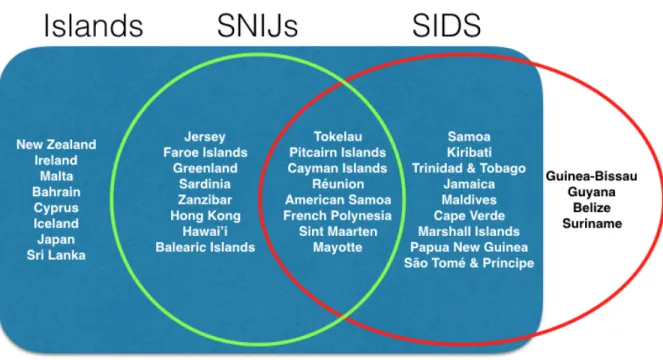
SNIJs with SIDS characteristics. The relationship between the terms of islands, SNIJs and SIDS is
represented in Figure 1.5.
SNIJs are sometimes neglected from the definition of SIDS, as the category of islands is often used
in a UN context which has little consideration of their role. Inclusivity of SNIJs could potentially add
large numbers to the total number of SIDS due to the many small jurisdictions that remain as entities
2 PIF members are Australia, Cook Islands, Fiji, Kiribati, Marshall Islands, Micronesia, Nauru, New Zealand, Niue, Palau,
Papua New Guinea, Samoa, Solomon Islands, Tonga, Tuvalu, and Vanuatu; associate members are New Caledonia and French Polynesia; observers are Guam, Timor-Leste, Tokelau, American Samoa and Wallis and Futuna.
3 CARICOM members are Antigua & Barbuda, Bahamas, Barbados, Belize, Dominica, Grenada, Guyana, Haiti, Jamaica,
within other nations. The problem becomes defining sovereignty and autonomy, as there are many
jurisdictional categories of governance. Some islands, such as Palau, the Marshall Islands and the
Federated States of Micronesia are independent members of the UN but remain in free association
with the United States under a Compact of Free Association (COFA), from which they receive
extensive aid, military protection, and rights to migration and work. In issues such as the
Israel-Palestine conflict, these COFA countries are SIDS that have notably been the only other countries to
vote alongside the US and Israel, while the rest of the world votes against or abstains (Cerone, 2012).
Tokelau could be defined as a SIDS through its status as an observer of PIF, but is often not counted
as one because of its constitutional relationship as a dependent territory of New Zealand. However,
Niue and the Cook Islands are usually counted due to their greater autonomy, and Tokelau’s
socio-economic characteristics are very similar to those of other SIDS nations.
The Government of Tokelau is also conscious of being part of the SIDS community while lacking the
full ability to take part at the UN level. At climate summits, Tokelau has strongly self-identified with
the SIDS group and participated alongside them (Nasau, 2014). Tokelau is an independent member
of organizations such as the Pacific Islands Forum (PIF), Coalition of low lying Atoll Nations on
Climate Change (CANCC), Secretariat of the Pacific Regional Environmental Program (SPREP) and
Pacific Islands Forum Fisheries Agency (FFA), which are entirely or majority made up of other SIDS
countries. At the 2014 Third International Conference on SIDS in Samoa, the Government of New
Zealand allowed the head of government, the Ulu o Tokelau, to speak in the single time slot allocated
to each UN member, affirming the place of Tokelau as a SIDS, but also affirming New Zealand’s
position of power over Tokelau’s political positionality (Nasau, 2014).
In the Pacific region, the political structure of the islands varies markedly, with most of the population
living in the twelve fully independent states and the remainder living in the eleven territories or
associated states with varying degrees of local autonomy. These Pacific SNIJs continue to be
administered in part by Australia (Norfolk Island), New Zealand (Tokelau, Niue and the Cook
Islands), France (New Caledonia, Wallis and Futuna and French Polynesia), the United States (Guam,
American Samoa and the Northern Mariana Islands) and the United Kingdom (the Pitcairn Islands).
Across the Pacific, SIDS populations range from Niue and Tokelau, each with under 1,500 people, to
Papua New Guinea with over 7 million. Pacific SIDS are notable in the enduring prominence of
traditional forms of governance, such as communal land ownership and chiefly titles (Dornan, 2015).
Within the region there is much cultural diversity between the Polynesian, Melanesian and Micronesian
Many Pacific countries and territories are fragmented and isolated with large populations spread over
dozens of islands. Kiribati has 100,000 people on 21 atolls spread over 3.5 million square kilometers
of land. Others SIDS are more condensed onto one or two main islands making transportation easier
between them. Niue’s small population all live on a single island, whereas Samoa is mostly spread over
two main islands frequently connected by a short ferry crossing. Fiji is a major transportation hub with
daily direct transport links to Australia, New Zealand, the United States, Korea and many other Pacific
islands. Others such as Tuvalu and Kiribati are only accessible via a single weekly flight from Fiji.
Tokelau and Pitcairn lack airports and are only accessible by occasional boats that may have a journey
time of several days. Their small size means that in smaller SIDS regardless of sovereignty status, costs
for administration remain disproportionately high and give rise to bloated public sectors, further seen
as a disadvantage to development (Connell, 2013).
Discussion about the development of SIDS usually concern their economic viability in the global
economy, concluding that islands are inherently economically uncompetitive, precluding them from
achieving sustainable development (Connell, 2013). Private sectors in these areas are seen as
fundamentally disadvantaged in the global economic system, as they lack the economies of scale to
host viable businesses (Winters & Martins, 2004). This narrative relies upon the portrayal of isolation
and lack of agency, with islands consistently posed as the vulnerable group manipulated by outsiders
for their own benefit.
1.2 Island innovation
Bucking this conventional wisdom, scholars have recently turned attention to the fact that islands are
also commonly places of innovation. Having some inherent economic disadvantages, they also have
creates resourceful communities and new ways of thinking that can set examples for the outside world
to follow (Baldachino, 2015). This is innovation in its broadest sense, from the development of niche
cottage industries to unique forms of political governance.
Island nations encourage small businesses to thrive and often have fewer people employed by
multinational companies. This is a trend observed even in larger island nations such as New Zealand.
Despite its very open liberal economy, New Zealand is still a nation of entrepreneurs (Hamilton &
Dana, 2003). The small size of the market discourages multinational entry and means islanders must
be more resourceful, retaining the small nature of their businesses. In the Chatham Islands, an
archipelago to the East of New Zealand, Dana (2003) found that a single business initiative to set up
a local airline proved crucial for the other businesses on the islands, illustrating the vulnerability that
small enterprises on islands may have and the steps they must go to to overcome them.
One form of small-scale entrepreneurship featured in this literature relies on unique traditional
methods to cope with island conditions. A lack of outside expertise means islanders must find their
own methods to be resourceful and adapt to the local environment. For example, in Fair Isle, Scotland,
a unique form of knitting became a mainstay of the economy, to the point where the handicraft was
named after the island (Butler, 2015). Local women advanced the economy and retained a unique
aspect of their culture, showing many of the most successful entrepreneurial activities can also be the
traditional ones and that the originality of island crafts is a key marketing point that can give
competitive advantage. These internally orientated innovations make use of island characteristics such
Another form of entrepreneurship relies on the uniqueness of island jurisdictions. SNIJ status
potentially offers a way to let islanders retain self-governance, while relying on the support of other
larger and more economically integrated nations. In many cases, this means the islands and the
islanders occupy a unique political situation that can be exploited for their benefit; but that can also
make them vulnerable to changing political conditions in their mother country. For example, Jersey is
a SNIJ in the form of a Crown Dependency of the United Kingdom, but exists outside of both the
United Kingdom and the European Union. Jersey’s economic success has relied on taking advantage
of this unique position and making creative legal changes to attract companies and investment
(Entwistle & Oliver, 2015). The small size of such jurisdictions means they have the agility to move
quickly before larger countries and carve out a niche to provide services that would not be possible in
a large country or as an integral polity of a larger country. The nature of many island economies to
rely on monocultures means they must be nimble to adapt and change to the market. Jersey produces
a range of services that are interconnected but not interdependent and so can adapt with changing
financial markets. In the case of American Samoa, designation as a territory has helped to sustain two
large tuna canneries, the largest private sector employers in the country, for several decades. The
territorial designation grants the tuna canneries duty free access to the US market as well as access to
lower cost labor than is available on the US mainland, important competitive advantages that sustained
the canneries – the largest source of private sector employment in American Samoa – for many
decades (Campling & Havice, 2007).
Islanders may also develop different attitudes towards risk to mainlanders. In the Maldives, islandness
helps shape the business and entrepreneurial cultural. Maldivians traditionally base business deals on
community trust and tradition, and it is rarely seen as necessary to formalize partnerships in business
to bypass the need for investment capital, and the lack of this and infrastructure is not seen as a
constraint. In this way, islanders can use their trust as a form of capital to engage in business. Faith
and the Islamic economic system also influence business practices, creating a differing situation to
other islands that is specific to the Maldivian context. The evidence suggests that the small size has an
impact on the community and in turn this affects entrepreneurship.
The innovation occurring on islands counters the conventional wisdom that they are unproductive
backwaters with little opportunity for business or potential to shape political processes. The
geographical situation of islandness itself can promote opportunity and be a driver of entrepreneurship
and ingenuity. Many islanders have long lived without the wide availability of goods and services
available to those on mainland areas, and this has created a culture of resourcefulness. In the face of
large scale environmental issues, this resourcefulness has been repurposed to maximize the benefit for
islanders to find a place in the global economic system. While a global climate crisis threatens the very
existence of many SIDS, it has also provided an opportunity to engage with the global
economic-political system.
1.3 Climate change rhetoric
Island nations, and SIDS in particular, are at the forefront of political action to reduce global
greenhouse gas emissions and this thesis investigates how island isolation and innovation intersect
with the dynamics of global climate politics. Sea level rise severely threatens the existence of several
atoll nations and many areas are now becoming more prone to impacts such as increased flood risk,
salt-water intrusion and storm surges. There are also long term risks such as reduced food security
There is a great pessimism for the future of low-lying atolls, that are often framed as doomed to
disappearing in the mainstream media and whose residents are seen as inevitable refugees (Farbotko,
2005). Farbotko (2010) argues that atolls are constructed through the lens of ‘wishful sinking’. This
implies that they represent the ‘canary in the coal mine’, and only become valuable in the eyes of the
rest of the world on their disappearance due to rising sea levels. In this discourse, the islanders are
portrayed – or portray themselves - as on the verge of evacuation as the land disappears beneath their
feet, and no thought is given to the effect of this discourse on their contemporary culture and
livelihoods. Farbotko argues that atolls represent laboratories that experience accelerated processes of
climate change in real time for the world to see and show the real implications of greenhouse gas
emissions, but this is used at the expense of islanders, who are portrayed as passive victims.
This pessimistic discourse of mainstream media neglects the positive impact islanders themselves are
having on the global stage by raising awareness of the very real threats they face and developing on
the ground projects to curb greenhouse gas emissions. The SIDS group of countries played a pivotal
role at COP15 in Copenhagen and COP21 in Paris, helping secure an agreement to curb global
greenhouse gas emissions (Barritt, 2015). Activists from across the Pacific Islands have also made their
voice heard through peaceful protest at coal exports in Australia (Clark, 2014). This evidence suggests
that rather than being passive and marginalized victims of environmental change and stunted global
politics that enable it to continue, Pacific islanders and their governments achieve and innovate agency
largely through the climate change debate, enabling them to reach a global audience.
On many islands, climate change has provided a new platform and urgency for innovation. SIDS want
and practical ways to express this (de Águeda Corneloup & Mol, 2014). Climate change adaptation
and mitigation have become a platform for SIDS to express their views and provide an alternative
path. Island governments want to become leaders and take advantage of their unique conditions as
laboratories of innovation (Greenhough, 2006). Increasing penetration of renewable energy is one way
that islands show leadership on climate issues.
1.4 Renewable energy as a tool for multi-scalar climate action
Islands are fortunate to have significant renewable resources at their disposal, in particular solar energy
in many SIDS. There are strong island-specific motivations driving this innovation in renewables,
which again run contra to the noncompetitive expectations held for SIDS. The cost of fuel imports is
some of the highest in the world, due to isolation and diseconomies of scale combined with inefficient
generation methods (Dornan, 2012). There is a strong political incentive to become global leaders for
environmental reasons, as islands have formed a niche position in climate change negotiations.
Large volumes of money have been made available through the United Nations Global Environmental
Facility (UNGEF) in order to help Pacific Island countries meet their requirements under the United
Nations Framework Convention on Climate Change (UNFCCC) (Barnett & Campbell, 2010).
National energy roadmaps are a tool created by non-governmental organizations (NGOs) to help
island governments meet targets for generation of renewable energy. Dornan (2012) commented that
PICs have some of the highest targets for renewable energy penetration in the world and questioned
whether these goals were achievable or made as a political statement to achieve global press.
test projects are being carried out for wind and wave energy. Funders consist of UNDP and bilateral
donations from a wide variety of countries. In Tuvalu, New Zealand funded an ambitious project to
provide solar generation for all outer islands, and is currently working on solar for the main atoll of
Funafuti (NZMFAT, 2015). The small size of Tuvalu has meant the project was mostly funded by a
single foreign donor, but in larger countries there are various ongoing projects and coordination can
be complicated.
This thesis focuses on Tokelau, which is acknowledged as the first country in the Pacific to take
significant steps in its renewable generation ability. In 2012 Tokelau completed a 1MW solar
installation that provided for over 95% of the nation’s electricity generation needs, and was widely
acclaimed for this display of environmental leadership. Tokelau is another atoll nation at serious risk
of climate change, and so has a strong incentive to lead by example and display the potential of
renewable energy generation. Through creative policy and technological innovation, Tokelau has
engaged the world to draw attention to the problems faced by SIDS. Tokelau has used this leadership
to encourage other countries to reduce greenhouse gas emissions and adopt renewable energy as a
mainstream source of power. As a pioneer in the region, Tokelau’s proof that solar works for Pacific
SIDS encouraged the installation of solar plants on its island neighbors in a region with previously
limited experience of renewables. The impact was also felt locally with large savings to the government
budget with the reduced reliance on expensive fossil fuel imports, showing the interplay of local and
global pressures that incentivized the construction of the project.
1.5 Objectives and methodology
The objective of this thesis is to use the case of Tokelau’s renewable project to explore the way that
collectively by engaging with multiple dimensions of climate change and efforts to address it – a
climate change motivated form of innovation. It contributes to understanding the role of renewable
energy in PICTs and the impact this development has had and is having in a global context.
As an isolated and depopulated territory, Tokelau would not be expected to be a leader in knowledge
production and technological innovation for addressing the pressing global problem of climate change
or the local conditions in an atoll nation that it is producing. The prevailing wisdom is that SIDS are
non-competitive in entrepreneurship, yet this tiny nation became a global leader in climate change
mitigation and adaptation by generating almost all of its electricity with solar photovoltaic panels
through the Tokelau Renewable Energy Project (TREP). How was Tokelau able to enact such
progressive energy policy local and global effects? What explains this innovation?
This thesis aims to explain how SNIJs and SIDS are essential categories linking global environmental
politics to entrepreneurship and innovation. By looking at the relationships of small islands to the
wider discourse, it aims to understand how islands have exerted agency to become key players in the
climate change debate. In order to examine this relationship, this paper uses the case study of TREP
and the following methods:
• comprehensive literature review in the fields of island innovation and global environmental
politics;
• analysis of historical relationship of SIDS with their colonial powers and the United Nations
system;
• documentation of how Tokelau emerged at the forefront of renewable energy action in the
• documentation of the local, national and international socio-economic processes that
influenced the development of TREP;
• analysis of the impact that renewable projects such as TREP can have on discourse
domestically and internationally;
• identification of the advantages and disadvantages that insularity poses to developing
renewable energy projects such as TREP.
In order to investigate these questions, the research examines perspectives of the various TREP
stakeholders including the Government of Tokelau, New Zealand Ministry of Foreign Affairs and
Trade, contracted companies and the United Nations Development Program. A semester in 2015
spent in the Geography and Pacific Studies Departments of the University of Auckland was valuable
for shaping research questions, background data on renewables projects in the Pacific and working
with and interviewing scholars that are experts on the Pacific. Attending conferences, including the
Caribbean Renewable Energy Forum in Miami was useful for comparing progress of renewables in
SIDS in other parts of the world.
The bulk of the research in the Pacific Islands took place between May and August of 2015, with time
spent in Niue, Tuvalu, Fiji and Samoa. Due to the two-day boat ride and infrequent service to Tokelau,
it was impossible to visit the islands, but meetings with various representatives of the Government of
Tokelau based in Apia and Samoa provided the information needed to make up for this. Prior to his
death in 2015, Aliki Faipule Foua Toloa, former Ulu and one of the key initiators of TREP, provided
a great deal of knowledge for his motivations for the project and the role of Tokelau in global climate
negotiations. Paula Faiva, Tokelau’s Climate Change Manager, also provided her inputs in Tokelau’s
Access to the archives of the Secretariat of the Pacific Regional Environmental Program (SPREP) in
Apia also proved to be a valuable resource of documents on renewable energy programs in the region.
As renewable energy is a relatively new and under-resourced part of SPREP’s work, there was a lack
of specific information in this area. However, there were many documents relating to the history and
regional planning of Tokelau that were useful for contextual analysis of the project, such as
administrator reports, national strategic plans and climate change impact assessments. A visit to
Thomas Jensen at the UNDP offices provided many technical and background documents on TREP
itself, including copies of the many site assessments and reports on the prospect of Tokelauan
Chapter 2: Literature review
“We are not major contributors to global greenhouse gas emissions… but we believe that if we are to show moral
leadership then we have to lead by example.”
-Dr. James Fletcher, Minister of Energy for St Lucia at
Paris United Nations Climate Conference (GreenTV, 2015)
Islands are not commonly seen as places of innovation. Discourses in the fields of political economy
and economic development in particular situate them as occupying colonial backwaters, with citizens
that lack the power to govern themselves effectively and drive their own development. Yet small island
developing states (SIDS) are leading the way in renewables and have set some of the most ambitious
targets for renewable energy penetration worldwide (Dornan, 2015). These actions are driven by the
increasing costs of traditional fossil-fuels and islanders’ desire to exert pressure on major greenhouse
gas emitters to provide an alternative to carbon-intensive economies. Most importantly, the impetus
for this action is typically driven by islanders themselves and represents the coalescence of multiple
kinds of island innovations.
There are two central themes of research in this study. It will first examine ideas of economic
competitiveness in SIDS development and their relationship to neoliberal globalization. The review
identifies trends in development literature and provides insight into the place of SIDS in economic
discourse as weak and vulnerable, and then turns to alternative theories that have been presented. This
knowledge is vital for understanding the mechanisms for development and the special cases of SIDS.
climate discourse. It sheds light on how environmental change has given SIDS new agency both locally
and on the international stage and how they are using this opportunity to take an increased role in
international affairs.
2.1 Competitiveness in Small Island Developing States
Sustainable development is a vital concern for SIDS, which have traditionally been seen as
uncompetitive and facing barriers that exclude any real opportunity for growth. The private sectors of
small countries are seen as fundamentally disadvantaged due to globalization, preventing them from
generating competitive exports or attracting significant amounts of foreign investment.
The isolated geography of SIDS is inevitably tied to theories of development. The conventional
wisdom holds out that isolation and small population are the primary dictators preventing robust
economic development. For example, Winters & Martins (2004) directly examine through quantitative
analysis claims that high costs of transportation to the rest of the world inhibit small remote countries.
The paper hypothesizes that small remote places are inherently uncompetitive due to factors such as
the high transportation costs. It uses several techniques to focus on remoteness and differentiate that
effect from size, but concedes it is impossible to fully differentiate these two factors and that SIDS
and SNIJs, which “face such great absolute disadvantages that exporting at world prices is either
impossible or generates factor incomes that are too low to subsist” (p348). There is no shortage of
research that suggests SIDS suffer from smallness and isolation. Research such as Briguglio (1995)
and Guillaumont (2010) conclude that small size and demographic factors impact vulnerability and
these are the main barriers to development and participation in the global economic system for small
Not all academics agree that smallness equates to stunted growth. Easterly & Kraay (2000) state that
small states have “received excessive attention from the literature”, highlighting an emphasis on their
vulnerability is unwarranted as they seem to often have higher incomes per capita than their mainland
neighbors and that there is no evidence of lower growth rates. They continue to say that policy advice
for small states should be no different from those of larger states. However, the focus is on the
smallness of states, and does assess the effects of isolation or transportation difficulties, which would
have different impacts on Pacific SIDS than other small countries such as Luxembourg and Djibouti.
Selwyn (1980) argues that the category of islands is an illegitimate social construct that has little impact
on an economy. This critique argues that peripherality and marginalization are important factors in
economic development, but the impact is no different to that of a remoter mainland area.
This discussion of smallness often discounts alternatives and perpetuates the idea that smallness
equates to vulnerability and low growth. Amoamo (2011) argues that the framing of islands as fragile,
small, peripheral and dependent is often assumed, and is entwined with the discourse of vulnerability.
Baldacchino (2015) contends that the very idea of independence for many small states was seen as
extravagant and precarious both before and after the event, and colonial powers doubted economic
or political viability. Concerns over independent states’ involvement in global politics were also
outlined, and colonial powers often feared the loss of support from their former colonies. Baldacchino
then argues that the belittling nature of discussion around SIDS maintains this negative discourse.
The vulnerability discourse in political economy and development studies has led to the development
of the migration-remittances, aid-bureaucracy (MIRAB) economy as the fundamental development
model, whereby economies rely almost entirely on the outflow of their population to send back money
& Walters, 1985). Authors such as Poirine (1998) & Bertram (2004) have pointed out that MIRAB
represents a useful mode of development for Pacific SIDS to use the only competitive advantages
they may have, based on a population able to emigrate for work and to build a diaspora that can lobby
for aid. Likewise, Connell (2013) insists MIRAB has ensured the continued viability of many of the
smallest nations, including Tokelau.
Many neoliberal economists have been critical of the MIRAB model as a valid pathway to sustainable
development (McKee & Tisdell, 1988). This has caused the exertion of pressure on small countries to
comply with principles of free trade and join organizations such as the World Trade Organization
(WTO). Wallis (2010) assessed Tonga’s accession to the WTO and concludes the costs outweigh the
benefits, and the neoliberal agenda has damaged the economy of Tonga. Furthermore, no transition
away from a remittance and aid dependent economy was achieved, supporting the conclusion that a
neoliberal approach is inappropriate for small Pacific economies. This approach sees insularity as a
problem without recognizing the threat of global integration to PICTs, which otherwise might protect
their economies through astute trade preferences; though their ability to do so has declined
dramatically as they have signed on to global and regional trade accords.
Connell (2013) states that “islanders have sought to develop cultural continuity with social change and
economic development” and concludes that a form of hybridity can be found to maximize benefits
to island communities, merging indigenous practices with capitalism. He discusses proactive and
opportunistic islanders crafting their own destiny in the face of serious challenges as a suitable way of
negotiating the risks of interacting with a neoliberal economy and an increasingly globalizing world.
the problems faced by larger globalized economies. In this way, islanders can tackle the problems that
specifically affect them most such as climate change through innovations using island advantages.
Building from these assertions, SIDS are also conceptualized as places for development and
entrepreneurship and laboratories of innovation in which small jurisdictions and insularity encourage
resourcefulness and entrepreneurship, suggesting that there is much more to island survival than a
MIRAB economy where innovation is a local response to tackle global issues to suit island needs
(Kelman et al., 2015). Baldacchino (2015) compiled the first publication to consider islands wholly in
the context of entrepreneurship, identifying the political categorization of sub-national island
jurisdictions (SNIJs) as a source of innovation and the advantages and disadvantages islanders face in
innovation. Diaspora is a second source of entrepreneurship and innovation. This paper outlines
three categories of innovation from islanders: entrepreneurship in small business, new governance
structures, and developing new cultural practices. Limited resources combined with island thinking
are seen as the key drivers of innovation.
These responses to the conventional wisdom of non-competitiveness and marginality highlight the
ways that islanders are central to their own future and have agency to make their own choices.
According to Baldacchino (2015), “all too often, one is here faced with a situation in which the... the
islander… becomes object matter: a ‘looked at’ reference group; stages for the enactment of processes
dictated from elsewhere” (p. 7). Many of these authors see islanders as succeeding in entrepreneurship
outside of the neoliberal framework and continuing to innovate. This research exists mostly in
cold-water SNIJs such as Prince Edward Island and Iceland, and neglects many of the cultural and
Specifically, the gap that this paper contributes to is linking innovation to renewable energy in the
Pacific region, and to the wider discourse of climate change – and more broadly, how global
environmental politics yield opportunities for agency and innovation. Many of the attributes of
islandness have led this region to become a world leader in developing sustainable energy, yet it has
been relatively neglected by academic scholarship. Where it has been covered, the projects are seen as
the achievements of outsiders, and little credit has been given to islanders themselves. This paper
assesses how SIDS in the Pacific have exerted agency to change this discourse, and specifically how
Tokelau was able to drive its own renewable future with indigenous thinking and to achieve 100% of
its electricity generation from solar.
2.2 Islands and global environmental politics
The review above leads to the conclusion that small states are not generally considered to impact the
agenda of superpowers, or more generally the direction of global geopolitics. However, Bernal (2015),
as Jamaican Ambassador to Washington, refutes this with his analysis of Jamaica’s impact on United
States foreign policy through his experience as Jamaican Ambassador to Washington. Bernal argues
against the conventional wisdom that small developing states exert limited influence on the behaviors
of large superpowers such as the United States, and that their actions and affairs are routinely
disregarded by these superpowers. Through the Jamaican-US case study, he illustrates the impact that
small nations can have on large nations through building influential diaspora and retaining the links to
these communities once established. Jamaica was able to mobilize support for its interests on Capitol
Hill and receive some preferential trade treatment and significant debt relief, including one of the first
This is a useful parallel to SIDS’ process of becoming a key part of dialogue in global environmental
politics; they have used the global environmental agenda to express agency in the discussion and affect
policy change. Despite only registering 5% of the world’s population, SIDS make up over 20% of the
United Nations member states, and so have an advantage in numbers and vote at key events and have
played a role disproportionate to their size and strength at international climate negotiations (Barnett,
2005). For example, small states are well known to be courted by pro-whaling powers such as Japan
in the International Whaling Commission and to leverage their votes for foreign aid (Strand and
Tuman 2012). The small economies of SIDS mean that relatively small investments of foreign aid can
be very important for their economies, and so this innovation in vote exchange is an important method
for them to raise funds, though which they are also impacting international environmental politics.
The formation of the Association of Small Islands States (AOSIS) in 1990 has been a fundamental
driver of SIDS voices and has succeeded in getting its discourse in the final agreements at climate
negotiations (de Águeda Corneloup & Mol, 2014). AOSIS and SIDS generally lack structural power
available to large state actors so must find leadership in other ways but have been able to use moral
arguments and environmental leadership strategies to influence opinions and make their voices heard
(de Águeda Corneloup & Mol, 2014). SIDS governments seek to achieve discursive hegemony by
building coalitions such as AOSIS to promote their story to the top of the agenda and using scientific
support to bolster claims. SIDS such as Tuvalu have also succeeded in driving an emotional story that
has helped to generate sympathetic public opinion in their favor (Farbotko & McGregor, 2010). This
is a form of entrepreneurial leadership innovation (de Águeda Corneloup & Mol, 2014).
Shibuya (1996) shows the origin of the island voice on climate change and the course that it followed
climate change by using low lying islands as a crisis issue. Farbotko and McGregor (2010) describe
how the Tuvalu delegation successfully forced a suspension of the Copenhagen conference by leading
a walk-out. However, the extent and scope of SIDS influence has limits. De Águeda Corneloup &
Mol (2014) point out that at COP15 “the entrepreneurial leadership strategies of SIDS were forcefully
overruled by the structural power of the large Annex-1 states and the emerging economies” (p. 290).
This appears to have changed at COP21 with greater success by AOSIS, though it is too early to see
the results and the complex international politics makes it almost impossible to isolate and identify a
single driver of outcomes.
At the United Nations, AOSIS has been the main representative of island voices, but other
international groupings have been important in shaping the discourse and forming lobbying groups in
the international political arena. The African, Caribbean & Pacific (ACP) group of states was created
by the Georgetown Agreement in 1975 and the small vulnerable economies (SVE) informal grouping
used by the World Trade Organization (WTO), but neither of these are exclusively island groupings
(Birkbeck & Harbourd, 2011). The ACP started as an alliance of former European colonies and
protectorates to enhance members’ economic development and global integration. This encouraged
some South-South cooperation between the members, but primarily allowed them to negotiate
preferential trade agreements with the European Union. These agreements were questioned by the
United States as a violation of free trade under the WTO, and subsequently the benefits offered to
many SIDS were reduced. For example, the preferential treatment given to Caribbean countries had
allowed the continuation of many smaller plantations on islands that would be uncompetitive when
forced to compete in a free world market (Anania, 2010). The reductions of preferences to many
By contrast, island dependencies and territories have not had an independent platform to voice their
views. The United States, Australia, the United Kingdom, France and New Zealand all retain control
over island territories in the Pacific region, and political associations of these states with their
territories affect the capacity of the territory to respond to climate change discourse (Barnett, 2005).
Each territory has a unique relationship with its main power and Grydehøj (2011) argues that the
governments of SNIJs are disproportionately large but can be used both to the advantage or
disadvantage of the population according to this relationship and its level of democratic
responsiveness. McElroy & Pearce (2006) argue that SNIJs have an advantage over similar sovereign
nations that leads to a superior economic performance and better quality of life due to the astute use
of their autonomous privileges. In some cases, this leads to islanders repeatedly voting to retain their
status quo of semi-autonomous political status, lacking full sovereignty and decision-making power.
In the Pacific, several international organizations enable island states to advocate for island issues
through regional cooperation; these include the Pacific Islands Forum (PIF), Secretariat of the Pacific
Regional Environmental Program (SPREP) and the Pacific Islands Forum Fisheries Agency (FFA).
However, the diversity of island voices and distinct interests within the Pacific can be a challenge for
the development of a unified front (Barnett, 2005). SNIJs have had varying success in engaging with
these forums. For example, those with greater autonomy such as Niue and the Cook Islands can
effectively represent themselves at international forums but others with less constitutional autonomy
on foreign relations such as Pitcairn Island and Tokelau are often beholden to the views of the larger
political power of which they are a part. PIF has Niue and the Cook Islands as full members, French
Polynesia and New Caledonia as associate members and Wallis and Futuna, Tokelau, American Samoa
and Guam as observer members, distinguishing the level of participation based on the political status
represented as full members of SPREP, along with the associated developed countries of United
Kingdom, United States, Australia, New Zealand and France. Pitcairn Island, the only Pacific territory
of the UK, is directly represented in neither body. There is a dearth of literature analyzing the ways
that the populations of these SNIJs participate in the global decision-making framework on
environmental issues, the factors that influence the nature of their participation and the ways that they
innovate to achieve their policy objectives by navigating the political relationships that SNIJ status
presents.
SNIJs like Tokelau are represented at global UN negotiations by their associated UN member, but
may find that their views do not directly align with those of the member state that represents them.
At UN conferences, Tokelau generally finds itself more allied with the AOSIS coalition, but its
constitutional relationship with New Zealand limits its ability to directly act on the decisions it would
like to happen. By working with associated groups such as PIF and SPREP, SNIJs like Tokelau are
able to still have their agenda heard through the voices of other member states. The Coalition of low
lying Atoll Nations on Climate Change (CANCC) has also given Tokelau a platform to promote its
cause by allying with the sovereign nations of Kiribati, the Marshall Islands, the Maldives and Tuvalu.
As Tokelau is the only CANCC member without a vote at the UN, this has become a new platform
to develop an independent voice away from New Zealand with support from sovereign nations with
aligned interests. The navigation of these various negotiating platforms is an important political
innovation that Tokelau, and other SNIJs, have developed to have their interests represented.
SIDS engagements with these organizations are dynamic and rapidly evolving, making it difficult for
important roles and contributions to the debate through moral leadership. There is also no research
on Tokelau’s role, despite its leadership, and the advantages and disadvantages that its constitutional
relationship with New Zealand offers. This study contributes to filling these gaps by identifying the
kinds of innovations at play in Tokelau’s effort to developing political and navigate global climate
Chapter 3: The story of Tokelau
“The thing that the elders are certain about is that Fakaofo won in the end; Nukunonu was conquered and the people
who had lived in Atafu fled away upon the ocean”
-Matagi Tokelau: History and Traditions of Tokelau (Office for Tokelau Affairs, 1991)
3.1 Physical setting
Any conversation of Tokelau with an outsider must first confront the remoteness of the islands. The
Pacific is a sea of remote islands, but Tokelau’s isolation as an entire nation stands out in a way perhaps
only paralleled in the Pacific Ocean by that of Pitcairn Island. Tokelau’s entire existence is orientated
around its remoteness and connection to the sea. Tokelau’s 12km2 of land area make it the smallest in
size of the non-self-governing territories in the Pacific, and the atolls are so low-lying that they can
barely be seen from just a few miles off shore.
The atolls each have large central lagoons, far greater in area than the narrow sandy strips of land that
surround them. Each is fully encircled by a barrier reef, and there are no deep water channels between
the atolls and the open ocean. The atolls have no naturally occurring freshwater, except the thin
freshwater lenses that collect just below the surface from rainwater falling on the land area that can
be accessed through shallow wells. The main food crops include coconut, breadfruit and pandanus,
with fish, turtles, sea birds and coconut crab also supplementing the traditional local diet.
Tokelauans are banned from travelling between them on their personal transport due to the number
of islanders who were lost at sea making the long crossings. If Tokelau has a corresponding ‘mainland’,
the closest would be Samoa. Tokelau has no airport and so to access the islands one must fly to Samoa
and take the forty-eight hour 500km crossing on the ferry that leaves once a fortnight. The boat itself
is renowned for being an uncomfortable ride, and is essentially a cargo vessel with room made on the
deck for passengers. All ships must anchor in the open ocean and use small boats to transfer food to
land, where islanders, a forklift or mobile crane transfer cargo onto island trucks.
A fourth atoll, called Olohega or Swains Island lies between Tokelau and Samoa. The island is
historically and culturally part of Tokelau, but in 1856 an American named Eli Hutchinson Jennings
established a coconut plantation on the island. Jennings and his ancestors effectively ruled the island
as a semi-independent dynasty until the 1920s, although it was later officially claimed by the United
States under the 1860 Guano Islands Act and is now administered as part of the territory of American
Samoa. While many Tokelauans continue to claim Olohega as an integral part of Tokelau’s territory
to this day, this is not recognized by New Zealand or the United States.
3.2 Pre-colonial history
Archaeological evidence and Tokelauan oral history indicate that the atolls were most likely settled
between 700 and 1000 years ago, although there is evidence of some human settlement on Olohega
as far back as 500AD. The islands were most likely sporadically inhabited for the first few centuries,
but by the time Europeans arrived there was already an established indigenous settlement on the
islands. It is unknown when exactly each island became permanently settled, but genealogies suggest
at least six generations had lived there prior to the arrival of blackbirders in 1863 who enslaved much
Precolonial history was complex and dynamic, and very different to the timeless image of harmonious
Polynesians living idyllic lives under the coconut trees portrayed by many visitors to the South Pacific
at that time. In the late 1700s, the atolls of Tokelau existed as a Polynesian kingdom under the
hegemony of the Chiefs of Fakaofo, who conquered Nukunonu and destroyed the village on Atafu.
These mutually hostile atolls were expected to pay tribute and send women to Fakaofo, causing
disputes to erupt periodically. At around the year 1800, Nukunonu was still subjugated whilst Atafu
was repopulated by settlers from Fakaofo. Olohega was an outpost with settlers from Fakaofo
exporting produce back to the dominant atoll.
European exploration of the atolls was spread from 1765 until 1825 but had little impact on the local
population until the 1840s. Fakaofo’s dominance was first challenged in the 1850s and a famine
drastically reduced its population. In 1861, the two subordinate atolls of Atafu and Nukunonu
converted to Christianity in an explicit rejection of Fakaofo’s gods and their dominance. Catholic
missionaries gained the most influence on Nukunonu as a returning island convert spread the faith,
paving the way for missionaries. In Atafu missionaries arrived from the protestant London Missionary
Society (LMS). Meanwhile, Olohega moved into private ownership with the arrival of Jennings and
his plantation business.
Fakaofo rejected foreign missionaries until 1863 when the island suffered another devastating decline
in population, this time due to the arrival of blackbirding ships from Peru which were raiding islands
across the Pacific to find slaves for the mines of South America. Tokelau was one of the worst affected
areas in the region, reducing the populations of Fakaofo and Nukunonu by around 50% to 200 and
so many island men. Given the relatively larger size of the island population, both LMS and Catholic
missionaries arrived in Fakaofo, who were also joined by some additional male settlers from Portugal
and Samoa who assimilated into the local population and helped with its recovery. Following the
decimation of the population and colonialism the struggle for dominance between the islands became
less pronounced (Hoëm, 2015).
This pre-contact history shows that Tokelau had a dynamic political history for centuries, and did not
exist as a single polity with equal island power until modern times. The social differences between the
atolls continue to exist today and impact contemporary local politics as each atoll council insisting
they must be treated equally without preference given to the others, while equally competing for their
own preferential treatment. This local politics has an impact on the development of the islands and is
one of the reasons an airport was never constructed on the islands. It would be politically challenging
and culturally impossible to allow the construction of an airport on one atoll lest it gain an advantage
over the other two, while also being financially impractical to construct airstrips on all three islands.
3.3 The British Empire to 19485
At the point of colonization by Europeans, each atoll had maintained its own unique culture. However,
to outsiders these were seen as homogenous communities and they were grouped into a single entity
under colonial rule. In 1877 the islands, then known as the Union Islands, fell under the protection of
the United Kingdom with the Western Pacific Order, which established a High Commissioner to the
Western Pacific, responsible for jurisdiction of British subjects on unclaimed islands in the region.
This was partly a response to the episodes of blackbirding in the region to give greater protection to
Pacific Islanders from marauding vessels. In 1889 the islands were officially incorporated into the
British Empire as a protectorate, and the Union Jack was raised on Nukunonu, Atafu and Fakaofo. In
1916 the Union Islands were incorporated into the Gilbert and Ellice Islands Colony. During this
period the islands remained a largely subsistence economy with traditional governance by the island
chiefs, although with strong influence from missionaries.
In 1926 the Tokelau Islands were disannexed from the British Gilbert and Ellice Islands Colony and
came under the administration of New Zealand as part of Western Samoa, which had been given to
New Zealand from Germany by mandate of the United Nations. The Tokelauan chain was largely
neglected by New Zealand during this period with occasional visits from a New Zealand administrator
and trading ships collecting copra. Services were largely provided by the missions and were
rudimentary.
Tokelau formally became part of New Zealand on January 1, 1949, and islanders became New Zealand
citizens according to the British Nationality and New Zealand Citizenship Act (1948), in line with the
changing relationship between the United Kingdom and New Zealand and formation of New Zealand
citizenship. The Letters Patent Constituting the Officer of Governor-General of New Zealand (1983)
split the Realm of New Zealand into five parts: the state of New Zealand, the self-governing states of
the Cook Islands and Niue, the Ross Dependency (a dependency of the state of New Zealand) and
Tokelau (a territory of the state of New Zealand).
Tokelau’s modern relationship with New Zealand has defined its current existence and allowed it to
Samoa or Tuvalu, they could have remained marginalized parts of these countries with little agency to
express themselves internationally. In these modern states, outer islands continue to be
underdeveloped and inaccessible compared to their capital island and Tokelau could have risked a
similar fate, particularly given its status as a cultural and linguistic minority group. Instead, as a SNIJ
of New Zealand, they have been able to carve their own brand as a somewhat autonomous nation,
with the benefits of association with a larger, richer power.
3.4 The independence debate6
New Zealand began to invest in island development from the 1950s in areas such as transport,
communications, education and health. In 1962 the UN’s ‘Declaration on the Independence of
Colonial Peoples’, New Zealand increased the amount of self-government given to the islands, leading
to the devolution of many political powers and increased provision of services. When Western Samoa
gained its independence in 1962, Tokelau was given the choice to join them in independence or
affiliate with the Cook Islands, but Tokelau asked to continue its current relationship with New
Zealand as a discrete dependent entity. This caused a wave of migration leading to the development
of the Tokelauan diaspora in New Zealand, where they held legal right to live due to citizenship.
In 1980, the United States and New Zealand signed the Treaty of Tokehega, in which the United
States relinquished its claims over Fakaofo, Atafu and Nukunonu, but asserted American sovereignty
over Olohega. Although each of the Tokelauan Faipule signed this treaty, there have been claims this
was under extreme pressure from New Zealand and that the islanders overall did not want to lose an
island they viewed as part of Tokelau. The claim resurfaced in 2006 when a draft constitution that was