David Y. Lee. A Case Study of Workforce Development Programs in the Cumberland County Public Library System. A Master’s Paper for the M.S. in I.S. degree. April, 2016. 56 pages. Advisor: Mary Grace Flaherty
This paper examines the workforce development programs implemented at the
Cumberland County Public Library. The case study focuses on the specific initiatives and evaluation methods implemented by the library for workforce development programs. Analysis indicates that the efforts and initiative of library personnel is a key factor in successful implementation and evaluation of workforce development programs in
addition to in-depth research and innovative approaches to data collection. Funding plays an important but supplementary role in supporting initiatives. Finally, job fairs are key workforce development initiatives which illustrate the findings in the paper.
Headings:
Cumberland County Public Library
Public Libraries – Case Studies
Workforce Development
A CASE STUDY OF WORKFORCE DEVELOPMENT PROGRAMS IN THE CUMBERLAND COUNTY PUBLIC LIBRARY SYSTEM
by David Y. Lee
A Master’s paper submitted to the faculty of the School of Information and Library Science of the University of North Carolina at Chapel Hill
in partial fulfillment of the requirements for the degree of Master of Science in
Information Science.
Chapel Hill, North Carolina
April 2016
Approved by
_______________________________________
Table of Contents
Introduction ... 2
Literature Review... 9
Methods... 18
Results ... 19
Discussion ... 37
Conclusion ... 48
References ... 50
Introduction
The Great Recession was one of the worst financial crises since the Great
Depression of 1929. The United States unemployment rate skyrocketed from 5.1 percent
in March 2008 (a few months prior to the collapse of Lehman Brothers) to a high of 10
percent in October 2009 (“Civilian Unemployment Rate”, 2015). During the same period
of time, the civilian employment population ratio fell from 62.7 percent to 58.5 percent
(“Civilian Employment Population Ratio”, 2015). It is estimated that nearly 8.7 million
jobs were lost during the Great Recession (“Employment Situation Summary”, 2015). Of
the 8.7 million jobs lost, 3.2 million jobs were tied to consumer demand and were
concentrated in three industries: manufacturing, professional and business services, and
retail trade (“Consumer Spending and U.S. employment from the 2007-2009 recession
through 2022”, 2014). After nearly seven years of expansionary monetary policy in the
form of quantitative easing and zero percent interest rates, the United States appears at
first glance to have successfully recovered from the financial crisis. However, the 5.1
percent unemployment rate reported as of September 2015, does not fully reflect the
overall state of the economy. Real median household incomes in the United States fell
from $54,423 in 2008 to $51,939 in 2013, which is well after the worst period of the
financial crisis and has remained stagnant, failing to recover in concert with the U.S.
stock market (“Real Median Household Income”, 2014). As of August 2015, there were
(jobless for 27 weeks or more) and accounted for 27.7 percent of the unemployed
(“Employment Situation Summary”, 2015). This is alarming as the longer one stays
unemployed, the more likely it is for one to lose job skills over time (skill deterioration)
and to become even more unemployable in the future. Furthermore, there were 6.5
million people employed part-time for economic reasons (these are people who desire
full-time employment but are working part-time because their hours were cut back or
were unable to find full-time jobs) and 1.8 million people marginally attached to the labor
force (those who were not in the labor force, wanted and were available for work, and
had searched for a job in the past year) (“Employment Situation Summary”, 2015).
These economic indicators are significant because they highlight the fact that our
economy is not experiencing typical cyclical fluctuations due to the business cycle. If that
were the case, most of the key economic indicators should have increased in concert with
each other during the recovery. For example, if the economy were truly recovering as per
the business cycle, then we should have observed increases in per capita GDP along with
increases in real median household income. Furthermore, under traditional business cycle
conditions, jobs which existed prior to the Recession should have returned with the
economic recovery as employers become more willing to hire employees to service
increased consumer demand. Instead, many jobs have simply disappeared and have been
replaced by new jobs such as those in healthcare services. For example, from 2007 to
2010, the goods-producing industry (consisting of mining, construction and
manufacturing) saw a 17.7 percent decrease in the number of jobs. Instead of seeing those
jobs return in the post-recession period, it is estimated that the goods-producing industry
Spending and U.S. employment from the 2007-2009 recession through 2022”, 2014).
This means that our economy is currently facing a systemic shift in the labor market. The
types of jobs that we are seeing are not the same jobs we had seen prior to the Great
Recession. Although there are many potential factors which may result in these systemic
changes to our economy, technology has had a tremendous impact on the way in which
we work and interact in our modern society.
Technology such as steam power and electricity led to massive advances in
innovation and economic output, essentially transforming the way people worked as well
as their productivity. These types of “general purpose technologies” are innovations
which interrupt and accelerate the normal rate of economic progress (Brynjolfsson, 2012,
p. 5). These so-called GPTs get better themselves over time and also lead to
“complementary innovations in the processes, companies and industries that make use of
them” (Brynjolfsson, 2012, p. 5). Computers are our modern day GPT, continuing to
transform the way in which we work and interact with each other, resulting in changes in
society, education, and the economy. While computers have completely revolutionized
our economic productivity, they have also created massive changes that have made it
difficult for society to adapt to these transformations. Computers have previously proven
to be very effective in performing repetitive tasks. However, modern-day advances in
technology have shown that computers are capable of processing enormous amounts of
data and gleaning valuable insights from that data, allowing computers to engage in much
more advanced analyses of information and pushing the limits of knowledge discovery.
The sheer pervasiveness of computers in our social lives as well as our work lives
our daily lives. While automation and smart computing may replace certain jobs such as
those in the manufacturing sector, it is more apparent that people across all industries will
need to utilize and work with computers in the modern workplace and will need the skills
to utilize and interact with technology in order to remain active and productive members
of the modern economy.
Technology and digital literacy in our modern economy are more crucial than
ever before. According to the United States Department of Commerce, American jobs
related to the Internet contributed an estimated $300 billion to U.S. GDP in 2009. In
addition, 96% of working Americans use new communication technologies as part of
their daily lives while 62% of working Americans use the Internet as a key part of their
jobs (“Fact Sheet: Digital Literacy”, 2011). During the period between 1998 and 2008,
the number of IT jobs increased by 26%, which was four times faster than U.S.
employment as a whole. It is estimated that by 2018, the number of IT-related jobs will
increase by 22 percent. However, while there is undoubtedly an increased need for digital
literacy due to the prevalence of technology in the workplace, there is also a need for
improving access to these digital technologies in the United States. For example, 28% of
Americans do not use the Internet at all, while 32% lack broadband service (“Fact Sheet:
Digital Literacy”, 2011). These statistics indicate that technology is transforming the way
we work and interact with each other, becoming a vital factor in improving human
productivity in the workplace. Not only is it important that people understand how to
effectively use computers and the Internet for enhancing their work-related productivity,
but that widespread access to these new technologies is an important issue in the
Understanding the growing prevalence of technology and its role in the modern
workplace, public libraries across the country have taken initiatives to improve digital
literacy and provide job assistance to members of their respective communities. Libraries
are ideally-suited to bridge the knowledge and skills gap between people and technology.
Providing free access to computers, books, reference materials as well as classes offering
computer instruction, libraries have the resources as well as the breadth of scope to reach
nearly every American across the country and make a positive impact. There are
approximately 119,487 libraries of all kinds across the United States (“Number of
Libraries in the United States”, 2015). As of 2012, there were 9,082 public libraries in the
United States, with 302.6 million people living within a public library services area
(accounting for 96.4 percent of the U.S. population) (“Libraries in the United States
Survey Fiscal Year 2012”, 2014). Public libraries across the country also provide
“workforce development” programs which are aimed at providing job-related training
and services to their communities. This typically involves resume-building, basic
computer literacy as well as assistance with completing online applications. According to
a 2012 report by the IMLS, 30 million Americans “used a library computer to address
career and employment needs in 2009, including submitting online applications,
searching for job opportunities, and working on their resumes” (“Talking Points:
Library/Workforce Partnerships Spur Economic Development”, 2012). Furthermore, the
IMLS reported that 3.7 million library patrons reported finding work due to library
services. In the state of North Carolina, there were reported estimates of 11,470
libraries across the state as of June 2015 (“NC Public Library Statistical Report, Table 12
– Library Programs, Attendance and Meeting Space”, 2015).
It is evident that libraries across the country are providing programs and resources
to help their communities gain the skills as well as the basic digital literacy necessary to
be skilled and active members of the modern American workforce. However, some
library systems have established innovative ways in providing workforce development
programs for their communities. The Cumberland County Public Library System in
Fayetteville, North Carolina was one of 10 winners of the 2012 National Medal for
Museum and Library Service, the nation’s highest honor for libraries and museums
serving their communities in exceptional ways (Greene, 2013). In particular, the
Cumberland County Public Library System was recognized for its workforce
development programs in offering computer access and job fairs to their local
community. This paper will investigate the workforce development programs offered by
the Cumberland County Public Library system, the people involved, as well as the data
collection methods implemented in order to identify the key elements which make their
programs and overall approach effective in regards to workforce development. It is
believed that by investigating the specific case of the Cumberland County Public Library
System and their workforce development programs, we will be able to obtain valuable
insights into which factors are most effective when developing programs which address
the workforce-related needs of their communities. Furthermore, this analysis will allow
us to identify effective policies regarding workforce development programs which may
be applicable to other library systems across the country. This will increase awareness of
may assist other library systems across the country in developing effective workforce
development programs of their own to better suit the specific needs of their communities.
Hopefully, this will assist libraries in improving their existing programs so they can
provide even more value to their communities regarding employment and skills training
Literature Review
Public libraries are currently faced with demands from the public as well as the
government regarding the programs and services they offer. On the one hand, libraries
are pressured by their communities to provide relevant programming and services to suit
their individual needs while policymakers demand that libraries provide these services
with lesser funding. A key reason for this pressure is that libraries have failed to present
the concrete benefits of their programs to the public to justify greater funding from
policymakers (Jaeger, 2015, p. 63). Jaeger argues that rather than simply asserting that
their programs help their communities without providing concrete evidence of their
economic value, it is necessary for libraries to become aware of the politics and
policymaking regarding funding and to effectively advocate for the role of libraries in
providing clear benefits to the public such as in providing employment-related assistance
to the public (Jaeger, 2015, p. 334). This is where data analysis becomes a crucial tool for
libraries to effectively advocate and articulate their positions and needs (Jaeger, 2013, p.
64).
Proper evaluation is central in order for libraries to advocate for their programs
and the benefits which those programs provide for their communities. Peter Hernon
defines evaluation as “a process of identifying and collecting data about specific services
or activities, establishing criteria by which their success can be assessed, and determining
both the quality of the service or activity and the degree to which the service or activity
primarily as a decision-making tool that assists library staff in allocating their scarce
resources to the activities and services that best facilitate the goals and objectives of the
library. There are two types of evaluation approaches: formative and summative.
Formative approaches to evaluation consist of ongoing assessments that provide
information to monitor and improve an activity or service in-progress where the primary
goal is to improve said service (Hernon, 1990, p. 8). Summative evaluation methods on
the other hand, focus on determining the level of program success or failure after
program implementation where the primary goal is to prove the value of the service
provided (Hernon, 1990, p. 8). However, one must be mindful when conducting program
evaluation to distinguish between effectiveness (the extent to which a service
accomplishes stated objectives) and efficiency (whether a resource allocation is
appropriate) (Hernon, 1990, p. 5).
Evaluation can also be divided into internal and external approaches which aim to
address different issues. Internal evaluation is ultimately for the benefit of the library and
informs decision-making as well as planning by implementing a systematic process of
quality review (Hernon, 2014, p. 50). External evaluation on the other hand, ultimately
addresses library stakeholders and informs them of how the library adds value to patrons,
other institutions as well as the community (Hernon, 2014, p. 76). For both internal and
external evaluation, evidence is obtained by collecting data through a variety of methods
such as comparative studies, data-mining, descriptive surveys, focus group interviews,
gap analysis, program evaluations, customer feedback, librarian observation and usage
Evaluation of library programs in general is a difficult task as there are concerns
regarding data collection as well as the nature of the data that is collected. In evaluating
library literacy programs, most evaluation reports consist of usage figures and qualitative
data from participants, which can be difficult and costly to obtain (Johnson, 1986, p. 10).
Furthermore, there is no guarantee that the data retrieved from these reports are
generalizable and unbiased. As a result, many library literacy programs are criticized as
being expensive, ineffectual and unnecessary (Johnson, 1986, p. 14). When libraries
evaluate their programs based on continued existence as the primary indicator of success,
the problem of effectively articulating the benefits of these programs is exacerbated. As a
result, it is crucial that program objectives are clearly outlined. Debra Johnson studied the
evaluation of library literacy programs and suggested that frameworks should be used and
established to clearly categorize evaluation measures (Johnson, 1986, p. 16). In addition,
approaching evaluation by using the proper tools was emphasized as being a key
component of successful evaluation (Johnson, 1986, p. 17). Systematic and standard
evaluation are seen as keys towards providing better evaluation measures of these literacy
programs.
This systematic approach towards standardizing evaluation measures is a shared
approach embraced by different types of libraries for a variety of programs. In evaluating
the effectiveness of clinical medical librarian programs, Kay Wagner found that through
a systematic review of evidence of 30 years of literature evaluating clinical medical
librarian programs, most research evaluated single, active programs and used descriptive
research methods (Wagner, 2004, p. 21). As a whole, evaluation of program effectiveness
in nature rather than comparative or analytically quantitative (Wagner, 2004, p. 29).
Again, standardization was a key recommendation outcome of their research.
In the realm of school libraries, evaluating library media program effectiveness in
teaching information technology literacy to students found that using established
standards of assured experiences in IT literacy was crucial towards improving the
effectiveness of their existing programs (Snyder, 2008, p. 25). Increased collaboration on
the part of instructors and librarians as well as teachers to ensure proper standards
training and preparation were key aspects of proper evaluation and implementation
(Snyder, 2008, p. 27).
In regards to tools to assist in the proper evaluation of library programs, Rachel
Applegate outlined the importance of evaluation plans as a tool to assist libraries by
providing them with a broad overview of how the organization is doing (Applegate,
2013, p. 163). Evaluation plans allow the library to demonstrate that the original need has
been addressed by measuring five broad types of program outcomes. These outcomes
include knowledge, skills, attitudes, behavior, as well as status and life condition
(Applegate, 2013, p. 178). Applegate notes that libraries are constantly in a state of
change for a multitude of reasons with multiple results. The most important benefit of
good evaluation plans and reports are that they provide the ability for the library to
determine the success and accomplishments of changes both before and after those
changes have been implemented (Applegate, 2013, p. 188).
While standardization of existing practices is a key factor in proper evaluation of
library program effectiveness, it is still difficult to establish standards regarding data
component of properly evaluating effectiveness, it is limited by the types of data
collection as well as the presentation of that data in a concrete and quantitative format. In
approaching the issue of evaluation of library programs, researchers at the University of
Pennsylvania Fels Institute of Government conducted an in-depth analysis to evaluate the
economic impact of the Free Public Library of Philadelphia on its community (Diamond,
2010, p. 3). This study used economic analysis to answer the question of what value the
Free Library of Philadelphia creates and adds to the economic lives and futures of the
users and citizens of Philadelphia. The researchers used field statistics from all
Philadelphia Library branches, interviews, surveys, census and BLS data for the city of
Philadelphia, as well as data from a database of Philadelphia home sales, real estate
values and trends. They estimated the economic value of helping citizens obtain literacy
and working skills at $21.8 million, as well as $6 million for workforce development
programs (finding job opportunities and developing job skills) as of fiscal year 2010
(Diamond, 2010, p. 7). This study is very unique in that the researchers focused on
quantitative data analysis to present concrete findings on the economic impact of the Free
Library on the city of Philadelphia. The study was able to concretely demonstrate how
libraries help people learn to read (literacy), help people find jobs and career
opportunities (workforce development), and help small business people get the market
research and insight needed to grow (Diamond, 2010, p. 9).
In general, assessing the economic benefits that arise from public library use in
the lives of patrons and the cumulative financial impact on the local community is
difficult. An assessment of public library evaluation measures found that cost-benefit
reasonable approach to assessing economic impact (Matthews, 2004, p. 151). This type of
cost-benefit analysis consists of estimating the benefits from library services such as the
value of books and materials which would have been purchased had patrons not used the
library to borrow those materials as well as estimated costs of services such as Internet
sessions, programs and exhibitions, and literacy tutors vs the cost of providing those
services (which consists of the library’s annual budget) to generate a total return on
investment (ROI). This cost-benefit analysis approach was utilized by the Miami-Dade
Public Library System in 1999 to roughly quantify the economic benefit of the library to
its patrons across all library services (Matthews, 2004, p. 145). However, establishing
direct links between library services and economic benefits is always a challenge and the
cost for generating usage statistics and conducting surveys is still a costly endeavor.
Other scholars have also dealt with the issue of assessing economic impact of
public libraries. Peter Brophy contends that it is easy to demonstrate that libraries have
some kind of economic impact via examples, however, it is difficult to concretely
measure it (Brophy, 2006, p. 82). Return on investment (ROI) has been highlighted as a
key indicator of economic impact especially by government agencies and investment
banks. ROI attempts to quantify the amount generated for each unit invested. It is
frequently encountered in public sector service-oriented organizations and is considered a
useful measure of economic impact (Brophy, 2006, p. 83). Customer preference
regarding patron’s valuations of services is another method undertaken to examine
economic impact. These are also related to concepts of patron use and non-use valuations
of library services. Finally, contingent valuation methods (CVM) have been identified as
value. It consists of issuing a survey to patrons asking how much they would be willing
to pay for something. The main issue with the CVM method is patron willingness to pay
for something since people’s valuations may be uncertain or their estimations vastly
different from what is stated and what is believed (Brophy, 2006, p. 83). However, as a
whole these methods of valuation present novel and interesting ways of assessing the
economic impact of libraries on their communities. In 2004, the British Library
conducted a study using the CVM approach which revealed that “each year the British
Library generates value around 4.4 times the level of its public funding” (Brophy, 2006,
p. 85). As a result, these methods of measuring economic impact and value in a
somewhat concrete manner provide interesting ways of presenting the case that public
libraries provide clear economic benefits to their communities which are measurable.
Regarding quality management in public libraries, some scholars have suggested
the adoption of generic quality standards such as ISO 9001 in ensuring quality of library
programming. ISO 9001 is a quality standard implemented in the business environment
which has become increasingly widespread and is slowly being adopted by the public
sector. It is a generic standard which can be applied to all types of organizations in all
sectors. The standard also offers a useful guide to quality assessment and knowledge
management in organizations (Balagué, 2011, p. 27). Program assessments rely heavily
on statistical data over the long run, which allows libraries to evaluate whether or not
these programs deliver what is expected by users as well as monitor whether or not these
programs reach the quality standards established by the library for those respective
programs under the ISO standards. Methods for assessing quality management include
interviews, getting feedback and self-assessment by staff (Balagué, 2011, p. 155). The
key to adopting these types of standards is ensuring constant improvement of quality via
evaluation of programs, assessing user satisfaction and assessing whether or not programs
meet established goals and standards set forth at program creation (Balagué, 2011, p.
163).
There are various methods for evaluating library programs across a wide variety
of libraries. However, there is a relative lack of research regarding the evaluation of
workforce development programs in public libraries. The Penn Fels study was one of the
first studies of its kind in presenting the economic value of public libraries and economic
development as a whole. However, this study was conducted by the School of
Government (focusing on public policy issues) of an institution of higher learning rather
than by libraries or library-affiliated federal organizations. For libraries to present their
case clearly to policymakers, it is necessary for librarians to take ownership of the data
which they collect regarding their various programs and directly interact with
policymakers regarding program funding. Librarians have the greatest incentives to
advocate for their institutions and the benefits of their programs and as a result, they need
to be aware of the policy issues and politics regarding funding which affects their
effectiveness and roles within their communities. The Penn Fels study is a great step
forward in demonstrating the effectiveness of library programs on their communities.
However, it is also important to know how librarians can improve the ways that they
advocate for their role in their communities in a concrete manner, which may or may not
be similar to the approach of the researchers at Penn. Also, it is not clear if libraries
quality of the data that they gather on their workforce development programs. Strong
analysis on data of inconsistent quality will still result in biased or unhelpful results.
Ensuring that data collection is standardized in order to provide quality data for
evaluation is extremely important in assisting libraries in their advocacy efforts.
Rationale
It is crucial to investigate how libraries collect data on their workforce
development programs and whether there are existing standards which inform and direct
these efforts. Quality data will lead to informative results and help libraries identify areas
of strength as well as areas in need of improvement in regards to their existing programs.
Understanding how libraries currently implement workforce development initiatives and
assess their effectiveness will help to identify areas where the library excels as well as
areas which could be improved upon. This will allow libraries to more effectively serve
their communities and provide greater economic benefits to their patrons as well as their
community in general.
The Question
There are two main issues of interest when assessing workforce development at
public libraries. First, what workforce development programs are currently implemented
by the Cumberland County Public Library system and how do they evaluate the
effectiveness of their programs. Second, identifying which factors have allowed them to
be successful in assisting patrons with job search and in positively contributing to their
Methods
I conducted a case study of the Cumberland County Public Library System,
specifically the West Regional Branch Library in Fayetteville, NC. An informational
interview was conducted in September of 2015 with the West Regional Branch Manager
of the Cumberland County Public Library, who was also the Job and Career Coordinator
of the Library. Data from the informational interview was collected by taking notes
during the interview session and by further transcribing the notes after the interview.
Cumberland County Public Library was selected as an ideal case to investigate because
they won the 2012 National Medal for Museum and Library Service for their workforce
development initiatives. The Job and Career Coordinator was chosen for the
informational interview because he was directly involved with the planning and
implementation of workforce development programs in the Cumberland County Public
Library System and would be able to provide context regarding key individuals, their
roles and their relationships within the area of workforce development at the Library. The
informational interview was selected as a data collection method in order to provide a
deep and rich analysis of the various program initiatives implemented at the Library and
the key individuals involved in workforce development at the Library. I also analyzed
2014-2015 public library data provided by the State Library of North Carolina on
workforce development programs at public library systems to provide context as well as
to compare the program offerings at various public library systems in North Carolina at a
Results
The Cumberland County Public Library system was selected for this case study
because it received recognition for its workforce development efforts. In 2012, The
Cumberland County Public Library was awarded the National Medal for Museum and
Library Science, “the nation’s highest honor conferred on museums and libraries for
service to the community” by the Institute of Museum and Library Science (IMLS),
primarily for their efforts in providing workforce development services for their
community. Furthermore, the library received the County Commission Economic
Effectiveness awards for their collaboration with organizations and for providing services
in the area of workforce development. As a result, it was determined that the Cumberland
County Public Library would be an ideal case study to investigate the effectiveness of
workforce development efforts of public libraries. The results below describe information
gathered from an informational interview on September 2015 with the West Regional
Branch Manager of the Cumberland County Public Library, who was also the Job and
Career Coordinator of the Library.
Area Demographics
Cumberland County in North Carolina has a population of approximately 328,000
people. 89.8 percent of the population consist of high school graduates or higher while
approximately 28 percent of the population has a bachelor’s degree or higher.
(approximately 41,000 people) (“Quick Facts: Cumberland County, North Carolina”,
2015). According to the United States Census Bureau in 2014, 53.2 percent of the
population were white, 37.6 percent were black or African American, 11 percent were
Hispanic or Latino, and 2.7 percent were Asian. Finally, according to the 2014 annual
employment figures, the occupations with the largest employment were in healthcare and
retail services (“Cumberland County Profile”, 2015).
Library Organization
There are eight library branches and one law library in the Cumberland County
Public Library System. The system is composed of one main library (Headquarters
Branch), four regional branches (North Regional, West Regional, East Regional and
Cliffdale), and three community branches. Each of the community branches are overseen
by a regional branch. Each library branch serves and addresses the particular needs of
their community. For example, the East Regional branch serves a community of primarily
older individuals with children in high school and who are financially more secure than
their counterparts in other communities such as in West Regional. As a result, each
library branch needs to evaluate the most effective use of their time (the primary cost)
and resources. However, even with these diverse communities, the library branches
specialize and synergize with each other to support the broader interests of Cumberland
County as a whole. For example, the Cumberland County Library System pools a variety
of talent to serve various needs. Librarians help with duties such as 21st century job
search and North Carolina Career Readiness Certification Training in addition to their
traditional duties whereas other individuals are brought into the library to assist with
resource managers to assist with interviewing tips and techniques. Finally, each branch
manager has additional responsibilities beyond their branch such as outreach, training
coordination, or emerging adult programs.
History and Motivations for Workforce Development Efforts
According to the Job and Career Coordinator, the rise in unemployment across the
United States due to the Great Recession led to a new focus on job and career training
programs at libraries starting in 2008. As a result, public libraries sought various ways to
assist patrons at the local level to deal with these new economic pressures.
At the time, the Cumberland County Public Library System (hereafter referred to
as “the Library”) faced the key challenge of knowing the effect of the new workforce
development programs that they had implemented. Their solution to this problem was the
implementation of job fairs. Job fairs satisfied two major goals. First, library workforce
development programs would provide training and skills to people so that they could
receive gainful employment with local employers and job fairs would serve to bridge the
gap between potential hires and employers. Second, the job fairs would enable the
Library to be recognized as an economic booster in the community.
Initially, the Library implemented job fairs with eighteen companies attending the
events at the Headquarters Branch. At the time, it was difficult to track the number of
people who were hired by companies since there was no concrete evidence or mechanism
for doing so. The lack of data made it difficult for library staff to evaluate the
effectiveness of their workforce development programs, especially because most
companies sent company representatives as opposed to human resources personnel to
for hiring so they had no knowledge of the results of prospective hires from these job
fairs. Thus, it was difficult for the library to know if potential company hires came from
former library patrons or to know which job fairs these companies were hiring from (that
of the Library or that of other organizations in the community). The solution to this
tracking problem was the use of stamps to mark resumes that had been completed with
the help of Library staff and resources. This allowed the Library to follow-up with human
resources personnel at these companies after several weeks to identify the number of
people hired who had received Library assistance.
After several job fairs as well as system-wide program development in workforce
development, the Library received a grant from the Golden LEAF Foundation of $6,640
which was subsequently used to invest in mobile laptops. According to their mission
statement, Golden LEAF Foundation’s mission is to “increase economic opportunity in
North Carolina’s rural and tobacco-dependent communities through leadership in
grantsmaking, collaboration, innovation, and stewardship as an independent and
perpetual foundation” (“Golden LEAF: About Us”, n.d.). The grants offered by the
Foundation focus on development in “agriculture, job creation and retention, and
workforce preparedness.” Prior to receiving the grant, the Library had a limited number
of laptops which were circulated among all eight library branches by courier. This
resulted in coordination issues which hampered the Library’s ability to offer more
workforce development programs to the public since these laptops were critical towards
providing effective resources towards these initiatives. After receiving the grant, the
significant increase in workforce development programs from approximately 100-160 job
programs per year to around 600 job programs per year.
Programs and Initiatives
The Library has implemented a wide variety of programs and initiatives aimed at
addressing the specific needs of their communities. As of September 2015, the Library
offered a total of 169 career programs to the public. A sampling of workforce
development initiatives are listed below.
Sample of Workforce Development Initiatives Implemented by the Library
Internet job cafes
Fashion shows
Soft-skill programs
NC REAL
FTCC events targeting unemployed, certification programs
Vocational fairs
Collaboration with the UNC Gillings School of Public Health
Collaboration with the Fayetteville Police Department
Library resource guides
The Library offers a variety of programs that provide services to the public on
workforce development issues in a variety of settings and in collaboration with a variety
of outside organizations. Internet job cafes allow librarians to conduct classes and interact
with individuals interested in learning more about library resources in spaces such as
restaurants with the benefit of utilizing library laptops to access and present library
resources to the public in a more open setting. The Library offers fashion shows which
are programs designed to inform people on what to wear to work and at job fairs. In
addition, a variety of soft skill programs are offered to address topics such as being
on-time, developing emotional awareness, being a good team member as well as leadership
The Library collaborates with NC REAL (Rural Entrepreneurship through Action
Learning), which is an organization aimed at developing entrepreneurial talent with a
particular focus on rural communities by offering programs that target existing and
potential young entrepreneurs (Dabson, n.d.). In addition, the Library works with the
Fayetteville Technical Community College (FTCC) to offer free events targeting
emerging adults and the unemployed. These programs are generally offered during
traditional work hours in order to target the unemployed. After completion of these
programs, the FTCC then provides participants with a certificate at the end of the
program. The Library also hosts vocational fairs targeted at emerging adults (both
college-bound and not-college-bound) in order to address job skills for people in
technical tracks such as welding. The FTCC works with local manufacturers such as
Goodyear to ensure that their programs in collaboration with the Library prepare students
with both technical and soft skills. Vocational fairs are also utilized to connect
individuals in technical fields with alternative opportunities such as real estate agents,
optometrists, trade apprentices and photographers.
The Library has extensively collaborated with a variety of other organizations in more
diverse fields as well. For example, in August 2012, the Library collaborated with the
UNC Gillings School of Public Health and hosted a Job and Health Fair to study the
health risks associated with unemployment through the Cumberland Community
Foundation. The grant offered by the Foundation was split between the Library and with
the UNC School of Public Health. People would come to the Library for the job fair
while the researchers at UNC would conduct health surveys on-site regarding health
individuals they had surveyed in order to check whether they had done what was
recommended by the UNC health officials to improve their health. The Library benefited
by being able to host their job fair while the UNC health officials were able to conduct
public health research on individuals who were unemployed or underemployed.
In May 2014, the Fayetteville Police Department conducted a re-entry job fair for
ex-convicts. The Library collaborated with the Department of Social Services by providing
40 mobile laptops to an Internet job café and connected with vendors in order to raise
awareness of the event. By providing resources to the Police Department in order to assist
with their job fair, the Library was able to receive the advocacy of the Police Department
on their behalf in order to increase awareness of the Library’s workforce development
initiatives across the state of North Carolina. This advocacy subsequently allowed the
Library to find greater opportunities to collaborate with other partners and organizations
such as local charities to provide clothing giveaways, the space to host these events as
well as additional resources to the homeless and former convicts.
Finally, the Library provides Library Resource Guides to the public to market their
services. The program allows librarians to help lead people, conduct classes and provide
class notes to the public. Typically, very little prior training is required for these
programs, otherwise, library and career resources training is provided. The guides cover
various topics such as search secrets (effective query methods), writing cover letters and
insider information. These guides address many issues facing patrons when companies
send prospective hires to online resources to complete online application when those
patrons may not have the technological literacy to find these resources online. As a result,
more effectively search for resources, especially those which are located online.
Examples of these resource guides include “Job Leads”, which has a listing of local jobs,
“Career Coach”, which is an FTCC resource designed to help people find jobs by
providing data on wages, employment, job postings, associated education and training, as
well as the “Fayetteville Cumberland County Chamber of Commerce”, which allows
people to search the chamber directory to find local businesses (“Job and Career
Resources: Career and Training”, n.d.).
Marketing is a central component in promoting the various workforce
development programs and initiatives of the Library. Raising awareness of the various
services and resources offered by the Library enables them to reach a wider audience on
workforce development issues as well as to promote the library’s services as a whole. As
we have seen previously, collaboration with other organizations is a key method of
raising awareness regarding the Library’s initiatives both within the community and
beyond. In addition, brochures are used as marketing tools to provide job resources in
booklet form. The marketing department works in tandem with other teams such as the
Workforce Development Taskforce to research and print these brochures for the public,
with the printed brochures paid for by the Cumberland County Workforce Development
Board. The Library also uses various mediums to raise awareness of their programs, from
local radio, to online resources such as Facebook and Twitter, as well as the local
newspaper. Finally, the Library provides weekly articles for library outreach which
Funding
Most economic development funding originates from external sources in the form
of grants beyond what the library traditionally receives from standard library operations.
Workforce development programs are typically funded by grants from sources such as
the Friends of the Library or from external sources such as the Golden LEAF Foundation.
With funding from external sources such as Golden LEAF, where the library was able to
purchase mobile PCs via a grant, there are typically conditions that must be met in order
to receive the grant. For example, one of the grant stipulations for the Golden LEAF
grant was that at least 80% of the respondents needed to have indicated that Library
programs had improved their skills. The Library collected this data through the use of
evaluation cards, which were then compiled into Library statistics for reporting purposes.
In addition, these evaluation cards were beneficial in that they could be utilized to gather
data and recommendations for other areas such as career programming as well as
programming targeted to certain groups. However, the Friends of the Library still
provides a significant source of grant funding for economic development programs such
as job fairs. Most of this funding is invested towards items such as providing free lunches
for job fair participants. This is significant as most grant funding serves to fund items that
facilitate existing programs rather than fund entirely new programs themselves. For
example, funding provided for mobile laptops allows for an expansion of existing
initiatives, not the creation of new initiatives altogether. In regards to traditional library
resources as opposed to grant funding, the bulk of those funds are directed towards staff.
For example, while the West Regional Branch has an approximately $11 million budget,
significant during my interview was that the Career Coordinator noted that the single
most important factor in determining the feasibility of programs was the cost of library
staff time and flexibility to work at job fairs. Therefore, while the majority of economic
development funding comes from grants, the most valuable resource is not the grant
funding itself but the staff and their time to work on these workforce development
initiatives.
People and Training
As we have seen, people are an important element towards determining the
success of workforce development programs. While we have seen examples of
collaboration and staff time in determining economic development program success,
there are other factors which also play an important role, such as direct involvement
between librarians and policymakers as well as training programs for staff and patrons.
In regards to libraries and policymaking, the Library Director at the West
Regional Branch is the only Director who sits on the Cumberland Workforce
Development Board. This places the Library Director in direct contact with policymakers
and with economic development issues facing the county as a whole. Due to the Library’s
direct participation in the policymaking issues regarding economic development, the
Library has become a part of a larger economic initiative as a whole in regards to the
wider community.
Training both staff as well as other departments and patrons is a key element in
investing in people. The Library works with other organizations in the county to provide
training services to members of external departments and agencies such as providing
extensive opportunities for training and growth. Librarians can take a variety of courses
to improve their skills in diverse areas such as reviewing resumes, using proprietary
databases as well as additional databases such as NC LIVE (online library resources), and
ReferenceUSA databases. Finally, the library offers extensive programs for patrons to
build skills and to engage in continuous learning. The Library provides job search boot
camps which provide resume and interview tips as well as 21st century job searching
strategies. The Library also provides instruction on navigating NC Works which is an
online resource for job seekers and employers in North Carolina (“NC Works Online”,
n.d.). Finally, the Library offers a “Book-a-Librarian” program which provides 45
minutes of individual instruction for any person twice a month on any topic. The program
is directed towards emerging adults and provides individualized instruction on a range of
topics such as starting a blog or using Excel. The “Book-a-Librarian” program is a way
for the library to meet the needs of patrons regarding any topic of interest and pairs them
with a librarian who can provide appropriate instruction on that topic.
Research and Reporting
Collecting and analyzing data for workforce development programs is extremely
important for the Library as the data is used for conducting internal research as well as
for reporting to state agencies. For example, program attendance numbers are reported to
state agencies due to state mandates for their library statistics.
The Library uses a variety of methods to collect and store data on their various
programs. For example, the Library uses Evanced calendar programming to track and
report attendance numbers for their programs. Evanced Solutions operates as a subsidiary
events” and offers event calendar management tools tailored to the particular needs of
libraries (“Evanced: Products”, n.d.). The Library can run reports on their calendar
software for job and career programs and generate attendance numbers. Reports can be
run on individual programs or aggregated for all workforce development programs. When
reports are sent to state agencies, the Library provides reports on their data at the
system-wide level rather than on individual branches.
At large events such as job fairs, the Library stations librarians at various
entrances and provides them with clicker counters to track the number of people
attending the job fair. Librarians also hand out exit surveys to people leaving the job fairs
to collect data on user satisfaction as well as comments regarding areas of improvement.
As we have seen with the reporting for the Golden LEAF Foundation, these exit surveys
are very important in determining the effectiveness of programs and for determining
whether the Library has been meeting requirements and conditions when offered grants
from organizations.
When conducting research, the Library makes use of various databases such as
NC LIVE to collect data on employment trends and the state of the local economy. NC
LIVE “offers free electronic access to resources for all ages on topics ranging from
careers, business, and investing, to health, history, and genealogy” (“NC LIVE: About”,
n.d.). Some of the databases useful in reporting economic data include ACCESSNC,
Business Link North Carolina, Job Openings, and ReferenceUSA. The Library can run
reports on the data provided in these databases to conduct research in addition to their
The Library has also established a Workforce Development Taskforce that
conducts research on workforce development services. For example, at the West
Regional Branch Library, the taskforce is comprised of fifteen people ranging from
librarians to graphic designers who list goals and conduct research based on a five-year
plan. The taskforce determines program feasibility and costs, specific hardware
requirements, scholarships as well as the availability of similar programs at other libraries
and academic institutions (notably community colleges). Once the taskforce generates a
report on proposed program initiatives, program feasibility and final recommendations,
the Job and Career Coordinator reviews the report and makes a final decision.
Job fairs
Job fairs are some of the Library’s largest workforce development events,
bringing together around one thousand potential job seekers with approximately forty
companies. They play a critical role in the Library’s efforts to connect businesses with
job seekers and serve to address multiple goals such as collecting data on the overall
effects of workforce development initiatives as well as promoting collaboration between
the Library, businesses, organizations and state agencies. As job fairs are large events, the
Library typically maintains a staff of around thirty to forty individuals to assist with
concurrent programs as well as with additional duties such as data collection, assisting
patrons at computer terminals and resume-building at these events. According to the Job
and Career Coordinator, since 2010, the Library has connected over 7000 people to
employers and nearly 550 people have been hired via library programs.
Collaboration with other businesses and agencies is an integral part in
Social Services for help in getting companies to come to the library for their job fairs. In
turn, the Library reciprocates by providing assistance and resources for the Department of
Social Services with their own job fairs and events. In addition, the Library works
towards recruiting more businesses and vendors to their job fairs in order to increase
exposure as well as to connect people to a greater range of businesses. Successful
recruitment of vendors results in building more relationships with businesses as well as
an increase in valuable information. In order to facilitate these relationships and track
vendors, the Job and Career Coordinator tracks nearly every business in Cumberland
County and whether the Library has contacted them for recruitment for Library job fairs.
The Career Coordinator maintains extensive information on these vendors which include
contact information, industry, and willingness to participate.
Job fairs are excellent sources for collecting data on the effectiveness of library
programs and initiatives. Notably, attendance numbers as well as the results from exit
surveys help to provide useful feedback on workforce development programs.
Attendance numbers indicate the types of programs that are in high demand by the public
while exit surveys serve to help the Library identify areas of success and areas in need of
further improvement. Furthermore, by tracking the resumes that library patrons complete
via library programs by using special identifying stamps, the Library is able to collect
information on patron employment results with the companies attending the job fair. For
example, the Library has a team that calls employers several weeks after the job fair for
follow-ups and determines how many people were hired from the Library’s job fair by
submitted by individuals who were eventually hired by the company and were completed
using Library services (by looking at those resumes with the Library’s stamp).
Other Library Systems
It is instructive to analyze public library statistics on workforce development
programs initiated at other library systems. For this comparison, it was decided to
compare library systems which served similar legal service population areas. According
to the Public Library Statistical Report “Instructions and Data Definitions” published by
the State Library of North Carolina for the period between July 2014 through June 2015,
the legal service population area is defined as “the number of people in the geographic
area for which a public library has been established to offer services and from which (or
on behalf of which) the library derives income, plus any areas served under contract for
which the library is the primary service provider” (“NC Public Library Statistical Report:
Instructions and Data Definitions”, 2015). It was believed that comparing library systems
with similar legal service populations would offer the best basis for comparison as the
size of a library system would be less likely to skew the initial interpretation when
comparing raw data regarding library program offerings (for example, comparing the
number of programs at large library systems with smaller library systems might make it
appear as though the larger library system does more for its community based on the
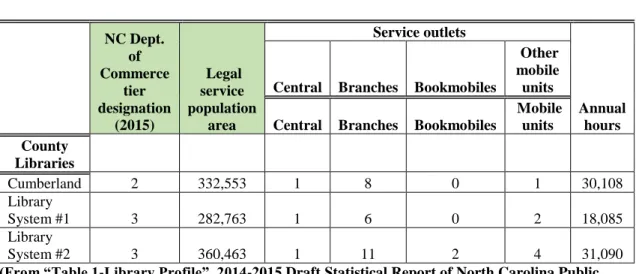
number of programs alone). The following table was based on the “Table 1: Library
Profile” dataset provided by the State Library of North Carolina in their 2014-2015
Statistical Report of North Carolina Libraries. The names of the library systems have
been replaced with aliases for the purposes of this paper (Library System #1 and Library
Table 1 NC Dept. of Commerce tier designation (2015) Legal service population area Service outlets Annual hours Central Branches Bookmobiles
Other mobile units
Central Branches Bookmobiles
Mobile units County
Libraries
Cumberland 2 332,553 1 8 0 1 30,108
Library
System #1 3 282,763 1 6 0 2 18,085
Library
System #2 3 360,463 1 11 2 4 31,090
(From “Table 1-Library Profile”, 2014-2015 Draft Statistical Report of North Carolina Public Libraries)
The NC Department of Commerce tier designation is a classification on economic
well-being which is assigned to each county by the NC Department of Commerce. According
to the NC Department of Commerce, they “annually rank the state’s 100 counties based
on economic well-being and assign each a Tier designation. The 40 most distressed
counties are designated as Tier 1, the next 40 as Tier 2 and the 20 least distressed as Tier
3. This Tier system is incorporated into various state programs to encourage economic
activity in the less prosperous areas of the state.” (“2016 County Tier Designations”,
2015). Furthermore, the tier designations are based on four key factors: “average
unemployment rate, median household income, percentage growth in population, and
adjusted property tax base per capita.” This economic tier designation serves as a useful
indicator in assisting with comparisons of library systems because it provides additional
context for workforce development programs implemented in various counties (since in
theory, economically distressed counties are more likely to need a broader range of
From “Table 1 - Library Profile” we can see that the three library systems have
similar legal service populations of approximately 325,000 on average. Furthermore, we
see that Cumberland County has a Tier 2 designation whereas Library Systems #1 and #2
have Tier 3 designations. Finally, Library System #2 is the largest library system in our
comparison based on the number of branches (11 branches).
The following tables show the number of programs as well as program attendance
between these three library systems. Categories labeled as “Technology/Computers” and
“Workforce Development” have been highlighted. The tables are based on the dataset
“Table 12 - Library Programs, Attendance, and Meeting Space” provided by the State
Library of North Carolina in their 2014-2015 Statistical Report of North Carolina
Libraries. Again, the names of the additional library systems have been replaced with
aliases for the purposes of this paper.
Table 2A
Number of Programs
Young Technology/ Workforce
Adult Adult Children Computers Development Total County
Libraries
Cumberland 792 580 2,607 213 157 3,979
Library
System #1 1,754 1,579 3,868 356 3 7,201
Library
System #2 1,003 243 2,014 2,705 710 3,260
Table 2B
(From “Table 12- Library Programs, Attendance, and Meeting Space”, 2014-2015 Draft Statistical Report of North Carolina Public Libraries)
The data in Table 2A indicates that Cumberland County has a fairly balanced
number of programs across various categories relative to the other two library systems
with no noticeably extreme values. Library System #1 has the greatest number of
children’s programs offered out of the three library systems (3,868 programs). Finally,
Library System #2 has the largest numbers of programs in technology and workforce
development out of the three library systems (2,705 technology and 710 workforce
development).
Table 2B shows that Cumberland County has the highest program attendance for
young adult programs and workforce development programs out of the three systems
(12,556 for young adult and 4,298 for workforce development). Library System #1 has
the highest program attendance for adult programs (19,355) and children’s programs
(127,338). Finally, Library System #2 has the highest program attendance numbers for
technology programs (48,721).
Young Technology/ Workforce Attendance
Adult Adult Children Computers Development Total Per Capita Use Attendance
County Libraries
Cumberland 12,422 12,556 75,265 1,005 4,298 100,243 0.30 10,600 64,499 Library System #1 19,355 10,934 127,338 711 22 157,627 0.56 12,228 52,187 Library System #2 12,584 2,049 64,132 48,721 3,360 78,765 0.22 3,604 45,179
Program attendance
Discussion
There are a multitude of programs and services which the Cumberland County
Public Library system implements that serve to distinguish their workforce development
programs from other library systems. However, there are several key themes that arise
from the data which may reflect why the Library is so unique in their approach to
workforce development. These themes consist of the central importance of people,
data-driven research and innovation, the role of funding as a means to support existing
programs and the central importance of job fairs as a workforce development initiative.
People
People (specifically library staff) are the central element that account for the
success of the workforce development programs implemented by the Library. From
interacting with policymakers on economic policy to collaboration with state agencies
and from advocacy of programs to the importance of staff time, people are crucial for the
library to develop their workforce development programs and to ensure their success.
In regards to interactions with policymakers, the Library Director at the West
Regional Branch is the only Director who sits on the Cumberland Workforce
Development Board. This is important for the Library because it allows the Library to
interact directly with policymakers on economic issues facing the county as a whole. As a
result, the Library is provided with unique insights and is placed as a key insider on the
economic issues facing the county as a whole while establishing the Library’s importance
for the benefit of the community. This insider status ultimately allows the Library to have
key information on economic development issues at a broader governmental and
policymaking level while also allowing the Library to take an active role in ensuring that
economic development efforts are successful. Additionally, this insider status allows the
Library to provide policymakers with increased awareness of the Library’s initiatives and
how they can serve to facilitate state agencies with their own initiatives.
Another example that highlights the importance of people is the role of
collaboration between the Library and other organizations across the state. For example,
the Library has collaborated with the UNC Gillings School of Public Health on job fairs.
This has served multiple goals in that the Library was able to host their job fair while
UNC researchers were able to conduct health surveys and research targeted to large
numbers of unemployed and underemployed people. Another example is when the
Library collaborates with state agencies such as the Fayetteville Police Department and
the Department of Social Services to assist with their re-entry job fairs for ex-convicts by
providing library resources. Both of these examples highlight two key benefits of
collaboration with other organizations. First, these collaborative efforts help to enhance
the effectiveness of program initiatives such as receiving grant funding for working with
the UNC Gillings School of Public Health and for accomplishing multiple goals at a
single event (job fair initiatives and health research) or for enhancing job fairs hosted by
the Police Department by providing much-needed resources at their event. Second, these
collaborative efforts help to market the Library’s workforce development initiatives
throughout the state by raising awareness of the Library’s offerings and by increasing the
outreach programs to advocate for Library programs as a whole (traditional library
programs as well as workforce development programs), the Library can foster close ties
with other organizations such as state agencies, academic institutions, and businesses
who will advocate on behalf of the programs and initiatives of the Library. This results in
a positive feedback effect in which collaboration allows for the Library to spread
awareness of their initiatives to other institutions that results in more grant funding as
well as greater opportunities to interact with more organizations throughout the state to
expand their program offerings further.
Finally, the Library’s investment in their staff is the final example which
highlights the crucial role that people play in developing and executing effective
workforce development programs. The Library provides staff training in areas such as
reviewing resumes or using proprietary databases. As a result, the Library ensures that
their staff have the resources and skills to be more effective when implementing various
library programs such as leading classes on workforce development topics such as using
spreadsheet software or navigating business and jobs databases or when creating Library
Resource Guides for the public. Also, we have seen from the interview with the Job and
Career Coordinator that the most significant factor in determining the feasibility of
programs was the cost of library staff time and their flexibility in working at various
times for a variety of events. It is significant that the Career Coordinator specifically
identified staff time as the single most important factor determining the feasibility of their
programs as opposed to other aspects such as funding or library spaces. However, while
these other aspects are important, they do not have the same impact on library programs