Module 4.1
Sensing the World Around Us
Stimuli are energies in the
environment that affect what we
do.
Receptors are the specialized cells
in our bodies that convert
environmental energies into
The Detection of Light
Light is the stimulus that the visual
system is designed to detect.
Visible light is just one very small
portion of the electromagnetic
spectrum, which is the continuum of all
the frequencies of radiated energy.
The human eye is designed to detect
energy in the wavelengths from 400 to
700 nm.
Figure 4.2
Figure 4.2 The lens gets its name from Latin for lentil, referring to its shape—an appropriate choice, as this cross section of the eye shows. The names of other parts of the eye also refer to their appearance.
The Structure of the Eye
The pupil is an adjustable opening in
the eye through which light enters.
The iris is the structure on the
surface of the eye, surrounding the
pupil, and containing the muscles
that make the pupil dilate or
constrict.
The iris gives your eye its
The Structure of the Eye
The cornea is a rigid, transparent
structure on the very outer surface of
the eyeball. It focuses light by directing
it through the pupil.
When the light goes through the pupil, it
is directed to the lens.
The lens is a flexible structure that can
vary in thickness, enabling the eye to
accommodate, adjusting its focus for
objects at different distances.
The Structure of the Eye
The lens directs the light through a
clear, jellylike substance called the
vitreous humor to the back of the
eyeball.
At the back of the eye is the retina,
the structure containing the visual
receptors.
Common Disorders of Vision
Presbyopia develops as humans age because
the lens decreases in flexibility, resulting in a reduced ability to focus on nearby objects.
Elongated eyeballs cause myopia, so that the
person can focus well on nearby objects, but not distant ones. This condition is also called nearsightedness.
Flattened eyeballs cause hyperopia, so that
the person can focus well on distant objects, but not on nearby ones. This is also called
Figure 4.3
Figure 4.3 The flexible, transparent lens changes shape so that objects (a) far and (b) near can come into focus. The lens bends entering light rays so that they fall on the retina. In old age the lens becomes rigid, and people find it harder to focus on nearby objects
Common Disorders of Vision
Glaucoma is a condition caused by
increased pressure within the eyeball,
causing damage to the optic nerve and
loss of peripheral vision.
A cataract is a disorder in which the
lens of the eye becomes cloudy. This
disorder is treated by removing and
replacing the actual lens with a
Concept Check
What happens if a person with
normal vision puts on contact lenses
designed for a person with myopia?
The Visual Receptors
The retina contains two types of
specialized neurons, the rods and
the cones.
We have many more rods than
cones.
About 5% of the visual receptors in
The Visual Receptors
The cones are utilized in color
vision, daytime vision and detail
vision.
The rods are adapted for vision in
dim light.
Species that are active at night
Table 4.1
The Visual Receptors
The fovea is the center of the
human retina, and the location of
the highest proportion of cones.
It is the area of the eye with the
greatest acuity.
Rods are more plentiful in the
Concept Check
If you see a brightly colored object
in the periphery of your vision, the
colors will not seem very bright at
all. Why is this?
You have mostly rods in the periphery of your
retina, thus a more limited ability to detect color.
Dark Adaptation
Most humans require one or two
minutes to see in the dark. This
process of gradual improvement is
called dark adaptation.
Exposure to light causes molecules
of retinaldehydes to be chemically
altered and stimulate the visual
Dark Adaptation
In conditions of normal daytime
light, these molecules are depleted
and regenerated at about the same
rate, so the amount available in
the retina is balanced and level of
visual sensitivity is constant.
Figure 4.8
Figure 4.8 These graphs show dark adaptation to (a) a light you stare at directly, using only cones, and (b) a light in your peripheral vision, which you see with both cones and rods. (Based on E. B. Goldstein, 1989)
Concept Check:
It is said that dogs and cats can see
in the dark – do you think this is
really true?
Although these animals have much better vision in
dim light than we do, there must be some light
Concept Check
In the daytime which predominates,
the fovea or periphery of the eye?
Unless you walk into a dark room, you will be using
the fovea, because cones are the receptors for
The Visual Pathway
The visual receptors send their
impulses away from the brain,
toward the center of the eye.
First the bipolar cells gather the
impulses from the rods and cones.
Then the bipolar cells make
synaptic contacts with ganglion
cells.
Figure 4.7
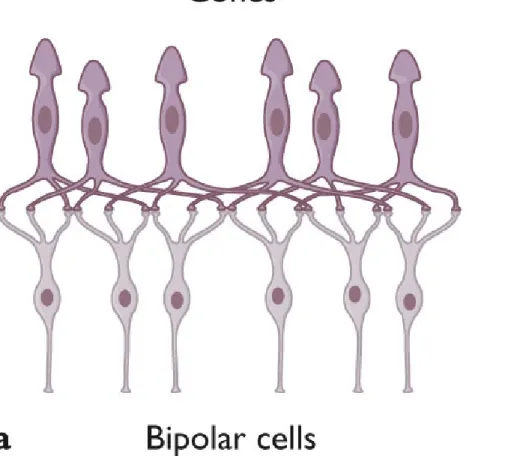
Figure 4.7 Because so many rods converge their input into the next layer of the visual system, known as bipolar cells, even a small amount of light
falling on the rods can stimulate the bipolar cells. Thus, the periphery of the retina, with many rods, has good perception of faint light. However, because bipolars in the periphery get input from so many receptors, they have only imprecise information about the location and shape of objects.
The Visual Pathway
The axons of the ganglion cells join together
to form the optic nerve, which makes a “U-turn” and exits the eye.
There are no photoreceptors at the point at
which the nerve leaves the eye. This is called the blind spot.
You are not aware of your blind spot
because information from the retina of each eye “fills in” the blind spot in the other eye. This integration occurs in the visual cortex.
The Visual Pathway
At the optic chiasm, half of each optic
nerve crosses to go to the opposite
side of the brain.
At this point the axons begin to
separate, sending information to a
number of locations in the brain.
The greatest number of axons goes to
Figure 4.9
Figure 4.9 Axons from cells in the retina depart the eye at the blind spot and form the optic nerve. In humans about half the axons in the optic nerve cross to the opposite side of the brain at the optic chiasm. Some optic nerve axons carry information to the midbrain; others carry it to the thalamus, which relays information to the cerebral cortex.
The Visual Pathway
The information from each retina is
integrated in the visual cortex.
Each cell in the cortex receives input
from both the left and the right retinas.
When the retinas are focused on the
same point in space, the input from
each side is easily integrated because
the message from each is almost the
same.
The Visual Pathway
If the images conflict with each
other, cortical cells will be
alternately stimulated and
inhibited as they try to integrate
the information.
The alternation between seeing the
conflicting information from each
retina is called binocular rivalry.
The Visual Pathway
The brain activity of the visual
cortex is crucial for the sense of
vision.
People with intact eyes but a
damaged visual cortex lose the
ability to imagine visual imagery.
Color Vision
Different wavelengths of
electromagnetic energy correspond
to different colors of light.
There are three kinds of cones that
respond to different wavelengths.
Cells in the visual path process the
information from these cones in
terms of opposites.
Color Vision
The three types of information are:
Red vs. green
Yellow vs. blue
White vs. black
The cells in the cerebral cortex
integrate the input from the parts of
the visual field to create a color
Color Vision
The Young-Helmholtz theory
This is also known as the
trichromatic theory.
It proposes that our receptors
respond to three primary colors.
“Color vision depends on the
relative rate of response by the
three types of cones.”
Color Vision
Each type of cone is most sensitive to
a specific range of electromagnetic
wavelengths.
Short wavelengths are seen as blue.
Medium wavelengths are seen as
green.
Figure 4.12
Figure 4.12 Sensitivity of three types of cones to different wavelengths of light. (Based on data of Bowmaker & Dartnall, 1980)
Color Vision
Each wavelength induces different
levels of activity in each type of cone.
For example, light that stimulates
the medium and long wavelength
cones about equally will be
perceived as
yellow
.
Light that excites all three types
Color Vision
The Opponent-Process Theory
Trichromatic theory does not account for
some of the more complicated aspects of color perception.
People experience four colors as primary –
red, green, blue and yellow.
People also report seeing colored
after-images after staring at an object of one
color. If you stare at a red object, you tend to see a green after-image when you stop staring.
Color Vision
The Opponent-Process Theory
Because of these facts, Ewald Hering
proposed that we perceive color not in
terms of separate categories but
rather in a system of paired opposites.
Red vs. green
Yellow vs. blue
White vs. black
Color Vision
The Opponent-Process Theory
The negative after-images that we
experience after staring at objects are
results of the alternating stimulation and inhibition of neurons in the visual system.
A bipolar neuron that responds strongly to
yellow will be inhibited by blue.
After you’ve stared at a yellow object, your
fatigued bipolar cell will behave as if it’s been inhibited, and yield a sensation of blue.
Concept Check
A bipolar cell is stimulated by red
wavelengths. You stare at a red
object. What will happen when you
stop staring?
Concept Check
Why do negative after-images that
you see seem to “move around?”
Because the image is in your eye, not from any
object at which you are gazing.
Color Vision
The Retinex Theory
The trichromatic and
opponent-process theory don’t account for
our experience of color constancy.
Color constancy is the tendency of
an object to appear nearly the
same color even though we see it
in a variety of lighting conditions.
Color Vision
The Retinex Theory
Edwin Land proposed that we perceive
color because the cerebral cortex
compares various retinal patterns
(thus the name: retina + cortex =
“retinex”).
By comparing different patterns of
light from different areas of the retina,
cortical cells synthesize a color
Color Vision
The Retinex Theory
The fact that certain types of brain
damage disrupt color constancy,
causing, for example, an object to
look orange under one level or type
of lighting, and red, green, yellow, or
even white under other conditions, is
considered to be strong evidence for
the Retinex theory.
Color Vision
Colorblindness
Total inability to distinguish
colors is very rare except as a
result of brain damage.
About 4% of all people are partly
Color Vision
Colorblindness
Colorblindness can result from the
absence of one of the three types of
cones.
Colorblindness can also result when
one of the three types of cones is less
responsive than the other two. The
color that stimulates that type of cone
is seen as almost gray.
Color Vision
Colorblindness
Red-green colorblindness is the most
common type.
There are two forms –
protanopia
, in
which the afflicted person lacks
long-wavelength cones, and
deuteranopia
,
in which the person lacks
medium-wavelength cones.
Yellow-blue colorblindness (known as
How We See
Before animals could see color, there
was no color.
What you see is “in your brain.” Not an
exact representation of the world
around you, but a construction and
interpretation of many stimuli.
Sensation seems simple, but it is
perhaps one of the most challenging
areas of this science.
Module 4.2
Hearing
The ear is designed to detect and
transmit sound waves to the brain.
Sound waves are vibrations in the air or
another medium.
Sound waves vary according to
frequency
and
amplitude
.
Frequency is measured by the number
of vibrations or cycles of the sound
wave per second, referred to as
hertz
(Hz.)
Figure 4.19
Figure 4.19 The period (time) between the peaks of a sound wave determines the frequency of the sound; we experience frequencies as different pitches. The vertical range, or amplitude, of a wave determines the sound’s intensity and loudness.
Hearing
The perception of frequency is referred to as
pitch.
We perceive a high-frequency sound wave as
high-pitched, and a low-frequency wave as low-pitched.
Amplitude is intensity of sound waves and is
perceived as loudness.
Pitch and loudness are psychological
experiences, and the perception of these
qualities does not solely depend on frequency and amplitude.
Hearing
The Ear
The ear is a complex organ. It converts
weak sound waves into waves of
pressure that can be transported by
sensory neurons and interpreted by the
brain.
The
cochlea
is the location of the
hearing receptors.
It is a spiral-shaped organ with canals
Hearing
The Ear Sound waves strike the tympanic
membrane, or eardrum.
The vibrations of the eardrum cause three
very tiny bones, the malleus, the incus, and the stapes, (literally the hammer, anvil and stirrup) to work to make the sound waves become stronger signals.
The stirrup causes the cochlea to vibrate. This vibration displaces hair cells along the
Figure 4.20
Figure 4.20 When sound waves strike the eardrum (a), they cause it to vibrate. The
eardrum is connected to three tiny bones—the hammer, anvil, and stirrup—that convert the sound wave into a series of strong vibrations in the fluid-filled cochlea (b). Those vibrations displace the hair cells along the basilar membrane in the cochlea, which is aptly named after the Greek word for snail. Here the dimensions of the cochlea have been changed to make the general principles clear.
Hearing
The Ear
The hair cells are connected to
neurons of the
auditory nerve
.
The auditory nerve transmits the
impulses from the cochlea to the
cerebral cortex.
Hearing
Hearing Loss
There are two common forms of deafness.
Conduction deafness results when the
three special bones in the ear fail to transmit sound waves properly to the cochlea.
Nerve deafness results from damage to
the structures that receive and transmit the impulses - the cochlea, hair cells, or auditory nerve.
Hearing
Pitch Perception
Adult humans can hear sound
waves approximately between
15,000 and 20,000 Hz.
How we hear pitch depends in
part on the frequency to which
we are listening.
Hearing
Pitch Perception
At low frequency (up to about 100
Hz), we hear by the workings of the
frequency principle
.
Sound waves passing through the
fluid in the cochlea cause all the hair
cells to vibrate, producing action
potentials that are synchronized with
the sound waves.
Hearing
Pitch Perception
At about 100-4000 Hz, we hear by the
workings of the
volley principle.
Fewer hair cells can fire at this pace,
but those that do respond in groups,
called volleys, and produce action
potentials.
Volleys are the chief mechanism for
transmitting most speech and music to
the brain.
Figure 4.21
Figure 4.21 The auditory system responds differently to low-, medium-, and high-frequency tones. (a) At low frequencies hair cells at many
points along the basilar membrane produce impulses in synchrony with the sound waves. (b) At medium frequencies different cells produce
impulses in synchrony with different sound waves, but the group as a whole still produces one or more impulses for each wave. (c) At high frequencies only one point along the basilar membrane vibrates; hair cells at other locations remain still.
Hearing
Pitch Perception
Beyond 4000 Hz, we hear by the workings of the place principle.
The place principle states that the location of the hair cells stimulated by the sound
waves depends on their frequency.
The highest frequency sounds vibrate hair cells near the stirrup.
Between 100 and 4000 Hz, we are hearing due to the combined effects of the volley and place principles.
Concept Check
You are listening to your mother on
the telephone. Which principle(s) of
hearing are operating to help you
hear her?
Hearing
Localization of sounds
How does the auditory system determine
the source of a sound?
To estimate the approximate location of
origin of a sound, the auditory system compares the messages received by the two ears.
The sound waves will arrive at the closer
ear slightly sooner (if coming from the
right, it arrives at the right ear just a little before it arrives at the left ear).
Hearing
Localization of sounds
The distance of a sound can be estimated based
on loudness and pitch.
A sound that is growing louder is interpreted as
approaching.
A higher frequency sound is interpreted as
nearer than a low frequency sound; a sound that is increasing in pitch is interpreted as approaching.
The only cue for absolute distance is the amount
Concept Check
If a person who uses hearing aids in
both ears is only wearing one in the
right ear, what will be the effect on
sound localization?
Sounds may be interpreted as coming from the right
even when they aren’t.
Concept Check
Why is it hard to tell whether a
sound originates in front or behind
you?
Because the sounds arrive in both ears at the
same time, there is no basis for comparison of the
source of the sound.
The Vestibular Sense
What we generally call balance is the vestibular sense.
The vestibule is a structure in the inner ear on each side of the head.
Changes in the position of the vestibule cause receptors to be stimulated.
These receptors tell the brain the direction of tilt, amount of acceleration and position of
the head with respect to gravity.
The vestibular sense plays a crucial role in maintaining balance and posture.
The Vestibular Sense
The structure of the vestibular system
Three
semicircular canals
are
oriented in three directions.
These canals contain a jellylike
substance and are lined with hair cells.
Acceleration causes the jellylike
substance to move the hair cells,
stimulating them.
The Vestibular Sense
The structure of the vestibular system
Hair cells are also contained in two
otolith organs
.
The
otoliths
are calcium carbonate
particles.
These particles stimulate different sets
of hair cells, depending on which way
the head tilts.
They are telling your brain “which way is
Figure 4.23
Figure 4.23 (a) Location of and (b) structures of the vestibule. (c) Moving your head or body displaces hair cells that report the tilt of your head and the direction and acceleration of movement.
The Cutaneous Senses
Touch is actually considered to be
several independent senses:
pressure
warmth and cold
pain
vibration
movement and stretch of skin
These sensations depend on several
different kinds of receptors.
The Cutaneous Senses
These are most noticeable in our
skin, but we do have the same
receptors in our internal organs,
allowing us to feel internal pain,
pressure, and temperature changes.
Therefore, we also refer to these
senses as comprising the
somatosensory system.
Figure 4.24
Figure 4.24 Cutaneous sensation is the product of many kinds of receptors, each sensitive to a particular kind of information.
The Cutaneous Senses
The primary somatosensory cortex
In certain areas, such as the fingertips and
lips, there are proportionally many more cutaneous receptors.
These areas also are allotted more tissue in
the parietal lobes of the human cerebral cortex.
Most humans with no impairment in these
areas are very good at identifying familiar objects by touch alone.
The Cutaneous Senses
Pain Pain receptors are simple nerve endings that travel to the spinal cord.
The perception of pain is a complex mixture of sensation and perception that is in part mediated by emotion.
Two different areas of the brain govern sensory and emotional interpretations.
This is one reason that at least some people can be distracted or use self-hypnosis to
The Cutaneous Senses
The gate theory of pain
Just seeking treatment or believing that
one has been treated can result in a reduction of symptoms.
The effectiveness of placebos in reducing
the experience of pain has been well supported by experimental studies.
A variety of processes can increase or
Figure 4.25
Figure 4.25 Pain messages from the skin are relayed from spinal cord cells to the brain. According to the gate theory of pain, those spinal cord cells serve as a gate that can block or enhance the signal. The proposed neural circuitry is simplified in this diagram. Green lines indicate axons with excitatory inputs; red
The Cutaneous Senses
The gate theory of pain
On the basis of these observations,
Metzack and Wall (1965) proposed
the gate theory of pain.
This is the theory that pain messages
must pass through a “gate,” thought
to be in the spinal cord.
The Cutaneous Senses
Neurotransmitters and pain
Substance P is a neurotransmitter
that the nervous system releases
for intense pains.
Reactions to painful stimuli are
reduced in animals that lack
substance P.
Figure 4.26
Figure 4.26 Substance P is the neurotransmitter most responsible for pain sensations. Endorphins are neurotransmitters that block the release of substance P, thereby decreasing pain sensations. Opiates decrease pain by mimicking the effects of endorphins.
The Cutaneous Senses
Neurotransmitters and pain
Endorphins
, which are chemically
identical to opiates, are released by the
nervous system in response to the
release of substance P.
They effectively weaken pain sensations.
Endorphin release can also be induced
by sensory experiences such as listening
to music or sexual activity.
The Cutaneous Senses
Neurotransmitters and pain
Capsaicin is the chemical that is present
in hot peppers.
It stimulates receptors that respond to
painful heat.
It causes the release of substance P and
depletes supply of it in the nervous
system.
Creams containing capsaicin can be
Phantom Limbs
A fascinating phenomenon in
neuroscience now under study is the
experience of phantom limbs
In the phantom limb phenomenon, an
amputee feels a missing body part as if
it were still there
These were once thought to be an
emotional reaction or mere irritation of
the stump of the missing limb
Phantom Limbs
The sensations are now understood to be produced by
activity in the neurons of areas in the somatosensory
cortex adjacent to the area once belonging to the missing limb
For example, the neurons of the face area are adjacent to
the hand area of the somatosensory cortex
These face neurons may occasionally produce a feeling of
a phantom hand by stimulating the area that once registered only sensations from the hand
The Chemical Senses
Taste and smell are jointly referred
to as the “chemical senses.” Many
invertebrates rely almost entirely on
these senses; other mammals use
them much more heavily than do
humans.
The Chemical Senses
Taste
The sense of taste detects chemicals on
the tongue.
Its major function is to control and
motivate our eating and drinking.
The taste buds are located in the folds
on the surface of the tongue. They
contain the vast majority of human
taste receptors.
Figure 4.28
Figure 4.28 (a) Taste buds, which react to chemicals dissolved in saliva, are located along the edge of the tongue in adult humans but are more widely distributed in children. (b) A cross section through part of the surface of the tongue showing taste buds. (c) A cross section of one taste bud. Each taste bud has about 50 receptor cells within it.
The Chemical Senses
Taste receptors
Traditionally the view from Western
medicine has held that there are four primary tastes – sweet, sour, salty, and bitter.
The flavor of monosodium glutamate
(MSG), a common ingredient in Asian cooking, may represent a fifth.
Researchers are using the word umami for
The Chemical Senses
Olfaction
Olfaction is another term for the
sense of smell.
The receptors for smell are located
in the mucous membranes in the
rear air passages of the nose.
They detect the presence of
Figure 4.30
Figure 4.30 Olfaction, like any other sensory system, converts physical energy into a complex pattern of brain activity.
The Chemical Senses
Olfaction
We are aware now that there are at
least hundreds of types of olfactory
receptors (contrast this with the
number of types of visual receptors).
Other mammals have many more
receptors than humans do.
Each type of olfactory receptor is
extremely specialized for one small
group of closely related chemicals.
Figure 4.29
Figure 4.29 The olfactory receptor cells lining the nasal cavity send information to the olfactory bulb in the brain. There are at least 100 types of receptors with specialized responses to airborne chemicals.
The Chemical Senses
Olfaction Smell is vital for food selection.
Neurons in the prefrontal cortex receive both taste and olfactory input, and combine them to produce the perception of flavor.
The olfactory tract also bypasses the relay system in the thalamus.
It travels to the olfactory bulb, a structure in the base of the brain that is directly in
The Chemical Senses
Olfaction
Especially in nonhuman mammals,
olfaction plays a vital social role.
These animals rely heavily on pheromones,
chemicals that they release into the environment.
Pheromones are important for sexual
communication, acting upon the
vomeronasal organ to send messages to other individuals regarding fertility and sexual receptivity.
The Chemical Senses
Olfaction
Humans prefer not to rely upon the
social influences of pheromones and
olfaction.
But there is some evidence that they
play a role anyway.
In one study, it was shown that female
college students who room together
tend to have synchronized menstrual
cycles.
Sensory Systems
The world that is sensed by a cat, a
snail, or a bat is very different that
the world that is sensed by you and
me.
The function of our senses is to
give us the information that we
need most to survive and thrive in
our environment.
Module 4.3
The Interpretation of Sensory
Perception of Minimal Stimuli
Thresholds
Early psychological researchers
thought it would be relatively
simple to determine the weakest
possible stimuli that humans
could detect.
Figure 4.32
Figure 4.32 Typical results of an experiment to measure a sensory threshold. There is no sharp boundary between stimuli that you can perceive and stimuli that you cannot perceive.
Perception of Minimal Stimuli
Thresholds It was soon discovered that no sharp line exists between stimuli that a person can detect and those that they cannot.
Therefore, a sensory threshold was defined as “intensity at which a given individual
can detect a stimulus 50% of the time.”
There are no guarantees however that an individual will report all the stimuli above the threshold, or fail to report all those
Perception of Minimal Stimuli
Thresholds
The environment (i.e. lighting
conditions) will also influence the
individual’s thresholds.
The absolute threshold has been
defined as the sensory threshold at the
time of maximum sensitivity; that is,
when conditions would allow for the
best possible receptivity to the
Figure 4.33
Figure 4.33 People can make two kinds of correct judgments (green backgrounds) and two kinds of errors (red backgrounds). Someone who too readily reports the stimulus present would get many hits, but also many false alarms.
Perception of Minimal Stimuli
Signal detection theory
When trying to detect relatively weak stimuli,
people can be correct and incorrect in two different ways, respectively.
A hit is a correct detection of an actual
stimulus.
A correct rejection occurs when no stimulus is
presented and no detection is claimed.
A miss is an incorrect rejection when a
stimulus actually is presented.
A false alarm is an incorrect detection when no
Perception of Minimal Stimuli
Signal detection theory Signal-detection theory is the study of people’s tendencies to make hits, correct rejections, false alarms, and misses.
Several factors work together to influence the rates of these outcomes.
The response in each trial does depend on what the person’s senses are conveying.
But an individual’s responses may also depend on their willingness to take a risk of an
incorrect response, and on the emotions that a particular stimulus might evoke.
Figure 4.34a
Figure 4.34a Results of an experiment to measure a sensory threshold using two different sets of instructions (with first version of instructions.)
Figure 4.34b
Figure 4.34b Results of an experiment to measure a sensory threshold using two different sets of instructions (with second version of instructions.)
Perception of Minimal Stimuli
Subliminal Perception
The concept of subliminal perception is
well known to the general public.
Subliminal perception is the idea that a
stimulus can influence behavior even
when it is so weak or brief that we do not perceive it consciously.
There is concern that subliminal
perception can powerfully manipulate human behavior.
Perception of Minimal Stimuli
What does “subliminal” mean?
When the term “subliminal” is used, it
refers to the quality of being “below the (sensory) threshold.”
Scientists use it to indicate that the
stimulus was not consciously detected in a given presentation.
Because the only way to know if a stimulus
has been detected is to ask, it is very
difficult to interpret the results of research on subliminal stimuli.
Perception of Minimal Stimuli
What subliminal perception cannot do
Claims that subliminal stimuli in
advertisements can make people buy things are unsupportable.
This claim has been tested repeatedly
and no evidence has been found.
Advertisements in American culture have
little need of subliminal stimuli. They are overtly and effectively manipulative.
Perception of Minimal Stimuli
What subliminal perception cannot do
Messages in music (recorded backwards or
superimposed) cannot make people do anything, evil or otherwise.
This claim has also been repeatedly tested
under controlled conditions.
No one listening to the messages can
discern these messages.
No one’s behavior has been changed after
Perception of Minimal Stimuli
What subliminal perception cannot do Subliminal audiotapes just don’t work
Claims that addictions can be overcome,
self-esteem can be improved, and general self-improvement can be achieved through the use of subliminal audiotapes are also unsupported.
Any results achieved through the use of
these tapes can be attributed to the
placebo effect or to the individual user’s motivation to improve.
Perception of Minimal Stimuli
What subliminal perception can do
Some subtle effects on subsequent perception
and emotion have been supported.
“Priming” individuals to see an object in
subsequent presentations has been achieved through repeated presentations (Bar &
Biederman, 1998).
Emotional states can be influenced by
subliminal presentation of messages that may be perceived as emotionally loaded (Masling et al., 1991).
Perception of Minimal Stimuli
Subliminal perception
The fact that subliminal
perception can influence
behavior at all is interesting.
But the effects overall are much
Perception and Recognition of Patterns
Brightness contrast There are interesting fundamental questions to answer in the area of perception
How does your brain decide how bright an object is?
The apparent brightness of an object that you are looking at can be increased or
decreased by the objects around it.
This phenomenon is called brightness contrast.
Perception and Recognition of Patterns
Face recognition
There are several interesting processes involved
in face recognition
To some extent, we use unusual characteristics to
recognize faces.
Most people recognize faces as a synthesized whole
configuration of features.
There appears to be an area that if damaged, causes
loss of the ability to recognize faces.
Children diagnosed with autism also are much poorer
The Feature-Detector Approach
One explanation for how we analyze complex stimuli suggests that we break them down
into component parts
We have feature detectors, specialized neurons that respond to the presence of certain simple features, such as angles and lines.
For example, one feature detector might be stimulated only by the presence of vertical lines, or 90º angles.
Feature detectors are essential for the first stages of analysis, but perception of complex stimuli requires other processes as well.
The Feature-Detector Approach
Hubel & Wiesel’s experiments
Important evidence for the existence of
feature detectors comes from the
Nobel Prize winning research of Hubel
and Wiesel (1981).
They inserted thin electrodes into cells
of the visual cortex in monkeys and
cats and recorded activity of those cells
when different light patterns were
Figure 4.38
Figure 4.38 Hubel and Wiesel implanted electrodes to record the activity of neurons in the occipital cortex of a cat. Then they
compared the responses evoked by various patterns of light and darkness on the retina. In most cases a neuron responded
vigorously when a portion of the retina saw a bar of light oriented at a particular angle. When the angle of the bar changed, that cell became silent but another cell responded.
The Feature-Detector Approach
Hubel & Wiesel’s experiments
The researchers were able to identify
cells that fired only in the presence
of vertical bars of light, and others
that only fired for horizontal bars.
In later experiments, they found cells
that only fired in response to
The Feature-Detector Approach
The waterfall illusion experienced by humans
is evidence that humans do indeed have feature detectors.
In this illusion, a person first stares at a
waterfall for one minute or more.
If the person then looks at cliffs immediately
after staring at the waterfall, the cliffs will appear to “flow upward.”
This suggests that the cells that detect
downward motion have become fatigued from the act of staring at the waterfall.
The Feature-Detector Approach
Do feature detectors explain perception?
Scientists believe that feature detectors are
just a first step in a series of complex processes that create perception.
Simple visual illusions such as the Necker
cube suggest that we must also actively impose meaning on images that we see.
There is a branch of psychology that
specializes in explaining how humans arrive at the integrated whole images and make
Gestalt Psychology
Gestalt psychology focuses on the human
ability to perceive overall patterns.
The word Gestalt has no true English
equivalent, but is close to synonymous
with “pattern” or “configuration.”
According to Gestalt psychologists,
visual perception is an active creation,
not merely the adding up of lines and
movement.
Gestalt Psychology
Principles of Gestalt Psychology
When looking at an image, we
make a distinction between
figure and ground
.
Gestalt Psychology
Principles of Gestalt psychology
This is a picture of a reversible figure
– a stimulus that can be perceived in
more than one way. When we decide
which side is the front of the object,
then we will see it as a stable image.
We are imposing order on an array,
not just adding up small features.
Gestalt Psychology
Principles of Gestalt psychology
The principle of proximity states that
humans tend to perceive objects
close together as belonging to a
group.
The principle of similarity states that
we perceive objects that resemble
Gestalt Psychology
Principles of Gestalt psychology
We may perceive continuation, and
fill in gaps in lines, or closure of
familiar figures.
We tend to perceive a good figure,
one that is simple and symmetrical.
Gestalt visual principles have
Fig4.44
Figure 4.44 Gestalt principles of (a) proximity, (b) similarity, (c) continuation, (d) closure, and (e) good figure.
Perception of Movement and Depth
Visual constancy
Visual constancy is our tendency to
perceive objects as keeping their size, shape, and color even though the image that strikes our retina changes from
moment to moment.
So an automobile that is driving away
looks like it is moving away, not merely shrinking, even though the image on our two retinas is growing smaller.
Figure 4.48a
Figure 4.48 (a) Shape constancy: We perceive all three doors as rectangles. (b) Size constancy: We perceive all three hands as equal in size.
Perception of Movement
Motion-blindness can result from
damage to a small area of the
temporal lobe.
This fact is further evidence that
the visual system analyzes
different aspects of an image via
different pathways in the brain.
Perception of Movement
How do we distinguish between our own
movement and the movement of objects?
The vestibular system works to keep the
visual system informed of the movements of your head.
We see motion when an object is moving
relative to the background.
When an object is stationary and the
background is moving, we may experience induced movement, a visual illusion in
which we incorrectly perceive the object as moving.
Perception of Movement
Stroboscopic movement is an illusion
of movement created by a rapid
succession of stationary images.
Animation and motion pictures work
by stroboscopic movement.
The phi effect, in which your brain
creates motion from rows of
adjacent lights blinking on and off
sequentially, is exploited by many a
nightclub and motel owner.
Depth Perception
Our retinas are two-dimensional
surfaces, but they give us very good
depth perception – our ability to
perceive distance.
There are several factors involved in
creating our depth perception.
Some are binocular cues (depending
on both eyes) and others are
Depth Perception
Binocular cues
One important contributor is retinal
disparity, which is the difference in
apparent position of an object seen
by each retina.
This discrepancy allows us to gauge
distance.
Convergence is the degree to which
our eyes must turn in to allow us to
focus on a very close object.
Figure 4.51
Figure 4.51 Convergence of the eyes as a cue to distance. The more this viewer must converge her eyes toward each other in order to focus on an object, the closer the object must be.
Depth Perception
Monocular cues Monocular cues allow a person to judge depth
and distance accurately using only one eye.
Object size can be used if we already have an
idea of the approximate size of the objects.
Linear perspective is used when parallel lines
are drawn so that they converge as they approach the horizon.
Detail – generally objects that are closer can be
seen in greater detail than those that are farther away.
Depth Perception
Monocular cues
Interposition – nearby objects will
obstruct objects that are farther away.
Texture gradient refers to the fact that
clusters of objects will seem more
densely packed the farther away the
clusters are.
Shadows give clues to distance
Depth Perception
Monocular cues
Accommodation, as you will recall, is
how the lens changes shape to focus
on objects, growing thinner to focus
on nearby objects and thicker to focus
on close things.
Motion parallax is the principle that
close objects will pass by faster than
distant objects.
Optical Illusions
An optical illusion is a
misinterpretation of a visual stimulus.
Psychologists are attempting to find a
parsimonious explanation for these
misinterpretations.
Many can be explained by
considering the relationship between
size perception and depth perception.
Optical Illusions
When we misjudge distance, we misjudge size as
well.
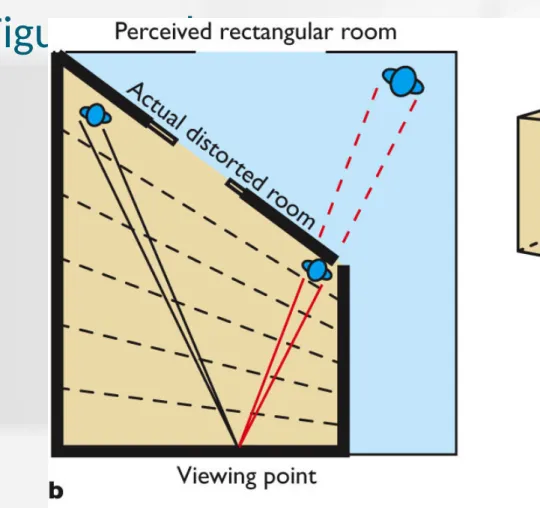
For example, the Ames room illusion causes us
to misjudge the heights of people standing in it using a powerfully misleading set of background cues.
We see an immensely tall and a very short
person, but once we remove all the misleading cues, we realize that they are people of similar height standing at different distances in relation to us.
Figure 4.57b
FIGURE 4.57b The Ames room is a study in deceptive perception, designed to be viewed through a peephole with one eye. (b) This diagram shows the positions of the people in the Ames room and demonstrates how the illusion of distance is created. (Wilson et al., 1964)
Figure 4.59
Figure 4.59 Several optical illusions depend on misjudging distances. The jar on the right seems larger because the context makes it appear farther away.
PLAY
ANIMATION
(Windows)
PLAY
ANIMATION
(Mac OS)
Optical Illusions
Even a two-dimensional drawing
can contain cues that lead to the
erroneous perception of depth.
The drawings of M.C. Escher work
Figure 4.58
Figure 4.58 These two-dimensional drawings puzzle us because we try to interpret them as three-dimensional objects.
Optical Illusions
Vision plays a prominent role in some
auditory illusions.
Visual capture effect is the tendency
to identify a sound as coming from a
visually prominent source rather than
its actual source. The inaccurate
judgment of sound’s distance leads us
also to misjudge its intensity.
Ventriloquism works using this
Optical Illusions
Cross-cultural influences
It is thought that how an individual sees
the Muller-Lyer illusion is partly influenced by cultural and other factors.
The illusion is stronger for city dwellers
and for children.
This suggests that experience with
buildings and with drawings of objects may have some impact on interpretation of two-dimensional images.
Optical Illusions
The moon illusion
To most people, the moon appears to be
about 30% larger when it is close to the horizon.
Measuring it with navigational equipment
will prove to you that it is in fact the same size.
It is hard to explain exactly why this
illusion occurs, but it probably is influenced by our tendency to use
background cues for reference in judging size.
Optical Illusions
The moon illusion
When the moon is at the horizon, we can
compare it to the other familiar objects
and the interposed terrain, so we judge
it to be very large.
When it is high in the sky, we have no
basis to gauge its distance at all. We
unconsciously judge the horizon moon to
be more distant, and therefore larger.