ISSN: 2231-5381
http://www.ijettjournal.org
Page 3233A Study on Region wise Price Variation of Construction Raw
Materials using Frequency Analysis through SPSS Software
Ashish H. Makwana1, Prof. Jayeshkumar Pitroda2 1
Student of final year M.E. C. E. & M., B.V.M. Engineering College, Vallabh Vidyanagar
2
Assistant Professor & Research Scholar, Civil Engg Department, B.V.M. Engineering College,Vallabh Vidyanagar
ABSTRACT: Materials are at the heart of all branches of engineering. Engineers are better engineers if they have a good understanding of the properties of the materials which they use. The challenge to the engineer is also made greater by the pace at which new materials are being developed. The most challenging issues in the Construction industry in the last decade is price variation of Construction raw materials. Many researchers have been done in the last decade however a deeper understanding is still needed to improve the region wise price variation of Construction raw materials by studying the market behavior in the construction industry. The aim of this study is to get the latest information and to identify the key factors that affect price variation of construction raw materials in Gujarat by study of market behavior in the construction industry. Data’s are collected through questionnaires and distributed to respondents who work at various projects in wide area in Gujarat. Respondents were required to rate and analyse using their experience and the factors were identified from past researches, which affects the project performance and then the level is measured based on their effect. The data collected are analyzed using Microsoft Excel or Statistical Package for the Social Sciences (SPSS Statistics 17.0) software which is analytical software.
KEYWORDS: behavior, construction raw materials, price variation, construction industry, respondents, performance
INTRODUCTION
Construction raw materials remains an intriguing subject and a dominant issue in the construction sector. Construction raw materials are one of the most important issues in both developed and
developing countries. The developed countries are aware of the importance of economic growth and social welfare.
A material can be anything: a finished product in its own right or an unprocessed raw material. Raw materials are first harvested from the source and divided into a form that can be easily transported and stored, then processed to produce semi-finished materials. These can be input into a new cycle of production and finishing processes to create finished materials, ready for distribution, construction, and consumption.
Engineering as a whole makes use of a vast diversity of materials. Civil engineering and building construction worldwide consume large quantities of natural materials such as stones, aggregates and wood. But there are also important manufactured materials such as cements, fired clay bricks and tiles, glass, plasters; an expanding use of polymer materials particularly for pipework, in geomembranes, as well as for coatings, fibres and adhesives; and of course all the major types of ferrous and non-ferrous metals: the steels, copper, zinc, aluminium, lead and others.
Raw materials are sold in what is called the factor market. This is because the raw materials are factors of production along with labour and capital. Raw materials are so important to the production process that the success of a country's economy can be determined by the amount of natural resources the country has within its own borders. A country that has abundant natural resources does not need to import as many raw materials, and has an opportunity to export the materials to other countries.
The objective of the present study is mentioned below:
ISSN: 2231-5381
http://www.ijettjournal.org
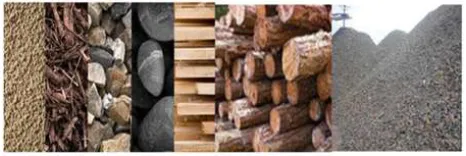
Page 3234Figure 1: Construction Raw materials
LITERATURE REVIEW
A raw material is the basic material from which a good product is manufactured or made, frequently used with an extended meaning. For example, the term is used to denote material that came from nature and is in an unprocessed or minimally processed state; e.g., fine sand, coarse sand, hand broken aggregate, crushed stone aggregate for hard quality, brick aggregates, rubble, quarry spalls, white bella stone, screened rounded gravel, binding material, unscreened gravel, hard murrum, stone dust, fly ash brick etc.
The material is anything made of matter, constituted of one or more substances. Wood, cement and any other matter are all examples of materials. Sometimes the term "material" is used more narrowly to refer to substances or components with certain physical properties that are used as inputs to production or manufacturing. In this sense, materials are the parts required to make something else, from buildings and art to airplanes and computers.
In this research construction raw material rates are as per Schedule of Rates (S.O.R.). These rates are helpful in preparation of estimates and also to serve as a guide in setting rates in connection with contract agreements, a schedule of rates for all items of work is maintained in the form of a printed book known as Schedule of rates (SOR).
The schedule of rates consists of a group of items such as excavation items, concrete items, masonry
items, demolition items, plumbing items,
electrification items etc.
As the rates of items mentioned in the schedule of rates are likely to vary, the SOR is periodically revised, usually after 3 years.
The Central Public Works Department (CPWD), a premier construction organization of the government of India, maintained printed schedule of rates book for various items of work and estimate is prepared with these rates. This SOR contains the rates of about 2500 to 3000 items. In the CPDW - SOR the items are covered under different subheads like building work, road work, water supply and sanitary items etc.
The price of the finished items are worked out by the analysis of rates with the standard requirements of materials, labour, equipments and necessary sundries like water charges, contractor‟s profit etc.
For region wise price variation analysis of construction raw materials were find out by Frequency distribution by using Statistical Package for the Social Sciences (SPSS Statistics 17.0) software.
EVOLUTION AND INNOVATION IN
MATERIALS FOR CIVIL ENGINEERING
No branch of engineering can provide such a long historical perspective on the significance of materials as civil construction. The survival of buildings, bridges and roads from ancient to modern times shows clearly the methods of construction in every era and region, and demonstrates repeatedly the close relation between available materials and structural and architectural design.
It is often noted that over several millennia until, say,
the eighteenth century, substantial buildings
ISSN: 2231-5381
http://www.ijettjournal.org
Page 3235Masonry structures may be built without jointing mortars but only at greater cost, requiring shaped stones; and jointing materials such as gypsum, resins, bitumens, and, later, limes have been of value since Egyptian times. The role of lime as a binder and the eventual emergence of recognizably modern Portland cements deserve more detailed discussion.
DESIGN OF QUESTIONNAIRES
QUESTIONS
1. How many cost of Fine Sand per cum?
2. How many cost of Coarse Sand per cum?
3. How many cost of Hand Broken Aggregate (90
mm to 25 mm size) per cum?
4. How many cost of Hand Broken Aggregate (63
mm to 40 mm size) per cum?
5. How many cost of Crushed Stone aggregate for
hard quality (40 mm to 63 mm size) per cum?
6. How many cost of Crushed Stone aggregate for
hard quality (40 mm size) per cum?
7. How many cost of Crushed Stone aggregate for
hard quality (20 mm size) per cum?
8. How many cost of Crushed Stone aggregate for
hard quality (10 mm size) per cum?
9. How many cost of Crushed Stone aggregate for
hard quality (10 mm to 20 mm size) per cum?
10. How many cost of Crushed Stone aggregate for
hard quality (6 mm to 10 mm size) per cum? 11. How many cost of Brick Aggregates (40 mm
size) per cum?
12. How many cost of Brick Aggregates (20 mm size) per cum?
13. How many cost of Brick (Conventional size) per
1000 Nos.?
14. How many cost of Brick (Modular size - 20 mm
x 20 cm x 10 cm) per 1000 Nos.?
15. How many cost of Rubble per cum?
16. How many cost of Rubble Heavy (Weight not less than 40 Kg.) per cum?
17. How many cost of Quarry Spalls per cum?
18. How many cost of White Bella stone (size 23 cm measured) per 100 Nos.?
19. How many cost of Screened Rounded Gravel
(10 mm size) per cum?
20. How many cost of Screened Rounded Gravel
(12 mm size) per cum?
21. How many cost of Murrum/Binding Material
per cum?
22. How many cost of Unscreened Gravel per cum?
23. How many cost of Hard Murrum per cum?
24. How many cost of Stone Dust per cum?
25. How many cost of Fly ash bricks conventional per 1000 Nos.?
DATA ANALYSIS & DATA INTERPRETATION
Price variance of region wise construction materials are found out by preparing survey questionnaire and raw materials data are collected from Schedule Of Rates (SOR). Data analysis is done in Microsoft Excel and Statistical Package for the Social Sciences (SPSS Statistics 17.0) software.
Different Gujarat regions are included such as
Ahmedabad, Gandhinagar, Nadiad, Anand,
Himatnagar, Mehsana, Patan, Palanpur, Bhuj, Rajkot, Jamnagar, Surendranagar, Junagadh, Bhavnagar, Amreli, Porbandar, Vadodara, Godhara, Bharuch, Dahod, Rajpipla, Surat, Tapi, Dang, Valsad, Navsari.
FREQUENCY DISTRIBUTION
A frequency distribution is a table that divides a set of data into a suitable number of classes, showing also the number of items belonging to each class. Such a table sacrifices some of the information contained in the data. Properties of frequency distribution relating to their shape are best exhibited through the use of graph. The most common form of graphical presentation of a frequency distribution is the histogram. The histogram of a frequency distribution is constructed of adjacent rectangles; the heights of the rectangles represent the class frequencies and the bases of the rectangles extend between successive classes boundaries. A histogram extends between successive classes boundaries.
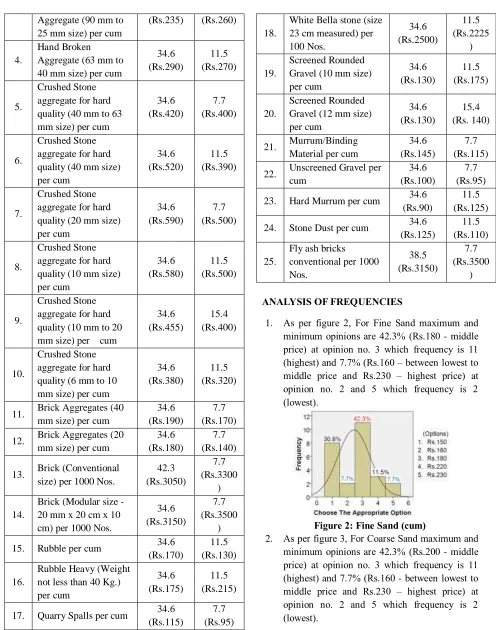
FREQUENCY TABLE Sr.
No. Variables
Frequency (%)
Max. Min.
1. Fine Sand per cum 42.3
(Rs.180)
7.7 (Rs.160)
2. Coarse Sand per cum 42.3
(Rs.200)
7.7 (Rs.160)
ISSN: 2231-5381
http://www.ijettjournal.org
Page 3236Aggregate (90 mm to 25 mm size) per cum
(Rs.235) (Rs.260)
4.
Hand Broken Aggregate (63 mm to 40 mm size) per cum
34.6 (Rs.290) 11.5 (Rs.270) 5. Crushed Stone aggregate for hard quality (40 mm to 63 mm size) per cum
34.6 (Rs.420) 7.7 (Rs.400) 6. Crushed Stone aggregate for hard quality (40 mm size) per cum 34.6 (Rs.520) 11.5 (Rs.390) 7. Crushed Stone aggregate for hard quality (20 mm size) per cum 34.6 (Rs.590) 7.7 (Rs.500) 8. Crushed Stone aggregate for hard quality (10 mm size) per cum 34.6 (Rs.580) 11.5 (Rs.500) 9. Crushed Stone aggregate for hard quality (10 mm to 20 mm size) per cum
34.6 (Rs.455) 15.4 (Rs.400) 10. Crushed Stone aggregate for hard quality (6 mm to 10 mm size) per cum
34.6 (Rs.380)
11.5 (Rs.320)
11. Brick Aggregates (40
mm size) per cum
34.6 (Rs.190)
7.7 (Rs.170)
12. Brick Aggregates (20
mm size) per cum
34.6 (Rs.180)
7.7 (Rs.140)
13. Brick (Conventional
size) per 1000 Nos.
42.3 (Rs.3050) 7.7 (Rs.3300 ) 14.
Brick (Modular size - 20 mm x 20 cm x 10 cm) per 1000 Nos.
34.6 (Rs.3150)
7.7 (Rs.3500
)
15. Rubble per cum 34.6
(Rs.170)
11.5 (Rs.130)
16.
Rubble Heavy (Weight not less than 40 Kg.) per cum
34.6 (Rs.175)
11.5 (Rs.215)
17. Quarry Spalls per cum 34.6
(Rs.115)
7.7 (Rs.95)
18.
White Bella stone (size 23 cm measured) per 100 Nos. 34.6 (Rs.2500) 11.5 (Rs.2225 ) 19. Screened Rounded Gravel (10 mm size) per cum 34.6 (Rs.130) 11.5 (Rs.175) 20. Screened Rounded Gravel (12 mm size) per cum
34.6 (Rs.130)
15.4 (Rs. 140)
21. Murrum/Binding
Material per cum
34.6 (Rs.145)
7.7 (Rs.115)
22. Unscreened Gravel per
cum
34.6 (Rs.100)
7.7 (Rs.95)
23. Hard Murrum per cum 34.6
(Rs.90)
11.5 (Rs.125)
24. Stone Dust per cum 34.6
(Rs.125)
11.5 (Rs.110)
25.
Fly ash bricks conventional per 1000 Nos. 38.5 (Rs.3150) 7.7 (Rs.3500 )
ANALYSIS OF FREQUENCIES
1. As per figure 2, For Fine Sand maximum and minimum opinions are 42.3% (Rs.180 - middle price) at opinion no. 3 which frequency is 11 (highest) and 7.7% (Rs.160 – between lowest to middle price and Rs.230 – highest price) at opinion no. 2 and 5 which frequency is 2 (lowest).
Figure 2: Fine Sand (cum)
2. As per figure 3, For Coarse Sand maximum and
ISSN: 2231-5381
http://www.ijettjournal.org
Page 3237Figure 3: Coarse Sand (Cum)
3. As per figure 4, For Hand Broken Aggregate (90mm to 25mm) maximum and minimum opinions are 30.8% (Rs.340 – between middle to highest price) at opinion no. 4 which frequency is 8 (highest) and 3.8% (Rs.260 - highest price) at opinion no. 5 which frequency is 1 (lowest).
Figure 4: Hand Broken Aggregate (90mm to 25mm) (Cum)
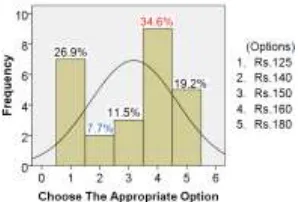
4. As per figure 5, For Hand Broken Aggregate (63mm to 40mm) maximum and minimum opinions are 34.6% (Rs.290 - highest price) at opinion no. 5 which frequency is 9 (highest) and 11.5% (Rs.250 - between lowest to middle price and Rs.270 – middle price) at opinion no. 2, 3 which frequency is 3 (lowest).
Figure 5: Hand Broken Aggregate (63mm to40mm) (Cum)
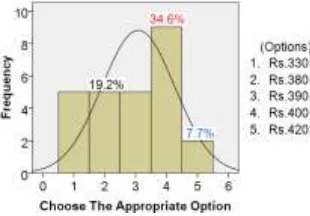
5. As per figure 6, For Crushed Stone aggregate for hard quality (40mm to 63mm size)
maximum and minimum opinions are 34.6% (Rs.400 – between middle to highest price) at opinion no. 4 which frequency is 9 (highest) and 7.7% (Rs.420 – highest price) at opinion no. 5 which frequency is 2 (lowest).
Figure 6: Crushed Stone aggregate for hard quality (40mm to 63mm size) (Cum)
6. As per figure 7, For Crushed Stone aggregate for hard quality (40mm size) maximum and minimum opinions are 34.6% (Rs.520 – highest price) at opinion no. 5 which frequency is 9 (highest) and 11.5% (Rs.410 – between lowest to middle price) at opinion no. 2 which frequency is 3 (lowest).
Figure 7: Crushed Stone aggregate for hard quality (40mm size) (Cum)
ISSN: 2231-5381
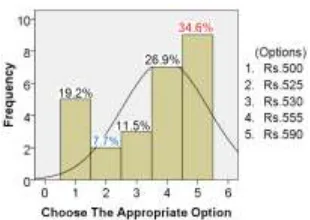
http://www.ijettjournal.org
Page 3238Figure 8: Crushed Stone aggregate for hard quality (20mm size) (Cum)
8. As per figure 9, For Crushed Stone aggregate for hard quality (10mm size) maximum and minimum opinions are 34.6% (Rs.580 – highest price) at opinion no. 5 which frequency is 9 (highest) and 11.5% (Rs.495 – lowest price) at opinion no. 1 which frequency is 3 (lowest).
Figure 9: Crushed Stone aggregate for hard quality (10mm size) (Cum)
9. As per figure 10, For Crushed Stone aggregate for hard quality (10mm to 20mm size) maximum and minimum opinions are 34.6% (Rs.455 – highest price) at opinion no. 5 which frequency is 9 (highest) and 15.4% (Rs.400 – lowest price, 415– between lowest to middle price, 425 –middle price) at opinion no. 1, 2, 4 which frequency is 4 (lowest).
Figure 10: Crushed Stone aggregate for hard quality (10mm to 20mm size) (Cum)
10. As per figure 11, For Crushed Stone aggregate for hard quality (6mm to 10mm size) maximum and minimum opinions are 34.6% (Rs.365 – between middle to highest price) at opinion no. 4 which frequency is 9 (highest) and 11.5% (Rs.330 – between lowest to middle price) at opinion no. 2 which frequency is 3 (lowest).
Figure 11: Crushed Stone aggregate for hard quality (6mm to 10mm size) (Cum)
11. As per figure 12, For Brick Aggregate (40mm size) maximum and minimum opinions are 34.6% (Rs.190 – highest price) at opinion no. 5 which frequency is 9 (highest) and 7.7% (Rs.175 – between middle to highest price) at opinion no. 4 which frequency is 2 (lowest).
Figure 12: Brick Aggregate (40mm size) (Cum)
ISSN: 2231-5381
http://www.ijettjournal.org
Page 3239Figure 13: Brick Aggregate (20mm size) (Cum)
13. As per figure 14, For Brick (Conventional size) maximum and minimum opinions are 42.3% (Rs. 3050 –lowest price) at opinion no. 1 which frequency is 11 (highest) and 7.7% (Rs.3100 – between lowest to middle price) at opinion no. 2 which frequency is 2 (lowest).
Figure 14: Brick (Conventional size) (1000 Nos.)
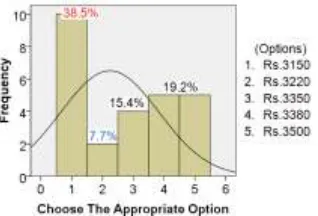
14. As per figure 15, For Brick (Modular size-20mm x20cm x10cm) maximum and minimum opinions are 34.6% (Rs. 3150 –lowest price) at opinion no. 1 which frequency is 9 (highest) and 7.7% (Rs.3200 –between lowest to middle price) at opinion no. 2 which frequency is 2 (lowest).
Figure 15: Brick (Modular size-20mm x20cm x10cm) (1000 Nos.)
15. As per figure 16, For Rubble maximum and minimum opinions are 34.6% (Rs. 130 –lowest price) at opinion no. 1 which frequency is 9 (highest) and 11.5% (Rs.145 – between lowest
to middle price, 180 – highest price) at opinion no. 2, 5 which frequency is 3 (lowest).
Figure 16: Rubble (Cum)
16. As per figure 17, For Rubble Heavy (Weight not
less than 40 kg.) maximum and minimum opinions are 34.6% (Rs. 155 –lowest price) at opinion no. 1 which frequency is 9 (highest) and 11.5% (Rs.230 – highest price) at opinion no. 5 which frequency is 3 (lowest).
Figure 17: Rubble Heavy (Weight not less than 40 kgs.) (Cum)
17. As per figure 18, For Quarry Spalls maximum and minimum opinions are 34.6% (Rs. 95 – lowest price) at opinion no. 1 which frequency is 9 (highest) and 7.7% (Rs.140 – between middle to highest price) at opinion no. 4 which frequency is 2 (lowest).
Figure 18: Quarry Spalls (Cum)
ISSN: 2231-5381
http://www.ijettjournal.org
Page 3240opinion no. 1 which frequency is 9 (highest) and 11.5% (Rs.2225 – between lowest to middle price) at opinion no. 2 which frequency is 3 (lowest).
Figure 19: White Bella Stone (size 23cm measured) (100 Nos.)
19. As per figure 20, For Screened Rounded Gravel
(10mm size) maximum and minimum opinions are 34.6% (Rs. 100 –lowest price) at opinion no. 1 which frequency is 9 (highest) and 11.5% (Rs.175 –highest price) at opinion no. 5 which frequency is 3 (lowest).
Figure 20: Screened Rounded Gravel (10mm size) (Cum)
20. As per figure 21, For Screened Rounded Gravel
(12mm size) maximum and minimum opinions are 34.6% (Rs. 110 – lowest price) at opinion no. 1 which frequency is 9 (highest) and 15.4% (Rs.140 – middle price, Rs.160 – between middle to highest price, Rs.190 – highest price) at opinion no. 3, 4, 5 which frequency is 4 (lowest).
Figure 21: Screened Rounded Gravel (12mm size) (Cum)
21. As per figure 22, For Murrum/Binding Material
maximum and minimum opinions are 34.6% (Rs. 75 –lowest price) at opinion no. 1 which frequency is 9 (highest) and 7.7% (Rs.115 – middle price) at opinion no. 3 which frequency is 2 (lowest).
Figure 22: Murrum/Binding Material (Cum)
22. As per figure 23, For Unscreened Gravel
maximum and minimum opinions are 34.6% (Rs. 95 – lowest price) at opinion no. 1 which frequency is 9 (highest) and 7.7% (Rs.100 – between lowest to middle price) at opinion no. 2 which frequency is 2 (lowest).
Figure 23: Unscreened Gravel (Cum)
ISSN: 2231-5381
http://www.ijettjournal.org
Page 3241Figure 24: Hard Murrum (Cum)
24. As per figure 25, For Stone dust maximum and
minimum opinions are 34.6% (Rs. 110 – lowest price) at opinion no. 1 which frequency is 9 (highest) and 11.5% (Rs.120 – between lowest to middle price, Rs.145 – highest price) at opinion no. 2, 5 which frequency is 3 (lowest).
Figure 25: Stone dust (Cum)
25. As per figure 26, For Fly ash bricks
conventional maximum and minimum opinions are 38.5% (Rs. 3150 – lowest price) at opinion no. 1 which frequency is 10 (highest) and 7.7% (Rs.3220 – between lowest to middle price) at opinion no. 2 which frequency is 2 (lowest).
Figure 26: Fly ash bricks conventional (1000 Nos.)
CONCLUSIONS
Following conclusions are drawn from the frequency distribution analysis:
a) For Fine Sand and Coarse Sand price opinions are more on Rs.180 and Rs.200 respectively those are medium costly compare to highest prices in Gandhinagar, Ahmedabad, Nadiad, Anand, Himatnagar, Mehsana, Patan, Palanpur, Bhuj, Rajkot, Jamnagar so there is low price variation compare to lowest price.
b) For Hand Broken Aggregate - 90mm to 25mm,
63mm to 40mm price opinion are more on Rs.340 that is between medium to highest price compare to lowest prices and Rs.290 that is highest costly compare to lowest and medium prices respectively in Gandhinagar, Ahmedabad, Nadiad, Anand, Himatnagar, Mehsana, Patan, Palanpur, Bhuj, Rajkot, Jamnagar so there is a price variation compare to lowest price.
c) For Brick (Conventional size) price opinions are more on Rs.3050 that is the lowest price in Nadiad, Anand, Himatnagar, Mehsana, Patan, Palanpur, Bhuj Amreli, Porbabdar, Surat, Navasari and for Brick (Modular size-20mm x20cm x10cm) price opinions are more on Rs.3150 that is the lowest price in Nadiad, Anand, Himatnagar, Mehsana, Patan, Palanpur, Bhuj, Rajpipla, Surat so there is no any price variation and beneficial for purchasing.
d) For Fly ash bricks conventional price opinions are more on Rs. 3150 that is the lowest price in Nadiad, Anand, Himatnagar, Mehsana, Patan,
Palanpur, Bhuj, Rajkot, Jamnagar,
Surendranagar so there is no any price variation and beneficial for purchasing and so on.
REFERENCES
[1] Richard A Johnson, “Miller & Freund‟s
Probability and Statistics for Engineers”, Seventh Edition, Prentice-Hall of India Private Limited, New Delhi-110 001, 2005.
[2] P. GANESH PRABHU, D. AMBIKA, “STUDY
ON BEHAVIOUR OF WORKERS IN
CONSTRUCTION INDUSTRY TO IMPROVE PRODUCTION EFFICIENCY”, International Journal of Civil, Structural, Environmental and
Infrastructure Engineering Research and
Development (IJCSEIERD), ISSN 2249-6866 Vol. 3, Issue 1, Mar 2013, 59-66, © TJPRC Pvt. Ltd.
[3] Hitesh D. Bambhava, Prof. Jayeshkumar
ISSN: 2231-5381
http://www.ijettjournal.org
Page 3242(IJETT) – Volume 4, Issue 6, June 2013, Pg.2330-2337.
[4] Material - Wikipedia, the free encyclopedia- https://en.wikipedia.org/wiki/Material
[5] Fundamental of materials-
http://www.thomastelford.com/books/SampleCh apters/MOCM%20sample%20chpt%201-5.pdf [6] Raw Materials Definition Investopedia
-http://www.investopedia.com/terms/r/rawmateri als.asp
[7] literature study-
http://rawmaterialcompany.files.wordpress.com/ 2011/04/dsc_0024.jpg
ACKNOWLEDGEMENT
The Authors thankfully acknowledge to Dr. C. L. Patel, Chairman, Charutar Vidya Mandal, Er.V. M. Patel, Hon.Jt. Secretary, Charutar Vidya Mandal, Mr. Yatinbhai Desai, Jay Maharaj construction, Dr. F. S. Umrigar, Principal, B.V.M. Engineering College, Prof. J. J. Bhavsar, Associate Professor, PG Coordinator, Civil Engineering Department, B.V.M. Engineering College Vallabh Vidyanagar, Gujarat, India for their motivations and infrastructural support to carry out this research.
AUTHOR’S BIOGRAPHY
Ashish Harendrabhai Makwana was born in 1988 in Jamnagar District, Gujarat. He received his Bachelor of Engineering degree in Civil Engineering from the Charotar Institute of Science and technology in Changa, Gujarat Technological University in 2012. At present he is Final year student of Master`s Degree in Construction Engineering and Management from Birla Vishwakarma Mahavidyalaya, Gujarat Technological University. He has a paper published in international journals.