Insurance Coverage for Children with Autism: Gaps and Opportunities in North Carolina
By
Nosipho Beaufort
A Master’s Paper submitted to the faculty of the University of North Carolina at Chapel Hill
In partial fulfillment of the requirements for the degree of Master of Public Health in
the Public Health Leadership Program.
Chapel Hill
2016
________________________________ Advisor:
________________________________ Second Reader:
2 Abstract
In 2016, the Centers for Disease Control and Prevention estimated total autism spectrum disorder prevalence (ASD) of 6.7 per 1000 eight year olds. Screening,
diagnostic and treatment services for ASD have been under-supported for many years. The Individuals with Disabilities Education Act, Part C was enacted to provide early identification and intervention services for children with developmental disabilities, including ASD, but has been implemented differently across the states. During the last decade, many states have enacted specific autism insurance mandates to improve access and close gaps in coverage, most recently the State of North Carolina. North Carolina’s mandate still leaves significant gaps in coverage for the ASD population. This paper reviews the current state of ASD insurance coverage nationwide and in North Carolina and recommends creating a North Carolina run health insurance exchange to allow the autism insurance mandate to be extended to health insurance plans
3 Introduction
Autism spectrum disorder (ASD) consists of several developmental brain conditions that were combined in the fifth edition of the Diagnostic and Statistical Manual of Mental Disorders, (DSM 5) under one disorder. ASD was first observed in 1943 by Dr. Leo Kanner and first listed in the third edition of the DSM- III in 1980 (Lai, Lombardo, & Baron-Cohen, 2014). The DSM-III defined autism as impaired speech and social development beginning before 30 months of age. Under the DSM-IV, the
definition of autism included autistic disorder, pervasive developmental disorder not otherwise specified (PDD-NOS) and Asperger disorder. In 2013, the DSM 5 revised the definition to include the term “spectrum” to allow for the inclusion of more types of symptoms with differing degrees of severity (CDC, 2014). For the purposes of this paper, ASD will refer to autism and autism spectrum disorder.
ASD prevalence has increased since early diagnoses, likely due to changes in diagnostic criteria and screening as well as changes in risk factors. When CDC began monitoring ASD prevalence in 2000, the Autism and Developmental Disabilities
4 The goals of this paper are to discuss the current state of private insurance
coverage for ASD services for children under the age of 18, how North Carolina compares to the national picture and recommend policies to North Carolina
policymakers to improve coverage of autism diagnosis and treatment services for its residents.
Health insurance coverage for ASD
The rising prevalence of ASD has led to an increasing need for screening, diagnostic and treatment services; however, health insurance coverage for these services varies significantly from state to state. ASD screening can be conducted as early as 6 months of age with diagnosis as early as 12 months (Boyd, Odom,
Humphreys & Sam, 2010). Although federal public resources have emphasized parent awareness of warning signs, formal screening, assessment and treatment interventions at an early age have contributed to improved outcomes later in like (Boyd, Odom, Humphreys, & Sam, 2010).Once diagnosed, parents are faced with a plethora of
potential treatment options including educational and behavioral interventions as well as pharmaceutical and medical treatments. These treatments are often implemented
simultaneously, with changes as the child matures (Inglese, 2009).
The cost of screening, diagnosis, and treatment can be very high, with the cost of behavioral therapy reaching over $35,000 per year (Bouder, Spielman, & Mandrell, 2009). Health insurance often covers the pharmaceutical and medical needs of the ASD pediatric population, but does not provide coverage for screening, diagnosis, and
5 The Individuals with Disabilities Education Act (IDEA) was enacted in 1975 as the Education for All Handicapped Children Act. The 2004 reauthorization added Part C to support early intervention treatment services for children through age two,
administered through state agencies. IDEA, Part C is a federal grant program that assists states in operating a comprehensive statewide program of early intervention services for infants and toddlers with disabilities, age birth through two years, and their families (U.S. Department of Education, 2016). States are required to comply with 17 statutory requirements to offer early intervention services to all infants and toddlers with disabilities. All 50 states participate in IDEA Part C but there is some variation in
implementation across states including fee structures and varying eligibility
requirements. Although IDEA Part C does support treatment and therapeutic services for children regardless of their insurance status, the services are only available through the age of two. Due to changes in funding, many states have adjusted their Part C programs to include free diagnostic and coordination of services, but have implemented insurance and fee structure requirements.
As of December 31, 2015, 43 states, including North Carolina, have passed legislation mandating specific ASD insurance coverage. For the purposes of this discussion, a specific ASD insurance mandate consists of legislation or an
6 Current State of Insurance Coverage for ASD
Stakeholders
Parents of children with autism and autism advocacy groups such as Autism Speaks have taken the lead in advocating and lobbying for improved autism insurance coverage for children. Autism Speaks was founded in 2005 by Bob and Suzanne Wright, grandparents of a child with ASD, and has led the push to enact insurance mandates across the United States. Historically, children with autism have been
underserved and underinsured relative to their needs (Young, Ruble & McGrew, 2009). Although Medicaid and other public insurance programs have covered many ASD
services, private insurance left considerable gaps, leading to high out of pocket costs for families (Young, et al, 2009.) Vohra, Madhavan, Sambamoorthi, and St Peter (2014) observed that caregivers of children with ASD were more likely to report challenges accessing services and insufficient insurance coverage than caregivers of children with other disabilities.
7 Individuals with Disabilities Act
IDEA, Part C established the Program for Infants and Toddlers. This program is a federal grant program that assists states in operating a comprehensive statewide
program of early intervention services for infants and toddlers with disabilities, age birth through two years, and their families. States are required to comply with 17 statutory requirements to offer early intervention services to all infants and toddlers with
disabilities, including Indian and homes infants and toddlers. All 50 states participate in IDEA Part C but there is some variation in implementation across states including fee structures and varying diagnosis eligibility requirements. Although IDEA Part C does support treatment and therapeutic services for children regardless of their insurance status, the services are only available through the age of two years.
Each state is allowed to determine its eligibility requirements for their IDEA Part C program. As a result, there is significant variation across states in the specificity and type of developmental delay and/or diagnosis for Part C services. Most states
categorize ASD as an eligible condition that has “a high probability of resulting in a developmental delay” but some states also require additional assessment
demonstrating significant developmental delay (Rosenberg, Robinson, Shaw, & Ellison, 2012).
8 for Part C treatment services. State sliding fee scales are determined based on family income and family size and vary from state to state. In Connecticut, the fee scale range may range from zero for a family earning less than $45,000 annually to $544 per month for a family of two earning more than $150,000. In North Carolina, the scale is
calculated as a percentage of the cost of services and varies from 20% - 100% of service costs or 5% of adjusted gross income (Public Consulting Group, 2011). As a result, it is difficult for a family to know which services will be covered through Part C federal or state resources and which services will require the use of insurance with out of pocket fees and deductibles.
Autism insurance coverage mandates
Currently, there are no federal laws requiring autism insurance coverage. The Patient Protection and Affordable Care Act (ACA) did not extend any specific benefits to individuals with ASD beyond the general benefits extended to all, such as eliminating lifetime dollar limits and eliminating pre-existing conditions (“ACA and Autism”, 2015). Many states have enacted autism insurance coverage mandates requiring eligible insurance companies to provide coverage for the diagnosis and treatment of autism spectrum disorders. Prior to 2005, only one state, Indiana, had an autism insurance mandate in place (Johnson, Danis, & Hafner-Eaton, 2014). Most states included autism insurance and treatment in limited mandates designated to cover mental health and neurological conditions. These limited mandates often lacked coverage for behavioral treatments such as applied behavioral analysis. Applied behavioral analysis, which may include adaptive behavioral treatments, targets key developmental areas such as
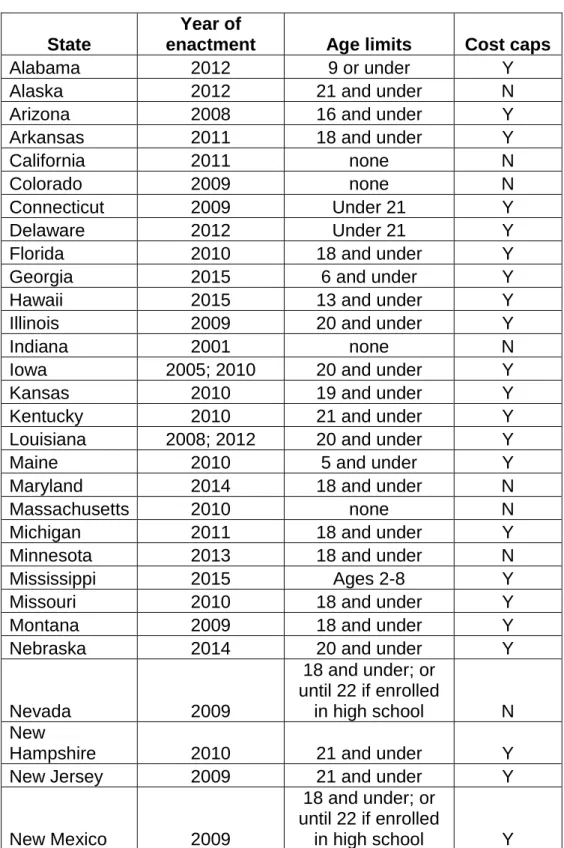
9 Lombardo, & Baron-Cohen, 2014). Behavioral treatments improve the development of intelligence, communication and socialization skills that are important for daily living skills later in life. Specific autism mandates tend to include a broader range of diagnosis and treatment coverage, require coverage for children through the age of 6 with some mandates require coverage through the age of 18 or 21. Eligible insurance providers vary widely from state to state with some mandates including all insurance providers and plan types while others limit to specific provider groups or plans. Although the ACA removed lifetime coverage caps, adaptive behavioral treatments are not included as an ACA service and are commonly subject to cost or hourly caps. Table 1 includes a breakdown by state of eligible ages and cost caps associated with ASD insurance mandates. Age limit includes ages that are eligible for coverage under the insurance mandate. Cost caps refer to states that include a cap either as a maximum dollar amount or number of hours for applied behavioral analysis or adaptive behavior treatments. The dollar amount caps vary from $20,000 to $50,000 per year with two states including a lifetime maximum of $200,000. The annual dollar caps may be identical regardless of age with some states instituting increases and/or decreases depending on the age of the child. Baller et al (2015) observed that although many states have struggled with the implementation of autism insurance mandates, access to autism services have increased. In addition to increasing access to services, out of pocket costs have decreased (Parish, Thomas, Rose, Kilany and McConville, 2012).
Autism insurance coverage in North Carolina
10 Carolina Infant-Toddler Program. In 2013, 1.21% of infants and toddlers one year of age and younger and 2.81% of infants and toddlers three years of age and younger were enrolled in the Infant and Toddler Program. North Carolina provides evaluation, assessment and service coordination to eligible families at no cost, but provides any additional services on a sliding scale based on a percentage of the cost of services. The sliding fee is determined based upon adjusted gross income and family size. Participating families have the option of using private insurance for covered services (North Carolina Department of Health and Human Services, n.d.).
North Carolina enacted Senate Bill 676: Autism Health Insurance Coverage on October 15, 2015 which became effective on January 1, 2016. North Carolina’s
mandate requires private group health benefit plans provided by employers with more than 100 employees and grandfathered individual plans to cover diagnosis, behavioral care, pharmacy care, psychiatric care, psychological care, therapeutic care and
adaptive behavioral treatment of ASD for individuals 18 years old and younger. The mandate also restricts termination of insurance coverage because of an autism
diagnosis. The North Carolina mandate includes an annual cap of $40,000 per year for adaptive behavioral treatment. The mandate does not apply to individual health
insurance plans or plans purchased in the health insurance marketplace that is
11 Identifying Gaps in Insurance Coverage
In order to assess the needs for broader insurance coverage, a series of questions and assumptions will be investigated using a literature review and review of state legislation. These include:
1. Where are the national gaps and variation in enacted autism insurance mandates?
a. Assumption: Autism insurance mandates vary greatly from state to state, leaving gaps in coverage when viewed together.
2. How does North Carolina’s autism insurance mandate compare to other states? a. Assumption: North Carolina is the most recent state to enact an autism
insurance mandate and has taken a similar approach to existing mandates.
Where are the national gaps and variation in enacted autism insurance mandates?
12 How does North Carolina’s mandate compare to other states?
North Carolina’s mandate is one of the more inclusive mandates that have been enacted as the legislation includes several types of treatment, the age of eligibility is through age 18 and the cost cap for adaptive behavioral therapy is slightly above the mean. However, there are still significant gaps in the legislation. The legislation is limited to group health plans and specific individual health plans that were sold in the North Carolina prior to the implementation of the ACA. The State Employee Health Plan includes services voluntarily but is not included in the mandate. As a result, many
families with individual plans sold after the implementation of the ACA are excluded from the mandate. North Carolina elected not to create a state run health insurance marketplace under the ACA and currently the health insurance marketplace is federally administered. As a result, North Carolina does not have authority to establish benefit requirements for insurance plans sold in the marketplace.
13 however, those plans will not be required to meet the standards of the mandate,
introducing additional variation of coverage and access to services.
Discussion
Although the majority of states have enacted ASD insurance mandates, when viewed as a whole there are still considerable gaps in covered populations and services. North Carolina’s ASD insurance mandate provides broad coverage by age and cost, but leaves some gaps as the mandate does not apply to all private health insurance plans purchased in North Carolina. As the ASD mandate comes into effect, North Carolina should consider additional changes to ensure ASD services are
available to all residents. Recommendations
SB 676 was a strong beginning to expand access to ASD assessment and treatment services in North Carolina, but is limited by the types of plans that are
included in the mandate. Currently, the ability to extend the ASD insurance mandate to all private insurance plans is limited by North Carolina’s failure to administer its health insurance market place. To address this issue, North Carolina should expand its participation in the ACA health insurance exchanges in order to improve the overall access to autism services throughout the state. By operating an insurance exchange or working collaboratively with the federal exchange, North Carolina can expand the health insurance mandates to the 613,487 North Carolinians who are currently enrolled in marketplace purchased plans.
14 As the mandate is in the early stages of implementation, it is difficult to measure the percentage of the ASD population that will receive coverage from the mandates or identify the proportion of available health insurance plans that are included in the mandate. Assessments will be needed throughout the implementation to measure the proportion of the population that are impacted by the mandate and the impact on out of pocket consumer costs as well as any changes to insurance premiums over time as a result of the mandate.
Conclusion
15 Tables
Table 1. State Differences in ASD Mandates
State
Year of
enactment Age limits Cost caps
Alabama 2012 9 or under Y
Alaska 2012 21 and under N
Arizona 2008 16 and under Y
Arkansas 2011 18 and under Y
California 2011 none N
Colorado 2009 none N
Connecticut 2009 Under 21 Y
Delaware 2012 Under 21 Y
Florida 2010 18 and under Y
Georgia 2015 6 and under Y
Hawaii 2015 13 and under Y
Illinois 2009 20 and under Y
Indiana 2001 none N
Iowa 2005; 2010 20 and under Y
Kansas 2010 19 and under Y
Kentucky 2010 21 and under Y
Louisiana 2008; 2012 20 and under Y
Maine 2010 5 and under Y
Maryland 2014 18 and under N
Massachusetts 2010 none N
Michigan 2011 18 and under Y
Minnesota 2013 18 and under N
Mississippi 2015 Ages 2-8 Y
Missouri 2010 18 and under Y
Montana 2009 18 and under Y
Nebraska 2014 20 and under Y
Nevada 2009
18 and under; or until 22 if enrolled
in high school N New
Hampshire 2010 21 and under Y
New Jersey 2009 21 and under Y
New Mexico 2009
18 and under; or until 22 if enrolled
16
New York 2011 None Y
North Carolina 2015 18 and under Y
Oregon 2013 None Y
Pennsylvania 2008 under 21 Y
Rhode Island 2011; 2012 under 15 Y
South Carolina 2007 under 16 Y
Texas 2007 9 and under N
Utah 2014 ages 2-9 Y
Vermont 2009 under 21 N
Virginia 2011 ages 2-6 N
Washington 2014 None
West Virginia 2011
18 months - 18
years Y
Wisconsin 2009 None N
17 References
ACA and Autism. (2013, April 01). Retrieved October 23, 2015, from
http://www.hhs.gov/programs/topic-sites/autism/aca-and-autism/index.html
American Psychiatric Association. Diagnostic and statistical manual of mental disorders. 5th ed. Arlington, VA: American Psychiatric Association; 2013
Baller, J. B., Barry, C. L., Shea, K., Walker, M. M., Ouellette, R., & Mandell, D. S. (2015). Assessing early implementation of state autism insurance mandates. Autism. doi:10.1177/1362361315605972
Barton, E. E., Harris, B., Leech, N., Stiff, L., Choi, G., & Joel, T. (2015). An Analysis of State Autism Educational Assessment Practices and Requirements. J Autism Dev Disord Journal of Autism and Developmental Disorders, 46(3), 737-748.
doi:10.1007/s10803-015-2589-0
Bouder, J. N., Spielman, S., & Mandell, D. S. (2009). Brief Report: Quantifying the Impact of Autism Coverage on Private Insurance Premiums. J Autism Dev Disord Journal of Autism and Developmental Disorders, 39(6), 953-957.
doi:10.1007/s10803-009-0701-z
Boyd, B. A., Odom, S. L., Humphreys, B. P., & Sam, A. M. (2010). Infants and Toddlers With Autism Spectrum Disorder: Early Identification and Early Intervention. Journal of Early Intervention, 32(2), 75-98. doi:10.1177/1053815110362690
18 Centers for Disease Control and Prevention (2016). Prevalence and Characteristics of
Autism Spectrum Disorder Among Children Aged 8 Years — Autism and Developmental Disabilities Monitoring Network, 11 Sites, United States, 2012. MMWR Surveill Summ 2016;65(No. SS-3):1–23. DOI:
http://dx.doi.org/10.15585/mmwr.ss6503a1
Chatterji, P., Decker, S. L., & Markowitz, S. (2015). The Effects of Mandated Health Insurance Benefits for Autism on Out-of-Pocket Costs and Access to Treatment. J. Pol. Anal. Manage. Journal of Policy Analysis and Management, 34(2),
328-353. doi:10.1002/pam.21814
Inglese, M. D. (2009). Caring for Children With Autism Spectrum Disorder, Part II: Screening, Diagnosis, and Management. Journal of Pediatric Nursing, 24(1), 49-59. doi:10.1016/j.pedn.2008.06.005
Johnson, R. A., Danis, M., & Hafner-Eaton, C. (2014). US state variation in autism insurance mandates: Balancing access and fairness. Autism, 18(7), 803-814. doi:10.1177/1362361314529191
Lai, M., Lombardo, M. V., & Baron-Cohen, S. (2014). Autism. The Lancet,383(9920), 896-910. doi:http://dx.doi.org/10.1016/S0140-6736(13)61539-1
North Carolina Department of Health and Human Services. (n.d.). North Carolina Infant-Toddler Program. Retrieved from http://www.beearly.nc.gov/
North Carolina Department of Health and Human Services (2015) North Carolina Part B Profile. Retrieved from https://osep.grads360.org/#
Parish, S. L., Rose, R. A., Andrews, M. E., & Shattuck, P. T. (2009). Receipt of
19 care needs: A multilevel analysis of state policy needs. Children and Youth
Services Review, 31(1), 63-70. doi:10.1016/j.childyouth.2008.05.010
Parish, S., Thomas, K., Rose, R., Kilany, M., & Mcconville, R. (2012). State Insurance Parity Legislation for Autism Services and Family Financial Burden. Intellectual and Developmental Disabilities, 50(3), 190-198. doi:10.1352/1934-9556-50.3.190
Public Consulting Group. (2011, December). Analysis of family cost participation policy (Rep.). Retrieved
ectacenter.org/~pdfs/meetings/.../PCG_Colorado_Final_Report.pdf
Rosenberg, S. A., Robinson, C. C., Shaw, E. F., & Ellison, M. C. (2012). Part C Early Intervention for Infants and Toddlers: Percentage Eligible Versus Served. Pediatrics, 131(1), 38-46. doi:10.1542/peds.2012-1662
Ruble, L. A., & Mcgrew, J. H. (2007). Community services outcomes for families and children with autism spectrum disorders. Research in Autism Spectrum
Disorders, 1(4), 360-372. doi:10.1016/j.rasd.2007.01.002
Stein, B. D., Sorbero, M. J., Goswami, U., Schuster, J., & Leslie, D. L. (2012). Impact of a Private Health Insurance Mandate on Public Sector Autism Service Use in Pennsylvania. Journal of the American Academy of Child & Adolescent Psychiatry, 51(8), 771-779. doi:10.1016/j.jaac.2012.06.006
Tregnago, M. K., & Cheak-Zamora, N. C. (2012). Systematic review of disparities in health care for individuals with autism spectrum disorders in the United States. Research in Autism Spectrum Disorders, 6(3), 1023-1031.
20 U.S. Department of Education. (2016, March 17). Early intervention program for infants
and toddlers with disabilities. Retrieved from http://www2.ed.gov/programs/osepeip/index.html
Vohra, R., Madhavan, S., Sambamoorthi, U., & Peter, C. S. (2013). Access to services, quality of care, and family impact for children with autism, other developmental disabilities, and other mental health conditions. Autism, 18(7), 815-826.
doi:10.1177/1362361313512902