Library Services. A Master’s Paper for the M.S. in L.S. degree. April, 2009. 59 pages. Advisor: Lisa Norberg.
Discussions of tensions in faculty-library relationships at academic institutions have appeared in LIS literature for some time, but few articles have directly addressed the information needs of faculty and their relationship to library services. This paper
examines faculty-library problems discussed in the current body of literature and further explores faculty knowledge, use and attitudes of specific library public services in the areas of reference, instruction and material access. It describes an online survey
distributed to University of North Carolina- Chapel Hill faculty members affiliated with the College of Arts and Sciences. Results indicate the need for improved library-to-faculty outreach to increase library-to-faculty awareness, use and value of services. This study provides results intended to improve library service development and outreach efforts to UNC-CH faculty members to encourage positive faculty-library relationships for
establishing and maintaining libraries as active and dynamic campus entities.
Headings:
College and university libraries – Relations with faculty and curriculum
Faculty Attitudes
Information needs—Evaluation
Information seeking – Faculty
FACULTY KNOWLEDGE,USE AND ATTITUDES OF LIBRARY SERVICES
by
Jennifer M. Klaudinyi
A Master’s paper submitted to the faculty of the School of Information and Library Science of the University of North Carolina at Chapel Hill
in partial fulfillment of the requirements for the degree of Master of Science in
Library Science.
Chapel Hill, North Carolina April 2009
Approved by
INTRODUCTION
In the past decade, librarians and those concerned with library and information science (LIS) research and design have focused more and more on user perspectives. We study how users access and employ our systems and materials with the intent of
designing better ways to meet user needs. In academic libraries, these studies frequently focus on the information needs of students, an undeniably important patron group. Much less literature, however, explores university faculty and their relationship to academic libraries. Of the literature that does discuss faculty-library relations, even less addresses the information needs of faculty. This study will examine the information needs of
faculty members at academic institutions. Research indicates several points of breakdown in academic faculty-library relations; this study will address gaps in research knowledge to improve library service to faculty members.
The term “service” as applied in LIS literature is admittedly nebulous, and some might argue that all library functions could be considered different facets of service. This study focuses on the public service aspects of the term. The chosen areas of library service include:
References services, such as reference desk visits, consultations with subject specialists, phone reference, email reference, chat/IM reference
Instructional services, such as instruction sessions for classes, library tours for classes, course websites for classes, subject guides for classes
Material access services, such as interlibrary loan, document delivery, e-journals and e-books
Research has suggested that faculty members are unaware of library services (Maughan, 1999; Hewitson, 2002). Housewright and Schonfeld (2008) suggested that faculty members value the library as a gateway or starting place for research less when compared to other library functions, and the value that faculty members do attribute to gateway function is declining over time. Many of the services that this study addresses are closely related to this gateway function. Reference services are generally meant to direct patrons to relevant resources, and instruction services are largely aimed at demonstrating research techniques. Housewright & Schonfeld’s results suggest two possibilities:
Faculty are unaware of library services that can aid their research and teaching processes, or
The literature suggests that librarians are aware that there is a problem when it comes to faculty collaboration, communication and outreach. They have read study results indicating that faculty members’ value of public service-oriented librarians is generally declining. They suspect that faculty members are unaware of services offered by the library and the role of librarians (Julien & Given, 2003). Librarians, however, are unsure of which services faculty members know about, how they discover them, which services they value and which services they use. This study explores these issues.
Research Questions:
What knowledge do University of North Carolina at Chapel Hill (UNC-CH) faculty members have about library services?
How did faculty become aware of the services with which they are familiar? What services do faculty members use and with what frequency?
What attitudes do faculty members have towards library services?
Though the literature illustrates breakdowns in library-faculty relationships and faculty perceptions and awareness about library roles and services, it does not examine specifics about which services they are aware of, how they discovered those services and which services might be useful to faculty members, largely because libraries and library research has failed to address the needs of faculty members as library users. A review of the literature illustrates this gap and demonstrates the need for research that examines faculty members as library patrons.
this study. The goal of this study is to gain a better understanding of what faculty members at one large research university know about the library services available to them. It is hoped that this research will help the librarians at UNC-CH assess and
possibly improve their communication and outreach efforts toward their faculty. It is also hoped that the results will provide some insight into what services faculty deem useful and offer directions in which the library may want to target resources to develop services that better meet the needs of faculty. Ultimately, the purpose of this study is to yield usable results for creating effective library-to-faculty outreach strategies at UNC-CH, encouraging faculty-library collaboration, and developing more relevant library services for UNC-CH faculty.
LITERATURE REVIEW
This section explores existing literature that addresses the roles that faculty
members inhabit in their profession, their professional concerns and limitations, the value they assign to libraries and library services, their awareness of the library and its services, the importance of library-faculty collaboration and the need to understand faculty as library patrons. The existing body of literature and research in the area of faculty-library relations contains several useful insights; however, further study of faculty members’ knowledge of, attitudes about and behaviors surrounding specific library services is needed.
Much of the literature considering library-faculty relations has focused on the perceptions of librarians. These articles illustrate breakdowns in communication, goal alignments, and perceptions and suggest that librarians, especially, are dissatisfied with the existing relationship between faculty and academic libraries. In their study, Julien & Given (2003) conducted a content analysis of 7 years’ worth of conversations related to faculty perceptions on a popular library instruction-focused listserv that demonstrated the disconnect that librarians feel in regards to faculty. Among their findings, the authors discussed conflicting themes relating librarians’ simultaneous expectation that faculty members should be aware of library services simply because they are faculty,
disappointment at their lack of library service and librarian-role awareness, and
librarians’ own perception of themselves as the primary experts of library services. Badke (2008) also addresses the perceived faculty-librarian power dynamic conflict, claiming that information professionals have allowed themselves to take the role of “second-class citizens in academia” by failing to realize their power (p. 49). Julien and Given (2003) summed up the heart of the perceived power/role conflict for librarians: “The bottom line seems to be the perception that faculty do not understand librarians as librarians
understand themselves” (p. 80). This clash in perceptions only begins to imply the complex relationship between faculty and librarians and serves as a starting point in understanding other breakdowns.
Badke, 2008). Much of the writing about perceived negative faculty personality traits has appeared in articles concerning bibliographic instruction or information literacy
instruction. Though it is not surprising that conflicts might arise in an area of the information field that necessitates collaboration between librarians and faculty, it is troubling to see that some information professionals have attributed these conflicts to faculty personality traits. This may be indicative of larger unaddressed issues concerning library-faculty relations.
What do faculty members do?
In order to learn about faculty members’ relationship to libraries, it is crucial to consider their professional roles, responsibilities, needs and limitations, and much of the literature has acknowledged the importance of faculty culture. Many authors have
stressed that faculty responsibility is generally divided into three primary areas: research, teaching and service, and point to these divided attentions when considering faculty’s perceptions of libraries and information seeking (Hardesty, 1999; Farber, 2000; Julien & Given, 2003; Badke, 2008). Hardesty (1999), a well known scholar in the area of faculty-library relations, especially relating to information literacy, emphasized the prioritization of research in faculty’s hierarchy of responsibilities in response to institutional pressures and promotion requirements. This observation has been echoed by other authors
interested in the faculty’s perception of information literacy of students, including McGuinness (2006) and Badke (2008). Hardesty also pointed out faculty’s general lack of formal education training and suggested that this lack of training may play a role in the oft-cited librarian perception that faculty members are resistant to sharing their
While faculty members’ emphasis of research over teaching might help to explain their resistance to library-led information literacy services, their divided responsibilities suggest a simple limitation that can be broadly applied to their relationship with library resources and services in general: time constraints. The acknowledgment of faculty time constraints has appeared over and over again in information science literature (McCarthy, 1985; Hardesty, 1999; Farber, 2000; Hewitson, 2002; Julien & Given, 2003; Badke, 2008). Longtime information literacy proponent, scholar and librarian Evan Farber pointed out in his 2004 reflections that even he forgot to initiate a bibliographic
instruction session for a humanities course he taught until late in the semester, under the pressures and time limitations involved in a faculty teaching role. Simply put, the literature has acknowledged that faculty members have several concerns and
responsibilities and not enough time, and this professional atmosphere has a major impact on their relationship to the library.
use familiar and trusted electronic resources that they believe represent their subject fields and are less likely to explore unfamiliar resources.
McGunness’ 2006 interview-based study, which examined faculty perceptions of undergraduate information literacy, links faculty subject expertise and personal research experience with a difficulty to understand the role of student research novices and the processes necessary to execute successful research. McGunness’ study suggested that faculty members are simultaneously dissatisfied with the way that undergraduates conduct research, and also unlikely to view information gathering as a skill or process that can be taught. Her results indicated that faculty members consider information literacy a skill that is naturally acquired independently. Faculty members’ views of research, methods to carry it out and its importance can contribute to an understanding of their relationship to libraries and library services.
What do faculty members value in the library?
The literature has also explored which aspects of the library and services faculty value. The functions of the library that McCarthy suggested were of primary interest to faculty in her 1985 seminal work, “The Faculty Problem,” have been corroborated in more recent studies as well. McCarthy suggested that faculty members see the library as a valuable physical space and, more importantly, as an information repository. She
In a more recent broad survey of faculty perceptions carried out by the Ithika Research Group and described in Schonfeld & Guthrie (2006) and Housewright & Schonfeld (2008), McCarthy’s 1985 observations are supported. The authors surveyed faculty regarding the importance of three library roles: “purchaser,” “archive” and “gateway.” Across disciplines, the purchaser role was ranked as most important. Value from discipline to discipline varied more for the other two roles, but the archive role was largely rated as the second most important, while the gateway role was ranked lower than the other two.
One of the primary goals of the study was to examine how the availability of electronic resources has impacted faculty value of library functions. To do this, they compared the results from the 2006 survey to results from similar surveys conducted in 2000 and 2003. The 2006 results strongly suggested that availability of electronic resources has increased the importance of the purchaser role in the view of faculty who are aware of the high cost of electronic journal subscriptions, but decreased the value of the library as a gateway to research. The authors also proposed a link between value rankings and availability of electronic resources within specific disciplines. Their results showed that faculty members in science disciplines with high electronic resource
availability valued the gateway role less than faculty members in the humanities with lower electronic resource availability.
results to faculty members’ lower awareness of the library’s role in providing services in an electronic environment. They characterize this as a sign of library success at providing easy access to resources, but also as an indication that libraries and their services are becoming less visible. The authors called for a deeper assessment of library services and how they can be developed to meet the needs of faculty: “Libraries must consider ways which they can offer new and innovative services to maintain, or in some cases recapture, the attention and support of faculty” (p. 7).
What do faculty members know about the library?
Hewitson (2002) stated an implicit relationship between faculty awareness and faculty value of library resources: “Indeed, the consensus appeared to be that it was only after members of staff had used the services themselves and incorporated them into their own work that they could see their value and develop the confidence to incorporate them into their teaching” (p. 47). In order to value library services, he implied, faculty must be aware of them and must use them. Only then can those resources be considered useful. Hewitson also related this awareness and value of faculty members to the instruction of students.
Schonfeld & Guthrie (2006) and Housewright & Schonfeld (2008) regarding the increase of electronic resources and its impact on faculty awareness of library services. Libraries were indeed complex and multi-faceted in 1985, but they surely have not gotten any simpler in the past 20 years. Hardesty (1999), Julien & Given (2003), Farber (2004), and Badke (2008) have all addressed librarians’ perceptions that faculty members are
unaware of library services and librarian roles.
Some study results have supported this librarian perception of faculty
unawareness. Maughan (1999) surveyed faculty use of library resources and services. Her data yielded high “insufficient experience” ratings for several services, most notably, instructional and document delivery services, which Maughan suggested might be the result of lack of awareness. She also cited some faculty responses to open-ended
questions regarding desired service changes in which faculty members requested services that were already being offered (p. 362).
Other articles have addressed faculty members’ stated desire for outreach as a means to learn about library resources and services and benefit from personalized
described the success of forming a team with the goal of providing personalized service to faculty members. These articles suggest that, though faculty may be unaware of some library functions, they might also be receptive to outreach attempts, and indeed, might desire them.
Collaboration is crucial; different perspectives necessary
Many of the articles cited in this paper relate to library-faculty relations in the area of student information literacy simply because, in order to execute instruction
effectively, librarians must collaborate with faculty members. Librarians have been aware of the necessity to consider faculty in this area for a long time. Much of this literature stresses the importance of faculty as the guiding force that leads students to the library. The idea that faculty must provide active encouragement and incentives in the form of carefully crafted assignments in order for students to value the resources and services of the library is McCarthy’s (1985) stated “faculty problem” (p. 142), and the discussion has been continued by Hardesty, Farber, Badke and others. Faculty members are responsible for communicating the importance of libraries to students, and if faculty members do not value the library as a gateway for beginning research and are unaware of many library resources and services, there is a breakdown.
faculty not only as colleagues or collaborators, but also as patrons. More research is needed to discover what library services faculty members will use and value in a changing information climate.
The literature indicates a sometimes-rocky relationship between faculty members and their librarian counterparts. Librarians, especially, seem acutely aware of the misaligned perceptions between librarians and faculty members regarding the value and roles of libraries and librarians in learning, teaching and research at academic institutions. While librarians acknowledge the complex responsibilities faced by teaching faculty, articles suggest some surprise on librarians’ part when it comes to faculty unawareness of
services and resources. Though literature and studies demonstrate the complex nature of the faculty profession and its relationship to faculty perceptions and use of the library, there is a surprising lack of research that approaches faculty members as library patrons with specific service needs. Many scholars interested in student information literacy acknowledge the importance of faculty influence on students when it comes to library value, but information professionals have inadequately addressed faculty needs. Faculty members are arguably the most important patron base of an academic library. They may be life-long library users and advocates to both their students and university
administrators. Libraries must make sure to address their needs as patrons. How can we expect faculty to pass on a rich appreciation for library services to students and
METHODOLOGY
This study used an online survey submitted via email to collect data. The survey consisted primarily of closed-ended Likert scale questions with three ranking questions, two open-ended questions, and two demographics questions (see Appendix C). The study used an online survey for three primary reasons supported by Babbie (2007):
Surveys are good methods for measuring attitudes Surveys allow for a large and broad sample size
Data collected from surveys allow for some flexibility in analysis
Faculty attitudes concerning library services were a major interest of this study, and Likert-style scales are established methods for measuring attitudes in social science research. Faculty knowledge of, and behavior surrounding, library services is also conducive to closed-ended scale style questions. The population of faculty members at the University of North Carolina at Chapel Hill is large, and an online survey allowed data collection from a much larger and broader sample than other methods like
Though interviewing was considered as another possible method for data collection, the allowance for a greater sample size, combined with the flexibility and efficiency of analyzing survey data, led to the choice of surveying. To collect additional qualitative data, the survey included two open ended-questions. These questions were more exploratory in nature and provided additional insight into faculty information needs.
Population and sampling
The targeted population included all permanent, tenured or tenure-track faculty affiliated with the College of Arts and Sciences at the University of North Carolina at Chapel Hill. UNC-CH’s Office of Institutional Research and Assessment (2007) cites the College of Arts and Sciences permanent, tenured or tenure-track faculty member
population at 715 in the fall of 2007. This serves as an estimate of the total population at the time the survey was distributed, February 2009.
Survey return rates for similar studies that target faculty perceptions of academic libraries vary. In a study at Duke University, Berger & Hines (1994) solicited a 20% faculty return rate for a mail-out survey. Other studies have been more successful, soliciting higher response rates. Maughan (1999) placed faculty response for a mail-out survey at 44% and Bancroft et al. (1998) had 62.5% of their faculty sample return another mail-out survey. During the planning phases of this research, the effect of the electronic format of this survey on return rates was difficult to predict, but a return rate range somewhere between 10 to 35 percent for this study was expected.
policy of sending messages at off-peak hours, the first invitation was sent out at
approximately 8:30 pm. The follow-up invitation was sent out via the College of Arts and Sciences faculty listserv on Thursday, February 26 at approximately 1:30 pm (see
Appendix B).
Instrument discussion
The questionnaire consisted primary of closed-ended Likert scale type questions with three ranking questions and two open-ended questions (see Appendix C). Qualtrics survey software was used to host the online survey. Respondents were asked to judge services in relation to their research and teaching. Research-related services included reference and material access type services. Teaching related services included
instructional type services. For each service, the survey contained questions relating to the study’s three research questions: knowledge of, behavior surrounding, and attitudes about the given services. Questions were presented in the following order: closed-ended Likert and multiple-choice questions, followed by ranking questions, followed by open-ended questions, and concluding with demographic questions. Below is a list of the specific services referred to in the questionnaire, with explanations:
Research
Reference
• One-on-one research consultations: faculty (and students) can schedule research
generally tailored to a specific research need. Librarians guide researcher towards relevant resources.
• Reference desk visits: unscheduled visits to a reference desk at a campus library.
These are generally staffed by librarians specializing in a variety of topics. Librarians provide on-the-spot guidance to library resources.
• Phone reference: patrons may call reference desks or librarians at campus
libraries to ask simple or complex questions about library services or information resources. Librarians may answer on-the-spot, or may take down necessary information and return calls.
• Email reference: similar to phone reference, but questions are asked via email.
Questions may be emailed to general reference desks or to specific librarians. Librarians may initially respond by asking for more information about questions received.
• Chat/IM reference: a real-time virtual reference service offered at several
UNC-CH libraries. Patrons may enter a chat via widgets that appear on library web pages (this method requires no special software on the patron’s end), or they may use chat clients like AIM or Google Talk to message libraries or librarians using buddy names.
Material Access
• Interlibrary loan: patrons may request materials that are not available through
UNC-CH’s library system from another library. Delivery generally takes between two days and two weeks, depending on material type and location
• Campus book delivery (Carolina BLU): a new service offered through the
articles), and can have them delivered to campus branch libraries or their campus mailboxes.
• Electronic books: complete books that are electronically accessible from the
library catalog.
• Electronic journals (including articles from databases): journals and articles that
are electronically available through several databases subscribed to by the library. Online journals can be accessed while on campus from the journal’s website; however from off-campus, they must be accessed via the library’s homepage.
Teaching
Instruction
• Library instruction workshops for your classes: librarian-led library instruction
sessions. Classes may be one-time or repetitive, and scheduled using a pool of available librarians or with a specific librarian. Sessions are tailored to each class and can serve as general introductions to library materials or more advanced research sessions.
• Library tours for your classes: physical tours conducted by available general
reference librarians or subject specialist librarians, meant to acquaint students with physical library services and resource locations.
• Online resource guides designed by the library specifically for your classes:
research. These pages can also be associated with blackboard course pages. This commonly corresponds with library instruction session requests.
• Library-designed subject resource guides (not designed for specific classes):
subject specialist librarians design online guides for specific subject areas. These pages are available through the library homepage and cover several topics and sub-topics of research.
Closed-ended Likert scale questions and multiple-choice questions were used to assess the faculty member’s level of awareness, method of discovery, use behaviors, and perceived usefulness for each service. After level of awareness questions, follow-up discovery questions (How did you first learn about ____?) were only be asked if the respondent indicated some level of familiarity (2 or more) with the service in question.
The survey included three ranking questions that asked participants to rank services based on perceived usefulness. The first ranking question asked participants to rank teaching-related services from 1 (most useful) to 4 (least useful). The second ranking question asked participants to rank research-related services from 1 (most useful) to 9 (least useful). The third question asked participants to rank service categories, reference services, instruction services and material access services, from 1 (most useful) to 3 (least useful) in regards to their work in general. The order of the services and service
categories presented for all of the ranking questions was randomized to minimize the possibility of presentation order influencing ranking choice.
service improvement. The second open-ended question was designed to elicit suggested services that the library should consider implementing. Finally, the survey concludes with two demographic questions that ask about faculty status and school affiliation.
Step by step study description
Below is a brief step-by-step timeline description of the study: 2/9/2009 Initial approval from UNC-CH’s IRB
2/10/2009- 2/16/09 3 pilot tests with 3 faculty members from the School of Information and Library Science; Minor modifications to question wording and survey structure; IRB modification form submitted
2/19/2009 Final study plan approved by UNC-CH’s IRB
2/20/2009 First study invitation sent to permanent faculty members affiliated with the College of Arts and Sciences via university massmail system
2/26/2009 Second study invitation sent via College of Arts and Science listserv
3/6/2009 Survey closed
3/7/2009-4/5/2009 Data analysis and write-up
RESULTS
One hundred and four electronic survey responses were collected and of those, 98 surveys were completed. An additional six surveys were disregarded because respondents indicated that they were not tenure or tenure-track faculty members. Ninety-two
though this rate cannot account for faculty affiliated with the College of Arts and
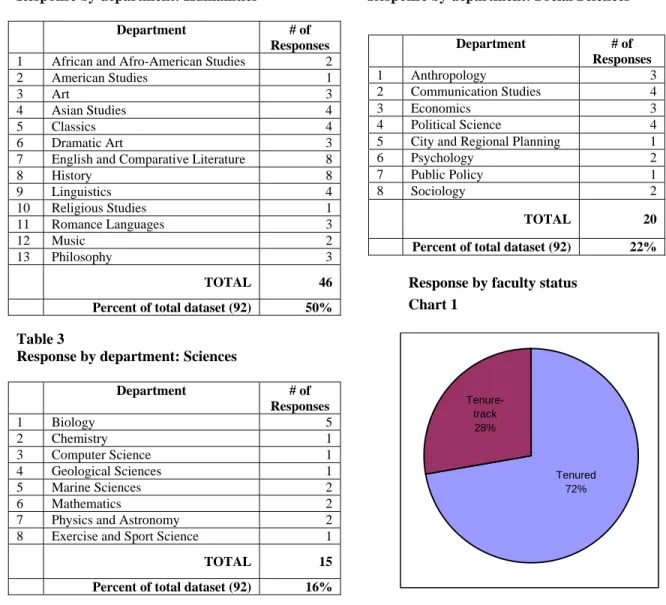
Sciences who are not subscribed to lists which were used for survey distribution, etc. (See Tables one, two and three for responses broken down by department). Departments were separated into three areas of study: humanities, social sciences, and sciences for analysis. Distinguishing between departments that fall into the humanities and social science categories is arguable, but for the purposes of this study, departments that focus more on empirical methods of study were categorized with the social sciences, while those that focus on more critical and analytical methods were categorized with the humanities.
Table 1 Table 2
Response by department: Humanities Response by department: Social Sciences
Department # of
Responses
Response by faculty status Chart 1
1 Anthropology 3 2 Communication Studies 4 3 Economics 3 4 Political Science 4 5 City and Regional Planning 1
6 Psychology 2
7 Public Policy 1 8 Sociology 2
TOTAL 20
Percent of total dataset (92) 22%
Department # of
Responses 1 African and Afro-American Studies 2 2 American Studies 1
3 Art 3
4 Asian Studies 4
5 Classics 4
6 Dramatic Art 3 7 English and Comparative Literature 8
8 History 8
9 Linguistics 4
10 Religious Studies 1 11 Romance Languages 3
12 Music 2
13 Philosophy 3
TOTAL 46
Percent of total dataset (92) 50%
Table 3
Response by department: Sciences
Department # of
Responses
1 Biology 5
2 Chemistry 1
3 Computer Science 1 4 Geological Sciences 1 5 Marine Sciences 2
6 Mathematics 2
7 Physics and Astronomy 2 8 Exercise and Sport Science 1
TOTAL 15
Percent of total dataset (92) 16%
Tenure-track 28%
Fifty percent of respondents were affiliated with departments in the humanities, 22% of respondents were affiliated with departments in the social sciences and 16% of respondents were affiliated with departments in the sciences. An additional 11
respondents, or approximately 12%, did not indicate their department affiliation. As shown in Chart one, 28% of respondents indicated that they were tenure-track faculty, while 72% or respondents indicated that they were tenured faculty.
Quantitative results by research question:
Quantitative results are discussed below in relation to this study’s research questions. Qualitative results are discussed in a later section.
What knowledge do University of North Carolina at Chapel Hill (UNC-CH) faculty members have about library services?
Respondents were asked to indicate their level of familiarity with specific
reference, material access and instructional services. Responses to Likert scale questions were averaged for analysis. Chart Two represents the averaged responses by area of studies for familiarity with reference services on a scale from 1 to 5, with 1 being not at all familiar and 5 being extremely familiar. Charts Three and Four are structured
Chart 2
Familiarity: Reference Services
1.00 1.50 2.00 2.50 3.00 3.50 4.00 4.50 5.00
1 on 1 consultations reference desk services phone reference services email reference services chat/im reference services 1 not at al l; 5 ext re mel y Humanities Social Sciences Sciences Chart 3
Familiarity: Material Access Services
1.00 1.50 2.00 2.50 3.00 3.50 4.00 4.50 5.00
interlibrary loan campus delivery Carolina BLU
1 not at al l; 5 ext re mel y Humanities Social Sciences Sciences Chart 4
Familiarity: Instructional Services
1.00 1.50 2.00 2.50 3.00 3.50 4.00 4.50 5.00
library workshops library tours course web pages general web subject guides
1 not at all; 5 extremely
For reference services, respondents in all categories indicated the highest level of familiarity with services offered at the reference desk (average of 3.3 out of 5).
Respondents in all categories also consistently indicated the lowest level of familiarity with chat/IM reference services (1.77 average). Sixty-one respondents indicated that they were “not at all” familiar with this service. Respondents reported similar familiarity levels with one-on-one consultation services (2.55 average), phone reference services (2.38 average) and email reference services (2.52 average).
Respondents indicated the highest average level of familiarity with material access services compared to other service types. The average familiarity response for interlibrary loan was the highest of all services in the survey at 4.44. Familiarity ratings were lower for campus delivery/Carolina BLU services (2.75 average), however, this service was relatively new at the time of the study.
Respondents indicated that they were least familiar with instructional services compared to other service types. Average familiarity ratings were slightly higher for library workshops (2.63 average) and library tours (2.74 average) as compared to electronic instructional services, course-specific web guides (2.33 average) and general web subject guides (2.30 average).
indicated the lowest level of familiarity with one-on-one consultation services and deviated from the average familiarity response the most for this service as well (1.27 compared to 2.55 average). Science affiliated respondents also indicated low familiarity levels for instructional services.
Tenured and tenure-rack familiarity responses were similar for most services. Tenure-track respondents indicated slightly lower average levels of familiarity with all services except for chat/IM reference services (2.21 tenure-track, 1.62 tenured) and campus delivery/Carolina BLU services (2.96 tenure-track, 2.61 tenured).
How did faculty become aware of the services with which they are familiar?
Respondents were asked where they first learned about services with which they indicated any (level 2 or more) familiarity. Chart five represents percentage of total responses to all “Where did you learn about…” service questions organized by respondent area of study. Chart six is organized by faculty rank.
Chart 5
0% 20% 40% 60% 80% 100%
Humanities Social
Sciences
Sciences
Where did you learn about services? by area of studies
other
don't recall
as a student
library website
from students
faculty colleagues
Chart 6
0% 20% 40% 60% 80% 100%
Tenured Tenure-track
Where did you learn about services? by faculty rank
Other
Don't recall
As a student
From lib web
From students
From fac coll
From lib employ
Respondents in all areas of study indicated that they learned about services most often from library employees (39% of total responses). Respondents affiliated with science departments reported that they learned of services from library employees the most (53% of responses) when compared to other areas of study (37% of responses from humanities, 37% from social sciences). All areas of study indicated that they learned of services from the library’s website second most frequently (26% of responses from humanities, 18% from social sciences and 28% from sciences). Several respondents indicated that they did not recollect where they learned of these services (20% total).
What services do faculty members use, and with what frequency?
Respondents were asked to indicate the frequency with which they used services in the areas of reference, material access and instruction. Chart six represents percentages of total responses for all respondent categories to questions examining reference services. Chart Seven represents material access service use, and Chart Eight represents
instructional service use.
Chart 6 0% 20% 40% 60% 80% 100%
percent of respondents
1 on 1 consultations reference desk services phone reference services email reference services chat/im reference services Frequency of Use: Reference Services
Once a w eek + Once every 2 w ks Once a month Once a semester Once a year Never Chart 7 0% 20% 40% 60% 80% 100%
percent of respondents
interlibrary loan campus delivery Carolina BLU E-books E-journals
Frequency of Use: Material Access Services
Once a week +
Once every 2 wks
Once a month
Once a semester
Once a year
Chart 8 0% 20% 40% 60% 80% 100% pe rc e n t o f re s o nde n ts library w orkshops
library tours course w eb pages
general w eb subject guides Frequency of Use: Instructional Services
Once a week + Once every 2 wks Once a month Once a semester Once a year Never
Of all reference services, respondents reported using services at the reference desk most frequently. Eighty-one percent of respondents in all categories indicated that they use services at the reference desk at least once a year or more. Respondents indicated that they use one-on-one consultations second most frequently. Forty-nine percent reported using this service at least once a year, with 51% reporting that they never use it. Respondents reported using chat/IM reference services the least. Eighty-six percent reported never using this service.
Of all service types, respondents reported using material access services the most. Sixty-six percent reported using electronic journals once a week or more. Respondents indicated that electronic journal services were used the most of any service. Interlibrary loan was ranked as the second most used service overall, though respondents indicated that they did not use it as frequently as electronic journals. Ninety percent indicated that they use interlibrary loan at least once a year.
(38% reported using these once a year or more), while respondents reported using course-specific web-guides the least (29% reported using these once a year or more).
What attitudes do faculty members have towards library services?
Respondents were asked to rate the usefulness of each service on a 5-point scale, with 1 being not at all useful and 5 being extremely useful. Respondents were instructed to rate services based on their perceptions of usefulness or potential usefulness even if they were unfamiliar with specific services. Chart nine represents average perceived usefulness of reference services by respondents’ area of studies. Chart ten represents average perceived usefulness of material access services and chart eleven represents average perceived usefulness of instructional services.
Chart 9
Perceived Usefulness: Reference Services
1.00 1.50 2.00 2.50 3.00 3.50 4.00 4.50 5.00
1 on 1 consultations
reference desk services
phone reference
services
email reference services
chat/im reference
services
1 not at all; 5 extremely
Humanties
Social Sciences
Chart 10
Perceived Usefulness: Material Access Services
1.00 1.50 2.00 2.50 3.00 3.50 4.00 4.50 5.00
interlibrary loan campus delivery
Carolina BLU
E-books E-journals
1 not at all; 5 extremely
Humanities
Social Sciences
Sciences
Chart 11
Perceived Usefulness: Instructional Services
1.00 1.50 2.00 2.50 3.00 3.50 4.00 4.50 5.00
library workshops library tours course web pages general web subject
guides
1 not at all; 5 extremely
Humanities
Social Sciences
Sciences
On average, respondents indicated that electronic journal services were the most useful of material access services and of services of all types (4.92 average), followed by interlibrary loan services (4.49 average). Electronic book services were rated as the third most useful material access service (3.93 average), and campus book delivery/Carolina BLU was rated as the least most useful material access service (3.45 average), though it was still rated relatively highly compared to services of all types. Interlibrary loan services and campus deliver/Carolina BLU services both received higher perceived usefulness ratings on the 5-point scale as compared to familiarity scales. Familiarly questions were not asked for electronic book or electronic journal services.
Of instructional services, respondents rated course-specific web guides as the most useful (3.42 average), though this was rated as the least used service in this
category. Respondents indicated that they perceived library tours to be the least useful of services in this category (2.72 average). Library workshops were rated as the second most useful instructional service (3.05 average) and general web subject guides were rated as the third most useful of this service type (2.85 average). All instructional services except for library tours received higher perceived usefulness ratings on the 5-point scale when compared to familiarity rating, and course-specific web guides received the highest increase between familiarity ratings and usefulness ratings (2.33 familiarity, 3.42 usefulness).
instructional services higher than social science affiliated respondents. Respondents from the three areas of the study deviated the least on ratings of material access services, especially electronic journal services (4.80 sciences, 4.95 social sciences, 4.96 humanities).
When analyzed by faculty rank, perceived usefulness ratings were similar overall, however, the results showed the most variance for ratings of some electronic services. Tenure-track faculty rated chat/IM reference services as more useful compared to tenured faculty (2.79 tenure-track, 1.85 tenured). Tenure-track faculty also rated electronic book services as more useful compared to tenured faculty (4.54 tenure-track, 3.71 tenured).
Respondents were also asked to rank the usefulness of instruction services to their teaching, reference and material access services to their research and service types to their work overall. Table Four represents the number of respondents ranking instruction services first, second, third or fourthin relation to their usefulness to teaching. Table Five represents ranking of reference and material access service in relation to their usefulness to research. Table Six represents ranking of service types in relation to their usefulness overall.
Table 4
Rank of services useful for teaching
library workshops
library tours
course web pages
general web subject
guides
1st 18 13 37 9
2nd 28 13 17 23
3rd 26 17 18 18
4th 7 35 9 22
Table 5
Rank of services useful for research
1 on 1 consultation s reference desk services phone reference services email reference services chat/im reference services interlibrary loan campus delivery Carolina
BLU E-books E-journals
1st 7 2 0 0 3 13 4 1 59
2nd 4 6 3 4 1 36 3 22 8
3rd 13 13 5 8 1 12 15 13 6
4th 20 11 7 9 0 9 9 14 4
5th 14 12 7 14 7 3 7 15 1
6th 12 15 10 17 5 2 11 3 1
7th 7 10 24 12 5 4 7 7 1
8th 3 8 19 9 14 5 9 9 2
9th 1 5 8 1 47 1 14 2 3
Mode 4th 6th 7th 6th 9th 2nd 3rd 2nd 1st
Table 6
Rank of service types for overall usefulness
reference services instructional services material access services
1st 11 1 78
2nd 57 27 4
3rd 19 60 5
Mode 2nd 3rd 1st
Respondents most often ranked electronic journals as the most useful service for their research by a fairly large margin. Fifty-nine respondents ranked electronic journals as the first most useful service to their research. Respondents most often ranked chat/IM reference as the least useful service to their research. Forty-seven respondents ranked chat/IM reference as the ninth most useful service. Material access services were ranked as more useful compared to reference services, with interlibrary loan and electronic books both being ranked as the second most useful service to their research most often (36 for interlibrary loan, 22 for electronic books).
Service type rankings were more clearly defined than other ranking questions. On average, respondents in all categories consistently ranked material access services as the most useful service type for their work in general (78 first place responses), reference services as the second most useful service type (58 second place responses) and instructional services as the third most useful service type (60 third place responses).
Qualitative responses
Respondents were asked two open-ended questions. The first asked for
suggestions to improve existing services, and the second asked for suggested services that the library does not yet offer. The first question received 36 responses. The second
that electronic access already seemed like a priority for the library: “Getting more and more publications online--which I'm sure continues to happen,” and “I want everything digital yesterday.”
Respondents brought up their desire for more service related outreach the second most frequently. Seven responses mentioned the desire for increased outreach, service promotion or service education. Responses included, “I think it might be helpful to have specific workshops (not so much on topic areas, but on services),” “Do a better job publicizing what you offer,” “I personally could use some ‘help for dummies,’
particularly when I am trying to use electronic resources,” and “As a teacher I would like presentations designed for teachers to show them how to encourage and guide students towards using library facilities of all kinds. / As a researcher I would like a presentation on the non-book resources offered by our library specific to my field.” Three respondents specifically mention the desire for faculty targeted workshops or presentations that cover services offered and how to use them.
Many respondents also mentioned their desire for improvements to the library website or mechanisms that the library uses to organize electronic information. Some mentioned a need for further unification of electronic services. For example, one
respondent requested electronic interlibrary loan request buttons in Worldcat that would automatically fill in electronic request forms. Another respondent expressed a desire for more unified electronic requesting between the Health Science libraries and Academic Affairs libraries. Other respondents mentioned the library’s homepage and the ways that electronic information is presented and organized: “My only complaint is that I
friendly. It's hard to initially identify online resources that might be useful for my teaching and research.”
Respondents also brought up some dissatisfaction with circulation policies, loan periods and fines. Five respondents mentioned these issues. Some expressed
dissatisfaction: “Bring circulation policies for faculty in line with those of other top-tier research institutions!” while others were more explicit about the changes they would like to see in circulation policies: “Lessening the fines for overdue materials and making ILL periods longer for faculty,” and “I continually rack up fines because of overdue materials. I think fines should be waived for faculty members.”
Study limitations
There are many benefits of conducting social science research by survey;
however, surveys do pose some inherent limitations. Babbie (2007) points out that while surveys allow for flexibility in the data analysis stage, they are inflexible instruments of data collection when compared to observation and interviewing (p. 277). Researchers must anticipate likely responses to questions and must format them in a way that a broad population can understand. Once a survey is distributed, it cannot be altered. This
public services. Since these services were pre-selected, it is possible that this study fails to capture other services that faculty use. The inclusion of open-ended questions was an attempt to increase the validity of this survey, allowing respondents to provide more in-depth and unanticipated information.
Another commonly cited limitation of survey studies is their reliance on sample self-selection. Researchers have limited control over which subjects of their sample will actually return survey responses. This can influence data results, as subjects who choose to respond to surveys may not be representative of the entire population. In the case of this study, members of a population known for being time-poor must be willing to take time out of their schedules to complete the survey. Willingness to submit this survey might indicate respondent characteristics that are unusual for the population at large.
The email method of distribution and electronic format of the survey might also be considered a study limitation. Respondents must have access to an internet-connected computer, check the email address that the invitation is submitted to within the study period and feel comfortable enough using the computer to complete an online survey. Though these circumstances may filter some respondents, considering that the target population is comprised of university faculty, this limitation is probably not as great a barrier as it might be for other subject populations.
DISCUSSION
with departments in the sciences consistently responded that they were less familiar with library services, used library services less and perceived library services as less useful when compared to faculty members in the social sciences or humanities. The consistency of these results is somewhat surprising, considering that the UNC-CH library system has five branch libraries targeting science-affiliated users (Biology/Chemistry, Geology, Health Sciences, Marine Sciences and Math/Physics).
Housewright & Schonfeld (2008) suggested that science faculty’s generally lower ratings of library services may be associated with the high percentage of scholarly
material available electronically in science fields. In this study, respondents affiliated with science departments indicated that they are, on average, less familiar with material access services and perceive them to be less useful compared to respondents affiliated with social science or humanities departments, though the deviation of science-affiliate responses was less compared to average responses for these services. It is possible, as Housewright & Schonfeld (2008) suggest, that users who exclusively use electronic articles without setting foot in the physical library or using other library services might dissociate electronic material access services from the library. It is not clear, however, if this explanation can be extended to the results of this study, as respondents were asked specifically to indicate perceived usefulness of electronic books and journals, and science-affiliated users still indicated lower perceived usefulness rating when compared to other faculty.
Of the services studied, material access services consistently received higher familiarity ratings, use ratings and usefulness ratings from respondents associated with all areas of study compared to reference and instructional services. These results echo
role of the library less when compared to “purchaser” and “archive” roles. While high ratings for material access services was no surprise, the consistency of low rankings and ratings regarding instruction services was somewhat surprising. All UNC-CH freshmen enrolled in a required composition sequence must come to the library for one-shot
instructional workshops. While humanities-affiliated respondents indicated that they were somewhat more familiar with instructional services, and perceived instructional services to be somewhat more useful when compared to faculty in other areas of study, their ratings for instructional services were not generally high and they consistently ranked instructional services as the least most useful service type. UNC-CH instruction librarians most frequently work with graduate teaching assistants who bring their composition sections into the library for workshop participation and this may contribute to the low instruction ratings and rankings from tenure and tenure-track faculty.
The results from this study did indicate that tenure-track faculty members are slightly more open to virtual services like chat/IM reference and electronic course guides designed for their classes when compared to tenured faculty members. While tenure-track faculty members rated these services as more useful than their tenured colleagues,
respondents in all categories reported low familiarity with these services. These results are especially interesting in the case of electronic course-specific guides. While
respondents indicated the second-to-lowest familiarity rating for course-specific guides out of instructional services, they also indicated that this was the most potentially useful instructional service.
several respondents asked for more information, service promotion or service education in their open-ended responses. Outreach methods might include publicized service workshops or demonstrations targeted at faculty by subject area, web or email updates targeted at faculty by subject area, increased librarian face-time or involvement with academic departments, or simply improved communication between the libraries and faculty members. Time-poor faculty members are not likely to seek out services, and if the UNC-CH libraries want faculty to value the services offered, they must get the word out. Talking about service promotion, education and outreach is one thing. Implementing it is another. Libraries are already budget, employee and time-stressed, especially at the time of writing. However, to improve UNC-CH faculty members’ perceptions about library services, the libraries must strive to develop creative and effective ways to reach out to their faculty population. While this is not an easy task, it is important.
Importance of Study
building. Third, faculty members hold sway over students and can have a large influence over how students view libraries. If faculty members do not see the library as a useful place to begin or expand research, they will not pass that appreciation on to their
students, and all of the excellent services offered to students risk going unnoticed. It is in the UNC-CH library system’s best interest to assess the faculty’s relationships to its services.
CONCLUSION
The existing body of literature has exposed weak points and disconnects in the relationships between academic libraries and faculty members. Research has indicated that, often, the perceptions of librarians and those of faculty members do not line up. Though librarians have recognized the importance of collaboration with faculty, especially in regards to the information literacy of students, the literature suggests that librarians have focused less on the information needs of faculty members as library patrons with specific needs. Housewright & Schonfeld (2008), as well as McCarthy (1985) and others have indicated that faculty members value the library as a gateway to begin or expand their research less than other library functions, and that the value that faculty members assign to the gateway function of the library is declining over time. The results from this online survey support those reports, but also show that faculty members are largely unaware of the services that the libraries offer.
REFERENCES
Babbie, E. (2007). The practice of social research (11th ed.). CA: Wadsworth. Badke, W. (2008). Infolitland: Information literacy and faculty. Online, 32(3), 47-49. Bancroft, A. F., Croft, V. F., Speth, R., & Phillips, D. M. (1998). A forward-looking
library use survey: WSU libraries in the 21st century. Journal of Academic Librarianship, 24(3), 216-224.
Bates, M. J. (1996). Learning about the information seeking of interdisciplinary scholars and students. Library Trends, 45, 155-164.
Berger, K. W., & Hines, R. W. (1994). What does the user really want? The library user survey project at duke university. Journal of Academic Librarianship, 20(5), 306-309.
Cawthorne, J. E. (2003). Integrating outreach and building partnerships: Expanding our role in the learning community. College & Research Libraries News, 64(10), 666-681.
Foster, N. F. (2005). Understanding faculty to improve content recruitment for institutional repositories. D-Lib Magazine, 11(1).
Farber, E. I. (2004). Working with faculty: some reflections. College & Undergraduate Libraries, 11(2), 129-135.
Hardesty, L. (1999). Reflections on 25 years of library instruction: Have we made progress? Reference Services Review, 27(3), 242-246.
Hewitson, A. (2002). Use and awareness of electronic information services by academic staff at Leeds Metropolitan University - A qualitative study. Journal of
Librarianship and Information Science, 34(1), 43-52.
Housewright, R., & Schonfeld, R. C. (2008). Ithaka's 2006 studies of key stakeholders in the digital transformation in higher education. Ithaka.
Julien, H., & Given, L. M. (2003). Faculty-librarian relationships in the information literacy context: A content analysis of librarians' expressed attitudes and experiences. Canadian Journal of Information & Library Sciences, 27(3), 65-87.
Maughan, P. D. (1999). Library resources and services: A cross-disciplinary survey of faculty and graduate student use. Journal of Academic Librarianship, 25(5), 354-366.
McCarthy, C. (1985). The faculty problem. Journal of Academic Librarianship, 11(3), 142-145.
McGuinness, C. (2006). What faculty Think–Exploring the barriers to information literacy development in undergraduate education. The Journal of Academic Librarianship, 32(6), 573-582.
Office of Institutional Research and Assessment (2009). Faculty and Staff Data.
Retrieved February, 2009, from University of North Carolina at Chapel Hill Office of Institutional Research and Assessment Website:
http://www.lib.unc.edu/instruct/citations/apa/online.html
Ramsay, K. M., & Kinnie, J. (2006). The embedded librarian. Library Journal, 131(6), 34-35.
Stahl, A. D. (1997). "What I want in a librarian": One new faculty member's perspective. Reference & User Services Quarterly, 37(2), 133-135.
APPENDIX A:EMAIL INVITATION
Subject line: Faculty – give feedback on library services
Dear faculty member,
Please take a few moments to provide feedback on library services geared toward aiding your research and teaching. This online survey will only take between 5-15 minutes of your time and will provide campus libraries with data for service development and prioritization.
All permanent, tenured and tenure-track faculty members affiliated with the College of Arts and Sciences are invited to participate. Please do not participate if you do not meet these conditions. Participation in this survey is completely voluntary. You will not be asked to provide any identifiable contact information. Data will be stored on password-secure networks and machines. IP addresses will be immediately destroyed upon data download and will not be linked or maintained with survey data. Click on this link to view the consent form and have the opportunity to participate in the study.
Feel free to contact me with any questions or concerns. Jennifer Klaudinyi
[email protected] 972.965.9634 MSLS Candidate 2009
Davis and House Undergraduate Library Reference and Instruction Advised by:
Lisa Norberg
APPENDIX B:EMAIL INVITATION FOLLOW-UP
Subject line: REMINDER Faculty – give feedback on library services
Dear faculty member,
Thanks to those of you that have already participated in this study.
If you have not yet participated, please take a few moments to provide feedback on library services geared toward aiding your research and teaching. This online survey will only take between 5-15 minutes of your time and will provide campus libraries with data for service development and prioritization.
All permanent, tenured and tenure-track faculty members affiliated with the College of Arts and Sciences are invited to participate. Please do not participate if you do not meet these conditions. Participation in this survey is completely voluntary. You will not be asked to provide any identifiable contact information. Data will be stored on password-secure networks and machines. IP addresses will be immediately destroyed upon data download and will not be linked or maintained with survey data. Click on this link to view the consent form and have the opportunity to participate in the study.
Feel free to contact me with any questions or concerns. Jennifer Klaudinyi
[email protected] 972.965.9634 MSLS Candidate 2009
Davis and House Undergraduate Library Reference and Instruction Advised by:
Lisa Norberg
Reference Familiarity
University of North Carolina-Chapel Hill Consent to Participate in a Research Study Adult Participants
Social Behavioral Form
________________________________________________________________________
IRB Study #_____09-0241______
Consent Form Version Date: __February 16, 2009___
Title of Study: “Faculty as Library Patrons: knowledge, use and attitudes of library services”
Principal Investigator: Jennifer Klaudinyi
UNC-Chapel Hill Department: School of Information and Library Science
UNC-Chapel Hill Phone number: (919) 962-8366
Faculty Advisor: Lisa Norberg [email protected] (919) 843-3590
Study Contact telephone number: (972) 965-9634
Study Contact email: [email protected]
_________________________________________________________________
What are some general things you should know about research studies?
You are being asked to take part in a research study. To join the study is voluntary.
You may refuse to join, or you may withdraw your consent to be in the study, for any reason, without penalty.
Research studies are designed to obtain new knowledge, which may help people in the future. You may not receive any direct benefit from being in the research study. There also may be risks to being in research studies.
Details about this study are discussed below. It is important that you understand this information so that you can make an informed choice about being in this research study. You should ask the researchers named above any questions you have about this study at any time.
What is the purpose of this study?
The purpose of this research study is to learn about UNC-CH faculty members’ knowledge, use and attitudes of library services on campus. The study results will be used to develop more relevant library services for faculty and create effective library-to-faculty outreach strategies.
Are there any reasons you should not be in this study?
You should not participate in this study if you are not a permanent tenured or tenure-track faculty member affiliated with the College of Arts and Sciences.
How many people will take part in this study?
If you decide to participate, you will be one of approximately 300 people in this research study.
How long will your part in this study last?
This electronic survey is brief and should take between 5-15 minutes to complete. Participants will not be contacted for any follow-up. Participation is limited to this single survey.
What will happen if you take part in the study?
All participants will be directed to an identical online survey. Participants will be asked to complete a series of closed ended questions and two open-ended questions. Participants will not be asked to provide names or other identifiable demographic information.
What are the possible benefits from being in this study?
Research is designed to benefit society by gaining new knowledge. You may also expect to benefit by participating through providing feedback that UNC-CH libraries can use to create and alter services to better suit your library and information service needs.
What are the possible risks or discomforts involved from being in this study?
There are no known risks associated with this study.
How will your privacy be protected?
Identifiable data will not be collected to ensure participant privacy and confidentiality. IP addresses collected by the survey software will be immediately destroyed upon data download and will not be maintained with participant data.
Please be aware of your surroundings as you participate in this study and take steps to ensure your own privacy as you see fit.
Will you receive anything for being in this study?
You will not receive anything for taking part in this study.
Will it cost you anything to be in this study?
There will be no costs for participating in the study
What if you are a UNC employee?
Taking part in this research is not a part of your University duties, and refusing will not affect your job. You will not be offered or receive any special job-related consideration if you take part in this research.
What if you have questions about this study?
You have the right to ask, and have answered, any questions you may have about this research. If you have questions, or concerns, you should contact the researchers listed on the first page of this form.
What if you have questions about your rights as a research participant?
All research on human volunteers is reviewed by a committee that works to protect your rights and welfare. If you have questions or concerns about your rights as a research subject you may contact, anonymously if you wish, the Institutional Review Board at 919-966-3113 or by email to [email protected].
-Title of Study: Faculty as Library Patrons: knowledge, use and attitudes of library services
Principal Investigator: Jennifer Klaudinyi
Participant’s Agreement:
I have read the information provided above. I have asked all the questions I have at this time. I voluntarily agree to participate in this research study.
The following questions ask about library services in relation to your research.
How familiar you are with these library reference services?
Not at all familiar 2 3 4 Extremely familiar
One-on-one research consultations with subject specialist
Services offered at reference desks
Reference services over the phone
Reference services via email
Reference services via chat/IM
Consultation learn
How did you first learn about one-on-one research consultations with subject specialist?
From library employees
From faculty colleagues
From students
From the library website
As a student
Don't recall
Other
Reference desk learn
How did you first learn about services offered at reference desks?
From library employees
From faculty colleagues
From students
From the library website
As a student
Don't recall
Other
Reference phone learn
From library employees
From faculty colleagues
From students
From the library website
As a student
Don't recall
Other
Reference email learn
How did you first learn about reference services via email?
From library employees
From faculty colleagues
From students
From the library website
As a student
Don't recall
Other
Reference chat/IM learn
How did you first learn about reference services via chat/IM?
From library employees
From faculty colleagues
From students
From the library website
As a student
Don't recall
Other
Reference use and usefulness
How frequently do you use these library reference services?
Never Roughly once a year
Roughly once a semester
Roughly once a month
Roughly once every two weeks
Roughly once a week or more
One-on-one research consultations with subject specialist