Grant L McLendon. Talking Back: How Congress Engages With the Public on Twitter. A Master’s Paper for the M.S. in IS degree. April, 2015. 27 pages. Advisor: Jaime Arguello
This paper examines political social media interaction between Members of the United States Congress and the general public on Twitter. Specifically it attempts to gain a better understanding of what motivates a Member of Congress to reply to a tweet by building a model to predict which tweets Members of Congress will reply to. Predicting social media interaction of elected Members of Congress is a challenging machine learning task. MOCs reply more often to positive tweets based on personal interactions they have had and positive feedback. The distribution of reply to non-reply tweets makes predicting responses very error prone. In this process a several methods of predicting rare events in text were attempted with inconclusive results.
Headings:
Text Mining
Machine Learning
TALKING BACK: HOW CONGRESS ENGAGES WITH THE PUBLIC ON TWITTER
by
Grant L McLendon
A Master’s paper submitted to the faculty of the School of Information and Library Science of the University of North Carolina at Chapel Hill
in partial fulfillment of the requirements for the degree of Master of Science in
Information Science.
Chapel Hill, North Carolina
April 2015
Approved by
_______________________________________
Table of Contents
1. Introduction ... 2
2. Literature Review ... 5
2.1 Citizen Government Communications in the Internet Era ... 6
2.2 Evaluating Twitter Interaction ... 8
2.3 Congress on Twitter ... 10
2.4 Predictive Features ... 12
2.5 The Question ... 14
3. Methodology ... 15
3.1 Data Collection ... 15
3.2 Data Analysis & Results ... 15
4. Discussion ... 18
5. Conclusion ... 20
1.
Introduction
The United States Congress spends a lot of time and effort attempting to
communicate with constituents (Hickey, 2010). Twitter has also exploded in popularity
and use by Members of Congress (MOCs). Of the 542 members of Congress (including
non-voting members), 517 have official Twitter accounts (Hickey, 2010).
Twitter is a social microblogging website, often classified as social media, that
allows public and private sharing of messages up to 140 characters. At its simplest level
Twitter is a microblog, allowing users to share their thoughts in a limited, short form.
Twitter also allows social interaction, messaging, and endorsements of others tweets. As
part of the constraint of twitter, special characters and unique terminology are used to
describe the communication tools built into Twitter. Twitter allows users to participate
in conversations using #hashtags, a single term which links all tweets on a topic
together. Users can @mention or @reply to other users, allowing one or
one-to-many engagement.
Compared to 2008 when a MOC maintaining a Twitter or social media presence was
the exception, Twitter has become a fundamental aspect of how Congress communicates
with constituents and the public. Twitter has become so ubiquitous that in 2010 and
2012 every single newly elected member of the House had an official Twitter account
before taking office (Chi and Yang, 2010). Media reports have cited Twitter as a key
component of a shift in congressional and political communication which contributed to
use of social media platforms (Lomberg, 2012; Hendricks and (Jr.), 2010; Staff, Staff;
Harfoush, 2009).
Given all the fuss around Twitter one would think that MOCs value the novel, rapid
input from constituents and the general public Twitter presents. However, this does not
appear to be true (Hemphill et al., 2013). Congressional engagement with Twitter as
anything other than a broadcast platform would appear to be minimal (Mergel, 2012).
Twitter seems to be treated as something of a second tier medium of interaction,
warranting less focus and attention than phone calls or even emails. Many MOCs’
Twitter accounts are often managed by a low ranking staffer or intern (Englin and
Hankin, 2012).
Part of the reason Twitter interaction may be relegated to low ranking staffers, is the
sheer volume of tweets directed at some MOCs. Initial data collection suggests that high
profile MOCs receive thousands of tweets per week. MOCs only respond to a small
portion of tweets to them (roughly 1%, see results). Given the rarity of responses and the
stated desire of both MOCs and constituents to interact, predicting which tweets will
receive a response is rather challenging. It is quite probable that MOCs (and their staff)
only view a small portion of incoming Tweets. However, there is no research regarding
this claim.
The characteristics of tweets to MOCs that garner responses are not well studied. In
studies of more general Twitter users, histories of having tweets replied to and larger
social networks increases the likelihood of replies (Artzi et al., 2012). However, it would
The traits that inspire responses from Members’ official Twitter accounts are
unclear. An initial, brief review of a small set of Twitter interactions with congress
persons suggests that MOCs are more likely to respond to high profile tweets by other
public figures, usually in line with existing policy goals. However, this is largely
conjecture on the part of this author. A larger sample size will demonstrate just which
features are actually influential in soliciting responses as well as elucidate any
differences in behavior between MOCs’ Twitter responses.
It is important to explain that MOCs typically maintain two or more Twitter
accounts. Strict Campaign finance regulations prohibit MOCs from using resources of
their office to campaign. Given that more often than not Congressional Twitter accounts
are maintained are run largely by Congressional staffers (Fitch and Goldschmidt, 2005),
the use of an official Twitter account for campaign purposes (i.e. directly soliciting votes
in an election) is forbidden. This means that MOCs will have second Twitter account for
election purposes that may have very different patterns of interaction with the public.
While examining the pattern of behavior of these campaign accounts may be useful and
interesting, it is not the focus of this research. This paper is strictly focused on the
utilization of Twitter as a means to deliver constituent services and constituent
interaction by MOCs.
We do know MOCs place a very high value on constituent services and constituent
interaction (Owen et al., 1999). Given the rising use of Twitter by MOCs and by the
public, it would make sense that Twitter would become a platform for dialogue with
MOCs. The rate of reply by MOCs is an excellent proxy for engagement by a MOCs
of an MOC and their office to respond to a finite number of tweets suggests that Twitter
responses may be a useful proxy for the features of constituent and public interaction a
MOC and their office find valuable and useful.
Combined with the current second tier of congressional communications which to
which Twitter seems to be relegated, those tweets which receive replies must be
extraordinary in some way, or contain some features which differentiate them from the
general flood of tweets to MOCS. Identifying the features of Tweets that receive replies
vs those that do not allows some novel insight into the focus and priorities of an MOC
and their staff. Understanding and taking advantage of these behaviors has the potential
to significantly improve engagement on Twitter by citizens and advocacy groups.
Prior research suggests that MOCs’ interactions with twitter are fairly facile and
self-aggrandizing Hemphill and Roback (2014), despite Twitter’s promotion as a platform for
engagement. By documenting and exploring just how engagement on Twitter does, or
does not, function, it may be possible to motivate better future interaction on the part of
constituents and MOCs. Which brings us to the question: What features of tweets to
congress members increase the likelihood of a reply?
2.
Literature Review
The work presented in this paper is informed by four different areas of prior
research: citizen government communications and their change in the Internet era, prior
methods of evaluating Twitter (and other social media) interaction in the general
2.1
Citizen Government Communications in the Internet Era
Congressional communications is a well-studied topic. There is no shortage of
literature exploring the importance, significance, and methodology of Congressional
communication (Miller and Stokes, 1963; Grossman, 1995; Semiatin, 2012).
Historically, the primary methods of communication with congress were letters, phone
calls, and in person visits (Hickey 2010). In the late 90s and early 2000s communication
shifted from largely analog to mostly digital (Semiatin, 2012). Now, several decades into
the digital revolution, the majority of communication with congress is done via digital
mediums (Hickey, 2010).
All indications are that Congress has neatly integrated digital mediums into existing,
analogous communication and media strategies. Grossman (1995) describes the early,
idealistic, views of the future digital communication between government and the
public. Grossman (1995) further articulates a vision of a more connected, more
functional democracy. Enriched by the transparency created by free flowing
communication to and from the halls of government. When the issue began to be studied
a few years later, a number of studies evaluated the contrast between conventional
means of communication and then emerging electronic modes.
Carter (1999), Owen et al. (1999), and Bimber (1999) all made similar, parallel
studies of electronic congressional communication. Owen et al. (1999) and Bimber
(1999) found that congress was using email in a very similar manner to their existing
communication strategies, treating email as a supplement for mass mailing and the
Franking privilege1. Carter (1999) and Bimber (1999) examined the differences between
the efficacies of these several methods, and found that while there were differences
between electronic and traditional communication methods, the differences were quite
small. Carter (1999) found that personalization of communication is important no matter
the medium. Formulaic emails and form letters receive fewer replies than personalized
communication. Carter (1999), Owen et al. (1999), and Bimber (1999) findings have
been reproduced and reinforced; Hickey (2010), Semiatin (2012), Nielsen (2011a), and
Christensen (2011) all found similar patterns of communication with congress. Thus,
further supporting the idea that congress hasn’t changed the way it communicates in the
past two decades; it has just changed mediums. Each of these authors have made novel
additional findings about congressional communication.
Over the course of the 1990s, a meme entered popular discourse, framing internet
activism as ‘slacktivism,’ a sort of minimal effort activism, less engaged than traditional
modes of activism (Christensen, 2011). Christensen (2011) thoroughly disassembles this
idea, demonstrating that online activists are also engaged offline, and that online
activism improves offline activism. This supports Cohen (2006) who demonstrates that
citizens who use the internet to contact government are more satisfied, as well as
Goldschmidt and Ocheiter (2008) and Hickey (2010) who demonstrate that, regardless
of modes of communication, citizens who contact government are more engaged.
Additionally, Goldschmidt and Ocheiter (2008), Hickey (2010), and Cohen (2006) all
show that citizens who receive contact back from government are more satisfied,
regardless whether the feedback was negative or positive.
Nielsen (2011b) further frames the issue of internet interaction as falling into two
means of one way communication, and a second mode of communication which
encourages “coproductive citizenship,” increasing citizen investment in the process of
government. Moore (2013), Semiatin (2012), and Hibbler (2009) expand the potentially
positive repercussions of governmental engagement with citizens via the internet and
social media. The consensus among these authors is that a more engaged citizenry are
more receptive to the messaging of the elected officials and are good for the system as a
whole.
2.2
Evaluating Twitter Interaction
Citizen interaction and engagement can be cultivated via engagement on social
media. There have been many attempts to engage with citizens on a variety of scales,
many unsuccessful (Semiatin, 2012). To evaluate what sorts of communications to and
from MOCs are successful, we must consider the question of evaluating interaction and
influence in social media. Of the immediately obvious approaches to quantifying and
evaluating Twitter use, the first is to try to measure the influence of a single user on
Twitter.
Bakshy et al. (2011) attempted to identify popular tweets and users. Their findings
were that a user’s influence, and the propagation of an individual tweet, can best be
predicted by looking at a user’s history of widely propagating tweets. Bakshy et al.
(2011) built on Boyd et al. (2010) who describe how conversations form and flow on
Twitter and how retweeting functions in a conversational context. Retweets can either
closely to trends identified by Ye and Wu (2010) and Sousa et al. (2010), both of whom
describe message propagation and the social aspect of Twitter interaction.
Sousa et al. (2010) describe two types of social networks forming on Twitter, those
that are ego-centered (retweets happen because of @mentions) and social networks
focused on the social aspect of interaction. This bears a close resemblance to the
graphing of Twitter communications done by Cogan et al. (2012). Cogan et al. (2012)
finds two distinct modes of social interaction on Twitter, which, when visualized,
present as a star or a radial pattern. In a star pattern, interaction happens in a non-linear
mode, while in a radial pattern, tweets flow from the interior out. This shared description
of sharply bifurcating pattern of interaction suggests a potentially unified model of
twitter social networks and interaction. It is not clear if these two dual models are
finding the same relationship, or different pairs of distinct relationships.
Both Budak and Agrawal (2013) and Bakshy et al. (2011) describe how Twitter
interactions are largely the result of engaged, low profile users. These users are the focus
of Romero et al. (2011), who, while attempting to identify influential Twitter users
makes the valuable observation that the discerning feature between influential and
non-influential Twitter users is simply overcoming the passive consumption most Twitter
users engage in.
Rossi and Magnani (2012) describe how similarly newly engaged users can gain
influence and followers by participating in large #hashtag discussions. Naturally, already
popular users gain more followers, but less popular followers reliably gain followers by
participating in the same discussions. Budak and Agrawal (2013) describes how users
in a conversation, specifically, which users will return and continue participating. Budak
and Agrawal (2013) find that users participate in chats where they feel socially
normative and included. Sharing linguistic traits with the broader group conversation
makes users more likely to continue participating in a group discussion.
Possibly more relevant to the subject of congress on Twitter, is the behavior of
business accounts. Popescu and Jain (2011) describe how businesses use Twitter for
self-promotion, with most of their tweets falling into four narrow categories of tweets:
announcements, brand awareness, engagement, and content endorsements.
2.3
Congress on Twitter
Social media has been credited as a critical factor in two presidential elections and
has grown from a niche service to broad adoption (Chi and Yang, 2011; Lomberg,
2012). There have been attempts to turn Twitter towards predicting events and
outcomes, however that idea has fallen out of popularity. Papers like Bravo-Marquez et
al. (2012) demonstrated the dubious predictive powers of Twitter. Bravo-Marquez et al.
(2012) attempted to predict the outcome of the 2012 US Presidential election using
Twitter popularity and sentiment analysis. Finding that Twitter opinion mining is not a
strong predictor of current or future events.
For the most part MOCs treat Twitter like broadcast media. Most Twitter use by
MOCs is very unidirectional with low rates of response (Golbeck et al., 2010; Hemphill
et al., 2013; Mergel, 2012; Otterbacher et al., 2012). Compared to other legislatures, the
US Congress is much less likely to reply to tweets (Otterbacher et al., 2012; Lietz et al.,
history of Congressional communications and the very high demands of the office
(Semiatin, 2012). Though in the earlier days of Twitter use MOCs were more likely to
respond to tweets than they have been recently (Straus et al., 2013; Chi and Yang, 2011,
2010).
Twitter adoption approached its current peak in Congress very rapidly in a very
narrow window of time around the 2009 Inauguration of President Barack Obama.
Straus et al. (2013); Chi and Yang (2010, 2011) all attempted to account for the features
of MOCs which drove or deterred adoption. Multiple studies found that in the period
around Obama’s Inauguration, Republicans were more likely to adopt Twitter than
Democrats were, and MOCs in more urban areas were more likely to adopt Twitter.
The use of Twitter as a broadcast tool rather than a participatory tool is confusing given
the findings of Hibbler (2009); Hickey (2010); Cohen (2006); Miller and Stokes (1963);
Nielsen (2011b), emphasizing that any interaction with MOCs substantially improves
the attitude of the public. The gain in sentiment is surely worth the time and effort
needed to interact.
It is possible that US MOCs don’t interact as much as their counterparts in other
countries because they view the public on Twitter as soap-boxing, pronouncing their
beliefs and benefits for their own satisfaction, rather than soliciting meaningful
engagement. However Hemphill and Roback (2014) and Roback and Hemphill (2013)
both show this not to be the case. In both studies, members of the public are largely
seeking to give input on specific issues and to build relationships with and lobby MOCs
The behavior and use of Twitter by MOCs is generally lackluster. It is rare to see a
call to action by a MOC, more often than not Twitter use is simple self-promotion and
publicizing actions a MOC has already taken (Hemphill et al., 2013). This contrasts
quite sharply with the behavior of German politicians in Thamm and Bleier (2013)
which show a distinct desire to both do their official duty communicating about their
office and to interact with the public. This reality of Twitter adoption and use runs
counter to the predictions of Grossman (1995) and similar who thought transparency
would be a higher priority use of internet communication tools (Chi and Yang, 2010).
The US Congress further differs from other parliaments in its relative low level of
interconnection with other MOCs. Lietz et al. (2014) showed that German political
parties exhibited a high degree of interconnection and communication, while Mergel
(2012) found that US MOCs are sparsely interconnected in their discourse (though
Mergel’s sample size was small). Otterbacher et al. (2012) shows that in other
democracies patterns of Twitter use by members of parliaments varies radically, with US
MOCs being the least engaged and the most self-promoting of the studied populations.
Given that Congressional communication via Twitter is so stunted, replies by MOCs
replying to tweets are rare. In a preliminary study, we found that roughly 1% of tweets
receive replies. These tweets might either be outliers, distinct, or supremely lucky to
receive a reply from a MOC’s account. Further study will determine the features that
increase a likelihood of replies.
2.4
Predictive Features
Reply prediction from text features owes a great deal to prior research in predictive
Artzi et al. (2012). Artzi et al. (2012) attempt to predict which features of a tweet most
strongly predict a reply. In addition, as with Bakshy et al. (2011) and Sousa et al. (2010),
historic features are the strongest predictor of future results. Artzi et al. (2012) find that
the strongest predictors of a reply are historic rates of reply and the strength of a user’s
social network (i.e. more popular users are more likely to have a tweet replied to). This
is quite similar to Hong et al. (2011) which find that the best predictors of retweets are a
large follower base and a history of receiving many retweets.
Hong et al. (2011) is an interesting contrast with Bakshy et al. (2011) which finds
that influential users have diminishing returns, from a publicity point of view, when
compared with average users. While large users with large follower pools are more
likely to receive retweets, the promotional cost of encouraging users with large
followings to retweet is significantly higher than thiose with small followings, and the
return on retweets by these users (re-retweets) is quite similar (Bakshy et al., 2011).
From a technical point of view, the most novel attempts to identify and predict
responses and behaviors to specific facets of text are those constructing more
complicated models than simple term frequency or user history. Users prefer information
sharing and random thoughts to self-centered updates (something that may prove
challenging for Congress) (Andre et al., 2012). Both´ Ritter et al. (2010) and
Danescu-Niculescu-Mizil et al. (2011) suggest novel methods for predicting interesting features in
the grand chaos of Twitter. Ritter et al. (2010) uses the idea of a ‘dialogue act’ to attempt
to identify conversations within the Twitter stream. The idea of a dialogue act is closely
related the ’Tweet Acts’ coined by Hemphill and Roback (2014) to describe the patterns
Danescu-Niculescu-Mizil et al. (2011) demonstrate that humans engage in linguistic
accommodation2 in Twitter, as they do in person. Danescu-Niculescu-Mizil et al. (2011)
is a particularly interesting complement to Boyd et al. (2010) and Budak and Agrawal
(2013). The contrast in modes patterns of engagement is enticing to explore further.
Further exploration of patterns and uses of linguistic accommodation in large-scale
discussions between strangers has the potential to reveal fascinating insights into very
large group communication.
Zhang et al. (2013) and Wang et al. (2012) are another pair interesting to contrast
and compare. Both attempt to discern some larger truth about some topic automatically.
In Wang et al. (2012), the goal is to give some useful insight about the 2012 Presidential
election, while Zhang et al. (2013) attempts to use the natural constraints of short,
conversational Twitter discussions of #hashtag topics to generate topic summaries.
Though the results are largely unrelated, the underlying effort to discern some larger
truth about some human state from an odd, constrained form of communication is
shared.
2.5
The Question
When considered in its totality, the literature surround congressional
communications, social media, and the internet suggests that increased engagement with
citizens improves citizens views of MOCs, and that engaging on Twitter is not
exceptionally difficult. But we find that MOCs do not use twitter anywhere near to its
2 Linguistic accommodation is an alteration of individual and group speech and linguistic
full potential. At the moment replies, and meaningful engagement are sufficiently rare
that the question of what encourages or changes how an MOC engages with Twitter is a
novel question. Are there distinct features of tweets MOCs reply to? Is the content of
these tweets differentiated in any substantial way from the general population of tweets
MOCs receive? Put succinctly, knowing only the text of a tweet, and whether or not it
received a reply, what features of tweets predict a response from an MOC?
3.
Methodology
3.1
Data Collection
From August 18 to September 30, the period surrounding the September 2014
session of the 113th Congress, tweets to and from Congress were collected in
cooperation with Mary Peterson and John Cluverius. These tweets were collected by
using an R script written by John Cluverius to scrape all public tweets to and from
MOCs. Approximately 159,000 tweets were collected from the Twitter API. Of these
tweets, 41,000 were from MOCs and 118,000 were to MOCs.
3.2
Data Analysis & Results
The subset of tweets that received replies from MOCs were extracted and analyzed
to find distinctive features from the broader pool of tweets. Specifically the tweets that
received replies were analyzed for features distinct from the larger population
Developing a robust model for predicting which tweets would receive replies proved
quite challenging. The distribution of the positive class relative to the total sample set in
the extreme; 175639 Negative instances and 2523 Positive instances. Presenting a ratio
The first method attempted was to train a simple logistic regression model on a
unigram feature set, generated from a test subset containing an equal number of positive
and negative instances. This method produced a model with an accuracy3 of 89.39% and
a Kappa of 0.787. Thus demonstrating that the positive and negative class are in fact
differentiated. In this data sub-set, the strongest predictive features were @mentions of
specific members of congress, such as Dana Orbacher. With these @mentions removed
this model produced an accuracy of 70% and a Kappa of 0.411.
However when this model was tested against a larger, more natural subset of the data
it produced significantly poorer results. On a dataset with a 1:12 positive to negative
distribution, the model produced an accuracy of 99% and a
Kappa of 0.201. Note that this statistic proved intensely
variable across test and training sets.
LIWC features were generated for the complete dataset;
these features did exhibit significant influence on the accuracy or Kappa scores of some
models trained using said feature set. In some instances, LIWC features with Unigram
features proved slightly worse than a simple unigram feature set. On some subsets LIWC
improved Kappa scores, and on other subsets LIWC features had no or negative impact
on Kappa scores. Results with LIWC features were sufficiently inconsistent that LIWC
features were not included in later experiments.
3 Accuracy is fairly meaningless in this case
Act \Pred No yes
No 175215 424
yes 2001 522
Next several models were trained on the complete natural distribution dataset in
typical n-fold cross validation method. This dataset proved rather onerous to analyze
because of its size, resulting in fewer training and testing experiments conducted on
larger feature sets (tri-grams, Part of Speech). The
full dataset was only tested a few times to verify that
smaller subsets were in fact producing results that were
representative of the larger dataset.
Next several models were trained on the complete
natural distribution dataset in typical n-fold cross validation method. This dataset proved
rather onerous to analyze because of its size, resulting in fewer training and testing
experiments conducted on larger feature sets (tri-grams, Part of Speech). The full dataset
was only tested a few times to verify that smaller subsets were in fact producing results
which were representative of the larger dataset.
The final method attempted was a modified 10-fold cross validation. A logistic
regression-training algorithm emphasizes the dominant class. In this case, models trained
on the natural distribution were prone to favoring the negative class, producing high
accuracies, but quite poor Kappa scores.
To account for this over-fitting, a custom cross-validation very model was devised.
For each training-fold, the training data was normalized to produce a 1:1 distribution of
the positive and negative class, the positive class was increase to match the negative by
duplicating all positive classes until an even ratio was achieved. This fold was then
tested on the remaining folds, and the process was repeated for all folds. This method
produced a model with 98.02% accuracy and 0.2748 Kappa. Almost identical results to Act \Pred No yes
No 175455 184
yes 2118 405
an unweighted model, which produced 98.64% Accuracy and 0.2955 Kappa on a simple
unigram feature representation. The same model and feature set without @mentions
produced 98.71% accuracy and 0.2563 Kappa. The model without @mentions had many
fewer false negatives, but many more false positives (See Tables 1 and 2).
An additional, proper modified 10-fold cross validation method was attempted,
using a 90% training fold, with an inflated number of positive instances to create a 1 to 1
ratio of the positive to the negative class, and a 10% test fold with a natural distribution.
However, the size of the inflated dataset was sufficiently large that it could not be run in
LightSide or Weka.
4.
Discussion
A cursory examination of those tweets in the positive class, and those which where
scored as false positives by the strongest model reveals that many of the tweets which
did not receive replies were quite similar to those (and in some cases identical to) those
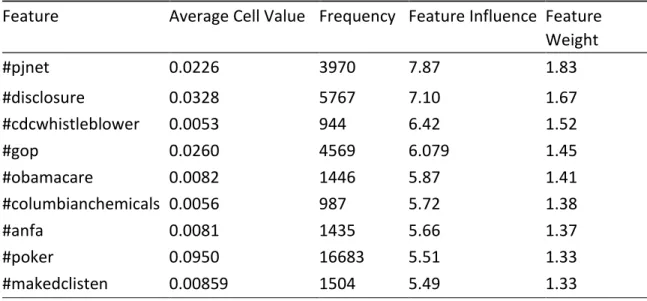
that did receive replies. Reliably identifying a tweet that will receive a reply is very Feature Average Cell Value Frequency Feature Influence Feature Weight
#pjnet 0.0226 3970 7.87 1.83
#disclosure 0.0328 5767 7.10 1.67
#cdcwhistleblower 0.0053 944 6.42 1.52
#gop 0.0260 4569 6.079 1.45
#obamacare 0.0082 1446 5.87 1.41
#columbianchemicals 0.0056 987 5.72 1.38
#anfa 0.0081 1435 5.66 1.37
#poker 0.0950 16683 5.51 1.33
#makedclisten 0.00859 1504 5.49 1.33
likely down impossible as MOCs receives such a volume of tweets. It is possible that
MOCs only see a small portion of the tweets they receive and reply at a higher rate to
those tweets they see, however there is no research on the subject available at time of
writing.
We can learn some interesting things about what MOCs priorities are on Twitter by
which tweets they elect to respond. Certain MOCs are much more engaged on Twitter
and reply much more frequently than others reply. @danarohrabacher was the strongest
or top three unigram feature in every model tested. Without @mentions, the robustness
of any model falls appreciably, reflecting how much engagement is dependent on an
individual MOC.
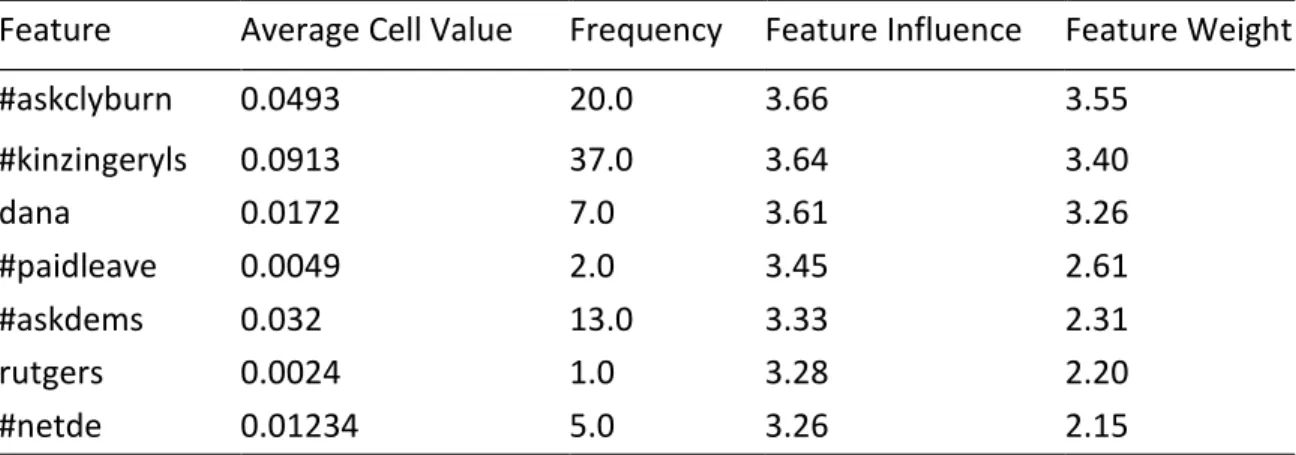
With @mentions removed the most solicitous topics were select items of public
policy and social engagement campaigns. MOCs would appear to intentionally ignore
certain topics as well. Among the features most strongly predictive of the negative class
were several related to online poker, which has been the subject of vocal and focused
social media campaign, which appears to have totally failed to gain focus of engagement
by MOCs, as can be seen in Table 4. This would suggest that unless an MOC is already
Feature Average Cell Value Frequency Feature Influence Feature Weight
#askclyburn 0.0493 20.0 3.66 3.55
#kinzingeryls 0.0913 37.0 3.64 3.40
dana 0.0172 7.0 3.61 3.26
#paidleave 0.0049 2.0 3.45 2.61
#askdems 0.032 13.0 3.33 2.31
rutgers 0.0024 1.0 3.28 2.20
#netde 0.01234 5.0 3.26 2.15
predisposed to want to engage on a subject, it is not worth an issue advocates time to
arrange to bombard them with tweets on the subject.
MOCs also are much more likely to ignore tweets about topics which are closer to
realm of conspiracy theories or social media tempests in a teapot (Benghazi, or
anti-vaccine campaigns for instance). Table 3 contains some of the most influential features
in predicting the negative class. As the accuracy scores have suggested, it is much easier
to predict the negative class than the positive class.
5.
Conclusion
In conclusion, tweets, which received replies from Members of Congress (MOCs),
were used to construct a model to attempt to predict with which tweets MOCs would
engage. The principal findings were that this is a very challenging task. The distribution
of tweets that do receive replies to those that don’t is on the order of 70:1 non-reply to
reply generating tweets. As most MOC responses were from a few MOCs, we can make
no meaningful conclusions about the general linguistic properties of tweets that receive
responses from MOCs.
Features in addition to simple text features could potentially significantly improve
reply prediction. Including social media influence metrics such as follower count and
prior positive interactions with MOCs and geographic location. Additionally it is not
known what percentage of tweets a MOC or their staff ever see. A survey or other
evaluation of the simple proportion of the quantity of tweets to an MOC that are ever
read by their office could greatly improve future research in this area.
Were these experiments to be continued or done over, this researcher would be much
remain untried due to time constraints and quite a bit of useful and informative data was
simply not recorded. These experiments relied on LightSIDE and Weka for feature
extraction, model training, and evaluation. Weka and LightSIDE are better suited to
smaller datasets and run into issues with large datasets (Multiple gigabytes). A
purpose-built tool would be better suited to future explorations of this subject area. Particularly
when exploring non-standard methods such as a weighted or inflated n-cross validation.
Further research into social media interactions with MOCs is warranted. Such
research may prove useful in improving public interaction and social media advocacy
campaigns. There is room for improvement in exploring other features, including social
6.
References
Andre, P., M. Bernstein, and K. Luther (2012). Who gives a tweet? Evaluating microblog content´ gives us an insight into what makes a valuable academic tweet.
Artzi, Y., P. Pantel, and M. Gamon (2012). Predicting Responses to Microblog Posts. In
Proceedings of the 2012 Conference of the North American Chapter of the
Association for Computational Linguistics: Human Language Technologies,
NAACL HLT ’12, pp. 602–606. Association for Computational Linguistics.
Bakshy, E., J. M. Hofman, W. A. Mason, and D. J. Watts (2011). Everyone’s an
Influencer: Quantifying Influence on Twitter. In Proceedings of the Fourth ACM
International Conference on Web Search and Data Mining, WSDM ’11, pp. 65–
74. ACM.
Bimber, B. (1999). The Internet and Citizen Communication With Government: Does the Medium Matter? 16(4), 409–428.
Boyd, D., S. Golder, and G. Lotan (2010). Tweet, Tweet, Retweet: Conversational Aspects of Retweeting on Twitter. In 2010 43rd Hawaii International Conference
on System Sciences (HICSS), pp. 1–10.
Bravo-Marquez, F., D. Gayo-Avello, M. Mendoza, and B. Poblete (2012). Opinion Dynamics of Elections in Twitter. In Web Congress (LA-WEB), 2012 Eighth Latin
American, pp. 32–39.
Budak, C. and R. Agrawal (2013). On Participation in Group Chats on Twitter. In
Proceedings of the 22Nd International Conference on World Wide Web, WWW
’13, pp. 165–176. International World Wide Web Conferences Steering Committee.
Carter, M. (1999). Speaking up in the Internet age: use and value of constituent e-mail and congressional web-sites. 52(3), 464–479.
Chi, F. and N. Yang (2010). Twitter in Congress: Outreach vs Transparency.
Chi, F. and N. Yang (2011). Twitter Adoption in Congress. 10(1).
Christensen, H. S. (2011). Political activities on the Internet: Slacktivism or political participation by other means? 16(2).
the First ACM International Workshop on Hot Topics on Interdisciplinary Social
Networks Research, HotSocial ’12, pp. 25–31. ACM.
Cohen, J. E. (2006). Citizen satisfaction with contacting government on the internet.
11(1), 51–65.
Danescu-Niculescu-Mizil, C., M. Gamon, and S. Dumais (2011). Mark My Words! Linguistic Style Accommodation in Social Media. pp. 745. 00053 arXiv: 1105.0673.
Englin, S. and S. Hankin (2012). The Advocacy Gap - Research for Better Advocacy.
Fitch, B. and K. Goldschmidt (2005). How Capitol Hill Is Coping With the Surge in Citizen Advocacy.
Golbeck, J., J. M. Grimes, and A. Rogers (2010). Twitter use by the U.S. Congress.
61(8), 1612–1621.
Goldschmidt, K. and L. Ocheiter (2008). How The Internet Has Changed Citizen Engagement.
Grossman, L. K. (1995). The Electronic Republic: Reshaping Democracy in the
Information Age. Viking Penguin.
Harfoush, R. (2009). Yes we did: an inside look at how social media built the Obama
brand. New Riders.
Hemphill, L., J. Otterbacher, and M. Shapiro (2013). What’s Congress Doing on Twitter?
In Proceedings of the 2013 Conference on Computer Supported Cooperative
Work, CSCW ’13, pp. 877–886. ACM.
Hemphill, L. and A. J. Roback (2014). Tweet Acts: How Constituents Lobby Congress via Twitter. In Proceedings of the 17th ACM Conference on Computer Supported
Cooperative Work & Social Computing, CSCW ’14, pp. 1200–1210. ACM.
Hendricks, J. A. and R. E. D. (Jr.) (2010). Communicator-in-chief: How Barack Obama
Used New Media Technology to Win the White House. Lexington Books.
Hibbler, L. E. (2009). Congressional Communications with Constituents through the use of Web 2.0 Technologies.
Hong, L., O. Dan, and B. D. Davison (2011). Predicting Popular Messages in Twitter. In
Proceedings of the 20th International Conference Companion on World Wide Web, WWW ’11, pp. 57–58. ACM.
Lietz, H., C. Wagner, A. Bleier, and M. Strohmaier (2014). When Politicians Talk: Assessing Online Conversational Practices of Political Parties on Twitter. arXiv: 1405.6824.
Lomberg, j. (2012). Twitter politics: How social media impacts presidential elections.
Mergel, I. (2012). “Connecting to Congress”: Twitter use among Members of Congress.
2012(3), pp. 108–114.
Miller, W. E. and D. E. Stokes (1963). Constituency Influence in Congress. 57(1), 45–56.
Moore, A. (2013). Fostering Citizen/Government Interactions on Facebook as a Way to Increase Engagement.
Nielsen, M. (2011a). Reinventing Discovery: The New Era of Networked Science. Princeton University Press.
Nielsen, R. K. (2011b). Mundane internet tools, mobilizing practices, and the coproduction of citizenship in political campaigns. 13(5), 755–771.
Otterbacher, J., M. A. Shapiro, and L. Hemphill (2012). Tweeting Vertically? Elected Officials’ Interactions with Citizens on Twitter.
Owen, D., R. Davis, and V. J. Strickler (1999). Congress and the Internet. 4(2), 10–29.
Popescu, A.-M. and A. Jain (2011). Understanding the Functions of Business Accounts on Twitter. In Proceedings of the 20th International Conference Companion on
World Wide Web, WWW ’11, pp. 107–108. ACM.
Ritter, A., C. Cherry, and B. Dolan (2010). Unsupervised Modeling of Twitter
Conversations. In Human Language Technologies: The 2010 Annual Conference
of the North American Chapter of the Association for Computational Linguistics,
HLT ’10, pp. 172–180. Association for Computational Linguistics.
Roback, A. and L. Hemphill (2013). ”I’D Have to Vote Against You”: Issue
Campaigning via Twitter. In Proceedings of the 2013 Conference on Computer
Supported Cooperative Work Companion, CSCW ’13, pp. 259–262. ACM.
Romero, D. M., W. Galuba, S. Asur, and B. A. Huberman (2011). Influence and Passivity in Social Media. In Proceedings of the 20th International Conference Companion
Rossi, L. and M. Magnani (2012). Conversation Practices and Network Structure in Twitter. In Sixth International AAAI Conference on Weblogs and Social Media.
Semiatin, R. J. (2012). Campaigns on the Cutting Edge. SAGE.
Sousa, D., L. Sarmento, and E. Mendes Rodrigues (2010). Characterization of the Twitter
@Replies Network: Are User Ties Social or Topical? In Proceedings of the 2Nd
International Workshop on Search and Mining User-generated Contents, SMUC
’10, pp. 63–70. ACM.
Staff, P. R. C. J. P. How the Presidential Candidates Use the Web and Social Media.
Straus, J. R., M. E. Glassman, C. J. Shogan, and S. N. Smelcer (2013). Communicating in 140 Characters or Less: Congressional Adoption of Twitter in the 111th Congress.
46(01), 60–66.
Thamm, M. and A. Bleier (2013). When Politicians Tweet: A Study on the Members of the German Federal Diet. 00001 arXiv: 1305.1734.
Wang, H., D. Can, A. Kazemzadeh, F. Bar, and S. Narayanan (2012). A System for Real-time Twitter SenReal-timent Analysis of 2012 U.S. Presidential Election Cycle. In
Proceedings of the ACL 2012 System Demonstrations, ACL ’12, pp. 115–120.
Association for Computational Linguistics.
Wigand, F. (2010). Twitter in Government: Building Relationships One Tweet at a Time.
In 2010 Seventh International Conference on Information Technology: New
Generations (ITNG), pp. 563–567.
Ye, S. and S. F. Wu (2010). Measuring Message Propagation and Social Influence on
Twitter.com, Volume 6430, pp. 216–231. Springer-Verlag Berlin.
WOS:0002890305.