ABTRACT
Blood-‐brain barrier formed by tight junctions between capillary epithelial cells (astrocytes) establishes a significant inhibition for the delivery of many therapeutic proteins to the central nervous system. The impediment of therapeutic proteins to cross this physiological barrier hinders their potentially important impact on the diagnostic and treatment of many diseases of nervous system. To address this limitation, the modification of a model protein, horseradish peroxidase (HRP), with amphiphilic block copolymer poly(ethylene oxide)-‐b-‐poly(propylene oxide)-‐b-‐poly(ethylene oxide), commonly known as Pluronic, was successfully developed and proved to increases permeability of proteins at physiological barriers, such as blood-‐brain barrier (BBB) and nasal epithelium(1).
This project primarily focused on the generation of monoamine Pluronic derivative P123, which upon the conjugation with horseradish peroxidase (HRP) previously showed a considerably enhanced cellular uptake of the conjugates (1). Pluronic 123 was reacted with 4-‐methoxytrityl chloride (MTr-‐Cl) to protect the hydroxyl group at one end of the polymer chain; the obtained mono-‐MTr–Pluronic was then activated using 1,1-‐carbonyldiimidazole (CDI), followed by a reaction with ethylenediamine (EDA). Using frequently employed analytical techniques such as gradient elution chromatography, gel permeation
chromatography, and TLC analyses, modified monoamine-‐Pluronic 123 molecules were successfully synthesized and isolated with a percent yield of 54.8%. For future project, the modified Pluronic compound will be later adopted for the synthesis of the HPR-‐P123 conjugates.
INTRODUCTION
A common approach for developing a competent drug delivery system is to incorporate the therapeutic protein with a synthetic transporter that results in an increased metabolic stability to enhance the cellular uptake of the drug to the central nervous system. To overcome the complication of delivering therapeutic proteins to the brain, the model proteins will be covalently modified with triblock Pluronic copolymer that serves as a synthetic carrier to facilitate the cellular transport of the protein across the blood-‐brain barrier. This project involves two major parts: (1) the generation of
monoamine P123 and (2) the attachment of monoamine Pluronic to SOD1. The synthesis of protein-‐polymer conjugates is achieved by attaching one end of modified monoamine-‐P123 molecule to the amino group of the proteins using a degradable or non-‐degradable
disulfide linkage. My particular interest lies in the generation of modified monoamine Pluronic which occurs via two principal steps: (1) the protection of the hydroxyl end of the polymer chain by 4-‐methoxytrityl chloride, (2) the activation of the hydroxyl group at the other end of the Pluronic using 1,1-‐carbonyldiimidazole (CDI), followed by the reaction with ethylenediamine (EDA). The monoamine P123 is then obtained after de-‐protecting the hydroxyl group in the presence of trifluoroacetic acid (TFA).
EXPERIMENTAL PROCEDURE Material and Devices
triethylamine, anhydrous acetonitrile, anhydrous pyridine, methanol, dichloromethane, toluene, ethanol, and nihydrin were purchased from Sigma-‐Aldrich Co. (St. Louis, MO, USA). Sephadex LH-‐20 gel was from Amersham Biosciences (Pittsburgh, PA, USA).
Protection of the hydroxyl group of P123
An amount of 2.32 g of Pluronic P123 (MW 5750) was dried in vacuo three times using 10mL anhydrous pyridine; the dried Pluronic P123 was then dissolved in another 15mL anhydrous pyridine. One molar equivalent of 4-‐methoxytrityl chloride (MTr-‐Cl, 0.12 g) was dissolved in anhydrous pyridine to make 5% solution, followed by the drop-‐wise addition to Pluronic P85 solution at stirring. The reaction was allowed to proceed for at least 3 hours at room temperature. The flask should be kept out of wet air by covering with Parafilm. The reaction was then stopped by adding 1mL of methanol and incubating for 15 minutes. The pyridine was removed in vacuo by coevaporation with 10 mL of toluene twice. The desired mono-‐MTr-‐P85 product was isolated from bis-‐MTr-‐P85 and nonreacted
Pluronic by adsorption chromatography on Silicagel G25 column (3 × 20 cm) using stepwise gradient elution of 100mL of dichloromethane (DCM), followed by 2%, 5%, and 10% methanol in dichloromethane (200mL each). Fractions of 7-‐8mL were collected each 20 minutes. The product was then analyzed by thin layer chromatography (TLC) in
dichloromethane/MeOH, 9:1, and detected in trifluoroacetic acid (TFA) vapors (a test for the presence of MTr-‐group). Bis-‐MTr-‐Pluronic fractions eluted first (Rf = 0.8), followed by mono-‐MTr-‐Pluronic (Rf = 0.6) and unreacted Pluronic (Rf = 0.4).
Scheme 1: Protection of the hydroxyl group of P123 by 4-‐Methoxytrityl Chloride
Activation of the non-‐protected hydroxyl group of P123 by 1,1-‐carbonyldiimidazole The obtained mono-‐ MTr-‐P123 was dried by coevaporation with 2 × 15 mL of anhydrous acetonitrile in vacuo and then reacted with 40-‐fold molar excess of 1,1-‐
carbonyldiimidazole (CDI, 1.04 g) in 10 mL of anhydrous acetonitrile. After incubation for 2h at 25℃, the reaction mixture was treated with 0.2 mL of water for 20 minute to quench the excess of CDI, and then added to a 40-‐fold molar excess of ethylenediamine (EDA, 0.43 mL) in 100 mL of ethanol upon stirring. The reaction mixture was incubated overnight at 25℃, and then run through a gel filtration column (Sephadex LH-‐20, 2.5 x 30 cm) to isolate monoamino-‐P123-‐OMTr product. After column chromatography, the collected product was coevaporated with 10 mL of methanol and redissolved in 10 mL of 2% TFA in
dichloromethane then incubated for 1h at 25℃. The obtained bright orange solution was
OH(CH2CH2O)20(CH2CH(CH3)O)70(CH2CH2O)20H + CH3O Cl
RT, 2h
avoid water
5750(g/mol) 2.32 g 0.4 mmol
in 10 mL anhydrous pyridine stirring
308.8 (g/mol) 0.12 g 1 x 0.4 mmol
in 2.5 mL anhydrous pyridine (5%) dropwise add to Pluronic
(COPh)Ph2CO(CH2CH2O)20(CH2CH(CH3)O)70(CH2CH2O)20H + ClH
6022.3 (g/mol) 0.99 g 0.16 mmol
concentrated in vacuo and neutralized by approximately 2 mL of 10% triethylamine in methanol. Gel filtration column (Sephadex LH-‐20, 2.5 × 30 cm) was used to isolate the resulting monoamino-‐P123. The product was then analyzed by TLC in dichloromethane/ MeOH, 9:1 (Rf = 0.4), and detected with 0.5% ninhydrine in ethanol solution, which is a test for an amino group.
Scheme 2: Synthesis of Monoamine Pluronic
RESULTS AND DISCUSSION
Protection of the hydroxyl group of P123
The protection of the hydroxyl group of Pluronic P123 by MTr-‐Cl was achieved via nucleophilic attack of the hydroxyl end of P123 to the electrophilic carbon atom of MTr-‐Cl,
HOP123 - OMTr + N
N O
N N
N
N O
O -P123 - OMTr RT, 2h
water quench
N
N O
O -P123 - OMTr + NH2CH2CH2NH2
overnight
NH2CH2CH2NH -CO-O-P123-OMTr
NH2CH2CH2NH -CO-O-P123-OMTr
TFA
NH2CH2CH2NH -CO-O-P123-OH 6022.3 (g/mol)
0.99 g 0.16 mmol in 15 mL anhydrous
acetonitrile
162.2 (g/mol) 1.04 g
40X 0.16 mmol = 6.4 mmol in 10 mL of anhydrous
acetonitrile
60 (g/mol), 0.899 (g/mL3) 0.43 mL (in 100 mL of ethanol)
40X 0.16 mmol = 6.4 mmol
5853.1 (g/mol) 0.5135 g 0.088 mmol
accompanied by the departing of the good leaving group, chloride ion. This reaction is very sensitive in the presence of water since MTr-‐Cl will preferably react with water instead of P123, interfering with the desired pathway. Thus, anhydrous pyridine was used to dry the Pluronic and MTr-‐Cl before the reaction. The reagent and solvent must also be kept out of water and wet air during the course of the reaction. The reaction between MTr-‐Cl and P123 can be allowed to occur more than 3 hours at room temperature. Indeed, the overall
modification degree of MTr-‐Cl at hydroxyl end of the Pluronic seemed to be better if reacting for 2 days at room temperature. The addition of methanol helped to stop the reaction because in the presence of methanol, MTr-‐Cl favorably interacts with the more easily accessible methanol molecules compare to the bulky chain of Pluronic molecules.
The isolation of mono-‐substituted –MTr-‐Cl from the product mixture was achieved by absorption chromatography on Silica G25 column using stepwise gradient elution. The fragments isolated on the Silica gel column had varying polarities that allow them to be chromatographically separated by changing the composition of the mobile phase over the course of the separation in order to affect the gradient elution. Stepwise gradient elution began with a less polar mobile phase dichloromethane (DMC) in order to remove the less polar compounds, bis-‐substituted MTrCl-‐Pluronic, which was well retained on the non-‐ polar stationary Silica gel. Composition of the solvent was then adjusted with methanol (2-‐ 5-‐10-‐15% methanol in DCM) to remove fractions of the more polar compounds, mono-‐ substituted-‐MTr-‐Cl-‐Pluronic, followed by non-‐reacted Pluronic.
showed brightly yellow color stained by trifluoroacetic acid vapor. Products modified with MTr-‐Cl displayed a combination of two colors, indicating the polymer had successfully been modified. Also, it was observed that the products moved further than the standard P123 in TLC plate since it had become more hydrophobic due to the attachment of methoxytrityl group (aromatic rings are generally non-‐polar) and thus moved along with the non-‐polar solvent (dichloromethane/MeOH: 9:1). Based on the known Rf values, it was confirmed that good separation of the components of the mixture was achieved and mono-‐substituted MTrCl-‐Pluronic was successfully isolated from bis-‐substituted and non-‐reacted Pluronic. Elution fractions numbered 85-‐93 were experimentally determined to contain the expected mono-‐substituted MTrCl-‐P123 product.
Figure 1: TLC Result for the Isolation of Mono-‐substituted MTrCl-‐P123
Rf = 0.84
Rf = 0.58
P MTrCl61 63 65 67 69 71 73 75 77 79 81 83 85 87 89 91 93 95 97 99 101 103 105
bis$substituted)MTrCl$P123
Activation of the non-‐protected hydroxyl group of P123
The activation of the non-‐protected hydroxyl group of Pluronic 123 was achieved via a nucleophilic attack of the nucleophilic hydroxyl end of P123 to the electrophilic carbonyl carbon of CID, accompanied by the leaving of one of the imidazole groups. The critical point of this reaction was absolutely free of water since water is more reactive and accessible than MTr-‐modified P123 and reacts with CDI. Thus, it was critically important to dry all the reagents by coevaporation with anhydrous acetonitrile before mixing. More to the point, excess amount of CDI (40-‐fold molar excess) was used to minimize the formation of by-‐products. Upon incubation for 2h at room temperature, the reaction mixture was treated with small amount of water to neutralize the nonreacted CDI molecules. In a similar manner, the amino group of ethylenediamine undergoes nucleophilic substitution reaction with the newly incorporated imidazole group, resulting in the formation of monoamino-‐ P123-‐OMTr that was later isolated on a gel filtration chromatography column. Activated MTr-‐P123 should be added in diluted ethylenediamine in excess amount of ethanol to minimize the possibility that the excess amino group at both ends of ethylenediamine possibly conjugates with two molecules of P123 forming by product.
The isolation of monoamino-‐P123-‐OMTr from the product mixture was achieved by size-‐exclusion chromatography on Sephadex LH-‐20 column in order to remove low molar mass compounds, including unreacted ethylenediamine and trace amount of CID. Gel permeation chromatography is a separation techniques often employed for isolation and characterization of a wide variety of polymers or other macromolecules in a mixture. This chromatographic technique allows the separation of the large modified Pluronic
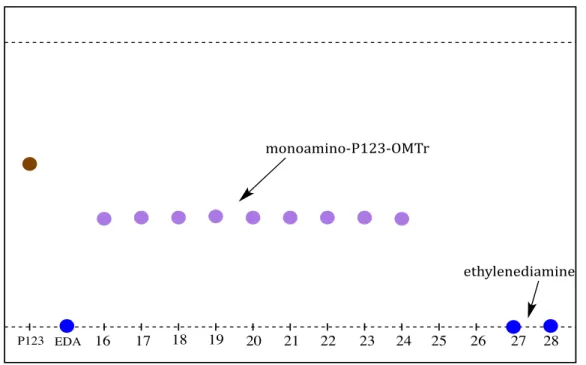
mechanism relies solely on the size of the molecules in solution rather than any physical properties or chemical interactions between substances. Gel permeation chromatography separates molecules based on their differences in molecular size by pumping them through specialized column, typically referred as the stationary phase, containing a highly porous, semi-‐rigid packing material. The size and shape of the molecule dictate its ability to interact with the pores on the stationary phase. The smaller molecules in the mixtures penetrate into the pores of the gel particles and are retarded whereas the larger molecules, which are excluded from the pores, elute more quickly from the gel permeation chromatography column. Thus, the modified Pluronic compound was eluted from the column first, followed by elution of unreacted ethylenediamine and trace amount of CID as depicted in Figure 2.
The obtained product was then analyzed by thin layer chromatography (TLC) in chloroform-‐MeOH (9:1), and detected with 0.5% ninhydrin of ethanol solution for the presence of amino group upon which the modified product turned purple on TLC plate.
Figure 2: TLC Result for the Generation of Monoamine P123 with Protected Hydroxyl Group
As depicted in scheme 2, the synthesis of modified amino-‐P123 was achieved by deprotecting the methoxytrityl group from the isolated monoamino-‐P123-‐OMTr using trifluoroacetic acid (TFA). The success of this step was accessed by testing for the removal of methoxytrityl group from amino-‐P123, which appeared colorless on TLC plate. An amount of 0.5135 g of amino-‐P123 was successfully synthesized and isolated,
corresponding to a relatively reasonable yield of 54.8%.
CONCLUSION
The primary purpose of this project, which involved the modification of the
Pluronic 123 triblock coplymer was successfully accomplished. Characterization of thin layer chromatography (TLC) in chloroform-‐MeOH (9:1) confirmed that mono-‐
substituted–MTr-‐Cl was successfully synthesized via a the nucleophilic attack of the
hydroxyl end of P123 to the electrophilic carbon atom of MTr-‐Cl, and isolate on a stepwise-‐ P123 EDA 16 17 18 19 20 21 22 23 24 25 26 27 28
monoamino&P123&OMTr
gradient elution column. Various experimental trials have shown that the overall
modification degree of MTr-‐Cl at the hydroxyl end of the Pluronic was better if the reaction was allowed to occur for at least 2 days at room temperature. An amount of 0.99 g of mono-‐ substituted–MTr-‐Cl was obtained, corresponding to a relatively reasonable yield of 76.7%. The expected product, monoamino-‐P123, was successfully synthesized by reacting the MTr-‐modified P123 with CDI, followed by the reaction with EDA. Upon separation of a gel permeation elution column and characterization by TLC, it was experimentally determined that the product was successfully synthesized with a relatively low yield of 54.8%. Even though diluted ethylenediamine in excess amount of ethanol was used, it was likely
possible that the excess amino group at both ends of ethylenediamine possibly conjugates with two molecules of P123, forming byproduct and thus significantly reducing the yield of monoamino-‐P123. However, the results together reveal a fairly good efficiency of the procedure of the synthesis. As for future project, the modified Pluronic compound will be later used for the synthesis of the HPR-‐P123 conjugates.
REFERENCES
(1) Yi, X.; Batrakova, E.; Banks, W.; Vinogradov, S.; Kabanov, A. Bioconjugate Chem. 2008, 19, 1071–1077.
(2) Yi, X.; Zimmerman, M.; Yang, R.; Tong, J.; Vinogradov, S.; Kabanov, A. Free Radical Biol.
Med. 2010, 49, 548-‐558.