0
Evaluation of a Sexual and Reproductive Health Peer
Education Curriculum for North Carolina Latino Adolescents
Jill Mead, Lexie Perreras, Chelly Richards, and Anna Stormzand
Capstone partner organization: El Pueblo, Inc.
Preceptor: Florence Simán, MPH
Faculty advisor: Clare Barrington, PhD, MPH
i
Acknowledgements
ii
Acronyms
Acronym Definition
MPH Master of Public Health
DsF Nuestros Derechos sin Fronteras
EBI Evidence-based Intervention
HB Health Behavior
HIV Human Immunodeficiency Virus
HSL Health Sciences Library
IRB Institutional Review Board
SEF Socio-ecological Framework
SRH Sexual and Reproductive Health
STI Sexually-transmitted Infection
UNC University of North Carolina at Chapel Hill
YLA Youth Leadership Academy
iii
Executive Summary
Latino adolescents in North Carolina face multiple sexual and reproductive health (SRH) challenges compared to their non-Latino peers, consistently reporting increased risky sexual health behaviors, higher rates of unplanned pregnancy and higher rates of sexually-transmitted infections (STIs). While evidence-based SRH interventions exist for adolescents in the United States, few are tailored for Latino adolescents and the challenges they may face. Though approaches such as peer education and advocacy skills have proven effective in SRH
interventions to decrease risk of adverse SRH health outcomes, few adolescent SRH programs incorporate these tools for increasing curriculum reach beyond program participants. El Pueblo, Inc., a Latino services and advocacy organization based in Raleigh, NC, sought to fill this need by developing Nuestros Derechos sin Fronteras (DsF) in 2009. DsF is a human rights-based curriculum that addresses SRH among Latino adolescents.
In 2012, El Pueblo requested the assistance of a University of North Carolina (UNC) Health Behavior (HB) Capstone team to develop and implement a formal evaluation of DsF. The evaluation of DsF had three goals: 1) improve the DsF curriculum, 2) demonstrate DsF
effectiveness, and 3) enhance DsF sustainability. To this end, the Capstone team reviewed existing quantitative and qualitative evaluation tools and created new evaluation materials as needed. Next, the Capstone team created a database to manage DsF evaluation data. Once evaluation materials and the database were completed, the Capstone team implemented the evaluation in collaboration with El Pueblo staff. Finally, the results of this evaluation were analyzed and compiled into a report and used to revise a funding guide that aids El Pueblo in writing grant proposals to sustain its youth SRH programs.
Through its work with El Pueblo, the 2012-2013 Capstone team gained experience with evaluating public health programs in a real-world setting. This experience included the use of quantitative and qualitative evaluation methods and increased knowledge about adolescent SRH education and program development. The Capstone team also gained exposure to the non-profit landscape in Raleigh, North Carolina, including the funding environment and resources available from supporting organizations. By collaborating with El Pueblo, the
iv
Table of Contents
Acknowledgements ... i
Acronyms ... ii
Executive Summary ... iii
Introduction ... 1
Background ... 3
Deliverables... 7
Discussion ... 13
Appendix A. Evaluated Latino Adolescent Sexual and Reproductive Health Programs ... 26
Appendix B. DsF Conceptual Model ... 29
Appendix C. DsF Program Evaluation Conceptual Model ... 30
Appendix D. 2012-2013 El Pueblo Capstone Team Gantt Chart ... 31
Figures and Tables
Figure 1. El Pueblo Capstone Logic Model for DsF Evaluation ... 2Table 1. Deliverable I ... 8
Table 2. Deliverable II ... 9
Table 3. Deliverable III ... 11
Table 4. Deliverable IV ... 12
1
Introduction
The following is a summary report of the 2012-2013 University of North Carolina at
Chapel Hill (UNC) El Pueblo Capstone project. The Capstone project entails a combination of
academic and field experience completed over the final two semesters of the Master of Public
Health (MPH) program in the Department of Health Behavior (HB) at the UNC Gillings School of
Global Public Health. The 2012-2013 UNC El Pueblo Capstone team consisted of four MPH
students. Under the mentorship of the teaching team, faculty advisor, and community partner,
the student team drafted a work plan and submitted the proposed project work to the UNC
Institutional Review Board (IRB) for approval. The submission did not constitute human subjects
research as defined by federal regulations and approval was deemed unnecessary by the IRB.
The Capstone team produced a set of four deliverables intended to meet the needs of El Pueblo
and its target audience. The goals of this project were to demonstrate DsF effectiveness,
improve the DsF curriculum, and enhance DsF sustainability.
El Pueblo, Inc. (referred to in this report as “El Pueblo”) is a statewide non-profit
organization in North Carolina dedicated since 1994 to strengthening and empowering this
growing population. Though based in Raleigh, the organization has a broad service area
concentrated in Wake, Orange, Durham, and Chatham counties. In addition to programs
focused on education, public safety, and civic participation, El Pueblo also has several health
programs focused on improving the health of the Latino community.
Since 2009, El Pueblo has worked with four groups of MPH Capstone students. In 2012,
El Pueblo requested the assistance of the current Capstone team in evaluating their youth
sexual and reproductive health (SRH) program. This group was the third to work on the
organization’s youth SRH program, Nuestros Derechos sin Fronteras (DsF), or Our Rights Have
No Borders. El Pueblo developed DsF in partnership with Ipas, a North Carolina-based
2
Capstone team. Designed for Latino adolescents ages 11 to18, DsF combines information
about SRH and rights with activities designed to empower youth to become peer educators in
their communities. DsF was designed to be linguistically and culturally appropriate for Latino
adolescents in North Carolina.
The Capstone team established an evaluation process for DsF and assisted El Pueblo in
seeking future funding opportunities to ensure program sustainability. The logic model below
(Figure 1) provides an overview of project inputs, activities, and expected outcomes and
impacts of the DsF implementation. Key inputs included the DsF curriculum and existing
evaluation materials, mentorship and guidance from several individuals, and research skills from
HB training. The Capstone team developed new evaluation tools, implemented the evaluation,
and analyzed the data. Results were used to develop a report and update a funding guide. The
outcomes and long-term impact of this work included: changes in participant SRH knowledge,
attitudes, and behaviors; a more effective DsF curriculum; and institutionalization of a DsF
evaluation process.
Figure 1. El Pueblo Capstone Logic Model for DsF Evaluation
3
This summary report begins with a Background section, which establishes a rationale for
the project and identifies current methods targeting youth SRH in Latino communities. The
Deliverables section provides a detailed overview of the project work including activities
undertaken for completing the team’s work and recommendations relevant to project
implementation and maintenance. Finally, the Discussion section explains strengths and
limitations of the project approach, describes the project’s impact on El Pueblo and Latino youth
SRH, and provides recommendations for project sustainability.
Background
Latino Youth SRH: Risk Behaviors and Outcomes
Nationwide, a high proportion of adolescents engage in risky SRH behaviors (Centers
for Disease Control and Prevention, 2012a). The 2011 National Youth Risk Behavior
Surveillance System (YRBSS) reported that almost half (47.4%) of high school students
engaged in sexual intercourse and among those students, 40% did not use a condom during
their last sexual intercourse (Centers for Disease Control and Prevention, 2012a). Data from the
2011 National YRBSS indicated that the percentage of sexually active Latino adolescents was
comparable to the national percentage for all adolescents; however, 18.5% of Latino
adolescents reported not using any method of pregnancy prevention, a higher percentage than
White (10%) or Black adolescents (13.3%) (Centers for Disease Control and Prevention,
2012b). The Latino population of North Carolina has grown very quickly, increasing by 111%
between 2000 and 2010 (United States Census Bureau, 2011). Within North Carolina,
adolescents were more likely to be sexually active and less likely to use condoms than their
peers in other states (Adolescent Pregnancy Prevention Campaign of North Carolina, 2012;
Centers for Disease Control and Prevention, 2012a). Latino adolescents in North Carolina were
also more likely to have multiple sexual partners (defined as four or more persons) compared to
4
Outcomes related to risky SRH behaviors, such as unintended pregnancies and
sexually-transmitted infections (STIs), have a negative impact on the health of adolescents in
the United States (Cardoza, Documet, Fryer, Gold, & Butler, 2012; Centers for Disease Control
and Prevention, 2011; Centers for Disease Control and Prevention, 2012a; Frost & Driscoll,
2006). In 2011, adolescents ages 15 to 24 comprised almost half of the 19 million new cases of
the eight most prevalent STIs reported annually nationwide (Bakker et al., 2011; Weinstock,
Berman, & Cates, 2004). Latino adolescents in particular experience a disproportionate burden
of negative SRH outcomes. Nationally, Latina adolescents had twice the rate of abortions and
STIs than White adolescents (Centers for Disease Control and Prevention, 2011; Guttmacher
Institute, 2012). Latinos in North Carolina experienced a Human Immunodeficiency Virus (HIV)
infection rate nearly four times as high as that of White respondents between 2004 and 2008
(State Center for Health Statistics and Office of Minority Health and Health Disparities, 2010).
Furthermore, the 2011 North Carolina YRBSS found that the pregnancy rate for Latina
adolescents ages 15 to 19 was 82.7 births per 1,000 females, compared to 34.4 and 49.7 births
per 1,000 among White and all female adolescents, respectively (Adolescent Pregnancy
Prevention Campaign of North Carolina, 2012). This disparity in SRH outcomes suggests a
need for SRH interventions designed for Latino adolescents in North Carolina.
Current Approaches Targeting Latino Youth S RH Behaviors
Currently, several evidence-based interventions (EBIs) related to SRH target Latino
adolescents (Appendix A). According to the Division of HIV/AIDS Prevention (n.d.), EBIs “are
based on direct, high-quality, empirical evidence that demonstrates a reduction in HIV/STD
incidence, reduced HIV-related risk behaviors, reduction in HIV viral load, or improvement in
HIV medication adherence behaviors.” These programs vary according to intended outcomes,
target audience characteristics, content, duration, intensity, delivery methods, and intended
settings. They also operate at different levels of the Socio-ecological Framework (SEF)
5
indicates that factors at the individual, interpersonal, organizational, community and public
policy levels interact to influence health-related behaviors. According to the SEF, health
behaviors are a product of the interaction between the individual and his/her physical and
socio-cultural environment, and only those interventions which affect the individual and their
environment simultaneously are sufficient to lead to long-term health behavior change (Sallis,
Owen, and Fisher, 2008). However, existing EBIs targeting SRH among Latino adolescents
focus mainly on individual and interpersonal level factors (Cardoza, Documet, Fryer, Gold, &
Butler, 2012; Fernández-Santos et al., 2011). The lack of interventions at the organizational,
community, and policy levels indicates a deficiency in available interventions that target multiple
levels of the SEF. This is important given that Latino adolescents encounter barriers that hinder
their ability to engage in SRH protective behaviors at all levels of the SEF.
Peer Education among Latino Youth
Peer education refers to the use of a self-identified group of individuals to educate others
within the same group and who often share similar socio-demographic characteristics and
exposures throughout the life course (Sciacca, 1987 as cited in Milburn, 1995). Practitioners use
peer education within a range of settings to address several adolescent health behavior topics,
including safer sexual practices, contraceptive usage, and healthy relationships (Harden, 2001;
Sriranganathan, 2012; Turner, 1999). The rationale for including peer education initiatives in
adolescent SRH programs assumes the cost-effectiveness of this approach, the credibility of
peers as sources of information, and the use of established social relationships and means of
communication (Harden, 2001; Turner, 1999). Peer education may be empowering for the
educators themselves, providing meaningful responsibilities for youth participants (Harden,
2001; Turner, 1999).
Despite the wide use of peer education, limited research has evaluated this approach
(Harden, 2001; Milburn, 1995; Sriranganathan, 2012). A systematic review of peer-delivered
6
the impact of peer education on at least one behavioral outcome (Harden, 2001). Two of these
interventions targeted sexual health in community-based settings (Harden, 2001). Ten of 15
qualitative studies reported positive appraisals of the peer education approach by program
participants, of which two focused on sexual health programs implemented in community
settings. Though literature on peer education is still emerging, current evidence suggests that
adolescents have the capacity to serve as effective SRH peer educators.
A systematic review conducted by Cardoza and colleagues (2012) identified 15 culturally
relevant SRH interventions for use among Latino adolescent populations. Of these, two included
a peer education component: The GIG and Poder Latino (de Anda, 2008; Sellers, McGraw,
McKinlay, 1994). Both interventions were designed to be administered by peer educators rather
than train participants to assume that role in the future. Participants in The GIG displayed
statistically significant increases in knowledge about STI and pregnancy risks and prevention (p
< .001) (de Anda, 2008). Among Poder Latino participants, HIV-infection risk was reduced by
9% and 15% for males and females, respectively (Sellers, McGraw, McKinlay, 1994). Males in
the intervention group were less likely to become sexually active than those in the comparison
group (OR = 0.08, p = .011). Females in the intervention group were less likely to have multiple
partners at follow-up than females in the comparison group (OR = 0.06, p = .005) (Sellers,
McGraw, McKinlay, 1994). Therefore, The GIG and Poder Latino reported positive outcomes for
peer-delivered SRH youth interventions.
Conversely, another systematic review of behavioral interventions targeting HIV risk
among Latinos reported greater efficacy among interventions delivered by non-peer facilitators
in reducing sexual risk behaviors (Herbst, 2007). It is important to note that the majority of
studies included in the review focused on adults rather than adolescents. However, for
adolescents, research suggests the peer group is an influential force that plays an important
role in emotional development. Thus, peer educators may be more effective at reducing risky
7
Nuestros Derechos sin Fronteras
Currently, no evidence-based Latino SRH program exists to develop adolescent capacity
to act as peer educators and advocate for SRH. DsF is novel in its focus on increasing the
capacity of Latino adolescents to serve as peer educators and emphasizes advocacy and media
skills (see Appendix B for a conceptual model of the DsF curriculum). By increasing the peer
education and advocacy capacities of its participants, DsF may influence factors at higher levels
of the SEF, such as social norms and policy. Consequently, evaluation of the DsF curriculum is
crucial for filling an important gap in the evidence base in addition to measuring program
implementation and program impact on DsF participants (see Appendix C for the conceptual
model guiding the DsF evaluation).
The 2012-2013 El Pueblo Capstone team evaluated the effectiveness of the DsF
program in the development of Latino youth SRH peer educators. This evaluation creates a
standard procedure for El Pueblo to measure DsF impact, enhance program sustainability, and
lead to program dissemination within North Carolina. More broadly, this work laid the foundation
for assessing whether peer education in this context leads to greater diffusion of positive
program effects at the individual, interpersonal, and community levels of the SEF.
Deliverables
The Capstone team produced four deliverables during the two semesters in which they
worked with El Pueblo (see Appendix D for a project timeline). These deliverables were
developed from the Capstone team’s scope of work outlined in the work plan and reviewed by
the Capstone team’s preceptor, faculty adviser, Capstone teaching team, and the DsF facilitator
throughout the year. The first deliverable consisted of two conceptual models as well as the
qualitative and quantitative evaluation tools. The conceptual models guided the Capstone team
in understanding and illustrating the logic behind DsF and the evaluation of the program to be
8
qualitative and quantitative evaluation tools created by the previous Capstone team, developed
new tools when necessary, and pilot tested these evaluation tools with a past DsF participant.
DsF staff and the Capstone team utilized these tools to conduct the process and outcome
evaluations of the DsF implementation. Data gathered using the evaluation tools informed the
second deliverable, an evaluation report, which summarized the findings of the evaluation of the
DsF curriculum. The third deliverable addressed the management and sustainability of data
collected through the evaluation. The team developed a database and a corresponding
facilitator evaluation guide to create a protocol for the collection, storage, and accumulation of
data for future DsF implementations. The fourth and final deliverable was an updated funding
guide. Developed by the previous Capstone team, the funding guide will assist El Pueblo in
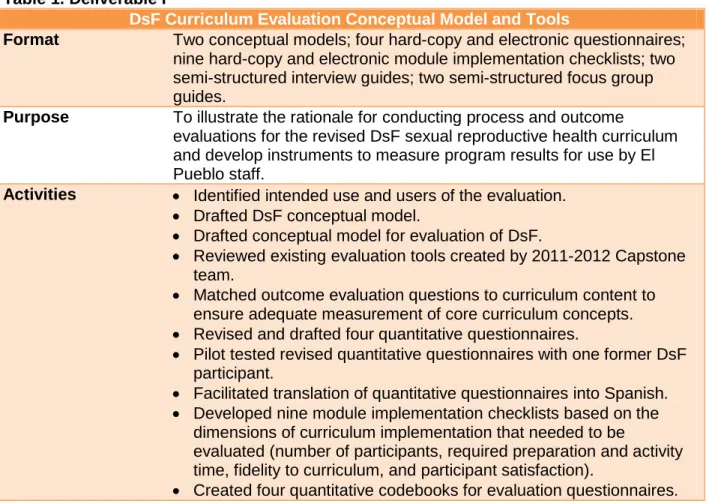
securing future funding for their health-related programs, including DsF. Tables 1 to 4 provide
detailed descriptions of all four deliverables.
Table 1. Deliverable I
DsF Curriculum Evaluation Conceptual Model and Tools
Format Two conceptual models; four hard-copy and electronic questionnaires; nine hard-copy and electronic module implementation checklists; two semi-structured interview guides; two semi-structured focus group guides.
Purpose To illustrate the rationale for conducting process and outcome
evaluations for the revised DsF sexual reproductive health curriculum and develop instruments to measure program results for use by El Pueblo staff.
Activities Identified intended use and users of the evaluation.
Drafted DsF conceptual model.
Drafted conceptual model for evaluation of DsF.
Reviewed existing evaluation tools created by 2011-2012 Capstone team.
Matched outcome evaluation questions to curriculum content to ensure adequate measurement of core curriculum concepts.
Revised and drafted four quantitative questionnaires.
Pilot tested revised quantitative questionnaires with one former DsF participant.
Facilitated translation of quantitative questionnaires into Spanish.
Developed nine module implementation checklists based on the dimensions of curriculum implementation that needed to be
evaluated (number of participants, required preparation and activity time, fidelity to curriculum, and participant satisfaction).
9
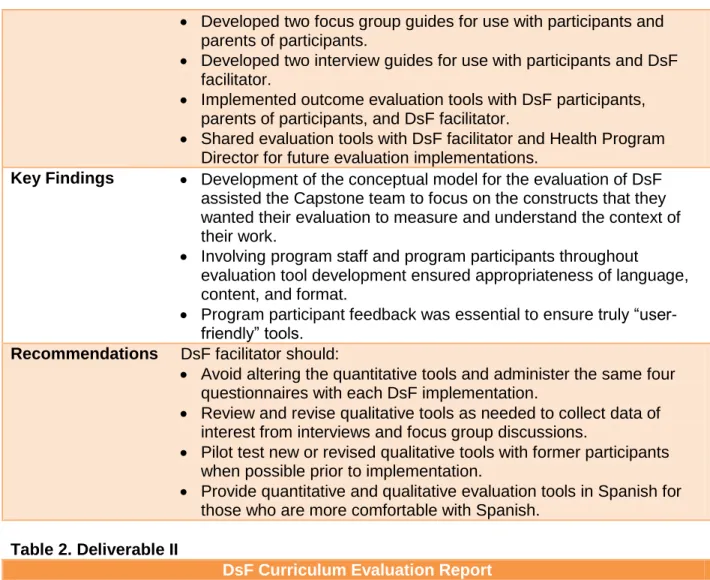
Developed two focus group guides for use with participants and parents of participants.
Developed two interview guides for use with participants and DsF facilitator.
Implemented outcome evaluation tools with DsF participants, parents of participants, and DsF facilitator.
Shared evaluation tools with DsF facilitator and Health Program Director for future evaluation implementations.
Key Findings Development of the conceptual model for the evaluation of DsF assisted the Capstone team to focus on the constructs that they wanted their evaluation to measure and understand the context of their work.
Involving program staff and program participants throughout evaluation tool development ensured appropriateness of language, content, and format.
Program participant feedback was essential to ensure truly “user-friendly” tools.
Recommendations DsF facilitator should:
Avoid altering the quantitative tools and administer the same four questionnaires with each DsF implementation.
Review and revise qualitative tools as needed to collect data of interest from interviews and focus group discussions.
Pilot test new or revised qualitative tools with former participants when possible prior to implementation.
Provide quantitative and qualitative evaluation tools in Spanish for those who are more comfortable with Spanish.
Table 2. Deliverable II
DsF Curriculum Evaluation Report
Format 43-page narrative report; one-hour PowerPoint presentation (37 slides)
Purpose To summarize process and outcome evaluation findings from the implementation of the revised DsF sexual reproductive health curriculum and share them with El Pueblo staff.
Activities Attended Fall DsF sessions (one Capstone team member at each session).
Collected module implementation checklists from DsF facilitator following each DsF session.
Administered and collected the four quantitative questionnaires from DsF participants prior to and post DsF curriculum implementation.
Entered and managed quantitative data using Deliverable III.
Attended DsF Celebration (final session of program) with DsF participants and parents of DsF participants.
Conducted one focus group with 10 DsF participants at DsF Celebration.
Conducted one focus group with 15 parents of DsF participants at DsF Celebration.
Conducted two interviews with DsF participants at DsF Celebration.
10
Reviewed audio recordings and hand written notes of focus group discussions and interviews.
Took notes in pairs to record observations, themes, and relevant quotes and created matrices.
Extracted major themes from qualitative interviews and focus groups in pairs and created visual displays of the data by theme.
Conducted analysis for process evaluation using module implementation checklists, focus groups, and interview data.
Conducted statistical analysis for outcome evaluation using pre- and posttest results from four quantitative questionnaires.
Created matrices using pre- and posttest outcome data to assess change over time in indicators.
Discussed qualitative and quantitative analysis methods with Health Behavior professors.
Drafted Evaluation Report (Background and Purpose, Evaluation Methods, Results, Discussion, Conclusions and Recommendations).
Drafted Executive Summary and compiled references and appendices for Evaluation Report.
Presented evaluation findings and recommendations in PowerPoint format to DsF facilitator and Health Program Director and solicited feedback.
Incorporated feedback into report.
Shared final evaluation report with DsF facilitator and Health Program Director.
Key Findings Follow-up with participants to conduct additional interviews by phone was a challenge for El Pueblo staff and Capstone team.
Small number of program participants (10) precludes ability to draw statistical conclusions from data at this time; quantitative data was interpreted using qualitative methods.
Entire curriculum was not implemented (five out of the eight modules were implemented) during this DsF cycle, therefore, this limits the generalizability of the evaluation findings.
Evaluation was impacted by program fidelity and this may have resulted in limited changes in participants’ knowledge, attitudes, and behaviors.
Process evaluation provided useful data for understanding outcome evaluation results.
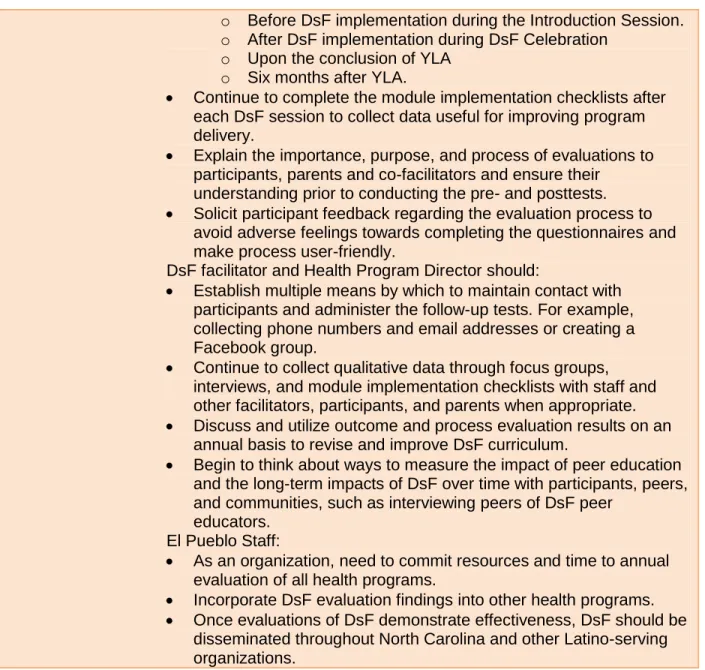
Recommendations DsF facilitator should:
Implement the full DsF curriculum (eight modules) according to protocol in order to fully evaluate the revised curriculum.
Continue to administer the same outcome evaluation
questionnaires with each DSF implementation to ensure the collection of comparable data over time.
Ensure one hour each during the introduction and final sessions to administer the four pre- and posttest questionnaires.
Ensure continued collection of evaluation data at all four time points to observe maintained changes in knowledge, attitudes, and
11
o Before DsF implementation during the Introduction Session. o After DsF implementation during DsF Celebration
o Upon the conclusion of YLA o Six months after YLA.
Continue to complete the module implementation checklists after each DsF session to collect data useful for improving program delivery.
Explain the importance, purpose, and process of evaluations to participants, parents and co-facilitators and ensure their
understanding prior to conducting the pre- and posttests.
Solicit participant feedback regarding the evaluation process to avoid adverse feelings towards completing the questionnaires and make process user-friendly.
DsF facilitator and Health Program Director should:
Establish multiple means by which to maintain contact with participants and administer the follow-up tests. For example, collecting phone numbers and email addresses or creating a Facebook group.
Continue to collect qualitative data through focus groups, interviews, and module implementation checklists with staff and other facilitators, participants, and parents when appropriate.
Discuss and utilize outcome and process evaluation results on an annual basis to revise and improve DsF curriculum.
Begin to think about ways to measure the impact of peer education and the long-term impacts of DsF over time with participants, peers, and communities, such as interviewing peers of DsF peer
educators. El Pueblo Staff:
As an organization, need to commit resources and time to annual evaluation of all health programs.
Incorporate DsF evaluation findings into other health programs.
Once evaluations of DsF demonstrate effectiveness, DsF should be disseminated throughout North Carolina and other Latino-serving organizations.
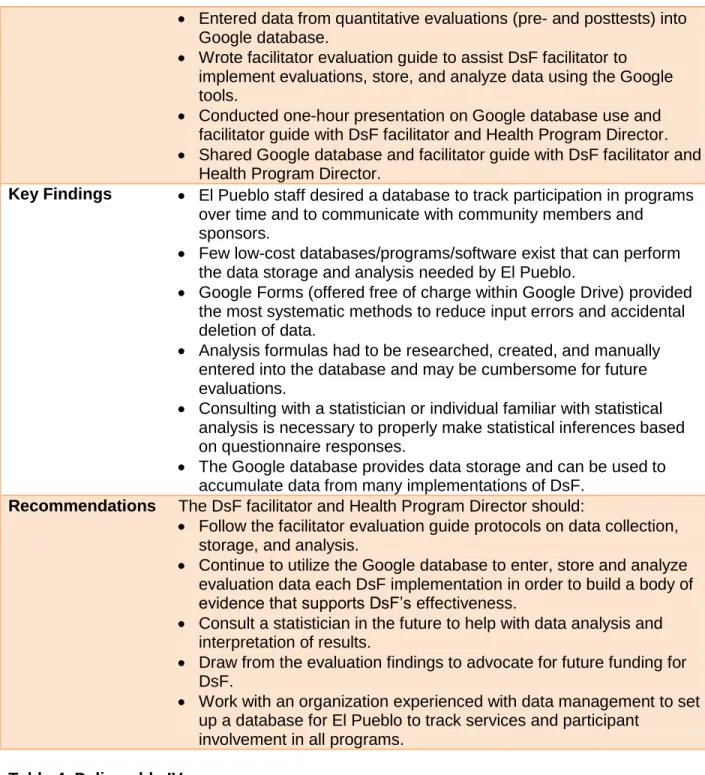
Table 3. Deliverable III
DsF Evaluation Database and Facilitator Guide to Evaluation
Format Five online Google surveys; one database of Google spreadsheets; nine-page facilitator evaluation guide
Purpose To provide a mechanism for collecting DsF outcome evaluation data for use by El Pueblo staff and a facilitator guide for data collection.
Activities Met with El Pueblo staff and assessed long-term data collection priorities and needs.
Researched database options and created a spreadsheet with database recommendations tailored to El Pueblo’s needs and capacity.
Shared database options spreadsheet with El Pueblo staff.
12
Entered data from quantitative evaluations (pre- and posttests) into Google database.
Wrote facilitator evaluation guide to assist DsF facilitator to implement evaluations, store, and analyze data using the Google tools.
Conducted one-hour presentation on Google database use and facilitator guide with DsF facilitator and Health Program Director.
Shared Google database and facilitator guide with DsF facilitator and Health Program Director.
Key Findings El Pueblo staff desired a database to track participation in programs over time and to communicate with community members and
sponsors.
Few low-cost databases/programs/software exist that can perform the data storage and analysis needed by El Pueblo.
Google Forms (offered free of charge within Google Drive) provided the most systematic methods to reduce input errors and accidental deletion of data.
Analysis formulas had to be researched, created, and manually entered into the database and may be cumbersome for future evaluations.
Consulting with a statistician or individual familiar with statistical analysis is necessary to properly make statistical inferences based on questionnaire responses.
The Google database provides data storage and can be used to accumulate data from many implementations of DsF.
Recommendations The DsF facilitator and Health Program Director should:
Follow the facilitator evaluation guide protocols on data collection, storage, and analysis.
Continue to utilize the Google database to enter, store and analyze evaluation data each DsF implementation in order to build a body of evidence that supports DsF’s effectiveness.
Consult a statistician in the future to help with data analysis and interpretation of results.
Draw from the evaluation findings to advocate for future funding for DsF.
Work with an organization experienced with data management to set up a database for El Pueblo to track services and participant
involvement in all programs.
Table 4. Deliverable IV
Updated DsF Funding Guide Format 41-page narrative guide
Purpose To summarize potential funding resources for ensuring DsF program sustainability at El Pueblo.
Activities Reviewed funding guide created by 2011-2012 Capstone team and brainstormed revisions.
Reviewed former funders’ priorities, guidelines, and time frames.
Contacted consultants-on-call for other potential funding sources.
13
Updated funding guide with new boilerplate language from qualitative evaluation results.
Updated funding guide with recent statistics from literature review.
Updated funding guide with new and existing funder information.
Shared updated funding guide with DsF facilitator and Health Program Director for future use seeking funding.
Key Findings It was necessary to update and add new funding sources from the previous year’s guide to make the document current and accurate.
While the funding environment is competitive, there are local funders in North Carolina, as well as nationally, that are interested in funding youth, reproductive health, and Latino-focused programs.
Updating the funding guide further strengthens El Pueblo’s ability to request and receive funding for DsF.
Recommendations The DsF facilitator and Health Program Director should:
Update the funding guide annually with new information about existing funders as well as potential new funders.
Insert new DsF participant and parent quotes to the funding guide each year.
To increase funding efforts and increase sustainability, continue to evaluate DsF with each implementation to create supporting evidence needed for soliciting funds.
Continue to reach out to partners and similar organizations in the area to solicit ideas about potential funders.
Look for creative ways to fundraise through videos, testimonials, and online resources.
Work with outside organizations, such as the Ms. Foundation, and students from regional universities to identify potential funders.
Through the development of these four deliverables, the Capstone team learned
first-hand about the time and effort that goes into successfully developing and implementing a
program evaluation. We encourage our partner organization to utilize the findings and
recommendations that the team lists above to further assist evaluation efforts in the future.
Discussion
The efforts of the Capstone team and El Pueblo staff throughout the 2012-2013
academic year produced data to improve the DsF curriculum and enhance the program’s
sustainability. Collaboration between the Capstone team and stakeholders was vital for
successful completion of the deliverables. The DsF evaluation not only produced data that was
useful for improvement of the DsF curriculum, but also developed a process for collecting data
14
dissemination of the DsF program to other Latino-serving organizations throughout North
Carolina in the future. By working with stakeholders, particularly the DsF facilitator and the El
Pueblo Health Programs director, this project helped to institutionalize the DsF evaluation
process within the organization. Additionally, the skills and knowledge acquired by members of
the Capstone team during this year will prove invaluable as they continue their careers as public
health practitioners.
Stakeholder Engagement
A number of stakeholders were instrumental to the Capstone team’s work throughout
this project. Beginning in the spring of 2012, the team collaborated with El Pueblo staff to
develop a work plan that guided the team’s efforts throughout the academic year. Early in the
fall semester, the team built relationships with El Pueblo staff members by attending events and
meetings hosted by the organization. Over the course of DsF’s implementation from November
to January, the team was able to spend time with DsF participants and become actively involved
in DsF activities. Capstone team members were also able to meet with and receive valuable
information from the parents of DsF participants and former DsF participants during the
evaluation process. Despite these successes, the Capstone team did face limitations when
engaging with some stakeholders, namely peers of DsF participants, the El Pueblo Board of
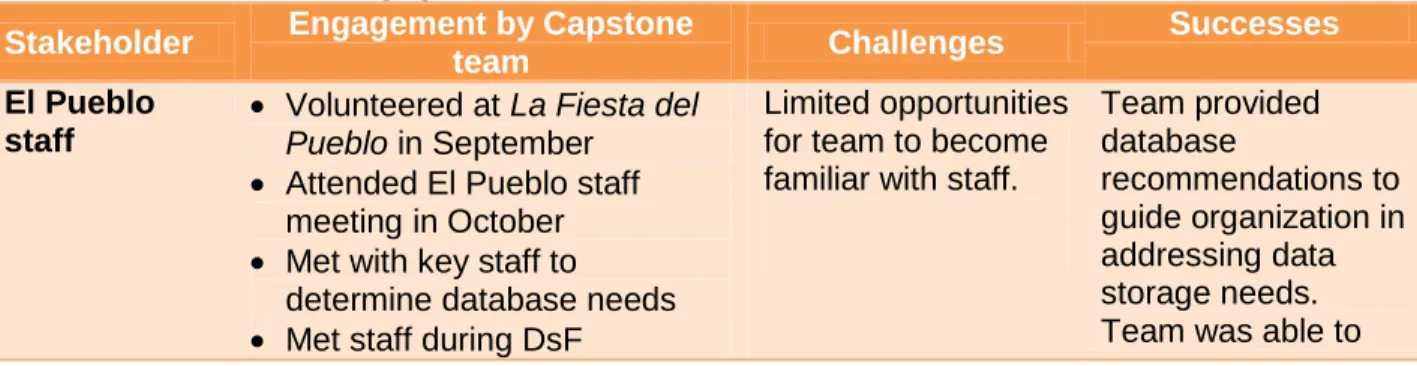
Directors, and other local Latino-serving and youth SRH organizations. Table 5 details methods
used to engage and work with different stakeholders, challenges faced by the team, and
successful collaborations.
Table 5. Stakeholder Engagement
Stakeholder Engagement by Capstone
team Challenges
Successes El Pueblo
staff
Volunteered at La Fiesta del Pueblo in September
Attended El Pueblo staff meeting in October
Met with key staff to determine database needs
Met staff during DsF
Limited opportunities for team to become familiar with staff.
Team provided database
15
implementation respond to felt
needs of El Pueblo staff.
DsF staff
Tania Durán-Eyre, DsF
Facilitator
Florence Simán, Capstone Preceptor
Participated in bi-weekly meetings
Provided weekly updates; weekly email and phone contact
Co-facilitated activities during implementation with DsF facilitator
Conducted interview with DsF facilitator
Presented evaluation findings and solicited feedback
together
Conducted training on DsF database
Former DsF facilitator left program in late summer and new facilitator was not hired until the fall. DsF facilitator also worked on another youth SRH program and much of her time was devoted to getting that program started.
There was clear communication between team and DsF staff throughout the year. Team was able to collect valuable information to assist with the program
recommendations from the DsF facilitator interview.
DsF
participants
All members of the Capstone team attended the
introduction session and at least one Capstone team member attended four of the five DsF sessions
Team attended the DsF Celebration in January
Conducted face-to-face interviews and focus groups with participants
Led icebreakers and some activities with DsF sessions
Administered pre- and posttest surveys with participants
Team was not able to meet all the youth at introductory session (only three out of ten youth attended) so some participants may have been unclear about the Capstone team’s role. Team also had to change roles often
(evaluator, observer, and co-facilitator) which may have been confusing to participants.
Team had a
consistent presence during DsF. Team got to know participants fairly well and, as a result, felt that they
provided honest feedback during interviews and focus groups.
Parents of DsF
participants
Met some parents during the introduction session
Met all parents during the DsF Celebration
Conducted a focus group with parents
Difficult to develop rapport with parents since the majority did not attend the introduction session.
Team received very helpful feedback from parents during the focus group held at DsF Celebration.
Former DsF participants
Pilot tested quantitative evaluation tools with one former DsF participant
Co-facilitated activities with two former participants throughout DsF
implementation
Short time period for locating and
administering the pilot test. Therefore, team was only able to test the tool with one former
participant.
Team was able to build rapport with former participants during DsF
implementation which future teams can build upon.
16
Carolina Latino-serving organizations
email from local SRH organizations for updates funding guide
not able to provide substantive funding information. This may have been due to time restraints as well as competing funding streams.
reach out to six people working on local SRH issues and promote
dialogue between El Pueblo and their organizations.
El Pueblo Board of Directors
Sent an introduction email to the Board of Directors during the fall semester that detailed the purpose and work of the team
Team was not able to attend a board meeting due to new board members and potential sensitivity of the SRH
curriculum.
Peers of DsF participants
Team did not have the opportunity to engage with peers of DsF participants. Impact on peers of DsF participants is a potential area that future teams could explore.
Knowledge and Experience Gained
The Capstone project will inform each team member’s future work as public health
professionals. The Capstone team was fortunate to have direct interaction with the DsF program
and to gain experience working in public health programming for youth, SRH, and Latino health.
This interaction gave the team the opportunity to experience the realities of program
implementation and learn about obstacles and limitations that complicate implementation
efforts. For example, the team observed how the DsF facilitator handled challenging group
dynamics during implementation sessions, which gave them insight about how to develop and
deliver interventions for adolescents. Team members also gained experience working directly
with youth and observed the challenges that SRH interventions face in recruitment and
implementation due to their sensitive subject matter. These firsthand observations allowed the
Capstone team to develop a more nuanced understanding of the intervention’s context,
17
commitment, it was invaluable for developing relationships that facilitated the evaluation efforts
and for making observations that informed the team’s recommendations.
The project also provided the opportunity to observe decision-making and resource
allocation in a local nonprofit organizational setting. This allowed the Capstone team to learn
about the challenge of evaluation in a real world setting where there were competing priorities.
Throughout the year, the Capstone team worked creatively to resolve issues, including the need
for a sustainable protocol for data storage and analysis, working around and within time and
staff constraints, and determining user acceptability for the evaluation materials they developed.
The team learned the importance of being prepared, yet flexible, for all types of situations that
may arise and to navigate overlapping priorities within El Pueblo and between supporting
organizations.
The development of project deliverables presented the Capstone team with a variety of
learning opportunities. The Capstone team gained knowledge of and experience planning and
conducting a program evaluation and learned a number of important lessons when developing
their plan for the evaluation and the evaluation materials. First, the Capstone team members
gained experience creating conceptual and logical frameworks for the intervention in order to
understand what constructs would need to be evaluated. Once the team understood the
intervention and constructs of interest, they gained experience developing questionnaires and
codebooks for outcome evaluation data collection and analysis. The Capstone team also
developed interview and focus group guides and module implementation checklists for process
evaluation data collection. Throughout the process of soliciting feedback from El Pueblo staff,
their faculty advisor, teaching team, and intended users (pilot testing), the Capstone team
developed an appreciation for the iterative process of developing evaluation tools. This
experience in developing the evaluation taught the team about the importance of adequately
preparing for an evaluation, from the utility of creating evaluation plans and conceptual models
18
of all materials. Throughout the development of all deliverables, the Capstone team consulted
with El Pueblo staff to inform them of their actions and solicit feedback with the goal of creating
materials that would be feasible for El Pueblo to use in future evaluations. They also learned
how important it is to gauge organizational readiness and capacity before initiating evaluation
efforts in order to anticipate issues that may facilitate or complicate the evaluation process.
The Capstone team also learned lessons from the implementation of the evaluation.
Although they attempted to anticipate all potential issues with evaluation tools through peer and
expert review, other issues emerged during the evaluation process, such as confusion caused
by the vocabulary, language, and format of the questionnaires, participant dissatisfaction with
the questionnaires, and the time burden imposed by the outcome and process evaluation tools.
Throughout the implementation of the evaluation, the Capstone team made note of these issues
and addressed them to the extent possible without compromising the overall goals of the
evaluation. The Capstone team solicited further feedback from El Pueblo staff, program
participants, the teaching team, and their faculty advisor. These efforts helped to minimize
facilitator and participant burden as much as possible. Therefore, even though Capstone team
preparations demonstrated the importance of being prepared and anticipating future issues, the
team’s experience with implementing the evaluation taught them the importance of being
flexible and continuing to modify their evaluation materials as necessary.
Once all evaluation data were collected, the Capstone team began the process of
analyzing and synthesizing the results in order to develop recommendations for the
improvement of subsequent implementations of DsF. Although the Capstone team was able to
use quantitative and qualitative knowledge and skills learned during the first year of MPH
program coursework, the team also sought outside expertise and knowledge to guide them in
their analysis of the data. Through their experience with the evaluation, the team learned about
how the lack of program fidelity complicated their ability to draw conclusions from outcome data.
19
results. These efforts provided a valuable experience in applying many of the lessons learned in
the Health Behavior MPH program to a real-world setting where they had to discuss ambiguous
results with committed stakeholders. Finally, the Capstone team developed a list of
recommendations to improve the delivery and evaluation of future DsF implementations. The
Capstone team shared their analysis and recommendations with El Pueblo staff, which gave
them experience focusing their results around specific themes and topics.
Impact of Capstone Work on Partner Organization
The 2012-2013 Capstone team’s work represents the first formal effort to demonstrate the
effectiveness of the DsF curriculum. Even though the program was only partially implemented
and outcome evaluation results were inconclusive, this first evaluation helped to establish a
sustainable and user-focused evaluation process for future implementations for DsF. By
collecting data on changes in participant knowledge, attitudes, and behaviors, El Pueblo will be
able to demonstrate DsF’s role in affecting the determinants of SRH and peer education
behaviors for Latino adolescents in North Carolina. El Pueblo’s demonstration of the program’s
effectiveness in changing SRH behaviors and outcomes will strengthen their ability to request
funding for future programmatic efforts. Furthermore, favorable outcomes for the DsF program
will contribute to the base of evidence regarding Latino adolescent SRH interventions and will
lead to a curriculum that can be disseminated to organizations across the state. The process
evaluation provided valuable information about the DsF program implementation and created a
mechanism for improving the DsF curriculum and future implementations. The creation of the
facilitator guide to evaluation will assist El Pueblo to evaluate subsequent DsF implementations
and build a body of evidence of the program’s effectiveness. Finally, an updated funding guide
will further strengthen El Pueblo’s ability to request and receive funding for continued support of
El Pueblo’s youth SRH programs.
20
A thorough review of relevant literature at the outset of this project indicated that DsF’s
approach, which combines culturally-appropriate SRH material with activities designed to
empower youth to act as peer educators, has not been rigorously evaluated in any setting. By
continuing to follow the outcome evaluation data collection protocols developed in cooperation
with the Capstone team, El Pueblo will be able to accumulate an evidence base to demonstrate
DsF’s role in affecting the determinants of SRH and peer education behaviors for Latino
adolescents in North Carolina. If El Pueblo can determine the effectiveness of their approach
through program evaluation, their efforts will contribute to the base of evidence regarding SRH
interventions targeted to Latino adolescents.
Recommendations
DsF Evaluation
An organizational commitment to continued evaluation of DsF is necessary to
accumulate the evidence needed to determine and demonstrate program effectiveness. If
future evaluation efforts yield more conclusive data, El Pueblo will achieve its goal of
understanding the impact of the program on participants and their community, adding to the
body of knowledge that supports this approach, and supporting efforts to achieve greater
dissemination of DsF throughout North Carolina. To support this goal, El Pueblo staff
implementing DsF should follow data collection, storage, and analysis protocols laid out in the
facilitator evaluation guide developed by the Capstone team. All tools necessary to conduct
process and outcome evaluations are available in English and Spanish in the evaluation tools
document created by the Capstone team. Using the focus group and interview guides to collect
qualitative evaluation data after each implementation cycle with participants and co-facilitators
will generate data and recommendations that can be used to revise the DsF curriculum to make
it more enjoyable and relevant for participants.
When delivering the outcome evaluation, the purpose and importance of evaluation
21
with participants just before administering pre- and posttests. Because of the sensitive nature of
SRH topics and the need for confidentiality, DsF participants should be consulted on the best
way to design and implement a DsF evaluation. It is important to impress upon the participants
that all answers are confidential, that they are not being tested, and that evaluation helps to
improve the curriculum and the program. Furthermore, the facilitator(s) should understand the
evaluation process and its purpose. It is important that evaluation occurs and is administered
the same way each time.
In addition to data collection efforts, El Pueblo should plan to discuss and utilize
evaluation results on an annual basis to revise the curriculum and improve implementation.
Furthermore, El Pueblo should reconsider the evaluation design periodically to assure that it is
feasible and measures indicators for the constructs that they want to capture. Currently, only
short and intermediate outcomes of knowledge, attitudes, self-efficacy, and behaviors are
measured by this evaluation design. El Pueblo may want to consider designs that also measure
long-term outcomes of interest, such as SRH behaviors and participants’ impact on their
broader community as peer educators. Adding these additional measures would potentially
generate further evidence of the efficacy of the DsF program. To adequately evaluate long-term
outcomes, El Pueblo needs to develop an evaluation plan that outlines goals and objectives,
indicators, and data collection methods for these measurements.
Ensuring fidelity to the DsF curriculum is important for the purposes of successfully
evaluating this program. By teaching all curriculum materials as planned in the curriculum, El
Pueblo will be able to measure the full impact of the intervention. Additionally, due to the small
group format, it might be necessary to analyze aggregated data from implementation sessions,
but this is only possible if the intervention is delivered with fidelity across sessions. The training
of DsF facilitators and routine completion of the module implementation checklists after each
session will ensure greater uniformity in program delivery over multiple implementation cycles
22
Future work
The Capstone team had several ideas for future projects that could facilitate the delivery
of DsF. For example, a DsF train-the-trainer manual could be written to support the training of
future facilitators. Developing additional training protocols for new staff and facilitators would
also ensure better preparation and uniformity across DsF implementations. One future
evaluation activity suggested by the Capstone team is the development of an evaluation plan to
assess the long-term impact of DsF. This evaluation plan can be created and implemented in
conjunction with measurements already being collected with the current evaluation tools. Once
evidence of effectiveness can be demonstrated, El Pueblo could create a dissemination plan
detailing ways in which to implement DsF within SRH programs for Latino youth in North
Carolina. Finally, funding is critical to sustainability of DsF. Funding will ensure the curriculum is
provided for future cohorts of DsF participants and that evaluation data will continue to
strengthen the evidence of effectiveness . Therefore, El Pueblo should continue to develop
23 References
Adolescent Pregnancy Prevention Campaign of North Carolina. (2012). North Carolina state of
adolescent sexual health and action plan. Retrieved 10/2/2012 from
http://files.appcnc.gethifi.com/news-and-publications/research-and-publications/north-carolina-state-of-adolescent-sexual-health-and-action-plan/Entire_Final_SASH_Report.pdf
Bakker, R., Steegers, E. A., Biharie, A. A., Mackenbach, J. P., Hofman, A., & Jaddoe, V. W.
(2011). Explaining differences in birth outcomes in relation to maternal age: The generation
R study. BJOG : An International Journal of Obstetrics and Gynaecology, 118(4), 500-509.
doi: 10.1111/j.1471-0528.2010.02823.x; 10.1111/j.1471-0528.2010.02823.x
Cardoza, V. J., Documet, P. I., Fryer, C. S., Gold, M. A., & Butler, J.,3rd. (2012). Sexual health
behavior interventions for U.S. Latino adolescents: A systematic review of the literature.
Journal of Pediatric and Adolescent Gynecology, 25(2), 136-149. doi:
10.1016/j.jpag.2011.09.011
Centers for Disease Control and Prevention. (2011). HIV and other STD prevention and United
States students. Retrieved 9/30/2012, 2012, from
http://www.cdc.gov/healthyyouth/yrbs/pdf/us_hiv_combo.pdf
Centers for Disease Control and Prevention. (2012a). Youth risk behavior surveillance - United
States, 2011. Retrieved 9/30, 2012, from http://www.cdc.gov/mmwr/pdf/ss/ss6104.pdf
Centers for Disease Control and Prevention. (2012b). Youth risk behavior surveillance system:
Selected 2011 national health risk behaviors and health outcomes by race/ethnicity.
Retrieved 9/30/2012 from
http://www.cdc.gov/healthyyouth/yrbs/pdf/us_disparityrace_yrbs.pdf
de Anda, D. D. (2008). Replication of an intensive educational intervention for youth pregnancy
24
Department of Health and Human Services. (2011). North Carolina youth risk behavior survey
(YRBS), high school 2011 survey results. Retrieved 10/22/2012 from
http://www.nchealthyschools.org/docs/data/yrbs/2011/statewide/high-school.pdf
Division of HIV/AIDS Prevention, National Center for HIV/AIDS, Viral Hepatitis, Sexual
Transmitted Diseases and Tuberculosis Prevention, Centers for Disease Control and
Prevention. (n.d.). Tiers of evidence: A framework for classifying HIV behavioral
interventions. Retrieved April 19, 2013, from http://www.cdc.gov/hiv/dhap/prb/prs/tiers.html.
Fernández-Santos, D. M., Figueroa-Cosme, W., Miranda, C., Maysonet, J., Mayor-Becerra, A.,
& Hunter-Mellado, R. (2011). Prevention strategies for HIV infection risk reduction among
Hispanic/Latino adolescents . In E. Barros (Ed.), HIV-infection-impact, awareness and
social implications of living with HIV/AIDS (pp. 183-200) Intech.
Frost, J. J., & Driscoll, A. K. (2006). Sexual and reproductive health of US Latinas: A literature
review. Retrieved 9/30/2012 from http://www.guttmacher.org/pubs/2006/02/07/or19.pdf
Guttmacher Institute. (2012). U.S. teenage pregnancies, births and abortions: National and state
trends and trends by race and ethnicity. Retrieved 10/2/2012 from
http://www.guttmacher.org/pubs/USTPtrends08.pdf
Harden, A. A. (2001). Peer-delivered health promotion for young people: A systematic review of
different study designs. Health Education Journal, 60(4), 339-353.
Herbst, J. J. H. (2007). A systematic review and meta-analysis of behavioral interventions to
reduce HIV risk behaviors of Hispanics in the United States and Puerto Rico. AIDS and
Behavior, 11(1), 25-47.
Milburn, K. K. (1995). A critical review of peer education with young people with special
reference to sexual health. Health Education Research, 10(4), 407-420.
Sallis, J. F., Owen, N., & Fisher, E. B. (2008). Ecological models of health behavior. Health
25
Sellers, D. E., McGraw, S. A., McKinlay,J. B. (1994). Does the promotion and distribution of
condoms increase teen sexual activity? Evidence from an HIV prevention program for
Latino youth. American Journal of Public Health, 84(12), 1952. Retrieved from
https://auth.lib.unc.edu/ezproxy_auth.php?url=http://search.ebscohost.com/login.aspx?dire
ct=true&db=f6h&AN=9501191609&site=ehost-live&scope=site
Sriranganathan, G. (2012). Peer sexual health education: Interventions for effective programme
evaluation. Health Education Journal, 71(1), 62-71.
State Center for Health Statistics and Office of Minority Health and Health Disparities. (2010).
North Carolina minority health facts: Hispanics/Latinos. Retrieved 9/30/2012, 2012, from
http://www.schs.state.nc.us/schs/pdf/Hispanic_FS_WEB_080210.pdf
Turner, G. G. (1999). A method in search of a theory: Peer education and health promotion.
Health Education Research, 14(2), 235-247.
United States Census Bureau. (2011). 2010 census briefs: The Hispanic population 2010.
Retrieved 3/12, 2013, from http://www.census.gov/2010census/
Weinstock, H., Berman, S., & Cates, W.,Jr. (2004). Sexually transmitted diseases among
American youth: Incidence and prevalence estimates, 2000. Perspectives on Sexual and
Reproductive Health, 36(1), 6-10. doi: 10.1363/psrh.36.6.04
26
Appendix A. Evaluated Latino Adolescent Sexual and Reproductive Health Programs
Program name Program type Participan t age range Participant gender Study population SEF individual- level SEF Interperson al-level Peer educator empower ment Evaluation of peer education component
DsF1 Sexual and reproductive health, advocacy, media skills 11-14, 14-19 Mixed gender Latino adolescents in central North Carolina
Yes Yes Yes In
development
Cuídate2 HIV risk reduction
13-18 Mixed gender American Hispanic adolescents (primarily Puerto Rican) in Philadelphia, PA
Yes No No n/a
Joven a Joven3 Social, sexual, and health-related teen issues High school students Mixed gender Latino/a adolesents in central North Carolina
Yes Yes Yes Unknown
Safer Choices 24
HIV, STD, & Pregnancy Prevention
7th-12th grade Mixed gender African Americans (29.7%) and Hispanic Americans (61.3%)
Yes Yes No n/a
The GIG5
HIV, STD, & Pregnancy Prevention Adolescent s Mixed gender Latino/a adolescents
Yes No
27 Joven Noble6 Youth developmen t program with HIV & STD prevention component
10-24 Male only
92.3 %Hispanic-American adolescents (17.9% foreign born, 82.1% born in the U.S.)
Yes No No n/a
Poder Latino7
AIDS prevention
14-19 Mixed gender Latino adolescents in 2 northeastern U.S. cities
Yes Yes
No-However, activities are led by specially trained peer leaders. n/a Children’ s Aid Society-Carrera Program 8 Comprehen sive sexuality education and pregnancy prevention program
13-15 Mixed gender African Americans or Caribbean (56%) and Hispanic Americans (42%), majority disadvantage d
Yes No No n/a
Social Skills Training9 HIV & pregnancy Prevention
13-18 Mixed gender White American (46.3%) and Hispanic Americans (53.7%)
Yes Yes No n/a
Familias Unidas + PATH10
Family-based sexual risk behavior
8th grade Mixed gender
Students with at least one parent from a
28
1Derechos sin Fronteras curriculum. 2
Villarruel A.M., Jemott, L.S., & Jemmott, J.B. (2005). Designing a culturally based intervention to reduce HIV sexual risk for Latino adolescents. Journal of the Association of Nurses in AIDS Care, 16(2), 23-31.
3“Joven a Joven.” (2012). Planned Parenthood of Central North Carolina. Retrieved October 23, 2012 from
http://www.plannedparenthood.org/centralnc/joven-joven-2832.htm
4 Tortolero, S.R., Markham, C.M. Addy, R.C., Baumler, E.R., Escobar-Chavez, S.L., Basen-Engquist, K.M., McKirahan, N.K., & Parcel,
G.S. (2008). Safer choices 2: Rationale, design issues, and baseline results in evaluating school-based health promotion for alternative school students. Contemporary Clinical Trails 29, 70-82.
5 De Anda, D. (2002) The Gig: An innovative intervention to prevent adolescent pregnancy and sexually transmitted infection in a
Latino community. Journal of Ethnic & Cultural Diversity in Social Work, 11(4), 251-277.
6 Tello, J., Cervantes, R.C., Cordova, D., & Santos, S. (2010). Joven noble: Evaluation of a culturally focused youth development
program. Journal of Community Psychology, 38(6), 799-811.
7 Sellers, D.E., McGraw, S.A., & McKinlay, J.B. (1994). Does the promotion and distribution of condoms increase teen sexual activity?
Evidence from an HIV prevention program for Latino youth. American Journal of Public Health, 84(12), 1952-1959.
8 Philliber, S., Williams Kaye, J., Herrling, S., & West, E. (2002) Preventing pregnancy and improving health care access among
teenagers: An evaluation of the Children’s Aid Society–Carrera Program. Perspectives on Sexual and Reproductive Health, 34(5), 244–251.
9
Houvell, M., Blumberg, E., Sipan, C., Hofstetter, C.R., Burkham, S., Atkins, C., & Felice, Marianne. (1998). Skills Training for pregnancy and AIDS prevention in Anglo and Latino youth. Journal of Adolescent Health, 23(2), 139-149.
10
Prado, G., Pantin, H., Briones, E., Schwartz, S.J., Feaster, D., Huang, S., Sullivan, S., Tapia, M.I., Sabillon, E., Lopez, B., & Szapocznik, J. (2005). A randomized controlled trial of a parent-centered intervention in preventing substance use and HIV risk behaviors in Hispanic adolescents. Journal of Consulting and Clinical Psychology, 75(6), 914-26.
and substance use
prevention
30
Appendix C. DsF Program Evaluation Conceptual Model
Goals
Intermediate Term
Long term
Short Term
Development of
program
Pilot testing of program
Revision of program to
meet community needs
Program
implementation in
controlled setting
(efficacy trial)
Demonstrated evidence
of program effectiveness
Evaluation by
Capstone student
team
Institutionalization of
program
Program with
characteristics that
allow it to be
disseminated
Dissemination
Program
31
Appendix D. 2012-2013 El Pueblo Capstone Team Gantt Chart
2012
2013
Activity
Sept. Oct.
Nov.
Dec.
Jan.
Feb.
March April May
El Pueblo DsF Curriculum Implementation
DsF sessions YLA sessions
Capstone Class Deliverables
Fall Work Plan
Draft Logic Model
Draft Literature Review
IRB Application
Spring Work Plan
Capstone Summary Report
Capstone Celebration Day Presentation
2012
2013
Activity
Sept. Oct.
Nov.
Dec.
Jan.
Feb. March April
May
Deliverable I: DsF Curriculum Evaluation Conceptual Model and Tools
Identify intended use and users of the evaluation Review existing evaluation tools created by 2011-2012 Capstone
team
Draft a conceptual model for evaluation
Finalize conceptual model
Draft a conceptual model for evaluation of DsF
Finalize evaluation of DsF conceptual model
Draft quantitative evaluation tools as needed
32
Pilot test quantitative tools
Finalize quantitative evaluation tools
Draft quantitative codebooks
Draft module implementation checklists to use in process
evaluation following each DsF session
Draft qualitative evaluation tools (interview/focus group guides to
use in process evaluation following DsF implementation)
Send qualitative evaluation tools for review
Incorporate feedback on tools
Finalize qualitative evaluation tools
Translate quantitative tools into Spanish
Finalize deliverable and submit for final approval
2012
2013
Activity
Sept. Oct.
Nov.
Dec.
Jan.
Feb. March April
May
Deliverable II: DsF Curriculum Evaluation Report
Each Capstone team member attend one fall DsF session Collect process data (after each DsF session) and outcome data collection documents (before and after implementation of DsF
curriculum) from El Pueblo staff
Enter quantitative data into database (before and after
implementation of DsF curriculum)
Create interview and focus groups matrices
Conduct two focus groups following DsF implementation
Conduct two interviews following DsF implementation
33
Draft “Results” section of evaluation report
Draft “Discussion” section of evaluation report
Draft “Conclusions and Recommendations” section of evaluation
report
Solicit feedback from El Pueblo stakeholders and mentors
regarding Evaluation Report
Draft “Executive Summary” section of the evaluation report Solicit feedback from El Pueblo stakeholders and mentors
regarding Executive Summary
Compile references and appendices
Compile all sections of the evaluation report, send final draft out
for review
Incorporate feedback
Finalize deliverable and submit for final approval
2012 2013
ACTIVITY Sept. Oct. Nov. Dec. Jan. Feb. March April May
Deliverable III: DsF Evaluation Database and User Guide
Assess El Pueblo data collection priorities
Research database options
Create database option spreadsheet with options
Create database for DsF evaluation program data
Capstone team members enter pre/post-test data
Outline sections for facilitator evaluation guide
Draft database facilitator evaluation guide
Incorporate feedback on facilitator evaluation guide, send out for
final approval
Conduct one training session on evaluation and database use
with DsF staff
34
2012 2013
Activity Sept. Oct. Nov. Dec. Jan. Feb. March April May
Deliverable IV: Updated Funding Guide
Review funding guide created by 2011-2012 Capstone team Update funding guide with new qualitative data and new funder
information