NEWFOUNDLAND AND LABRADOR
BOARD OF COMMISSIONERS OF PUBLIC UTILITIES
120 Torbay Road, P.O. Box 21040, St. John’s, Newfoundland and Labrador, Canada, A1A 5B2
REQUEST FOR PROPOSALS FOR TRANSCRIPTION
SERVICES
TERMS OF REFERENCE
I. IntroductionThe Board is an independent, quasi-judicial regulatory tribunal constituted by the Public Utilities Act, R.S.N.L. 1990. The Board has responsibilities for regulating electric utilities, automobile insurance rates, petroleum products pricing, ambulance service licensing, trans-island bus service licensing and, where directed by Government, for expropriations and other matters. Statutory responsibilities are carried out under the authority of: the Public Utilities Act; the Electrical Power Control Act; the Petroleum Products Pricing Act; the Automobile Insurance Act; the Insurance Companies Act; the Motor Carrier Act; the Motor Vehicle Transport Act; the Expropriation Act; andthe Public Utilities Acquisition of Lands Act.
The Board from time to time conducts proceedings in relation to these responsibilities. Pursuant to the provisions of the Public Utilities Act, the Board is required to provide a full and complete record of all proceedings, which may include, at the Board’s discretion, the recording and transcribing of any proceedings before the Board.
II. Scope of Work
1. The service provider will, when requested by the Board, provide recording and transcription services for proceedings in accordance with the terms and conditions set out in Schedule A. General administrative duties may be included in these services.
2. The service provider’s staff will provide and operate its own digital recording equipment at proceedings held in St. John’s and, when required, outside of the St. John’s region. 3. Transcription must be completed on a timely basis. The service provider must make
transcriptions available on a same-day, overnight/one-day, three-day or seven-day basis as required by the Board. The majority of Board proceedings will require same-day service.
4. Transcripts are to be provided in a paper copy and forwarded electronically in adobe acrobat format (*pdf), or in another manner that the Board prescribes.
5. The service provider may be requested to transcribe recordings made by persons other than the service provider’s own staff.
6. The service provider may be required to meet periodically with personnel from the Board to ensure that a quality service is being provided in an efficient manner.
III. Term of Engagement
1. The contract will be for a term of three years with an unqualified right for the Board to renew for a further term of three years upon the terms set out in the initial contract. The Board reserves the unqualified right not to renew the contract.
IV. Proposal Content
1. Proposals must include the following:
(a) a general description of unique qualifications, with an emphasis on quality and efficiency of service;
(b) confirmation of capacity to undertake the services when and as required by the Board; (c) confirmation that the facilities and equipment to provide this service are available; (d) the completed Fees Table as set out in Schedule B;
(e) names of three professional references to whom transcription services have been provided.
(f) description of the experience in providing services similar to those being requested by the Board
(g) policies with respect to billing practices and payment terms over the three-year contract period;
(h) the specifications of technical equipment used such as recording equipment, computer software, audio tapes, etc; and
(i) indexing capability of the software program used in the transcription.
V. Selection Criteria
1. Proposals will be evaluated based on the following:
(a) the ability to meet the requirements as set out in this Terms of Reference;
(b) the experience of the service provider in providing services similar to those being requested by the Board;
(c) the availability of the service provider, including access to an appropriate level of resources and support services;
VI. Conditions
1. The Board makes no claim, expressed or implied, with regard to the volume of work that may result from the acceptance of a proposal for the provision of these services.
2. The Board will not be liable for any costs incurred by the proponents in the preparation and presentation of their proposals.
3. The Board reserves the right to accept or reject any or all proposals. The lowest or any proposal shall not necessarily be accepted and the Board may, at its sole discretion, accept a non-compliant proposal.
4. The Board reserves the right to discuss any or all proposals and to request additional information from any or all proponents.
5. All materials, documents, findings and electronic data, conceived, developed or produced by the service provider in the recording of the Board’s proceedings shall be the property of the Board and shall be delivered to the Board at the end of every proceeding.
VII. Process
1. Closing Date and Time
(a) Four copies of the proposal must be delivered to the Board, no later than 12:00 noon, on Friday, March 22, 2013.
(b) For mail or courier delivery the envelope should be sealed and clearly marked and addressed as follows:
Proposal for Recording and Transcribing Services
Director of Corporate Services & Board Secretary Board of Commissioners of Public Utilities P. O. Box 21040
Suite E- 210, 120 Torbay Road St. John's, NL
A1A 5B2
2. Additional information
Additional information may be obtained by contacting the Board Secretary at (709)726-8600 or by email at [email protected].
3. Selection Committee
Service providers may be required to be interviewed as part of the selection process. If selected to meet with the Board it is expected that the service providers and persons who would be assigned to provide services to the Board will attend.
4. Decision
The appointment is expected to be made prior to March 27, 2013 to take effect on April 1, 2013.
Cheryl Blundon
Director of Corporate Services & Board Secretary
SERVICES Schedule “A” Page 1
1. For the purpose of these Terms of Reference, the Board provides the following definitions.
(a) Transcription Page - is the printing medium used by the service provider for billing purposes. Transcription Pages shall have line numbering and should contain an average of 180 words. A sample Transcription Page is attached for information purposes.
(b) Copy Page - is the reproduction of original Transcription Pages that have been reformatted so that four transcription pages fit on a 8.5 X 11 sheet of paper. Copies should contain an average of 800 words on an 8.5 X 11 inch sheet of paper. A sample Copy Page is attached for information purposes.
(c) Same-day Service - Transcripts are to be provided electronically within 6 hours on the same day following conclusion of the proceeding and in paper format by 8:30 a.m. the next day.
(d) Overnight/One-day Service - Transcripts are to be provided electronically and in paper format before noon the following day after the proceeding was recorded, weekends included.
(e) Three-day Service - Transcripts are to be provided electronically and in paper format before noon on the third day after the proceeding was recorded, weekends included.
(f) Seven-day Service - Transcripts are to be provided electronically and in paper format before noon on the seventh day after the proceeding was recorded, weekends included.
2. Proponents are required to provide recording and transcription services as requested by the Board from time to time as follows:
(a) Recording Services
The service provider will record and monitor proceedings using its own equipment. General administrative duties may also be included with the provision of these services. The service provider must be available to provide the services upon request of the Board.
(b) Transcription Services
The service provider will transcribe the recording of proceedings onto a Transcription Page. Transcription Pages are required to be minimized so that four Transcription Pages fit on a standard 8 ½ X 11 inch sheet of paper. The service provider must provide a same-day, overnight-one-day, three-day or seven-day service when requested by the Board. The majority of Board proceedings will require same-day service.
FEES AND DISBURSEMENTS Schedule “B” Page 1
FEES
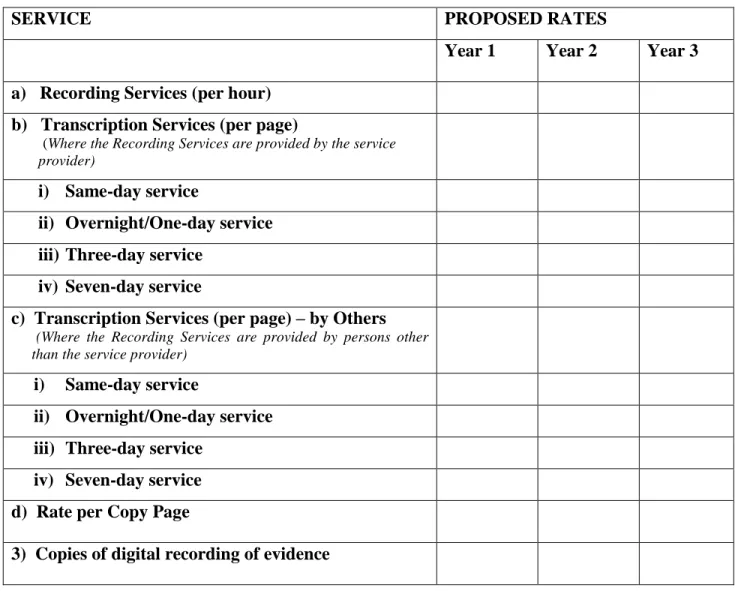
The service provider shall provide a detailed statement of Fees that will be charged for the services in the format set out below.
Table of Fees
SERVICE PROPOSED RATES
Year 1 Year 2 Year 3
a) Recording Services (per hour) b) Transcription Services (per page)
(Where the Recording Services are provided by the service provider)
i) Same-day service
ii) Overnight/One-day service iii) Three-day service
iv) Seven-day service
c) Transcription Services (per page) – by Others (Where the Recording Services are provided by persons other than the service provider)
i) Same-day service
ii) Overnight/One-day service iii) Three-day service
iv) Seven-day service d) Rate per Copy Page
3) Copies of digital recording of evidence
Requirements:
1. The hourly rate for Recording Services must be the same for services provided in and outside the St. John’s region. The service provider may charge an eight-hour minimum rate for travel outside of St. John’s.
2. The service provider shall set out the rates for transcription services where the proceeding was recorded by its own staff and, if different, where it was recorded by persons other than the service providers’ own staff.
3. The service provider shall set out the rates for a Transcription Page on the basis of each of: Same-day, Overnight/One-day, Three-day or Seven-day service.
FEES AND DISBURSEMENTS Schedule “B” Page 2
5. The service provider will provide a rate for providing copies of the digital recording used for recording evidence during a proceeding.
DISBURSEMENTS
1. All disbursements require the prior approval of the Board.
2. When the service provider is requested to provide recording services outside of the Board’s main hearings room, the service provider or representative may be required to travel with Board personnel.
3. When travel is required the Board will make the travel arrangements on the same basis as travel by Board personnel and the Board will pay travel expenses, such as airfare, vehicle travel and accommodation costs.
Sample Transcription Page
However, severe weather events do have a 1
significant impact on outages consequences for 2
our customers. Chris, could you bring up Graph 3
2-1, please. So this graph includes outages 4
caused by severe weather events. The graph 5
shows the duration and frequency of outages 6
from 2007 to 2011. In 2010, customers 7
experienced almost 14 hours of outage. 2010 8
was a particularly difficult year due to the 9
March ice storm and Hurricane Igor in 10
September. 11
KELLY, Q.C.: 12
Q. You mentioned that customer service 13
expectations are constantly evolving. What 14
can you tell the Board about that? 15
MR. SMITH: 16
A. A prominent feature of Newfoundland Power’s 17
interactions with its customers is a growing 18
influence of electronic technology. More 19
customers are now choosing to interact with 20
the company through electronic means. For 21
example, 18 percent of our customers are now 22
billed electronically. Customers are also 23
interacting more with the company via email. 24
Chris, could you bring up Tab 2-2 on Page 206, 25
Page 5
1 However, severe weather events do have a
2 significant impact on outages consequences for
3 our customers. Chris, could you bring up Graph
4 2-1, please. So this graph includes outages
5 caused by severe weather events. The graph
6 shows the duration and frequency of outages
7 from 2007 to 2011. In 2010, customers
8 experienced almost 14 hours of outage. 2010
9 was a particularly difficult year due to the
10 March ice storm and Hurricane Igor in
11 September.
12 KELLY, Q.C.:
13 Q. You mentioned that customer service
14 expectations are constantly evolving. What
15 can you tell the Board about that?
16 MR. SMITH:
17 A. A prominent feature of Newfoundland Power’s
18 interactions with its customers is a growing
19 influence of electronic technology. More
20 customers are now choosing to interact with
21 the company through electronic means. For
22 example, 18 percent of our customers are now
23 billed electronically. Customers are also
24 interacting more with the company via email.
25 Chris, could you bring up Tab 2-2 on Page 206,
Page 6
1 please. This table shows the number of
2 customer initiated contacts by telephone and
3 the website for 2007 to 2011. In 2011, for
4 the first time customer initiated contacts to
5 the website actually exceeded contacts by
6 telephone.
7 KELLY, Q.C.:
8 Q. Are there other examples of how Newfoundland
9 Power responds to evolving customer
10 expectations?
11 MR. SMITH:
12 A. Our customers are indicating they want to
13 conserve energy and lower their electricity
14 bills. We’re responding to this with energy
15 conservation programs. There have been over
16 17,000 participants since the program began in
17 2009. Based on our experience, Newfoundland
18 Power and Hydro recently reassessed the
19 portfolio of programs. The results are
20 reflected in the five year energy conservation
21 plan, which is provided in Volume II of the
22 Application. The primary change in the five
23 year plan is to improve program accessibility.
24 The new plan is intended to reach a broader
25 scope of customers, not just those with
Page 7
1 electric heat. The biggest area of expansion
2 is the small technologies program for
3 residential customers, and a new program for
4 commercial customers. Participation in the
5 expanded plan will help customers lower their
6 electricity bills. By the end of 2014, annual
7 gross energy savings are forecast to be 49. 5
8 gigawatt hours. These savings translate into
9 9.4 million dollars of annual avoided fuel at
10 Holyrood. Customer energy conservation costs
11 are forecast to increase from 3 million
12 dollars per year to 4.8 million dollars per
13 year in the test period. To put this in
14 perspective, the break even point on the 2013
15 and 2014 cost will be about two and a half
16 years. The energy savings for most
17 conservation programs, however, will continue
18 for years into the future. So to summarize,
19 we feel that we’ve been successful in
20 responding to customer’s primary concerns of
21 reliability and price. We believe this is
22 reflected in our customer satisfaction index,
23 which is on Table 2-1 of Page 2-3 of the
24 company’s evidence, which shows customer
25 satisfaction has been relatively stable from
Page 8
1 2007 to 2011.
2 KELLY, Q.C.:
3 Q. How is cost efficiency reflected in
4 Newfoundland Power’s customer operations?
5 MR. SMITH:
6 A. A good indicator of efficiency in Newfoundland
7 Power’s operations is the operating cost per
8 customer. Chris, could you bring up Table 2-5
9 on page 2-9, please. This table shows the
10 company’s operating cost per customer forecast
11 to 2014. In this table, you will see that
12 operating costs per customer is forecast to
13 increase through the test period. This
14 increase is mainly due to the company’s energy
15 conservation efforts. The last line in Table
16 2-5 excludes energy conservation costs. When
17 conservation costs are excluded, the company’s
18 operating cost per customer will actually
19 decrease on an inflation adjusted basis.
20 KELLY, Q.C.:
21 Q. Can you give us a particular example of how
22 efficiencies are reflected in the test period?
23 MR. SMITH:
24 A. A key area which reflects efficiencies is the
25 operating labour cost. In each of 2013 and