PROJECT TEACHING IN BIOMEDICAL ENGINEERING
D.M.S.Campos*, A.C. Queiroz
ESEIG – IPP, Escola Superior de Estudos Industriais e de Gestão, Instituto Politécnico do Porto Abstract: Bologna strategy endures and makes teaching a new challenge. Student-based learning is difficult to achieve especially when their background is based on a knowledge learning bases.
This paper aims at discussing a new approach to the teaching of Biomaterials and Electromagnetism, using a student centred competence based learning. A semester project was proposed involving these two units in which students had to comprehend, do a critical analysis and propose improvement solutions of several (one each group) biomedical devices. The students rapidly bonded to the idea as the theme chosen would directly concur to their future work. They were also encouraged to draw a project plan and in every class a situation status would be made with each group and the developments achieved during the respective week analysed. From this brainstorming new ideas and solid solutions were drawn. Students learnt that two, at first, completely different classes had more in common than expected: both units were well integrated in the project, which gave them the sense that biomedical is really a wide spectra engineering and of what they will get in touch in “real life”, moreover they learnt that most of the time the first choices, although wrong, can make them go a long way. The outcome results of this project were fantastic as 14 of 15 students were approved. In fact the quality and solutions achieved at the end of the project overcame our expectations not only for the solution itself but also, and probably more important for the students’ enthusiasm and commitment.
Keywords: project teaching, engineering education, interdisciplinary.
*Correspondence to: DMS Campos, ESEIG, R. D. Sancho I, 981, 4480 Vila do Conde, Portugal. E-mail: [email protected]
1. INTRODUCTION
The not so recent reform of the European Higher Education System, imposed by the Bologna agreement and the Bergan Communique, is having a profound impact both on organisations and institutions, where it is required to implement learning outcomes and assessment policies for all curricula (Bergen Communique, 2005; Bresciani,2006; Hubball and Burt, 2004; Hubball and Gold, 2007). Furthermore, these strategies also imply a different approach to teaching, going from a teacher centered to a student centered learning.
Portugal's case is no different from many others; teachers urged to understand the new developments and tried to effectively change the teaching methods. Nevertheless, the students’ resistance to new methodologies is high.
In accordance to the equality and mobility required by the Bologna agreement, in the academic year of 2006/07 a reorganisation of the Portuguese National Higher Education System took place. The most visible effect of the reorganisation was the change in duration of the Engineering undergraduate degrees from 5 to 3 years.
Although this new structure brought Portugal close together with the undergraduate degrees from the northern Europe, promoting mobility of students and teachers around the Higher Education Institutions in Europe, as a Latin country it has had a major drawback in the community acceptance of these “new” 3 year graduate students. Moreover, the 12 years of undergraduate teaching that precede the Higher Education is, still today, teacher-centered. Therefore, first year students are not ready to endure a student-centered course as they were not prepared in such way. They lack autonomy, will, self-confidence, but also oral presentation, group organisation and debate skills.
This is a drawback in the implementation of the student-centered learning strategies in the first year and teachers face students' lack of motivation and higher abandon rates, therefore taking the problem forward to the 2nd year.
Engineering teaching in Portugal, as in many other European countries, had a traditional teaching model – teacher-centered learning - with the teacher passing the necessary information in lectures and assessment based on end of term exams. Laboratory work was also performed based on a protocol follow up.
Since most Universities maintained the 5 year degree (Integrated Master), as they were obliged by the Portuguese Engineers Association, the educational methodologies had very little changes. The importance of teaching best practices, especially in the cases where a 5 year engineering course are now reduced to 3 years is of utmost importance.
In order to obtain both the theoretical as well as the practical knowledge, essential in engineering, student-based learning based on inquiry-based teaching and research-led-teaching are methodologies that are being successfully tested in the engineering field.
Biomedical engineering is a relatively recent scientific field that has grown into an engineering degree in recent years. This degree is of broad spectra comprising areas of interest such as biology, medicine, materials science, and electronics, among others. The strategies adopted to overcome the clear differences in medical and engineering areas were having a straight collaboration between medical and engineering institutions and having different background teachers preferably with interconnecting research areas.
2. CASE STUDY
The Biomedical Engineering degree in Escola Superior de Estudos Industriais e de Gestão (ESEIG) had it's beginning in October of 2006. The degree resulted from a collaboration with ESEIG and ESTSP (Escola Superior de Tecnologias da Saúde do Porto) – both schools from Instituto Politécnico do Porto (IPP).
Originally, the degree's main objective was to suppress the gap that effectively exists between the two already referred areas namely in what medical machines (both medical instruments and medical devices) are concerned.
Looking at the program of the 2nd year of BsC in Biomedical Engineering one could imagine, at a
first glance, that the student-centered teaching would be difficult and that the interdisciplinarity found was close to none. Nevertheless, when teaching Biomaterials and Electromagnetism some
baselines that are common could be found. Furthermore, in a 3 year degree course it is of utmost importance to provide students with tools that they can and will use in a future job, instead of just turning them into information archives. In this way and trying to approach teaching to the new paradigm, an interdisciplinary assignment was proposed.
1.1 Study group
To comprise the assignment objectives a group of students of the 2nd year of Biomedical
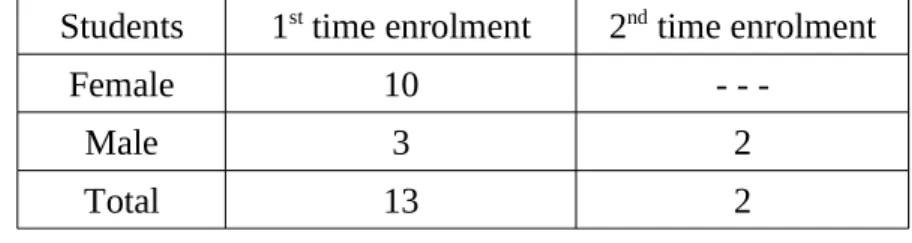
Engineering was used. This group consisted of 15 students distributed according to the following table:
Students 1st time enrolment 2nd time enrolment
Female 10
-Male 3 2
Total 13 2
Table 1 - Study group distribution.
The students had a homogeneous distribution, with an 87% 1st time enrolment rate. As they were
all 2nd year students, they were well acquainted which led to a better work relation both inside
and outside the formed teams. Groups were organized by the students under the guideline of a maximum of two. The goal was to maximize productivity but also to hold the students accountable for their choices.
The project themes were randomly sorted from a previously given list.
Different themes and groups resulted in a variety of different approaches led by different group methodologies. This process was weekly supervised.
1.2 Interdisciplinary Assignment
In order to fulfil the assignment students had to analyse a biomedical device; each team had a different biomedical device. The biomedical devices to be studied were:
• Responsive drug delivery system;
• Pacemaker;
• Artificial heart;
• Dialysis system;
• Neuromuscular functional simulation;
• Cardiopulmonary bypass;
• Biomedical micro-machines.
In this process, students were required to:
1. Separate the main components and their function in the device; 2. Comprehend device interactions both with host and environment;
3. Understand device’s biocompatibility problems, gaining knowledge of devices' pros and cons, in this particular area;
4. Improve the device and compare it with the original solution (no restrictions were made on this – the teams could minimize an existing problem or limitation, optimize the process or the use, find a way to reduce costs, etc).
It was made very clear to the groups that a critical, scientific, engineering analysis was expected of them. An adequate state of the art with a good theoretical background and a solid bibliography and reference articles (from reliable sources) was necessary and it would be reflected on their final grade.
Both Biomaterials and Electromagnetism courses had a percentage of their global evaluation resting on this interdisciplinary assignment but students were warned that this assignment was truly interdisciplinary and the areas of expertise ranged far from just these two areas. Groups were advised to work on the assignment overlooking that it was proposed by those two courses and search for the necessary information in all areas necessary to achieve the proposed objectives.
1.3 Learning outcomes
As it was already stressed, within three years, students have to be prepared to enter the market, therefore the educational system has to provide the students with more than just theoretical knowledge, especially in their area of expertise - Biomedical Engineering.
Nowadays, to form engineers it is necessary to move away from a conventional, pre-Bologna, teacher-oriented learning system where the learning outcomes were comprised mainly of theoretical knowledge. Now the learning outcomes have to ensure that more than just theoretical knowledge, the students have to learn how to search for knowledge (to know how to know) and most importantly the students need to know how to approach and solve real life problems and situations (to know how to do).
The assignment aimed at achieving these goals; more than just learning the theory, students acquired skills they can use throughout their working lives:
• to search for the necessary knowledge using reliable sources;
• to face a real life problem approach and critically analyse it, using both scientific knowledge
and common sense to propose an improvement to the original problem.
These assignment outcomes go further than science itself, students were expected to plan forward, improve their group skills, write a coherent report and do a short presentation, once all of these parameters were also to be evaluated.
1.4. Methodology
In order to achieve the goals a clear methodology was exposed to the students in the first lesson. Furthermore, this was given in writing and posted in the courses webpage (webcourse).
Goals, check points and strict deadlines were proposed as well as a detailed list of requirements to be fulfilled.
A review article was supplied to all groups, to work as “kick start” to their biomedical device and in two weeks time a “game plan” should be uploaded in the webcourse.
One week after the deadline for the “game plan” there was a first meeting with the groups, this was the first checkpoint. The agenda, for each group, was to discuss their specific device selection, their planning and their reference list.
Each group meeting was carefully planned by the teachers and a scheme of green, yellow and red cards was taken. After each meeting the groups were told about their situation, whether they were going on the right track (green), if there were still some faults they had to mend (yellow) or if their plan made no sense (red), in this latter case the groups were given an opportunity to redo their “game plan”.
This was a very important checkpoint because it helped groups stay focused without interfering with their independence. In fact, the whole idea of such an early check was that their track was only half drawn (let’s not forget that they were 2nd year students) and therefore on the meeting
only ideas were debated and some questions on the background of the idea were raised.
Checkpoints were set more or less regularly depending on the groups’ progress, always having in mind not to lead them but to actually make them think about the track they were following. Nevertheless, an “open door” policy was implemented, being this a student-based learning.
In order to facilitate the final report evaluation a master report form was given to the groups in order to insure that some of the requirements of the assignment were fulfilled. This report was to be uploaded in the webcourse.
The final checkpoint was the presentation. Groups had to present their work and should stress the following points: Device; Properties; Interactions; Comprehensive analysis; Improvements/solution.
3. RESULTS AND DISCUSSION
The results obtained were very positive; more than just achievement of good results, the students devoted the necessary time and energy on the assignment as they felt that the themes were adequate to the biomedical engineering area of expertise and that the learning experience was valuable and worth the effort. This was shown early on by their enthusiasm while researching information.
All groups uploaded and presented their assignment on schedule.
However, the students' enthusiasm didn't always resulted in good planning or even a good definition of what was important and what wasn't which was evident in their first checkpoint. The results for the first checkpoint were given in terms of a scheme of green, yellow and red cards defined above. These results are presented in the following chart (Figure 1).
Only one of the groups that received a red card shown an evidently lack of effort in producing their “game plan”, the other groups were overwhelmed by the amount of information that they found and had difficulties choosing a specific biomedical device and therefore weren't able to define an appropriate planning. These groups had another opportunity to redo their “game plan” and did so but were effectively behind in the timetable they had to fulfill all the requirements.
Figure 1 - First checkpoint grading.
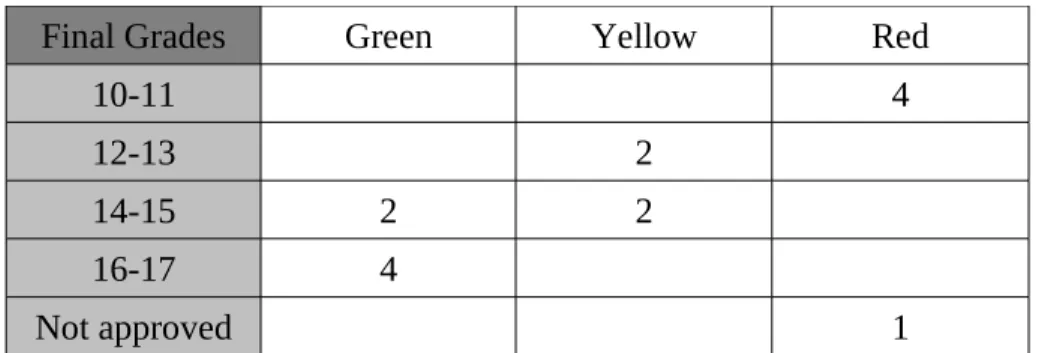
Groups that received a green card went on according to initial planning which produced better organized reports with more information relating to each subject. They were not necessarily the ones with better information, nevertheless had some of the best grades, as one would expect. The relation between the first checkpoint grading and the final grades is shown in Table 2.
Final Grades Green Yellow Red
10-11 4
12-13 2
14-15 2 2
16-17 4
Not approved 1
Table 2 - Final grades in terms of the first checkpoint grading.
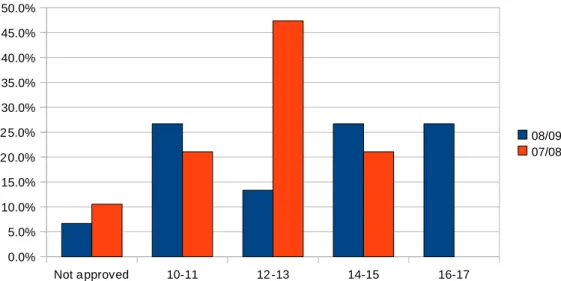
The results were very positive since only one student failed the assignment and clearly it was because of lack of interest (missing several checkpoints). Also, two of the lower grades resulted in bad planning (these two groups were behind after receiving a red card) and had they had an extended deadline they were sure to produce better results since they were on the right track. The global evaluation resulted in significantly better grades than the previous year (Figure 2). The main reason for this was a well organized planning by setting specific requirements and checkpoints in order to help the groups stay focus without reducing their autonomy. Also, the groups accepted the responsibilities they were given and responded with enthusiasm to the theme.
This was possible because of small number of students in the 2nd year of Biomedical Engineering
that allowed a group organization of no more than two elements but also a close coordination between the two courses' teachers.
Green Yellow Red
Figure 2 – Comparative final results.
4. CONCLUSIONS
To develop the necessary skills of a Biomedical Engineer is a difficult task to do in a 3 year degree, especially without compromising the extension of the course program. This is the Bologna's paradigm and in this article we proposed a student-based learning methodology that is project-based learning.
Results were very satisfying and although we cannot have any comparison with the pre-bologna evaluation, the evolution of the evaluation method is more than evident.
5. REFERENCES
Bergen Communique. “The European Higher Education Area: Achieving the Goals.” Communique of the Conference of European Ministers Responsible for Higher Education: The Bologna Process, Bergen, May 2005.
Bresciani, M. J. Outcomes-Based Academic and Co-curricular Program Review. Sterling, Va.: Stylus, 2006.
Hubball, H. T., and Burt, H. D. “An Integrated Approach to Developing and Implementing Learning-Centred Curricula.” International Journal for Academic Development, 2004, 9(1), 51–65.
Hubball, H. T., and Gold, N. “The Scholarship of Curriculum Practice and Undergraduate Program Reform: Theory Practice Integration.” In D. Cox and L. Richlin (eds.), New Directions for Teaching and Learning, no. 97. San Francisco: Jossey-Bass, 2007.
Not approved 10-11 12-13 14-15 16-17 0.0% 5.0% 10.0% 15.0% 20.0% 25.0% 30.0% 35.0% 40.0% 45.0% 50.0% 08/09 07/08