SMARTCATs STSM final report
Impact of the NO
xaddition on methane JSR oxidation, with different types of
diagnostic techniques (GC, CRDS, IRTF)
1. Details of the STSM
Reference number: ECOST-STSM-CM1404-38317
Applicant details
Lorena Marrodán
PhD student at University of Zaragoza. Department of Chemical and Environmental Engineering
Home institution
Aragón Institute of Engineering Research (I3A)
Edificio I+D+i, C/Mariano Esquillor s/n. 50018 Zaragoza, Spain
Host institution
Research group of Frédérique Battin-Leclerc
Laboratoire Réactions et Génie des Procédés, CNRS, Université de Lorraine 1, rue Grandville, BP 20451. 54001 Nancy Cedex, France
Working groups involved
WG2 Chemistry for control of by-products in Smart Energy Carrier conversion
WG1: Smart energy carriers gas phase chemistry: from experiments to kinetic models
Type and length of stay
STSM, from 11/09/2017 to 20/12/2017
2. Purpose of the STSM
The limited fossil fuel resource and its harmful effects on the climate have increased the interest for environmentally friendly fuels. Biomass looks like a promising fuel source due to its sustainability, security supply and low threat to the environment. Produced from the biomass anaerobic digestion procedure, the so-called “biogas”, consists mainly of methane and carbon dioxide with trace amounts of nitrogen and sulfur compounds. Biogas plays an important role as potential renewable gas-phase fuel. It can be used to the generation of electricity or heat and also as a fuel. The main nitrogen
compound present in biogas is ammonia, which could easily convert to NO with the presence of oxygen even at low temperatures.
In this context, the main objective of this research stay is to carry out a study of the effect of the NOx addition on the oxidation of methane, identifying and quantifying the species formed during the
oxidation in a jet-stirred reactor. The experimental data obtained will be used for the validation of a detailed kinetic-chemical mechanism that can be used as a prediction tool to evaluate the behavior of methane under conditions different from those tested in this study and, therefore, help in the decision of engine design.
3. Description of work carried out during the STSM and the main results obtained
During the STSM, the different oxidation experiments were carried out in a laboratory-scale spherical fused silica jet-stirred reactor, JSR (volume of 85 cm3).The reactant gases were premixed in a
preheating zone before entering the reactor center through four nozzles which create high turbulence resulting in homogeneity in composition and temperature of the gas phase. The residence time inside the preheater was quite short with respect to the one in the reactor which was fixed at 1.5 s within all the experiments investigated. Both the reactor and the preheater were heated using Thermocoax resistances. The reactor temperature was measured by a type-K thermocouple located at the center of the reactor. The pressure in the reactor was controlled by a needle valve positioned downstream of the reactor and kept at 107 kPa. Argon, oxygen, NO, NO2 and methane were provided by Messer
(purities of 99.99%, respectively). The flow rates of the reactants were controlled by mass flow controllers. The uncertainty in the flow rate measurements is 0.5%. The gases leaving the reactor were analyzed on-line using two gas chromatographs (GCs), a NOx analyzer (Thermo Scientific Model 42i), a
FTIR (Thermo Scientific Antaris) spectrometer and a cw-CRDS spectroscopy cell.
• The first GC equipped with a thermal conductivity detector was used to quantify O2. The
second GC equipped with flame-ionization detector preceded by a methanizer and a Plot-Q capillary column was used to quantify CH4, CO, CO2, C2H4, C2H6 and C2H2.
• The chemiluminescence NOx analyzer was adopted to measure NO and NO2. • The FTIR spectrometer was used to detect the CH3NO2 (if any) and HCN species.
• cw-CRDS infrared spectroscopy was used to detect H2O, CH2O and HONO (if any) species, the
detailed description of this instrument is provided in [1].
Experiments for the oxidation of methane, and methane doped with NO and NO2 were performed
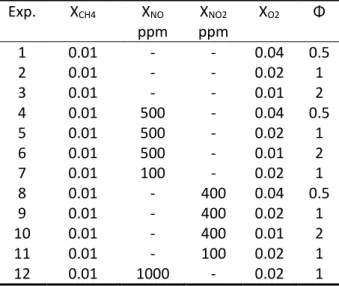
for different equivalence ratios, from fuel-lean (φ=0.5) to fuel-rich (φ=2) conditions over the 650-1200 K temperature range. The experimental conditions investigated in this study are presented in Table 1.
Numerical calculations were conducted with CHEMKIN-PRO software package [2]. Transient solver was applied in the simulation tasks with sufficient time allowed to reach the steady state solution. A detailed kinetic mechanism, derived from POLIMI kinetic framework, was used to interpret the experimental data.
Table 1. Experimental conditions (inlet compositionvolume basis; balanced Ar). Exp. XCH4 XNO ppm XNO2 ppm XO2 Φ 1 0.01 - - 0.04 0.5 2 0.01 - - 0.02 1 3 0.01 - - 0.01 2 4 0.01 500 - 0.04 0.5 5 0.01 500 - 0.02 1 6 0.01 500 - 0.01 2 7 0.01 100 - 0.02 1 8 0.01 - 400 0.04 0.5 9 0.01 - 400 0.02 1 10 0.01 - 400 0.01 2 11 0.01 - 100 0.02 1 12 0.01 1000 - 0.02 1
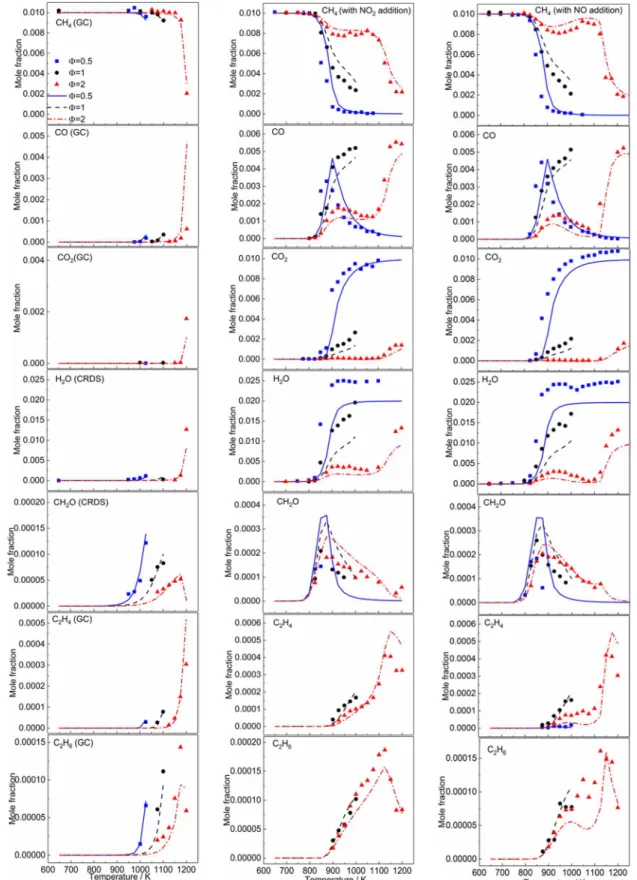
Figure 1 shows the evolution of major carbon compound species and water for the oxidation of methane (left), methane doped with NO (middle) and NO (right) for the three studied equivalence ratios (φ=0.5, 1 and 2). Dynamic behaviors (oscillations) occur under oxidizing and stoichiometric conditions when the temperature is above 1050 K and 1100 K, respectively. This is, too, an interesting topic of research in such systems, but beyond the goals of this specific study.
In general, there is a good agreement between experimental results and modeling calculations. In particular, the addition of NO2 or NO produces comparable results on the methane oxidation,
anticipating the onset temperature for CH4 consumption to lower temperatures (825 K) regardless of
Figure 1. Species profiles comparison between experimental data and model predictions. The left column is for the oxidation of neat methane; the middle column is for the oxidation of methane doped with NO2 (400 ppm); the right column is for the
oxidation of methane doped with NO (500 ppm). From now on, symbols represent experiments and lines denote simulations. Experiments and simulations are not presented for conditions where oscillations were observed.
In order to evaluate the effect of the amount of added NO2 and NO on the methane oxidation,
three more sets of experiments with addition of 100 ppm NO2 or NO and addition of 1000 ppm NO
(sets 7,11 and 12 in Table 1), respectively, were conducted. The experimental results are shown in Figure 2. It was found that the onset temperature for methane oxidation is independent of the added amount of NO2 and NO. Moreover, with the lower added amount of NO2 or NO, the methane
conversion is slower. With 1000 ppm of added NO, methane conversion shows a trend similar to that with 500 ppm NO addition.
Figure 2. Mole fractions of methane for different amount of NO2 and NO.
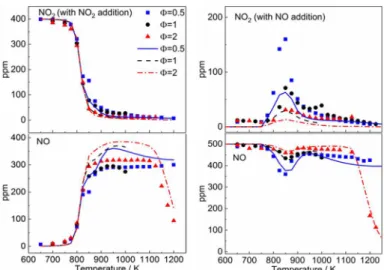
Figure 3 shows the evolution of NO2 and NO profiles as a function of temperature for methane
oxidation in presence of NO2 (left) and NO (right), respectively. When NO2 is added to the reactant
mixture it converts to NO. The increase of the NO mole fraction is quite sharp over the range 800-900 K, and is independent of equivalence ratio. After that, it attains a “plateau”. Only under rich conditions the NO concentration drops from 300 to 100 ppm when the temperature increases from 1100 K to 1200 K, temperatures at which HCN has been detected by FTIR.
Figure 3. Experimental and modeling profiles for NO2 and NO during the oxidation of methane in presence of 400 ppm NO2
(left) and in presence of 500 ppm NO (right).
In the presence of NO (500 ppm), the mole fraction of NO2 peaks at 850 K, which corresponds to
temperature is above 850 K, meanwhile, the mole fraction of NO increases to a stable value until the temperature is beyond 900 K.
ADDITIONAL WORK: study of the effect of NOx addition in the oxidation of n-pentane
As the main purpose of the STSM was successfully completed, we started a new project but related to the previous one: the experimental jet-stirred oxidation of fuel components doped with NOx. In this
case the fuel component selected was n-pentane because it is a component of gas-turbine and gasoline engine fuel blends and it is an intermediate species in the oxidation of higher hydrocarbons.
The experimental procedure is similar to that previously described in the case of methane. In this case, the residence time was kept constant at value of 2 s, the mole fraction of the fuel was 0.01 and only one equivalence ratio was analyzed φ=1. Different amounts of NO were added to the reactant mixture, 1000 ppm and 500 ppm, and in the case of NO2, only 400 ppm.
Figure 4 shows the results obtained during the oxidation of n-pentane without NO and with different amounts of NO and stoichiometric conditions. In the low temperature range it can be observed the characteristic NTC region of n-pentane. However, when NO is added to the mixture, independently of the amount, the conversion of n-pentane shifts to higher temperatures, and this characteristic region almost disappears in the case of 1000 ppm of NO, and shyly appears but at higher temperatures in the case of 500 ppm of NO. As can be observed, NO inhibits the conversion of n-pentane. 500 600 700 800 900 1000 1100 0.000 0.002 0.004 0.006 0.008 0.010 0.012 φ=1 without NO 1000 ppm NO n -p e n ta n e ( m o le f ra c ti o n ) Temperature (K) 500 600 700 800 900 1000 1100 0.000 0.002 0.004 0.006 0.008 0.010 0.012 φ=1 without NO 500 ppm NO n -p e n ta n e ( m o le f ra c ti o n ) Temperature (K)
Figure 4. Mole fraction of n-pentane obtained experimentally during its oxidation without NO (opened symbols) and with NO (filled symbols), for 1000 ppm of NO (left) and 500 ppm of NO (right) and stoichiometric conditions. In the case of the addition of NO2 (Figure 5), the trend in the n-pentane consumption is almost the
same that in the absence of NO2 at low temperatures, and the NTC region can also be observed, but
as the temperature is increased, above 750 K, the n-pentane consumption seems to be promoted by the presence of NO2.
500 600 700 800 900 1000 1100 0.000 0.002 0.004 0.006 0.008 0.010 0.012 φ=1 without NO 400 ppm NO2 n -p e n ta n e ( m o le f ra c ti o n ) Temperature (K)
Figure 5. Mole fraction of n-pentane obtained experimentally during its oxidation without NOx (opened symbols) and
with 400 ppm of NO2 (filled symbols) and stoichiometric conditions.
4. How the STSM has contributed to the action’s aim
In relation to the SMARTCATs COST Action (CM1404), this STSM represents a collaboration between two different Working Group, WG1: Smart energy carriers gas phase chemistry: from experiments to kinetic models, and WG2: Chemistry for control of by-products in Smart Energy Carriers conversion. Moreover, the core of the Action is to improve the understanding of combustion kinetics and by-products formation, so the work carried out during this STSM with the study of the oxidation of methane and n-pentane, two fuel components, and the knowledge of the impact of NOx addition
will contribute to define the strategies for a cleaner operation mode in engines and minimize their pollutant emissions, which clearly contributes to the Action’s objectives.
5. Future collaboration
This research collaboration has been a good opportunity to obtain interesting advances and results concerning the effect of NOx addition on the oxidation of methane and n-pentane. Our intention is to
continue and deeply analyze the inhibiting or promoting effect of NOx in the oxidation of n-pentane,
not only from an experimental point of view, also with the validation of a kinetic mechanism able to describe the trends experimentally observed.
At this point I would like to thank the host institution (research group of Frédérique Battin-Leclerc) for giving me the opportunity of working with them and for all the support during my stay in Nancy.
6. Foreseen publications/articles resulting from the STSM
The main results obtained from the study of the impact of NOx addition on methane oxidation have
been submitted to be considered in the 37th International Symposium on Combustion, which will be
7. Acknowledgements
The authors acknowledge COST Action CM1404 (EU) for financial support. Ms. Marrodán acknowledges Aragon Government for the predoctoral grant awarded.
8. References
[1] C. Bahrini, O. Herbinet, P.-A. Glaude, C. Schoemaecker, C. Fittschen, F. Battin-Leclerc, Chem.
Phys. Lett., 534 (2012) 1-7.