Service Definition Document for
Cloud Application Development Services
Table of Contents
1. Overview ... 3
2. Service Details ... 3
3. Service Benefits ... 5
1.
Overview
Cloud Computing allows development without investing in new infrastructure or licensing new software and as a pay-per-use service. Developing software can be a complex and challenging experience based on cloud computing delivery model.
The custom software development leveraging cloud computing services can have a significant positive impact on business. In order to realize this gain, the cloud based software development process has to be approached in a disciplined and organized way.
2.
Service Details
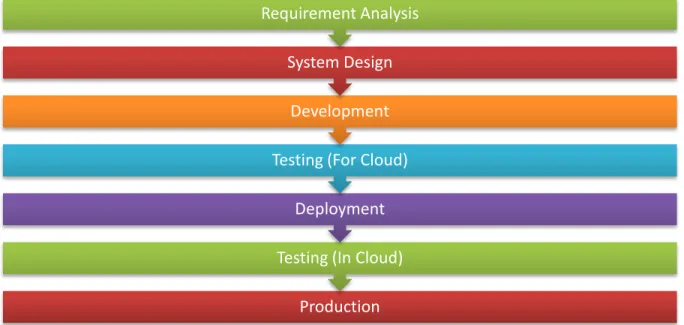
Zensar’s Cloud based Application Development based approach addresses Software Development as illustrated below:
Figure 1 – Service Details Requirement Analysis
In this process the study and analysis of the existing applications / processes is carried out to understand the business need. In case of fresh application development interviews, discussions and meetings are helpful to understand business functionality.
In this phase customer business and application is analyzed with respect to cloud background and provides input on approach for cloud readiness:
Identify appropriate cloud services for application development Cloud specific requirement for business and application
Addressing cloud specific application risks, issues and constraints
Production
Testing (In Cloud)
Deployment
Testing (For Cloud)
Development
System Design
Requirement Analysis
Application assessment using PoC to do feasibility study
System Design
System Design focuses on architectural design (what modules are needed and how are they going to interact), low-level design (how the individual programs are going to work) and user interface design (what are the user interfaces going to look like). During this phase, software's overall structure is defined.
Key Objectives of System Design: Prepare
Architectural design (Including cloud aspects such as: scalability, security, Storage, Integration, session, DR and Failover etc.)
Functional design document Technical design document Screen Layouts Finalization
Development & Testing (For Cloud)
During this stage, the application code will be developed based on the deployment architecture selected. The code developed will ensure a flexible and scalable application. Developers will perform testing (For Cloud) locally on simulated environment before the software is ready for deployment. The major tasks involved in this phase are:
Coding as per the design and coding standards.
Test and capture the observed behaviour of the system developed for cloud environment Deployment & Testing (In Cloud)
Once the system is ready it can be deployed on Cloud – Staging environment and Testing (In Cloud) is performed to check if the system maps with the base requirements, business rules, performs in the optimum manner and meets all such areas that formed the purpose for the system development. UAT would be performed by the business users who are the end users of the system, QA specialists at customer level and the business group that initiated the project requirement if applicable.
The major tasks involved in this phase are:
Deployment – Staging environment and Testing (In Cloud) Perform the User Acceptance Testing (UAT)
Fixing the bugs Record the results Production & Warranty
After the confirmation and receiving satisfactory feedback from testing group, software moved from staging to production environment. Many cloud vendors provides staging environment for the temporary deployment and with one click it can be moved to production environment.
Post implementation support and monitoring (i.e. Warranty support) starts when the deployment phase is over. Deployment consists of all of the activities that make a software system available for business use and is currently out of scope of the work.
The major tasks involved in this phase are: Post-production support and monitoring Lessons Learnt
3.
Service Benefits
Efficient Cloud Development lifecycle
Use of RAD (Rapid Application Development) Tool for generating .NET and JAVA code Use of Guidelines and Checklists
Use of White Papers and Best Practices
Cloud-centric architecture design (Extensive use of cloud architecture patterns) Faster time to market due to use of Reusable components and Solution accelerators Ready Infrastructure (Cloud CoE Lab) and Cloud Platforms
Annexure
Information Assurance
Not Applicable
Disaster Recovery
Not Applicable as supplied by Platform
On-Boarding and Off Boarding Processes/Scope
Not Applicable
Pricing
Refer to the Rate Card for Pricing Document
Service Management Details
Not Applicable
Service Constraints
None
Service Levels
None
Financial Recompense Model for not meeting Service Levels
Please refer to the Terms and Conditions document
Training
o For Solution / Application developed (All trainings will be provided on “Train-the-trainer” basis)
Ordering and Invoicing Process
Please refer to the Terms and Conditions document
Termination Terms
Data Restoration / Service Migration
Not Applicable
Consumer Responsibilities
Not Applicable
Technical Requirements
Not Applicable