276
ESTABLISHING OF OBJECTIVES IN THE PROCESS OF THE MAIN
AGRICULTURAL WORKS
PANDIA OLIMPIA1), SĂRĂCIN ION.2), OLARU LIVIU2)
1)
University of Agronomic Sciences and Veterinary Medicine, Bucharest, Faculty of Management, Economic Engineering in Agriculture and Rural Development, 59 Marasti Blvd, District 1, Bucharest, Romania. E-mail: [email protected]
2)
University of Craiova, Faculty of Agriculture, 13 A.I.Cuza St., Craiova, Dolj, Romania. E-mail: [email protected]; [email protected]
Keywords: phytotechnical conditions, conventional agriculture, precision agriculturemin
ABSTRACT
In this article there are presented few of the objectives which are required in the management of the works for agricultural cultures foundation like: the execution of agricultural works with superior qualitative indices; the execution of agricultural works respecting the protection and conservation of soil, respectively the seizure of the carbon in soil; the assurance of vegetative place of plants; the realization of agricultural works in optimal time with minimum costs.
Are presented the agricultural used aggregate and the mandatory adjustments imposed by those. It is make a comparative analysis of qualitative indices of agricultural works conducted in conventional system and conservative system and an economic analysis of the costs with the works for of agricultural cultures in these two systems. Are elaborated a series of conclusions and recommendations.
INTRODUCTION
The agro-production process consists of a series of components of the technique with which the cultivator acts on the soil and the plant to form the crop. [1]
These elements are grouped into
methods, works, and processes,
depending on the soil, the species and the vegetation. They can be of a general character, with mandatory application to all agricultural crops, or a particular character with application for certain crops or applied only to plants. [2]
The modernization in agricultural
production aims at expanding and diver- sifying the mechanization of agricultural works, as it ensures the increase of the labor productivity, the achievement of the good quality works at the optimum terms, which leads to the increase of
the harvest and the decrease of the costs over time.
Machines must be as universal as possible, easy to handle, with allow weight, with removable active organs, which allows a reduction in specific investment, metal and fuel consumption. At the same time, their exploitation will be more economical and efficient, and lower fuel consumption, by categories of works. [8]
1. What you need to know when you start a technology:
1.1. What you want to do, culture, set-up period, vegetation period, phytotechnical conditions, etc.
1.2. What farming system do you want to practice:
Conventional agriculture, intensively mechanized, with competitive products,
277
concentration and specialization of
production.
Extensive agriculture with low input: subsistence, with poorly competitive production. Organic or organic farming – intensive and less aggressive en relation to environmental factors, with less competitive agricultural products in the short term, but which are considered superior in terms of quality. Organic agriculture - the exclusive use of organic fertilizers in relatively high doses. Conservative agriculture consists of
applying modern agricultural
technologies to increase production. Precision agriculture: the most advanced form of agriculture, which is practiced on narrower surfaces, based on the most modern methods of controlling the quality of different environmental resources, the optimal application of all technological
components. Sustainable (integrated)
agriculture - intensive production of competitive products with harmonious, environmentally friendly relations.
1.3. You choose the technology but keep in mind: the climate, the soil and
the money "Technology is imposed by
the climate, the type of soil and the money you have," says Viorel Matei, one of the farmers with experience in agriculture, which exploits over 3,000 hectares in Banat. [7]
"For now, I opt to work interleaved, that is, where scarification is going to happen, in the next year to make a cut. But not in exceptional situations, when the terrain is very difficult; of course, then it is necessary to enter again with the scarifier. [6]
The farmer knows that technologies have changed lately and many farmers prefer not to show up. "I work on two fronts, where the land is beaten come with a scarification work at a depth of 40-60 cm, after which I compulsively cut. Not only does it give the crop plant the opportunity to grow normally but incorporates into the soil and vegetal remains, which are major nitrogen deposit. Prof. Vasile Popescu, in a specialized publication, points out that
after the summer plow the land is very well prepared, the water is stored in the soil until the autumn and there is provided about 100 kg of nitrogen in the soil by incorporating the vegetal remains „in a non-precipitated area, a minimum system of soil works is required.
At the seed incorporation level, a starter dose of nitrogen and phosphorus is added, which represents 20% of the fertilizer standard administered for each culture set up. [4] Experience has led to significant savings in terms of costs per hectare, meaning that less fuel is used as well as moderate fertilizer doses, about 200 kg of NPK active substance. It is advisable that the minimum system of work should be applied only in the spring.
MATERIAL AND METHOD
It is based on studies and researches made by specialists in the field of sustainable agriculture.
Sustainable agriculture is a long- term
and long-term action aimed at
overcoming the problems and constraints of conventional agriculture currently practiced by most farmers.
(I)Tillage systems
The system with no loosening,
synonymous with: direct sowing,
sowing in the slit, chemicalsystem, mulch
system, stubble system, ecological
system, no till. [1]
This system is based on the introduction of seed directly into the stalk of the pre-culture without performing any previous soil loosening work, except for the simultaneous sowing of a very narrow strip of sowing only a few centimetres to allow seed to be introduced into the soil. Control of weeds, including weeding plants, is carried aut only by chemical me
thods with the help of biological
herbicides if possible. [5]
278 mobilization of the soil in strips or strips with a width of 5 to 20 cm, intended only for sowing, between these bands
the soil remaining completely
undisturbed, uncorked and covered with vegetal remains so that the surface of the soil after sowing to remain covered over 30%. Compared to the previous work, which referred to direct sowing, by stripping, the soil is disturbed to a greater extent, the degree of coverage of the vegetal remains is lower, but the risk of soil degradation in the long run is higher. [3]
Fig.1. Execution of the soil loosening work in strips. Source: authors.
Vertical lying work consists in loosening and mobilizing the soil on a depth of 20-30 cm, or even deeper, without turning the furrow. The soil surface remains covered after sowing vegetal remains in a convenient proportion (over 30%). At the same time, soil compaction is shorter in the short term.
Fig.2. Execution of scarifying and rolling work. Source: authors.
The bobbling is a technological plant
cultivation that allows for the
development of balls or "elevated areas"
used as germinating beds where the seed is to be introduced, alternatively with lower areas that can be used as watering pads or areas for the movement of agricultural machinery for other works. Scarification or deep loosening of the
soil Deep churning, without turning the
furrow, is one of the works that influences the condition of crops when climate conditions are not entirely favourable. This is done to break the waterproof layer of the soil and to allow infiltration of water and air from the upper layers.
Fig.3. Execution of the deep licking work. Source: authors.
The work is done in the summer months,
July - August, or autumn after
harvesting crops. The minimum depth cannot be less than 40 cm and the maximum depth can be up to 80 - 90 cm, in this case it is a soil drainage that is not recommended to be done annually. (II)Cut costs by optimizing engine speed
The method is based on analysis of the traction diagram of the aggregate used for the execution of agricultural works, for both soil cultivation systems. Plowing is the agricultural work that consumes about 30% of the amount of
diesel allocated to all mechanized
agricultural work as a result of high
specific consumption, which has
negative economic repercussions.
279
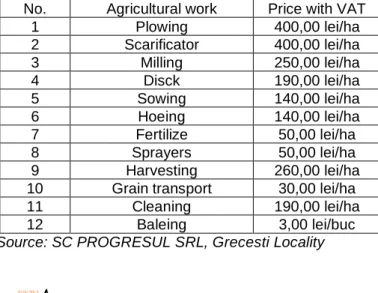
Table 1.
The tariffs applied to the farm works for the provision of services with equipment for the year 2017/2018 la SC PROGRESUL SRL, GRECESTI
No. Agricultural work Price with VAT
1 Plowing 400,00 lei/ha
2 Scarificator 400,00 lei/ha
3 Milling 250,00 lei/ha
4 Disck 190,00 lei/ha
5 Sowing 140,00 lei/ha
6 Hoeing 140,00 lei/ha
7 Fertilize 50,00 lei/ha
8 Sprayers 50,00 lei/ha
9 Harvesting 260,00 lei/ha
10 Grain transport 30,00 lei/ha
11 Cleaning 190,00 lei/ha
12 Baleing 3,00 lei/buc
Source: SC PROGRESUL SRL, Grecesti Locality
Fig. 4. External feature of the thermal engine. Source: authors.
RESULTS AND DISCUSSIONS
Air and water are the factors that, along with the nutrients obtained from
biochemical processes in the soil,
conditioned by these factors, provide the favorable environment for plant growth and development.
Table 2. Porosity and apparent density of soil according to the work performed
Agricultural work Porosity
( %)
Apparent density (g/cm3)
Aeration Total
Plowing at 28 cm 24.3 35.7 0.91
Loosening 26.0 34 0.87
Deep hatch 28.7 31.3 0.81
Vertical milling 31.1 28.9 O.78
Source: http://www.fao.org/nr/land/sustainable-and-management/en/
Generally, a middle soil consists of 50% solids and 50% open spaces, occupying 25% with air and 25% with
280 Depending on the type of soil and how it is worked, the volume of the soil can vary very much. So, when talking about
soil porosity, we have in mind these spaces that keep the volume of water and air in the soil steady.
CONCLUSIONS
Total soil porosity can be 48-60%, of which capillary porosity 30-36% and non-capillary porosity (aeration) 18-24%. Aeration porosity is considered deficient when it is 6-10%, moderate 11-22% and good when it represents 23-30% of the soil compartments.
It is practically considered a favorable situation for crop plants when the soil pores are occupied 2/3 with water and 1/3 with air. The root system develops well at 1.07-1.45 g / cm3 Da and the soil nitrification process at Da of 1.11-1.15 g / cm3.
Radical changes in soil porosity occur after plowing. Thus, prior to cutting, the capillary porosity was 26.1%, and the pore size was 12.3%, while the non-capillary porosity 11.2, and after 42.5% the pore.
BIBLIOGRAPHY
1. Bonciu, E., 2017 - Food processing, a necessity for the modern world in the context of food safety: a Review. Annals of the University of Craiova - Agriculture,
Montanology, Cadastre Series, Vol.
47(1), pp. 391-398.
2. Bonciu E., 2016 - Basic raw materials used in processing of the snack food (ecological/non ecological) and their expanding capacity. Annals of the University of Craiova - Agriculture,
Montanology, Cadastre Series, Vol.
46(1), pp. 42-47.
3. Borza, M., 2008 - Difficulties in
Achieving Sustainable Agriculture in Romania, Scientific Papers Magazine,
vol. (51) 218-221, ISSN 1454-7414.
4. Frăţilă,R., 2008 - Comparative
agricultural technologies (course support), pp. 51-52
5. Hera, C.,1999-Sustainable Agriculture - Performance, Agris Publishing House, pp. 51-61.
6. Oancea, J., 2005-Advanced
Agricultural Technologies, Ceres Publishing House, Bucharest, pp. 93-101.
7. Radulescu, V.C., 2003 -
Sustainable Develoment and Economic and Financial Implications of Organic Farming Organization, ASE, Bucharest, pp. 8-9; 26-27.
8. Sin, Ghe., 2004 - Technological Management of Field Cultures, Ceres Publishing House, Bucharest, pp. 406-436.
9. Sustainable Land Management,
http://www.fao.org/nr/land/sustainable-and- management/en/, Accessed
February 20, 2018. 10.