98
THE INFLUENCE OF THE BERRY SIZE ON THE SKIN ANTHOCYANINS
CONTENT OF SOME BLACK WINE VARIETIES
MATIJAŠEVIĆ S. 1A,POPOVIĆ T.3, GLIŠIĆ M.1, ISAJLOVIĆ S.1, RANKOVIĆ-VASIĆ Z. 1, PRŽIĆ Z.1, NIKOLIĆ D.1, ĆIRKOVIĆ D. 2
1Belgrade University, Faculty of Agriculture, Department for horticulture, Belgrade, Serbia; 1a coresponding author e-mail: [email protected] 2Collage Of Agriculture and Food technology, Prokuplje, Serbia; 3University of Montenegro, Faculty of Biotechnology, Podgorica, Montenegro;
ABSTRACT
The influence of the berry size on the skin anthocyanins content of the black wine grape varieties Cabernet sauvignon (clone 169), Merlot (clone 348) and Pinot noir (clone 115) was studied. Research was conducted in vineyard of Experimental estate “Radmilovac” and in the laboratory of Faculty of Agriculture, University of Belgrade. The aim of the research was the determination of an anthocyanin of malvidin-3-glucoside on the berry skin. For all three varieties, berries were separated into three categories: small, medium and large. Based on the results, the goal was to compare the berry skin anthocyanin content of different sizes of berries. Determination of fertility coefficients, yield indicators, analysis of the composition and structure of clusters and berries and the content of sugars and total acids were performed regularly. The obtained results on the content anthocyanin of malvidin-3-glucoside were expressed in mg/g skin fresh weight. Varieties Cabernet sauvignon and Pinot noir had an expected result, meaning that the highest anthocyanin content was recorded in the smallest berries (diameter < 7.5 mm). For the Merlot variety, the highest anthocyanin content was observed in the medium berries (diameter 7.6 – 10 mm). The lowest anthocyanin content in varieties Cabernet sauvignon and Merlot was obtained in the largest berries (diameter > 10.1 mm), which was the expected result, while in the Pinot noir variety the lowest anthocyanin content was registered in the medium category (diameter 7.6 – 10 mm). Variety Cabernet sauvignon (clone 169) showed the highest anthocyanins content (average 6.871 mg/g fresh skin weigh), followed by Merlot variety, clone 348 (average 4.61 mg/g fresh skin weigh), whereas the lowest anthocyanin content was observed in Pinot noir, clone 115 (average 4.05 mg/g fresh skin weigh).
Keywords: variety, clone, berry, berry skin, anthocyanins.
INTRODUCTION
Irrespective of cultivar
characteristics, total polyphenols and their qualitative profiles are influenced by interactions of environmental factors and cultivation techniques, such as irrigation, pruning, canopy management, row orientation, etc. (Poni et al., 2006;Chorti et
99 contents of components determining must quality (Roby and Matthews, 2004; Santesteban and Royo, 2006). However, according to Roby et al., (2004), the berry content of all solutes increased approximately in proportion to the increase in berry size, and other researchers have reported that other factors besides the size of the berry, such as temperature, cultivation techniques, rainfall, etc., are involved in grape composition (Walker et al. (2005) and Matthews & Nuzzo (2007) concluded that the resultant winemaking traits of large or small berries depend more on the factor modifying the weight of the berry (variety, water deficit, etc.) than on the size itself.
Variety is one of the major factors determining the difference in size and composition of the berry as a result of specific genetic characteristics associated with growth and the relative proportion of the components (flesh, seeds and skin) and their relationships (Nicolas et al., 2013) Genetics determines composition and has an influence on the ability of the variety to accumulate compounds, on the way in which photosynthetic products are distributed within the plant and on their influence on secondary metabolism (Sadras et al., 2008) Weight and number of seeds have a direct impact on total berry weight due to the hormonal regulation exerted by the seeds on cell proliferation and expansion (Ristic and Iland, 2005). The relationships between the various components provide information on the oenological potential of the wine grape (Attia et al., 2010; Chaves et al.,2007; Barbagallo et al., 2011).
MATERIALS AND METHODS
The study was imposed during 2017 at the Experimental estate “Radmilovac” Faculty of Agriculture, University of
Belgrade, Serbia. The experiment was established in experimental vineyard located in Belgrade vineyard region (44o
45´ 24,66´´ N, 20o 34´ 54,50´´ E, altitude
153 m). Three black wine grape varieties: Cabernet sauvignon (clone 169), Merlot (clone 348) and Pinot noir (clone 115) was studied. In all cases the rootstock was Kober 5BB. The vines were spacing 3m x 1m, with rows oriented N-S, a canopy height of 0.9 m, and spur (leaving two buds) and canes (leaving 10 buds) pruned, and durig the resaerch, were applied standard cultivation techniques. The experiment was laid out with 9 plants of each variety. Yield was determined at harvest.Total yield per vine and the number of clusters per vine was recorded. Yield was expressed in kg/vine.
The composition and structure of clasters and berries were done using a method described by Žunić and Garić (2010). Three samples (replicates) of 5 bunches were randomly collected and analized from each variety.
100 New samples for average 50 berry skins were created: skins were removed from frozen beeries. first making a small cut to the skin with a scalpel, then carefully peeling it from the berry. Skin was immersed in liquid nitrogen prior to grind to a fine powder using a ceramic vessel. 1 g homogenized berry skin powder was taken and moved into penicillin bottle and extracted with 10 mL of ethanol solution. Bottles were closed with rubber stopper and left for one hour with shaking every 10 minutes. After extraction period, extract was decanted to separate from precipitate and keeped in the fridge. 200μl of extracted sampe used and added 3,8ml 1 mol HCl. Tubes left on dark place for minimum 3h (not longer than 24h). After that, samples was analyzed. Total skin anthocyanins were determined by spectrophotometry and absorbance read at 540 nm. From these values, total anthocyanins content was calculated using the formula:
AC
AC – anthocianin content
A520 – spectrophotometric values at absorbance at 540 nm
DF – dilution factor (at 1 mol HCl):20 10,5 ml - standard volume of extract
500 – apsorption of 1% solution malvidine-3-glucoside
homogenate mass: 0,95-1,05g
RESULTS AND DISCUSION Yield parameters
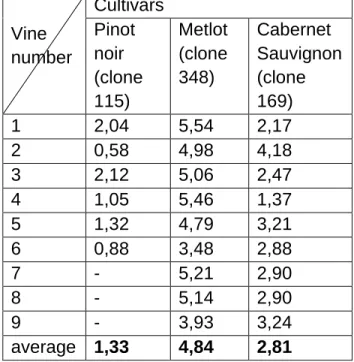
Merlot variety had the highest yield and average yield per vine was 4,84 kg.
Yield was varied from 3,48 to 5,54kg/ vine. Average yield per vine of variety Cabernet sauvignon was varied from 1,37 to 4,18kg, average 2,81kg/vine. The lower yield was obteined at cv. Pinot noir. Average yield was 1,33 kg/vine, and varied from 0,58 do 2,12 kg/vine. Ranković-Vasić (2013) reported that aveage yield of cv. Pinot noir was 1,61-1,79 kg/vine. In this study, average yield was lower (1,33kg/vne).
Table 1. Yield of grapes per plants (kg)
Cv. Merlot (Clone 348) had significantly higher yied conpareing with others cultivars. Our result show that achieved yield per vine cv.Cabernet sauvignon was 2,81kg and this walue is higher than results reported by authors Vukosavljević and Garić (2015)–1,885 kg/vine and Pržić (2014) (1,89kg) and significantly higher than Paprić et al. (2008).
Bunch and berry structure
Vine number
Cultivars Pinot noir (clone 115)
Metlot (clone 348)
Cabernet Sauvignon (clone 169)
1 2,04 5,54 2,17
2 0,58 4,98 4,18
3 2,12 5,06 2,47
4 1,05 5,46 1,37
5 1,32 4,79 3,21
6 0,88 3,48 2,88
7 - 5,21 2,90
8 - 5,14 2,90
9 - 3,93 3,24
101 Variety Pinot noir was characterized by the smallest bunch size paremeters. Average bunch mass was 84g. % of bunch stem was 4,33%, and % of berries 95,65% (5,42 % of skin, 2,68% of seeds and 87,56 % of pulp. Bunch length varied from 6,6 to
12.9 cm (average 9,05 cm); width varied from 5,5 to 12,5 cm (average 8,13 cm); weight varied from 58 to 175 g (average 116,8 g).
Bunch and berry structure
Table 2.
Parameter Cultivar
Pinot noir Merlot Cabernet
sauvignon
Bunch composition
Bunch mass (g) 116,8 221 190
Bunch length (cm) 9,05 17,15 16,07
Bunch width (cm) 8,13 11,03 9,8
Number of berries per bunch 113,66 198,93 149,06
Total weight of beeries in bunch (g)
111,26 213,46 182,73
Weight of rachis (g) 5,53 7,53 7,26
Berry composition
Mass of 100 berries (g) 90,66 103,66 122,66
Skin weight of 100 berries (g) 4,07 4,51 7,29
Seed weight of 100 berries (g) 5,003 3,87 3,89
Seed number of 100 berries 197 145,66 141
Weight od 100 seeds (g) 2,53 2,69 2,78
Weight of one berry (g) 0,906 1,03 1,22
Skin weight of one berry (g) 0,04 0,044 0,072
Seed weight of one berry (g) 0,049 0,038 0,038
Seed number of one berry 1,97 1,45 1,41
Weight od one seed (g) 0,025 0,026 0,027
Pulp mass of 100 berries (g) 81,59 95,27 111,47
Skin mass of bunch (g) 4,61 8,99 10,83
Seed mass of bunch (g) 5,73 7,71 5,76
Pulp mass of bunch (g) 100,91 196,76 166,14
Seed number of bunch 225,96 289,85 209,46
Average berry length (mm) 11,78 10,31 9,98
102
Bunch structure
% of bunch stem 4,74 3,42 3,81
% of berry 95,25 96,57 96,17
% of berry skin 3,94 4,06 5,71
% of seed 4,92 3,49 3,03
% of pulp 86,37 89,003 87,42
Berry structure
% of skin 4,51 4,35 5,94
% of seed 5,51 3,74 3,16
% od pulp 89,96 91,89 90,87
Average weight of bunch stem (rachis) was 5,53 g, and average weight all berries per bunch was 111,26 g. Number of berries per bunch varied from 47 to 197 berries. Compared to other observed varieties, Pinot noir had the highest values of berry diameter (11,78 mm length and 10,28 mm width). Skin weight was 4,07 g, seed weight was 5,003g, and berry pulp weight was 81,59g. Bunch structure is expressed in percentages of bunch stem (rachis) and berries in a bunch. Variety Pinot noir had 4,74% of bunch stem, 95,25% of berries in a bunch and 3,94% of berry skin. The lowest % of pulp in bunch was recorded in variety Pinot Noir (86,37%), but this variety characterized by highest % of seeds (4,92%). Berry structural composition expressed in percentages of berry skin, berry pulp and seeds and variety Pinot noir had the following valuess: 4,51% of berry skin; 5,51% seeds and 89,96% berry pulp respectively. Vlaue of % of bunch stem was higher and value of %of berries was lower than results reported by Rankovic-Vasic (2013).
103 than it reported by Pajovic et al. (2009), while all other parameters were lower.
Variety Cabernet sauvignon: bunch length varied from 11,4 to 20,3 cm (average 16,07 cm), width varied from 5,9 to 14,8 cm (average 9,8 cm), weight varied from 135 to 262 g (average 190 g). Average weight of bunch stem (rachis) was 7,26 g, and average weight all berries per bunch was 182,73 g. Number of berries per bunch varied from 47 to 197 berries (average 149,06 berries). Skin weight was 4,07 g, seed weight was 5,003g, and berry pulp weight was 81,59g. Compared to other observed varieties, Cabernet sauvignon was characterized by the highest berry weight (1,22 g) and skin weight (7,29 g), but smallest berry diameter (9,98 x 9,85 mm). Bunch structure: 3,81%. of bunch stem; 96,17% of berries in a bunch; 5,71% of berry skin; 3,03% of seed and 87,42% of pulp in bunch was recorded in variety Cabernet sauvignon. Compared to other observed varieties, Cabernet sauvignon had the highest % of berry skin (5,94%). This parameter had positive impact on high anthocyanin content, and our result confirm that. Other berry structural composition was: 3,16% seeds and 90,87% berry pulp.
Values of the structural analysis bunch and bunch mass, number and mas of berries in the bunch, bunch stem mass, pulp mass in 100 berries, % of pulp in berries was higher; mass of 100 berries, number of seeds in 100 berries and % of bunch stem was accoeding to, while for
other parameters results was lower than results reported by Markovic et al. (2011).
Anthocyanin content in berry skin
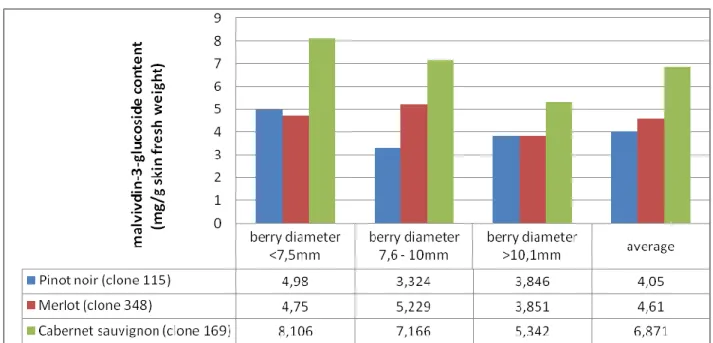
Quantification of berry skin anthocyanin content was the major part of this paper. Content was established in skin of three categories of berry size: small, medium and large. According to other authors decreasing berry size increase anthocyanin content, cause higher proportion of skin in total berry weight. Our results shown same or similar tendency (Figure 1).
The highest anthocyanin content was found in the small berry category 4,98 mg/g, but Cabernet sauvignon, Pinot noir had higher content malvidin-3-glucoside in large (3,846 mg/g) then medium (3,324 mg/g) berry category. Compared to the other observed varieties, Pinot noir had the lowest average content of malvidin-3-glucoside (4,05 mg/g skin fresh weight).
104
Figure 1. Skin anthocyanin content observed varieties influenced by berry size
The highest anthocyanin content was found for the small berry category and values were decrese incrising the berry size (8,106 mg/g small category; 7,166 mg/g medium category and 5,342 mg/g large category). Observing average content of anthocyanins, the highest values was recorded et cv. Cabernet sauvignon, then Merlot, and the lowest content had Pinot noir. Results were in accordance with Liu et al. (2015).Moyer et al. (2002) suggests. that the amount of skin or surface area increases as berry size decreases; leading to the general observation that smaller fruit contain more anthocyanins per unit volume in plant species whose pigments reside exclusively in the skin. Cabernet sauvignon show expected results, the higher anthocyanin content was from small berry category (< 7,5mm), and anthocyanin content decreased increasing berry size. Similar to Cabernet sauvignon, Pinot noir had the highest anthocyanin content in small berry category (4,98 mg/g),
but different to same variety, Pinot noir had higher content of malvidine-3-o-glucoside in large berries ( 3,846mg/g) than small berries(3,324 mg/g).
CONCLUSION
Compearing yield of grapes, cv. Merlot had significantly higher yield in regard to others cultivars. Parameters of banch and berry structure significantly varied among cultivars. The lowest anthocyanin content recorded in large category of berries (> 10,1 mm) of cv. Cabernet sauvignon and Merlot. The highest anthocyanin content had cv. Cabernet sauvignon, clone 169 (average 6,871 mg/g FW of skin), than cv. Merlot, clone 348 (average 4,61 mg/g FW of skin). The lowest anthocyanin content had cv. Pinot noir, clone115 (average 4,05 mg/g FW of skin).
ACKNOWLEDGEMENTS
105
BIBLIOGRAPHY
1. Attia, F., Garcia, F., Ben Mariem, F., Nuzzo, V., Dedieu, F., Garcia, M., Lamaze, T., (2010). Water stress in
Tannat and Duras grapevine cultivars (Vitis vinifera.): Leaf photosynthesis and grape phenolic maturity, J. mt.Sci. Vigne Vin, 8 1-93.
2. Barbagallo, M., Guidoni, S., Hunter, J.J.,(2011). Berry size and qualitative
characteristics of Vitis vinifera L. cv. Syrah. S. Afr. J. Enol. Vitic., 32(1), 129-136.
3. Chaves, M., Santos, T.P., Souza, C.R., Ortuflo, M.F., Rodrigues, M.L.,Lopes, C.M., Maroco, J.P., Pereira, J.S., (2007). Deficit irrigation in grapevine improves water-use efficiency while controlling vigour and production quality, Ann. Appl. Biol., 150, 23 7-252.
4. Chorti, E., Guidoni, S., Ferrandino, A. Novello, V., (2010). Effects of different cluster sunlight exposure levels on ripening and anthocyanin accumulation in Nebbiolo grapes, Am. J. Enol. Vitic., 61 (1), 23-30.
5. Iland, P. G., Cynkar, W., Francis, I. L., Williams, P. J., & Coombe, B. G.
(1996). Optimisation of methods for the determination of total and red‐free glycosyl glucose in black grape berries of Vitis vinifera. Australian Journal of Grape and Wine Research, 2(3), 171-178.
6. Marković, N., Ličina, V.,
Atanacković, Z., Trajković, I., Ranković-Vasić, Z. (2011):
Agrobiološka svojstva klonova Kaberne sovinjon ISV F V-5 i ISV F V-6.
International Scientific Symposium of Agriculture-"Agrosym Jahorina 2011". Proceeding. pp. 427-434.
7. Matthews, M.A., Nuzzo, V., (2007).
Berry size and yield paradigms on grapes and wines quality. In: Nuzzo, V (ed). Proc. Intl. WS on Grapevine, Venosa, Italy, 31 October 2007. Acta Hort. 754.
8. Mei-Ying Liu, Ming Chi, Yong-Hong Tang, Chang-Zheng Song, Zhu-Mei Xi Zhen-Wen Zhang (2015). Effect of Three Training Systems on Grapes in a Wet Region of China: Yield, Incidence of Disease and Anthocyanin Compositions of Vitis vinifera cv. Cabernet Sauvignon. Molecululs. Vol. 20; 18967-18987.
9. Nicolas, P., Lecourieux, D., Gomès, E., Deirot, S. & Lecourieux, F.,(2013).
The grape berry-specific basic helix-loop-helix transcription factor VvCEB1 affects cell size. J. Exp. Bot.
10. Pajović, R., Popović, T., Boškov, K.,
Beleski, K. (2009). Privredno-tehnološke karakteristike grožđa sorte Vranac i introdukovanih sorti Kaberne sovinjon i Merlo u uslovima Podgoričkog vinogroja (Crna Gora) i Skopskog vinogorja (Makedonija).
Agroznanje, vol. 10., br. 1; 89-96. 11. Paprić Đ., Korać Nada, Kuljančić I.,
Medić Mira, Ivanišević D., Božović P.(2008). Obojene vinske sorte i klonovi vinove loze u Fruškogorskom vinogorju. Letopis naučnih radova, 32
broj I, 88-93.
12. Poni, S., Canalini, L., Bernizzoni, F., Civardi, S. Intrieri, C., (2006). Effects of early defoliation on shoot synthesis, yield components, and grape composition, Am. J. Enol. Vitic. Vol. 57: 397-407.
106 14. Ranković-Vasić, Z. (2013). Uticaj
ekološkog potencijala lokaliteta na biološka i antioksidativna svojstva sorte vinove loze burgundac crni (Vitis vinifera L.). Doktorska disertacija. Beograd. 119-153.
15. Ristic, R., Iland, P. (2005).
Relationships between seed and berry development of Vitis vinifera L. cv. Shiraz: developmental changes in seed morphology and phenolic composition, Australian. Journal of. Grape and Wine Resesrch: Vol. 11: 43-58.
16. Roby, G., Harbertson, J.F., Douglas, A.A., Matthews, M.A., (2004). Berry size and vine water deficits as factors in wine grape composition: Anthocyanins and tannins, Australian. Journal of. Grape and Wine Resesrch. Vol 10: 100-107.
17. Roby, G., Matthews, M. (2004).
Relative proportions of seed, skin and flesh, in ripe berries from Cabernet Sauvignon grapevines grown in avineyard either well irrigated or under water deficit, Australian. Journal of. Grape and Wine Resesrch, Vol.10: 74-82.
18. Sadras, V.0., Collins, M., Soar, C.J.,
(2008). Modelling variety-dependent dynamics of soluble solids and water in berries of Vitis vinofera, Australian. Journal of. Grape and Wine Resesrch, Vol.14: 250-259.
19. Santesteban, L., Royo, B., (2006).
Water status, leaf area and fruit load influence on berry weight and sugar accumulation of cv. 'Tempranillo' under semiarid conditions. Scientia Horticulturae. Vol. 109: 60-65.
20. Vukosavljević. V, Boškov, K.,
Pajović, R., Stojanov, M., Đurić, M., Murtić, S., Kojović, R. (2011). Rodni potencijal i kvalitet sorte merlo u trsteničkom vinogorju. Zbornik radova
XVI Savetovanja o biotehnologiji - sa međunarodnim učešćem. 4 - 5. Mart, Čačak, Vol. 16. (18): 385-391.
21. Vukosavljević, V., Garić, M. (2015).
Prinos i kvalitet grožđa sorte Kaberne sovinjon u agroekološkim uslovima Levačkog vinogorja. Zbornik radova XX savetovanja o biotehnologiji.13-14. Mart, Čačak. Vol. 20.(22): 245-253. 22. Walker, R.R., Blackmore, D.H.,
Clingeleffer, P.R., Kerridge, G.H., Rithl, E.H., Nicholas, P.R., (2005).
Shiraz berry size in relation to seed number and implications for juice and wine composition, Australian. Journal of. Grape and Wine Resesrch. Vol. 11: 2-8.
23. Žunić, D., Garić, M. (2010) Posebno