STUDY ON THE ESTABLISHMENT OF A FLOURISHING WITH CIRCULAR
POOLS IN GORJ COUNTY
COLĂ MUGUREL
Key words: trout farm; held since hatching; eggs incubator.
ABSTRACT
The fact that they prefer the importation of caviar directly from Denmark embrionate of the species ' Danish Trout "leads to the use of the technological process of genetic material of high productive qualities, thus eliminating the genetic alterations, and this trouble, being more resistant to disease, has an optimum range of feeding larger than other species of salmonids, and is less demanding to water qualities. Otherwise the conversion ratio of food consumed in body mass is very thankful (1:1). Trout House Păstrăvarului-Gorj Peștișani, is located in the mountain area at 850 m above sea level, making the maximum accessibility to be at any time of year, neînregistrându-is very low temperatures, so that during the whole year to register a trial of feeding-asimilaţie nemaintâlnit in many of the trout to flourishing in the country.
INTRODUCTION
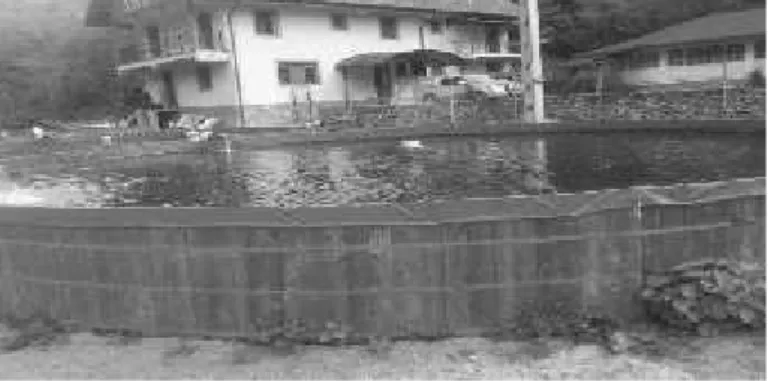
The practice of rearing of trout, fish weighing an average of more than 60 g are used predominantly circular pools (Photo 1) large (diameter 3 m, 4 m, 4.5 m or 7 m). Advantages. They have easily and economically, ensure a uniform quality of the water in all the growth, allow the optimization of the ecotehnologice conditions, rapid and efficient discharge of solids and layered observation of uneaten feed (Decei, i. 2001). Optimum ratio between the diameter and the depth of the river is 3 to 1 and 10 to 1. The circular basins, water supply is carried out in parallel on the wall of the pelvis, which generates a movement of water around its vertical axis as a primary rotation. By rubbing the current primary wall and the bottom of the basin, creating a secondary transverse intensity level, which has a component radial surface, directed from the Center to the wall of the pelvis, and a component radial oriented from bottom, toward the center of the basin wall. Radial component of the ass carrying solid materials deposited towards the drain basin, central autocurăţirea. The water that feeds the circular basins cannot change instantaneously qualities physico-chemical properties (temperature, oxygen content, ammonia, nitrite, pH, carbon dioxide, etc.) and biological (contents in suspended solids, germs) and water (Bud, i. 2007) at the same time, through a good mixing of the water, the whole fish population, he lived in the aquatic environment with the same qualities. For maintaining the health of muscle tone and respiration, as well as to direct sound towards the core of layered drain basin, water rotation speed should not exceed 15-30 cm/second (Cola, M., 2015).
MATERIAL AND METHOD
The total area owned by Obstea Teaching is 11.258,4217 hectares, of which on an area of 0,9945 ha, was established a farm for raising trout. Here were built, water basins capture growth and House pastravarului
A special area is located in the outskirts of Teaching, to the North, 14.6 km from the Centre of the commune, i.e. 3.0 km from Tail Lake Vija, at an altitude of 850 m, being composed of actual farm of trout and home construction pastravarului P + 1, having dimensions of 21, 3x23, 12 m.
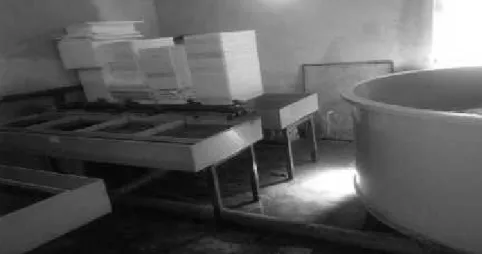
Farm growth is composed of 10 pools, circular with a diameter of 10 m with a useful volume of water. Density in pools can be over 50 kg/m3 of water, which represents a potential production of about 50 t over a year. There and incubation station (fig. 3.4; 3.5) in order to obtain juveniles required for growth as well as for sale to other units. Their main activity the production of trout, with a production capacity at present, 10 t of trout consumption per annum. Flow is sized to produce deliverable trout throughout the year.
Disposal of trout consumption is ensured through the conclusion of contracts with farm businesses in the area, as well as for sale directly from the store or trout from teaching.
Figure 2 The Incubation station
RESULTS AND DISCUSSION Profile trout capability
Due to the fact that not much can be sold all the fish at once (when the aggregate mass of it reaches 10 t), which is exploited in time at different lengths and masses (from 200 g/PC at 400 g/PC, and even more so), the quantity of fish and recovered over time on a production cycle is over, gently touching 10t 13-14 t.
Setting the amount of spawn
As the peculiarity of trouth subject to discussion, dynamics of increase in sea trout here is particularly rapid (within 10 months from the date on which the incubation eggs, trout specimens were 238, 7 g/PC) production cycle needs to be reduced to 1-1,2 years, maximum 1,5 years, because already on 21 February of the current year the transfer was made in alevinilor troci and if the growth is as fast as possible at the end of the year to fish hatched this year may be much started it harness.
Furthermore, as a thing that cannot be overlooked in calculating the amount of eggs required for the production of 10 t trout, is that the trout farm may appear a parazitoză, and causing mortality of 40-45% among seedlings 2 months, thus causing the need for eggs to be doubled their amount.
- losses (in kg) at one year of age up to the age of 1.5 years. 0,5%;
- 50,000 PCs. Trout = > 0.5% x 50,000 = 250 kg (assuming that 1 year average fish weight 330 g/PC, it appears that the losses during this period are 757) trout in the age of one year; so the number of fishes (P1 +) which has to be before this period to realize 10t is: 50,000 + 757 = 50.757 PCs;
- loss from age 6 months up to one year of age. 3%;
- 50.757 PCs. x 3% = 1.522 PCs. get lost; so the number of fishes (P1) that should be before this period to realize 10t is 50.757 + 53.279 = 1522 PCs;
- losses from hatching until 6 months. 20%;
- 53.279 PCs x 20% = 10655 PCs are lost; so the number of fishes (P0 +) which has to be before this period to realize is: 53.279 + 10t 10655 = 63934 pieces;
- losses caused by a disease that can occur in the trout farm approx. 45%;
- 63934 x 45% = 28770 PCs are lost; so the number of fishes (P0) which has to be before this period to realize 10t is: + = 63934 28770 92704 pieces;
- losses recorded from embryonic until hatching. 5%;
- 92704 x 5% = 3311 PCs are lost; so the number of fish that should be before this period to realize is: + 10t 92704 3311 = 97339 PCs.
Therefore, in order to achieve the 10t trout consumption within trout, need to acquire about 100,000 eggs embrionate .
Biological material
Being a trout farm that today produces only 10 tonnes of trout and sometimes having problems related to flow and the amount of oxygen dissolved in water, in Trout House Păstrăvarului are not Peștișani Gorj trout specimens for breeding, shortages are importing eggs from the species embrionate from Denmark called conventional Danish trout. The practice of importing eggs fertilized is quite useful because it guarantees the quality in terms of what genetic trout will develop from these eggs.
Feed
Trouth is used in Peștișani exclusively feed granulated, shortages of imported brand is the Trouvit sold under the name 1,2,3, 4, wobbling and 0.2 with different chemical composition depending on the age of the fish (Table 1).
Table 1
Chemical composition of extruded feed Wobbling
Protein %
Fat %
Ash %
Fiber %
Phosphorus %
Digestibily energy Mj/kg
NUTRA 4,0 58.0 12.0 9.8 0.9 1.50 18.8
NUTRA 3.0 55.0 16.0 10.0 0.6 1.45 18.7
NUTRA 2,0/0
54.0 18.0 10.0 0.6 1.45 19.4
Establish the need for incubators
The necessary quantity of incubators for 100,000 pieces spawn has been established based on the experience of the other and of the flourishing "Trout instructions on the growth of trout", and bearing in mind that the fewer eggs have been incubated in an incubator, with both succeeding incubation process increases, so it was determined that it would be very nice if it would put as many 10,000 eggs on an incubator resulting in that it takes 10 incubators type Wacek. This number of incubators represent 42% of the number of incubators available păstrăvăria (incubators), so that the facilities can păstrăvăriei incubation without problems a much larger number of eggs compared to normal
Trout production
In order to ensure constant production levels established trouth calculated on stages of development will be carried out annually within păstrăvăriei:
-Rainbow Trout 97339 PCs.
-Trout seedlings aged 6 months (P0 +) 63934 PCs. -Trout seedlings aged one year (P1) 53.279 buc. -trout in the age of 2.5 years (P2 +) 50.757 buc
Sizing water glaze
The basic elements that have been taken into account (when designing trouth), focused on biochemical characteristics of the water from the power supply and temperature stenoterma water from the spring that feeds the trout. Preliminary flow for replenishment of watersheds and costs specific to each stage of development of the trout were established according to the requirements of the trout toward the conditions of growth of trout to m2water surface and the specifics of the area in which is located located trout.
Thus the demand for gloss water calculated is as follows: -for growing seedlings in troci 30 m2
-for growing saplings (P0) 230 m2 -for growth (P1) 720 m2
-for growth (P2) 2,280 m2
-breeding for growth (R) 300 m2 -quarantine 90 m2
-retention basins for growing (P2) 560 m2 -water reserve and fishing 700 m2
Pool for alevinilor growth
For raising seedlings in the first phase of development in the trout farm there are 40 pieces made with pool dimensions 200 x 60 x 30 cm, located under the shed that they ensure protection against sunlight. Pool requirements for the current production capacity is 12-18 (it has been calculated taking into account the initial density of popular approx. 7,600 pieces nursery/PCs feeders and density at the end of the period of growth of approximately 4.900 PCs/PCs stock feeders).
Establishment of the amount of water
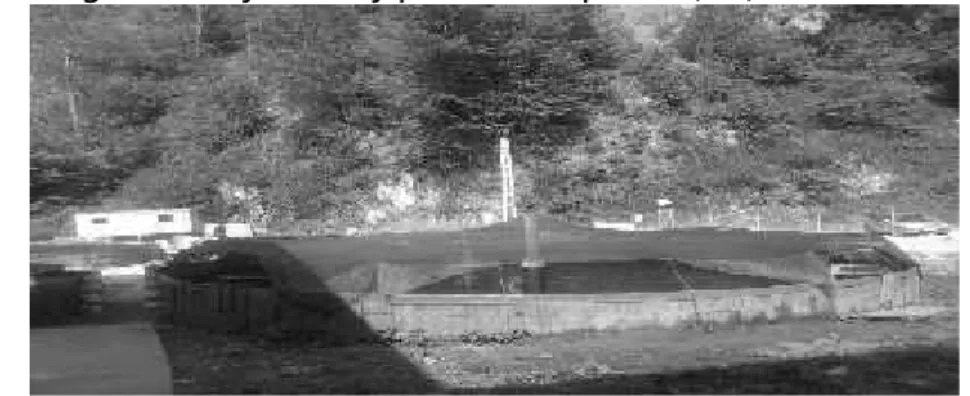
The required water flow power trout settled according to specific watersheds and surface water consumption for the various stages of development made by Brook trout, as well as production capacity (10 t). Experience in the practice of the native trouth highlights a rate necessary to achieve the 10 t trout of about 333 l/Pestișani be a trout.La basin reservoirs on the Bistrița River which allows achieving a relatively constant flow throughout the year, over 300 l/s, which is adjusted by means of a monk and a home water filter.
Figure 3 Basin reservoirs on the Bistrița River
Raising seedlings and seedlings for tanks
Stage in these pools takes 5-6 months after they are sort of three size categories and past pools (P1). At the age of one year they pass in the ponds (P2)
Figure 4 Pools for juvenile age 5-6 months (P1)
The period from 6 months to 1 year (when it is expected that all production will be harnessed) corresponds to a flock of about 53,000 pieces fish weight between 40 g-400 g; If we assume that the entire herd will have 10 t (păstrăvăriei capacity) and the average weight of a trout will be 180 grams, the amount of food used at this age will be of 180 kg per day, which corresponds to the maximum production capability of păstrăvăriei at this time is necessary for fish to be harnessed.
CONCLUSIONS
Compared with other mountain areas located in the flourishing with variations of geoclimatic conditions Trouth House, Păstrăvarului-Gorj Peștișani is located in the mountain area at 850 m above sea level, making the maximum accessibility to be at any time of year, with very low temperatures, so that during the whole year to register a trial of feeding asimilation without in many of the trout to flourishing in the country.
The fact that they prefer the importation of trout directly from Denmark embrionate of the species ' Danish Trout "leads to the use of the technological process of genetic material of high productive qualities, thus eliminating the genetic alterations, and this trouble, being more resistant to disease, has an optimum range of feeding larger than other species of salmonids, and is less demanding to water qualities. Otherwise the conversion ratio of food consumed in body mass is very thankful (1:1).
The use of granulated feed imported high-quality leads to the elimination of the risk of illness due to lack of some nutrients from food necessary for the proper development, and a percentage of the asimilaţie better than the classic recipes of food for trout (conversion index is 1:1).
Using materials of the maintenance and manufacturing (food, medications, monitoring and control systems) in the future will come from a decrease in the cost price per kg fish, which will cause it to be accessible for several walks, without a luxury food, thus encouraging high consumption of trout at the level of the population, leading to the establishment of a secure and permanent described by reducing considerably the risk of interruption of the technological flow
BIBLIOGRAPHY
1. Bud I.,1990 - Tehnologia creşterii şi exploatării peştilor. Curs univ. Tipo Agronomia, Cluj-Napoca.
2. Bud, i., Ionescu, O., Vlădău, V.V., Pop, S.N., 2007 - Peştii din apele reci. Păstrăvii.
Editura Risoprint, Cluj-Napoca.
3.Colă, M., 2015 -Salmonicultura.Editura Sitech,Craiova.