Smile and Laughter in Human-Machine Interaction: a study of
engagement
Mariette Soury
1,2, Laurence Devillers
1,3 1 LIMSI-CNRS, BP133, 91403 Orsay cedex, France2 University Paris 11, 91400 Orsay, France
3 University Paris Sorbonne 4, 28 rue serpente, 75005 Paris, France
E-Mail: [email protected], [email protected]
Abstract
This article presents a corpus featuring adults playing games in interaction with machine trying to induce laugh. This corpus was collected during Interspeech 2013 in Lyon to study behavioral differences correlated to different personalities and cultures. We first present the collection protocol, then the corpus obtained and finally different quantitative and qualitative measures. Smiles and laughs are types of affect bursts which are defined as short emotional “non-speech” expressions. Here we correlate smile and laugh with personality traits and cultural background. Our final objective is to propose a measure of engagement deduced from those affect bursts.
Keywords: affect bursts, personality traits, sense of humor
1
Introduction
While spoken language constitutes a strong communication channel in human-machine interaction, previous works demonstrated that relevant information is simultaneously and spontaneously conveyed nonverbally (Campbell, 2007).
The experiment presented in this paper was designed to evaluate the impact of a user’s individual characteristics (cultural background, sense of humor, personality traits) on his propensity to express amusement in front of a machine. Specifically, we focused on affect bursts as the expression of users’ emotional state. The notion of affect burst has been introduced by Scherer (Scherer, 1994) as very brief, discrete, nonverbal expressions of affect in both face and voice as triggered by clearly identifiable events”. Affect bursts are defined as short emotional “non-speech” expressions interrupting speech.
Examples of expressions exclusively due to push effects are affect bursts (i.e., Krumhuber & Scherer, 2011) or infant grunts. Pursuing the ideas of Johnstone et al. (Johnstone et al., 2000) about prototypes in emotion expression, it may be that some emotions are expressed through prototypical affect bursts, while others are not. A simple criterion for prototypes could be that they are spontaneously produced by speakers and easily identified by listeners. (Schroeder, 2003) shows that affect bursts, presented without context, can convey a clearly identifiable emotional meaning. This subject, although theoretically described in detail, does not seem to have been extensively studied experimentally.
In this study, we refer to smiles and laughs as affect bursts. Our purpose is to evaluate how these affect bursts can reveal the subject’s engagement in the interaction1. Previous work by Tanaka (Tanaka et. al., 2010) investigated the impact of cultural differences on the perception of emotions; our assumption is that cultural differences impact the expression of emotions as well. In order to account for users’ individuality in the expressive behavior, we needed large amount of multicultural data. Few existing resources are multicultural. In our previous experiments, we only used French real-life corpora recorded in call center (Devillers & Vidrascu, 2007) to study negative and positive laughter. In (Schroeder, 2003) the corpus used is in German language. We opted to collect a new audio and video corpus during the Interspeech 2013 conference.
The second section of this paper presents the protocol designed to acquire multimodal data in a man-machine interaction, and the resulting corpus is detailed in the third section. The correlations between participants’ profile and the collected affect bursts are described in the fourth section.
2
Collection protocol
In this study, we used two tasks for inducing smiles and laughs:
Passive induction tasks such as watching funny
videos or listening to jokes
Active induction tasks such as Tongue-Twisters
game reading on a computer screen or repeating
with the Nao robot (Aldebaran Robotics).
1 Research partially supported by Oseo project ROMEO2,
45-person sample All Videos
Tongue- twisters (read
on screen)
Number of closed
smiles 164 131 33
Relative duration of
closed smiles - 9.48% 2.70%
Number of open
smiles 429 251 178
Relative duration of
open smiles - 32.78% 13.83%
Table 2 : Type of smile elicited by task - number of smiles, and relative length to the task duration
3.4
Co-occurring events in audio and video
Our work hypothesis is that while laugh is an open expression of emotion, smile is a more subtle one and might occur more easily in a non-familiar environment.
We temporally aligned annotations for audio and video channels for the “videos” and “tongue-twisters read” task, and observed the co-occurrence of events. We distinguished 4 cases: no event in either modality, event only in audio (laugh), event only in video (smile), and bimodal event. The latter represents 12.44% of all events observed on the complete session. Results are visible in Table 3.
45-person
sample no event
audio event
video event
bimodal event
complete “screen” session
36,88% 11,82% 38,87% 12,44%
Videos 33,53% 10,69% 40,17% 15,61%
tongue-twisters
read 42,98% 13,86% 36,49% 6,67%
Table 3 : co-occurrence of laughs and smiles by task
If we observe tasks separately, bimodal events represent 15.61% and 6.67% of the observed events in the “videos” and “tongue-twisters read” tasks, respectively. The tongue-twisters task implied the active participation of the subjects, whereas the videos task allowed for more passive reactions, which could explain the disparity.
We can see that events occurred more frequently in video than in audio: on the “screen” part of the interaction alone, we induced more smiles than laughs.
4
Correlations between smiles, laughs and
user profile
4.1
With cultural background
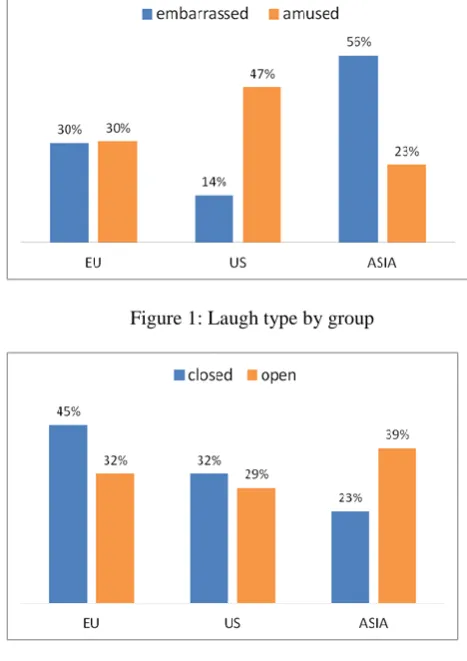
In order to evaluate the impact of the cultural background of the participants on their propensity to laugh and smile, we separated the data in 3 categories. We observed the ratio of amused (resp. embarrassed) laughs
produced by each group on the total number of amused (resp. embarrassed) laughs (presented in Figure 1). We proceeded in the same manner for open and closed smiles (presented in Figure 2). The imbalanced representation of the 3 populations was taken into account to correct the skewness of the data.
On the observed sample, the participants of the “Asia” group produced the majority of the embarrassed laughs (56%), while the participants of the “US” group produced the majority of the amused laughs (47%). For those two groups, the number of amused and embarrassed laughs are imbalanced (resp. 23% and 56% for Asia, resp. 47% and 14% for US), contrary to the “EU” group who contributed to both categories equally.
Regarding the smiles, the “EU” group produced the majority of the closed smiles (45%) while the “Asia” group produced the majority of the open smiles (39%). The “US” group contributed to both categories in almost equal measures.
4.2
With OCEAN personality traits
During the design of the experiment, we expected the personality of each participant to impact on the expression of their amusement. We have been working with the OCEAN personality trait inventory on previous experiment to asset personality traits; we made the assumption that Openness, Extraversion and Neuroticism traits would have the most impact on affect bursts
Figure 1: Laugh type by group
[3] Krumhuber E. & Scherer, K. “Affect bursts: Dynamic patterns of facial expressions”, journal of Emotion. vol. 11, No 4 (pp 742), 2011
[4] John O. P., Donahue E. M., Kentle R. L., "The Big
Five Inventory--Versions 4a and 54.", Berkeley:
University of California, Berkeley, Institute of
Personality and Social Research, 1991
[5] Johnstone T & Scherer, K. “Vocal communication of emotion”. In M. Lewis & J.Haviland (Eds). Handbook of emotions (pp. 200-235) New-York - Guilford Press,
2000
[6] McGhee, P. E., “Humor, healing, and the amuse system: Humor as survival training.”, Dubuque, Iowa: Kendall/Hunt Publishing, 1996
[7] Scherer, K. R.. “Affect Bursts, in Emotions: Essays on Emotion Theory” (S. H.M. van Goozen, N. E. van de Poll, & J. A. Sergeant, eds.),. Hillsdale, NJ: Lawrence
Erlbaum, (pp 161-193), 1994
[8] Schröder, M. “Experimental study of affect bursts”,
Speech Communication – Special session on speech
and emotion, vol. 40, No 1-2, 2003