7
RESEARCH ON CORN HYBRIDS BEHAVIOR UNDER
THE APPLICATION OF NEW TECHNOLOGICAL CONCEPTS IN
OSMANCEA-CONSTANTA AREA
AEDIN CELZIN (1,2), MIRCEA VIOREL (2), MARIN DORU IOAN (2)
(1) SC Micul Agricultor SRL, Osmancea, Județul Constanța, România; e-mail:[email protected] (2) Universitatea de Științe Agronomice și Medicină Veterinară din București, B-dul Mărăști, Sector 1, București; e-mail: [email protected]
Keywords: technological concepts, biological potential, hybrids, Zea mays L.
ABSTRACT
The emergence of new growing concepts aiming to achieve the biological yield potential of crops, soil conservation and the increase in economic efficiency, had also an echo in the agriculture of Dobrogea area. Farmers were involved in finding the best solutions to achieve these goals. Research conducted at SC Micul Agricultor SRL farm, located in Osmancea, Constanta County is an example in this direction. This research aimed to establish the corn hybrids best adapted to the climatic and pedologic conditions of the area, and the most
efficient soil tillage system and to optimize crop fertilization.
For this purpose, the behavior of Mas 40 F, Dartona and P 9911 corn hybrids was studied under conventional (plowing) and minimum soil tillage (tiger and disk) for the following fertilization levels: unfertilized, N90P40K40 and N90P40K40 + Greenstart - 25 kg/ha.
The best results were obtained when using tiger to perform basic soil tillage and fertilizing with N90P40K40 + 25 kg/ha Greenstart. For this variant, all hybrids had the highest yields ranging
from 13.56 to 13.93 t/ha.
INTRODUCTION
Conventional agriculture, based on plowing as an intensive soil tillage, has disadvantages as high costs and the uneven distribution of inputs compared to the expected efficiency, high energy and labor inputs and low productivity, much more it involves major risks in terms of soil degradation and environmental pollution (Cociu I. Al., 2011).
Used correctly, tillage favor soil self-repairing processes and increase its productive potential (Ankwe M.A., 2007).
Conservative agriculture is of great importance for stopping soil degradation, leads to a good capitalization of rainfalls and irrigation water, diminishing climate change effects, reducing costs and, last but not least, increasing productivity (Sayre K.D., 2010).
Yield level and its quality are the result of the interaction between soil nutrition conditions and climatic conditions (Frye W.W., 1991).
8 soil humus and disturbing soil balance (Berca M., 2011).
Along other factors, soil tillage contributes by nearly 20% to corn yield (Khurshild K., 2006).
The average corn yield recorded under the conditions of INCDA Fundulea, during 2007-2015, was significantly lower under conventional soil tillage (plowing) compared to no-tillage or minimum soil tillage (chisel, scarified) (Cociu Al., 2017).
The energy consumed is different depending on the equipment used for soil tillage, as follows: plowing - 5325 kwh/ha, chisel 20 cm - 5137 kwh/ha, chisel 40 cm - 5219 kwh/ha and disk - 5031 kwh/ha (Marin D.I.,2015).
In sustainable agriculture, fuel costs are lower by 12-58% compared to deep plowing technology. Also, the maximum pollution level was recorded for deep plowing (Šarauskis J., 2015).
Soil tillage has a great influence on weed species development, each tillage system favoring the growth of certain species. Plowing and disk favor Sorghum halepense and Cirsium arvense species
(Duary B., 2016).
Under the conditions of Dobrogea, the optimal sowing period for corn is from April 1st to April 20th (Bîlteanu Gh., 1998).
Corn responds differently to sowing density depending on its genetic potential, different densities having a significant effect on yield (Luque S.F., 2006, Bayram G., 2016).
Conservative soil tillage includes a wide variety of methods, from direct sowing (no-tillage, direct drill) to deep tillage without turning the furrow (Guş P., 2003).
The experience of the countries where the conservative agriculture has expanded shows that this is of great importance in stopping soil degradation, leads to a good capitalization of rainfall water and irrigation water, diminishes climate change effects, reduces costs and, last but not least, increases productivity (Sayre K.D., 2010).
Research on corn hybrids using conventional tillage and minimum tillage has demonstrated the superiority of minimum tillage on morphological and yield characteristics (Oncica Maria Cristina, 2016).
Research on the influence of soil tillage on corn yield confirmed that the smallest yield was achieved by disk tillage (Marin D.I., 2015).
Balanced fertilization is one of the main factors contributing to increased yield and its quality (Filipović Adrijana, 2016).
Applying nitrogen and phosphorus, in the form of complex fertilizers, stimulates the absorption of phosphorus by corn plants (Albineţ E., 2004).
In lack of fertilization yields decrease year after year, due to the decrease in soil fertility (Kumar R., 2000).
Adding a dose of starter fertilizer with nitrogen and phosphorus at the level of seed incorporation had the effect of increasing yield (Muşat M., 2013).
Current progress depends on farmers' interest in practicing a high-performance agriculture, at global standards.
MATERIALS AND METHODS
Research was conducted in 2017 in the field conditions of Osmancea,
9 The soil type on which the experience was placed was cambic chernozem of the Chernozem group. In the plowing layer, the soil is neutral (pH =7.1), medium supplied in humus (2.38%), well supplied with phosphorus (139.8 ppm), and well supplied with potassium (214.8 ppm).
Osmancea, Constanţa County, is located in a temperate continental area with a multiannual average temperature (average 30 years) of 12.1°C. The average annual temperature, recorded in 2017, was 12.8 °C with 0.7 °C above the multiannual average.
During the analyzed period, although higher than the multiannual average, temperatures were favorable for corn crop. The exception, however, was the minimal April temperatures that were low, prolonging germination. They had a monthly average of 4.2°C. Monthly average crop temperatures (April to August) were higher compared to the multiannual average except April (10.1°C vs. 10.3°C multiannual average).
The normal amount of rainfall for the Osmancea area is 430.2 mm. In 2017, 569.5 mm of rainfalls was recorded, 139.3 mm higher than the multiannual value. This was due to the fact that in the third decade of July the rainfall recorded 113 mm, in the form of a torrential rain that was not properly used by corn crop. Between April and July
there were more rainfall compared to the multiannual value, allowing a good development of corn crops. August recorded similar values compared to the multiannual value in term of rainfall (5.2 mm less).
The experiment had a 3 x 3 x 3 split plot design, in three replications with the following factors: Factor A = soil tillage: a1 = plowing (Ct), a2 = tiger, a3 = disk; Factor B = fertilization: b1 = NPK – 0 (Ct), b2 = N90P40K40, b3 = N90P40K40 + Greenstart – 25 kg/ha; Factor C = hybrid: c1 = MAS 40 F, c2 = Dartona and c3 = P 9911.
Corn was sown after winter wheat (Triticum aestivum). Soil tillage and fertilization were performed according to experimental practices. Seedbed was prepared in spring by disking. Sowing was carried out randomized at a density of 63.000 germinating seed/ha at 5 cm depth. Seeds were treated with fungicides and insecticides by the seed supplier.
Weed control was conducted preemergent using the commercial product Wing P (212,5 g/l dimetenamid-P
and 250 g/l pendimetalin) at a dose of 3,5 l/ha. At the stage of 4-6 leafs REKORD™ (0.4 l/ha Callam® (12,5% tritosulfuron + 60% dicamba) + 0,7 l/ha Samson® Extra 6 OD (60 g/l nicosulfuron) + 1 l/ha DASH® HC (plant growth regulator) was applied. Weeds extent was determined by the numerical and gravimetric method.
RESEARCH RESULTS
Soil tillage and hybrid influence on corn plants emergence
In 2017, within Micul Agricultor farm, Osmancea it was found that soil tillage and hybrid influenced the percentage of emerged plants. At plowing the percentage of emerged corn plants
10
of sprouted seedlings for all hybrids, as follows: MAS 40 F – 93.1%, Dartona – 92.6% and P9911 – 92.5%.
Tiger soil tillage resulted in the highest percentage of sprouted seedlings as an average of the three hybrids, of
96.3% (Figure 1).
Figure 1. Percentage of sprouted plants according to soil tillage and hybrid, Osmancea
Soil tillage influence on weed species composition in the corn crop
Weed species were: Convolvulus arvensis, Sorghum halepense from seeds and rhizomes and Xanthium spinosum. Sun-flower plants were also found due to the fact that it was a pre-plant from 2015.
The highest density was recorded by Sorghum halepense from the seeds: 13.1 plants/sqm for plowing, 16.1 plants/sqm for tiger and 38.2 plants/sqm for disk. Throughout the crop, areas of
Sorghum halepense from rhizomes was reported.
The total number of weeds/sqm increased according to soil tillage, from
20.1 (plowing) to 31.2 (tiger) and to 55.4 (disk).
Weeds fresh biomass varied according to their density/sqm. The highest weeds biomass was recorded for plowing – on average of 45 g/sqm. Tiger and disk, soil tillage systems that do not involve turning the furrow, resulted in a decrease of fresh weeds biomass with values of 32.5 g/sqm and 37.2 g/sqm. Dry biomass of weeds recorded values between 2.4 g/sqm (tiger) and 2.9 g/sqm (disk)(Figure 2).
11
Since the crop was treated with herbicides and harrowed, weeds had not developed and had not influenced corn yield.
Soil tillage and fertilization influence on corn yield
The results of the research carried out under the conditions of Osmancea – Constanţa, at Micul Agricultor farm, highlighted the fact that the basic soil tillage, fertilization and hybrids had a decisive influence on the achievement of large and stable corn yield.
Control value, against which yield increases were calculated in 2017 was the variant plowing and unfertilized for the
hybrids MAS 40 F, Dartona, P9911 and their average.
Yield increases for MAS 40 F hybrid compared to the control plowing-unfertilized variant were very significant. The exception was the variant tiger-unfertilized with a yield growth of 0.45 t/ha, which was distinctly significant. When disk tillage was conducted for the unfertilized variant the yield difference recorded compared to control was very significant negative and had a value of
0.97 t/ha (Table 1).
Table 1
Soil tillage and fertilization influence on corn yield of the hybrid MAS 40 F (t/ha), Osmancea
Soil tillage Fertilization
MAS 40 F
Yield (t/ha) (%) Diff. (t/ha)
Plowing
Unfertilized 8,71 100 Ct
N90P40K40 10,75 123 2,04
***
N90P40K40+Gr 13,47 155 4,76***
Tiger
Unfertilized 9,16 105 0,45**
N90P40K40 12,80 147 4,09
***
N90P40K40+Gr 13,77 158 5,06***
Disk
Unfertilized 7,74 89 -0,97ooo
N90P40K40 9,57 110 0,86
***
N90P40K40+Gr 11,04 127 2,33***
Dl 5%=0,33 t/ha; Dl 1%=0,49 t/ha; Dl 0,1%=0,75 t/ha Gr = Greenstart-25kg/ha
Table 2
Soil tillage and fertilization influence on corn yield of the hybrid Dartona (t/ha), Osmancea
Soil tillage Fertilization
DARTONA
Yield (t/ha) (%) Diff. (t/ha)
Plowing
Unfertilized 8,55 100 Ct
N90P40K40 11,01 129 2,46
***
N90P40K40+Gr 13,00 152 4,45***
Tiger
Unfertilized 8,96 105 0,41*
N90P40K40 12,11 142 3,56
12
N90P40K40+Gr 13,56 159 5,01***
Disk
Unfertilized 7,5 88 -1,05ooo
N90P40K40 9,84 115 1,29
***
N90P40K40+Gr 11,35 133 2,8***
Dl 5%=0,41 t/ha; Dl 1%=0,57 t/ha; Dl 0,1%=0,79 t/ha Gr = Greenstart-25kg/ha
Dartona hybrid achieved very significant yield increases for all variants compared to control, except for tiger-unfertilized variant, with a yield increase of only 0.41 t/ha, not significant in statistical terms. For disk soil tillage in the unfertilized variant, yield recorded was lower compared to control, with a very significant difference of 1.05 t/ha (Table 2).
Yield increases compared to control, plowing-unfertilized variant, for the hybrid P9911 were not significant (0.05 t/ha) for the variant tiger-unfertilized, very significant negative for disk-unfertilized (1.12 t/ha), distinctly significant positive for disk and fertilization level N90P40K40 (0,78 t/ha) and very significant for the other variants (table 3).
Table 3
Soil tillage and fertilization influence on corn yield of the hybrid P9911 (t/ha), Osmancea
Soil tillage Fertilization P9911
Yield (t/ha) (%) Diff. (t/ha)
Plowing
Unfertilized 9,1 100 Ct
N90P40K40 11,44 126 2,34
***
N90P40K40+Gr 13,64 150 4,54 ***
Tiger
Unfertilized 9,05 99 -0,05ns
N90P40K40 12,37 136 3,27
***
N90P40K40+Gr 13,93 153 4,83 ***
Disc
Unfertilized 7,98 88 -1,12oo
N90P40K40 9,88 109 0,78
**
N90P40K40+Gr 12,28 135 3,18***
Dl 5%=0,56 t/ha; Dl 1%=0,80 t/ha; Dl 0,1%=1.17 t/ha Gr = Greenstart-25kg/ha
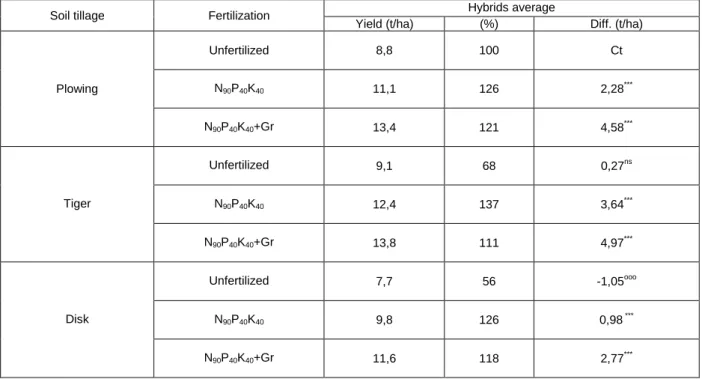
Considering the average yield of the three hybrids for the variant plowing-unfertilized as control, yield increases of other variants were very significant (except tiger and disk for the unfertilized level).
Yield increase of tiger-unfertilized compared to control was not statistically significant.
13
Table 4
Soil tillage and fertilization influence on corn yield (hybrids average) (t/ha), Osmancea
Soil tillage Fertilization Hybrids average
Yield (t/ha) (%) Diff. (t/ha)
Plowing
Unfertilized 8,8 100 Ct
N90P40K40 11,1 126 2,28***
N90P40K40+Gr 13,4 121 4,58***
Tiger
Unfertilized 9,1 68 0,27ns
N90P40K40 12,4 137 3,64***
N90P40K40+Gr 13,8 111 4,97***
Disk
Unfertilized 7,7 56 -1,05ooo
N90P40K40 9,8 126 0,98 ***
N90P40K40+Gr 11,6 118 2,77***
Dl 5%=0,43 t/ha; Dl 1%=0,62 t/ha; Dl 0,1%=0,90 t/ha
1000 grains weight (TGW)
Compared to the average 1000 grains weight of the three hybrids for the control variant plowing-unfertilized, it was found that most of the tested variants recorded very significant positive differences with values between 3.1 and 93.9 g, except for disk – unfertilized variant.
Soil tillage performed with tiger influenced 1000 grains weight of all hybrids, thus TGW for this variant compared to control was 9.6 g higher in the unfertilized variant, 63.2 g higher in the variant fertilized with N90P40K40 and
93.9 g higher in the variant fertilized with N90P40K40 and Greenstart.
1000 grains weight for the variant disk-unfertilized was lower compared to control with a very significant negative difference of 22.5 g. For the fertilization level N90P40K40 1000 grains weight of the three hybrids was by 3.1 g higher compared to control, while by using starter fertilization, TGW increased by
36.1 grams (table 5).
Table 5
Soil tillage and fertilization influence on 1000 grains weight (g), Osmancea
Soil tillage Fertilization
Hybrids average
TGW (g) (%) Diff. (g)
Plowing
Unfertilized 232,8 100 Ct
N90P40K40 267,3 114,8 34,5
***
14 Tiger
Unfertilized 242,3 104,1 9,6***
N90P40K40 296,0 127,2 63,2***
N90P40K40+Gr 326,7 140,3 93,9***
Disk
Unfertilized 210,2 90,3 -22,5ooo
N90P40K40 235,9 101,3 3,1
***
N90P40K40+Gr 268,9 115,5 36,1*** Dl 5%=1,25 g; Dl 1%=1,68 g; Dl 0,1%=2,23 g
CONCLUSIONS
Climate conditions, soil tillage, and hybrids have influenced the percentage of emerging plants. Tiger had the greatest influence on the percentage of sprouting seedling, which was on average 96.3% hybrids. For this variant P9911 hybrid recorded the highest percentage of 97.3%.
Soil tillage also influenced the number of weeds and their dry and fresh biomass. Due to the fact that the weeds were control by rational crops rotation, the floral composition was limited to weed species more difficult to control:
Convolvulus arvensis, Sorghum
halepense from seed and rhizomes and
Xanthium spinosum. The basic soil tillage carried out with disk resulted in the
largest number of weeds per sqm - 55.4. Plowing and turning the furrow, led to the lowest number of weeds per sqm - 20.1.
Soil tillage, fertilization and hybrids influenced corn yield and 1000 grains weight. The best yield results were obtained for tiger and the fertilization level N90P40K40 + 25 kg / ha Greenstart was fertilized. Under these conditions, MAS 40 F hybrid achieved 13.77 t/ha, DARTONA hybrid recorded 13.56 t ha and P9911 hybrid obtained 13.93 t/ha. The average yield of the hybrids was 13.8 t/ha.
1000 grain weight recorded the highest value of 326.7 g in the tiger variant, fertilized with N90P40K40 + 25 kg /
ha Greenstart.
BIBLIOGRAPHY
Albineţ E., 2004 – Tehnologia culturii porumbului în condiţii de irigare. Ed. Universitas, XXI, Iaşi;
Ankwe M.A., Ubochi J.N., 2007 – Short them changes în soil properties under tillage systems and ther effect on sweet potato growth and yield in an Ultisol in south-eastern Nigeria. Australian Journal of soil Research, vol. 45, p.351-358;
Bayram G., Turgut J., Karasu A., 2016 – The effect of different plant density on yield, yield components and some quality
parameters of two hybrid corn (zea mays indentata Sturt.) varieties. Conference paper: Radovi Pojoprivrednog Fakulteta Univerziteta u Sarajevu (Works of the faculty of Agriculture University of Sarajevo), vol. 61, nr. 66, p.223-227;
Bîltenu Gh., 1998 – Fitotehnie. Editura Ceres, București, p.266-270;
Berca M., 2011 – Agrotehnică.
Transformarea modernă a agriculturii. Editura Ceres, București;
15
fundamentarea, dezvoltarea de tehnologii durabile și economic viabile bazate pe agricultura conservativă. Analele I.N.C.D.A.Fundulea, vol. LXXIX, nr. l,
Agrotehnica culturilor, 121-129;
Cociu I., Al., Elena Alionte, 2017 – The effect of different tillage system on grain yild and its quality of winter wheat, maize and soybean under different weather conditions. Romanian Agricultural Research, no. 34, p.1-9;
Duary B., Dash S., Teja K.,C., 2016 –
Impact of Tillage on seed bank, population dynamics and Management of weeds. State Agricultural Technologists Service Association, West Bengal, India.
SATSA Mukhaptra Anual Technical ISSUE, vol. 20, ref. 37, p.104-112;
Filipović Adrijana, Vujević Irena, Ivanković Stanko, Ćorić Rodica Jurcović Drăgan, Višnja Vasili, 2016 –
The efect of soil selenium fertilization treatment on the content of some ions (Cd, Fe, Zn, and Se) and yield of two corn hibrids. 9th Congress of The Soil Science Society of Bosnia & Herzegovina. Vol. 21, ref.36, p.179-190;
Frye W.W., Thomas W.G., 1991 –
Management of long term field experiment. Agronomy Journal, vol. 83, nr. 1, p.58-61;
Guș P., Rusu T., Ileana Bogdan, 2003 -
Sisteme convenţionale şi
neconvenţionale de lucrare a solului.
Editura Risoprint, Cluj-Napoca;
Khurshild K., Iqbal M., Saleem Ariff M., Nawaz A., 2006 – Effect of Tillage and Mulch on Soil Physical Properties and Growth of Maize. International Journal of Agiculture and Biology, vol. 8, nr.5, p.593-596;
Kumar R., Sing G., Walia S.,S., 2000 –
Long term effect of manure and fertilizers on rice yield and soil fertility status in rice – wheat system. Environ. Ecol., vol.18, p.
546–549;
Luque S. F., Cirilo A.G., Otegui M. E., 2006 – Genetic grains in grain yield and related physiological attributes in Argentina mayze hybrids. Field Crop Research, vol. 95, p. 383 -397;
Marin I. D., RusuT., Mihalache M., Ilie L., Nistor Elena Bolohan, C., 2015 –
Influence of soil tillage upon production and energy efficiency in weat and maize crops. AgroLife Scientific Journal, vol. 4, nr.2, p.43-47;
Mușat M., 2013 – Arătura rămâne
lucrarea de bază a solului?. Revista Ferma;16septembrie. https://www.revista- ferma.ro/articole/agronomie/aratura-ramane-lucrarea-de-baza-a-solului;
Oncică (Moraru) Maria, Cristina Dobrinoiu, Ricuța - Vasilica Vișan, Luminița Dănilă (Guidea) Silvana, Oprea Izabela, 2016 – The influence of genotype and soil tillage system on forming production components for sweet corn under soil-climate condition specific to Romanien plain. Scientific Buletin, USAMV, Buc., Series F, Biotechnologies, vol. XX, p. 69-74;
Sayre K.D., Govaerls B., 2010 –
Conservation Agriculture – Providing the basis for the Development of Sustenable crop Management Tehnologie. 8th International Weat Conference, St. Petersburg, Rusia;
Šarauskis E., Buragienė S.,
Romaneckas K., Kriaučiūniė Z., Janiskos, A., Adamavičienė, A., Naujokienė V., 2015 – An analyses of corn tillage and cultivation energy consumtion and GHB emission.