19
BENEFICIALTREATMENTS ON PVX AND PVY INFECTED POTATO
(SOLANUM TUBEROSUM L.) PLANTS
CARMEN LILIANA BĂDĂRĂU1,2*
, ANDREEA TICAN 1, MIHAELA CIOLOCA1 1) National Institute of Research and Development for Potato and Sugar Beet, Brasov 2) Transilvania University of Brașov, Faculty of Food and Tourism, 148 Castle Street, Brașov,
500014, Romania, Phone: +40268.472.222 Email: [email protected]
Keywords: Potato Virus Y, Potato Virus X, chemotherapy, electrotherapy
ABSTRACT
This study presents the efficiency of some combined techniques (chemo- and electrotherapy) in decreasing the infection level of PVY and PVX infected plants (cv. Roclas). The infected plantlets were exposed to 100 mA for 5, 10 and 20 minutes (electrotherapy), washed, divided into single node cuttings and multiplied in vitro. Chemotherapy was undertaken with ribavirin (RBV) and oseltamivir (OSMV). Solanum tuberosum L. plantlets regenerated were removed from the culture medium, acclimated in green house. The survivor plants were indexed (DAS ELISA, Bioreba, Switzerland). Distinguished virus elimination rates were obtained for all the material infected, using the most severe variants of electrotherapy (100mA/10minutes; 100mA/20 minutes). The highest values were registered in case of PVX infected material.
INTRODUCTION
Potato virus X (PVX), a Potexvirus, is present sometimes in commercial stocks of most varieties. Unfortunatly, it is responsible for some of the uncertainties encountered in
field inspections. This virus is most dangerous when Potato virus Y is present because the
synergy between these two pathogens causes severe symptoms in potatoes.
Potato virus Y (PVY), member of the Potyviridae is a dangerous pathogen for solanaceous crops. Beeing one of the the most economically disease problem in seed potatoes in many areas of the world, this virus has received an important attention. Potato virus Y is responsible for decreases in yield and quality, but the requirement for strict virus tolerance limits for certified seed is a hugge problem in seed potato production. Yearly, many lots are rejected as certified seed because their high levels of this virus, resulting in a significant reduction in crop value and in a shortage of certified seed, especially of certain cultivars that are highly susceptible to PVY infection [16].
Elimination of PVY and PVX from potato supply is essential for seed potato production. Also, in this study, the efficiency of some techniques (chemotherapy, electrotherapy) in eliminating PVY and PVX and producing virus-free plants (cultivar ‘Roclas’) was evaluated.
Untill now, many compounds were tested for their antiviral activity but few were effective [14]. The most used substance is the ribavirine (Virazol), an analogue of guanosine, wich when added to the medium at concentrations of 10-50 mg/l, was effective against PVX, PVY, PVS and PVM in potato [2, 3, 6, 10, 11]. However, ribavirin at active dose is usually phytotoxic causing an increase in culture time, death of some meristems, and the need for frequent transfers to fresh media [10]. In our research we used oseltamivir (Tamiflu) for reducing the phytotoxic effect of the ribavirine.
20
plant tissues in order to disrupt or degrade viral nucleoprotein and eliminate its virulence activity [7,12,13].
Elimination of PVY and PVX from potato supply is essential for seed potato production. Also, in this study, the efficiency of some techniques (chemotherapy, electrotherapy) in eliminating PVY and PVX and producing virus-free plants (cultivar ‘Roclas’) was evaluated.
MATERIAL AND METHOD
Solanum tuberosum L. microplants cv. Roclas, tested virus free, were obtained from the Biotechnology Department of National Institute of Research and Development for Potato and Sugar Beet Brasov. The microplants were transferred to greenhouse conditions 30 days. For obtaining positive material, a part of these plants were mechanically inoculated [1] using secondary infected sources (two isolates for each virus). The plants had previously tested positive by ELISA for PVY and PVX respectively, to confirm the occurrence of single infection by PVY or by PVX in the selected material. Tissue samples infected mother plants growing in the greenhouse were used as positive control. Stem segments excised from infected potato plants were transferred two times in
MS medium with antiviral compounds (sub-culture S1 – 26 days, sub-culture S2 – 30
days). Plantlets obtained were divided into single node cuttings (about 1cm length) and sub-cultured on a fresh MS medium (sub-culture S3). After 28 days the plantlets were planted in pots, under greenhouse conditions.
DAS ELISA test. The antiserum and conjugated used for viruses detection were obtained in our laboratory [5]. The analysis was performed following the protocol described by Clark and Adams [4] (100 l per well).
Chemotherapy was carried out on nodal cuttings with a single axillary bud and was undertaken with ribavirin (RBV, Sigma, Q0125) and oseltamivir (OSMV, Tamiflu,
LaRoche) in the following way: RBV 40 mg·l-1 + OSMV 40 mg·l-1
.
Electrotherapy treatments and regeneration of virus-free plants. Before the treatment, the greenhouse-grown inoculated plants were assayed by DAS-ELISA for verify the virus presence. Plants with similar levels of virus concentration were used to obtain stem segments containing axillary buds for electrotherapy. Each infected plant provided
for approximately 3 nodal cuttings that were subsequently used for electrotherapy
treatment. From each stem one node was cut for the control (untreated by electrotherapy) and the stem segments remaining were immersed in natrium chloride solution (1M) in an electrophoresis tank and exposed to electric currents of 100 mA for 5, 10 and 20 minutes using a power supply (Tehsys E250V). After treatment, the stems were surface sterilized using 96% ethanol for 30 s followed by 0.1% sodium hypoclorite for 1 min and rinsed three times in distilled water. Explants were prepared by dividing stem segments into nodal cuttings with a single axillary bud. The cuttings were cultured in test tubes containing MS medium with antivirals compounds.
In the aime to estimate an electrotherapy treatment leading to high rates of both virus elimination and plant regeneration, the Therapy Efficiency Index (TEI) was used [12]. The TEI was estimated with the following relation:
TEI = percentage of regenerated plantlets × percentage of virus-free samples / 100
Statistical analysis. Data were analyzed by ANOVA and Duncan’s Multiple Range Test and scored as significant if P<0.05.
RESULTS AND DISCUSSIONS
21
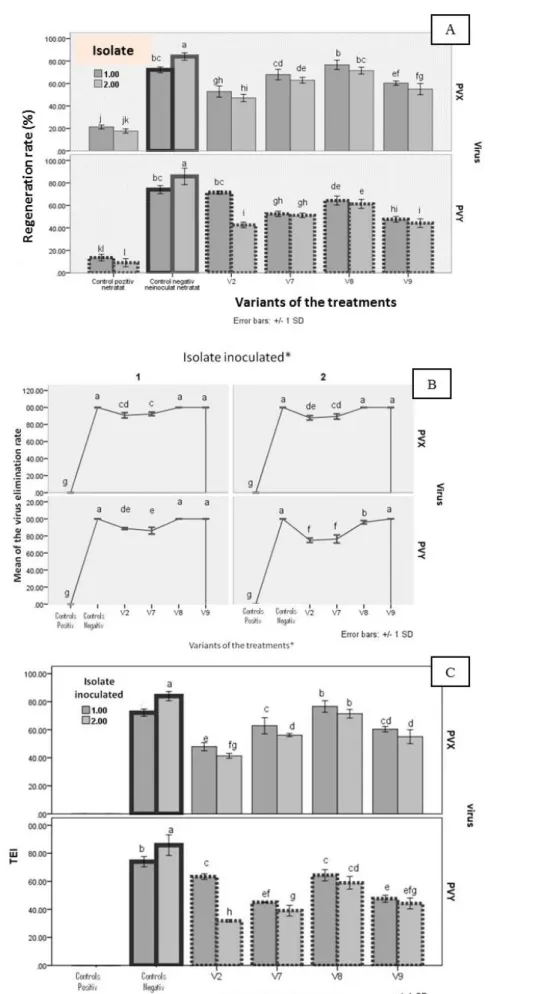
The Figure 1 showed that the two viruses were not very different in responding to the treatments (excepting the variant 100mA, 10minutes). The success of electrotherapy in producing virus-free plants depends upon both plant regeneration and virus elimination rates. An increase in the number of virus-free plants for both viruses was observed as the intensity of the electric current was raised.
After the third subculture (S3), the mean values for regeneration rate (estimated as percentage of total number of regenerated plants from cultivated plants) was 47,6-61,9% for the material PVY infected and treated, respectively 55,0- 72.22% for PVX infected explants treated by electrotherapy and chemotherapy. Concerning the PVY infected material, the action of current applied 5, 10, 20 minutes, lead to the following values of the regeneration rate 51,3%, 61,9% and 47,6% (Table 1). The plants PVX infected had a different behavior, the regeneration rate (the mean values for all the variants) recorded to different values in the variants, in function of the time period of electrotherapy treatment. Thus, in case of material PVX initially infected, using three durations of electrical current (5, 10, 20minutes) the following values were obtained for the values of regeneration rate mean: 63,6%, 72,22% and 55,0% (Table 1). The values obtained for regeneration rate of infected material with PVX were higher than those specified in bibliography [10].
Table 1
Mean values for regeneration rate of the PVY and PVX plants treated (cv. Roclas)
Variant
Electro therapy mA/min
The rate regeneration* of infected material
PVY PVX
Regene rated plantsa/ Treated plants b
%±SD
Regene rated plantsa/ Treated plants b b
%±SD
Positive
control 0/0 3/30 10.0±2.431 5/28 187.8±3.521 Negative
control 0/0 10/12 83.3±2.944 12/14 85.7±6.834
V2 0/0 18/42 42,7±8.611 20/42 47.6±10.672
V7 100/5 20/39 51.3±1.852 28/44 63.6±7.157 V8 100/10 26/42 61.9±9.659 26/36 72.22±9.81 V9 100/20 20/42 47.6±8.392 22/40 55.0±4.064 a
number of regenerated plants (all repetitions);
b
number of treated explants (all repetitions);
*Values = mean of three repetitions. The results were recorded after three subcultures: 2 subcultures S1, S2 explants treated by electrotherapy and a subculture S3 untreated explants transferred on medium MS. S1=subculture on medium MS with antivirals (Oseltamivir 40mg/l +Ribavirin 40mg/l).
Abreviations: PVY= potato virus Y; PVX= potato virus X; SD= standard deviation
22
23
All the plants regenerated from variant V8, after electrotherapy and transferred on medium with antivirals were viruses free for the material PVX infected and in case of
plants PVY infected, only 94% from plants were virus free. For the variants V7 the virus
elimination rate was 78.00% for material inoculated with PVY and treated, respectively 90.22% for material inoculated with PVX.The highest virus elimination rate was obtained at the highest time period of the treatment with electric current (20min, 100mA). Although raising the treatment time, increased the mean virus elimination rate, it also decreased the mean plant regeneration rate, so TEI index has to be used as a basis in identifying the most efficient electrotherapy treatment.
The results of the present research work show that the regeneration of explants in vitro
is influenced by electrotherapy treatment and depends upon the electric current intensity. Many papers suggest that the regeneration rate of virus-free plants obtained after
electrotherapy is higher than that of plants exposed to more conventional virus elimination techniques including meristem culture and chemotherapy [14,15].
Usually, plant regeneration depends upon several factors, including genotype, physiological state of the explant, culture medium, the cultivation conditions and the interactions between these factors [17]. The electric pulses are also reported as stimulants of plant differentiation in vitro [7]. It was demonstrated that regeneration of potato plant tissues could be improved by exposing explants to mild electric currents [12].
Sometime the electrotherapy technique is not more efficient than other conventional techniques in eliminating viruses from plant tissues. However, it seemed to be more effective, faster, easier and less demanding than other methodes in regenerating virus-free plants. It can also be effectively combined with chemotherapy as demonstrated earlier [14,15]. It has been postulated as a hypothesis that viral nucleoproteins may be denatured by when it is exposed to electric current [12]. It has been suggested that denaturation of viral particles may occur during transport through the plasmodesmata in the apoplastic space. Inactivation of specific nucleoprotein that assist in cell-to-cell movement to threedimensional structures leads to blockage, which prevents further penetration of virus particles to healthy cells [7,13]. The molecular basis of this phenomen is poorly understood.
CONCLUSIONS
This study revealed that chemotherapy (40 mg/l RBV + 40 mg/l OSMV) and electrotherapy (100mA, 10 minutes), had beneficial effects on PVX and PVY elimination from potato
plant tissues. But, some elements remain to be tested and/or improved:
- the treatments success is cultivar dependent (we used only cv.’Roclas’)
- the phytotoxicity of the treatments has to be verify
- to estimate the efficiency of the treatments with bulked samples is required
Further investigations are needed for combine chemotherapy + electrotherapy, for improvement and optimization of these techniques.
Acknowledgment This work was supported by a grant of the Romanian National Authority for
Scientific Research, CNDI-UEFISCDI, project number 104/2012.
BIBLIOGRAPHY
1. Bădărău, C.L., Mărculescu, A., Chiru, N., Chiru, S.C., 2012- Benefic effects of essential oils treatments in healthy and potato virus Y infected plants of Solanum tuberosum L. (cv. Roclas) and Nicotiana tabacum (cv.White Burley). Romanian
Agricultural Research29: 281-288.
24
3. Cassel, A.C., 1987- In vitro induction of virus-free potatoes by chemotherapy”. Biotechnology in Agriculture and Forestry, Vol. 3. Potato (ed.) Y.P.S. Bajaj, p. 40-50, Ed. Berlin, Germany, Springer-Verlag.
4. Clark, M.F. and Adams, A.N., 1977- Characterization of the microplate method of the enzyme-linked immunosorbent assay for the detection of plant virus. Journal of General Virology 34: 475-483.
5. Cojocaru, N., Bădărău, C.L., Doloiu, M., 2009- Potato virus Y (PVY) purification and achievement of antisera for ELISA identification of infected plants, in Proceeding of the 2nd International Symposium “New Researches in Biotechnology”, Series F (Special volume), Biotechnology, Bucharest, pp. 18-25.
6. Griffiths, H.M., Slack, S.A., Dodds, J.H., 1990- Effect of chemical and heat therapy on virus concentrations in in vitro potato plantlets. Canadian Journal Botanic 68: 1515-1521.
7. Hormozi-Nejad, M.H., Mozafari, J., Rakhshandehroo, F., 2010- Elimination of Bean common mosaic virus using an electrotherapy technique. Journal of Plant Diseases and Protection 117 (5): 201–205.
8. Hull, R., 2002- Induction of disease: Virus movement through he plant and effect on
plant metabolism. In: Matthew’s Plant Virology, Fourth Edition, pp. 373-41.
9. Jung-Yoon, Y., Hyowon, S., Young-Mee, C., Young-Eun, P., 2003- Ribavirin, electric current and shoot tip culture to eliminate several potato viruses. Journal of Plant Biotechnology 5: 101-105.
10. Klein, R.E., Livingston, C.H., 1982 Eradication of potato virus X from potato with ribavirin treatment of cultured potato shoot tips. American Potato Journal 59: 359-365. 11. Klein, R.E., Livingston, C.H., 1993- Eradication of potato viruses X and S from potato shoot-tip cultures with ribavirin. Phytipathology 73: 1049-1050.
12. Lozoya-Saldaña, H., Abelló, F.J., García, G.., 1996- Electrotherapy and shoot tip culture eliminate potato virus X in potatoes. American Potato Journal 73:149-154
13. Sabry Mahmoud, Y.M., Maher, Hosseny, H., Mahmoud, S.Y.M., Abdel-Ghaffar, H.,
2009 Evaluation of some therapies to eliminate Potato Y Potyvirus from potato plan.
International Journal of Virology 5: 64-76.
14. Schuster, G., 1988- Synthetic antiphytoviral substances. Applied Virology Research 1:
265-283.
15. Mahmoud, S.Y.M., Hosseny, M.H., Abdel-Ghaffar, M.H., 2009- Evaluation of some therapies to eliminate potato Y potyvirus from potato plants. International Journal of Virology 5: 64-76.
16. Steward, G., De Boer, S., Lorenzen, K. ,Withworth, J., Nolte, P., Singh, R.,.
Boucher, A, Xu ,H., 2010- Potato virus Y an evolving concern for potato crops in the United State and Canada. Plant Disease 94(12): 1384-1397.