DEHYDRATION OF FRUITS AND VEGETABLES IN
THE MICROWAVE FIELD
GLODEANU MIHNEA, ALEXANDRU TUDOR, VASILE CRISTIAN University of Craiova, Faculty of Agriculture
Keywords: vegetables, fruits, proteins, microwave
ABSTRACT
Vegetables and fruits are basic materials for the food, due to the high content of proteins, lipids, carbohydrates, and minerals such as potassium, sodium, magnesium, etc. Having regard to those considerations eating fruits and vegetables is recommended during the entire year, being beneficial to health.
The seasonal nature of these products, relatively short harvest periods, large or medium perishable character determined constantly improving of conservation technologies through dehydration for vegetable products, in order to enhance product quality, reduce nutrient losses, increasing the safety and efficiency of machinery, etc.
Because traditional methods of dehydration of fruits and vegetables does not ensure maintenance of color, flavor, texture, state of enzymes, proteins, fats and vitamins content, it requires the development of alternative methods, which reduce the effects caused by time and temperature on on vegetal products, in the same time with the elimination of chemical treatments.
An important direction in researches concerning conservation through drying of fruits and vegetables it refers to the use in the process of the the microwaves. For this purpose paper proposes to establishthe dehydration technology of fruits and vegetables, achieved through a dehydration instalation with controlled microwave regimen and also the advantages of using this ecological procedure.
INTRODUCTION
Technology dehydration of fruits and vegetables in microwave field, comprising several distinct phases and operations performed in a specific order.
Ordered assembly of operations that are running in frame of the dehydration process of fruits and vegetables determines the technological flow. Achieving technological flow includes specialized machinery and systems compatible from constructive and functional point of view (Banu C., et al., 2002).
Structure of technological lines of dehydrated fruit and vegetable production is achieved begining from drying device. In this case, microwave dehydration device can be used independently, or can be integrated into a complex production lines, with continuous flow (Niculae, D. et al., 1997, Popescu C., 2006).
The installation, performed the treatment of fruit and vegetables in the microwave field in order to dehydration, intended for food consumption, or for other food industry processes and technologies (David C. T., 1984, Miron D. et al.,1986)
Main technological operations performed in the dehydration of fruits and vegetables in the microwave field are: reception fruits/vegetables; washing, division into pieces; blanching; dehydration in microwave field; sorting losses; packaging and storage.
Status parameters of the product, that define and characterize the process of dehydration are the following: temperature (%); moisture (%); the speed of drying (% moisture/min).
Determination of mentioned state parameters was made taking into account the following factors:
- initial mass (mi) of the load introduced into the processing chamber with microwave
- the percentage of dry substance (DS) in the product (%);
- time intervals (t) between the measurements were made (min);
- quantities of water (w) extracted from samples during the time intervals t (g). Expression of the percentage of the amount of water (A) removed from the product is determined by the relation (Jones, P.L., 1995):
(%) 100
) (
100
2 2 1
M M M A
(1)
where: M1is the initial moisture and M2- final moisture content;
Drying speed (sD) is given by the amount of water evaporated per unit time to 100
kg of dry matter:
sD= F100. sevap ( %/min) (2)
where: F100= S·100·; S - surface evaporation for 1 kg of the product (m2);
-=100/DS - the amount of material which contain 1 kg dry matter; - SU - the percentage of dry substance from the product (%);
The moisture evaporation rate is defined as the amount of water that is evaporated per unit area per unit time (Jones, P.L., 1995):
DS
s w
evap
100 . 0
(g/m2·min) (3)
wherew0= Δm/Δtis the the amount of water evaporated from the sample per unit time
(g/min); Δm and Δt- the variation of the amount of mass of the sample, respectively the
time interval in which it occurred.
MATERIAL AND METHODS
For dehydration of some species of fruits and vegetables was used a microwave system which comprises an magnetron tube model Panasonic 2M137 (forced air-cooled) (http://www.electronic-spare parts.com/descript/2/2m137.htm).
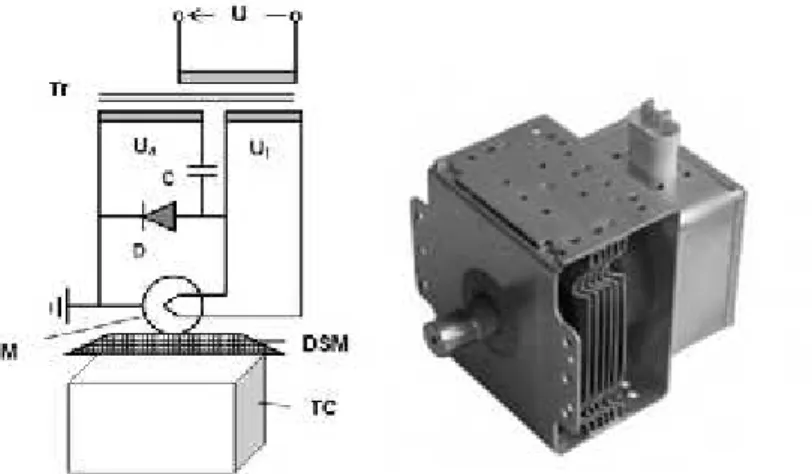
Scheme of the continuous generator of microwaves (with magnetron) used in experiment is shown in figure 1 (Lojewski G., 2005).
after (http://electronica-azi.ro/2003/06/26/magnetronul-generator-continuu-de-microunde-pentru-cuptoare-de-
uz-industrial-si-casnic/;http://webhost.uoradea.ro/vsoproni/fisiere%20site/tehnologii-cu-microunde-laborator.pdf)
a) b)
Fig. 1. a) Scheme of microwave generator with magnetron: Tr - high voltage transformer; U – supply tension; Ua- anode voltage; Uf- filament voltage; C – high tension capacitor; D - high tension diode;
Technical characteristics of the magnetron used are presented in table 1.
Table 1
The average composition of waste water resulting from a milk processing enterprises Magnetron tube model Panasonic 2M137
Output Power (kW) 1,3
Filament Voltage Vac) 4,4
Filament Current (Aac) 14
Anode Voltage (V) 4,5
Frequency (MHz) 2455
Outline Dimension (mm) 125x100x134
Weight (kg) 1,2
The experiments were carried out in accordance with the technological operations described above, and were carried out on the following species and varieties of fruit and vegetables: apples (Jonathan); pears (Napoca); carrots(Triumf).
For conducting experiments apples and pears were cut into slices with a thickness of about 8 mm, and carrots into slices with thickness of 3-4mm.
Working process of the installation of dehydration with microwave is carried out as follows:
- the products are placed as evenly as possible (in treatment chamber) in a layer with a thickness which varies according to the physico-chemical properties;
- applying microwave treatment;
- dehydrated material is discharged and analyzed. In all cases it was started from the initial sample data:
- initial state (natural/treated);
- initial mass of the sample: 250 (g);
- initial temperature (0C); - initial moisture (%),
and it has sought to achieve final humidity (%) provided in product standards.
RESULTS AND DISCUSIONS
Based on measurements made during the course of the experiments and applying mathematical relationships calculation above, it was determined state parameters of the product during the drying process in the microwave field.
Table 2
Experimental results for apples dehydration regimen
Nr.
Drying time between measurement
s∆t (min)
Temperature (0C)
Sample weigt m
(g)
The amount of water evaporated from within the
measurement range ∆m ( g)
Moisture (%)
Speed drying (%moist/min)
Rate of evaporation
of water (g/m2min)
Obs.
1 0 18,0 250,00 0 79,8 0 0 Initial
heating
2 5 42,5 250,00 0 79,7 4,9 15,5
3 5 59,5 237,50 12,50 78,7 5,9 17,8
4 5 62,0 220,25 17,25 76,8 9,2 35,3
Drying with approx. constant speed
5 5 61,5 202,40 17,85 74,5 9,1 35,0
6 5 61,5 184,29 18,11 72,6 9,1 35,0
7 5 61,0 165,80 18,49 70,1 9,2 35,3
8 5 61,8 147,07 18,73 67,8 9,2 35,3
9 5 62,3 127,34 19,73 63,2 9,0 34,6
10 5 61,5 108,11 19,23 60,4 9,2 35,3
11 5 60,9 90,01 18,10 56,6 9,2 35,3
12 5 62,6 72,53 17,48 45,3 6,1 33,8 Final
drying
13 5 61,3 63,79 8,74 24,4 3,9 16,9
14 10 35,4 58,80 4,99 19,3 3,6 6,1 Cooling
The data recorded during the test and calculated physical quantities that define the evolution of state parameters during the dehydration process is presented in tables 2, 3, 4.
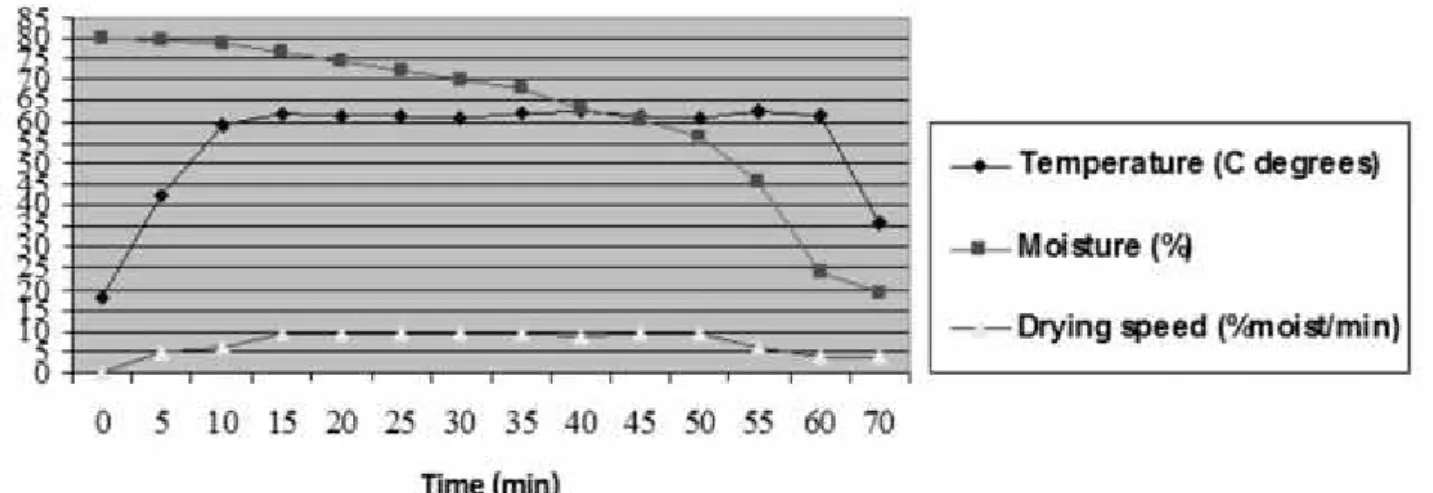
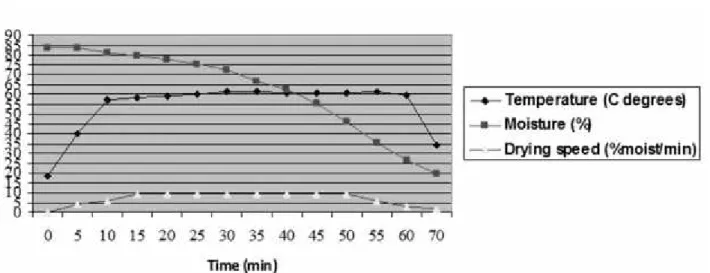
Based on the values presented were traced the typical dehydration curves obtained using microwave technology (fig. 2, 3, 4).
Fig. 2. Variation of status parameters during the dehydration of the variety Jonathan apples.
Analyzing the values of the table2 and following the evolution of state parameters (temperature, humidity, speed of drying) of figure 2, shows the following:
- drying process of the apples from 79,8% to 19,3% moisture was carried out with the rate of evaporation of water (in the drying procedure) at a approx. constant average rate of 35,1 g/m2·min;
- the average speed of drying during the drying period at a approx. constant rate was 9,1% moisture/min;
- average operating temperature drying the constant drying regimen was about 61,30C;
Laboratory test results highlight the quality of the finished product, expressed through organoleptic and physico-chemical properties determined from samples collected from experiments.
Table 3
Experimental results for pears dehydration regimen
Nr.
Drying time between measurement
s∆t (min)
Temperature (0C)
Sample weigt m
(g)
The amount of water evaporated from within the
measurement range ∆m ( g)
Moisture (%)
Speed drying (%moist/min)
Rate of evaporation
of water (g/m2min)
Obs.
1 0 18,5 250,00 0 83,6 0 0 Initial
heating
2 5 40,2 250,00 0 83,6 4,4 12,1
3 5 57,0 238,60 11,40 81,2 6,1 16,9
4 5 58,4 220,99 17,61 79,6 9,3 36,3
Drying with approx. constant speed
5 5 58,8 202,76 18,23 77,5 9,4 36,7
6 5 60,2 183,86 18,90 75,3 9,5 37,1
7 5 61,0 164,26 19,60 72,1 9,5 37,1
8 5 61,3 143,50 20,76 66,6 9,4 36,7
9 5 60,8 122,86 20,64 62,3 9,5 37,1
10 5 60,4 103,10 19,76 55,4 9,5 37,1
11 5 60,6 84,30 18,80 46,1 9,4 36,7
12 5 61,2 69,28 15,02 35,2 5,9 22,0 Final
drying
13 5 59,7 58,84 10,44 26,3 3,1 11,2
14 10 34,4 54,62 4,22 19,4 1,6 4,7 Cooling
Fig. 3. Variation of status parameters during the dehydration of the variety Napoca pears.
Analyzing the values of the table 3 and following the evolution of state parameters (temperature, humidity, speed of drying) of figure 3, shows the following:
- drying process of the pears from 83,6% to 19,4% moisture was carried out with the rate of evaporation of water (in the drying procedure) at a approx. constant average rate of 36,8 g/m2·min;
- the average speed of drying during the drying period at a approx. constant rate was 9,4% moisture/min;
- average operating temperature drying the constant drying regimen was about 60,1 0C;
Laboratory test results highlight the quality of dehydrated pears.
Table 4
Experimental results for carrots dehydration regimen
Nr.
Drying time between measurement
s∆t (min)
Temperature (0C)
Sample weigt m
(g)
The amount of water evaporated from within the
measurement range ∆m ( g)
Moisture (%)
Speed drying (%moist/min)
Rate of evaporation
of water (g/m2min)
Obs.
1 0 18,0 250,00 0 81,2 0 0 Initial
heating
2 5 41,3 250,00 0 80,7 0,8 0,9
3 7 58,0 233,75 16,25 80,4 5,4 13,8
4 7 60,2 208,50 25,25 77,5 14,8 36,0
Drying with approx. constant speed
5 7 60,5 181,25 27,25 74,3 15,0 36,5
6 7 60,7 152,25 29,00 70,1 15,1 36,8
7 7 61,8 121,65 30,60 65,8 15,1 36,8
8 7 63,3 91,90 29,75 51,4 15,0 36,5
9 7 64,2 63,16 28,74 50,1 14,9 36,3
10 7 62,1 34,46 28,70 32,3 6,8 17,0 Final
drying
11 7 64,4 28,48 5,98 16,6 4,1 10,0
12 10 34,6 26,31 2,17 9,8 0,6 1,4 Cooling
Total time: 78 min.
Analyzing the values of the table 4 and following the evolution of state parameters (temperature, humidity, speed of drying) of figure 4, shows the following:
- drying process of the apples from 81,2% to 9,8% moisture was carried out with the rate of evaporation of water (in the drying procedure) at a approx. constant average rate of 36,4 g/m2·min;
- the average speed of drying during the drying period at a approx. constant rate was 14,9% moisture/min;
- average operating temperature drying the constant drying regimen was about 61,70C.
CONCLUSIONS
1. The main advantage of microwave heating to the conventional process consists in heating at the same time of the whole volume of the material.
2. Using the method of microwave drying it is a solution that significantly reduce energy consumption and decreasing the duration of treatment.
3. Other advantages of the use of microwave dehydration are simplifying construction and reducing the size of technological installations and not least, increasing the quality level of final products.
4. Analyzing the results obtained from experiments (compared with the requirements of product standards) highlights the quality requirements, in the case of dehydrated fruits and vegetables by application the drying technology in the field of microwave.
BIBLIOGRAPHY
1. Banu C., et al., 2002, Engineer's handbook of food industry, TECHNICAL Publishing House,Bucharest.
2. David C. T., 1984, Microwawe heating for the food industry in overview Trumpler, R. F. G.
3. Jones, P.L., 1995, The Industrial Applications of RF and Microwave Heating -Microwave and high frequency heating - Short Course, International Conference St. John’s College, Cambridge University, U.K.
4. Lojewski G., 2005, Microwave Devices and Circuits, TECHNICAL Publishing House,Bucharest.
5. Miron D. et al., 1986, Technological installations with microwave with applications in industry,Symposium "Academy Days Iasi" 10-15 nov., Iaşi.
6. Niculae, D. et al., 1997, Microwave Heating Application, Microwave and High Frequency,Heating International Conference, Fermo, Italy.
7. Popescu C., 2006,Pedologie – bonitare funciara, Editura Universitaria, Craiova. 8.
http://webhost.uoradea.ro/vsoproni/fisiere%20site/tehnologii-cu-microunde-laborator.pdf
9. http://electronica-azi.ro/2003/06/26/magnetronul-generator-continuu-de-microunde-pentru-cuptoare-de-uz-industrial-si-casnic/