© Asian Academy of Management and Penerbit Universiti Sains Malaysia, 2020. This work is
EXAMINING STUDENTS’ CONTINUANCE USAGE
INTENTION FOR WEB-BASED EDUCATIONAL TOOLS:
A DEVELOPED INTEGRATED STRUCTURAL
MODEL APPROACH
Azizul Yadi Yaakop1*, Nomahaza Mahadi2, Zailin Zainal Ariffin3, Zuha Rosufila Abu Hasan1, and Madzli Harun1
1Faculty of Business, Economics and Social Development, Universiti Malaysia Terengganu, 21030 Kuala Nerus, Terengganu, Malaysia
2Azman Hashim International Business School, Universiti Teknologi Malaysia, Jalan Sultan Yahya Petra, 54100 Kuala Lumpur, Malaysia
3Universiti Pertahanan Nasional Malaysia, Kem Sungai Besi, 57000 Kuala Lumpur, Malaysia
*Corresponding author: [email protected]
Published online: 30 June 2020
To cite this article: Yaakop, A.Y., Mahadi, N., Zainal Ariffin, Z., Abu Hasan, Z.R., & Harun, M. (2020). Examining students’ continuance usage intention for web-based educational tools: A developed integrated structural model approach. Asian Academy of Management Journal,25(1), 25–41. https://doi.org/10.21315/aamj2020.25.1.2
To link to this article: https://doi.org/10.21315/aamj2020.25.1.2 ABSTRACT
The primary objective of this study is to examine an integrated model of continuance intention within the context of task-technology fit (TTF) model and technology acceptance model (TAM); to empirically test this integrated model in explaining students’ continuance usage intention of web-based educational tools. To this end, Malaysia’s Ministry of Education has set a theme of Higher Education 4.0: Knowledge, Industry and Humanity as a pledge in the effort to revamp the higher education ecosystem in Malaysia. The elements, inter alia, is to implement 21st century pedagogy incorporating the latest teaching and learning technologies. Parallel with this initiative, the usage of Web 2.0 interactive educational tools has gained a significant recognition in Malaysia’s higher education in recent years. A new model integrating TTF model and TAM is introduced in this study. This study applied quantitative survey in the main data collection. Purposive sampling technique was used, and the data collection was conducted in a public university via Google Forms. In this study, SmartPLS is used to analyse the data. Even though the findings are partly hypothetical, it is inspiring to reveal an integrated conceptual model in
exploring consumer behavioural intention related to Malaysia’s higher education context. It is hoped that the findings will suggest the legitimacy of the integrated framework and insights in Malaysian users’ continuance intention about adopting Web 2.0 educational tools.
Keywords:task-technology fit model, technology acceptance model, Web 2.0 educational
tools, TTF, TAM
INTRODUCTION
Web 2.0 applications are gaining popularity and present many educational benefits in the context of teaching and learning in higher education. The beneficial outcomes in integrating technology into information literacy classes resulted in the increase of the level of engagement, creativity, and reflection from the participants in active learning scenarios (Maceira & Wong, 2017). A robust development in technology has positioned the usage of Internet as powerful learning tool in educational environment and it has become imperative to understand the continuance usage intentions among students (Huang et al., 2014), particularly learners in tertiary education (Althunibat, 2015). In addition, Ghavifekr and Mahmood (2017) posited that the component of co-participatory activities and student demographic element were found to be the main factors affecting the usage of the e-learning platform in Malaysia. However, empirical study exploring the barriers to the integration of technology into higher education, such as technology infrastructure, technology satisfaction, faculty effort, and graduates’ competency are scarce and lack of comprehensive understanding (Alzu’bi et al., 2014; Liu, 2008; Masrek, 2015). Particularly, research concerning students in higher education situated in developing countries (Iqbal & Qureshi, 2012; Cheon et al., 2012).
Following through, many researchers proposed that the factors explaining students’ continuance usage intention of web-based educational tools as a learning adoption should be conducted in various universities in order to broaden the understanding (Cheon et al., 2012; Masrek, 2015), reduce generalisation, and further validating the prior research findings (Huang, 2014). For this reason, a compounded collaborative result should precisely underlie the importance of continuance intention about adopting Web 2.0 educational tools particularly within the higher education ecosystem in Malaysia. Nonetheless, the area is still in an introductory stage in Malaysia and requires more insights in order to accomplish a successful implementation and integration (Maceira & Wong, 2017; Mirabolghasemi et al., 2011). In order to achieve a successful implementation and adoption of this technology amongst students in tertiary education, it is essential to understand the confounding factors of the learning adoption. Mirabolghasemi et al. (2011)
proposed that students react differently when dealing with a new technology. This is in relation with the result of a research conducted in public universities in Malaysia that shows students are not afraid of venturing and exploring internet learning but anxious about the cost incurred such as cost of the devices and services (Mirabolghasemi et al., 2011). However, the extent to which continuance usage intention may have impact on the behavioural intention to use web-based educational tools is yet to be established. Ain et al. (2015) defined behavioural intention as a construct to understand individual’s intention in using a particular technology for a variety of tasks. Correspondingly, this paper explored the impact of continuance intention within the context of task-technology fit (TTF) model and technology acceptance model (TAM), to better understand the students’ continuance usage intention of web-based educational tools in Malaysia higher education.
Although it is clear that the use of Web 2.0 interactive learning tools is on the rise and the fact that the implementation of e-learning in Malaysia has been going on for over a decade, there has been a dearth of emphasis placed to verify students’ adoption, satisfaction, and continuance intention towards this technology, especially among Malaysian students. In a recent study by Ghavifekr and Mahmood (2017), the component of co-participatory activities and student demographic element were found to be the main factors affecting the usage of the e-learning platform in Malaysia. They posited that it is best to look on the function of connecting the students and lecturers and improve from there because barriers like this could lead to frustration amongst academic faculty and students in their goal of exploiting the potential of Web 2.0 learning technology, which is rapidly changing the national education landscape. Because of these swift developments, the mechanism of realisation of the intention to continue using the technology will need to be continually updated. It raises a need of further research of web-based educational tools implications by considering multiple factors adopted from the existing body of frameworks having influences on continuance usage. Besides the ever-growing attention to this pedagogy, studies have to be more detailed and valid responses need to be gauged to understand the phenomenon from a limited student population. Mun and Hwang (2003) argued that identifying the critical factors related to user acceptance of technology continues to be an important issue considering the growing reliance on information systems and increasing rapidity of the introduction of new technologies into learning environment.
There were studies conducted in Universiti Teknologi Malaysia and Monash University during the early years of e-learning implementation 2004–2007. The findings show that students were prepared for the innovative approach of learning merely as a supporting tool and not as a primary component of knowledge delivery
system. The question is: In the era or Industrial Revolution 4.0, has the role of Web 2.0 learning perceived as an integral part of the system? Or is it still a supporting tool? A decade after this implementation, students’ acceptance, and satisfaction and continuance usage intention of Web 2.0 educational tools could be further understood. The research focused on an integrated theoretical framework of TTF model and TAM to examine the phenomenon. The integrated framework was first introduced by Wu and Chen (2017) to examine students’ continued usage of massive open online courses (MOOCs) in China.
LITERATURE REVIEW
TTF Model
TTF model is a commonly used model to evaluate how information technology leads to performance by assessing the match between task and technology characteristics (Wu & Chen, 2017). Consumers’ ability to use the technology is believed to be determined by both the characteristics of the task and the technology. Although the model has been widely used in many information technology research works, studies that integrate TTF and TAM are somewhat lacking and vague. TTF are two dimensional – individual-technology fit (IT) and task-technology fit (TT). Individuals’ degree of familiarity and length of experience with information system are normally associated with their adaptation behaviour (Wu & Chen, 2017). This scenario depicts IT. The more experienced one is with a system, the better they know and understand how the system works. In the context of online shopping behaviour, consumers who are familiar with the online shopping system or technology used in e-commerce are said to feel at ease using the technology. On the other hand, TT is the degree of how the capabilities of the information system match the tasks that the consumer must perform (Goodhue et al., 2000). Empirical studies have suggested that both IT and TT predict perceived ease of use (PEOU) and perceived usefulness (PU). Thus, the first set of hypotheses is formulated to investigate the influence of TTF model, i.e., IT and TT, on PU and PEOU of Web 2.0 educational tools in Malaysia:
H1: IT significantly predicts PU of Web 2.0 educational tools in Malaysia
H2: IT significantly predicts PEOU of Web 2.0 educational tools in Malaysia
H3: TTF significantly predicts PU of Web 2.0 educational tools in Malaysia
H4: TTF significantly predicts PEOU of Web 2.0 educational tools in
TAM
TAM is an adaption of theory of reasoned action (TRA) which was developed by Davis (1989) to measure the level of technology acceptance and the acceptance in using Internet to make online transaction. TAM assumes that users’ behavioural intention to use a particular system can be employed to determine the actual system usage. The original level of the consumer technology acceptance can be measured by using four dimensions namely PEOU, PU, attitude towards usage of the new technology (AT), and the intention towards usage of the new technology. PEOU and PU are known as two fundamental factors to determine users’ acceptance of technology. According to Rafique et al. (2014), TAM is a concept that can represent the consumers, how they start or adapt new technological system or information technology, and it is widely used to identify individual intention in using new technology. Various versions of extended TAM have been proposed and frequently used and they are amongst the most important models for understanding consumers’ views toward online learning environment (Abdullah & Ward, 2016; Al-Gahtani, 2016). In the context of this study, TAM is a framework that fits the purpose to predict university students’ Web 2.0 continuance usage intentions. According to Çelik and Yilmaz (2011), the initial TAM variables may not adequately to measure the key that influence consumer attitude and intention toward online shopping. Alalwan et al. (2018) have extended TAM including perceived enjoyment, innovativeness and trust in their study. The enjoyment is a major factor that influences consumers to use new technology, while trust plays an equal important role in consumer online shopping behaviour. Purani et al. (2019) have also used the extended TAM to include behavioural aspects related to a specific section of customers – personal characteristics and social influences were the main focus. The result from the studies indicates that perceived risk is related to the intention to adopt online shopping. The result shows that the less perceived risk of a user in online shopping, the more likely that the user adopts to online shopping. From the result, the personal characteristic and trust also have significant influence on the consumer intention to adopt online shopping. After a series of research, the variables of the TAM have been extending widely with the inclusion of variables such as perceived risk (PR), subjective norm (SN), perceived trust (PT), and perceived enjoyment (PE) to the the classical TAM (Pavlou, 2003; Wu & Chen, 2017). The dimension of PEOU has been a significant factor included in various studies, among others, studies that examine accessibility of information, navigation of website, functionality and process of ordering (Reibstein, 2002). In the context of this research, it is opined that consumers like to adopt websites that are user-friendly (Chiu et al., 2005; Jambulingan et al., 2016). A good design website can increase consumer satisfaction and lead to a higher online shopping intention (Lee & Lin, 2005). If consumer perceived the website is difficult to use, complicated
and ambiguous, they will have a lower intention toward online shopping. Thus, fifth and sixth hypotheses are formulated to investigate the influence of PEOU on PU and attitude towards usage of Web 2.0 education tools in Malaysia:
H5: PEOU significantly predicts PU of Web 2.0 educational tools in
Malaysia
H6: PEOU significantly predicts the attitude towards usage of Web 2.0
educational tools in Malaysia
In this research, PU refers to the consumers’ beliefs about the usefulness of Internet webstore for their online shopping behaviour. PU is said to affect consumers’ intention both directly and indirectly through consumers’ favourable attitude (Pavlou, 2003; Lai & Wang, 2012; Ducey, 2013). In the previous study conducted in Malaysia, PU of a specific system had a direct significant influence on the usage (Oly Ndubisi & Jantan, 2003). Kim and Song (2010) stated that the intention to purchase through the internet is influenced by the PU and consumers are expected to purchase online because of its convenience. The PU of online shopping platforms may influence the consumers’ online purchase intention in the future (Cheng & Yee, 2014). Therefore, the seventh hypothesis is developed to test whether PU positively influences attitude towards usage of Web 2.0 education tools in Malaysia:
H7: PU significantly predicts consumers’ attitude towards usage of Web
2.0 educational tools in Malaysia
Attitude is defined as a favourable or unfavourable, negative or positive evaluative reaction towards something or someone (Davis, 1989). Attitudes also refer to happiness, dislike, feelings of joy, disgust, pleasure, or hatred towards a given behaviour (Triandis, 1979). Attitude towards a behaviour refers to the degree of which person has unfavourable or favourable evaluation of the behaviour. Attitude towards online shopping can be defined as positive or negative emotion of consumer drive to stimulus purchasing behaviour on the Internet (Schlosser, 2003). According to Davis (1989), consumer intention to use an information system is influenced by attitude towards behaviour of use and attitude is an intermediary between perception and behaviour explanatory. To investigate consumer intention, one has to identify consumers’ attitude towards online shopping. It is known that the attitude towards online shopping has a substantial impact on online purchasing intention. For example, if a consumer is unlikely to have a favourable predisposition towards online shopping, an excellent product sold online for this particular consumer would be meaningless. Other research
works have discovered similar result, i.e., attitude and online purchase behavioural intention are related, and intention to use an internet transaction is dominated by favourable predisposition towards online transaction (attitude) (Zarrad & Debabi, 2012). Therefore, the eighth hypothesis was developed to test the predictability of attitude towards continuance usage of Web 2.0 education tools in Malaysia:
H8: Attitude towards usage of Web 2.0 educational tools significantly
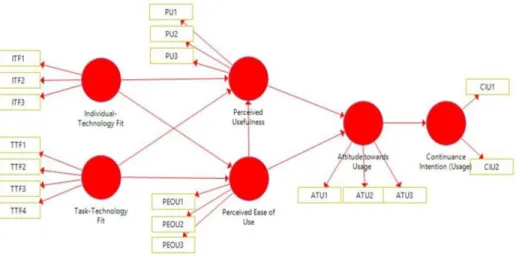
predicts continuance usage of Web 2.0 educational tools in Malaysia The following diagram illustrates the research framework of this study.
Figure 1. Research framework
METHODOLOGY
The study was exploratory and descriptive, and carried out hypotheses testing on the collected responses. The respondents were explained about the key variables’ characteristics; once their responses have been collected and analysed, relationships would be drawn between variables as per proposed model in order to test the hypotheses. There is no or minimal research interference and this research is based on field study. Existing studies on the key variables covered in this study were mostly based on self-administered questionnaires, as they alleviated biasedness of the respondents and hence result in minimum or no research interference. In the quest for a better model to elucidate students’ acceptance, satisfaction, and continuance intention towards Web 2.0 educational tools, the researcher holds to the belief that past tested framework can direct one to the reality of reasoning.
Accordingly, the possibility of the reality being the outcome of an observed model is pursued. This can be achieved through quantitative methods of processing data in which the researcher allows the observed model to describe the reality, and most importantly, are free from making any intuitive judgements in explaining the phenomena. Furthermore, in this research, the study setting was non-contrived in which field study method was used and the researcher interference was mostly avoided. Unit of analysis in this study was individuals as the responses were gauged based on the individual perception and experience with regards to the variables under study. A purposive sampling method is used in this study because the population frame is non-existent and the scope is limited to students attending courses using Web 2.0 educational tools (such as, but not limited to, blendspace. com, voicethread.com, padlet.com, and getkahoot.com) during semester 2, session 2017/2018 and semester 1, session 2018/2019 in a public university in the east coast of Malaysia. A total of 159 responses were collected from the period of the academic semester. Since the study planned to use SmartPLS for analyses, small sample size is common to investigate theoretical models like the one proposed by this study (Willaby et al., 2015). In this study, cross-sectional study was carried out, where questionnaires were sent to the required respondents through online Google Forms application. This quantitative survey study was based on an online set of questionnaires consisting of two sections. The online questionnaires were launched to all potential respondents at the end of the courses. Section 1 aims to gather the socio-demographic background of each respondent. Meanwhile, Section 2 of the questionnaire consists of questions related to variables measuring TTF-ECM. Data collected was coded and recorded in SPSS for descriptive statistical analyses and SmartPLS for post-hoc analyses.
RESULTS
Measurement model is also known as outer model in PLS-SEM. It is used to establish latent variables by certain indicator variables. There are two types of measurement models, which are reflective measurement model and formative measurement model; this paper uses the reflective measurement model. There are several steps to assess the reliability and validity of the construct measure. They are Internal Consistency, Indicator Reliability, Convergent Validity, and Discriminant Validity. After the reliability and validity are established, the structural model can then be examined (Hair et al., 2014). The composite reliability (CR) is a method to assess for internal consistency. According to Hair et al. (2013), the CR should be higher than 0.70. According to Table 1, the value of construct range is between 0.869 and 0.959. As can be seen on Table 1, the outer loadings and the AVE values are between the suggested values.
Table 1
Result summary for reflective measurement model
Construct Items Loading CR AVE Decision
IT ITF1 0.846 0.869 0.689 Supported
ITF2 0.864
ITF3 0.778
TT TTF1 0.837 0.926 0.806 Supported
TTF2 0.889
TTF3 0.841
TTF4 0.892
PU PU1 0.910 0.904 0.759 Supported
PU2 0.930
PU3 0.853
PEOU PEOU1 0.853 0.905 0.76 Supported
PEOU2 0.889
PEOU3 0.872
Attitude towards usage ATU1 0.888 0.959 0.921 Supported
ATU2 0.850
ATU3 0.877
Continuance usage
intention CIU1CIU2 0.9630.956 0.922 0.748 Supported Discriminant validity can be measured by two methods, which are cross loadings and Fornell-Larcker criterion (Hair et al., 2013). The Fornell-Larcker criterion is a second approach to assess Discriminant Validity. Table 2 indicates that the value of square root of each construct is higher than its highest correlation with other constructs. This indicates that discriminant validity is achieved.
Structural models signify the theoretical or conceptual element of the path model (Hair et al., 2013). The methods to assess the structural model are coefficients of determination (R2) and path coefficients. The assessment of structural model also
answers H1 until H8. If the regression model is properly applied and estimated, it
can be assumed that the higher the value of R2, the greater the exploratory power
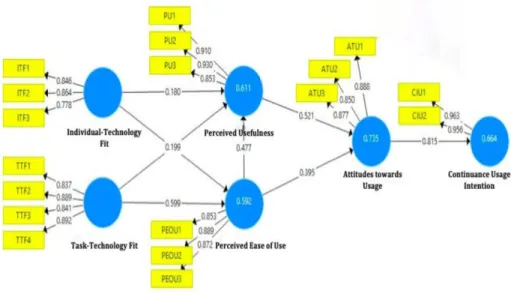
of the regression equation and therefore the better the prediction for the dependent variable (Hair et al., 2013). Referring to Figure 2, the value of R2 is 0.664, which
of the variance in continuance intention. Another 33.6% is explained by other variables that can be identified in a different research.
Table 2
Fornell-Larcker criterion
Construct IT PU PEOU Attitude towards
usage
Continuance
usage intention TTF
IT 0.830
PU 0.645 0.898
PEOU 0.661 0.747 0.871
Attitude towards
usage 0.682 0.816 0.784 0.872
Continuance
usage intention 0.652 0.731 0.666 0.815 0.960
TTF 0.754 0.696 0.757 0.788 0.790 0.865
Figure 2. Measurement model
The PLS-algorithm is run to evaluate the relationship of exogenous variable and endogenous variable. Other than that, in order to determine the significance level, bootstrapping is applied through SmartPLS and the results are revealed by the output of path coefficient on Table 3. According to Hair et al. (2013), the significant
value of one-tailed is **p < 0.01 (2.33) and *p < 0.05 (1.645). Table 3 illustrates that
H1 until H4 are supported (β = 0.180, p < 0.01, β = 0.209, p < 0.05, β = 0.199, p <
0.05, β = 0.599, p < 0.01), which confirms that IT and TT have influence on PEOU. It is important to note that analysis for H3 is supported with marginal significance as the p-value was slightly greater than 0.05. Other than that, H5 and H6 are also
supported (β = 0.477, p < 0.01, β = 0.395, p < 0.01), which confirms that PU and attitude towards usage were influenced by PEOU. H7 is supported (β = 0.521,
p < 0.01) which confirms that PU has influence on attitude toward usage. H8 is also
supported (β = 0.815, p < 0.01) which confirms that continuance usage intention was influenced by attitude toward usage. The structural model is analysed to test the hypothesis. The PLS bootstrapping was run to confirm the hypotheses among the variables.
Table 3.
Path coefficients
Hypothesis Original sample
(O)
Standard deviation (STDEV)
T statistics (|O/
STDEV|) p values Decision
H1 IT → PU 0.180 0.076 2.380 *0.018 Supported
H2 IT → PEOU 0.209 0.075 2.782 **0.006 Supported
H3 TT → PU 0.199 0.103 1.943 *0.053 Supported
H4 TT → PEOU 0.599 0.067 8.989 **0.000 Supported
H5 PEOU → PU 0.477 0.109 4.359 **0.000 Supported
H6 PEOU → Attitude
towards usage 0.395 0.058 6.874
**0.000 Supported
H7 PU → Attitude
towards usage 0.521 0.063 8.316
**0.000 Supported
H8 Attitude towards
usage → Continuance
usage intention
0.815 0.027 30.097 **0.000 Supported
Note: **p < 0.01 (2.33), *p < 0.05 (1.645) DISCUSSION
This study further verifies the notion that the two-dimensional TTF has a strong influence on students’ perception about the ease of use and usefulness of this new pedagogical method of teaching. In a recent study by Sun et al. (2019), TTF was also found to have an impact on TAM. In a nutshell, this empirical study offers an alternative measurement of technology acceptance measurement together with
the suggestion to establish an integrated model of TFF-TAM, in the design and improvement of technological continuance usage context. Each dimension was found to have a significant positive relationship as hypothesised except for TT-PU by a marginal p-values. However, the study did not focus on some other factors, supposedly providing the most accurate explanation to technological continuance usage. Future research might wish to conduct studies to highlight this issue, possibly using a combination of structured and unstructured approaches which may enhance the validity and reliability of the research findings.
All in all, it is inspiring to reveal an integrated conceptual framework in exploring students’ continuance usage behavioural intention in this new pedagogical methodology in Malaysia. Facing more sophisticated students’ needs, the advancement of technology and challenged by more aggressive demands of the industry in the job market, educators may use this proposed framework in strategising their approaches to new methods of delivering lesson in the classrooms. Having said that, with the rapid development of pedagogical technology and the advent of numerous web-based educational tools, the application of such may also change in the future. The idea of executing a content that is current and entertaining may have successfully gotten educators and students to interact electronically. However, for some, the popularity Web 2.0 educational tools to provide creative content for the new generation via online avenues could be seen as a way to boost brand awareness; nothing much than a huge marketing buzz. Nevertheless, Web 2.0 is seen as the beginning for a bright future of education and may become more figurative in users’ minds than the conventional pedagogy as a marketing stimulus that stands out relative to others in their environment.
CONCLUSION
In general, the researcher hopes that this study has offered a modest contribution to the limited body of scholarly research in this subject area. Specifically, it is hoped that it has contributed to a greater understanding of the integrated effect of TTF and TAM. Besides providing literature for future scholarly research avenues, for a factor that so profoundly affect continuance usage, it is also hoped that this will be a good starting point for researchers to further examine technology acceptance measurement particularly in the education sector. The researchers proposed that other context of educational application should be explored; further research could be examined to include mobile educational system or intelligent tutoring systems – which is gaining popularity in community or institutions that practice heutagogy. Faculty members could be also be examined to understand
their motives, acceptance, and continuance intention towards a specific novel pedagogical methodology.
ACKNOWLEDGEMENTS
The author would like to thank Universiti Malaysia Terengganu for providing the research grant (Talent and Publication Enhancement – Research Grant, TAPE-RG Phase 1/2018 55107).
REFERENCES
Abdullah, F., & Ward, R. (2016). Developing a general extended technology acceptance model for e-learning (GETAMEL) by analysing commonly used external factors. Computers in Human Behavior, 56, 238–256. https://doi.org/10.1016/ j.chb.2015.11.036
Ain, N., Kaur, K., & Waheed, M. (2015). The influence of learning value on learning management system use: An extension of UTAUT2. Information Development, 32(5), 1306–1321. https://doi.org/10.1177/0266666915597546
Alalwan, A.A., Baabdullah, A.M., Rana, N.P., Tamilmani, K., & Dwivedi, Y.K. (2018). Examining adoption of mobile internet in Saudi Arabia: Extending TAM with perceived enjoyment, innovativeness and trust. Technology in Society, 55,
100–110. https://doi.org/10.1016/j.techsoc.2018.06.007
Althunibat, A. (2015). Determining the factors influencing students’ intention to use m-learning in Jordan higher education. Computers in Human Behavior, 52,
65–71. https://doi.org/10.1016/j.chb.2015.05.046
Alzu’bi, M.M., Jali, M. Z., & Farydi, Q. (2014). Student acceptance of mobile learning in the Malaysian higher education institutions [paper presentation]. International Conference on Humanities Sciences and Education, 12–13 May, Kuala Lumpur. Al-Gahtani, S.S. (2016). Empirical investigation of e-learning acceptance and assimilation:
A structural equation model. Applied Computing and Informatics,12(1), 27–50. https://doi.org/10.1016/j.aci.2014.09.001
Çelik, H.E., & Yilmaz, V. (2011). Extending the technology acceptance model for adoption of e-shopping by consumers in Turkey. Journal of Electronic Commerce Research,12(2), 152–164.
Cheng, B., & Yee, S. (2014). Factors influencing consumers’ online purchase intention: A study among university students in Malaysia. International Journal of Liberal Arts and Social Science, 2(8), 121–133.
Cheon, J., Lee, S., Crooks, S.M., & Song, J. (2012). An investigation of mobile learning readiness in higher education based on the theory of planned behavior. Computers and Education,59(3), 1054–1064. https://doi.org/10.1016/j.compedu.2012.04.015 Chiu, Y.B., Lin, C.P., & Tang, L.L. (2005). Gender differs: Assessing a model of online
purchase intentions in e-tail service. International Journal of Service Industry Management,16(5), 416–435. https://doi.org/10.1108/09564230510625741
Davis, F.D. (1989). Perceived usefulness, perceived ease of use, and user acceptance of information technology. MIS Quarterly, 13(3), 319–340. https://doi. org/10.2307/249008
Ducey, A.J. (2013). Predicting tablet computer use: An extended technology acceptance model [Master’s dissertation]. University of South Florida.
Ghavifekr, S., & Mahmood, H. (2017). Factors affecting use of e-learning platform (SPeCTRUM) among University students in Malaysia. Education and Information Technologies,22(1), 75–100. https://doi.org/10.1007/s10639-015-9435-z
Goodhue, D.L., Klein, B.D., & March, S.T. (2000). User evaluations of IS as surrogates for objective performance. Information & Management,38(2), 87–101. https://doi. org/10.1016/s0378-7206(00)00057-4
Hair, J.F., Ringle, C.M., & Sarstedt, M. (2013). Partial least squares structural equation modeling: Rigorous applications, better results and higher acceptance. Long Range Planning, 46(1–2), 1–12. https://doi.org/10.1016/j.lrp.2013.01.001 Hair, J.F., Sarstedt, M., Hopkins, L., & Kuppelwieser, V.G. (2014). Partial least squares
structural equation modeling (PLS-SEM): An emerging tool in business research. European Business Review, 26(2), 106–121. https://doi.org/10.1108/ebr-10 -2013-0128
Huang, R.T., Hsiao, C.H., Tang, T.W., & Lien, T.C. (2014). Exploring the moderating role of perceived flexibility advantages in mobile learning continuance intention (MLCI). The International Review of Research in Open and Distributed Learning, 15(3), 140–157. https://doi.org/10.19173/irrodl.v15i3.1722.
Huang, Y. (2014). Empirical analysis on factors impacting mobile learning acceptance in higher engineering education [Doctoral dissertation]. University of Tennessee, Knoxville.
Iqbal, S., & Qureshi, I.A. (2012). M-learning adoption: A perspective from a developing country. The International Review of Research in Open and Distributed Learning, 13(3), 147–164. https://doi.org/10.19173/irrodl.v13i3.1152
Jambulingan, M., Sorooshian, S., & Selvarajah, C. (2016). Tendency of generation Y in Malaysia to purchase online technological products. International Business Management, 10(2), 134–146.
Kim, H. & Song, J. (2010). The quality of word-of-mouth in the online shopping mall. Journal of Research in Interactive Marketing, 4(4), 376–390. https://doi .org/10.1108/17505931011092844
Kim, T., Suh, Y.K., Lee, G., & Choi, B.G. (2010). Modelling roles of task‐technology fit and self‐efficacy in hotel employees’ usage behaviours of hotel information
systems. International Journal of Tourism Research,12(6), 709–725. https://doi. org/10.1002/jtr.787
Lai, E., & Wang, Z. (2012). An empirical research on factors affecting customer purchasing
behavior tendency during online shopping [paper presentation]. 2012 IEEE International Conference on Computer Science and Automation Engineering, Zhangjiajie, 25–27 May, 583–586. https://doi.org/10.1109/icsess.2012.6269534 Lee, G.G., & Lin, H.F. (2005). Customer perceptions of e-service quality in online
shopping. International Journal of Retail & Distribution Management, 33(2), 161–176. https://doi.org/10.1108/09590550510581485
Liu, Y. (2008). An adoption model of mobile learning [paper presentation]. 2008 IADIS International Conference on e-Commerce, 25–27 July, Amsterdam, 235–240. Maceira, T.E., & Wong, D.A. (2017). Beyond passive learning: Utilizing active learning
tools for engagement, reflection, and creation. In R. Canuel & C. Chricton, Mobile technology and academic libraries: Innovative services for research and learning (pp. 73–89). Association of College and Research Libraries. https://doi. org/10.5860/crl.79.2.291
Masrek, M.N. (2015). Predictors of mobile learning adoption: The case of Universiti Teknologi MARA [paper presentation]. Proceedings of the 7th International Conference on Information Technology (ICIT), 20–23 December, Shanghai. https://doi.org/10.15849/icit.2015.0063
Mirabolghasemi, M., Iahad, N.A., & Yadegaridehkordi, E. (2011). Investigating the dynamic relationships among the indicators of the community of inquiry model in blended learning [paper presentation]. 2011 International Conference on Research and Innovation in Information Systems, 23–24 November, Kuala Lumpur 1–5. https://doi.org/10.1109/icriis.2011.6125701
Mun, Y.Y., & Hwang, Y. (2003). Predicting the use of web-based information systems: Self-efficacy, enjoyment, learning goal orientation, and the technology acceptance
model. International Journal of Human-Computer Studies, 59(4), 431–449. https://doi.org/10.1016/s1071-5819(03)00114-9
Oly Ndubisi, N. & Jantan, M. (2003). Evaluating IS usage in Malaysian small and medium-sized firms using the technology acceptance model. Logistics Information Management,16(6), 440–450. https://doi.org/10.1108/09576050310503411 Pavlou, P.A. (2003). Consumer acceptance of electronic commerce: Integrating trust and
risk with the technology acceptance model. International Journal of Electronic Commerce,7(3), 101–134. https://doi.org/10.1080/10864415.2003.11044275 Purani, K., Kumar, D.S., & Sahadev, S. (2019). e-Loyalty among millennials: Personal
characteristics and social influences. Journal of Retailing and Consumer Services, 48, 215–223. https://doi.org/10.1016/j.jretconser.2019.02.006
Reibstein, D.J. (2002). What attracts customers to online stores, and what keeps them coming back? Journal of the Academy of Marketing Science, 30(4), 465–473. https://doi.org/10.1177/009207002236918
Rafique, M., Rizwan, M., Batool, A., & Aslam, F. (2014). Extending TAM, in terms of trust and attitude towards the online shopping intention. Journal of Public Administration and Governance, 4(3), 90–108. https://doi.org/10.5296/jpag. v4i3.5851
Schlosser, A.E. (2003). Experiencing products in the virtual world: The role of goal and imagery in influencing attitudes versus purchase intentions. Journal of Consumer Research,30(2), 184–198. https://doi.org/10.1086/376807
Sun, S., Xiong, C., & Chang, V. (2019). Acceptance of information and communication technologies in education: An investigation into university students’ intentions to use mobile educational apps. International Journal of Enterprise Information Systems,15(1), 24–44. https://doi.org/10.4018/ijeis.2019010102
Triandis, H.C. (1979). Values, attitudes, and interpersonal behaviour [paper presentation].
Nebraska Symposium on Motivation, 1 January, University of Nebraska Press, Lincoln.
Willaby, H.W., Costa, D.S., Burns, B.D., MacCann, C., & Roberts, R.D. (2015). Testing complex models with small sample sizes: A historical overview and empirical demonstration of what partial least squares (PLS) can offer differential psychology.
Personality and Individual Differences, 84, 73–78. https://doi.org/10.1016/ j.paid.2014.09.008
Wu, B., & Chen, X. (2017). Continuance intention to use MOOCs: Integrating the technology acceptance model (TAM) and task technology fit (TTF) model. Computers in Human Behavior, 67, 221–232. https://doi.org/10.1016/j.chb.2016.10.028 Wu, B., & Zhang, C. (2014). Empirical study on continuance intentions towards E-Learning
2.0 systems. Behaviour and Information Technology, 33(10), 1027–1038. https:// doi.org/10.1080/0144929x.2014.934291
Zarrad, H., & Debabi, M. (2012). Online purchasing intention: Factors and effects. International Business and Management,4(1), 37–47.
APPENDIX
Dimensions Items References
PU I believe web-based educational tools
improve my learning performance Wu & Chen (2017); Wu & Zhang (2014); Kim et al. (2010)
Using web-based educational tools enhances my learning effectiveness Using web-based educational tools easily translates the learning material into specific knowledge
PEOU Learning to use web-based educational
tools is easy Wu & Chen (2017); Wu & Zhang (2014) It is easy to become proficient in using
web-based educational tools
The interaction with web-based educational tools is clear and understandable
Attitudes
towards usage I believe that using web-based educational tools is a good idea Wu & Chen (2017); Kim et al. (2010) I believe that using web-based educational
tools is advisable
I am satisfied in using web-based educational tools
Dimensions Items References Continuance
usage intention I intend to continue to use web-based educational tools in the future Wu & Chen (2017); Wu & Zhang (2014) I will continue to use web-based
educational tools increasingly in the future
IT I can independently and consciously use
web-based educational tools in my course Wu & Chen (2017); Yu & Yu (2010) I actively participate in various types of
discussion in using web-based educational
tools
I try to my best to get good marks for outstanding performance in using web-based educational tools
TTF Web-based educational tools fit for the
requirements of my learning Wu & Chen (2017); Kim et al. (2010)
Using web-based educational tools fits with my educational practices
It is easy to understand which tools to use in web-based educational tools