DEVELOPMENT AND TRANSFER IN READING ABILITY: A STUDY OF ZAIREAN EFL LEARNERS
MUKENGESHAY Djeh Katombe
Thesis Submitted to the University of London for the Degree of PhD
1993
ABSTRACT
In general, educational practices in Zairean secondary schools point to a positivistic orientation to literacy, in spite of the fact that one of the stated aims of secondary education is to encourage independent thinking in students.
For this reason, one of the aims of the present study was to promote greater independence in students by presenting a humanistic-interpretive approach to reading, as demonstrated by the practice of sustained silent reading. For this purpose, some of the students involved in the study (the experimental subjects) were presented with graded readers in English, in a 20h (1h/week) experimental reading programme. Moreover, in keeping with the view of reading as a unitary process, transferable across languages, a second aim of the study was to explore the possibility of transfer in reading ability between French as a L2 and English as a FL.
ACKNOWLEDGEMENTS
A number of people inspired me the confidence and enthusiasm necessary for the completion of this work. I would like to thank them all.
I am particularly indebted to C Wallace, to the late K R Cripwell, to C P Hill, and to H G Widdowson for the academic supervision and the models of scholarship that they each provided me with.
I would also like to express my indebtedness to the staff and students of three secondary schools of Kinshasa, Zaire: Complexe Scolaire Cardinal Malula, College Boboto, and Lycee Bosangani where the data exploited in this study originated. For their timely advice and support, I wish to express my gratefulness to the following: Haile M Aberra, Nicholas Drennan, S Kapeta, J I Kapoli, Kayembe Shamba, Luanga Kasanga, Malele ma Ludani, Manuela Manun-Ebo, Matondo Mbela, Mbatika Placide, Mulamba Nshindi, Mumba wa Mumba, Mwaka Hippolyte, Mwaka Lusala Lona, Tshibengabo Kamana, Nkulu Kabuya, Nzwanga Mazemba, to William Halton and all the members of the 20 Gower Street PhD support group.
I would also like to acknowledge the daily words of encouragement from Sybil Spence in the ESOL Department.
A special contribution to the achievement of this work, which I acknowledge with love, consisted of mailed words of love and prayers from my wife, Kapinga Ngalula, from afar sharing the burden of a would-be thinker.
Finally, I would like to acknowledge that without the financial assistance of the government of the United Kingdom (through the O.D.A. and the British Council officials), and that of the government of the Republic of Zaire, this work could not have been conceived of and brought to fruition.
TABLE OF CONTENTS
PAGE
ABSTRACT 2
DEDICATION 3
ACKNOWLEDGEMENTS 4
TABLE OF CONTENTS 5
LIST OF ABBREVIATIONS 11
LIST OF FIGURES 12
LIST OF TABLES 13
INTRODUCTION 16
Note 18
1 LIIERACY, READING TO LEARN A FOREIGN LANGUAGE,
AND THE TRANSFER OF LIIERACY SKILLS 19
1.1 Literacy 20
1.1.1 Literacy as social practice 20
1.1.2 Literacy as knowledge 29
1.2 Reading to learn a foreign language 38
1.2.1 The key issue: language learning 38
1.2.2 Reading: a means to an end 41
1.3 Transfer of literacy skills 47
1.3.1 The notion and requirement 47
1.3.2 The generating principle: CALP 50
1.3.3 The threshold hypothesis 52
1.4 A concluding note 53
Note 55
2 THE LTIERACY CONTEXT OF ZAIRE AND THE TEACHING/
LEARNING OF ENGLISH AS A FOREIGN LANGUAGE 56
2.1.1 Zaire's large language repertoire 57
2.1.2 A three-layer structure of languages 59
2.1.3 Orality vs. literacy 60
2.1.4 Language in formal education 62
2.1.5 The language situation and the development of CALP 64
2.2 Some aspects of the educational system 66
2.2.1 Primary education, and introduction to literacy 66 2.2.2 Secondary education, and the practice of literacy 69
2.2.3 Tertiary education, and teacher training 72
2.3 English as a foreign language (EFL) in Zaire 74
2.3.1 Social importance of English 74
2.3.2 Aims of secondary school EFL teaching/ learning 77 2.3.3 Timetable for secondary school EFL teaching/ learning 80 2.4 Constraints on reading development in Zairean schools 80
2.4.1 Institutional constraints 81
2.4.1.1 The organisation and conduct of reading classes 82
2.4.1.2 Provision of resources 83
2.4.1.3 The textbook 84
2.4.2 Teacher constraints 86
2.4.2.1 Teacher training 87
2.4.2.2 Classroom practice 89
2.4.2.3 Model 91
2.4.3 Student constraints 92
2.4.3.1 Motivation 92
2.4.3.2 Perception of the use of reading in English 94
2.4.3.3 World experience and level of competence 94
2.5 In conclusion 96
Note 98
3 READING AND READING DEVELOPMENT 99
3.1 A definition of reading 99
3.1.2 Reading as communication 104
3.1.3 Reading as search for meaning 105
3.1.4 Reading as asking questions 106
3.2 Reading ability: a skill or a compendium of skills 108
3.2.1 The debate 110
3.2.2 The subskill view of reading, and some evidence for it 111 3.2.3 The unitary view of reading, and some evidence for it 114
3.2.4 The two approaches in action 117
3.2.5 A choice, for the promotion of learning 118
3.3 Graded readers and the development of reading 123
3.3.1 Development of language knowledge 124
3.3.2 Development of the knowledge of language use 125
3.3.3 Development of reading strategies 126
3.3.4 Development of attitude to reading 127
3.3.5 Some exemplars 127
3.4 A few words of caution 130
3.5 Reading in Ll and reading in FL: strategy use and
knowledge, and comprehension 132
3.5.1 Strategy use and knowledge 133
3.5.2 Comprehension 138
3.6 A final word 139
4 RATIONALE AND CONDUCT OF THE EMPIRICAL WORK 141
4.1 Problem and hypotheses 141
4.2 Subjects and context 145
4.3 Study instruments 148
4.3.1 Measurement instruments 148
4.3.1.1 Questionnaires 149
4.3.1.2 Cloze passages 151
4.3.2 Treatment instruments 154
4.4.1 Administration of measurement instruments 156
4.4.2 Administration of the treatment 159
4.5 Design synopsis 161
Notes 162
5 THE DATA 164
5.1 Questionnaire responses 164
5.1.1 Students' perception of their reading environment and
opportunities 164
5.1.2 Students' perception of their use of reading strategies 178
5.1.2.1 Definition of categories 178
5.1.2.2 Proportions of positive reading strategy claimers 181
5.2 Performance on the doze passages 188
5.2.1 Pre-treatment results 189
5.2.2 Post-treatment results 194
5.3 Relating questionnaire data to doze reading performance 198 5.4 The experimental subjects and the graded readers 200
5.4.1 Quantity of reading 201
5.4.2 Preferred levels and topics of graded readers 204
5.5 A concluding note on the data 206
6 A DISCUSSION OF THE STUDY HYPOTHESES IN THE LIGHT
OF THE DATA 207
6.1 On the similarity between reading in French and reading in
English 210
6.2 On the correlation between French and doze reading 214
6.2.1 Level of performance 216
6.2.1.1 Performance of high scorers in French 217
6.2.1.2 Performance of high scorers in English 221
6.2.1.3 Performance of low scorers in French 223
6.2.1.4 Performance of low scorers in English 224
6.2.2 Features on the similarity between reading in French and
reading in English 226
6.3 On the expected greater improvement of the experimental
subjects 228
6.3.1 Ascertaining the improvement 228
6.3.2 Ascertaining the greater improvement of the
experimental subjects 232
6.3.3 The treatment and the improvement in the experimental
subjects' performance 234
6.4 Re-visiting the subjects' perceptions about reading in
French and reading in English 238
6.5 A few notable cases 241
6.6 Conclusion 244
7 IMPLICATIONS AND CONCLUSION 245
7.1 Summary of findings 245
7.1.1 On the involvement of strategies in successful doze
reading 246
7.1.2 On the importance of some of the strategies in doze
reading 247
7.1.3 On the transfer of one reading strategy: word skipping 247 7.1.4 On the overall tendency to improve on doze reading 248 7.1.5 On the experimental subjects' engagement with graded
readers 248
7.2 Reflections on the use of questionnaires 248
7.3 Reflections on the use of doze passages 251
7.4 On the practice of sustained silent reading 253
7.6 The missing link 257
BIBLIOGRAPHY 262
APPENDICES 277
Appendix A: Cloze passages in English 277
Appendix B: Cloze passages in French 282
Appendix C: Cloze deletion items by their analytical
categories based on Jons' (1990) 5-category model 286
Appendix D: Questionnaire in English 292
Appendix E: Questionnaire in French 294
LIST OF ABBREVIATIONS
CALP : cognitive/ academic language proficiency
CG 1/2 : control group 1/2
df : degree of freedom
EFL : English as a foreign language
EG 1/2 : experimental group 1/2
ELT : English language teaching
ELSIP : English language self-instruction package
En English
ESL : English as a second language
FL : foreign language
fn : footnote
Fr : French
Frust : frustration reading level
Indep : independent reading level
Inst : instruction reading level
Lar : less avid readers
L 1/2/n : first/ second/ nth language
Mar : more avid readers
N : number
n.s. : non significant
O.D.A. : Overseas Development Agency
r : correlation coefficient
p : probability (NB: unless otherwise specified, the significance level in this study is .05).
SD : standard deviation
V.O.A. : Voice of America
LIST OF FIGURES
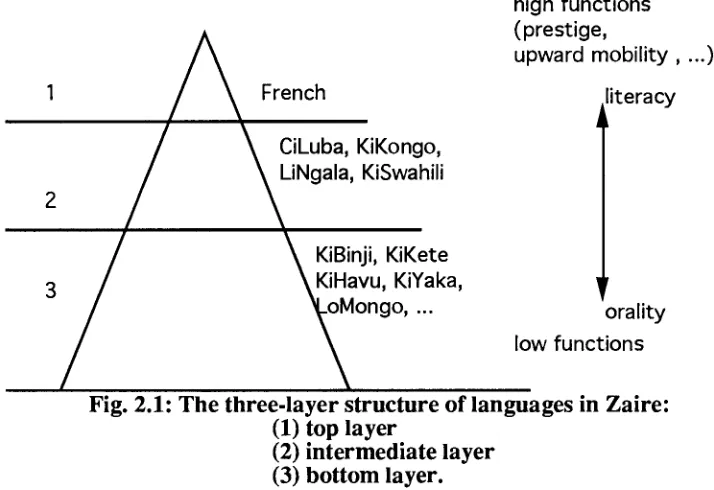
PAGE Fig. 2.1 The three-layer structure of languages in Zaire 59 Fig. 2.2 Ideal relationship between reading and
language competence 95
Fig. 3.1 Relationship between reading aloud and silent
reading, as adapted from Hill (1977) 100
Fig. 3.2 Unmediated reading aloud, as adapted from Hill
(1977) 102
Fig. 3.3 Relationship between essential variables in reading
instruction, as adapted from Dakin (1969: 100) 119 Fig. 6.1 The virtuous circle of the transfer of reading ability 223 Fig. 6.2 Proportions of the sample by reading levels in English
at the pretest and at the posttest 229
Fig. 6.3 Proportions of the sample by reading levels in French
at the pretest and at the posttest 230
LIST OF TABLES
PAGE Table 2.1 Time allocation (in hours per week) for L1/French
literacy tuition in Zairean primary schools 68
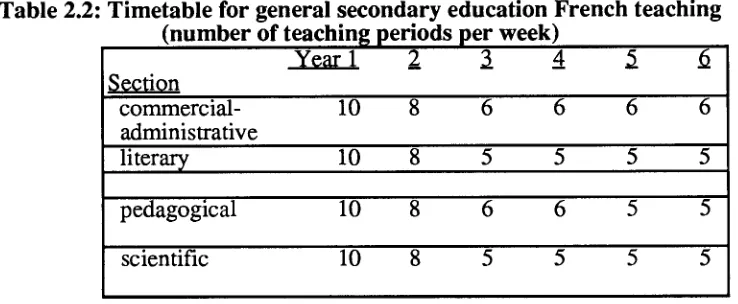
Table 2.2 Timetable for general secondary education French
teaching 71
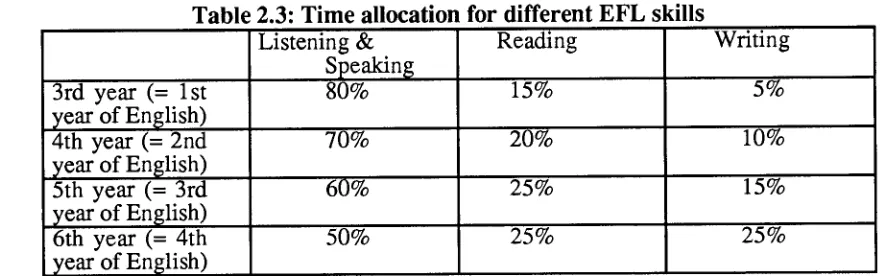
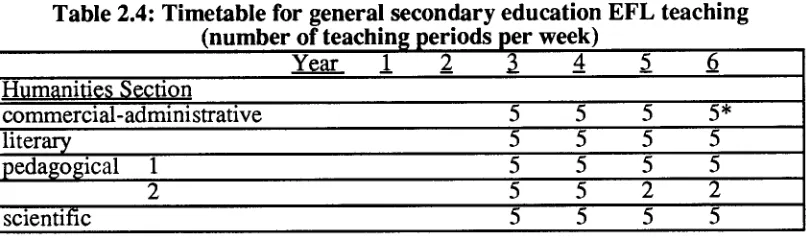
Table 2.3 Time allocation for different EFL skills 78 Table 2.4 Timetable for general secondary education EFL
teaching 80
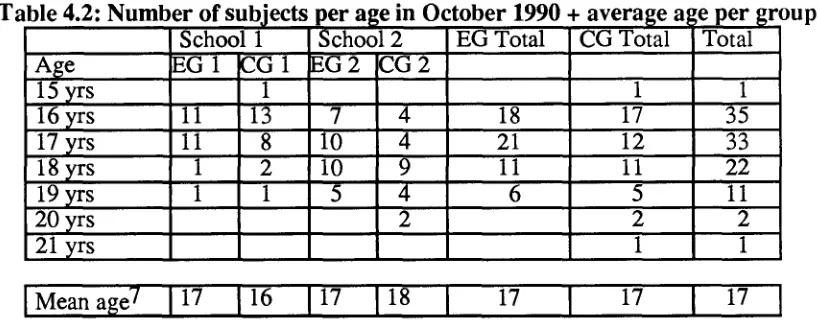
Table 4.1 Number of subjects per group per school 147 Table 4.2 Number of subjects per age in October 1990 +
average age per group 147
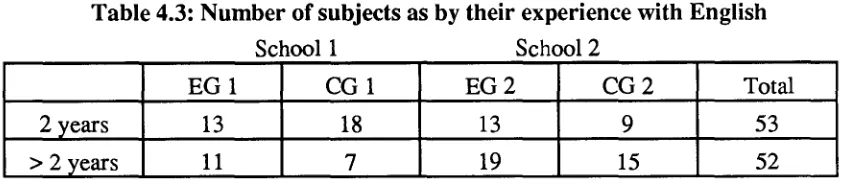
Table 4.3 Number of subjects as by their experience with
English 148
Table 4.4 Timetable for the administration of measurement
instruments 158
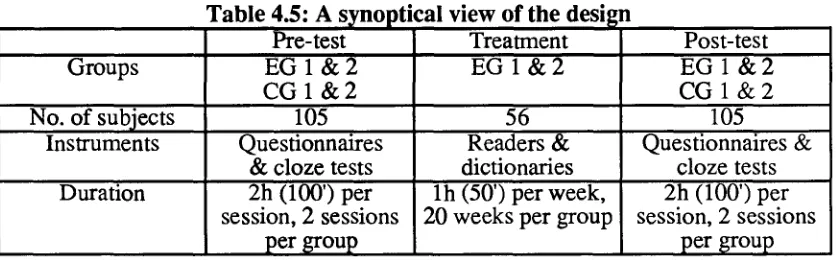
Table 4.5 A synoptical view of the design 161
Table 5.1 Proportions of subjects by their estimation of the frequency of reading in French (Fr), and in English (En)
among their parents 166
Table 5.2 Proportions of subjects by their estimation of the frequency of reading in French (Fr), and in English (En)
among their teachers 168
Table 5.3 Proportions of subjects by their perceived model
reader in French (Fr), and in English (En) 170
Table 5.4 Proportions of subjects by their estimation of the frequency of their opportunities of reading in French (Fr),
and in English (En) 172
Table 5.5 Proportions of subjects by their declared possession
of books in French (Fr), and in English (En) 174
Table 5.6 Proportions of subjects by their preferred reading
topics in French (Fr) and in English (En) 176
Table 5.7 Proportions of positive reading strategy claimers in
PAGE Table 5.8 Proportions of positive reading strategy claimers in
English before (Pre) and after (Post) the treatment 184 Table 5.9 Proportions of positive reading strategy claimers in
both French and English before (Pre) and after (Post) the
treatment 187
Table 5.10 Descriptive statistics on pre-treatment doze
reading in French 189
Table 5.11 Proportions of subjects by reading levels, based on
pre-treatment doze reading in French 190
Table 5.12 Descriptive statistics on pre-treatment doze
reading in English 191
Table 5.13 Proportions of subjects by reading levels, based on
pre-treatment doze reading in English 191
Table 5.14 Descriptive statistics on post-treatment doze
reading in French 194
Table 5.15 Proportions of subjects by reading levels, based on
post-treatment doze reading in French 195
Table 5.16 Descriptive statistics on post-treatment doze
reading in English 196
Table 5.17 Proportions of subjects by reading levels, based on
post-treatment doze reading in English 197
Table 5.18 Descriptive statistics on the number of books
putatively read 201
Table 5.19 Distribution of the experimental subjects by group
according to the number of books reportedly read 202 Table 5.20 Proportions of subjects by their estimated number
of pages of a story book in French (Fr)/in English (En) likely
to be read in 10 minutes 203
Table 5.21 Proportions of reader level selection times in each
experimental group 204
Table 6.1 Proportions of subjects by their identification of the
order of words on the page of a dictionary 211
Table 6.2 Proportions of subjects as to their awareness of the
usefulness of the title of a text 212
Table 6.3 Proportions of positive reading strategy claimers in
PAGE Table 6.4 Correlation between pre-treatment French and
English doze reading 215
Table 6.5 Correlation between pre-treatment French and
English doze reading by high scorers in French 217
Table 6.6 Correlation between pre-treatment French and
English doze reading by high scorers in English 221 Table 6.7 Correlation between pre-treatment French and
English doze reading by low scorers in French 223
Table 6.8 Correlation between pre-treatment French and
English doze reading by low scorers in English 225 Table 6.9 Comparison of pretest (1) and posttest (2) means at
English doze reading 231
Table 6.10 Comparison of pretest (1) and posttest (2) means at
French doze reading 231
Table 6.11 Comparison of groups' pretest and posttest
correlation coefficients for English doze reading 233 Table 6.12 Comparison of groups' pretest and posttest
correlation coefficients for French doze reading 233 Table 6.13 Comparison of some experimental subjects' pretest
and posttest correlation coefficients for English doze
reading, and for French doze reading 235
Table 6.14 Comparison of pretest (1) and posttest (2) means at
French, and at English doze reading by low scorers 236 Table 6.15 Comparison of some low scorers' pretest and
posttest correlation coefficients for French, and for English
doze reading 237
Table 6.16 Proportions of experimental and control groups' positive reading strategy claimers in both French and
English before (Pre) and after (Post) the treatment 238 Table 6.17 Proportions of positive reading strategy claimers in
both English and French who maintained their views after
the treatment 240
Table 6.18 Proportions of subjects who improved at English
doze reading 242
Table 6.19 Proportions of subjects who improved at French
INTRODUCTION
Research interest in a given domain can derive from the experiences of life in which the would-be researcher may have found himself, which engage his curiosity and force him to try to understand the phenomena in his environment. My interest in enquiring into aspects of reading started from my interrupted experience as a student of Spanish as a foreign language, and from my experience as a teacher of English as a foreign language.
Six years or so ago, I was taking Spanish lessons at the Spanish Cultural Centre of Kinshasa, Zaire. Formal lessons in the grammar and vocabulary of the language were the usual diet, notwithstanding the principles of communicative language teaching disseminated by scholars like Widdowson (1978). Apart from the formal classes, the Spanish Centre offered among other facilities a reading room, where students could spend some of their time browsing through reading materials in Spanish. My attempts at one of the books in the reading room, with the help of the knowledge of a few Spanish words and grammar rules, revealed to me that I could make sense of some of the texts. I could "read" in Spanish, after only a few months of language tuition at the Centre. I had not been taught to read in Spanish as such. I was being taught the language in the most orthodox audio-lingual tradition by people who knew their language (native speakers), and from whom I expected to draw some knowledge of the language.
The question then arises as to where my ability to make sense of written Spanish texts came from. A person familiar with books, as I am, could only relate the occurrence to his ability to make sense of written texts in other languages. I can read materials in CiLubal, my first language, the language in which I was introduced to literacy. I can read materials in French, my second language, without which my thought processes could not have developed as they are today. I can read materials in English, my third language, the study of which I chose to pursue in my post teen years. I can read materials in LiNgala, my children's first language, and of course, materials in some other Zairean languages which I can claim to read just because I can recognise their graphic symbols and render aloud their combinations.
teacher of English, to investigate the possibility of transfer in reading ability between French and English among young 7airean EFL learners.
As far as language learning is concerned, a more important phenomenon that emerged from my Spanish experience was the possibility of new learning taking place from the reading I did in Spanish. That reading helped me to learn more of the Spanish language, and to stabilise the grammar and vocabulary that I was exposed to during the formal classes. If I could read and learn Spanish, then Zairean EFL learners could also read and learn English without explicit instruction, I said to myself.
Note
1 LIIERACY, READING TO LEARN A FOREIGN LANGUAGE, AND THE TRANSFER OF LITERACY SKILLS
The superordinate term I am concerned with in this chapter is literacy, which can be understood as the ability to read and write. However, such a definition only states "the nuts-and-bolts part of literacy" (Solomon, 1986), obvious in much of today's world, from the different sorts and uses of written language.
More than the ability to read and write, literacy is seen in the first section of this presentation as a social practice, comprising various literacy events. The term "literacy event" is understood here in the sense proposed by Heath (1983) as any action in which production and/ or comprehension of the written text plays a role. In this study, the term "text" can be understood as referring to any self-contained piece of language that is used or is potentially usable for communication or language teaching/ learning purposes.
Heath's definition of literacy event obviously includes the print-based teaching and learning of languages, as may be encountered in formal education. I am concerned with the teaching and learning of languages in this work, particularly with foreign language learning, as may be achieved through reading. Thus, reading to learn a foreign language is the subject of the second section of this chapter.
There is a distinction between second and foreign languages (L2/FL), worth noting here in reference to French as L2 and English as FL in this work. If we want to distinguish between second and foreign languages, we need to take into account the cultural context in which the learning of an additional language takes place, as proposed by Corson (1989). According to Corson, second language learning "takes place within the culture to which the language relates". For example, Wallace's (1988) learner readers learn English as their L2 (ESL) in England, where the language is also the first language (L1) of many other people. It is understood that foreign language learning occurs within a culture that is different from the culture to which the language relates. So, a Zairean e.g., living in Kinshasa, Zaire, will learn Spanish as a foreign language.
shall put forward some of the reasons for its maintenance in the Zairean school curriculum, in Chapter 2.
As to French, there are Zairean scholars (see e.g., Mbulamoko 1974, quoted in EDIDEPS, 1986: 336; or Tumba, 1977) who argue that French is a "foreign" language. These scholars capitalise on the foreign origin of the language, and on the fact that its acquisition is generally associated with schooling. Nonetheless, I consider this language as a second language in the sense proposed by Corson (1989): In Zaire, French is the vehicle of some aspects of the Zairean culture, beside other languages. I shall elaborate on the sociolinguistic situation of Zaire in Chapter 2.
French as L2 and English as FL come into contact in the Zairean formal education system. It is possible for the learning of one of these languages to influence the learning of the other. So, I address the issue of the transfer of literacy skills across languages in the third section of the current chapter. This issue is the other basic notion, apart from the notion of reading to learn a foreign language, on which the present study hinges (see research questions in Chapter 4).
1.1 Literacy
In this section, literacy is successively looked at as social practice, and knowledge. It is understood that the two notions are separated for the purposes of analysis.
1.1.1 Literacy as social practice
Historically, literacy begins when language starts to be used as shapes in writing. A relevant observation in this respect was made by Halliday (1973) that the most important thing about written language is that it is language. Halliday's observation can lead to another equally pertinent observation that literacy, the use of written language, is language use.
align themselves to speech act theory, which can as a matter of course be said to have evolved from the recognition of the fact that people do things with words (see e.g., Austin, 1962). The phrase "literacy event" should likewise be considered primarily as the written counterpart of "speech event", "involving a number of possible moves or acts" (Wallace, 1992: personal communication).
This functional orientation to language underlines the differing demands of everyday language use for particular domains of life, in which people assume roles that they judge appropriate. Language is not used for its own sake, but in order to do things with it. Language use is purposeful.
So is literacy. People use it for such purposes as: getting informed about practical problems, maintaining social relationships, keeping records, etc. (see e.g., Heath, 1983).
Because literacy involves humans as social beings, it is a social practice. To understand the idea of literacy as a social practice, one may want to begin with the notion of practice. This term can be understood as a place (e.g., a surgeon's practice) where certain types of activities are usually undertaken. It can also refer to the recurrent, purposeful activities (e.g., legal practice, religious practice, etc.) in which people engage. It is in this second sense that one can speak of literacy as a social practice:
...the carrying out of a goal-directed sequence of activities, using particular technologies and applying particular systems of knowledge. (Scribner & Cole, 1978: 457)
Seen as social practice, literacy includes various activities related to the use of the written form of language, by people in their interactions with one another. Some of the activities in which written texts play a role are public (e.g., advertising), and some others are private (e.g., personal letter writing, pleasure reading, etc.).
write), or indirect (e.g., for an illiterate person who is read to, or a young child born to literate parents and raised to "ways with words" (Heath, 1983) as found in books. These interactions obviously bring benefits to participants in literacy events in terms of width of vocabulary, particular style, etc..
The Churchill example cited above suggests that literacy can influence speaking. It can then be said that literacy covers the whole of language use, as the new language or ways of using language that one may pick up from one's interactions with written texts will be ready for use in reading, writing, listening, and speaking. And, in some communities, the particular ways in which these skills are put to use in particular circumstances may be seen as attributes of a highly regarded section of the community, whose experiences have been shaped by contacts with books.
In this sense, literacy is usually an attribute of the elite, whose behaviour, attitudes, values and beliefs are often adopted and perpetuated as the dominant culture. For instance, literate people may be admired for their use of an elaborated as well as a restricted code (see Bernstein, 1971: 76); they may have control of a high dialect in addition to a low dialect in a situation of diglossia (see Ferguson, 1959); they may be noticed to use a lingua franca in addition to an ethnic language in a multilingual setting, etc.. I can bring in here the example of Zaire, a multilingual setting (see Chapter 2), where "true" literacy is associated with the knowledge of French, a non-native language of wider communication. As an attribute of the Zairean elite, the knowledge of French facilitates communication both outside one's immediate ethnolinguistic community, and with non Zairean French-speaking people.
As an attribute of communities, literacy can be studied within the conceptual framework proposed in Barton & Ivanic (1991). In this framework, literacy is used in various "domains of everyday life" (e.g., school, home, etc.). In their use of literacy, people fulfil different appropriate "roles", that may change with the context of literacy use. For example, in a given household, only the husband may read and fill in official forms, whereas the wife may write out cheques or prepare shopping lists. In addition, in their literacy practices, people may have "networks of helpers" or "literacy brokers" who provide support in dealing with print. For example, a literate child acts as a literacy broker when he writes letters for his non-literate parents. Furthermore, people's literacy practices are sustained by various values that literacy holds for a given community.
assumed to be appropriate for themselves in those events. Also, particular circumstances of literacy use may impose particular roles on participants.
If literacy is understood in terms of the appropriateness of roles in different domains of literacy use, then its development and practice relate to imparting and exercising "communicative competence" (see Hymes, 1972). For this reason, we need to remember that literacy is a cover term for many activities, given the multiplicity of roles in which people may adequately use their communicative competence in different social institutions and settings. For example, literacy may involve such various activities as singing from a book (e.g., among the Athabaskans, observed by Scollon & Scollon, 1981), being read to (e.g., the case of the Tuvaluans studied by Vetter, 1991), reciting the Holy Scriptures (e.g., among the Vai literates observed by Scribner & Cole, 1978; or among the Amish as reported by Fishman, 1987), reading aloud (e.g., the Vai literates' experimentation in the pronunciation of concatenated written messages, as reported in Scribner & Cole, 1978), reading silently, learning from books, writing, etc..
At this juncture, I would like to mention some of the literacy practices that may be attested among Zaireans. There have not yet been studies that describe the uses of written language in Zaire. Nonetheless, I rely on my experience as Zairean and on the accounts of literacy practices in other communities (see e.g., Barton & Padmore 1991, Heath 1983, or Klassen 1991), to identify some Zairean literacy practices.
The attempts to identify these practices are made along the lines of the conceptual framework sketched in Barton & Ivanic (1991) in terms of domains, roles, networks, and values of literacy.
The domains of everyday life in which Zaireans encounter literacy fall into the same categories as those identified by Klassen (1991) in the everyday urban life of Latin Americans in North America. These domains are "home, streets, and stores; bureaucracies; places of work; schools; and church." It is understood that the present work is particularly concerned with literacy practices in Zairean schools. However, below, I briefly discuss the literacy practices in Zairean homes, streets, and places of worship, because it is necessary to understand these in order to see how they may impinge on schools.
household, correspondence, school work (if the family raises school children), and religious materials.
The literacy events relating to the management of a household ordinarily include reading calendars and making marks on them to remember appointments or important dates (it is not uncommon to find dates or addresses written in charcoal on a house wall), reading water and electricity bills (for urban dwellers), reading medication dosages on pharmaceutical products, etc.. In homes where there are school children, overseeing children's homework is an important literacy event, in which two documents are generally used. These are children's school diary and "cahier de communication" (a special notebook for the exchange of messages related to children's school work between parents and school authorities).
The literacy events identified above require managing French written language. But, as we shall see in Chapter 2, only a minority of Zaireans are competent in French. Literacy events that involve French print, of necessity exclude women in most households. This differentiation of roles for adult males and females living in the same household is a result of the fact that fewer women than men are formally educated, and consequently competent in French. Because of women's lack of competence in French in most cases, fathers are generally the only people responsible for helping children with their school work at home, and for exchanging notes with school authorities on children's achievement. If the father cannot cope, the network of support in coping with French print includes relatives, neighbours, or other acquaintances as "literacy brokers" [to use Barton & Padmore's (1991) term again].
A literacy broker might be called in to read for example a message in French from school authorities. Before explaining what the message is about, he would be expected to read it aloud. In this way, the person who requested the support would be sure that the support was really given: He would be sure that the literacy broker read and understood the message so as to be able to transmit it verbally. If the literacy broker was called in to write a message, he would also have to read it aloud and eventually translate it for the person who requested the support. The functioning of such networks of support in coping with literacy problems indicates the communal nature of literacy practices in Zairean homes.
French or of the Zairean language involved. People engage in letter writing and reading as a way of communicating with relatives and friends who do not live locally. French and a Zairean language are also involved in the use of written language for religious purposes in Zairean homes. The Bible, or other religious literature, in French may be used by educated adult male members of the household. They may read this literature silently on their own if they have a place in the home and some time to do so. Or they may join fellow believers in places of worship. Less or non formally educated adult males, adult female members of the household and children use the religious literature in Zairean languages, which they may read together. The reason for the differentiation of languages here is the same as that given above concerning the use of print in connection with children's school work.
In churches and other places of worship, people may read from their Bibles, or prayer books. Usually, one person reads aloud while the other members of the congregation follow silently from their own Bibles or prayer books. Singing from books is also an everyday literacy event in these places. To aid their memory, the members of a congregation may write down the verses recommended by the preacher of the day. Bible reading and preaching also take place on buses or trains, along major streets or near marketplaces. People are entertained at these Bible gatherings by self-styled preachers. There are usually two preachers -the main preacher, and an assistant who may act as a reader, or an interpreter when French and a Zairean language are involved. Reading aloud to the group and translation are involved in this practice of literacy.
Beside these Bible gatherings, the street is a domain of literacy use in its own right, because of the environmental print that one may encounter. Public print in the streets (at least in urban areas) includes street names, numbers and names of buses, billboards, posters, etc.. In Zaire, these are usually in French, which is probably one of the reasons why many people ignore them. Another reason may be the fact that people ordinarily trust information passed on orally. The bus driver or one of the passengers on a given bus would shout out the number and name of the bus to a person in need. A child playing near his home would tell one the name of the street one had taken. One clearly does not need a street map or tourist information leaflet to find one's way around.
languages.) Newspapermen habitually display the different issues that they have for sale on the ground along the arteries of big towns. People, usually men, come and assemble around them, and start commenting on the different headlines appearing in the newspapers. They may indulge in this for hours, not ready to buy any of the newspapers and go away to read it for themselves. People who assemble around a newspaper in this way can be said to belong to the same network of literacy practice. They are, so to speak, members of the same "reading community" (see Brumfit, 1992: 5; or Wallace, 1992: 19). With their comments in one of the Zairean languages, they support one another in understanding the headlines on the front page of a newspaper in French. This literacy practice supplies the participants with something to talk about. Like Klassen's (1991) informants on the literacy practices of Toronto Latin Americans, they enjoy "talking with others about the major stories in the newspaper." The communal nature of Zairean literacy practices is again evident in this context.
The literacy practices that I have identified above fall into two of the general categories found in other communities (see e.g., Barton & Padmore, 1991; or Klassen, 1991): maintenance and management of the household, and maintenance of communication. Barton & Padmore (1991), and Klassen (1991) identified another category of literacy use, i.e. the use of literacy for personal reasons (e.g., personal enjoyment or leisure). It involves personal silent reading, or writing done on one's own for enjoyment.
This use of literacy is barely noticeable among Zaireans. Observations in this sense were made by Dianzungu (1991) and Mwaka (1992) concerning reading. For Dianzungu, reading is not part of the Zairean culture. This all-embracing observation relies on the facts that in general the Zairean people do not depend on information from books to manage their day-to-day living, and that books sell very poorly in Zaire. For example, the 2000 copy printing of Dianzungu's own book 1 , written in KiKongo to disseminate knowledge about the protection of land among Lower Zaire peasants, sold out only after 6 months from its publication. And, as Dianzungu (1991: 106) notes, the publishing house had already published 13 different titles (all in French), "but none of them had even approached such a success."
It can be demonstrated that Zaireans do not read for enjoyment because of the economic context of their lives. Books are generally imported, and costly. But, it can also be said that Zaireans do not read for enjoyment because the ways in which they are socialised into literacy at school are not geared to this practice.
As a domain of literacy, the school has the role of producing more literate members of society (see Ferdman, 1990). It should enable students to participate in different literacy events, in order to manage their lives, to maintain communication, to learn, and to enjoy themselves. However, the roles played by teachers and students inside the classroom may not adequately prepare the students to use literacy for all these purposes.
In Zairean schools, the role of the teacher requires that he talk to explain to students what to do during class or for homework, to explain what should have been done in homework, to give instructions, to supply a model of pronunciation, to correct mistakes, etc.. Because the teacher knows everything, as it were, the role of the students requires that they listen to the teacher, follow his instructions, take notes, etc.. Here are a few literacy events in which Zairean students may engage during class time: text analysis, reading aloud/ silently from hand-outs, reading aloud/ silently from the blackboard/ a book/ a notebook, memorising texts, copying from the blackboard/ a book/ a notebook, taking notes while listening to the teacher, writing short compositions, repeating sentences read aloud by the teacher, etc.. Learning from the written word appears to be the most favoured literacy activity, done with the support of the teacher as a "literacy broker".
However, I have no recollection of classroom time devoted to the use of literacy for personal enjoyment. And the literacy events that may be attested in Zairean schools do not seem to encourage independent literacy uses (e.g., library work) for learning. I shall come back to these observations in my discussion of constraints on reading development in Chapter 2.
denying or devaluing aspects of their cultural identity. Extending this thinking to school literacy, Ferdman speculates that a student
... who believes that reading books assigned at school is not 'something that my people do', will be less likely to complete such assignments. (Ferdman, 1990: 196)
Related observations reminding one that mainstream school literacy may be at odds with students' pre-school or out-of-school lived experiences of literacy are found in Heath (1983) or in Fishman (1987). Fishman (1987) noted for example that there were certain school literacy behaviours that young Amish children would not promptly adopt, because these behaviours did not exist in their definition of literacy, as Amish Jews: third-person formal essay writing and original approaches to topics were assumed to be alien forms of literacy, and consequently were never learned.
A slightly different issue relates to the practice of literacy at school, but across classes. Generally, educational practices reflect socially prevailing expectations and attitudes. As we have seen, the practice of silent reading for enjoyment is not common in Zairean schools or society at large. As this practice is an innovation, particularly concerning EFL classes, we need to note the following observation by Widdowson (1990):
One cannot expect that learners will take readily to modes of behaviour in the language class which are at variance with those which are promoted in their other lessons.
(Widdowson, 1990: 128)
I would like to comment, using Barton & Padmore's (1991) terminology, that learners may not readily agree to play "roles" which they assume to be culturally "inappropriate", or at least which they have not understood.
These words of caution will need to be taken into account in the interpretation of the results of the experimental treatment (see Chapters 5 & 6) used in this study, which consisted of silent reading in English by Zairean EFL learners. Wallace's (1992: 20) observation in respect of silent reading would appear to be very pertinent here:
Indeed the whole idea of reading silently and alone for pleasure may be a culturally alien one for many groups- a point that warrants consideration when attempting to devise a pedagogy to promote extensive reading in a second or foreign language.
learner readers may need during reading instruction, in Sub-section 1.2.2 and in Chapter 3 of this work.
Now, I wish to say a word on literacy as knowledge.
1.1.2 Literacy as knowledge
... at its core literacy implies knowledge (Lewis & Gagel, 1992).
Knowledge is at the heart of language, which in turn is at the heart of literacy, the use of written language. There thus does not appear to be much of an exaggeration to say that literacy is some kind of knowledge (see e.g., Brumfit, 1992: 3). In the same way as language use implies knowledge of language, I can say that literacy implies knowledge of language, more particularly knowledge of written language.
An examination of what scholars say about knowledge can help one to understand the kind of knowledge that literacy is. According to Anderson (1982), there are two types of communicative knowledge pertaining to language: declarative knowledge and procedural knowledge.
Declarative knowledge in turn comprises two types of knowledge: the language user's knowledge of linguistic rules and elements, and his pragmatic and discourse knowledge in one or more languages (Rerch & Kasper (1987), i.e. systemic and schematic knowledge (Widdowson, 1990). According to Widdowson (1990: 163), systemic knowledge is a frame of reference in the mediation of meaning. It is "subservient" to schematic knowledge. The latter type of knowledge accounts for the fact that different "indexical meanings" (meanings of linguistic expressions as used in particular contexts of language use) are possible. Widdowson's notion of "contextual plausibility" in the expression and interpretation of texts relates to this context dependence [that is, domain- and situation-specificity (see e.g., Erickson, 1984 or Scribner & Cole, 1978)] of language use, which is ipso facto also a feature of literacy.
The sum of procedures that activate declarative knowledge and allow for language use is referred to as procedural knowledge ("knowledge how"). Procedural knowledge can be acquired through practice (see Fraser, 1991). In language use, it selects and combines rules and elements from the declarative knowledge in order for language users to express and interpret meanings appropriately.
Literacy is, like oral language use, based on the individual's declarative knowledge. Appropriate use of this knowledge for the purposes of communication indicates that procedural knowledge is in action. Thus, literacy includes declarative as well as procedural knowledge.
Because literacy can be conceived of as knowledge, and because current theoretical orientations about the nature of knowledge may exert an influence on people's understanding of literacy and their understanding of its acquisition or development, a word needs to be said on the three major theoretical orientations to knowledge that are recognised nowadays among social scientists: "the positivistic", "the humanistic-interpretive", and "the critical" orientations (see e.g., Roth, 1984; Walsh, 1991). Positivists conceive of knowledge as separate from the individual and from his actions, experience and social context. In this conception, knowledge is quantifiable and verifiable information. The positivistic conception of knowledge has an implicit theory of learning as well as teaching. Learning appears to be an absorption of decontextualised, general principles that are applicable to all circumstances. These principles can be broken into discrete pieces for instruction purposes. The discrete pieces of knowledge are organised in a hierarchy such that simple pieces are subsumed in complex structures of knowledge (see also my discussion of the subskills approach to reading, in Chapter 3). The theory of teaching controls the selection, gradation, and presentation of the different bits of knowledge for "systematic feeding" (Walsh, 1991). The teacher transmits the different bits objectively and in a principled way, as they are laid down in the textbook. Teacher and student are controlled by the textbook, which they must follow step by step. With regard to participation in literacy events, I can say with Edelsky (1991) that teacher and student are made to play the social role of objects, rather than subjects, as they are not in control. The student, a passive recipient, has the task of absorbing the different bits of knowledge, which he will have to regurgitate when the time comes and if the need arises.
teaching and learning of English as a foreign language. Zairean children learn and know about the primacy of French over other languages in use among Zaireans even before they start going to school. In their first days at school, they may be heard boasting about their knowledge of French. However, when such children are pressed into speaking French by a person whom they may know as a speaker of the language, there will be heard a stream of words translating like
Good morning, sir. How are you today? I am well. Today is Monday and tomorrow will be Tuesday, etc..
or something along these lines. This stream of words may not at all be related to the context of the particular event, or it may not be appropriately conveying any content. This regurgitation may be accompanied by the compulsory crossing of the forearms on the chest, as usually required by the teacher. It is a natural instance of second or foreign language learners having constructed a stereotypical model of the target language to mimic Its result is usually what Balester (1991) refers to as hyperfluency (discourse that is both inappropriate and incompetent in the target audience's estimation).
In Zairean EFL classes, the practice of dialogue memorisation and recitation appears to aim at the development of hyperfluency in the EFL learners.
For the purposes of this presentation, hyperfluency can be seen as an attempt by the learner to regurgitate what had been transmitted, as evidence of knowledge.
From the foregoing it can be said that, in a positivistic pedagogy, little or no connection exists between knowledge and its practical, human purposes (see Roth, 1984), because knowledge is transcendent of culture and history. In other terms, a positivistic pedagogy ignores the differences of roles that people may play, the differences of the domains of literacy use, the cultural specificity of literacy users, etc.. The assumed transcendence of knowledge makes de Castell & Luke (1987) observe that the positivistic view of knowledge strips teachers and students of their identities as language users. And, as de Castell & Luke also observe, it removes language acquisition and use from their real pragmatic context and resituates them
as empty formalisms in a no-man's land where thought and action are detached from authoritative thinking and acting.
In this no-man's land, the literacy program and instructional technology have the ultimate authority (see also Goodman, 1989; Harste, 1989; or Shannon, 1989). For this reason, the diverse socio-economic, cultural and linguistic realities of students are thought to be extraneous to the task of teaching and to the acquisition of neutral, universal content (Walsh, 1991). These realities do not need to be taken into account at school, for the purposes of standardisation and uniformity in the teaching and learning process.
It has been said elsewhere, however, that some of the individual differences in the acquisition of literacy at school can be traced back to the learners' previous experiences with literacy in other domains of literacy use (see e.g., Ferdman, 1990; or Fishman, 1987). The work of Heath (1983) can be mentioned here again as illustrative of the idea that knowledge never exists independently of the individuals that produce and use it as members of a given community. Furthermore, the children that Ingham (1982: 153) identified as "avid readers" can also be mentioned for having "inherited" the good habit of wanting to read from their parents, who were frequent readers. The social, collaborative nature of literacy as a system of knowledge has equally been underlined by Brumfit (1992) who, referring one to Wells (1985), comments that
Children read best when they have been read to, when they have seen their parents and older brothers and sisters reading, and when they are part of a genuine reading community.
(Brumfit, 1992: 5)
The opening paragraphs of this presentation referred to literacy as a social practice and thus implicitly favoured the notion of literacy as social knowledge. As such, it is acquired through personal involvement, as may be inferred from a humanistic-interpretive point of view, which I turn to next.
necessary for the construction of knowledge by learners. In this theory, texts are not considered as the unique source of knowledge; instead they afford, as Walsh says, a supplement to and an extension of students' own experiences and discovery.
There have been attempts to implement humanistic-interpretive conceptions of knowledge in the practice of education. Some of these attempts resulted for example in learner-centred pedagogies, for which some of the theoretical bases can be taken from the theory and practice of adult teaching and learning. Brundage & MacKeracher (1980) e.g., identified relevant principles, of which three can be mentioned here:
- the learner reacts to all experience as he sees it, not as the teacher presents it. Concerning reading, for example, this principle acknowledges the personal nature of perception, which makes it easy to understand why no two readers may give exactly the same interpretation to any given paragraph as "our perceptions are determined almost exclusively by our experiences" (Dechant & Smith, 1977: 36). But, it also needs to be noted that these experiences may be shared with other members of one's reading community (Wallace, 1992: 19).
- the learner does not learn when over-stimulated or when experiencing extreme stress or anxiety. At the level of methodology, this principle appears to imply that the learner should be drawn "... into an affective engagement with the learning process ..." (Widdowson, 1990: 13). The practice of suggestopedia (see e.g., Bancroft, 1978) and the pedagogical concerns about lowering the learners' affective filter (see Krashen, 1989: 10) may be taken as attempts to implement this principle.
- the learner learns best when the content is personally relevant to past experience or present concerns and the learning process is relevant to life experiences. Personal relevance, as Goodman (1986) argues, makes language learning easy. This principle takes one back to Dewey (1982, a memorial reprint) who insisted that education should be about the real world.
Learner-centredness, as an expression of the humanistic-interpretive orientation to knowledge, culminates in a cluster of approaches to language teaching in which communication features as the ultimate goal of pedagogy. Such a goal amounts to enabling the learner to act in the world.
learner himself, as an active participant in the acquisition of knowledge. What he needs is a meaningful interaction with whatever it is that he is to learn. Meaningful interaction in language learning is persuasively emphasised by Widdowson (1978) in his suggestions of ways of "teaching language as communication".
However, the humanistic-interpretive conception of knowledge came to be criticised e.g., on the ground that it
... does not necessarily consider as essential the social and cultural dynamics, realities, and struggles involved in the interpretation, definition and understanding of [...] experiences.
(Walsh, 1991: 13)
Because of this, Walsh pleads for the adoption of a critical orientation to knowledge. This is a view of knowledge, people and experience, that is connected to practical human needs, that is, to the individual and structural influences that operate both upon and within society. This theoretical understanding characterises knowledge as socially constructed, historically generated, and ideologically based (Walsh, 1991). It is therefore always partial and bound to change due to the social, cultural and linguistic conditions in which the individual lives.
The three conceptions of knowledge (viz. positivistic, humanistic, and critical) presented above may not necessarily be exclusive of one another in the acquisition and practice of literacy. I am here trying to relate these orientations to the inclusive model of literacy proposed by Wells (1991). In this model, Wells distinguishes four requirements for a full exercise of literacy: control of the written code, awareness of the appropriate register for the occasion, accurate and explicit matching of linguistic form to conceptual structure, and a creative and intentional exploration of alternatives within texts. These he terms respectively as the performative, the functional, the informational, and the epistemic levels of literacy. The relationship of inclusiveness existing between these four levels is explained below.
At the performative level, the emphasis is on the code as code. Becoming literate is simply a matter of acquiring the skills necessary for decoding and encoding messages in writing, according to the conventions of letter formation, spelling and punctuation that are current in one's community (Wells, 1991). Emphasis put at this level on the code as such may relate to the positivistic theoretical orientation to knowledge as independent of individuals, and in need of being transmitted from the source to the learner as its passive recipient. Mechanical aspects of literacy may constitute this type of knowledge. Distinct reading skills, if they are identified and their hierarchy established (see my discussion in Chapter 3), may also constitute this type of knowledge. Then, where the subskills approach to reading is adopted, the emphasis of instructional activities can be said to be on the performative level of literacy.
In Wells' model, the performative ability of the participant in a literacy event forms the basis on which the functional level of literacy is built. According to Wells, functionality refers to the uses that are made of literacy in interpersonal communication (see also Halliday, 1973). One is literate if one can cope with the demands of everyday life that involve written language. There may be particular demands for particular situations: different social roles to play, different types of texts to deal with, etc..
The informational level relates to the role of literacy in the communication of knowledge. Literacy is a means of acquiring or recording information. One can recognise here the heuristic function of language. Literacy gives access to knowledge. It is for this reason, one can say, that most literate parents expect their children to attain the informational level of literacy. If they were asked why they wanted their children to learn to read and write, they would be most likely to mention acquisition of knowledge from books as the ultimate aim: acquiring literacy for subsequent school achievement.
The functional and the informational levels both emphasise the role of literacy as a mode of communication. In this respect, it may be noted with Meek (1991) or Wallace (1992) that people have repertoires of literacies. The work of Street (1984) with Iranians has shown that people's different repertoires of literacies may be developed in different domains of literacy use. The work of Scribner & Cole (1981) has also shown how functionally specialised literacy can be.
Scribner & Cole report about three different literacy traditions existing among the Vai literates of north-western Liberia: Arabic literacy, English literacy, and Vai literacy. Vai literacy has been used for over a century for personal and village public needs. It is learned in informal contexts without schooling. Arabic literacy is associated with the learning of the Qur'an and is learned through a long process of schooling relying to an important extent on memorisation. English literacy is associated with schooling outside the village. The Vai example shows how different literacies may co-exist to serve different communicative and informational purposes.
The most inclusive of all the levels of literacy in Wells' model is the epistemic level. This level recognises the changes that reading and writing can make in the mental lives of individuals, and societies. Meek's (1991) example about the influence of Bunyan's and Milton's writings in Churchill's speech can be recalled here. It shows that becoming literate refers to the acquisition of particular ways of acting upon and transforming knowledge and experience. Churchill could be said to have transformed knowledge and experience as the writing styles of Bunyan and Milton merged in his speech.
epistemic level of literacy, should be the ultimate goal of formal education. For example, Article 23 of the 1986 Zairean Education Law mentions the development of a critical mind, intellectual creativity and curiosity as one of the goals of secondary education. This is an ideal, which the current literacy practices do not seem to promote. But if it is attained, the literate person will realise for example that:
Reading Einstein or Darwin is not just acquiring knowledge; it is sharing an intellectual adventure [...] In this sense, literacy is a kind of love, not an ability or an accomplishment. It is participation, education in the classical sense - being brought up to be part of something, not just to be successful in a career.
(Solomon, 1986: 42)
In this view, literacy means education. In its widest sense, this meaning of literacy is broader than its current understanding among Zaireans, for whom literacy ordinarily means formal education, as the following anecdote suggests. Political opponents usually say of one another that they are "semi-literate" to remind their audience of their own formal education background.
Literacy is obviously a difficult notion to grasp: multifarious and multidimensional (see e.g., Levine, 1986); but it is a tool of social practice through language, whose utility in a literate society is unquestionable. The individual can use it to do a number of things, including learning, as the heuristic function of language also extends to literacy in particular. This tool can be acquired in different settings provided that there is some help from knowledgeable persons who are also users of literacy, as suggested in Heath (1986) or Scribner & Cole (1978).
As a tool of social practice and a mode of language use, literacy can be acquired through interactions with other human beings. People can learn to use it by example during those social interactions requiring its use. Seen as a mode of knowing, literacy should involve personal interaction with written messages. For this reason, the learner must be put in a situation where he can use the competence already acquired in order for learning to accrue.
1.2 Reading to learn a foreign language
"Verba volant, scripta manent". This Latin saying captures a feature that writing imposes on language: the permanence of written texts, as opposed to the evanescence of speech. Because of this feature, it can be said, Walsh (1992: 267) expressed the view that literacy requires and facilitates a direct attention to language. This view can be said to have inspired the title of the current section, as the FL text that a learner may have before his eyes can alert him to the features of that language.
The title of this section can also be said to have been inspired by a report like Stevick's (1982: 45) that an effective system of language teaching that was popular in the 1920s and the 1930s was the Reading Method.
From such views and reports, can stem the belief that, although reading in a foreign language is both a reading problem and a language problem (see Alderson, 1984), this double problem can be lessened by practice in actual reading in the foreign language. Actual reading in the foreign language would appear to be some strictly "literate" form of immersion in the foreign language. However, a minimum level of competence in the language is required. Cummins' (1979) notion of the threshold of language competence, discussed in 1.3.3 below, is related to this idea of a minimum level of competence.
In this section, I discuss first of all the notion of second/ foreign language learning, a key issue in a study like this one, of which the subjects are foreign language learners. Secondly, I will present some views on reading, as one means to the end of language learning.
1.2.1 The key issue: language learning
The title of this section would suggest some bias towards message-orientated activities, for reasons deriving from views on literacy expressed in 1.1, some of the corollaries of which will be spelt out as this presentation proceeds.
For Dodson (1978), the most effective language learning involves a constant interaction between medium-orientated and message-orientated activities [See also Widdowson (1990: 15), on the relationship between formal instructional and natural use of language]. Each kind of activity is necessary; neither is sufficient by itself. The language teacher's problem is the creation of conditions that constantly engage the learner in this interaction.
Interaction between medium-orientated and message-orientated activities can be created for example when the language curriculum proposes discrete bits of knowledge (see e.g., 1.1.2 above) for systematic absorption alongside activities of a holistic nature. One may teach the past tense out of context, and then allow the learners to realise how meaning is achieved with this formal unit within the context of a story. Let us note that a whole language teacher would start with the story, and make the learners extrapolate from the context how meaning is achieved with a given formal unit (see e.g., Goodman, 1986: 9).
My own research design (see Chapter 4) can be said to have involved this combination of orientations: My experimental subjects were taught discrete English language forms in their usual EFL classes, and, in addition, they were given books to read on their own. This could be taken as a way of reconciling the positivistic and the humanistic orientations to knowledge. I must recognise nonetheless that it may be difficult to reconcile orientations which are fundamentally opposed, "or at least, will appear to be so to students, if they are not offered explanations as to the principles underlying different activities" (Wallace, 1993: personal communication).
While Dodson distinguishes between two kinds of activities, Krashen (1981) distinguishes between two cognitive levels which he refers to as acquisition and learning. Acquisition, which is sub-conscious, is the most effective and central means of internalising language for adults as well as for children. Learning is conscious, and involves deliberate use of the "monitor" to focus on form and check for correctness. Acquisition generates foreign language, and learning monitors it.
attended learning in which learners control some aspects of the process. Basically, Fxrch & Kasper's distinction is similar to Krashen's acquisition/ learning distinction. I construe Fxrch & Kasper as saying that unattended acquisition of the target language may follow from the learner's comprehension of the language input that he receives as communication in or outside the classroom. This type of learning is particularly relevant to the development of communicative competence. It is experiential learning (see e.g., Stern, 1990). In this sense, reading can be considered as a source of language input for communication and learning that is based on linguistically accessible texts.
The terms "acquisition" and "learning" are also used by Stevick (1982) who, unlike Krashen, insists that they should not be seen as two discrete ways of coming to grips with a foreign language and mastering it. Acknowledging that the process of learning a foreign language is complex, Stevick proposes that acquisition and learning be considered as the ends of a continuum which rests on a single process.
Understood in this sense, these two levels of language learning can be shown, historically, to have always had a place in pedagogy (see e.g., Hawkins, 1988; Little et al, 1989; Widdowson, 1990), aiming at the development of the learner's communicative competence. Hawkins (1988) e.g., reminds one that when Latin was the lingua franca of all educated people in Europe, the grammar schools of the Middle Ages and the Renaissance had the business of teaching Latin grammar, and expected the students to use the language for all purposes. As he notes:
It was recognised that, though the daily 'grammar grind' might be necessary, pupils could not be expected to learn to use Latin without constant practice, motivated by engaging in activities that interested them.
(Hawkins, 1988: 4)
be supplemented. One means can be the learner's actual engagement with written texts in the foreign language: reading.
1.2.2 Reading: a means to an end
In the search of reasons for the justification of the adoption of reading as a way of helping students to learn a foreign language, one may posit with the proponents of communicative language teaching that the object of foreign language learning is communication, the "generator" of acquisition. As is well known, communication through language can be oral or written, and in literate communities the visual mode of language use can be as important as the oral/ aural one. If the object of learning is communication, then the valid theoretical orientation to knowledge is the humanistic-interpretive, where literacy as communicative interaction between social beings (e.g., the reader and the writer) is emphasised. My choice of reading exposure as experimental treatment (see Chapters 3 & 4) with Zairean EFL learners purported to privilege this view of literacy as communicative interaction.
It is commonplace to argue that genuine communication in the target language in foreign language classrooms is rare. The teacher needs to take this reality into account by offering students opportunities to use the target language for communication. Reading in the target language can be seen as a way of fostering actual communication through the target language. I am thinking of literacy events in which students use meaningful reading materials to achieve their purposes, not literacy events in which students are made to do exercises that are communicatively purposeless. Goodman (1986: 49) on his part suggests the involvement of students "in authentic literacy events and in a wide range of real comprehensible texts [...]", focusing on meaning.
Meaningful communicative interaction, as I understand it, may require the use of authentic texts [i.e. texts that are not "written for a pedagogic purpose" (Wallace, 1992: 76)]. In this work, I also consider authenticity as a feature of texts that were not normally produced for classroom use, but are brought into the classroom for language teaching/ learning purposes, because of their linguistic accessibility.
qualifications to the notion of authenticity by relating it to how the learning task is conducive to language learning, and to the social context of the language classroom. As I said earlier, authentic texts that are communicatively accessible can be brought into the classroom as pedagogic devices. Little et al (1989) advise this type of texts as the chief source of target language input, in order to allow the learner to acquire language in the process of using language. However, as Wallace (1992) warns, authentic texts may be linguistically too complex for foreign language learners especially. We therefore need to "reconcile the requirements of authenticity and high-interest content with those of linguistic accessibility" (Wallace, 1992: 76). This can be done for example by assessing the difficulty of texts, or by selecting texts within a given genre which is familiar to the learners.
Text difficulty can be assessed through readability formulae, e.g., Fry's (1977) criteria of word length and sentence length. According to these criteria,
the greater the frequency of long words and sentences in a hundred-word sample, taken from the beginning, middle, and end of a text, the harder the text is judged to be.
(Wallace, 1992: 77)
However, text difficulty may depend on factors that are inherent in learners such as knowledge, and motivation. Then, as Wallace (1992) advises, we may need an approach, like cloze procedure, which forces the learner to make guesses and use context to predict meaning, focusing on the process of reading.
The control of the accessibility of texts, as Widdowson (1978) observes, may result in the production of "simplified texts" or "simple accounts". A simple account is
the recasting of information abstracted from some source or other to suit a particular kind of reader [it is] designed to meet a communicative purpose, directed at people playing their roles in a social context.
(Widdowson, 1978: 89)