CMMI
®
for Development, Version 1.3
CMMI-DEV, V1.3
CMMI Product Team
Improving processes for developing better products and services
November 2010TECHNICAL REPORT
CMU/SEI-2010-TR-033 ESC-TR-2010-033
Software Engineering Process Management Program Unlimited distribution subject to the copyright.
This report was prepared for the SEI Administrative Agent ESC/XPK
5 Eglin Street
Hanscom AFB, MA 01731-2100
The ideas and findings in this report should not be construed as an official DoD position. It is published in the interest of scientific and technical information exchange.
This work is sponsored by the U.S. Department of Defense. The Software Engineering Institute is a federally funded research and development center sponsored by the U.S. Department of Defense. Copyright 2010 Carnegie Mellon University.
NO WARRANTY
THIS CARNEGIE MELLON UNIVERSITY AND SOFTWARE ENGINEERING INSTITUTE MATERIAL IS FURNISHED ON AN “AS-IS” BASIS. CARNEGIE MELLON UNIVERSITY MAKES NO WARRANTIES OF ANY KIND, EITHER EXPRESSED OR IMPLIED, AS TO ANY MATTER INCLUDING, BUT NOT LIMITED TO, WARRANTY OF FITNESS FOR PURPOSE OR MERCHANTABILITY, EXCLUSIVITY, OR RESULTS OBTAINED FROM USE OF THE
MATERIAL. CARNEGIE MELLON UNIVERSITY DOES NOT MAKE ANY WARRANTY OF ANY KIND WITH RESPECT TO FREEDOM FROM PATENT, TRADEMARK, OR COPYRIGHT INFRINGEMENT.
Use of any trademarks in this report is not intended in any way to infringe on the rights of the trademark holder.
Internal use. Permission to reproduce this document and to prepare derivative works from this document for internal use is granted, provided the copyright and “No Warranty” statements are included with all reproductions and derivative works.
External use. This document may be reproduced in its entirety, without modification, and freely distributed in written or electronic form without requesting formal permission. Permission is required for any other external and/or commercial use. Requests for permission should be directed to the Software Engineering Institute at [email protected].
This work was created in the performance of Federal Government Contract Number FA8721-05-C-0003 with Carnegie Mellon University for the operation of the Software Engineering Institute, a federally funded research and development center. The Government of the United States has a royalty-free government-purpose license to use, duplicate, or disclose the work, in whole or in part and in any manner, and to have or permit others to do so, for government purposes pursuant to the copyright license under the clause at 252.227-7013.
For information about SEI publications, please visit the library on the SEI website (www.sei.cmu.edu/library).
The following service marks and registered marks are used in this document:Capability Maturity Model
Carnegie Mellon CERT CMM CMMI CMM Integration IDEALSM SCAMPISM
CMMI, CMM, CERT, CMM Integration, Carnegie Mellon, and Capability Maturity Model are registered in the U.S. Patent and Trademark Office.
Preface
CMMI® (Capability Maturity Model® Integration) models are collections of
best practices that help organizations to improve their processes. These models are developed by product teams with members from industry, government, and the Software Engineering Institute (SEI).
This model, called CMMI for Development (CMMI-DEV), provides a comprehensive integrated set of guidelines for developing products and services.
Purpose
The CMMI-DEV model provides guidance for applying CMMI best practices in a development organization. Best practices in the model focus on
activities for developing quality products and services to meet the needs of customers and end users.
The CMMI-DEV, V1.3 model is a collection of development best practices from government and industry that is generated from the CMMI V1.3
Architecture and Framework.1 CMMI-DEV is based on the CMMI Model
Foundation or CMF (i.e., model components common to all CMMI models
and constellations2) and incorporates work by development organizations to
adapt CMMI for use in the development of products and services.
Acknowledgments
Many talented people were involved in the development of the V1.3 CMMI Product Suite. Three primary groups were the CMMI Steering Group, Product Team, and Configuration Control Board (CCB).
The Steering Group guided and approved the plans of the Product Team, provided consultation on significant CMMI project issues, and ensured involvement from a variety of interested communities.
The Steering Group oversaw the development of the Development constellation recognizing the importance of providing best practices to development organizations.
1
The CMMI Framework is the basic structure that organizes CMMI components and combines them into CMMI constellations and models.
2
A constellation is a collection of CMMI components that are used to construct models, training materials, and appraisal related documents for an area of interest (e.g., development, acquisition, services).
ii Preface The Product Team wrote, reviewed, revised, discussed, and agreed on the structure and technical content of the CMMI Product Suite, including the framework, models, training, and appraisal materials. Development activities were based on multiple inputs. These inputs included an A-Specification and guidance specific to each release provided by the Steering Group, source models, change requests received from the user community, and input received from pilots and other stakeholders.
The CCB is the official mechanism for controlling changes to CMMI models,
appraisal related documents, and Introduction to CMMI training. As such,
this group ensures integrity over the life of the product suite by reviewing all proposed changes to the baseline and approving only those changes that satisfy identified issues and meet criteria for the upcoming release. Members of the groups involved in developing CMMI-DEV, V1.3 are listed in Appendix C.
Audience
The audience for CMMI-DEV includes anyone interested in process improvement in a development environment. Whether you are familiar with the concept of Capability Maturity Models or are seeking information to begin improving your development processes, CMMI-DEV will be useful to you. This model is also intended for organizations that want to use a
reference model for an appraisal of their development related processes.3
Organization of this Document
This document is organized into three main parts: Part One: About CMMI for Development
Part Two: Generic Goals and Generic Practices, and the Process Areas Part Three: The Appendices and Glossary
Part One: About CMMI for Development, consists of five chapters:
Chapter 1, Introduction, offers a broad view of CMMI and the CMMI for Development constellation, concepts of process improvement, and the history of models used for process improvement and different process improvement approaches.
Chapter 2, Process Area Components, describes all of the components
of the CMMI for Development process areas.4
Chapter 3, Tying It All Together, assembles the model components and explains the concepts of maturity levels and capability levels.
3
An appraisal is an examination of one or more processes by a trained team of professionals using a reference model (e.g., CMMI-DEV) as the basis for determining strengths and weaknesses.
4
A process area is a cluster of related practices in an area that, when implemented collectively, satisfies a set of goals considered important for making improvement in that area. This concept is covered in detail in Chapter 2.
Chapter 4, Relationships Among Process Areas, provides insight into the meaning and interactions among the CMMI-DEV process areas. Chapter 5, Using CMMI Models, describes paths to adoption and the use of CMMI for process improvement and benchmarking of practices in a development organization.
Part Two: Generic Goals and Generic Practices, and the Process Areas, contains all of this CMMI model’s required and expected components. It also contains related informative components, including subpractices, notes, examples, and example work products.
Part Two contains 23 sections. The first section contains the generic goals and practices. The remaining 22 sections each represent one of the CMMI-DEV process areas.
To make these process areas easy to find, they are organized
alphabetically by process area acronym. Each section contains descriptions of goals, best practices, and examples.
Part Three: The Appendices and Glossary, consists of four sections: Appendix A: References, contains references you can use to locate documented sources of information such as reports, process
improvement models, industry standards, and books that are related to CMMI-DEV.
Appendix B: Acronyms, defines the acronyms used in the model. Appendix C: CMMI Version 1.3 Project Participants contains lists of team members who participated in the development of CMMI-DEV, V1.3.
Appendix D: Glossary, defines many of the terms used in CMMI-DEV.
How to Use this Document
Whether you are new to process improvement, new to CMMI, or already familiar with CMMI, Part One can help you understand why CMMI-DEV is the model to use for improving your development processes.
Readers New to Process Improvement
If you are new to process improvement or new to the Capability Maturity
Model (CMM®) concept, we suggest that you read Chapter 1 first. Chapter 1
contains an overview of process improvement that explains what CMMI is all about.
Next, skim Part Two, including generic goals and practices and specific goals and practices, to get a feel for the scope of the best practices
contained in the model. Pay close attention to the purpose and introductory notes at the beginning of each process area.
In Part Three, look through the references in Appendix A and select additional sources you think would be beneficial to read before moving forward with using CMMI-DEV. Read through the acronyms and glossary to
iv Preface become familiar with the language of CMMI. Then, go back and read the details of Part Two.
Readers Experienced with Process Improvement
If you are new to CMMI but have experience with other process improvement models, such as the Software CMM or the Systems
Engineering Capability Model (i.e., EIA 731), you will immediately recognize many similarities in their structure and content [EIA 2002a].
We recommend that you read Part One to understand how CMMI is different from other process improvement models. If you have experience with other models, you may want to select which sections to read first. Read Part Two with an eye for best practices you recognize from the models that you have already used. By identifying familiar material, you will gain an understanding of what is new, what has been carried over, and what is familiar from the models you already know.
Next, review the glossary to understand how some terminology can differ from that used in the process improvement models you know. Many concepts are repeated, but they may be called something different.
Readers Familiar with CMMI
If you have reviewed or used a CMMI model before, you will quickly recognize the CMMI concepts discussed and the best practices presented. As always, the improvements that the CMMI Product Team made to CMMI for the V1.3 release were driven by user input. Change requests were carefully considered, analyzed, and implemented.
Some significant improvements you can expect in CMMI-DEV, V1.3 include the following:
High maturity process areas are significantly improved to reflect industry best practices, including a new specific goal and several new specific practices in the process area that was renamed from
Organizational Innovation and Deployment (OID) to Organizational Performance Management (OPM).
Improvements were made to the model architecture that simplify the use of multiple models.
Informative material was improved, including revising the engineering practices to reflect industry best practice and adding guidance for organizations that use Agile methods.
Glossary definitions and model terminology were improved to enhance the clarity, accuracy, and usability of the model.
Level 4 and 5 generic goals and practices were eliminated as well as capability levels 4 and 5 to appropriately focus high maturity on the achievement of business objectives, which is accomplished by applying capability level 1-3 to the high maturity process areas (Causal Analysis and Resolution, Quantitative Project Management, Organizational Performance Management, and Organizational Process Performance).
For a more complete and detailed list of improvements, see http://www.sei.cmu.edu/cmmi/tools/cmmiv1-3/.
Additional Information and Reader Feedback
Many sources of information about CMMI are listed in Appendix A and are also published on the CMMI website—http://www.sei.cmu.edu/cmmi/. Your suggestions for improving CMMI are welcome. For information on how to provide feedback, see the CMMI website at
http://www.sei.cmu.edu/cmmi/tools/cr/. If you have questions about CMMI, send email to [email protected].
Table of Contents
Preface ii
Purpose i
Acknowledgments i
Audience ii
Organization of this Document ii
How to Use this Document iii
Readers New to Process Improvement iii
Readers Experienced with Process Improvement iv
Readers Familiar with CMMI iv
Additional Information and Reader Feedback v
Part One: About CMMI for Development
1
1 Introduction 3
About Process Improvement 4
About Capability Maturity Models 5
Evolution of CMMI 5
CMMI Framework 7
CMMI for Development 7
2 Process Area Components 9
Core Process Areas and CMMI Models 9
Required, Expected, and Informative Components 9
Required Components 9
Expected Components 9
Informative Components 10
Components Associated with Part Two 10
Process Areas 11
Purpose Statements 11
Introductory Notes 11
Related Process Areas 12
Specific Goals 12
Generic Goals 12
Specific Goal and Practice Summaries 12
Specific Practices 13
Example Work Products 13
Subpractices 13
Generic Practices 13
Generic Practice Elaborations 14
Additions 14
Supporting Informative Components 14
Notes 14
Examples 14
References 15
Numbering Scheme 15
Typographical Conventions 16
3 Tying It All Together 21
Understanding Levels 21
viii Table of Contents
Understanding Capability Levels 24
Capability Level 0: Incomplete 24
Capability Level 1: Performed 24
Capability Level 2: Managed 25
Capability Level 3: Defined 25
Advancing Through Capability Levels 25
Understanding Maturity Levels 26
Maturity Level 1: Initial 27
Maturity Level 2: Managed 27
Maturity Level 3: Defined 28
Maturity Level 4: Quantitatively Managed 28
Maturity Level 5: Optimizing 29
Advancing Through Maturity Levels 29
Process Areas 30
Equivalent Staging 34
Achieving High Maturity 37
4 Relationships Among Process Areas 39
Process Management 39
Basic Process Management Process Areas 40
Advanced Process Management Process Areas 41
Project Management 43
Basic Project Management Process Areas 43
Advanced Project Management Process Areas 45
Engineering 47
Recursion and Iteration of Engineering Processes 50
Support 50
Basic Support Process Areas 51
Advanced Support Process Areas 52
5 Using CMMI Models 55
Adopting CMMI 55
Your Process Improvement Program 56
Selections that Influence Your Program 56
CMMI Models 57
Interpreting CMMI When Using Agile Approaches 58
Using CMMI Appraisals 59
Appraisal Requirements for CMMI 59
SCAMPI Appraisal Methods 59
Appraisal Considerations 60
CMMI Related Training 61
Part Two: Generic Goals and Generic Practices, and the Process Areas
63
Generic Goals and Generic Practices 65
Overview 65
Process Institutionalization 65
Performed Process 65
Managed Process 66
Defined Process 66
Relationships Among Processes 67
Generic Goals and Generic Practices 68
Applying Generic Practices 120
Causal Analysis and Resolution 127
Configuration Management 137
Decision Analysis and Resolution 149
Integrated Project Management 157
Measurement and Analysis 175
Organizational Process Definition 191
Organizational Process Focus 203
Organizational Performance Management 217
Organizational Process Performance 235
Organizational Training 247
Product Integration 257
Project Monitoring and Control 271
Project Planning 281
Process and Product Quality Assurance 301
Quantitative Project Management 307
Requirements Development 325
Requirements Management 341
Risk Management 349
Supplier Agreement Management 363
Technical Solution 373
Validation 393
Verification 401
Part Three: The Appendices
413
Appendix A: References 415
Information Assurance/Information Security Related Sources 419
Appendix B: Acronyms 421
Appendix C: CMMI Version 1.3 Project Participants 425
CMMI Steering Group 425
Steering Group Members 425
Ex-Officio Steering Group Members 426
Steering Group Support 426
CMMI for Services Advisory Group 426
CMMI V1.3 Coordination Team 427
CMMI V1.3 Configuration Control Board 427
CMMI V1.3 Core Model Team 428
CMMI V1.3 Translation Team 428
CMMI V1.3 High Maturity Team 429
CMMI V1.3 Acquisition Mini Team 429
CMMI V1.3 Services Mini Team 429
CMMI V1.3 SCAMPI Upgrade Team 430
CMMI Version 1.3 Training Teams 430
x Table of Contents
SVC Training Team 431
CMMI V1.3 Quality Team 431
Part One:
1 Introduction
Now more than ever, companies want to deliver products and services better, faster, and cheaper. At the same time, in the high-technology environment of the twenty-first century, nearly all organizations have found themselves building increasingly complex products and services. It is unusual today for a single organization to develop all the components that compose a complex product or service. More commonly, some components are built in-house and some are acquired; then all the components are integrated into the final product or service. Organizations must be able to manage and control this complex development and maintenance process. The problems these organizations address today involve enterprise-wide solutions that require an integrated approach. Effective management of organizational assets is critical to business success. In essence, these organizations are product and service developers that need a way to manage their development activities as part of achieving their business objectives.
In the current marketplace, maturity models, standards, methodologies, and guidelines exist that can help an organization improve the way it does business. However, most available improvement approaches focus on a specific part of the business and do not take a systemic approach to the problems that most organizations are facing. By focusing on improving one area of a business, these models have unfortunately perpetuated the stovepipes and barriers that exist in organizations.
CMMI® for Development (CMMI-DEV) provides an opportunity to avoid or
eliminate these stovepipes and barriers. CMMI for Development consists of best practices that address development activities applied to products and services. It addresses practices that cover the product’s lifecycle from conception through delivery and maintenance. The emphasis is on the work necessary to build and maintain the total product.
CMMI-DEV contains 22 process areas. Of those process areas, 16 are core process areas, 1 is a shared process area, and 5 are development specific
process areas.5
All CMMI-DEV model practices focus on the activities of the developer organization. Five process areas focus on practices specific to
development: addressing requirements development, technical solution, product integration, verification, and validation.
5
A core process area is a process area that is common to all CMMI models. A shared process area is shared by at least two CMMI models, but not all of them.
Introduction 4
About Process Improvement
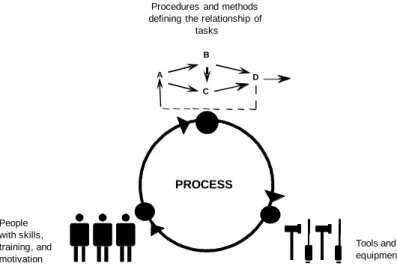
In its research to help organizations to develop and maintain quality products and services, the Software Engineering Institute (SEI) has found several dimensions that an organization can focus on to improve its business. Figure 1.1 illustrates the three critical dimensions that organizations typically focus on: people, procedures and methods, and tools and equipment.
Procedures and methods defining the relationship of
tasks
Tools and equipment People
with skills, training, and motivation
A B
C D
PROCESS
Figure 1.1: The Three Critical Dimensions
What holds everything together? It is the processes used in your
organization. Processes allow you to align the way you do business. They allow you to address scalability and provide a way to incorporate knowledge of how to do things better. Processes allow you to leverage your resources and to examine business trends.
This is not to say that people and technology are not important. We are living in a world where technology is changing at an incredible speed. Similarly, people typically work for many companies throughout their careers. We live in a dynamic world. A focus on process provides the infrastructure and stability necessary to deal with an ever-changing world and to maximize the productivity of people and the use of technology to be competitive.
Manufacturing has long recognized the importance of process effectiveness and efficiency. Today, many organizations in manufacturing and service industries recognize the importance of quality processes. Process helps an organization’s workforce to meet business objectives by helping them to work smarter, not harder, and with improved consistency. Effective
processes also provide a vehicle for introducing and using new technology in a way that best meets the business objectives of the organization.
About Capability Maturity Models
A Capability Maturity Model® (CMM®), including CMMI, is a simplified
representation of the world. CMMs contain the essential elements of effective processes. These elements are based on the concepts developed by Crosby, Deming, Juran, and Humphrey.
In the 1930s, Walter Shewhart began work in process improvement with his principles of statistical quality control [Shewhart 1931]. These principles were refined by W. Edwards Deming [Deming 1986], Phillip Crosby [Crosby 1979], and Joseph Juran [Juran 1988]. Watts Humphrey, Ron Radice, and others extended these principles further and began applying them to
software in their work at IBM (International Business Machines) and the SEI
[Humphrey 1989]. Humphrey’s book, Managing the Software Process,
provides a description of the basic principles and concepts on which many
of the Capability Maturity Models® (CMMs®) are based.
The SEI has taken the process management premise, “the quality of a system or product is highly influenced by the quality of the process used to develop and maintain it,” and defined CMMs that embody this premise. The belief in this premise is seen worldwide in quality movements, as evidenced by the International Organization for Standardization/International
Electrotechnical Commission (ISO/IEC) body of standards.
CMMs focus on improving processes in an organization. They contain the essential elements of effective processes for one or more disciplines and describe an evolutionary improvement path from ad hoc, immature processes to disciplined, mature processes with improved quality and effectiveness.
Like other CMMs, CMMI models provide guidance to use when developing processes. CMMI models are not processes or process descriptions. The actual processes used in an organization depend on many factors, including application domains and organization structure and size. In particular, the process areas of a CMMI model typically do not map one to one with the processes used in your organization.
The SEI created the first CMM designed for software organizations and
published it in a book, TheCapability Maturity Model: Guidelines for
Improving the Software Process [SEI 1995].
Today, CMMI is an application of the principles introduced almost a century ago to this never-ending cycle of process improvement. The value of this process improvement approach has been confirmed over time.
Organizations have experienced increased productivity and quality, improved cycle time, and more accurate and predictable schedules and budgets [Gibson 2006].
Evolution of CMMI
The CMM Integration® project was formed to sort out the problem of using
Introduction 6
improvement framework was intended for use by organizations in their pursuit of enterprise-wide process improvement.
Developing a set of integrated models involved more than simply combining existing model materials. Using processes that promote consensus, the CMMI Product Team built a framework that accommodates multiple constellations.
The first model to be developed was the CMMI for Development model (then simply called “CMMI”). Figure 1.2 illustrates the models that led to CMMI Version 1.3.
v1.02 (2000) V1.02 (2000) v1.1 (2002) V1.1 (2002)
History of CMMs
CMM for Software V1.1 (1993)
Systems Engineering CMM V1.1 (1995)
EIA 731 SECM (1998) INCOSE SECAM (1996) Integrated Product Development CMM (1997) Software CMM V2, draft C (1997)
CMMI for Development V1.2 (2006)
CMMI for Acquisition V1.2 (2007)
Software Acquisition CMM V1.03 (2002)
V1.2 (2009)
CMMI for Services
CMMI for Acquisition V1.3 (2010)
CMMI for Development V1.3 (2010)
CMMI for Services V1.3 (2010)
Figure 1.2: The History of CMMs6
Initially, CMMI was one model that combined three source models: the
Capability Maturity Model for Software (SW-CMM) v2.0 draft C, the
Systems Engineering Capability Model (SECM) [EIA 2002a], and the
Integrated Product Development Capability Maturity Model (IPD-CMM)
v0.98.
6
EIA 731 SECM is the Electronic Industries Alliance standard 731, or the Systems Engineering Capability Model. INCOSE SECAM is International Council on Systems Engineering Systems Engineering Capability Assessment Model [EIA 2002a].
These three source models were selected because of their successful adoption or promising approach to improving processes in an organization. The first CMMI model (V1.02) was designed for use by development organizations in their pursuit of enterprise-wide process improvement. It was released in 2000. Two years later version 1.1 was released and four years after that, version 1.2 was released.
By the time that version 1.2 was released, two other CMMI models were being planned. Because of this planned expansion, the name of the first CMMI model had to change to become CMMI for Development and the concept of constellations was created.
The CMMI for Acquisition model was released in 2007. Since it built on the CMMI for Development Version 1.2 model, it also was named Version 1.2. Two years later the CMMI for Services model was released. It built on the other two models and also was named Version 1.2.
In 2008 plans were drawn to begin developing Version 1.3, which would ensure consistency among all three models and improve high maturity material in all of the models. Version 1.3 of CMMI for Acquisition [Gallagher 2011, SEI 2010b], CMMI for Development [Chrissis 2011], and CMMI for Services [Forrester 2011, SEI 2010a] were released in November 2010.
CMMI Framework
The CMMI Framework provides the structure needed to produce CMMI models, training, and appraisal components. To allow the use of multiple models within the CMMI Framework, model components are classified as either common to all CMMI models or applicable to a specific model. The common material is called the “CMMI Model Foundation” or “CMF.” The components of the CMF are part of every model generated from the CMMI Framework. Those components are combined with material
applicable to an area of interest (e.g., acquisition, development, services) to produce a model.
A “constellation” is defined as a collection of CMMI components that are used to construct models, training materials, and appraisal related
documents for an area of interest (e.g., acquisition, development, services). The Development constellation’s model is called “CMMI for Development” or “CMMI-DEV.”
CMMI for Development
CMMI for Development is a reference model that covers activities for developing both products and services. Organizations from many industries, including aerospace, banking, computer hardware, software, defense, automobile manufacturing, and telecommunications, use CMMI for Development.
Introduction 8
CMMI for Development contains practices that cover project management, process management, systems engineering, hardware engineering,
software engineering, and other supporting processes used in development and maintenance.
Use professional judgment and common sense to interpret the model for your organization. That is, although the process areas described in this model depict behaviors considered best practices for most users, process areas and practices should be interpreted using an in-depth knowledge of CMMI-DEV, your organizational constraints, and your business
2 Process Area Components
This chapter describes the components found in each process area and in the generic goals and generic practices. Understanding these components is critical to using the information in Part Two effectively. If you are
unfamiliar with Part Two, you may want to skim the Generic Goals and Generic Practices section and a couple of process area sections to get a general feel for the content and layout before reading this chapter.
Core Process Areas and CMMI Models
All CMMI models are produced from the CMMI Framework. This framework contains all of the goals and practices that are used to produce CMMI models that belong to CMMI constellations.
All CMMI models contain 16 core process areas. These process areas cover basic concepts that are fundamental to process improvement in any area of interest (i.e., acquisition, development, services). Some of the material in the core process areas is the same in all constellations. Other material may be adjusted to address a specific area of interest.
Consequently, the material in the core process areas may not be exactly the same.
Required, Expected, and Informative Components
Model components are grouped into three categories—required, expected, and informative—that reflect how to interpret them.
Required Components
Required components are CMMI components that are essential to
achieving process improvement in a given process area. This achievement must be visibly implemented in an organization’s processes. The required components in CMMI are the specific and generic goals. Goal satisfaction is used in appraisals as the basis for deciding whether a process area has been satisfied.
Expected Components
Expected components are CMMI components that describe the activities that are important in achieving a required CMMI component. Expected components guide those who implement improvements or perform
appraisals. The expected components in CMMI are the specific and generic practices.
Process Area Components 10
Before goals can be considered to be satisfied, either their practices as described, or acceptable alternatives to them, must be present in the planned and implemented processes of the organization.
Informative Components
Informative components are CMMI components that help model users understand CMMI required and expected components. These components can be example boxes, detailed explanations, or other helpful information. Subpractices, notes, references, goal titles, practice titles, sources, example work products, and generic practice elaborations are informative model components.
The informative material plays an important role in understanding the model. It is often impossible to adequately describe the behavior required or expected of an organization using only a single goal or practice statement. The model’s informative material provides information necessary to achieve the correct understanding of goals and practices and thus cannot be
ignored.
Components Associated with Part Two
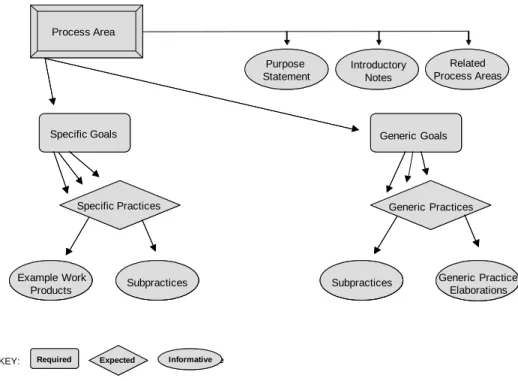
The model components associated with Part Two are summarized in Figure 2.1 to illustrate their relationships.
Process Area
Generic Practices Generic Practices Generic Goals Generic Goals
Expected InformativeInformative
Required
KEY:
Purpose Statement
Introductory Notes
Related Process Areas
Subpractices Subpractices Specific GoalsSpecific Goals
Specific Practices Specific Practices
Typical Work Products Example Work
Products SubpracticesSubpractices Subpractices
Generic Practice Elaborations
Figure 2.1: CMMI Model Components
The following sections provide detailed descriptions of CMMI model components.
Process Areas
A process area is a cluster of related practices in an area that, when implemented collectively, satisfies a set of goals considered important for making improvement in that area. (See the definition of “process area” in the glossary.)
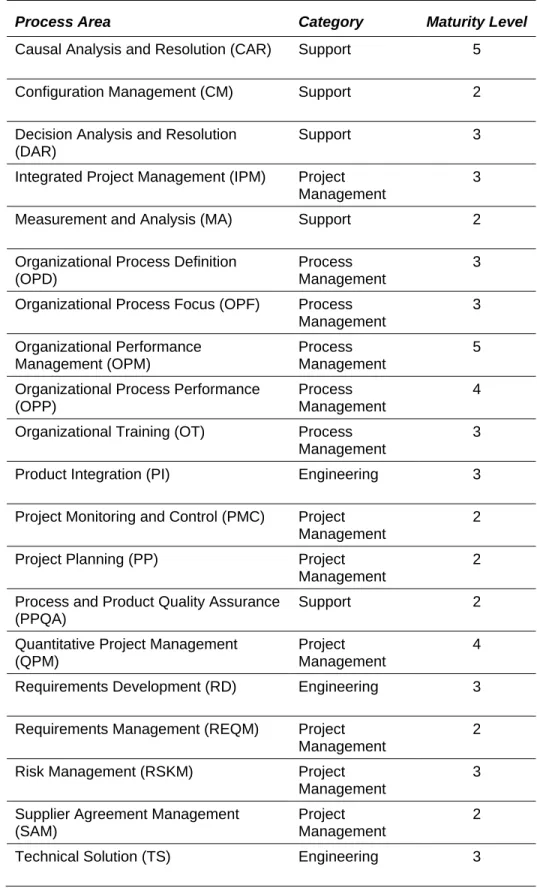
The 22 process areas are presented in alphabetical order by acronym: Causal Analysis and Resolution (CAR)
Configuration Management (CM)
Decision Analysis and Resolution (DAR) Integrated Project Management (IPM) Measurement and Analysis (MA)
Organizational Process Definition (OPD) Organizational Process Focus (OPF)
Organizational Performance Management (OPM) Organizational Process Performance (OPP) Organizational Training (OT)
Product Integration (PI)
Project Monitoring and Control (PMC) Project Planning (PP)
Process and Product Quality Assurance (PPQA) Quantitative Project Management (QPM)
Requirements Development (RD) Requirements Management (REQM) Risk Management (RSKM)
Supplier Agreement Management (SAM) Technical Solution (TS)
Validation (VAL) Verification (VER)
Purpose Statements
A purpose statement describes the purpose of the process area and is an informative component.
For example, the purpose statement of the Organizational Process Definition process area is “The purpose of Organizational Process
Definition (OPD) is to establish and maintain a usable set of organizational process assets, work environment standards, and rules and guidelines for teams.”
Introductory Notes
The introductory notes section of the process area describes the major concepts covered in the process area and is an informative component.
Process Area Components 12
An example from the introductory notes of the Project Monitoring and Control process area is “When actual status deviates significantly from expected values, corrective actions are taken as appropriate.”
Related Process Areas
The Related Process Areas section lists references to related process areas and reflects the high-level relationships among the process areas. The Related Process Areas section is an informative component.
An example of a reference found in the Related Process Areas section of the Project Planning process area is “Refer to the Risk Management process area for more information about identifying and analyzing risks and mitigating risks.”
Specific Goals
A specific goal describes the unique characteristics that must be present to satisfy the process area. A specific goal is a required model component and is used in appraisals to help determine whether a process area is satisfied. (See the definition of “specific goal” in the glossary.)
For example, a specific goal from the Configuration Management process area is “Integrity of baselines is established and maintained.”
Only the statement of the specific goal is a required model component. The title of a specific goal (preceded by the goal number) and notes associated with the goal are considered informative model components.
Generic Goals
Generic goals are called “generic” because the same goal statement applies to multiple process areas. A generic goal describes the characteristics that must be present to institutionalize processes that implement a process area. A generic goal is a required model component and is used in appraisals to determine whether a process area is satisfied. (See the Generic Goals and Generic Practices section in Part Two for a more detailed description of generic goals. See the definition of “generic goal” in the glossary.)
An example of a generic goal is “The process is institutionalized as a defined process.”
Only the statement of the generic goal is a required model component. The title of a generic goal (preceded by the goal number) and notes associated with the goal are considered informative model components.
Specific Goal and Practice Summaries
The specific goal and practice summary provides a high-level summary of the specific goals and specific practices. The specific goal and practice summary is an informative component.
Specific Practices
A specific practice is the description of an activity that is considered important in achieving the associated specific goal. The specific practices describe the activities that are expected to result in achievement of the specific goals of a process area. A specific practice is an expected model component. (See the definition of “specific practice” in the glossary.) For example, a specific practice from the Project Monitoring and Control process area is “Monitor commitments against those identified in the project plan.”
Only the statement of the specific practice is an expected model component. The title of a specific practice (preceded by the practice number) and notes associated with the specific practice are considered informative model components.
Example Work Products
The example work products section lists sample outputs from a specific practice. An example work product is an informative model component. (See the definition of “example work product” in the glossary.)
For instance, an example work product for the specific practice “Monitor Project Planning Parameters” in the Project Monitoring and Control process area is “Records of significant deviations.”
Subpractices
A subpractice is a detailed description that provides guidance for
interpreting and implementing a specific or generic practice. Subpractices can be worded as if prescriptive, but they are actually an informative component meant only to provide ideas that may be useful for process improvement. (See the definition of “subpractice” in the glossary.) For example, a subpractice for the specific practice “Take Corrective Action” in the Project Monitoring and Control process area is “Determine and document the appropriate actions needed to address identified issues.”
Generic Practices
Generic practices are called “generic” because the same practice applies to multiple process areas. The generic practices associated with a generic goal describe the activities that are considered important in achieving the generic goal and contribute to the institutionalization of the processes associated with a process area. A generic practice is an expected model component. (See the definition of “generic practice” in the glossary.) For example, a generic practice for the generic goal “The process is institutionalized as a managed process” is “Provide adequate resources for performing the process, developing the work products, and providing the services of the process.”
Only the statement of the generic practice is an expected model component. The title of a generic practice (preceded by the practice
Process Area Components 14
number) and notes associated with the practice are considered informative model components.
Generic Practice Elaborations
Generic practice elaborations appear after generic practices to provide guidance on how the generic practices can be applied uniquely to process areas. A generic practice elaboration is an informative model component. (See the definition of “generic practice elaboration” in the glossary.) For example, a generic practice elaboration after the generic practice “Establish and maintain an organizational policy for planning and performing the process” for the Project Planning process area is “This policy establishes organizational expectations for estimating the planning parameters, making internal and external commitments, and developing the plan for managing the project.”
Additions
Additions are clearly marked model components that contain information of interest to particular users. An addition can be informative material, a specific practice, a specific goal, or an entire process area that extends the scope of a model or emphasizes a particular aspect of its use. There are no additions in the CMMI-DEV model.
Supporting Informative Components
In many places in the model, further information is needed to describe a concept. This informative material is provided in the form of the following components:
Notes Examples References
Notes
A note is text that can accompany nearly any other model component. It may provide detail, background, or rationale. A note is an informative model component.
For example, a note that accompanies the specific practice “Implement Action Proposals” in the Causal Analysis and Resolution process area is “Only changes that prove to be of value should be considered for broad implementation.”
Examples
An example is a component comprising text and often a list of items, usually in a box, that can accompany nearly any other component and provides one or more examples to clarify a concept or described activity. An example is an informative model component.
The following is an example that accompanies the subpractice “Document noncompliance issues when they cannot be resolved in the project” under the specific practice “Communicate and Ensure the Resolution of
Noncompliance Issues” in the Process and Product Quality Assurance process area.
Examples of ways to resolve noncompliance in the project include the following: Fixing the noncompliance
Changing the process descriptions, standards, or procedures that were violated Obtaining a waiver to cover the noncompliance
References
A reference is a pointer to additional or more detailed information in related process areas and can accompany nearly any other model component. A reference is an informative model component. (See the definition of “reference” in the glossary.)
For example, a reference that accompanies the specific practice “Compose the Defined Process” in the Quantitative Project Management process area is “Refer to the Organizational Process Definition process area for more information about establishing organizational process assets.”
Numbering Scheme
Specific and generic goals are numbered sequentially. Each specific goal begins with the prefix “SG” (e.g., SG 1). Each generic goal begins with the prefix “GG” (e.g., GG 2).
Specific and generic practices are also numbered sequentially. Each specific practice begins with the prefix “SP,” followed by a number in the form “x.y” (e.g., SP 1.1). The x is the same number as the goal to which the specific practice maps. The y is the sequence number of the specific practice under the specific goal.
An example of specific practice numbering is in the Project Planning
process area. The first specific practice is numbered SP 1.1 and the second is SP 1.2.
Each generic practice begins with the prefix “GP,” followed by a number in the form “x.y” (e.g., GP 1.1).
The x corresponds to the number of the generic goal. The y is the sequence number of the generic practice under the generic goal. For example, the first generic practice associated with GG 2 is numbered GP 2.1 and the second is GP 2.2.
Process Area Components 16
Typographical Conventions
The typographical conventions used in this model were designed to enable you to easily identify and select model components by presenting them in formats that allow you to find them quickly on the page.
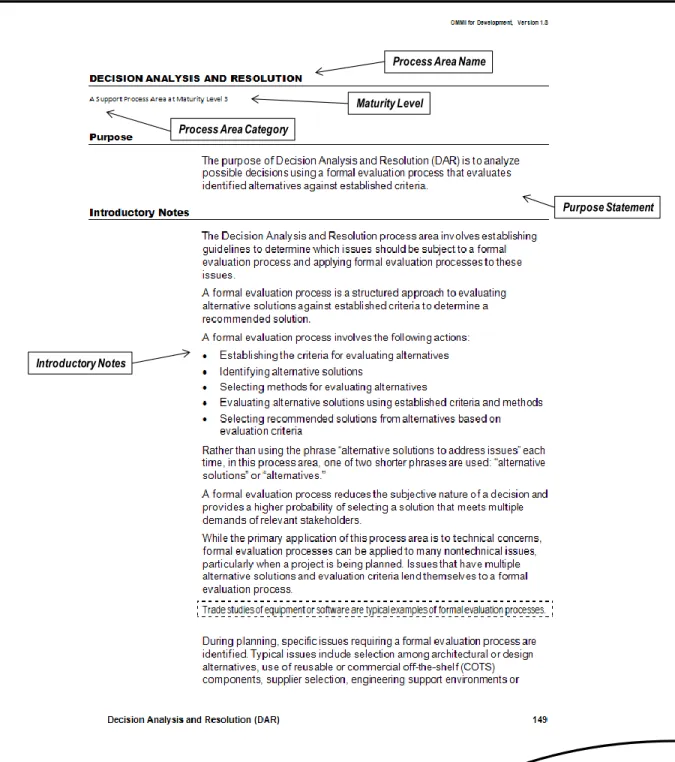
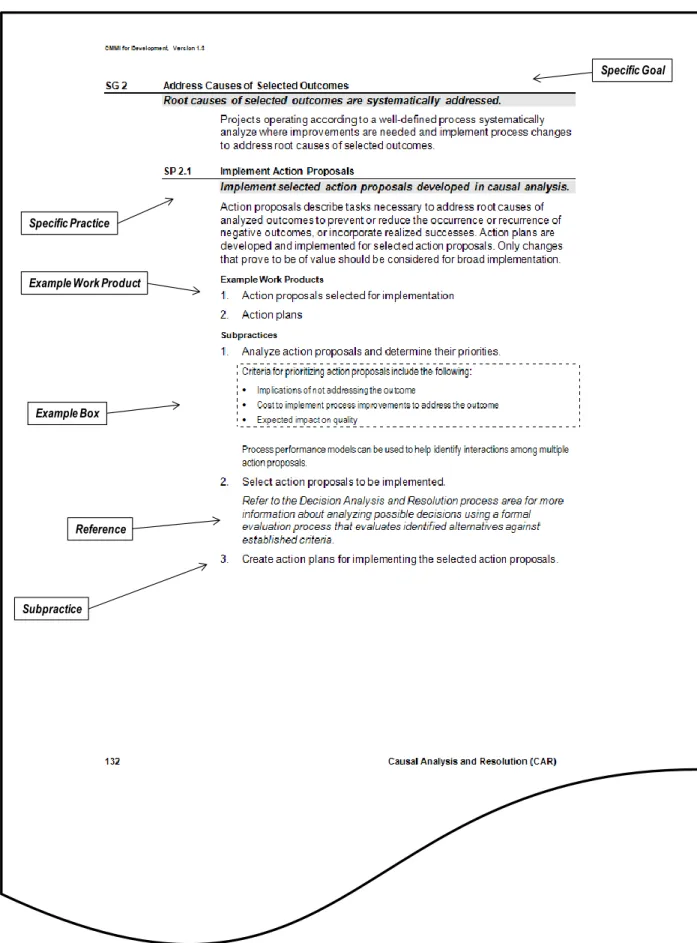
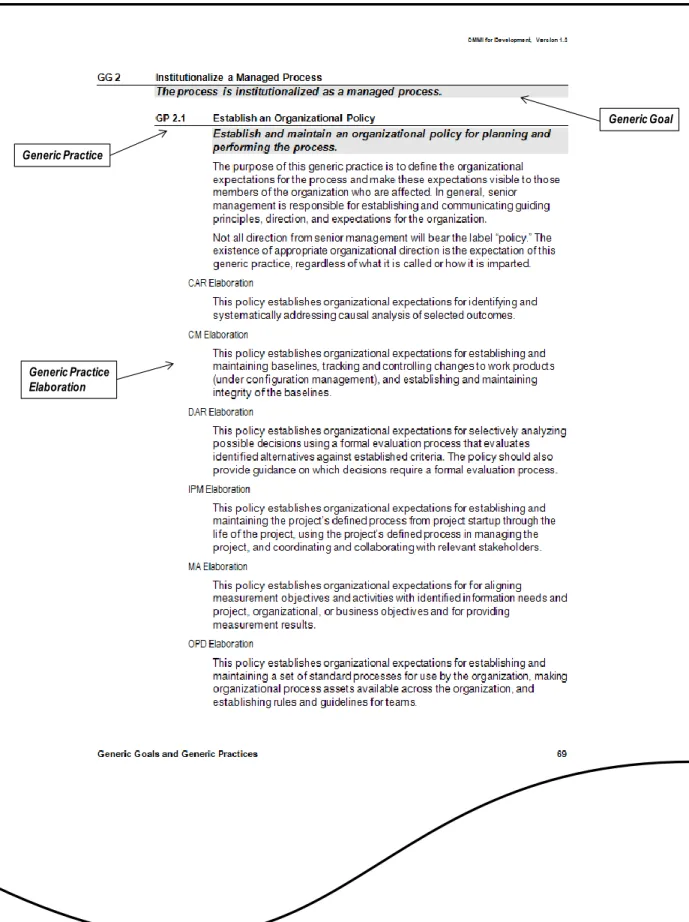
Figures 2.2, 2.3, and 2.4 are sample pages from process areas in Part Two; they show the different process area components, labeled so that you can identify them. Notice that components differ typographically so that you can easily identify each one.
Figure 2.2: Sample Page from Decision Analysis and Resolution Process Area Name
Process Area Category
Maturity Level
Purpose Statement
Process Area Components 18
Figure 2.3: Sample Page from Causal Analysis and Resolution Reference
Subpractice
Example Work Product
Specific Goal
Specific Practice
Figure 2.4: Sample Page from the Generic Goals and Generic Practices Generic Practice
Generic Goal
Generic Practice Elaboration
Process Area Components 20
3 Tying It All Together
Now that you have been introduced to the components of CMMI models, you need to understand how they fit together to meet your process
improvement needs. This chapter introduces the concept of levels and
shows how the process areas are organized and used.
CMMI-DEV does not specify that a project or organization must follow a particular process flow or that a certain number of products be developed per day or specific performance targets be achieved. The model does specify that a project or organization should have processes that address development related practices. To determine whether these processes are in place, a project or organization maps its processes to the process areas in this model.
The mapping of processes to process areas enables the organization to track its progress against the CMMI-DEV model as it updates or creates processes. Do not expect that every CMMI-DEV process area will map one to one with your organization’s or project’s processes.
Understanding Levels
Levels are used in CMMI-DEV to describe an evolutionary path
recommended for an organization that wants to improve the processes it uses to develop products or services. Levels can also be the outcome of
the rating activity in appraisals.7 Appraisals can apply to entire
organizations or to smaller groups such as a group of projects or a division. CMMI supports two improvement paths using levels. One path enables organizations to incrementally improve processes corresponding to an individual process area (or group of process areas) selected by the organization. The other path enables organizations to improve a set of related processes by incrementally addressing successive sets of process areas.
These two improvement paths are associated with the two types of levels: capability levels and maturity levels. These levels correspond to two approaches to process improvement called “representations.” The two representations are called “continuous” and “staged.” Using the continuous representation enables you to achieve “capability levels.” Using the staged representation enables you to achieve “maturity levels.”
7
For more information about appraisals, refer to Appraisal Requirements for CMMI and the Standard CMMI Appraisal Method for Process Improvement Method Definition Document [SEI 2011a, SEI 2011b].
Tying It All Together 22
To reach a particular level, an organization must satisfy all of the goals of the process area or set of process areas that are targeted for improvement, regardless of whether it is a capability or a maturity level.
Both representations provide ways to improve your processes to achieve business objectives, and both provide the same essential content and use the same model components.
Structures of the Continuous and Staged Representations
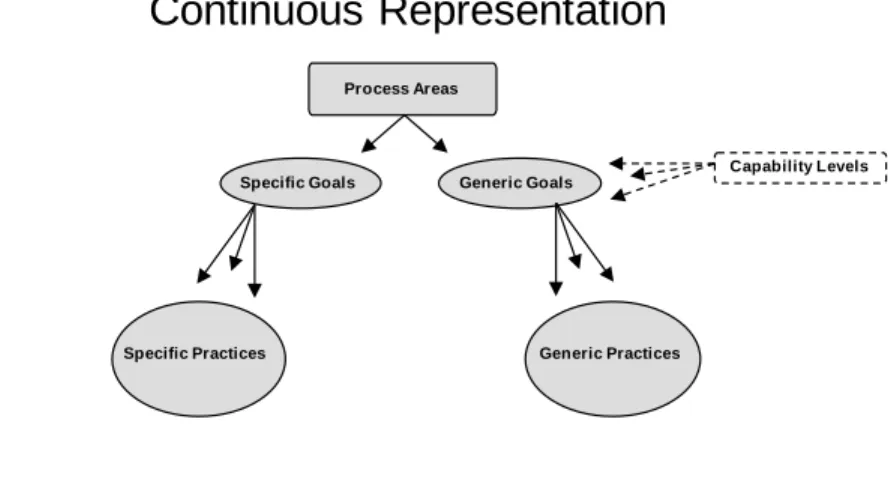
Figure 3.1 illustrates the structures of the continuous and staged representations. The differences between the structures are subtle but significant. The staged representation uses maturity levels to characterize the overall state of the organization’s processes relative to the model as a whole, whereas the continuous representation uses capability levels to characterize the state of the organization’s processes relative to an individual process area.
Process Areas
Capability Levels
Continuous Representation
Generic Practices Generic Goals
Specific Goals
Specific Practices
Maturity Levels
Staged Representation
Generic Practices Generic Goals
Specific Goals
Specific Practices
Process Areas
What may strike you as you compare these two representations is their similarity. Both have many of the same components (e.g., process areas, specific goals, specific practices), and these components have the same hierarchy and configuration.
What is not readily apparent from the high-level view in Figure 3.1 is that the continuous representation focuses on process area capability as measured by capability levels and the staged representation focuses on overall maturity as measured by maturity levels. This dimension (the capability/maturity dimension) of CMMI is used for benchmarking and appraisal activities, as well as guiding an organization’s improvement efforts.
Capability levels apply to an organization’s process improvement achievement in individual process areas. These levels are a means for incrementally improving the processes corresponding to a given process area. The four capability levels are numbered 0 through 3.
Maturity levels apply to an organization’s process improvement
achievement across multiple process areas. These levels are a means of improving the processes corresponding to a given set of process areas (i.e., maturity level). The five maturity levels are numbered 1 through 5.
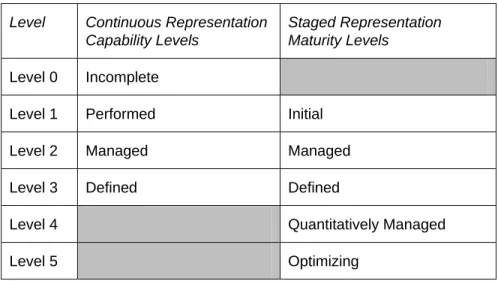
Table 3.1 compares the four capability levels to the five maturity levels. Notice that the names of two of the levels are the same in both
representations (i.e., Managed and Defined). The differences are that there is no maturity level 0; there are no capability levels 4 and 5; and at level 1, the names used for capability level 1 and maturity level 1 are different.
Table 3.1 Comparison of Capability and Maturity Levels
Level Continuous Representation
Capability Levels
Staged Representation Maturity Levels
Level 0 Incomplete
Level 1 Performed Initial
Level 2 Managed Managed
Level 3 Defined Defined
Level 4 Quantitatively Managed
Level 5 Optimizing
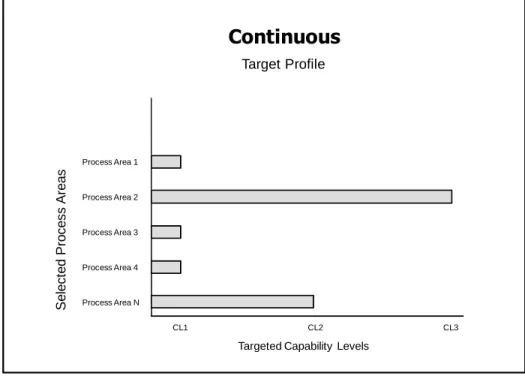
The continuous representation is concerned with selecting both a particular process area to improve and the desired capability level for that process area. In this context, whether a process is performed or incomplete is important. Therefore, the name “Incomplete” is given to the continuous representation starting point.
Tying It All Together 24
The staged representation is concerned with selecting multiple process areas to improve within a maturity level; whether individual processes are performed or incomplete is not the primary focus. Therefore, the name “Initial” is given to the staged representation starting point.
Both capability levels and maturity levels provide a way to improve the processes of an organization and measure how well organizations can and do improve their processes. However, the associated approach to process improvement is different.
Understanding Capability Levels
To support those who use the continuous representation, all CMMI models reflect capability levels in their design and content.
The four capability levels, each a layer in the foundation for ongoing process improvement, are designated by the numbers 0 through 3:
0. Incomplete
1. Performed
2. Managed
3. Defined
A capability level for a process area is achieved when all of the generic goals are satisfied up to that level. The fact that capability levels 2 and 3 use the same terms as generic goals 2 and 3 is intentional because each of these generic goals and practices reflects the meaning of the capability levels of the goals and practices. (See the Generic Goals and Generic Practices section in Part Two for more information about generic goals and practices.) A short description of each capability level follows.
Capability Level 0: Incomplete
An incompleteprocess is a process that either is not performed or is partially performed. One or more of the specific goals of the process area are not satisfied and no generic goals exist for this level since there is no reason to institutionalize a partially performed process.
Capability Level 1: Performed
A capability level 1 process is characterized as a performed process. A
performed process is a process that accomplishes the needed work to produce work products; the specific goals of the process area are satisfied. Although capability level 1 results in important improvements, those
improvements can be lost over time if they are not institutionalized. The application of institutionalization (the CMMI generic practices at capability levels 2 and 3) helps to ensure that improvements are maintained.
Capability Level 2: Managed
A capability level 2 process is characterized as a managed process. A
managed process is a performed process that is planned and executed in accordance with policy; employs skilled people having adequate resources to produce controlled outputs; involves relevant stakeholders; is monitored, controlled, and reviewed; and is evaluated for adherence to its process description.
The process discipline reflected by capability level 2 helps to ensure that existing practices are retained during times of stress.
Capability Level 3: Defined
A capability level 3 process is characterized as a definedprocess. A
defined process is a managed process that is tailored from the
organization’s set of standard processes according to the organization’s tailoring guidelines; has a maintained process description; and contributes process related experiences to the organizational process assets.
A critical distinction between capability levels 2 and 3 is the scope of standards, process descriptions, and procedures. At capability level 2, the standards, process descriptions, and procedures can be quite different in each specific instance of the process (e.g., on a particular project). At capability level 3, the standards, process descriptions, and procedures for a project are tailored from the organization’s set of standard processes to suit a particular project or organizational unit and therefore are more consistent, except for the differences allowed by the tailoring guidelines.
Another critical distinction is that at capability level 3 processes are typically described more rigorously than at capability level 2. A defined process clearly states the purpose, inputs, entry criteria, activities, roles, measures, verification steps, outputs, and exit criteria. At capability level 3, processes are managed more proactively using an understanding of the
interrelationships of the process activities and detailed measures of the process and its work products.
Advancing Through Capability Levels
The capability levels of a process area are achieved through the application of generic practices or suitable alternatives to the processes associated with that process area.
Reaching capability level 1 for a process area is equivalent to saying that
the processes associated with that process area are performedprocesses.
Reaching capability level 2 for a process area is equivalent to saying that there is a policy that indicates you will perform the process. There is a plan for performing it, resources are provided, responsibilities are assigned, training to perform it is provided, selected work products related to performing the process are controlled, and so on. In other words, a capability level 2 process can be planned and monitored just like any project or support activity.
Tying It All Together 26
Reaching capability level 3 for a process area is equivalent to saying that an organizational standard process exists associated with that process area, which can be tailored to the needs of the project. The processes in the organization are now more consistently defined and applied because they are based on organizational standard processes.
After an organization has reached capability level 3 in the process areas it has selected for improvement, it can continue its improvement journey by addressing high maturity process areas (Organizational Process
Performance, Quantitative Project Management, Causal Analysis and Resolution, and Organizational Performance Management).
The high maturity process areas focus on improving the performance of those processes already implemented. The high maturity process areas describe the use of statistical and other quantitative techniques to improve organizational and project processes to better achieve business objectives. When continuing its improvement journey in this way, an organization can derive the most benefit by first selecting the OPP and QPM process areas, and bringing those process areas to capability levels 1, 2, and 3. In doing so, projects and organizations align the selection and analyses of
processes more closely with their business objectives.
After the organization attains capability level 3 in the OPP and QPM process areas, the organization can continue its improvement path by selecting the CAR and OPM process areas. In doing so, the organization analyzes the business performance using statistical and other quantitative techniques to determine performance shortfalls, and identifies and deploys process and technology improvements that contribute to meeting quality and process performance objectives. Projects and the organization use causal analysis to identify and resolve issues affecting performance and promote the dissemination of best practices.
Understanding Maturity Levels
To support those who use the staged representation, all CMMI models reflect maturity levels in their design and content. A maturity level consists of related specific and generic practices for a predefined set of process areas that improve the organization’s overall performance.
The maturity level of an organization provides a way to characterize its performance. Experience has shown that organizations do their best when they focus their process improvement efforts on a manageable number of process areas at a time and that those areas require increasing
sophistication as the organization improves.
A maturity level is a defined evolutionary plateau for organizational process improvement. Each maturity level matures an important subset of the organization’s processes, preparing it to move to the next maturity level. The maturity levels are measured by the achievement of the specific and generic goals associated with each predefined set of process areas.
The five maturity levels, each a layer in the foundation for ongoing process improvement, are designated by the numbers 1 through 5:
1. Initial
2. Managed
3. Defined
4. Quantitatively Managed
5. Optimizing
Remember that maturity levels 2 and 3 use the same terms as capability levels 2 and 3. This consistency of terminology was intentional because the concepts of maturity levels and capability levels are complementary.
Maturity levels are used to characterize organizational improvement relative to a set of process areas, and capability levels characterize organizational improvement relative to an individual process area.
Maturity Level 1: Initial
At maturity level 1, processes are usually ad hoc and chaotic. The organization usually does not provide a stable environment to support processes. Success in these organizations depends on the competence and heroics of the people in the organization and not on the use of proven processes. In spite of this chaos, maturity level 1 organizations often produce products and services that work, but they frequently exceed the budget and schedule documented in their plans.
Maturity level 1 organizations are characterized by a tendency to
overcommit, abandon their processes in a time of crisis, and be unable to repeat their successes.
Maturity Level 2: Managed
At maturity level 2, the projects have ensured that processes are planned and executed in accordance with policy; the projects employ skilled people who have adequate resources to produce controlled outputs; involve relevant stakeholders; are monitored, controlled, and reviewed; and are evaluated for adherence to their process descriptions. The process
discipline reflected by maturity level 2 helps to ensure that existing practices are retained during times of stress. When these practices are in place, projects are performed and managed according to their documented plans. Also at maturity level 2, the status of the work products are visible to management at defined points (e.g., at major milestones, at the completion of major tasks). Commitments are established among relevant stakeholders and are revised as needed. Work products are appropriately controlled. The work products and services satisfy their specified process descriptions, standards, and procedures.
Tying It All Together 28
Maturity Level 3: Defined
At maturity level 3, processes are well characterized and understood, and are described in standards, procedures, tools, and methods. The
organization’s set of standard processes, which is the basis for maturity level 3, is established and improved over time. These standard processes are used to establish consistency across the organization. Projects establish their defined processes by tailoring the organization’s set of standard processes according to tailoring guidelines. (See the definition of “organization’s set of standard processes” in the glossary.)
A critical distinction between maturity levels 2 and 3 is the scope of standards, process descriptions, and procedures. At maturity level 2, the standards, process descriptions, and procedures can be quite different in each specific instance of the process (e.g., on a particular project). At maturity level 3, the standards, process descriptions, and procedures for a project are tailored from the organization’s set of standard processes to suit a particular project or organizational unit and therefore are more consistent except for the differences allowed by the tailoring guidelines.
Another critical distinction is that at maturity level 3, processes are typically described more rigorously than at maturity level 2. A defined process clearly states the purpose, inputs, entry criteria, activities, roles, measures,
verification steps, outputs, and exit criteria. At maturity level 3, processes are managed more proactively using an understanding of the
interrelationships of process activities and detailed measures of the process, its work products, and its services.
At maturity level 3, the organization further improves its processes that are related to the maturity level 2 process areas. Generic practices associated with generic goal 3 that were not addressed at maturity level 2 are applied to achieve maturity level 3.
Maturity Level 4: Quantitatively Managed
At maturity level 4, the organization and projects establish quantitative objectives for quality and process performance and use them as criteria in managing projects. Quantitative objectives are based on the needs of the customer, end users, organization, and process implementers. Quality and process performance is understood in statistical terms and is managed throughout the life of projects.
For selected subprocesses, specific measures of process performance are collected and statistically analyzed. When selecting subprocesses for analyses, it is critical to understand the relationships between different subprocesses and their impact on achieving the objectives for quality and process performance. Such an approach helps to ensure that subprocess monitoring using statistical and other quantitative techniques is applied to where it has the most overall value to the business. Process performance baselines and models can be used to help set quality and process
A critical distinction between maturity levels 3 and 4 is the predictability of process performance. At maturity level 4, the performance of projects and selected subprocesses is controlled using statistical and other quantitative techniques, and predictions are based, in part, on a statistical analysis of fine-grained process data.
Maturity Level 5: Optimizing
At maturity level 5, an organization continually improves its processes based on a quantitative understanding of its business objectives and performance needs. The organization uses a quantitative approach to understand the variation inherent in the process and the causes of process outcomes.
Maturity level 5 focuses on continually improving process performance through incremental and innovative process and technological
improvements. The organization’s quality and process performance objectives are established, continually revised to reflect changing business objectives and organizational performance, and used as criteria in
managing process improvement. The effects of deployed process improvements are measured using statistical and other quantitative techniques and compared to quality and process performance objectives. The project’s defined processes, the organization’s set of standard processes, and supporting technology are targets of measurable improvement activities.
A critical distinction between maturity levels 4 and 5 is the focus on managing and improving organizational performance. At maturity level 4, the organization and projects focus on understanding and controlling performance at the subprocess level and using the results to manage projects. At maturity level 5, the organization is concerned with overall organizational performance using data collected from multiple projects. Analysis of the data identifies shortfalls or gaps in performance. These gaps are used to drive organizational process improvement that generates measureable improvement in performance.
Advancing Through Maturity Levels
Organizations can achieve progressive improvements in their maturity by achieving control first at the project level and continuing to the most advanced level—organization-wide performance management and continuous process improvement—using both qualitative and quantitative data to make decisions.
Since improved organizational maturity is associated with improvement in the range of expected results that can be achieved by an organization, maturity is one way of predicting general outcomes of the organization’s next project. For instance, at maturity level 2, the organization has been elevated from ad hoc to disciplined by establishing sound project
management. As the organization achieves generic and specific goals for the set of process areas in a maturity level, it increases its organizational maturity and reaps the benefits of process improvement. Because each