I
n its Spring 2000 issue, Popular Government published “How to Read Governmental Finan-cial Statements, Part 1.” That article described the general format and meaning of governmental financial statements for elected officials, man-agers, and others without an ac-counting or financial reporting back-ground. It also described generally accepted accounting principles, or GAAP, and their role in establish-ing consistency in financial report-ing among governmental entities across the country.1 The article noted that GAAP reporting require-ments for governrequire-ments would be changing in future years. This arti-cle introduces readers to the new governmental financial reporting requirements.2Governmental GAAP are pro-mulgated by the Governmental Ac-counting Standards Board, or GASB. The GASB has been the primary standard-setting body for governmental GAAP since its inception in 1984. Current reporting requirements for governments have been in place for decades, amended in various ways by the GASB. The cur-rent reporting model, as described in Part 1 of this article, has served users well, but early on, the GASB indicated its intention to thoroughly research ways to improve the usefulness of gov-ernmental reports. The new reporting standards summarized in this article are the culmination of a fifteen-year project. In June 1999 the GASB issued Basic
Financial Statements—and Management’s Discussion and Analysis—for State and Local Governments (GASB Statement No. 34). This standard is designed to ex-pand the usefulness of governmental re-ports by addressing operational as well as fiscal accountability. Operational ac-countability “requires that a government demonstrate the extent to which it has met its operating objectives efficiently and effectively . . . and whether it can continue to do so.”3Fiscal accountability “requires that governments demonstrate compliance with public decisions con-cerning the raising and spending of pub-lic monies in the short term (usually on budgetary cycle or one year).”4Current financial reporting requirements always have focused on fiscal accountability, with an emphasis on various compliance
is-of most governmental entities, as the adoption of annual budgets and the evaluation and establishment of tax rates on an annual basis confirm. Although most users of governmen-tal financial statements agree that this focus is very important in the gov-ernment environment, there has long been a consensus that users also need to assess operational account-ability.
Operational accountability is ob-viously the focus in the private sec-tor. Again, although most users agree that the vast differences in objectives between the public and private sec-tors prohibit a one-size-fits-all model of financial reporting, the GASB does believe that governmental financial reporting also should include ele-ments of operational accountability. The challenge is to include them without compromising or diminish-ing the usefulness of the current model’s strengths, specifically its fund-based in-formation. The GASB has attempted to achieve this balance by adding an addi-tional level of financial reporting to the GAAP–mandated external financial state-ments that is specifically designed to fo-cus on a government’s operational ac-countability.
Even though the GASB released the pronouncement establishing the new standards in June 1999, it readily recog-nized that the changes in external finan-cial reporting requirements would be time-consuming to implement and, in some cases, costly. Therefore it estab-lished a schedule that takes into account the perceived readiness of governmental entities to implement the new standards. The GASB generally believed that large
How to Read Governmental
Financial Statements, Part 2
Gregory S. Allison
P O P U L A R G O V E R N M E N T
The author is an Institute of Government faculty member who specializes in governmental accounting and financial
than the small entities, and the schedule reflects this belief. Thus, depending on the size of their revenue base,5 govern-ments in North Carolina must imple-ment the new standards as follows: Phase 1—Revenue base of $100 million or more
Financial reports for fiscal years ended June 30, 2002
Phase 2—Revenue base of between $10 million and $100 million
Financial reports for fiscal years ended June 30, 2003
Phase 3—Revenue base under $10 million Financial reports for fiscal years ended June 30, 2004
Financial Reporting
Requirements
The combined financial statements and note disclosures discussed in Part 1 of this series make up what is currently known as the general purpose financial statements. These financial statements represent the minimum necessary to be in accordance with GAAP. The new fi-nancial reporting model replaces the concept of general purpose financial statements with a somewhat different reporting structure, as follows:
• Management’s Discussion and Analysis (MD&A)
• Basic Financial Statements Government-wide Financial Statements
•Statement of Net Assets • Statement of Activities Fund Financial Statements Note Disclosures
• Other Required Supplementary Information
In general, the fund financial state-ments, note disclosures, and other re-quired supplementary information are very similar to what is currently required, and accordingly they are the focus of Part 1 of this series. This article focuses on the MD&A and the government-wide finan-cial statements, which basically are new reporting requirements. Notable changes to the fund financial statements and the note disclosures are highlighted.
Management’s Discussion and Analysis The MD&A has its roots in private-sector reporting. Its primary purpose is to “provide the narrative introduction and overview that users need to interpret the basic financial statements.”6 Con-sidered required supplementary informa-tion, the MD&A should prove to be a useful document to accountants and nonaccountants alike for a summary of key data reported in the financial state-ments themselves.7 This document rep-resents management’s opportunity to present both a short- and a long-term analysis of its entity’s activities and finan-cial condition. The MD&A is not the proper forum for subjective information, such as goals, objectives, forecasts, and the like. Rather, it is a summary and analysis of currently known facts and financial data.
The general information required to be reported in the MD&A is as follows:
• A brief discussion of the basic finan-cial statements of the government, highlighting their relationship to one another and the information that each is intended to provide • Condensed financial information
based on the government-wide financial statements, as well as the fund financial statements
• An analysis that informs users whether the government’s financial situation has improved or deterio-rated
• A discussion of relevant budgetary events, such as significant amend-ments to the original budget and significant differences between budgeted and actual amounts • Any currently known facts or other
information that would or could have a direct bearing on the gov-ernment’s financial condition
The MD&A focuses on the current year and generally provides a comparison with the previous year’s operations. Al-though relevant charts, graphs, or other visual aids are not required, enhancing the narrative with them is useful.
Most managers and elected officials are familiar with a comprehensive annu-al financiannu-al report (CAFR). Entities that prepare CAFRs include a letter of
trans-mittal in its introductory section. A let-ter of transmittal is not the same as an MD&A, nor is the MD&A designed to replicate or replace the letter of trans-mittal. A letter of transmittal is generally a formal transmission of the CAFR to the users and describes the format of the document, the broad policies of the gov-ernment, and any other subjective infor-mation (for example, goals, objectives, and forecasts) deemed useful by man-agement. Governmental entities that pre-pare CAFRs must continue to include a letter of transmittal, in addition to an MD&A. Governmental entities that do not prepare CAFRs still will be required to prepare an MD&A. The two docu-ments should not duplicate information. The limited financial analysis that cur-rently appears in many letters of trans-mittal will be moved to the MD&A when the new reporting standards are implemented. Otherwise, the general information included in the letter will remain the same.
Basic Financial Statements
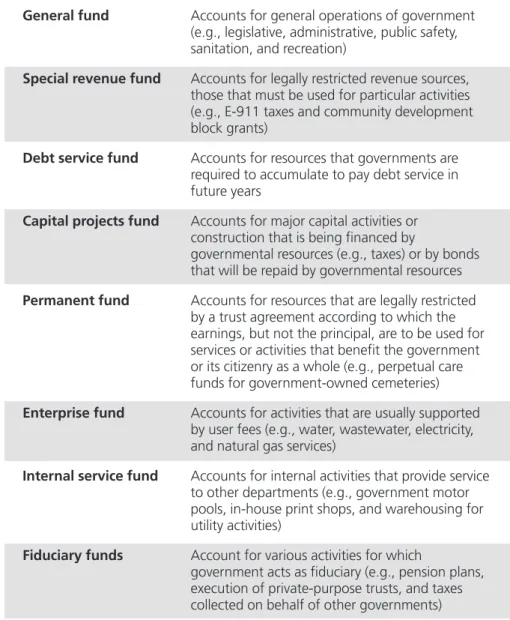
Governmental entities report their finan-cial information in three broad categories of funds: governmental, proprietary, and fiduciary. Within each category, several fund types are available to account for all the government’s activities and ser-vices (see Table 1). The basic financial statements provide two different per-spectives on the government’s financial situation: government-wide information and fund financial information, both of which are supported by a single set of note disclosures (notes containing criti-cal details about important financial issues—for example, significant ac-counting policies, components of invest-ment portfolios, capital assets informa-tion, and specifics about the types of long-term indebtedness the government has incurred). Government-wide infor-mation basically represents the new re-porting requirements, whereas the fund financial information represents infor-mation similar to what is currently re-quired by GAAP. In broad terms the government-wide financial information presents a picture of the government as a whole, focusing on the governmental funds and enterprise funds only, and including all their respective assets and liabilities. In contrast, the fund financial
ernment for their intended purpose. These are capital assets such as land, buildings, equipment, and vehicles. Al-though not spendable, they are of signifi-cant worth and cannot be ignored when assessing an entity’s overall net worth. Likewise, governmental funds also have “long-term liabilities,” those that are not due immediately but will be paid back in future periods. Although the government is not currently using resources to repay these long-term liabilities, it needs to accumulate resources to do so in the future. Accordingly, all short- and long-term liabilities must be taken into ac-count when assessing the overall net worth of an entity.
Operating statements of governmental funds report their revenues and expen-ditures. Per current GAAP, governmental funds focus on current financial re-sources. Thus, revenues are recognized only when they are considered available, as opposed to when they are earned. Governmental fund operating state-ments are similar to a checkbook regis-ter. Revenues are like deposits; expendi-tures are like withdrawals. Again, this is useful information when focusing on spendable resources only, but it falls short when assessing the overall earn-ings (that is, revenue earned but not nec-essarily available) of the fund and thus its total economic picture.
The government-wide statements provide the total economic picture for governmental activities and business-type activities. Specifically, governmen-tal funds are aggregated. The financial and nonfinancial assets of the funds are reported, as are the financial liabilities and long-term liabilities. Revenues for the aggregated funds are reported when earned, not just when available in cash. The aggregation results in a single col-umnar presentation known as “govern-mental activities.”
Proprietary funds, which include en-terprise and internal service funds, cur-rently focus on all assets and liabilities in their individual fund presentations, as well as on all revenue that is earned, not just that which is available. However, for purposes of assessing the govern-ment as a whole, the activities of an internal service fund should not be con-of governmental funds (that is, general,
special revenue, capital projects, debt service, and permanent funds) focus on financial assets and financial liabilities.8 A “financial asset” is an asset that either is in cash form or will convert to cash in its natural course. A “financial liability” is a very short-term liability, to be paid off soon, presumably with cash that is on hand or will be received in the near future. This focus is consistent with the budgetary approach to management that is characteristic of the governmental environment. Also, for assessing the short-term financial liquidity of a gov-ernment (for example, the resources available to finance current activities), this limited focus serves a useful purpose.
However, governmental funds also information focuses on all the major
funds of a government, including the fiduciary funds, and it retains the tradi-tional measurement focuses (that is, cur-rent financial resources for governmen-tal funds and togovernmen-tal economic resources for proprietary funds, described in more detail later in this article) required by current GAAP.
Government-wide Financial Statements The primary feature of the new reporting requirements is the government-wide fi-nancial statements. These statements are similar to private-sector financial infor-mation in that they are designed to pre-sent a picture of an entity as a whole, as opposed to by fund. These statements focus on two broad types of activities: Table 1.Fund Types
General fund Accounts for general operations of government (e.g., legislative, administrative, public safety, sanitation, and recreation)
Special revenue fund Accounts for legally restricted revenue sources, those that must be used for particular activities (e.g., E-911 taxes and community development block grants)
Debt service fund Accounts for resources that governments are required to accumulate to pay debt service in future years
Capital projects fund Accounts for major capital activities or construction that is being financed by
governmental resources (e.g., taxes) or by bonds that will be repaid by governmental resources Permanent fund Accounts for resources that are legally restricted
by a trust agreement according to which the earnings, but not the principal, are to be used for services or activities that benefit the government or its citizenry as a whole (e.g., perpetual care funds for government-owned cemeteries) Enterprise fund Accounts for activities that are usually supported
by user fees (e.g., water, wastewater, electricity, and natural gas services)
Internal service fund Accounts for internal activities that provide service to other departments (e.g., government motor pools, in-house print shops, and warehousing for utility activities)
Fiduciary funds Account for various activities for which
government acts as fiduciary (e.g., pension plans, execution of private-purpose trusts, and taxes collected on behalf of other governments)
mechanism for internal services (for exam-ple, in-house print shops). They do not enhance or limit the government’s financial condition as a whole. The business-type activities column therefore represents only the entity’s enterprise funds.
The government-wide financial state-ments do not include the fiduciary activ-ities of a government. This information is reported in the fund financial statements. Since fiduciary activities are controlled by trust agreements and independent parties, they do not enhance or limit the governmental entity’s economic picture as a whole.
Statement of Net Assets
The standard accounting equation of “assets = liabilities + equity” also can be stated as “assets – liabilities = net assets.” The statement of net assets (see Exhibit 1) reports the total assets, the total liabili-ties, and, accordingly, the net assets of both the governmental and the business-type activities of a government. The state-ment can be used to answer the following questions:
• What does each activity (that is, governmental and business-type) of the governmental entity ownas of June 30?
• What does each activity of the gov-ernmental entity oweas of June 30? • What is each activity’s net worthas
of June 30?
Again, the uniqueness of the mental activities column on the govern-ment-wide statement of net assets is that all assets, not just financial assets, are reported, as are all liabilities, not just short-term liabilities. Thus the net worth (that is, the net assets) reflects the total economic picture of the governmental ac-tivities, not just the spendable net worth, as the fund balance reflects in the fund Exhibit 1
Source: Portions of GASB’s Guide to Implementation of GASB Statement 34 on Basic Financial Statements — and Management’s Discussion and Analysis — for State and Local Governments: Questions and Answers, copyrighted by the Governmental Accounting Standards Board, 401 Merritt 7, P.O. Box 5116, Norwalk, Connecticut 06856-5116, are reprinted with permission. Complete copies of this publication are available from the GASB.
Net assets.In the new government-wide financial statements, equity termi-nology for both the governmental and the business-type activities will be “net assets.” This terminology reflects the restatement of the accounting equation:
Assets – Liabilities = Net Assets As described earlier, both governmen-tal and business-type activities focus on total economic resources. Each activity reports all assets, not just those that are liquid, and all liabilities, not just those that are current. Thus their net worth (that is, assets minus liabilities) results in a net assets figure that includes both expendable and nonexpendable pieces. This may be best illustrated with an ex-ample. Assume that a governmental fund has the following financial assets and financial liabilities:
Financial Assets
Cash $ 65,000
Investments 576,400
Taxes receivable 243,500 Due from other funds 25,000
Total assets $909,900
Financial Liabilities
Accounts payable $ 46,899 Salaries payable 15,750 Due to other funds 95,000 Due to other governments 188,000
Total liabilities $345,649
Using the accounting equation, the net assets, or net worth, of this entity would be $564,251. Since all the assets are financial assets (that is, cash or assets that will convert to cash) and all the lia-bilities are short-term, the net assets of $564,251 reflect an amount that will eventually be available to spend for other items, assuming that there are no specific restrictions on it. Per current governmental GAAP, this reflects how governmental funds are reported: the measurement focus is on current finan-cial resources. Also, the net assets are simply known as the “fund balance.”
However, using the same assumptions yet introducing nonfinancial assets (for example, capital assets) and long-term li-abilities results in a significant difference
Financial Assets
Cash $65,000
Investments 576,400
Taxes receivable 243,500 Due from other funds 25,000 Capital assets 2,250,000
Total assets $3,159,900
Financial Liabilities
Accounts payable $46,899 Salaries payable 15,750 Due to other funds 95,000 Due to other governments 188,000 Bonds payable 2,550,000
Total liabilities $2,895,649
Although the entity has the same amount of liquid assets and short-term debt, net assets are only $264,251. From a total economic perspective, consider-ing all spendable and nonspendable assets, as well as all liabilities that the entity will eventually have to pay, its net worth is significantly less. The first cal-culation answers a limited question: What are net spendable resources for the cur-rent period? The second calculation answers a much broader question: What is the entity’s net worth overall? Each calculation is equally valuable, but the information is used for different pur-poses. For example, the latter calcula-tion of net worth cannot be used simply to identify what is spendable. Likewise, the former calculation does not assess an entity’s total net worth.
The GASB believes that both types of information are useful and should be available to users of governmental fi-nancial statements to assess both spend-able net worth and total economic net worth. Current GAAP provide only spendable net worth information for governmental funds. The net assets cal-culated on the new government-wide financial statements for governmental activities provide the total economic per-spective.
Net assets are divided into three clas-sifications, as follows:
• Invested in capital assets, net of related debt
This amount is calculated by sub-tracting any outstanding debt incurred to procure capital assets from the value of the assets them-financial statements. In contrast, the
busi-ness-type activities column is basically the same as the total enterprise funds report-ed in the fund financial statements.
Part 1 of this series provides a de-tailed overview of the types of assets and liabilities that are common to a balance sheet, as well as the terminology used for equity (that is, “fund balance” for governmental funds and “retained earn-ings” for proprietary funds). With the exception of the equity terminology, these same types of assets and liabilities are generally found on the statement of net assets. Accordingly, this article fo-cuses on the specific differences between the statement of net assets and the afore-mentioned balance sheet.
Infrastructure.As stated earlier, the government-wide statement of net assets will include all assets of the governmen-tal and business-type activities. Included, however, for the first time will be infra-structure assets of the governmental activities. These are roads, bridges, side-walks, and the like—assets that are cer-tainly significant in value but of use only to the government. Heretofore these assets have not been included on the bal-ance sheet of governmental entities. However, the GASB believes that it is important to include this information in order to give users a complete economic picture of the government. Governments will be required to include infrastructure as an asset as it is procured, but they also will have to include infrastructure ac-quired within approximately the last twenty years.9
This requirement will be time-consuming to implement and could be costly in some jurisdictions. Although procuring professional services to help with the identification and the capitaliza-tion of these assets is certainly not re-quired, many entities may have to do so. Realizing the difficulties that govern-ments might encounter, the GASB is allowing additional time for implemen-tation of the retroactive portion of in-frastructure capitalization. Specifically, Phase 1 and Phase 2 governments have an additional four years from the re-quired implementation date of the new standards to get this piece into place.10 However, new infrastructure will have to
Exhibit 2 Source:
Portions of
GASB’
s Guide to Implementation of GASB Statement 34 on Basic Financial Statements
—
and Management’
s Discussion and Analysis
—
for
State and Local Governments: Questions and
Answers
, copyrighted by the Gover
nmental Accounting Standar
ds Boar
d, 401 Merritt 7, P
.O. Box 5116, Norwalk, Connecticut 06856-5116, a
re
r
eprinted with permission. Complete copies of this
publication ar
e available fr
portion. For most governmental jurisdictions in North Carolina, this will be a positive amount. • Restricted net assets
This amount reflects net assets whose use is restricted by indepen-dent external third parties. Assets that would be part of this calculation are cash, investments, or receiv-ables related to grants or restricted shared revenues. A common North Carolina example is Powell Bill assets held by a municipality but not yet spent. The state restricts use of those assets to specific street construction and maintenance proj-ects. Again, for most governmental jurisdictions, this will be a positive amount unless there are significant outstanding restricted liabilities. • Unrestricted net assets
In short, this amount reflects all net assets that were not classified into one of the other two categories. This would typically be all noncapital or unrestricted assets, such as cash, investments, and receivables, minus all noncapital liabilities, such as accounts payable. There are numer-ous scenarios in which this amount could actually be negative, though that does not necessarily indicate a problem. It could simply mean that at present, certain long-term liabilities exceed the currently available spendable assets. Assets will need to be accumulated to repay these liabilities as they come due in the future. (For a further discussion of potentially negative unrestricted net assets in North Carolina govern-ments, see the sidebar on this page.) Statement of Activities
The new government-wide operating statement is referred to as the “statement of activities” (see Exhibit 2). This state-ment reports the changes in a govern-ment’s net assets during the year. As with the statement of net assets, the focus is on the entity’s governmental and business-type activities. The statement of activities reports the revenues earned and the ex-penses incurred during the year. The
ter-minology used in the statement remains 1 of this series. The focus here is on the
The most noticeable difference in the new statement is its format. The focus is actually expenses, followed by various types of revenues. This reflects the fact that, in the public sector, “the goal is to provide needed services, not maximize revenue.”11Information is broken down by functional categories in both the gov-ernmental and the business-type activi-ties. For governmental activities these functional categories include, but are not limited to, general governmental services, public safety, public works, recreation, and sanitation. Examples of business-type functional categories are water, waste-water, and electric operations.
Program revenues. The statement of activities is actually read horizontally. An expense column is presented first, followed by three categories of program revenues. Program revenues are defined by GASB Statement No. 34 as revenues derived “directly from the program itself or from parties outside the reporting government’s taxpayers or citizenry, as a whole; they reduce the net cost of the function to be financed from the govern-ment’s general revenues.”12Program rev-enues are reported in three categories:
• Charges for services
• Program-specific operating grants and contributions
• Program-specific capital grants and contributions
Charges for services typically include user fees such as garbage collection fees or water charges. Grants and contribu-tions are resources received by the gov-ernment whose grantors or contributors require use for either operating or capital purposes in specified functional areas. Common examples for North Carolina governments are Powell Bill funds and community development block grants.
These revenues are reported in columns following the expense column. Net columns are then presented for gov-ernmental activities or business-type activities. For most of the functional cat-egories, especially for the governmental activities, this net amount will reflect a deficit. This does not indicate financial difficulties or any type of loss. It simply reflects the fact that governmental enti-ties do not fund the majority of their
N
EGATIVEU
NRESTRICTEDN
ETA
SSETSAny of the three classifications of net assets (that is, invested in capital assets, restricted net assets, and unrestricted net assets) may be negative amounts. However, negative amounts are going to be most common in the “unrestricted net assets” classification. For North Carolina counties, negative amounts in “unrestricted net assets” will not be unusual because the North Carolina General Statutes require counties to issue debt on behalf of the schools. This debt remains a legal liability of the county, while the assets procured by the proceeds (school buildings, school equipment, and so on) become the property of the school district. In short, the county has debt but no assets to offset it; the schools have assets but no debt to offset them. Even though the debt proceeds will be used for capital procurement, the capital is not that of the county. Therefore the outstanding liability is an offset not in the “invested in capital assets” classification but in the “unrestricted net assets” classification. With no asset offset, the liability often will result in a negative “unrestricted net assets” calculation.
Ironically, counties where explo-sive growth is occurring will actually be more negatively affected. These counties are issuing more and more debt to keep up with the need for additional school facilities. Managers and elected officials should not interpret these negative amounts as an indication of financial diffi-culties. Similarly, large positive “invested in capital assets” amounts in the school systems’ financial statements should not be con-sidered an indication of spendable net worth.
full cost of those services. Instead, gen-eral, unrestricted revenues such as taxes subsidize these activities.
Below these amounts, the statement of net assets includes all the governmen-tal entity’s general revenues. General revenues include, but are not limited to, taxes (for example, property taxes, sales taxes, and income taxes), interest, unre-stricted grants and contributions, and transfers between governmental and business-type activities. Again, this for-mat visually represents how governmen-tal entities are generally structured. Tax-ation and revenue sources of a similar type subsidize public-purpose functions that rarely could be considered self-sufficient.
The net effect of expenses, program revenues, and general revenues is either an increase or a decrease in net assets of both the governmental and the business-type activities. The ending net assets for each activity should agree with the net assets reported on the statement of net assets. In summary, the statement of net assets is a snapshot of all assets, liabilities, and net assets at the end of the fiscal year (June 30 for North Caro-lina governments). The statement of activities reports all the transactions for the governmental or business-type activities throughout the year that either increase or decrease the applicable activities’ net assets. Fund Financial Statements
and Note Disclosures
As noted earlier, the new financial re-porting model presents financial infor-mation from two different perspectives. The government-wide financial state-ments provide information on the gov-ernmental and business-type activities as a whole, and the fund financial state-ments focus on the individual funds. Specifically the governmental fund in-formation focuses on current financial resources, while the proprietary and fi-duciary fund information focuses on total economic resources. The reporting requirements for the fund financial statements are adequately summarized in Part 1 of this series and thus are not repeated in this article. In short, balance sheets, operating statements, and state-ments of cash flow (for proprietary funds) for each major fund are included in the fund financial statements.13
The new reporting requirements include a reconciliation between the government-wide and the fund financial statements. This reconciliation should prove invaluable for users to understand why certain information is included on one statement but not on another, or how a transaction can be viewed from the perspective of either current financial resources or total economic resources.
Another required element of the basic financial statements is the note disclo-sures. Obviously, some changes were necessary to incorporate explanations of the new government-wide financial statements (for example, describing the measurement focus used and the inclu-sion of infrastructure assets). Generally, though, the form and the content of the note disclosures have remained un-changed.
North Carolina governments are required to adopt budgets for each of their funds except internal service and fiduciary. Budgetary comparisons must be presented in the fund financial sec-tion. GASB Statement No. 34 gives gov-ernmental entities the option to include budgetary information as other required supplementary information. Making budgetary information required supple-mentary information lessens the audit coverage to which it is subject. However, since this information is critical to exhibiting compliance with state bud-getary statutes, North Carolina govern-ments will be required to include these budgetary presentations as basic finan-cial statements.
Conclusion
This article is intended to provide managers and elected officials with an over-view of the new financial reporting require-ments that will be affecting governrequire-ments all across the nation. It is impossible to teach governmental GAAP in the con-text of an article like this. However, Parts 1 and 2 of this series highlight for managers and elected officials the funda-mental information included in the new financial reporting model, in the hope that these officials will better understand how to interpret financial information and ultimately better fulfill their fiduci-ary responsibilities.
Notes
1. For purposes of this article and in terms of the scope of jurisdiction of the Governmental Accounting Standards Board (GASB), “governmental entities” are state and local governmental entities only. They include, but are not limited to, counties, municipalities, public school systems, public authorities, public colleges and universities, and similar entities. The federal government is not subject to the GASB’s reporting requirements.
2. This article does not review the current governmental reporting requirements. Refer
to the Spring 2000 issue of POPULAR
GOVERNMENT, page 23, for that information. 3. STEPHENJ. GAUTHIER, ANELECTED OFFICIAL’SGUIDE TO THENEWGOVERNMENTAL FINANCIALREPORTINGMODEL13 (Chicago: Gov’t Finance Officers Ass’n, 2000).
4. GAUTHIER, ANELECTEDOFFICIAL’S
GUIDE, at 13.
5. The “revenue base” is defined as total governmental fund revenues (that is, general, special revenue, debt service, and capital projects) and enterprise funds (for example, utility funds). For North Carolina govern-ments, the revenue base is as of June 30, 1999.
6. GAUTHIER, ANELECTEDOFFICIAL’S
GUIDE, at 23.
7. “Required supplementary informa-tion” is information required to be included in the financial statements to be in accordance with GAAP but not subject to the same level of audit coverage as the basic financial statements.
8. A balance sheet reports the assets, the liabilities, and the equity (that is, the net worth) of a governmental entity. Refer to Part 1 of this series in the Spring 2000 issue of POPULARGOVERNMENTfor a complete description of a balance sheet.
9. The reporting standards actually require governments in Phase 1 or 2 of implementation to include major infrastructure assets acquired in the fiscal years ending after June 30, 1980. For North Carolina governments, this is for infrastructure acquired since July 1, 1980.
10. Phase 1 North Carolina governments will have until the fiscal year ending June 30,
2006, to implement the retroactive portion of
the infrastructure reporting requirement; Phase 2 North Carolina governments will have until the fiscal year ending June 30, 2007.
11. GAUTHIER, ANELECTEDOFFICIAL’S
GUIDE, at 28.
12. General Accounting Standards Board,
Basic Financial Statements—and Manage-ment’s Discussion and Analysis—for State and Local Governments, Statement No. 34, ¶ 48 (Norwalk, Conn.: GASB, June 1999).
13. GASB Statement No. 34 requires gov-ernments to report by major fund. Govern-ment officials can determine major funds by a calculation based on materiality, or they have the discretion to declare any or all of their funds “major.”