Biodiesel
Handling and Use Guide
Fourth Edition
NREL/TP-540-43672
Revised January 2009
National Renewable Energy LaboratoryNotice
This report was prepared as an account of work sponsored by an agency of the United States government. Neither the United States government nor any agency thereof, nor any of their employees, makes any warranty, express or implied, or assumes any legal liability or responsibility for the accuracy, completeness, or usefulness of any information, apparatus, product, or process disclosed, or represents that its use would not infringe privately owned rights. Reference herein to any specific commercial product, process, or service by trade name, trademark, manufacturer, or otherwise does not necessar-ily constitute or imply its endorsement, recommendation, or favoring by the United States government or any agency thereof. The views and opinions of authors expressed herein do not necessarily state or reflect those of the United States govern-ment or any agency thereof.
Available electronically at http://www.osti.gov/bridge
Available for a processing fee to U.S. Department of Energy and its contractors, in paper, from: U.S. Department of Energy
Office of Scientific and Technical Information P.O. Box 62
Oak Ridge, TN 37831-0062 phone: 865.576.8401 fax: 865.576.5728
email: mailto:[email protected] Available for sale to the public, in paper, from:
U.S. Department of Commerce National Technical Information Service 5285 Port Royal Road
Springfield, VA 22161 phone: 800.553.6847 fax: 703.605.6900
email: [email protected]
1.0 Introduction . . . 5
2.0 Biodiesel Basics. . . 6
2.1 What Is Biodiesel? . . . 6
2.2 Benefits of Biodiesel Use. . . 7
2.3 Other Biodiesel Attributes . . . 9
3.0 Biodiesel (B100). . . 10
3.1 B100 Quality Specification. . . 12
3.2 Variation in Biodiesel Properties . . . 15
3.3 Energy Content . . . 16
3.4 Low-Temperature Properties . . . 17
3.5 Cetane Number . . . 19
3.6 Transport and Storage. . . 19
3.6.1 Stability . . . 19
3.6.2 Microbial Contamination . . . 21
3.6.3 Cleaning Effect . . . 21
3.6.4 Materials Compatibility . . . 21
3.6.5 Storage Tanks and Dispensing Equipment . . . 22
3.6.6 Transport. . . 22
3.7 Use of B100 and High Blend Levels . . . 23
4.0 Biodiesel Blends. . . 23
4.1 Specifications . . . 23
4.1.1 B5 and Lower Blends . . . 23
4.1.2 B6 to B20 Blends. . . 23
4.2 Low-Temperature Properties . . . 25
4.3 Lubricity . . . 29
4.4 Blending, Storage, and Transport. . . 29
4.4.1 Blending . . . 29
4.4.2 Stability. . . 32
4.4.3 Cleaning Effect . . . 33
4.4.4 Materials Compatibility . . . 34
5.0 BQ-9000 Program for Supply Chain Management . . . 34
6.0 Engine Warranties . . . 35
7.0 Taxes and Incentives . . . 35
7.1 Off-Road Diesel . . . 35
8.0 Safety, Health, and Environmental Issues. . . 36
8.1 Signs, Labels, and Stickers . . . 36
8.2 Fire Safety Considerations. . . 36
9.0 Frequently Asked Questions. . . 37
10.0 Information Resources . . . 38
11.0 Glossary. . . 39
Appendix A. Sample Biodiesel Material Safety Data Sheet . . . 41
Contents
Appendix D. Density and Viscosity as a Function of Temperature . . . 44
Appendix E. Biodiesel Materials Compatibility Summary Tables . . . 48
Elastomers . . . 48
Metals. . . 49
Appendix F. BQ-9000 Sample Certificate of Analysis . . . 50
Figure 1. Basic Transesterification Process . . . .6
Figure 2. Average Emission Impacts of Biodiesel Fuels in CI Engines . . . .8
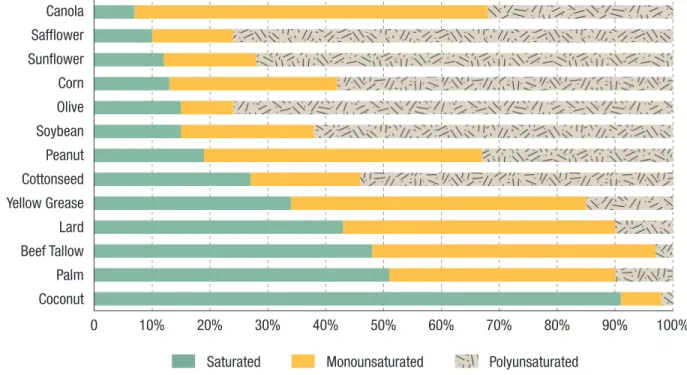
Figure 3. Composition of Various Biodiesel Feedstocks in Order of Increasing Saturated Fatty Acid Content . . . .16
Figure 4. Cetane Number of Two Petroleum Diesels and Several Biodiesels . . . .19
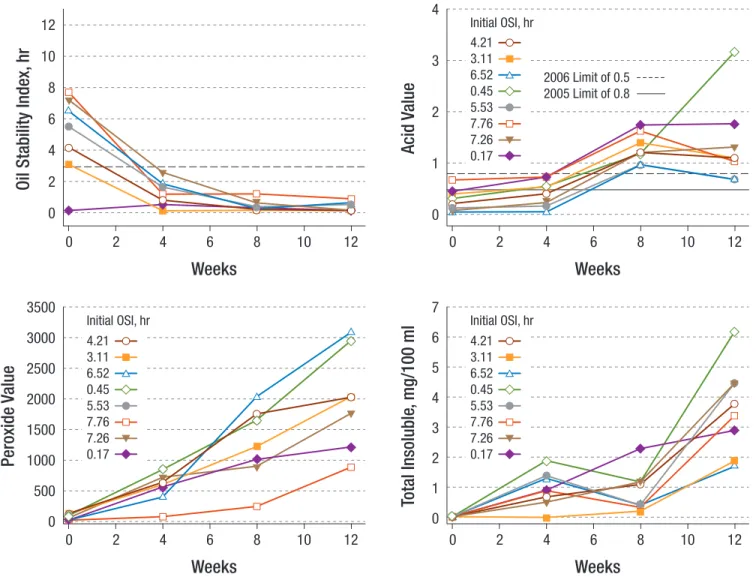
Figure 5. ASTM D4625 Long-Term Storage Stability for B100 Samples Having a Range of Initial Induction Periods. . . . .20
Figure 6. Biodiesel/Diesel Blend Cloud Point Test Results. . . .26
Figure 7. Biodiesel/Diesel Blend Cloud Point Test Results (0%–10% Biodiesel Blend Range). . . .26
Figure 8. Biodiesel/Diesel Blend Pour Point Test Results. . . .26
Figure 9. Biodiesel/Diesel Blend Pour Point Test Results (0%–10% Biodiesel Blend Range) . . . .26
Figure 10. Biodiesel/Diesel Blend Cold Filter Plugging Point Test Results . . . .26
Figure 11. Biodiesel/Diesel Blend Cold Filter Plugging Point Test Results (0%–10% Biodiesel Blend Range) . . . .26
Figure 12. Adjusting Cloud Points of B20 Fuels with Blends of No. 1 and No. 2 Diesel . . . .27
Figure 13. Cold Flow Properties of Some Soy Biodiesel Blends, ºF . . . .28
Figure 14. HFRR Lubricity as a Function of Biodiesel Content for a No. 1 and a No. 2 Diesel Fuel . . . .29
Figure 15. D4625 Storage Results for B5 Blends Made from B100 with Varying Levels of Oxidation Stability as Measured by the OSI Induction Time . . . .32
Figure 16. D4625 Storage Results for B20 Blends Made from B100 with Varying Levels of Oxidation Stability as Measured by OSI or Rancimat Induction Time . . . .33
Figures
Table 1. Select Properties of Typical No. 2 Diesel and Biodiesel Fuels . . . 11Table 2. Requirements for Biodiesel (B100) Blend Stock as Listed in ASTM D6751-08a. . . 12
Table 3. Fuel Properties as a Function of Fuel Composition in Diesel Engines . . . 16
Table 4. Heating Value of Diesel and Some Biodiesel (B100) Fuels. . . 17
Table 5. Cold Flow Data for Various B100 Fuels. . . 18
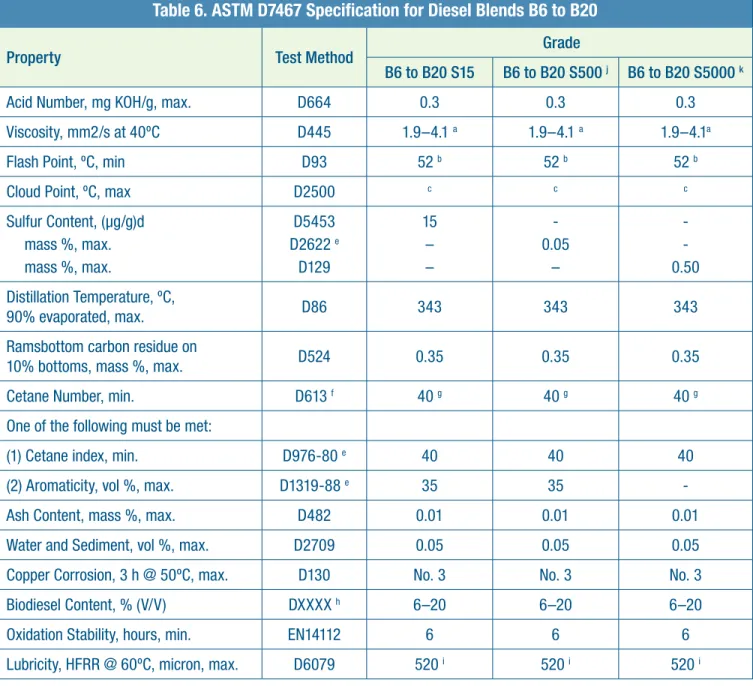
Table 6. ASTM D7467 Specification for Diesel Blends B6 to B20 . . . 24
Tables
AFV . . . .alternative fuel vehicle ASTM . . . . .ASTM International B100 . . . .100% biodiesel
B20 . . . .20% biodiesel, 80% petroleum diesel Btu . . . .British thermal unit
Ca . . . .calcium
CFPP . . . .cold filter plug point CI . . . .compression ignition CO. . . .carbon monoxide COA. . . .certificate of analysis CO2 . . . .carbon dioxide
DOE. . . .U.S. Department of Energy DOT. . . .U.S. Department of Transportation
ECRA. . . .Energy Conservation Reauthorization Act of 1998 EPA . . . .U.S. Environmental Protection Agency
EPAct. . . .Energy Policy Act of 1992 (amended in 1998) FAME. . . .fatty acid methyl esters
GHG. . . .greenhouse gas HC . . . .hydrocarbon
HFRR. . . .high-frequency reciprocating rig IRS . . . .Internal Revenue Service K . . . .potassium
KOH. . . .potassium hydroxide LTFT . . . .low-temperature flow test Mg. . . .magnesium
MSDA . . . . .material safety data sheet
MSHA . . . . .U.S. Department of Labor Mining Safety Health Administration Na . . . .sodium
NBB. . . .National Biodiesel Board NOx . . . .nitrogen oxides
NFPA . . . .National Fire Protection Association NREL . . . .National Renewable Energy Laboratory OEM . . . .original equipment manufacturer
OSHA. . . .Occupational Safety and Health Administration OSI . . . .Oil Stability Index
PAH . . . .polyaromatic hydrocarbons PM. . . .particulate matter
ppm. . . .parts per million
RCRA. . . .Resource Conservation & Recovery Act of 1976 RFS . . . .Renewable Fuels Standard
SO2 . . . .sulfur dioxide
UL . . . .Underwriters Laboratories VOC . . . .volatile organic compound
This document is a guide for those who blend, store, distribute, and use biodiesel and biodiesel blends. It provides basic information on the proper and safe use of biodiesel and biodiesel blends in compression-ignition engines
and boilers, and it is intended to help fleets, individual users, blenders, distributors, and those involved in related
activities understand procedures for handling and using biodiesel fuels.
Biodiesel is manufactured from plant oils, animal fats, and recycled cooking oils. Biodiesel’s advantages are as follows:
• It is renewable. • It is energy efficient.
• It displaces petroleum-derived diesel fuel.
• It can be used as a 20% blend in most diesel equipment with no or only minor modifications. • It can reduce global warming gas emissions.
• It can reduce tailpipe emissions, including air toxics.
• It is nontoxic, biodegradable, and suitable for sensitive environments.
In this report, biodiesel refers to the fuel produced from renewable sources that meets ASTM International D6751, the standard for biodiesel. A number following the “B” indicates the percentage of biodiesel in a gallon of
fuel; the remainder of the gallon can be No. 1 or No. 2 diesel, kerosene, jet A, JP8, heating oil, or any other distil
-late fuel. Pure biodiesel is also known as B100.
Biodiesel is most commonly used as a blend with petroleum diesel. At concentrations of up to 5 vol % (B5) in conventional diesel fuel, the mixture will meet the ASTM D975 diesel fuel specification and can be used in any application as if it were pure petroleum diesel; for home heating oil, B5 will meet the D396 home heating oil specification.At concentrations of 6% to 20%, biodiesel blends can be used in many applications that use diesel fuel with minor or no modifications to the equipment, although certain manufacturers do not extend warranty coverage if equipment is damaged by these blends. The B6 to B20 blends are covered by the ASTM D7467 speci
-fication that was approved in June 2008 and will be published later in 2008. Biodiesel can even be used as a fuel in its pure form (B100) if proper precautions are taken.
B20 is the most commonly used biodiesel blend in the United States because it provides a good balance between material compatibility, cold weather operability, performance, emission benefits, and costs. B20 is also the minimum blend level allowed for compliance with the Energy Policy Act of 1992 (EPAct), which requires the use of renewable fuels and/or alternative fuel vehicles (AFVs) by certain covered fleets. Equipment that can use B20 includes compression-ignition (CI) engines, fuel oil and heating oil boilers, and turbines.
B100 or higher blend levels such as B50 require special handling and may require equipment modifications.
These issues can potentially be managed with heaters and/or changing engine seal and gasket materials. However,
because the level of special care needed is high, the National Renewable Energy Laboratory (NREL) and the U.S. Department of Energy (DOE) do not recommend the use of high-level biodiesel blends, except where human exposure to diesel particulate matter (PM) is elevated and health concerns merit the additional attention to equip
-ment and fuel handling. Always consult your engine or combustion equip-ment manufacturer for further informa
-tion about procedures before using biodiesel blends higher than B20.
1.0 Introduction
2.0 Biodiesel Basics
This section provides a basic overview of biodiesel. You can also refer to Section 9 (Frequently Asked Questions) for answers to general questions from your management, customers, or reporters. Technical details about many aspects of biodiesel are provided in Sections 3 to 8.
2.1 What Is Biodiesel?
Biodiesel is a diesel replacement fuel for use in CI engines. It is manufactured from plant oils (soybean oil, cot
-tonseed oil, canola oil), recycled cooking greases or oils (e.g., yellow grease), or animal fats (beef tallow, pork lard). Because plants produce oils from sunlight and air, and can do so year after year on cropland, these oils are
renewable. Animal fats are produced when the animal consumes plants or animals, and these too are renewable.
Used cooking oils are mostly plant based, but may also contain animal fats. Used cooking oils are both recycled
and renewable.
The biodiesel manufacturing process converts oils and fats into chemicals called long-chain mono alkyl esters, or
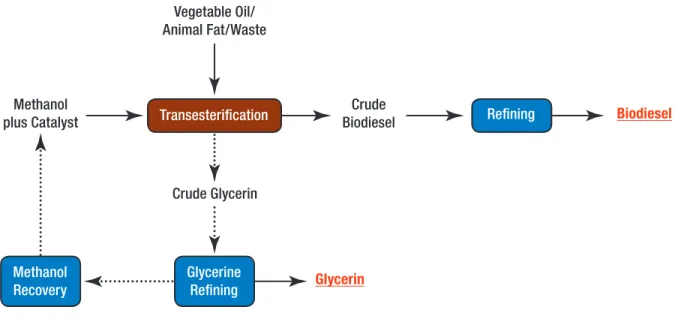
biodiesel. These chemicals are also referred to as fatty acid methyl esters (FAME) and the process is referred to as transesterification. Figure 1 provides a simplified diagram of the transesterification process. Roughly speaking, 100 pounds of oil or fat are reacted with 10 pounds of a short-chain alcohol (usually methanol) in the presence of a catalyst (usually sodium hydroxide [NaOH] or potassium hydroxide [KOH]) to form 100 pounds of biodiesel and 10 pounds of glycerin. Glycerin is a sugar, and is a coproduct of the biodiesel process.
Raw or refined plant oil, or recycled greases that have not been processed into biodiesel, are not biodiesel and should be avoided. Research shows that plant oils or greases used in CI engines at concentrations as low as 10% to 20% can cause long-term engine deposits, ring sticking, lube oil gelling, and other maintenance problems
and can reduce engine life. These problems are caused mostly by the greater viscosity, or thickness, of the raw oils
(around 40 mm2/s) compared with that of the diesel fuel, for which the engines and injectors were designed (1.3 to
4.1 mm2/s). Through the process of converting plant oils or greases to biodiesel by transesterification, the viscosity
of the fuel is reduced to values similar to conventional diesel fuel (biodiesel values are typically 4 to 5 mm2/s).
Vegetable Oil/ Animal Fat/Waste
Crude Biodiesel
Crude Glycerin
Biodiesel
Glycerin Methanol
plus Catalyst Transesterification
Glycerine Refining Methanol
Recovery
Refining
Biodiesel is a legally registered fuel and fuel additive with the U.S. Environmental Protection Agency (EPA). The EPA registration includes all biodiesel that meets the ASTM biodiesel specification, ASTM D 6751,2 and does not
depend on the oil or fat used to produce the biodiesel or the specific production process employed.
Other products, many of which are offered to consumers without the benefit of EPA registration or extensive
testing and demonstrations, are mislabeled as “biofuels.” If you purchase methyl ester that does not meet ASTM
biodiesel standards, it is not legal biodiesel and should not be used in diesel engines or other equipment designed
to operate on diesel fuel. Methyl esters are used as an industrial lubricant and solvent in some applications, so be
sure to purchase only ASTM grade methyl esters (biodiesel).
ASTM International3 is a consensus-based standards group that comprises engine and fuel injection equipment
companies, fuel producers, and fuel users whose standards are recognized in the United States by most govern
-ment entities. The specification for biodiesel (B100) is ASTM D6751. This specification is a compilation of efforts
from researchers, engine manufacturers, petroleum companies and distributors, and many other fuel-related
enti-ties, and it is intended to ensure the quality of biodiesel used as a blend stock at 20% and lower blend levels. Any biodiesel used in the United States for blending should meet ASTM D6751 standards.4
The ASTM D6751 definition of biodiesel states that biodiesel is composed of mono-alkyl esters of long-chain
fatty acids derived from plant oils or animal fats. The term mono-alkyl esters indicates that biodiesel contains
only one ester linkage in each molecule. Plant oils contain three ester linkages and are therefore not legally
biodiesel. Biodiesel can be made from methyl, ethyl, isopropyl, and other alcohols, but most biodiesel research
focuses on methyl esters. Virtually all commercial production in the United States today is based on methyl esters. Some research has been conducted on ethyl esters (biodiesel produced with ethanol as the alcohol rather than methanol); however, higher ethanol prices relative to methanol, lower ethyl ester conversions, and the dif
-ficulty of recycling excess ethanol internally in the process have hampered ethyl ester production in the market -place. Therefore, in this document we will consider only methyl esters.
The definition of biodiesel recognized by both the EPA for fuel registration purposes and the Internal Revenue Service (IRS) for the blender’s tax credit is essentially the same as the definition in ASTM D6751:
A fuel comprised of mono-alkyl esters of long chain fatty acids derived from vegetable oils or animal fats, desig-nated B100, and meeting the requirements of ASTM D 6751.
Biodiesel is a recognized alternative fuel under the Energy Policy Act of 1992 (EPAct), as amended in 1998. EPAct requires that more than 75% of new vehicle purchases by certain federal, state, and alternative fuel pro
-vider fleets be alternative fuel vehicles (AFVs). As a recognized alternative fuel, any vehicle certified to run on B100 could qualify under the AFV purchase provisions of EPAct, but no generally available vehicles are intended to run on B100. B100 is more expensive than other alternative fuel options, and the original equipment manu
-facturer (OEM) community has had little interest in certifying vehicles on B100, so this vehicle credit has not
created a market for biodiesel.
EPAct was amended in 1998 by the Energy Conservation and Reauthorization Act (ECRA). The amendment allowed qualified fleets to use B20 in existing vehicles to generate AFV purchase credits, with some limitations. This has created significant demand for B20 by government and alternative fuel provider fleets.
2.2 Benefits of Biodiesel Use
Biodiesel Provides a High Energy Return and Displaces Imported Petroleum
Life-cycle analyses show that biodiesel contains 2.5 to 3.5 units of energy for every unit of fossil energy input in
its production, and because very little petroleum is used in its production, its use displaces petroleum at nearly a 1-to-1 ratio on a life-cycle basis.5,6,7 This value includes energy used in diesel farm equipment and transportation
equipment (trucks, locomotives); fossil fuels used to produce fertilizers, pesticides, steam, and electricity; and methanol used in the manufacturing process. Because biodiesel is an energy-efficient fuel, it can extend petro
-Biodiesel Reduces Life-Cycle Greenhouse Gas Emissions
When biodiesel displaces petroleum, it significantly reduces greenhouse gas (GHG) emissions. By one estimate, GHG emissions (including carbon dioxide [CO2], methane, and nitrogen oxide [NOx]) are reduced by 41%, if biodiesel is produced from crops harvested from fields that were already in production.5 When plants such as
soybeans grow, they take CO2 from the air to make the stems, roots, leaves, and seeds (soybeans). After the oil is extracted from the soybeans, it is converted into biodiesel. When the biodiesel is burned, CO2 and other emissions
are released and return to the atmosphere. This cycle does not add to the net CO2 concentration in the air because
the next soybean crop will reuse the CO2 as it grows. When fossil fuels such as coal or diesel fuel are burned,
however, 100% of the CO2 released adds to the CO2 concentration levels in the air.
Biodiesel Reduces Tailpipe Emissions
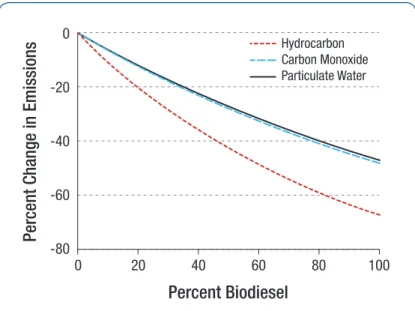
Biodiesel reduces tailpipe PM, hydrocarbon (HC), and carbon monoxide (CO) emissions from most modern four-stroke CI or diesel engines. These benefits occur because biodiesel contains 11% oxygen by weight. The fuel oxygen allows the fuel to burn more completely, so fewer unburned fuel emissions result. This same phenomenon reduces air toxics, which are associated with the unburned or partially burned HC and PM emissions. Testing has shown that PM, HC, and CO reductions are independent of the biodiesel feedstock. The EPA reviewed 80 biodie
-sel emission tests on CI engines and has concluded that the benefits are real and predictable over a wide range of biodiesel blends (Figure 2).8 EPA’s review also indicated that B20 increased NOx by about 2% relative to petro
-leum diesel use. A more detailed analysis of the database examined by EPA, plus more recently published results, confirms the positive impact of B20 on emissions of HC, CO, and PM.9 However, examination of the NOx results
shows that the effect of biodiesel can vary with engine design, calibration, and test cycle. At this time, the data
are insufficient for users to conclude anything about the average effect of B20 on NOx, other than that it is likely
very close to zero.
In contrast, when biodiesel is used in boilers
or home heating oil applications, NOx tends
to decrease because the combustion process
is different (open flame for boilers, enclosed
cylinder with high-pressure spray combustion
for engines). The NOx reduction seen with
biodiesel blends used in boilers appears to be independent of the type of biodiesel used. In
blends with heating oil up to 20% biodiesel, NOx is reduced linearly with increasing biodie
-sel content. For every 1% biodie-sel added, NOx decreases by 1%. A B20 heating oil fuel will reduce NOx by about 20%.10,11 Sulfur dioxide
(SO2) emissions were also reduced when the
two fuels were blended, because biodiesel contains much less sulfur than typical heating
oil does. A 20% blend of biodiesel in heating oil will reduce SO2 by about 20%.
Heating oil and diesel fuel dyed red for off-road use (agriculture, power, boiler fuels, construction, forestry, and mining) can contain as much as 500 ppm sulfur. Blending biodiesel into off-road diesel fuel can significantly reduce SO2 emissions. Nonroad diesel will transition to 15 ppm sulfur beginning in 2010.
Biodiesel and Human Health
Some PM and HC emissions from diesel fuel combustion are toxic or carcinogenic. Using B100 can eliminate as much as 90% of these air toxics. B20 reduces air toxics by 20% to 40%. The positive effects of biodiesel on air toxics have been shown in numerous studies.
0 -20 -40 -60 -80
0 20 40 60 80 100
Per
cent Change in Emissions
Percent Biodiesel
Hydrocarbon Carbon Monoxide Particulate Water
Recently, the U.S. Department of Labor Mining Safety Health Administration (MSHA) has implemented rules for underground mines that limit workers’ exposure to diesel PM. MSHA found that switching from petroleum diesel fuels to high blend levels of biodiesel (B50 to B100) significantly reduced PM emissions from underground diesel vehicles and substantially reduced workers’ exposure. However, even low concentrations of biodiesel reduce PM emissions and provide significant health and compliance benefits wherever humans receive higher levels of expo
-sure to diesel exhaust.
Biodiesel Improves Engine Operation
Even in very low concentrations, biodiesel improves fuel lubricity and raises the cetane number of the fuel. Diesel engines depend on the lubricity of the fuel to keep moving parts, especially fuel pumps, from wearing
prematurely. One unintended side effect of the federal regulations, which have gradually reduced allowable fuel
sulfur to only 15 ppm and lowered aromatics content, has been to reduce the lubricity of petroleum diesel. The hydrotreating processes used to reduce fuel sulfur and aromatics contents also reduces polar impurities such
as nitrogen compounds, which provide lubricity. To address this, the ASTM D975 diesel fuel specification was modified to add a lubricity requirement (a maximum wear scar diameter on the high-frequency reciprocating rig [HFRR] test of 520 microns). Biodiesel can impart adequate lubricity to diesel fuels at blend levels as low as 1%.
Biodiesel Is Easy To Use
Finally, one of the biggest benefits to using biodiesel is that it is easy. Blends of B20 or lower are literally a “drop in” technology. No new equipment and no equipment modifications are necessary. B20 can be stored in diesel fuel tanks and pumped with diesel equipment. B20 does present a few unique handling and use precautions, but most users can expect a trouble-free B20 experience.
2.3 Other Biodiesel Attributes
Lower Energy Density
Biodiesel contains 8% less energy per gallon than typical No. 2 diesel in the United States and 12.5% less energy
per pound. The difference between these two measurements is due to the higher density of biodiesel compared with diesel fuel. All biodiesel, regardless of its feedstock, provides about the same amount of energy per gallon or per pound. Typical values are as follows:
Btu/lb Btu/gal
Typical Diesel No. 2 18,300 129,050
Biodiesel (B100) 16,000 118,170
The difference in energy content between petroleum diesel and biodiesel can be noticeable with B100. For B20, the differences in power, torque, and fuel economy are 1% to 2%, depending on the base petroleum diesel. Most users report little difference in fuel economy between B20 and No. 2 diesel fuel. As the biodiesel blend level is lowered, differences in energy content become proportionally less significant; blends of B5 or lower cause no noticeable differences in performance in comparison to No. 2 diesel.
Low-Temperature Operability
In some areas of the country, the cold flow properties of biodiesel are important. Unlike gasoline, petroleum
diesel and biodiesel both freeze or gel at common winter temperatures; however, biodiesel’s freeze point may be
20º to 30ºF higher than that of petroleum diesel. If the fuel begins to gel, it can clog filters and eventually become so thick that it cannot be pumped from the fuel tank to the engine. However, with proper handling, B20 has been used successfully all year in the coldest U.S. climates.
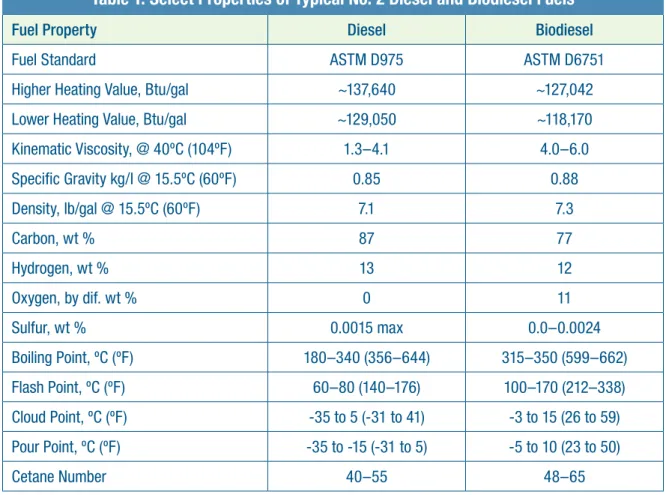
This section describes the basic considerations for handling and blending B100. In the United States it is equally common to handle B99 and B99.9 blends, as these qualify for a federal blender’s tax credit. The considerations in this section also apply to B99 and B99.9. The storage and handling procedures for B100 are very different from those for B20 and lower biodiesel blends, and they vary significantly from those of diesel fuel. Table 1 lists some of the physical and chemical properties of B100 and petroleum diesel. Using B20 and lower blends signifi -cantly reduces or eliminates the effects of these property differences for use as an engine fuel. However, since
many distributors store and handle B100 before blending, a good understanding of B100 properties is valuable. Following are several significant attributes specific to B100 that should be considered when handling, storing,
and using it.
• B100 is a good solvent. It may loosen or dissolve varnish and sediments in fuel tanks and fueling systems left by conventional diesel over time. If your system contains sediments, you should definitely clean your tanks and fuel system before handling or using B100.
• B100 freezes at higher temperatures than most diesel fuel. This must be taken into account if handling or using B100, especially in aboveground storage tanks. Most B100 starts to cloud at 35º to 60ºF (2º to 15ºC), so heated fuel lines and tanks may be needed, even in moderate climates, during winter. As B100 begins to
gel, the viscosity also begins to rise to much higher levels than most diesel fuel does, which can increase the
stress on pumps. The high cloud point makes B100 use challenging in colder climates.
• B100 is not compatible with some hoses and gaskets. B100 may soften and degrade certain types of rubber compounds used for hoses and gaskets (buna-N, nitrile, natural rubber) and may cause them to leak and degrade to the point where they crumble and become useless. For bulk handling of B100, seals, gaskets, and hoses must be compatible with B100. (See Appendix E for information about material compatibility.) Using Soy biodiesel, for example, has a cloud point (the temperature at which crystals begin to form) of 32ºF (0ºC). In contrast, most petroleum diesels have cloud points of about 10º to 20ºF (-12º to -5ºC). Blending of biodiesel can significantly raise the cloud point above that of the original diesel fuel. For example, a recent study13 showed that,
when soy biodiesel was blended into a specially formulated cold weather diesel fuel (cloud point of -36ºF [-38ºC]) to make a B20 blend, the cloud point of the blend was -4ºF (-20ºC). In very cold climates, this cloud point may still not be adequate for wintertime use. To accommodate biodiesel in cold climates, low cloud point petroleum diesel or low-temperature flow additives, or both, are necessary.
Storage Stability
Although biodiesel blends have adequate storage stability for normal use, special precautions must be taken if they are to be stored for extended periods. This might occur in a snow plow or farm implement used seasonally,
or in the fuel tank of a backup generator. If the fuel will be stored for more than a few months, a stability additive is recommended, and acidity should be measured monthly.
Finally, biodiesel is generally more susceptible than petroleum diesel to microbial degradation. In the case of
spills in the environment, this is a positive attribute because it biodegrades more rapidly. However, microbial
con-tamination of fuel storage tanks can plug dispensers and vehicle fuel filters and cause vehicles to stall. This is not
unheard of for petroleum diesel, but anecdotal evidence suggests it is a greater problem for biodiesel blends. The
best way to deal with this issue (for both petroleum diesel and biodiesel) is adequate fuel storage tank housekeep -ing and monitor-ing, especially minimiz-ing water in contact with the fuel. Water bottoms must be removed from tanks, and standing tanks should be sampled and tested for microbial contamination.
B100 in an engine constructed with incompatible materials can cause a fuel spill on a hot engine, ruin a fuel pump, or clog a filter as the hose material gradually erodes. Use extreme care to ensure any part of the fuel system that touches the fuel is compatible with B100. Some systems already have biodiesel-resistant materi
-als, but many do not, because these materials are usually slightly more expensive.
• B100 is not compatible with some metals and plastics. Biodiesel will degrade and form high sediment levels if contacted for long periods by copper or copper containing metals (brass, bronze) or with lead, tin, or zinc (galvanized surfaces). These high sediment levels may clog filters. B100 may also permeate some common plastics (polyethylene, polypropylene) over time, so these should not be used for storing B100.
Table 1. Select Properties of Typical No. 2 Diesel and Biodiesel Fuels
Fuel Property Diesel Biodiesel
Fuel Standard ASTM D975 ASTM D6751
Higher Heating Value, Btu/gal ~137,640 ~127,042
Lower Heating Value, Btu/gal ~129,050 ~118,170
Kinematic Viscosity, @ 40ºC (104ºF) 1.3–4.1 4.0–6.0
Specific Gravity kg/l @ 15.5ºC (60ºF) 0.85 0.88
Density, lb/gal @ 15.5ºC (60ºF) 7.1 7.3
Carbon, wt % 87 77
Hydrogen, wt % 13 12
Oxygen, by dif. wt % 0 11
Sulfur, wt % 0.0015 max 0.0–0.0024
Boiling Point, ºC (ºF) 180–340 (356–644) 315–350 (599–662) Flash Point, ºC (ºF) 60–80 (140–176) 100–170 (212–338) Cloud Point, ºC (ºF) -35 to 5 (-31 to 41) -3 to 15 (26 to 59) Pour Point, ºC (ºF) -35 to -15 (-31 to 5) -5 to 10 (23 to 50)
3.1 B100 Quality Specification
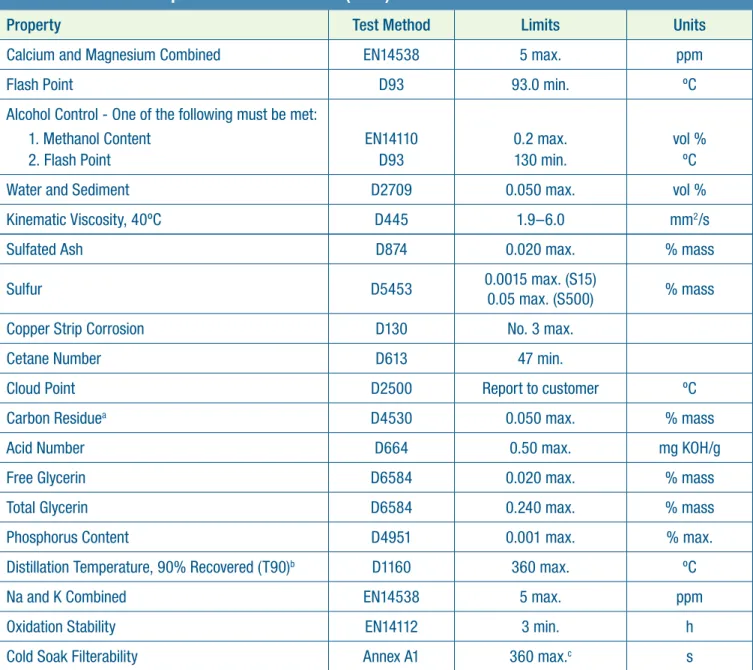
The ASTM specification for biodiesel (B100) is ASTM D6751. This specification is frequently updated, and as of this writing the most current version is D6751-08a, summarized in Table 2.
Sulfated Ash D874 0.020 max. % mass
Sulfur D5453 0.0015 max. (S15) 0.05 max. (S500) % mass
Copper Strip Corrosion D130 No. 3 max.
Cetane Number D613 47 min.
Cloud Point D2500 Report to customer ºC
Carbon Residuea D4530 0.050 max. % mass
Acid Number D664 0.50 max. mg KOH/g
Free Glycerin D6584 0.020 max. % mass
Total Glycerin D6584 0.240 max. % mass
Phosphorus Content D4951 0.001 max. % max.
Distillation Temperature, 90% Recovered (T90)b D1160 360 max. ºC
Na and K Combined EN14538 5 max. ppm
Oxidation Stability EN14112 3 min. h
Cold Soak Filterability Annex A1 360 max.c s
a Carbon residue shall be run on the 100% sample. b Atmospheric equivalent temperature.
c B100 intended for blending into diesel fuel that is expected to give satisfactory vehicle performance at fuel temperatures at or below 10ºF (-12ºC)
shall comply with a cold soak filterability limit of 200 s maximum.
Table 2. Requirements for Biodiesel (B100) Blend Stock as Listed in ASTM D6751
Property Test Method Limits Units
Calcium and Magnesium Combined EN14538 5 max. ppm
Flash Point D93 93.0 min. ºC
Alcohol Control - One of the following must be met: 1. Methanol Content
2. Flash Point
EN14110 D93
0.2 max. 130 min.
vol % ºC
Water and Sediment D2709 0.050 max. vol %
This specification is intended to ensure the quality of biodiesel to be used as a blend stock at 20% and lower levels. Any biodiesel used in the United States for blending must meet ASTM D6751 before blending. ASTM
D6751 is based on the physical and chemical properties needed for safe and satisfactory diesel engine operation.
It is not based on the specific raw materials or the manufacturing process used to produce the biodiesel. The fin
-ished blend stock must meet the properties specified in Table 2 as well as the following definition:
Biodiesel,noun, a fuel comprised of mono-alkyl esters of long chain fatty acids derived from vegetable oils or
animal fats, designated B100.
This specification was not intended to be applied to B100 used in a pure form. However, buyers and sellers are encouraged to use ASTM D6751 for the commercial trading of biodiesel (B100) whether the fuel is planned for B100 use or for blending. Other arrangements or specifications can be legally used if the buyer and seller agree as long as they meet pertinent local, state, and federal regulations (EPA sulfur limits, Occupational Safety and Health Administration [OSHA] safety limits on flash point, etc.). However, B100 must meet the requirements of D6751 for blends to be legal fuels under the Clean Air Act fuel registration requirements, to legally claim the biodiesel blender’s tax credit, and to be a legal blending component under many state regulations.
The intent of each quality requirement in Table 2 is described here:
• High levels of Group I and II metals. Sodium (Na), potassium (K), calcium (Ca), and magnesium (Mg) can cause deposits to form, catalyze undesired side reactions, and poison emission control equipment. The Group I and II metals are limited as the combination of metals in each category, Na+K and Ca+Mg. For each
combination, the limit is 5 ppm.
• Flash point. A minimum flash point for diesel fuel is required for fire safety. B100’s flash point is required to
be at least 93ºC (200ºF) to ensure it is classified as nonhazardous under the National Fire Protection Asso
-ciation (NFPA) code.
• Alcohol. It is critical to ensure that the manufacturer has removed excess methanol used in the manufactur -ing process. Residual methanol in the fuel is a safety issue, because even very small amounts reduce the
flash point; can affect fuel pumps, seals, and elastomers; and can result in poor combustion properties. The intent of the alcohol control requirement is to limit methanol to less than 0.2 wt %. This can be accom
-plished by meeting a higher flash point requirement of 130ºC (266ºF); or by measuring methanol content by
gas chromatography.
• Water and sediment. This refers to free water droplets and sediment particles. The allowable level for B100 is set at the same level allowed for conventional diesel fuel. Poor drying techniques during manufacturing or contact with excessive water during transport or storage can cause B100 to be out of specification for water content. Excess water can lead to corrosion and provides an environment for microorganisms. Fuel oxida
-tion can also raise sediment levels, so this test can be used in conjunc-tion with acid number and viscosity to determine if fuels have oxidized too much during storage.
• Viscosity. A minimum viscosity is required for some engines because of the potential for power loss caused by injection pump and injector leakage. This is not an issue for B100, and the minimum is set at the same level as for petroleum diesel. The maximum viscosity is limited by the design of engine fuel injection systems. Higher viscosity fuels can cause poor fuel combustion that leads to deposit formation
as well as higher in-cylinder penetration of the fuel spray, which can result in elevated engine oil dilution
with fuel. The maximum allowable viscosity in ASTM D975 for No. 2 diesel is 4.1 mm2/s at 104ºF (40ºC).
ASTM D6751 allows for slightly higher viscosity than D975, primarily because that is where the normal viscosity of B100 lies. Biodiesel blends of 20 vol % or lower should have a viscosity within the range allowed by D975.
• Sulfated ash test. This test measures the amount of residual alkali catalyst in the biodiesel as well as any
other ash-forming compounds that could contribute to injector deposits or fuel system fouling.
• Sulfur. This is limited to reduce sulfate and sulfuric acid pollutant emissions and to protect exhaust cata -lyst systems when they are deployed on diesel engines in the future. Sulfur content of 15 ppm or lower is
also required for proper functioning of diesel particle filters. Biodiesel generally contains less than 15 ppm sulfur. The test for low-sulfur fuel (ASTM D5453) should be used for accurate results instead of D2622, which will provide falsely high results caused by the test’s interference with the oxygen in the biodiesel. • Copper strip corrosion test. This test is used to indicate potential difficulties with copper and bronze fuel
system components. The requirements for B100 and conventional diesel are identical, and biodiesel meeting other D6751 specifications always passes this test. Copper and bronze may not corrode in the presence of
biodiesel fuel, but prolonged contact with these catalysts can degrade the fuel and cause sediment to form.
• Cetane number. An adequate cetane number is required for good engine performance. Conventional diesel must have a cetane number of at least 40 in the United States. Higher cetane numbers help ensure good cold start properties and minimize the formation of white smoke. The ASTM limit for B100 cetane number is set at 47, because this is the level identified for “Premium Diesel Fuel” by the National Conference of Weights and Measures. Also, 47 has been the lowest cetane number found in U.S. biodiesel fuels. The cetane index (ASTM D976) is not an accurate predictor of cetane number for biodiesel or biodiesel blends, because it is based on a calculation that uses specific gravity and distillation curve, both of which are different for biodie -sel than for petroleum die-sel.
• Cloud point. This is the most commonly used measure of low-temperature operability; fuels are generally
expected to operate at temperatures as low as their cloud point. The B100 cloud point is typically higher than the cloud point of conventional diesel. Cloud point must be reported to indicate biodiesel’s effect on the final blend cloud point. Low-temperature properties and strategies for ensuring good low-temperature
performance of biodiesel blends are discussed in more detail in later sections.
• Carbon residue. This measures the carbon-depositing tendency of a fuel and is an approximation of the ten
-dency for carbon deposits to form in an engine. For conventional diesel fuel, the carbon residue is measured on the 10% distillation residue. Because B100 boils entirely at the high end of the diesel fuel range and in a very narrow temperature range, it is difficult to leave only a 10% residual when distilling biodiesel. So, bio-diesel carbon residue specifies that the entire biobio-diesel sample be used rather than the 10% distilled residue. • Acid number. The acid number for biodiesel is primarily an indicator of free fatty acids (natural degradation products of fats and oils) and can be elevated if a fuel is not properly manufactured or has undergone oxida
-tive degradation. Acid numbers higher than 0.50 have been associated with fuel system deposits and reduced life of fuel pumps and filters.
• Free and total glycerin. These numbers measure the amount of unconverted or partially converted fats and by-product glycerin in the fuel. Incomplete conversion of the fats and oils into biodiesel can lead to high total glycerin. Incomplete removal of glycerin can lead to high free glycerin and total glycerin. If these
numbers are too high, the storage tank, fuel system, and engine can be contaminated. Fuels that exceed these limits are highly likely to plug filters and cause other problems. One of the major shortcomings of the D6584 gas chromatograph (GC) method is its sensitivity to diesel fuel. Diesel fuel components react dif
-ferently on the column used in the GC—they make the determination of free glycerin very difficult and
may damage the column. Thus, many labs are unable to determine free and total glycerin by this method in
samples with even small amounts of diesel fuel, such as B99.9.
• Phosphorus content. This is limited to 10 ppm maximum in biodiesel because it can damage catalytic con
-verters; phosphorus above 10 ppm can be present in some plant oils. Biodiesel produced in the United States
• T90 distillation specification. This specification was incorporated to ensure that fuels have not been contami
-nated with high boiling materials such as used motor oil. B100 exhibits a boiling point rather than a distilla
-tion curve. The fatty acids from which biodiesel are produced are mainly straight-chain HCs with 16 to 18
carbons that have similar boiling point temperatures. The atmospheric boiling point of biodiesel is generally
626º to 675ºF (330º to 357ºC).
• Oxidation stability. Biodiesel can oxidize during storage and handling, leading to the formation of peroxides, acids, gums, and deposits. The minimum oxidation stability requirement is intended to ensure the storage stability of B100 and biodiesel blends.
• Cold soak filterability. This is the newest requirement. It was added in 2008 in response to data indicating
that some B100 could, in blends with petroleum diesel of up to 20%, form precipitates above the cloud point. B100 meeting the cold soak filterability requirements does not form these precipitates. This, along with
cloud point, is needed to predict low-temperature operability.
The D6751 specification also includes the following workmanship statement:
The biodiesel fuel shall be visually free of undissolved water, sediment, and suspended matter.
B100 should be clear, although it may come in a variety of colors. The biodiesel’s color does not indicate fuel quality. ASTM recently passed specifications for biodiesel blends. These include the allowance of up to 5% biodiesel in D975-compliant diesel fuel, with no changes to the allowable diesel fuel performance properties. A separate specification for B5 to B20 blends is discussed in Section 4.
3.2 Variation in Biodiesel Properties
As with petroleum-based fuels, the ASTM specifications for biodiesel allow a variety of feedstocks and processes to be used in its production. The specifications prescribe a largely feedstock-neutral, performance-based set of requirements that ensure the B100 is fit to be used in diesel engines. Biodiesel can be produced commercially
from a variety of oils and fats:
• Animal fats. Edible, inedible, and all other variations of tallow, lard, choice white grease, yellow grease,
poultry fats, and fish oils
• Plant oils. Soy, corn, canola, sunflower, rapeseed, cottonseed
• Recycled greases. Used cooking oils and restaurant frying oils.
Biodiesel can also be made from other oils, fats, and recycled oils such as mustard, palm, coconut, peanut, olive,
sesame, and safflower oils, trap greases, and even oils produced from algae, fungi, bacteria, molds, and yeast. Some properties of finished biodiesel such as cetane number, cloud point, and stability depend heavily on the feedstock. Compared with the chemistry of diesel fuel, which contains hundreds of compounds, the chemistries of different
fats and oils typically used for biodiesel are very similar. Each fat or oil molecule is made up of a glycerin back-bone of three carbons, and on each carbon is attached a long-chain fatty acid that reacts with methanol to make the methyl ester, or biodiesel. The glycerin backbone is turned into glycerin and sold as a by-product of biodiesel
manufacturing. The fats and oils contain 10 common types of fatty acids that have 12 to 22 carbons, more than 90% of which are 16 to 18 carbons. Some of these chains are saturated, some are monounsaturated, and others are polyunsaturated. Within the limits of the specifications, the differing levels of saturation can affect some biodie -sel fuel properties.
Each feedstock is set apart from the others because it is made of different proportions of saturated,
Under each category of fatty acids in Table 3 is shown its general impact on fuel properties and emissions. These
are trends only; other factors such as additives may modify these trends.
As with conventional diesel fuel, the best type of biodiesel for your applications will be based on several factors.
A No. 2 petroleum diesel fuel with a cetane number of 50 and a cloud point of 40ºF (4ºC) may be suitable for December in Texas, but a No. 1 petroleum diesel with a cetane number of 42 and a cloud point of -20ºF (-29ºC)
may be best for a December in Minnesota. The considerations and trade-offs are like those made for petroleum
diesel fuel. The following data provide more detail about B100 properties and considerations.
3.3 Energy Content
With conventional diesel fuels, the inherent energy content of the fuel (typically measured in British thermal units [Btu] per gallon) is the largest factor affecting the fuel economy, torque, and horsepower delivered by the fuel. The energy content of conventional diesel can vary up to 15% from supplier to supplier and from summer
to winter. This variability is due to changes in its composition determined by the petroleum feedstock, as well as
refining and blending practices. No. 2 diesel fuel usually has a higher energy content than No. 1 diesel fuel, and
blend values are somewhere in between.
Canola Safflower Sunflower Corn Olive Soybean Peanut Cottonseed Yellow Grease Lard Beef Tallow Palm Coconut
0 10% 20% 30% 40% 50% 60% 70% 80% 90% 100%
Saturated Monounsaturated Polyunsaturated
Figure 3. Composition of Various Biodiesel Feedstocks in Order of Increasing Saturated Fatty Acid Content
Table 3. Fuel Properties as a Function of Fuel Composition in Diesel Engines
Saturated Monounsaturated Polyunsaturated
Cetane Number High Medium Low
Cloud Point High Medium Low
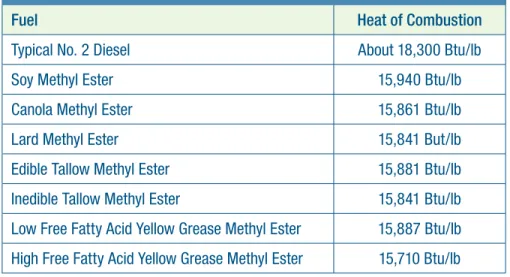
With biodiesel, or B100, the refining (esterification or transesterification process) and blending methods have no significant effect on energy content. B100 varies little because the energy content of the fats and oils used to make biodiesel are similar. Therefore, B100 made from most of the common feedstocks will have the same fuel economy, power, and torque. Compared with most No. 2 diesel fuel in the United States, B100 has a slightly lower energy content (12.5%/lb or 8%/gal). Typical No. 2 diesel fuel has an energy content of around 18,600 Btu/lb. The energy in a pound of biodiesel made from several feedstocks is shown in Table 4. Losses in power, torque, and fuel economy would be expected to be proportional to the difference in energy content.
The energy content of biodiesel blends and diesel fuel is proportional to the amount of biodiesel in the blend and
the heating value of the biodiesel and diesel fuel used to make the blend. For example, B20 users experience a 1% loss in fuel economy on average and rarely report changes in torque or power.
3.4 Low-Temperature Properties
The low-temperature properties of biodiesel and conventional petroleum diesel are extremely important. Unlike
gasoline, petroleum diesel and biodiesel can freeze or gel as the temperature drops. Different diesel fuel
formu-lations are sold during the winter in colder climates. If the fuel begins to gel, it can clog filters on dispensing equipment and may eventually become too thick to pump. B100 is commonly stored in heated above-ground
tanks for blending in winter. Important low-temperature performance metrics for handling and blending of
B100 are as follows:
• Cloud point. The temperature at which small solid crystals are first visually observed as the fuel is cooled. Below cloud point, these crystals might plug filters or could drop to the bottom of a storage tank. However,
fuels can usually be pumped at temperatures below cloud point.
• Pour point. The temperature at which the fuel contains so many agglomerated crystals that it is essentially a
gel and will no longer flow. Distributors and blenders use pour point as an indicator of whether the fuel can
be pumped, even if it would not be suitable for use without heating or taking other steps.
These guidelines should be followed for storing biodiesel (B100) in winter:
• B100 should be stored at temperatures at least 5º to 10ºF higher than the cloud point. A storage tempera
-ture of 40º to 45ºF (4º to 7ºC) is fine for most B100, although some B100 fuels may require higher storage
Table 4. Heating Value of Diesel and Some Biodiesel (B100) Fuels
14Fuel Heat of Combustion
Typical No. 2 Diesel About 18,300 Btu/lb
Soy Methyl Ester 15,940 Btu/lb
Canola Methyl Ester 15,861 Btu/lb
Lard Methyl Ester 15,841 But/lb
Edible Tallow Methyl Ester 15,881 Btu/lb Inedible Tallow Methyl Ester 15,841 Btu/lb Low Free Fatty Acid Yellow Grease Methyl Ester 15,887 Btu/lb High Free Fatty Acid Yellow Grease Methyl Ester 15,710 Btu/lb
• B100 can be stored underground in most cold climates without additional considerations because under
-ground storage temperatures are normally above 45ºF (7ºC). Above-ground storage and handling systems
should be protected with insulation, agitation, heating systems, or other measures if temperatures regularly
fall below the cloud point. This precaution includes piping, tanks, and pumping equipment.
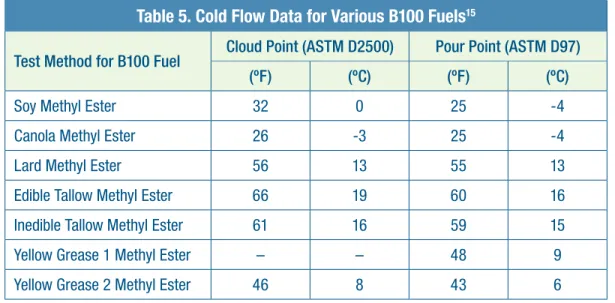
The cloud point of B100 starts at 30º to 32ºF (-1º to 0ºC) for most plant oils that are composed primarily of mono- or polyunsaturated fatty acid chains; the cloud point can go as high as 80ºF (27ºC) or higher for animal fats or frying oils that are highly saturated. Examples of the cloud and pour points of B100 made from various sources are listed in Table 5. The pour point of B100 is usually only a few degrees lower than the cloud point, so once
biodiesel begins to freeze, gelling can proceed rapidly if the temperature drops only a few degrees further.
B100 tanks and fuel lines should be designed for the cold flow properties of the biodiesel used and the local climate. Fuel pumps, lines, and dispensers must be protected from the cold and wind chill with properly approved heating and insulating equipment. Fuel in aboveground tanks should be heated to 5º to 10ºF (-15º to -12ºC)
above the fuel cloud point.
Once crystals begin to form, they will go back into solution as the fuel warms. However, that process can be slow if the fuel is heated only slightly above the cloud point. Crystals formed in biodiesel or diesel fuel can drift to the
bottom of the tank and begin to build up a gel layer. Slow agitation can prevent crystals from building up on the
tank bottom or, once present in the fuel, can help to bring the crystals back into liquid form. If B100 has gelled completely, the B100 should be heated to 100º to 110ºF (38º to 43ºC) to melt the most highly saturated biodiesel
components if the fuel needs to be used immediately. Lower temperatures can be used if there is more time to
allow the biodiesel to liquefy.
Some additive manufacturers provide data that show their cold flow additives can reduce the pour point of a B100 by as much as 30ºF (12ºC), but only with very large amounts of additives. At more typical treat rates, benefits
were below detection levels.
B100 in the United States cannot be effectively managed with current cold flow additives, as can some petroleum diesel or European rapeseed-oil-based biodiesel. The level of saturated compounds in U.S. oils and fats is too high for most additives to be effective. Cold flow additives’ effectiveness can also change dramatically, depending on the exact type of biodiesel and the processing it has undergone; this is much like the situation with diesel fuel. Cold flow additives have been used much more successfully with biodiesel blends. You should work directly with
the additive manufacturers on this issue.
Table 5. Cold Flow Data for Various B100 Fuels
15Test Method for B100 Fuel Cloud Point (ASTM D2500) Pour Point (ASTM D97)
(ºF) (ºC) (ºF) (ºC)
Soy Methyl Ester 32 0 25 -4
Canola Methyl Ester 26 -3 25 -4
Lard Methyl Ester 56 13 55 13
Edible Tallow Methyl Ester 66 19 60 16
Inedible Tallow Methyl Ester 61 16 59 15
Yellow Grease 1 Methyl Ester – – 48 9
3.5 Cetane Number
Cetane number is a measure of the ignition delay (the time from fuel injection into the chamber to ignition); higher cetane numbers
are believed to provide easier starting and
quieter operation. The ASTM D6751 speci
-fication for biodiesel requires a minimum cetane number of 47; the cetane number required of petroleum diesel fuel is only 40. B100 produced from highly saturated feedstocks (such as lard, tallow, and used cooking oils) can have a cetane number of 60 or higher. Soy-, sunflower-, corn-, and
canola-based biodiesel will have cetane
numbers closer to 47. Figure 4 shows the
cetane numbers of various biodiesel samples and compares them with those of diesels.
3.6 Transport and Storage
3.6.1 Stability
Stability can refer to two issues for fuels: long-term storage stability or aging and stability at elevated
tempera-tures or pressures as the fuel is recirculated through an engine’s fuel system. For petroleum diesel, long-term storage stability is commonly referred to as oxidative stability. Thermal stability is the common term for the stability of fuels at elevated fuel system temperatures. For B100, storage stability is the paramount concern; thus, D6751 includes an oxidation stability requirement.
The oxidation stability test, EN14112 (also referred to as the Oil Stability Index [OSI] or the Rancimat test), involves heating a specified quantity of B100 to 230ºF (110ºC) while air is bubbled through at a specified flow rate. The air then passes through a water bath that collects the volatile acids formed in oxidation. A conductivity meter is used to monitor the water. A stable B100 can go for many hours under these conditions without forming volatile oxidation products. This period of time, before oxidation products form, is called the induction time or induction period. The stability requirement in D6751 is that B100 have a minimum three-hour induction time. Because this requirement applies at the time of blending, many biodiesel producers make B100 with a four- or five-hour induction time.
In biodiesel, fuel aging and oxidation can lead to high acid numbers, high viscosity, and the formation of gums and sediments that clog filters. If the oxidation stability, acid number, viscosity, or sediment measurements exceed the limits in ASTM D6751, the B100 is degraded to the point where it is out of specification and should not be used. Biodiesel with high oxidation stability (longer induction time) will take longer than biodiesel with low oxidation stability to reach an out-of-specification condition. Monitoring the acid number and viscosity of B100 over time can indicate whether it is oxidizing. B100 should be tested at receipt to ensure that it is within specification.
In some cases, deposits from the cleaning or solvent effect of B100 have been confused with gums and sediments that could form in storage as the B100 ages. Although sediment can clog a filter in either case, care should be taken to make sure the reason for the clogging is properly identified. For example, if oxidation stability and acid number are within specification, the formation of sediment is most likely due to the cleaning effect and not to aging or oxidation.
Guidelines to help identify biodiesel and storage conditions that will provide the highest levels of stability follow:
EPA Highway Diesel CARB Diesel Lard Edible Tallow Inedible Tallow Yellow Grease 1 Yellow Grease 2 Canola Soy
0 10 20 30
Cetane Number
40 50 60 70
saturated fat), the stability of the fuel decreases by a factor of 10. The points of unsaturation on the bio-diesel molecule can react with oxygen, forming peroxides that break down into acids, sediments, and gums. • Heat and sunlight will accelerate this process.
• Certain metals such as copper, brass, bronze, lead, tin, and zinc will accelerate the degradation process and form even higher levels of sediment. B100 should not be stored in systems that contain these metals. Metal
chelating additives, which deactivate these metals, may reduce or eliminate their negative impact.
• Some types of feedstock processing and biodiesel processing can remove natural antioxidants, potentially lessening stability. Plant oils and fats are produced with natural antioxidants—nature’s way of protecting the
oil from degradation. Bleaching, deodorizing, or distilling oils and fats, either before or as part of the biodiesel
process, can remove these natural antioxidants; other processes leave the antioxidants in the finished biodiesel. • Keeping oxygen from the biodiesel reduces or eliminates fuel oxidation and increases storage life. Commer
-cially, this is done by using a nitrogen blanket on storage tanks or storing biodiesel in sealed drums or totes.
• Antioxidants, whether natural or incorporated as additives, can significantly increase the storage life or stability of B100.
The ASTM D4625 test is used to simulate storage in underground storage tanks. The test is accelerated by a factor of 4 for petroleum fuels; that is, one week of storage at D4625 conditions (43ºC or 110ºF, open to air) simu
-lates one month of storage in an underground tank. This acceleration factor has not been validated for B100, but it is still a useful guide. ASTM D4625 data (see Figure 5) indicates that B100 will rapidly lose oxidation stability
3500 3000 2500 2000 1500 1000 500 0
0 2 4 6 8 10 12
Peroxide
Value
Weeks
4.21 3.11 6.52 0.45 5.53 7.76 7.26 0.17Initial OSI, hr 7
6 5 4 3 2 1 0
0 2 4 6 8 10 12
Total Insoluble
, mg/100 ml
Weeks
4.21 3.11 6.52 0.45 5.53 7.76 7.26 0.17 Initial OSI, hr 12 10 8 6 4 2 00 2 4 6 8 10 12
Oil Stability Inde
x,
hr
Weeks
4 3 2 1 00 2 4 6 8 10 12
Acid
Value
Weeks
Initial OSI, hr4.21 3.11 6.52 0.45 5.53 7.76 7.26 0.17
2006 Limit of 0.5 2005 Limit of 0.8
under these storage conditions, and even a nearly eight-hour induction time sample can be reduced to less than
three hours in four weeks (simulated four months of storage). Figure 5 also shows that these materials, with one exception, are oxidizing and not just losing “oxidation reserve” because of the increasing peroxide value. Acid values remain relatively constant for the first four weeks of storage. Insoluble formation does not become signifi
-cant until after eight weeks (simulated eight months) of storage.
B100 should not be stored longer than four months unless it has been treated with synthetic antioxidants. Nonoxi -dizing storage conditions in containers with little head space or under a nitrogen blanket will also be helpful. In
fact, when B100 is being stored longer than about two months, it should be tested for oxidation stability every two weeks. One of the best ways to stabilize biodiesel is to blend it with petroleum diesel.
3.6.2 Microbial Contamination
Biocides are recommended for conventional and biodiesel fuels wherever biological growth in the fuel has been a problem. If biological contamination occurs, water contamination should be suspected and will need to be
controlled because the aerobic fungus, bacteria, and yeast HC-utilizing microorganisms usually grow at the
fuel-water interface. Anaerobic colonies, which usually reduce sulfur, can be active in sediments on tank surfaces and cause corrosion. Because the biocides work in the water phase, products that are used with diesel fuels work
equally well with biodiesel.
3.6.3 Cleaning Effect
Methyl esters have been used as low-VOC (volatile organic compound) cleaners and solvents for decades. Methyl esters make excellent parts cleaners, and several companies offer methyl esters as a low-VOC, nontoxic replace
-ment for the volatile solvents used in parts washers. Because B100 comprises methyl esters that meet ASTM
D6751, it will dissolve the accumulated sediments in diesel storage and engine fuel tanks. These dissolved
sedi-ments can plug filters. If this happens, it can cause injector deposits and even fuel injector failure. If you plan to use or store B100 for the first time, clean the tanks and any parts in the fuel system where sediments or deposits may occur before filling the tanks with B100.
The level of cleaning depends on the amount of sediment in the system (if the system is sediment-free there should be no effect) as well as the biodiesel blend level (the higher the blend level, the greater the cleaning poten
-tial). The cleaning effect is much greater with B100 and blends with 35% or more biodiesel, in comparison to B20
and lower blends.
Biodiesel spills should be cleaned up immediately, because biodiesel can damage some types of body and engine paint. Biodiesel can also remove decals from tanks or vehicles near fueling areas. All materials that are used to absorb biodiesel spills should be considered combustible and stored in a safety can.
3.6.4 Materials Compatibility
B100 will degrade, soften, or seep through some hoses, gaskets, seals, elastomers, glues, and plastics with pro
-longed exposure. Some testing has been done with materials common to diesel systems, but more data are needed
on the wide variety of grades and variations of compounds that can be found in these systems, particularly with
B100 in U.S. applications. Nitrile rubber compounds, polypropylene, polyvinyl, and Tygon® materials are par
-ticularly vulnerable to B100. Before handling or using B100, ask the equipment vendor or OEM if the equipment is suitable for B100 or biodiesel. In some cases, the vendor may need the chemical family name for biodiesel (the methyl esters of fats and oils) to look up the information or even the exact chemical name of some of the biodie
-sel components, such as methyl oleate, methyl linoleate, methyl palmitate, or methyl stearate. Oxidized biodie-sel and biodiesel blends can contain organic acids and other compounds that can significantly accelerate elastomer degradation. (Published data on B100 material compatibility are summarized in Appendix E.) There have been no significant material compatibility issues with B20, unless the B20 has been oxidized.
replacement materials they are using. It is advisable to set up a monitoring program to visually inspect the equip -ment once a month for leaks, seeps, and seal decomposition. It would be wise to continue these inspections even
after one year, as experience with B100 is still relatively limited.
3.6.5 Storage Tanks and Dispensing Equipment
Most tanks designed to store diesel fuel will store B100 with no problem. Acceptable storage tank materials include aluminum, steel, fluorinated polyethylene, fluorinated polypropylene, Teflon®, and most fiberglass. If you are in doubt, contact the tank vendor or check the National Biodiesel Board (NBB) Web site (www.biodiesel.org). Brass, bronze, copper, lead, tin, and zinc may accelerate the oxidation of diesel and biodiesel fuels and create fuel insolubles (sediments) or gels and salts when reacted with some fuel components. Lead solders and zinc linings should be avoided, as should copper pipes, brass regulators, and copper fittings. The fuel or fittings tend to change color, and insolubles may plug fuel filters. Affected equipment should be replaced with stainless steel, carbon
steel, or aluminum.
In some locales, an Underwriters Laboratories (UL) listing is required by insurance companies or by state or local regulations for the tanks used for fuel storage and for equipment used to dispense fuels. (UL is an independent, not-for-profit, nongovernmental organization that tests products for public safety.) As biofuels use has become more widespread, the issue of UL listing has become a larger concern as UL-certified equipment for biodiesel and biodiesel blend service is extremely limited. Vendors must submit examples of their equipment to UL for testing. UL testing programs are currently underway for equipment to be used with biodiesel and biodiesel blends, includ -ing dispensers, aboveground steel tanks, underground steel tanks, nonmetallic tanks, aboveground and
below-ground piping, coatings, sumps, and heating equipment. However, until UL certification is available, the lack of permissible equipment may be a barrier to biodiesel and biodiesel blend storage and use in some locations.
3.6.6 Transport
As with petroleum diesel, B100 must be transported in a way that does not lead to contamination. The following
procedures are recommended for trucks and railcars and are used by distributors and transporters of petroleum-derived diesel:
• Ensure that trucks and railcars are constructed of aluminum, carbon steel, or stainless steel. • Ensure proper inspection or washout (washout certificate) before loading.
• Check for previous load carried and residual. Generally only diesel fuel or biodiesel is acceptable as a residual. If the vessel has not gone through a washout, some residuals (including food products, raw plant oils, gasoline, or lubricants) may not be acceptable.
• Ensure that there is no residual water in the tank.
• Check that hoses and seals are clean and made from materials that are compatible with B100.
• Determine the need for insulation or a method to heat truck or rail car contents if shipping during cold weather. B100 is challenging to ship in cold weather. In the winter, most B100 is shipped in one of the fol -lowing ways:
- Hot (or at least warm), in trucks for immediate delivery at 27º to 54ºC (80º to 130ºF)
- Hot, around 50ºC (122ºF), in railcars for delivery in seven to eight days (arrives warm if only one week has passed since loading)
- Frozen, in railcars equipped with external steam coils (the fuel in the tank cars is melted at the final desti
-nation with steam)
- In a blend with winter diesel, kerosene, or another low-cloud-point fuel in either railcars or trucks.
Regardless of how the biodiesel arrives, procedures that prevent the temperature of B100 from dropping below
its cloud point must be used to store and handle it. The cloud point of the biodiesel, ambient temperatures, and
the time the fuel is in transport should all be considered when transporting B100 to ensure that the fuel does
4.0 Biodiesel Blends
This section focuses on blending B100 with petroleum diesel to make B20, but the approach is similar for other blend levels, such as B2 or B5. As discussed in the previous sections, the performance properties of B100 can be significantly different from those of conventional diesel. Blending biodiesel into petroleum diesel can minimize these property differences and retain some of the benefits of B100. B20 is popular because it represents a good balance of cost, emissions, cold weather performance, materials compatibility, and ability to act as a solvent. B20 is also the minimum blend level that can be used for EPAct compliance for covered fleets.
4.1 Specifications
4.1.1 B5 and Lower Blends
The specification for conventional diesel fuel, ASTM D975, allows up to 5 vol % biodiesel to be blended into compliant diesel fuels. The biodiesel must meet D6751. The biodiesel blend must meet all the numeric require
-ments for diesel fuel properties specified in D975; none were changed or relaxed to accommodate biodiesel. ASTM Method D7371 Standard Test Method for Determination of Biodiesel (Fatty Acid Methyl Esters) Content in Diesel Fuel Oil Using Mid Infrared Spectroscopy (FTIR-ATR-PLS Method) must be used to determine the
biodiesel blend percentage.
4.1.2 B6 to B20 Blends
A new ASTM specification (D7467) was recently published for blends containing 6 vol % to 20 vol % biodiesel. The biodiesel must meet D6751. The requirements of this new specification are shown in Table 6. The require
-ments are based on those in D975, with some additions. The 90% distillation temperature is allowed to be 5ºC higher than that for D975 diesel fuel. New requirements for acid number, biodiesel content, and oxidation stability
3.7 Use of B100 and High Blend Levels
Most biodiesel currently in use involves blends of B20 or lower in a variety of applications. The price and lack of regulatory incentives have limited the experience with blend levels of B50 and higher. (One market actively involved in high blend levels is the underground mining industry, which is trying to limit workers’ exposure to diesel PM.) Thus, most of the information in this section is intended for biodiesel use as a blending component. In particular, the D6751 specification does not claim to provide biodiesel of adequate quality for use as a pure fuel. If you want to use B100 as a fuel, these recommendations should help:
• Contact other B100 users. The NBB has names of individuals and businesses as well as reference materials about B100 storage, handling, and use. If you manage a fleet, contact your Fleet Management Association or Clean Cities Coalition to find out if anyone near you has experience with B100. Ask your B100 vendor for
some recommendations.
• Ask other users what they did, how they did it, how long it took, how much it cost, what problems they
encountered, how long they have been using B100, and what kinds of engines and equipment they use B100 in. • Discuss your needs with your vehicle dealership and ask for advice, including any recommendations from
European distributors or other U.S. fleet customers. You are probably not alone.
• Replace materials you know will be problematic and institute a monitoring program based on the informa
-tion presented in Sec-tion 3.6.4, Materials Compatibility.
• Plan and budget for the time and expense of increased fuel filter changes or cleaning your fuel system when first starting to use B100.