Constant Thresholds
Can Make Target Set Selection Tractable
?Morgan Chopin1??, Andr´e Nichterlein2, Rolf Niedermeier2, and Mathias Weller2? ? ?
1
LAMSADE, Universit´e Paris-Dauphine, France [email protected]
2
Institut f¨ur Softwaretechnik und Theoretische Informatik, TU Berlin, Germany
{andre.nichterlein, rolf.niedermeier, mathias.weller}@tu-berlin.de
Abstract. Target Set Selection, which is a prominent NP-hard problem occurring in social network analysis and distributed computing, is notoriously hard both in terms of achieving useful approximation as well as fixed-parameter algorithms. The task is to select a minimum number of vertices into a “target set” such that all other vertices will become active in course of a dynamic process (which may go through several activation rounds). A vertex, which is equipped with a threshold valuet, becomes active once at leasttof its neighbors are active; initially, only the target set vertices are active. We contribute further insights into islands of tractability forTarget Set Selectionby spotting new parameterizations characterizing some sparse graphs as well as some “cliquish” graphs and developing corresponding fixed-parameter tractabil-ity and (parameterized) hardness results. In particular, we demonstrate that upper-bounding the thresholds by a constant may significantly alle-viate the search for efficiently solvable, but still meaningful special cases ofTarget Set Selection.
1
Introduction
The NP-hard graph problem Target Set Selection (TSS) is defined as follows: Given an undirected graph G = (V, E) where each vertex v ∈ V is assigned a positive integer threshold value thr(v), the task is to find a minimum-cardinality target set S ⊆ V. A vertex setS ⊆ V is called a target set of G if it “activates” all vertices inG in a dynamic process where a vertex v gets activated once at least thr(v) many of its neighboring vertices are activated. Initially, only the vertices in S are active. TSS generalizes well-known graph problems such asDominating Setwith thresholds [14],Vector Dominating Set [25], k-Tuple Dominating Set [18] (all these variants allow for only one “activation round”),Vertex Cover[5] (where the threshold value equals the vertex degree),Irreversible k-Conversion Set [10] and r-Neighbor
?
Major part of this work was done while all authors were at TU Berlin.
?? Main work done during a three-month visit of TU Berlin supported by DAAD. ? ? ?
Supported by the DFG, project DARE (NI 369/11).
To appear in the Proceedings of the The 1st Mediterranean Conference on Algo-rithms (MedAlg), Ein-Gedi, Israel, December 2012, Lecture Notes in Computer
Bootstrap Percolation [1] (where the threshold of each vertex is k or r,
respectively), and so-called dynamic monopolies [24] (where the threshold of a vertexv with degree deg(v) equalsddeg(v)/2e—in the following this condition is referred to asmajority thresholds). Besides being a problem of considerable graph-theoretic interest, TSS is also motivated by applications in areas such as social network analysis [5,17] and distributed computing [24]. Indeed, different research communities using different names for describing the same or similar concepts, some work has been done independently from each other.
Since previous work has shown that TSS is computationally very hard [2,5,22], it is a natural approach to search for practically relevant, but computationally tractable special cases. We contribute to this line of research by starting from the following: While TSS is linear-time solvable both on trees [5] and on cliques [22,26], it turns hard if the treewidth is unbounded [2] (more specifically, it is W[1]-hard with respect to the parameter treewidth of the graph) and it is NP-hard on graphs with diameter two [22] (cliques are exactly the diameter-one graphs). In this work, we focus on parameterizations measuring the distance from being a tree or forest and parameterizations measuring the distance from being a clique or cluster graph. Along these lines, we are particularly interested in the role of the allowed thresholds and one of our main conclusions is that bounding the thresholds by a constant (independent of the vertex degree) may be decisive in order to gain (fixed-parameter) tractability. This is of interest since in several applications (such as influence spreading in social networks) it is conceivable that constant thresholds suffice to model the underlying application scenarios.3
Previous Work. We focus on previous results that have direct relation to our work and refrain from discussing the history of work on TSS (a more thorough review of previous work can be found in [22]).
Chen [5] showed hardness of approximation for TSS, and Ben-Zwi et al. [2] obtained parameterized hardness results, particularly with respect to the param-eter “treewidth”.4 Recently, further parameterized complexity studies for the structural graph parameters “diameter”, “cluster editing number”, “vertex cover number”, and “feedback edge set number” have been undertaken [22]. Moreover, polynomial-time algorithms for TSS restricted to special graph classes including chordal graphs and block-cactus graphs have been developed [4, 6,26].
The role of the threshold values resp. threshold functions has been studied in some publications. For instance, Dreyer and Roberts [10] showed NP-hardness for TSS when all vertices have a threshold oft,t≥3. Centeno et al. [4] and Chiang et al. [6] exploited threshold values being upper-bounded by two to develop polynomial-time algorithms for TSS on chordal graphs. Most interesting in our context, however, is the result of Ben-Zwi et al. [2] who showed that TSS is
3
For instance, independent of my total number of friends it may suffice that at least five of my friends (that is, neighbor vertices) in a social network buy a certain product to convince me about the product’s usefulness.
4 Indeed, they also showed that TSS is polynomial-time solvable on constant-treewidth
Vertex Cover Number [22] [22] [22] Feedback Edge
Set Number [22] [22] [22] Distance to
Clique
F F
Cluster Vertex Deletion Number
F F
Clique Cover Number
F
Bandwidth
F F F
Distance to Cograph
F [2]
Feedback Vertex Set Number [2] F [2]
Distance to Interval
F [2]
Pathwidth [2] F [2]
Treewidth [2] F [2]
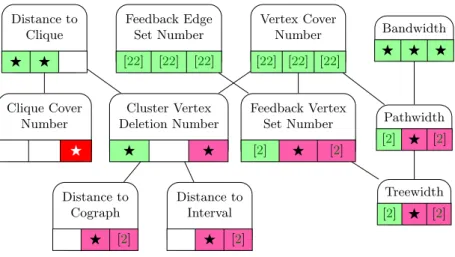
Fig. 1.Overview of the relations between structural graph parameters and our results for TSS. An edge from a parameterαto a parameterβbelow ofαmeans thatβcan be upper-bounded in a linear function inα. The three rectangles below each parameter indicate the known results for TSS with (from left to right:) constant, majority, and general threshold function. The white star at the “clique cover number” means NP-hard for constant values of this parameter, dark violet background means W[1]-NP-hard, light green background means FPT, and white background indicates an open question. Results marked with a star are obtained in this paper.
W[1]-hard with respect to the treewidth in case of unbounded threshold values whereas they showed it to be fixed-parameter tractable for the same parameter once the threshold values are bounded by a constant.
Our Contributions. Starting from the efficient solvability of TSS on trees and cliques [5, 22, 26], we also investigate to what extent efficient algorithms can be obtained for more general graph classes. On the one hand, we generalize from trees, thus in a way following previous work [2, 22] and consider further parameters measuring tree-likeness or sparseness, and, on the other hand we spot several parameters measuring distance to “cliquish” graphs. In both lines, we put particular emphasis on how the allowed threshold functions (arbitrary versus majority versus constant) influence computational complexity.5 Our findings, which are pictorially presented (including the relations between parameters) in Figure 1, read as follows.
We start with the “sparse setting”. For majority thresholds, we show that W[1]-hardness results for parameters such as “feedback vertex set number” and “pathwidth” for general threshold functions (which are due to Ben-Zwi et al. [2])
5
Notably, all our positive results for constant thresholds generalize to the case that the maximum thresholdtmax is given as an additional parameter. However, to keep
extend to the case of majority thresholds. Conversely, the very same parameteri-zations lead to fixed-parameter tractability results in case of constant threshold values [2]. Further, we briefly indicate that TSS is fixed-parameter tractable for the parameter bandwidth6 even in case of arbitrary threshold functions.
Our main results are related to the “cliquish setting”. The most central result here is that, with respect to the parameter “cluster vertex deletion number” (that is, the minimum number of vertices to delete from a graph to transform
it into a union of disjoint cliques [15]), TSS is W[1]-hard for general thresholds but becomes fixed-parameter tractable in case of constant thresholds (the case of majority thresholds is open). For the larger (thus “weaker” [19]) parameter “distance to clique” (the minimum number of vertices to delete to make a graph a clique), however, TSS is fixed-parameter tractable for both constant and majority thresholds whereas this is open for general thresholds. Finally, for the parameter “clique cover number” (the minimum number of cliques needed to cover all vertices of a graph) we show NP-hardness even for parameter value two (rendering fixed-parameter tractability very unlikely) whereas the (fixed-parameterized) complexity is open in case of majority and constant thresholds.
Several proof details (particular concerning hardness proofs) are deferred to a full version of the paper.
2
Preliminaries and Parameter Identification
Preliminaries. We use standard graph-theoretic notation. For graphsG= (V, E), we usen:=|V|andm:=|E|. We omit the index of the neighborhoodNG(v) or degree degG(v) of a vertexv ifGis clear from the context. To formally define
Target Set Selection, consider a graphG= (V, E) and a function thr :V →
N∪ {0}. For a vertex setS⊆V, we define the set of vertices that areactivated
by S in theith round asAi
G,thr(S) with
A0
G,thr(S) :=S and
Aj+1G,thr(S) :=AjG,thr(S)∪ {v∈V | |N(v)∩ AjG,thr(S)| ≥thr(v)}. We callr(S) := max{i| Ai−1
G,thr6=A i
G,thr}thenumber of activation rounds and say that S is a target set for (G,thr) if Ar(S)G,thr(S) = V. We can now formally define the central problem of this work:
Target Set Selection (TSS)
Input: An undirected graphG= (V, E), a threshold function thr :V →N∪ {0}and an integerk≥0.
Question: Is there a target setS⊆V forGwith|S| ≤k?
We denote the maximum threshold of an instance (G,thr) bytmax(G,thr) := max{thr(v)|v∈V(G)}. Again, we omit (G,thr) if it is clear from the context.
6 A graph withbandwidth khas a linear arrangement of its vertices v
1, . . . , vn such
Parameterized Complexity. One dimension of a parameterized problem is the input sizes, and the other one is theparameter (usually a positive integer). A parameterized problem is calledfixed-parameter tractable (fpt) with respect to a parameter kif it can be solved inf(k)·sO(1) time, wheref is a computable function only depending on k. A core tool in the development of fixed-parameter algorithms is polynomial-time preprocessing bydata reduction [3,13]. Here, the goal is to transform a given problem instanceI with parameterkin polynomial time into an equivalent instanceI0 with parameterk0≤ksuch that the size ofI0 is upper-bounded by some function g only depending on k. If this is the case, we callI0 a (problem)kernel of sizeg(k). Usually, this is achieved by applying polynomial-time executable data reduction rules. We call a data reduction ruleR
correct if the new instanceI0 that results from applyingRtoI is a yes-instance if and only ifI is a yes-instance. An instance is calledreduced with respect to some data reduction rule if further application of this rule has no effect on the instance. The whole process is calledkernelization.7
Downey and Fellows [9] developed a parameterized theory of computational complexity to show (presumable) fixed-parameter intractability by means of parameterized reductions. A parameterized reduction from a parameterized prob-lem P to another parameterized problem P0 is a function that, given an in-stance (x, k), computes in f(k)·sO(1) time an instance (x0, k0) (with k0 only
depending onk) such that (x, k) is a yes-instance ofP if and only if (x0, k0) is a yes-instance ofP0. The basic complexity class for fixed-parameter intractability is called W[1] and there is good complexity-theoretic reason to believe that W[1]-hard problems are not fpt [9,12,23].
Parameter Identification. Fixed-parameter algorithms work best if the parameter they are designed for is small in practice. TSS having many applications on social networks [11], it is natural to extract small parameters from typical properties of social networks.
When the network models friendships for example, we expect the network to be made up of multiple cliques (or otherwise dense substructures) that overlap. This motivates considering the number of cliques needed to cover all vertices [16] (the “clique cover number”) or the number of vertices to remove to obtain a clique (the “distance to clique”). As the latter parameter is somewhat restrictive, we also considered the number of vertices to delete in order to obtain a collection of disjoint cliques (the “cluster vertex deletion number”). Recently, the cluster vertex deletion number was also used to parameterize problems related to coloring and hamiltonicity [8].
In some applications, we deal with very sparse social networks, for instance networks modeling sexual contacts [11, Chap. 2, Fig. 2.7]. In these cases, parame-ters related to the sparseness of the input graph are interesting. Among them, we consider the number of vertices to remove to obtain an edgeless graph (“vertex cover number”), the number of edges or vertices to remove to obtain a forest 7 It is well-known that a parameterized problem is fixed-parameter tractable if and
(“feedback edge set number” and “feedback vertex set number”) as well as some graph width parameters (treewidth, pathwidth, bandwidth). For definitions of treewidth, pathwidth, cographs, and interval graphs see for example Diestel’s book [7].
Data Reduction. We use the following two data reduction rules throughout this work.
If the threshold of a vertex exceeds its degree, it cannot be activated by its neighbors and, hence, the vertex is part of any target set. Moreover, we consider threshold-0 vertices as already active.
Reduction Rule 1 ([22, Reduction Rule 1]) Let G = (V, E) and v ∈ V. Ifthr(v)>deg(v), then deletev, decrease the threshold of all its neighbors by one and decrease kby one. If thr(v) = 0, then deletev and decrease the thresholds of all its neighbors by one.
If the instance is reduced with respect toReduction Rule 1, then every degree-one vertex has threshold one. Thus, considering an arbitrary degree-one vertex we do not choose it to be in the target set as choosing its neighbor is at least as good. Hence, this vertex does not help in activating any other vertex. This is formalized in the next data reduction rule.
Reduction Rule 2 ([22, Reduction Rule 5]) Let(G= (V, E),thr, k)be an instance of TSS reduced with respect to Reduction Rule 1 and let v ∈ V with thr(v) = deg(v) = 1. Then delete v fromG.
3
Parameters Related to Sparse Structures
In this section, we consider parameters that measure the sparseness of the input graph. Since trees are the most sparse connected graphs and TSS is polynomial time solvable on trees [5], parameters measuring the distance to trees are most interesting. Canonical candidates for this are the treewidth, the pathwidth, and the feedback vertex set of the input graph. Notably, a fixed-parameter algorithm of Ben-Zwi et al. [2] for the parameter treewidth tw can solve TSS intO(tw)max nO(1)time, implying fixed-parameter tractability for the three parameters mentioned above if the maximum thresholdtmax is some constant. We extend this result by showing W[1]-hardness for them if we, instead of limiting the maximum threshold by a constant, require the thresholds to respect the majority condition. The proof even shows hardness for the combination of the feedback vertex set, the pathwidth, the deletion-distance to cograph, and the vertex-deletion-distance to interval graph. The proof is based on and further extends the W[1]-hardness reduction presented by Ben-Zwi et al. [2].
Theorem 1. Target Set Selection with majority threshold is W[1]-hard even with respect to the combination of the following parameters: feedback vertex set, distance to cograph, distance to interval graph, and pathwidth.
Bandwidth. Another possible measure for sparseness is the bandwidth of the input. Here, our result is of more positive nature.
Theorem 2. Target Set Selectionis fixed-parameter tractable with respect to the parameter bandwidth.
Proof. Let (G= (V, E),thr, k) be an instance of TSS. First, exhaustively apply Reduction Rule 1to get a new equivalent instance (G0 = (V0, E0),thr0, k0). Let bw denote the bandwidth ofG0. It is not hard to show that thr0(v)≤degG0(v)≤2 bw for allv∈V0. Moreover, Ben-Zwi et al. [2] gave a (tmax)O(tw)n-time algorithm for solving TSS, where tw is the treewidth of the input graph and tmax is the maximum threshold value. It follows that this algorithm applied to Gruns in
time (2 bw)O(bw)nsince tw≤2 bw. ut
4
Parameters Related to Dense Structures
In contrast to the previous section, we now consider TSS with respect to pa-rameters related to the denseness of the input graph. Since cliques are the most dense graphs and TSS is polynomial time solvable on cliques [22], parameters measuring the distance to cliques are most interesting. In particular, we consider the vertex deletion distance to clique and to a collection of disjoint cliques (also called cluster vertex deletion set size), and the clique cover number.
Unrestricted Thresholds. Here, we research the general TSS setting without constraints on the thresholds of the input. As hinted in the introduction, these variants are hard with respect to the denseness measures employed.
Theorem 3. Target Set Selectionis W[1]-hard with respect to the parame-ter “cvd number”.
see Proof 2 (appendix)
Theorem 4. Target Set Selectionis NP-hard and W[2]-hard with respect to the parameter “target set size” k, even on graphs with clique cover number two.
see Proof 3 (appendix)
Restricted Thresholds. In the spirit of researching the influence of bounded thresholds to TSS, we consider the parameters distance to clique and cluster vertex deletion number (cvd number). Recall that we showed W[1]-hardness for the parameter cvd number (for unbounded thresholds) in the previous paragraph. By presenting an exponential-size problem kernel, we show that the problem becomes tractable for this parameter if the maximum threshold is a constant.
First, we show that TSS with majority thresholds or constant thresholds is fixed-parameter tractable with respect to the parameter distance`to clique. We can even show fixed-parameter tractability for less restrictive threshold functions. To this end letP(V) be the power set ofV.
Theorem 5. Target Set Selectionis fixed-parameter tractable with respect to the parameter distance ` to clique when the threshold function thr fulfills the restriction “thr(v)> g(`)⇒thr(v) =f(N(v))” for all vertices v∈V and arbitrary functions f :P(V)→N andg:N→N.
Proof. We prove the theorem by giving a fixed-parameter algorithm computing a minimum-size target set for (G,thr). To this end, we introduce some notations. LetX ⊂V, |X|=`, denote a set of vertices such thatG[V \X] is a clique. We define a non-standard “twins” equivalence relation≡by
u≡v ⇐⇒ (N[u] =N[v])∧(thr(u) = thr(v))∧(u∈X ⇐⇒ v∈X).
Since the thresholds and neighborhoods of all vertices in an equivalence classZare equal, we can denote this threshold and this neighborhood by thr(Z) andN[Z], respectively. LetZ1, Z2, . . . , Zsbe a list of all nonempty equivalence classes of≡. SinceG[V \X] is a clique, we know that for allu, v ∈V \X :N[u] =N[v] if and only ifNG[X][u] =NG[X][v]. Due to the condition thr(v)> g(`)⇒thr(v) = f(N(v)), for each subsetX0⊆X, there are at mostg(`) + 1 equivalence classes disjoint fromX whose neighborhood inXis exactlyX0. Hence,s≤2`(g(`)+1)+`.
LetS be a minimum-size target set for (G,thr). WithS, we can defineri as the number of the first activation round in which all vertices of Zi are active. More formally,ri := min{j|Zi⊆ A
j
G,thr(S)}. Letr:= max{ri|1≤i≤s}. In the following, we upper-bound r by s. We do this by showing that for each 1≤j ≤r, there is an 1≤i≤ssuch thatri =j. Assume this was false, that is, there is some activation roundj such that none of the equivalence classes gets activated in roundj. Sincej≤r, there is some vertexv that gets activated in round j. Let Zi denote the equivalence class of v. Since j ≥ 1, we know that|N(v)∩ AjG,thr−1 (S)| ≥thr(v). Since for each vertexu∈Zi, thr(u) = thr(v) andN(u) =N(v), we conclude thatZi⊆ AjG,thr(S), contradicting the assumption that ri6=j.
Now we describe our algorithm. In the first phase, we guess the correct values ofri for all 1≤i≤s. There are at mostrs≤sspossibilities to do so.
In the second phase of the algorithm, we use an ILP formulation to solve the problem. Each variable xi in the ILP represents the number of vertices in the equivalence class i that are in the target setS. We use the constraints to model the activation process: For each equivalence classZi, the number of active neighbors in round ri exceeds thr(Zi). Two types of active neighbors are considered. First, the vertices inN[Zi]∩S. Second, the vertices in all equivalence
classesZj⊆N[Zi] that are active in roundi, that is,rj< ri. More formally,
Minimize: s
X
i=1 xi
subject to: ∀1≤i≤s: thr(Zi)≤
X
Zj⊆N[Zi] rj≥ri
xj+
X
Zj⊆N[Zi] rj<ri
|Zj|
∀1≤i≤s:xi∈ {0,1}.
By the discussion above, a solution to this ILP corresponds to a minimum-size target set for (G,thr). Since the ILP formulation has s variables, a result by Lenstra [20] implies that solving it is fixed-parameter tractable with respect to s. Since at mostss such ILPs have to be solved and s ≤2`(g(`) + 1) +`, fixed-parameter tractability with respect to` follows. ut
Clearly,Theorem 5is a pure complexity classification result. Since the majority thresholds and constant thresholds both satisfy the restrictions required in Theorem 5, the next corollary immediately follows.
Corollary 1. Target Set Selection with majority thresholds and constant thresholds is fixed-parameter tractable with respect to the parameter distance to clique.
Next, we show fixed-parameter tractability for TSS with constant thresholds with respect to the parameter “cvd number”. In the following, we assume that an optimal cvd setXof the input graph is given. If this is not the case, then one might instead use a simple factor-3 approximation.8Either way, we abbreviate`:=|X|.
In this section we use the notation of “critical cliques”. Here, a cliqueKin a graph iscritical if all its vertices have the same closed neighborhood andK is maximal with respect to this property.
First, we present a data reduction rule allowing us to bound the number of vertices with the same open or closed neighborhood by the maximum thresh-oldtmax.
Reduction Rule 3 Let I := (G = (V, E),thr, k) be an instance of TSS that is reduced with respect to Reduction Rule 1 and let v1, v2, . . . , vtmax+1 ∈V be vertices such that either
N(v1) =N(v2) =. . .=N(vtmax+1)or N[v1] =N[v2] =. . .=N[vtmax+1]. Furthermore, let v1 be the vertex with the highest threshold, that is, for all 1≤
i≤tmax+ 1 it holds thatthr(v1)≥thr(vi). Then delete v1.
Lemma 1. Reduction Rule 3is correct and can be applied exhaustively inO(n+ m)time.
8
A graph is a cluster graph if and only if it contains no inducedP3, that is, an induced
path of three vertices. Using this characterization, the factor 3-approximation simply deletes all vertices occurring in an inducedP3.
see Proof 4 (appendix)
In the following we assume that the input graph Gis reduced with respect toReduction Rule 1andReduction Rule 3. Thus, G[V \X] consists of disjoint cliques, each of size at most 2`tmax. Hence, in order to show a problem kernel it remains to bound the number of cliques inG[V \X]. To this end, we introduce the following notation:
Definition 1. LetI:= (G= (V, E),thr, k) be an instance of TSS, letX ⊆V be a cvd set, and letS ⊆V. LetC1, C2⊆V be two clusters inG[V\X]. We callC1 and C2 equivalent with respect to X, denoted by C1 ≡X C2, if there exists a bijectionf :C1→C2 such that for everyv∈C1 it holds that thr(v) = thr(f(v)) and N(v)∩X = N(f(v))∩X. Furthermore, we call C1 and C2 equivalent with respect toX and S, denoted byC1≡SX C2, if the bijectionf additionally fulfillsv∈S ⇐⇒ f(v)∈S for allv∈C1.
Note that ≡X is an equivalence relation on the clusters in G[V \X] with at most (tmax+1)2`tmaxequivalence classes. To see this, observe that each equivalence class is uniquely determined by 2`(possibly empty) sequences of thresholds. One for each subset ofX. SinceGis reduced with respect to Reduction Rule 3, each such sequence contains between 0 andtmax thresholds. Since each threshold is at mosttmax, the number of equivalence classes is at most
tmax
X
i=0 timax
!2`
≤ (tmax+ 1)tmax2 `
= (tmax+ 1)2`tmax.
In the following, our goal is to bound the number of cliques in one equivalence class in a function depending only ontmax and`. Note that once we achieve this goal, we have a problem kernel with respect to the parameter “cvd number”. The next lemma is a first step towards this goal.
Lemma 2. LetI := (G= (V, E),thr, k) be an instance of TSS, let X ⊆V be a cvd set for G, and let S ⊆ V, |S| ≤ k, be a target set for G. Furthermore letC1, C2, . . . , Ctmax+1⊆V be clusters inG[V \X]that are pairwise equivalent with respect toX andS. Then, S\C1 is a target set forG[V \C1].
Proof. LetS0 =S\C1andG0=G[V\C1]. We prove the lemma by contradiction: Assume thatS0 is not a target set forG0. LetY ⊆V \C1be the set of vertices that are activated inGin some roundibut are not activated inG0 in the roundi. Formally,Y :={v∈V\C1| ∃i≥1 : v∈ Ai
G,thr(S)∧v /∈ AiG0,thr(S0)}. SinceS0is not a target set forG0, the setY is not empty. In particular,Y contains all vertices inG0 that are not activated byS0. Letv∈Y be the vertex that is activated first in G, that is, for all u∈Y it holds that u∈ Ai
G,thr(S)⇒v∈ AiG,thr(S), 1≤i. Since v ∈ Y and Y ⊆ V \C1, it holds that v /∈ S. Let i ≥ 1 be the round in whichv becomes active inG, that is,v∈ Ai
G,thr(S)\ A i−1
G,thr(S). Thus,
|NG(v)∩ AiG,thr−1 (S)| ≥ thr(v). Since v is in G
0 not activated by S0, it follows
Ai−1
G,thr(S) =∅. Thus,A i−1
G,thr(S)\ A i−1
G0,thr(S0)⊆C1. SinceNG(v)\NG0(v)⊆C1, it follows thatNG(v)∩AG,thri−1 (S)∩C16=∅andv∈X. Letu∈NG(v)∩AG,thri−1 (S)∩C1. Note thatC1 andCj, 1< j≤tmax+ 1, are equivalent with respect toX andS and, hence, there is a bijectionfj as described in Definition 1. Thus, it is easy to see that u∈ Ai−1
G,thr(S) ⇒fj(u)∈ A i−1
G,thr(S). Moreover, since u∈NG(v) it follows thatfj(u)∈NG(v) and, thus,fj(u)∈NG0(v). Hence,fj(u)∈NG0(v)∩
Ai−1
G0,thr(S0) for all 2≤j≤tmax+ 1 and thus|NG0(v)∩ AiG−01,thr(S0)| ≥tmax. Hence, thr(v)>|NG0(v)∩ Ai−1
G0,thr(S0)| ≥tmax, a contradiction. ut Since we do not know the target setS forG, two problems have to be solved in order to convert this lemma into a data reduction rule: The first problem is to find out by how much we have to decreasek, or, equivalently, how to compute|S∩C1|
in polynomial time? The second problem is that we do not know the target setS. As we show in the following, the key in overcoming these two problems is to increase the number of equivalent clustersCj in the assumption of the lemma.
To this end, we first compute a lower and upper bound on the size of the target set forG. LetGX be the graph that results from activating all vertices in X and applyingReduction Rule 1 exhaustively. LetCX
1 , C2X, . . . , CζX denote the maximal cliques ofGX. Clearly, for each cliqueCXofGX there is a clusterC inG[V\X] such thatCX ⊆C. LetSX ⊆V be an optimal solution forGX. Note thatSX can be computed in linear time [22,26]. By construction ofGXit is clear that|SX|is a lower bound for the size of any target set forG. Furthermore,SX∪X is a target set for G. Hence, if k < |SX| we can immediately answer no and ifk≥ |SX|+|X|=|SX|+`we can answer yes. Thus, we assume in the following that|SX| ≤k <|SX|+`. Besides these general bounds on the target set size we can also derive bounds for the number of vertices in a target set for each cluster C in G[V \X]: If there is a (uniquely determined) clique CX in GX such that CX ⊆ C, then set min(C) = |SX∩CX|. In case there is no such clique in GX, set min(C) = 0. Finally, set max(C) = min{tmax,min(C) +`}. Clearly, min(C) and max(C) are lower resp. upper bounds on the number of vertices ofC that are in an optimal target set forG. Note that if two clustersC1 andC2 inG[V \X] are equivalent with respect toX, then min(C1) = min(C2). Furthermore, having`+ 1 clustersC1, . . . , C`+1 in G[V \X] that are equivalent with respect toX, we can conclude that for any optimal target setS there is a cluster Ci, 1≤i≤`+ 1, having exactly min(C1) vertices in the target set, since otherwise, the solutionSX∪X forGcontains fewer vertices thanS. Likewise, if there are`+rclustersC1, . . . , C`+rthat are equivalent with respect to X, then it is clear that for any optimal target setS at leastr of these clusters contain exactly min(C1) vertices ofS. Hence, increasing the number of equivalent clusters to at least`+tmax+ 1 solves the first problem.
We overcome the second problem by relaxing the condition for the clus-tersC1, . . . , Ctmax⊆V to “equivalent with respect toX” instead of “equivalent with respect toX andS” and increase the number of equivalent clusters: We can assume that, out of each cluster C, at most max(C)≤tmax vertices are in a target set. Thus, there are at most t2max` possibilities for choosingtmax vertices
from a cluster to be in a target set: Choose at mosttmaxvertices with the highest threshold from each of the at most 2` critical cliques of the cluster.9 Thus, when increasing the number of clusters that have to be equivalent with respect toX to `+t2`
max(tmax+ 1) we can conclude with the pigeonhole principle that there are clusters Ci1, . . . , Cit
max +1 that are equivalent with respect to X andS for any target set S and each clusterCij contains min(Cij) vertices ofS. Hence, applyingLemma 2to this set we arrive at the following reduction rule.
Reduction Rule 4 Let I := (G = (V, E),thr, k) be an instance of TSS that is reduced with respect to Reduction Rule 1 and let X ⊆ V be a cvd set of size `. LetC1, C2, . . . , Cα ⊂V be disjoint clusters in G[V \X] such that α= `+t2`
max(tmax+ 1) and for each pairCi, Cj, 1≤i, j≤α, it holds that Ci ≡X Cj. Then deleteC1 and reduce kby min(C1).
The correctness of the data reduction rule follows fromLemma 2and the above discussion. As to the running time, note thatReduction Rule 4can be exhaustively applied in O(n2) time. Since we require that the cvd set X is given, we can compute the clusters in G[V \X] in linear time. Then, we sort the vertices in these clusters by neighborhood and threshold. This can be done in O(nlog(n)) time. After this sorting the check whether two clusters are equivalent with respect to X can be done in linear time: Simply iterate over the sorted vertices and check whether the current vertices in both clusters have the same neighborhood and threshold. Overall, iterating over all clusters inG[V \X], determining the equivalent clusters, and deleting the respective clusters can be done inO(n2) time.
With these data reduction rules we now arrive at the following theorem.
Theorem 6. Target Set Selection admits a problem kernel withtO(2`tmax)
max `
vertices, where` is the size of a cvd set and tmax the maximum threshold. The problem kernel can be found inO(n2)time.
Proof. LetI:= (G= (V, E),thr, k) be an instance of TSS that is reduced with respect to Reduction Rules1,3, and4. Furthermore letX ⊆V be a cvd set and let`=|X|.
SinceIis reduced with respect toReduction Rule 3, the clusters inG[V \X] have size at most 2`tmax. Hence, there are at most (tmax+ 1)2`tmax clusters inG[V \X] that are all pairwisenot equivalent with respect toX. Furthermore, since I is reduced with respect to Reduction Rule 4, each equivalence class of≡X contains at most`+t2
`
max(tmax+ 1) clusters. Thus, the number of clusters in G[V \X] is bounded by (`+t2`
max(tmax+ 1))(tmax+ 1)2 `t
max, each of these clusters contains at most 2`tmax vertices. Overall this givestO(2`tmax)
max ` vertices inG[V \X] and, thus,Gcontains at most tO(2`tmax)
max ` vertices. The Reduction Rules1and3 can both be applied exhaustively inO(n+m) time andReduction
9
Having a set of vertices with the same closed neighborhood and the task is to chooses of them to be in a target set, it is best to choose the s vertices with the highest thresholds [22, Observation 7].
Rule 4 can be applied exhaustively in O(n2). Overall, the kernelization runs
in O(n2) time. ut
Clearly this problem kernel implies that TSS is fixed-parameter tractable with respect to the combined parameter (tmax, `). This leads to our next corollary considering TSS with constant thresholds.
Corollary 2. Target Set Selectionwith constant thresholds is fixed-parameter tractable with respect to the parameter “cvd number”.
5
Conclusion
We showed that constant threshold values, as can be assumed in several real-world applications of TSS, can help to find efficient algorithms that exactly solve TSS. This extends previous work of Ben-Zwi et al. [2] where this observation was made for the parameter treewidth. A question left open in our work is whether or not TSS is fixed-parameter tractable with respect to the parameter cluster vertex deletion number for majority thresholds. A second open question arising from our work is whether or not TSS is fixed-parameter tractable with respect to the parameter “distance to clique” for general thresholds. Indeed, these two cases are part of the more general open question whether, in terms of computational complexity, TSS with majority thresholds is basically as hard as for general thresholds but significantly easier for constant thresholds10—the results we achieved in this paper may be interpreted as directing to a corresponding conjecture. Considering the practical relevance of TSS, it would be interesting to incorporate further natural parameters into the search for islands of tractability; among these we clearly have “graph diameter” (note, however, that this parameter needs to be combined with others since TSS is already hard on diameter-two graphs [22]) and “number of activation rounds” (the case of only activation round— that is, the non-dynamic setting—leads to variants of domination [14,18, 25]; again, in order to lead to tractability results, this parameter needs to be combined with others [22]).
Bibliography
[1] J. Balogh, B. Bollob´as, and R. Morris. Bootstrap percolation in high dimensions. Combinatorics, Probability & Computing, 19(5-6):643–692, 2010. Cited on p.2. [2] O. Ben-Zwi, D. Hermelin, D. Lokshtanov, and I. Newman. Treewidth governs the
complexity of target set selection. Discrete Optimization, 8(1):87–96, 2011. Cited on pp.2,3,4,6,7,13,16, and17.
[3] H. L. Bodlaender. Kernelization: New upper and lower bound techniques. InProc. 4th IWPEC, volume 5917 ofLNCS, pages 17–37. Springer, 2009. Cited on p.5. [4] C. C. Centeno, M. C. Dourado, L. D. Penso, D. Rautenbach, and J. L. Szwarcfiter.
Irreversible conversion of graphs. Theoretical Computer Science, 412(29):3693 – 3700, 2011. Cited on p.2.
10
[5] N. Chen. On the approximability of influence in social networks. SIAM Journal on Discrete Mathematics, 23(3):1400–1415, 2009. Cited on pp.1,2,3, and6. [6] C.-Y. Chiang, L.-H. Huang, B.-J. Li, J. Wu, and H.-G. Yeh. Some results on the
target set selection problem. Journal of Combinatorial Optimization, 2012. Online available. Cited on p.2.
[7] R. Diestel. Graph Theory, volume 173 ofGraduate Texts in Mathematics. Springer, 4th edition, 2010. Cited on p.6.
[8] M. Doucha and J. Kratochv´ıl. Cluster vertex deletion: A parameterization between vertex cover and clique-width. InProc. 37th MFCS, volume 7464 ofLNCS, pages 348–359. Springer, 2012. Cited on p.5.
[9] R. G. Downey and M. R. Fellows. Parameterized Complexity. Springer, 1999. Cited on pp.5and19.
[10] P. A. Dreyer, Jr. and F. S. Roberts. Irreversible k-threshold processes: Graph-theoretical threshold models of the spread of disease and of opinion. Discrete Applied Mathematics, 157:1615–1627, 2009. Cited on pp.1and2.
[11] D. Easley and J. Kleinberg. Networks, Crowds, and Markets: Reasoning about a Highly Connected World. Cambridge University Press, 2010. Cited on p.5. [12] J. Flum and M. Grohe. Parameterized Complexity Theory. Springer, 2006. Cited
on p.5.
[13] J. Guo and R. Niedermeier. Invitation to data reduction and problem kernelization. ACM SIGACT News, 38(1):31–45, 2007. Cited on p.5.
[14] J. Harant, A. Pruchnewski, and M. Voigt. On dominating sets and independent sets of graphs. Combinatorics, Probability and Computing, 8(6):547–553, 1999. Cited on pp.1and13.
[15] F. H¨uffner, C. Komusiewicz, H. Moser, and R. Niedermeier. Fixed-parameter algorithms for cluster vertex deletion. Theory of Computing Systems, 47(1):196– 217, 2010. Cited on p.4.
[16] R. M. Karp. Reducibility among combinatorial problems. In R. E. Miller and J. W. Thatcher, editors,Complexity of Computer Computations, pages 85–103. Plenum Press, 1972. Cited on p.5.
[17] D. Kempe, J. Kleinberg, and ´E. Tardos. Maximizing the spread of influence through a social network. InProc. 9th ACM KDD, pages 137–146. ACM Press, 2003. Cited on p.2.
[18] R. Klasing and C. Laforest. Hardness results and approximation algorithms of k-tuple domination in graphs.Information Processing Letters, 89(2):75–83, 2004. Cited on pp.1and13.
[19] C. Komusiewicz and R. Niedermeier. New races in parameterized algorithmics. In Proc. 37th MFCS, volume 7464 ofLNCS, pages 19–30. Springer, 2012. Cited on p.4.
[20] H. W. Lenstra. Integer programming with a fixed number of variables.Mathematics of Operations Research, 8:538–548, 1983. Cited on p.9.
[21] R. M. McConnell and J. Spinrad. Linear-time modular decomposition and efficient transitive orientation of comparability graphs. InProc. 5th SODA, pages 536–545. ACM/SIAM, 1994. Cited on p.22.
[22] A. Nichterlein, R. Niedermeier, J. Uhlmann, and M. Weller. On tractable cases of target set selection. Social Network Analysis and Mining, 2012. Online available. Cited on pp.2,3,6,7,11,12, and13.
[23] R. Niedermeier. Invitation to Fixed-Parameter Algorithms. Oxford University Press, 2006. Cited on p.5.
[24] D. Peleg. Local majorities, coalitions and monopolies in graphs: a review. Theoret-ical Computer Science, 282:231–257, 2002. Cited on pp.2and13.
[25] V. Raman, S. Saurabh, and S. Srihari. Parameterized algorithms for generalized domination. InProc. 2nd COCOA, volume 5165 ofLNCS, pages 116–126. Springer, 2008. Cited on pp.1and13.
[26] T. Reddy, D. Krishna, and C. Rangan. Variants of spreading messages. InProc. 4th WALCOM, volume 5942 ofLNCS, pages 240–251. Springer, 2010. Cited on pp.2,3, and11.
A
Appendix
A.1 Basic Reduction
Ben-Zwi et al. [2] proved W[1]-hardness for TSS with respect to the parameter treewidth. In the following, we recall their reduction, since it forms a basis for other W[1]-hardness reductions in this work. The reduction, which we will refer to asbasic reduction, is from the W[1]-hardMulticolored Cliqueproblem, which is defined as follows.
Multicolored Clique (MCC)
Input: An undirected graphG= (V, E), an integerk≥0, and a coloring col :V → {1, . . . , k}.
Question: Does G contain a multicolored clique of size k, that is, a vertex subsetV0 ⊆V with|V0|=k such that for allu, v∈V0it holds that{u, v} ∈Eand col(u)6= col(v)? Let (G,col, k) be an MCC instance. An equivalent instance (G0,thr, k0) is con-structed as follows. For each color c∈ {1, . . . , k}, create avertex-selection gad-get Xc consisting of a star whose leaves one-to-one correspond to vertices with colorcinG. The center vertices of the star is calledguard. For each pair of distinct colors c1, c2 ∈ {1, . . . , k}, letE{c1,c2} ⊆E be the set of all edges that connect vertices of colorc1with vertices of colorc2and create the followingedge-selection gadget X{c1,c2}. The edge-selection gadgetX{c1,c2}consists of a star whose leaves one-to-one correspond to edges inE{c1,c2}. The center vertex is calledguard.
The second type of gadgets is a validation gadget. They use the arbitrary bijection low : V → {1, . . . , n} and the bijection high : V → {n, . . . ,2n−1}
defined as high(v) = 2n−low(v) for eachv∈V. For each{c1, c2} withc1, c2∈ {1, . . . , k}, add two validation gadgets Vc1,c2 andVc2,c1 each consisting of two vertices. Now, for each{u, v} ∈E{c1,c2} such that col(v) =c1, connect the first
validation gadgetVc1,c2 as follows:
Letv0 be the vertex inXc1 corresponding tov. First, add low(v) vertices and connect them tov0and to the first vertex ofVc1,c2. Next, add high(v) vertices and connect them tov0 and to the second vertex ofVc1,c2. Analogously, withv{u,v} denoting the vertex in X{c1,c2} corresponding to {u, v}, add high(v) vertices
and connect them to v{u,v} and to the first vertex of Vc1,c2. Then, add low(v) vertices and connect them to v{u,v} and to the second vertex of Vc1,c2. The second validation gadget Vc2,c1 is analogously connected to the vertex of Xc2 that corresponds touand to v{u,v} inX{c1,c2}.
We call all the vertices adjacent to vertices of a validation gadgetconnection vertices. The thresholds are set as follows: Guard vertices and connection vertices have threshold one, the two vertices in each validation gadget have threshold 2n, and the remaining vertices in the selection gadgets have a threshold equal to their degree. Finally,k0=k+ k2
. This completes the reduction.
As to the correctness: If the instance (G,col, k) is a yes-instance of MCC then the vertices chosen to be in the target set ofG0 refer to the multicolored
clique inG: For each vertex in the clique, the corresponding vertex in the vertex-selection gadget is in the target set. Furthermore, for each edge in the clique the corresponding vertex in the edge-selection gadget is in the target set. This target set activates the whole graph. In the reverse direction the validation gadgets play a central role: Each validation gadget connects a vertex-selection gadget with and edge-selection gadget. The vertices in the validation gadget only become activated if a vertex in the vertex-selection gadget and a vertex in the edge-selection gadget are in the target set such that the corresponding vertex and edge inGare incident. Basically this ensures that one has to choose vertices inG0 into the target set that refer to a multicolored clique in G. We refer the reader to Ben-Zwi et al. [2] for more details.
A.2 Proof 1 (Theorem 1)
Proof. We modify the basic reduction to get the new, equivalent instance (G00,thr0, k00) as follows. For each vertexv in a validation gadget, add degG0(v)−
4nvertices adjacent tov. Moreover, for each guard vertexvadd degG0(v)−2 neigh-bors. LetX be the set of vertices added so far. Insert a new vertexuadjacent to all vertices inX and add|X|+ 2(k0+ 2) vertices to the neighborhood ofu. To complete the modification of the graph, for every vertexvin a selection gadget, attach degG0(v) neighbors. Finally, set thr0(v) =ddegG00(v)/2efor allv∈V(G00)
andk00=k0+ 1. We claim that (G00,thr0, k00) is equivalent to (G0,thr, k0). “⇒”: Suppose that there is a solution S0 for (G00,thr0, k00). First, observe thatu∈S0 since, otherwise,uwould not become active. Indeed, even if all the vertices inG00plus k00 degree-one neighbors ofuare activated, the vertexuwill not be activated since its threshold is|X|+k00+ 1. Sinceuis in all solutions, we may consider the equivalent instance where uis removed together with all its neighbors (they all have threshold one and thus get activated byu). Moreover, for each removed vertex v, we have to decrease the threshold of the vertices in N(v) by one. This operation leaves a graph with many degree-one vertices of threshold one. ApplyingReduction Rule 2, we arrive at the instance (G0,thr, k0). By correctness ofReduction Rule 2, the equivalence follows.
“⇐”: Conversely, let S be a solution for (G0,thr, k0). Since activating u and exhaustively applying Reduction Rule 2 results in (G0,thr, k0), it is clear that S∪ {u} is a target set for (G00,thr0) of sizek0+ 1.
To complete the proof of the theorem, it is enough to observe that if we remove the vertex u, all guard vertices, and the validation gadgets (that is,
k 2
+k+ 1 vertices), then we get stars and isolated vertices. ut
A.3 Proof 2 (Theorem 3)
Proof. We modify the basic reduction (seeSection 3) as follows. Make all con-nection vertices that have a common vertex in a (vertex- or edge-) selection gadget to a clique. The thresholds of the connection vertices are modified as follows: In each maximal clique of the connection vertices, an arbitrary ordering
of the vertices is fixed. Then the first vertex has threshold one, the second has threshold two, and theith vertex has thresholdi. SeeFigure 2 for a scheme of the reduction.
Note that each connection vertex is contained in exactly one maximal clique. Notice also that the following holds. LetC be such a maximal clique,V1(resp. V1andV2) denote the validation gadget adjacent toC, andvthe vertex adjacent toC in the vertex-selection gadget (resp.the edge-selection gadget). Then all connection vertices inC are activated if and only if eithervis activated or all the vertices inV1 (resp.V1andV2) are activated.
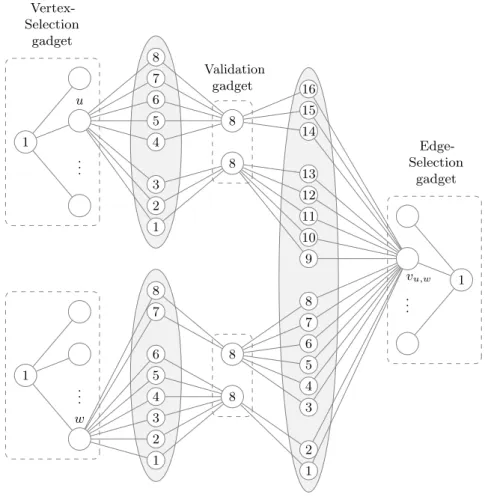
Vertex-Selection gadget 1 . . . u 4 5 6 7 8 1 2 3 Validation gadget 8 8 1 . . . w 7 8 1 2 3 4 5 6 8 8 Edge-Selection gadget 1 . . . vu,w 14 15 16 9 10 11 12 13 3 4 5 6 7 8 1 2
Fig. 2.Graph obtained after carrying out the modifications in the proof ofTheorem 3 (withn= 4). The vertices inside an ellipse form a clique. The numbers in the vertices denote the thresholds. If no number is inside a vertex, the threshold is equal to the degree.
We now prove that (G,col, k) is a yes-instance ofMulticolored Cliqueif and only if (G0,thr, k2+k) is a yes-instance of TSS.
“⇒”: Suppose that (G,col, k) has a multicolored cliqueC⊆V of sizek. Then the setS={v∈C} ∪ {vu,v|u, v∈C}is a target set for (G0,thr, k0). Indeed, in the first step of the propagation process every guard vertex is activated since they are all adjacent to a vertex inS. After 4nsteps, all the connection vertices adjacent to a vertex inS get activated. During the next step, all 4 k2vertices in validation pairs will be activated sinceC is a multicolored clique of sizek. From now on, it is not hard to see that the entire graph will be activated.
“⇐”: Conversely, assume that (G0,thr, k0) has a target setS ⊆V0 of sizek. First, we may assume thatSdoes not contain any guard vertex since they all have threshold one. Moreover, one has to pick up in the target set at least one vertex in each selection gadget to activate the guard vertex of the latter. Indeed, recall that every neighbor of a guard vertex has a threshold equal to its degree and the guard vertex is not in the target set. Thus, every target set contains at least one vertex in each selection gadget. Furthermore, sincek0 = k2+k we conclude that there isexactly one vertex from each selection gadget in a minimal target set. Suppose now that we select two verticesu∈Xc1 andv∈Xc2together with an edge-vertex vu0,v0 ∈ X{c
1,c2} for some c1, c2 ∈ {1, . . . , k} such that vu0,v0 is not incident to bothuand v. Without loss of generality, we may assume thatu6=u0. Then at least one vertex in the validation gadgetsVc1,c2 andVc2,c1 will not be activated. To see this, recall that for allw∈V0 it holds that high(w) + low(w) = 2nand, since u6=u0, we have either low(u) + high(u0)<2nor high(u) + low(u0)<2n. This implies, as previously discussed, that some connection vertices will not be
activated, a contradiction. ut
A.4 Proof 3 (Theorem 4)
Proof. We present a parameterized reduction fromHitting Set, which isW [2]-complete [9] with respect to the parameter “target set size”.
Hitting Set (HS)
Input: A collectionF of subsets of a finite setU and an inte-gerk≥0.
Question: Is there a subset U0 ⊆ U with U0 ≤ k such that U0 contains at least one element from each subset inF?
Given an HS-instance (F, U, k) consisting of a set family F = {F1, . . . , Fm}
over a universe U ={u1, . . . , un} and an integer k ≥0, we construct a TSS-instance (G,thr, k) consisting of a graphG= (V, E), a threshold function thr : V →N∪ {0}, andk.
The graphG= (V, E) is constructed as follows. A set of vertices VU contains a vertex for every element u∈U, that is,VU :={vu|u∈U}. Analogously, a second setWF contains a vertex for every subset, that is,WF :={wF |F ∈ F }.
vui
· · ·
2α+ 3 3α+ 4 4α+ 5
VU
WF
1
· · ·
α+ 2
. . . 1 VB 1 . . . α+ 2 VB
2
. . . 2α+ 3 VB
3
. . . 3α+ 4 VB
4
. . . 4α+ 5 VB
5
x thr(x) =|WF|+k
V2
V1
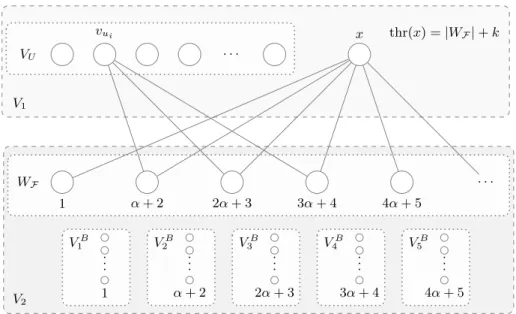
Fig. 3.A schematic picture of the constructed graph. The vertices in each box form a clique. The only way to activate all vertices with a target set of sizek is to choose kvertices inVUsuch that thesekvertices activate all vertices inWF.
subset vertices. There is an edge between an element vertex vu and a subset vertexwF if and only ifu∈F. Next, add a new vertexx6∈(VU∪WF) toGand
connectxto all vertices inWF. Then, makeV1:=VU∪ {x}a clique. Add|F | −1
sets of verticesVB
1 , . . . , V|F |−B 1 to the graph, each set containing α:=|U|+ 2 vertices and letVB =S|F |−1
i=1 V B
i . Finally, makeV2:=WF∪V1B∪. . .∪V|F |−B 1 a clique.
The thresholds are set as follows. For every subset vertex wFi ∈ WF, set
the threshold thr(wFi) := (i−1)α+i, for every element vertex vu ∈ VU, set thr(vu) := |{F ∈ F | u ∈ F}|+k+ 1, and for each vertex v ∈ ViB, 1≤i≤ |F | −1, set thr(v) := (i−1)α+i. Finally, complete the construction by setting thr(x) :=|WF|+k
SinceV1 andV2are cliques, the constructed graphGis a diameter-two graph whose vertices can be covered by two cliques, seeFigure 3.
For the correctness it remains to show that (F, U, k) is a yes-instance of HS if and only if (G,thr, k) is a yes-instance of TSS.
“⇒”: If (F, U, k) is a yes-instance, then there exists a size-k hitting setU0 forF. We show thatS:={vu|u∈U0}is a size-ktarget set forG. SinceU0 is a hitting set, every vertex inWF has at least one neighbor inS. Thus, all vertices
in V1 become active in 2|WF| −1 rounds: In the first roundwF1 is activated since thr(wF1) = 1. Then in the second round, all vertices inV1B are activated since all these vertices also have threshold one andwF1is active. For 2≤i≤ |WF|,
in the (2i−1)th round the vertex wF
i is activated and in the next round all vertices inViB: The neighbors of wFi that are active in round 2i−2 are: All vertices inV1B∪. . .∪ViB−1, the verticeswF1, . . . , wFi−1 and at least one vertex inS. Since the threshold is thr(wFi) = (i−1)α+i, the vertexwFi is activated. Then, there are (i−1)α+iactive vertices inV2 and, hence, all vertices inViB are activated in the 2ith round. After all vertices inV
2 are active,xis activated. Finally, in the last round all vertices inVU\Sare activated since for every vertex in VU \S all neighbors inWF and xhave been activated.
“⇐”: If (G,thr, k) is a yes-instance of TSS, then there is a target set S of size at mostk. We first show thatS⊆VU.
Assume towards a contradiction that there is a vertex inS\VU. Then,|S∩
VU| ≤k−1. Let `denote the first round in which a vertex inVU\S is activated, that is, `:= min{j| AjG,thr(S)∩(VU \S)6=∅}. Moreover, let vu∈ A`
G,thr(S)∩ (VU\S). Note that, by definition of`, it holds that|AG,thr`−1 (S)∩(V1)| ≤k. Hence:
|NG(vu)∩ A`G,thr−1 (S)|=|NG(vu)∩ A`G,thr−1 (S)∩WF|
+|NG(vu)∩ A`−1
G,thr(S)∩(V1)|
≤|{F ∈ F |u∈F}|+k
<|{F ∈ F |u∈F}|+k+ 1 = thr(vu),
a contradiction. Hence,S⊆VU.
Finally, we show that U0 := {u | vu ∈ S} is a hitting set for F. To this end, we show that every subset vertexwhas a neighbor inS and, hence, is hit by U0. Assume towards a contradiction that there exists a vertex wFi ∈WF
withNG(wFi)∩S=∅. To this end letXi := (S
i≤j≤|F |−1V B j )∪(
S
i≤j≤|F |{wFi}).
Let `denote the first round in which a vertex inXi is activated, that is, `:= min{j| AjG,thr(S)∩Xi6=∅}. Hence|A`−1
G,thr(S)∩WF|=|A `−1
G,thr(S)∩(WF\X i)| ≤ i−1 and|A`−1
G,thr(S)∩V
B|=|A`−1
G,thr(S)∩(V
B\Xi)| ≤ |S
1≤j<iV B
j |= (i−1)α. Letv∈Xi∩VB, then we have:
|A`−1
G,thr(S)∩NG(v)|=|A`G,thr−1 (S)∩V
B|+|A`−1
G,thr(S)∩WF|
≤(i−1)α+i−1 <(i−1)α+i≤thr(v)
and, thus, A`
G,thr(S)∩Xi ∩VB = ∅. Now consider v ∈ Xi∩(WF \ {wFi}). Observe that|A`−1
G,thr∩V1|=|S|=k. Thus, we have:
|AG,thr`−1 (S)∩NG(v)| ≤ |AG,thr`−1 (S)∩VB|+|A`G,thr−1 (S)∩WF|+|A`G,thr−1 (S)∩V1|
≤(i−1)α+i−1 +k < iα+i+ 1≤thr(v)
and, thus,A`
G,thr(S)∩Xi∩(WF\ {wFi}) =∅. Finally, considerv=wFi:
|A`G,thr−1 (S)∩NG(v)| ≤ |A`G,thr−1 (S)∩V B
|+|A`G,thr−1 (S)∩WF| ≤(i−1)α+i−1
<(i−1)α+i= thr(v) and, thus, wFi ∈ A/ `
G,thr(S). Altogether we have A `
G,thr(S)∩X
i ∩VB = ∅,
A`
G,thr(S)∩Xi∩(WF\ {wFi}) =∅, andwFi ∈ A/ `
G,thr(S) and, hence,A`G,thr(S)∩
Xi=∅, a contradiction. ut
A.5 Proof 4 (Lemma 1)
Proof. For the running time, note that computing the critical cliques of a graph can be done in linear time [21]. Thus, we first compute the critical cliques of the graph in linear time. Then we iterate over the critical cliques and if one of them has sizetmax+r,r >0, then we delete thervertices of this critical clique having the largest thresholds. This can clearly be done in linear time. Notice that a maximal set of vertices with the same open neighborhood form a critical clique in the complement graph. Hence, in a second step, we repeat the procedure with the complement graph. Then the graph is reduced with respect toReduction Rule 3. Furthermore observe that Reduction Rule 1is not applicable after Reduction Rule 3was applied.
To show the correctness, we prove that the instance (G0 = (V0, E0),thr, k)
that is produced byReduction Rule 3is a yes-instance if and only if the input instanceI is a yes-instance.
“⇒:” Since (G0,thr, k) is a yes-instance, there exists a target set S ⊆V0,
|S| ≤k, that activates all vertices inG0. Hence,Sactivates all vertices ofV\ {v1} inG. Since (G,thr, k) is reduced with respect toReduction Rule 1, the vertexv1 is activated by its neighbors. Thus,S is also a target set for (G,thr, k).
“⇐:” Since (G,thr, k) is a yes-instance, there exists a target set S ⊆ V,
|S| ≤k, activating all vertices inG. LetW ={v1, v2, . . . , vtmax+1}be the vertices considered in the reduction rule. First observe that we can assume W\S6=∅, (that is, not all vertices ofW are in the target set) since otherwise,S0=S\ {v1}
is also a target set: In the first activation round all vertices inN(v1) become active and, since (G,thr, k) is reduced with respect toReduction Rule 1, it follows that v1is active after the second round. Thus,S0 is also a target set.
Now consider the case thatv1∈/ S. Since for allvi∈W it holds that thr(v1)≥
thr(vi) andv1is activated by its neighbors, it is clear that all vertices inW\ {v1}
are active once v1 is active. Since |W| > tmax this implies that all vertices in NG(v1) become active inG0 and, thus, S is a target set forG0.
Finally, consider the case thatv1 ∈ S. Let w∈ W \S be the vertex with the highest threshold, that is, for allvi∈W \S it holds that thr(w)≥thr(vi). Observe thatS0= (S\ {v1})∪ {w}is a target set forG0: SinceS activates all vertices inW it is clear thatS0 activates all vertices inW \ {v1}. This implies
that all vertices inN(v1) are activated byS0 inG0 since|W \ {v1}|=tmax and all vertices in W have the same neighborhood. Thus,S0 activates all vertices