When disasters
and conflicts
collide
Improving links between
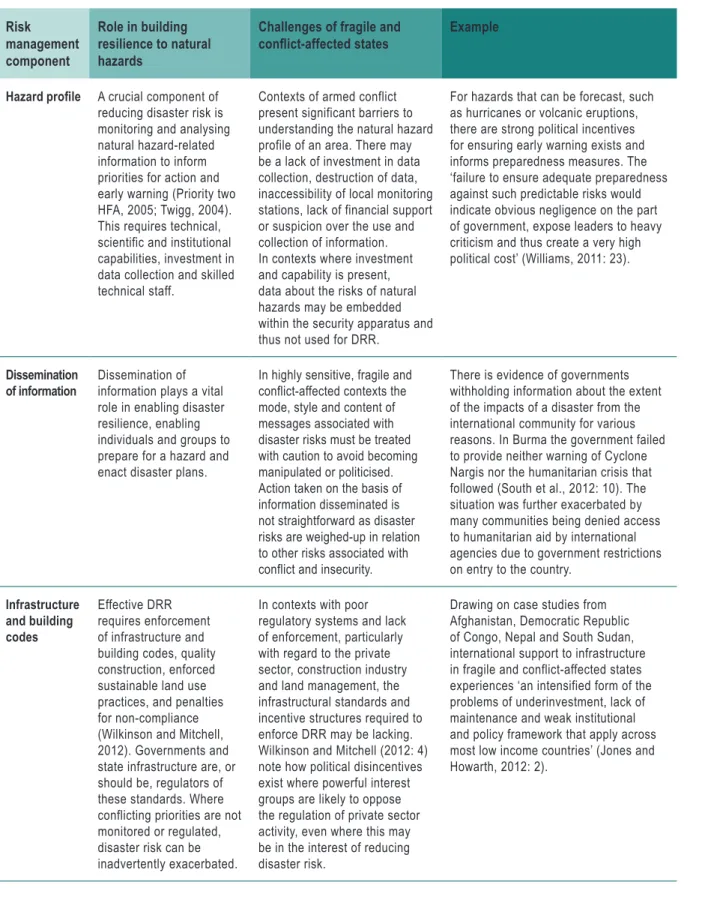
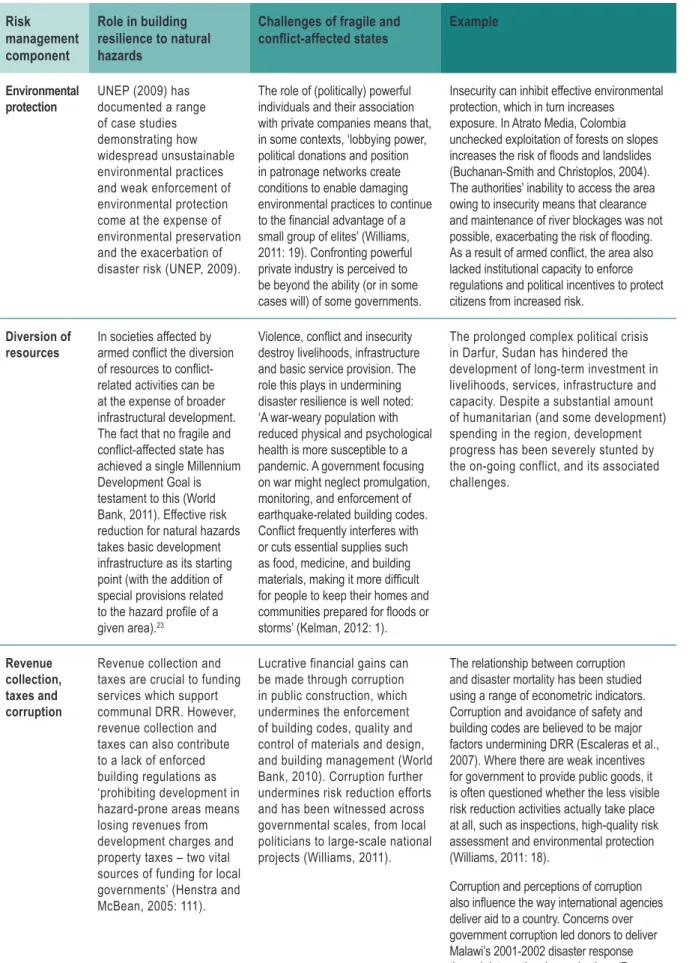
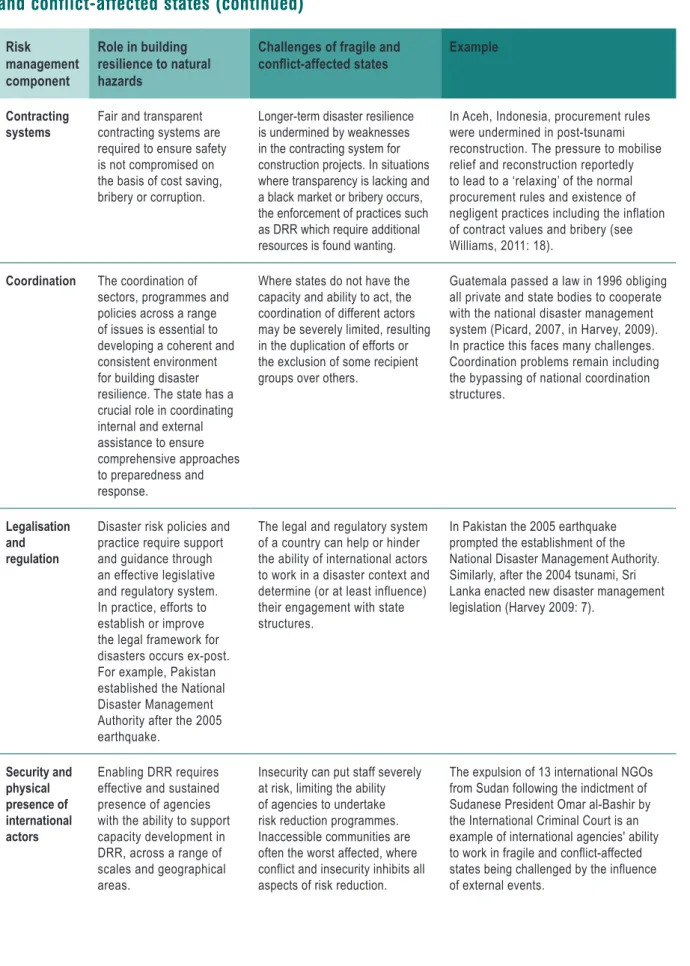
disaster resilience and
conflict prevention
Katie Harris, David Keen
and Tom Mitchell
Overseas Development Institute
203 Blackfriars Road
|
London SE1 8NJ
|
UK
Tel: +44 (0)20 7922 0300
Fax: +44 (0)20 7922 0399
www.odi.org.uk
The views presented in this paper are those of
the author(s) and do not necessarily represent
the views of ODI or our partners.
This material has been funded by UK aid from the UK Government, however the views expressed do not necessarily reflect the UK Government’s official policies.
When disasters
and conflicts
collide
Improving links between
disaster resilience and
conflict prevention
Katie Harris, David Keen
and Tom Mitchell
February 2013
Acknowledgements
The authors would like to thank Nick Harvey and Joanna Macrae at DFID for their support and guidance. Thanks go to ODI Research Fellows, Simon Levine, Lilianne Fan, Emily Wilkinson and Jan Kellett, and to Sarah Bailey (independent, formerly ODI), John Twigg (University College London), and Emma Lovell (ODI). Significant contributions were also made by independent researchers Shirley Matheson, Rachel Flynn, Katina Aitken-Laird and Paula Silva Villanueva.
Thanks go to the interviewees who contributed their honest reflections and insights on the topic, and in many instances provided examples of their work: Joel Hafvenstein, Sudarshan Reddy Kodooru and Oenone Chadburn (Tearfund), Andrew Mitchell (independent, formerly of Action Against Hunger), Simone Field (Christian Aid), Ilan Kelman (CICERO), Terry Cannon (Institute of Development Studies), Janani Vivekananda (International Alert), Ivan Campbell and Hannah Wright (Saferworld), Kate Crowley (CAFOD), Marcus Oxley (Global Network for Disaster Reduction), Jack Campbell (Global Facility for Disaster Reduction and Recovery), Kathryn Chelminski, David Jensen, Dennis Hamro-Drotz and Marisol Estrella (UNEP), Sasja Kamil (CORDAID), Maggie Ibrahim and Tim Midgley (World Vision), Lydia Poole, Georgina Brereton and Dan Sparks (Development Initiatives), Kelly Hawyrlyshyn (Plan UK), Erik Rottier (CARE Nederland), and Ayesha Siddiqi (Kings College London).
Contents
Executive summary
vi
The scale of the challenge vii
The impact of natural disasters on conflict vii
The impact of conflict and fragility on ‘natural’ disasters viii
Lessons from current efforts to strengthen resilience viii
Towards a conceptual framework ix
Recommendations x
1 Introduction
1
2 The challenge
3
3 The impact of natural disasters on conflict
10
3.1 Grievances 12
Natural resource and environmental scarcity 12
Resource allocation pre- and post-disaster 13
3.2 Opportunities 14
Economic opportunities 14
Political opportunities 14
3.3 Feasibility 15
4 The impact of conflict on natural disasters
16
4.1 Impact of conflict on the causes of disasters 18
4.2 Impact of conflict on disaster response 23
4.3 Impact of disasters on individual coping strategies 23
5 Integrated approaches to managing conflict and natural disaster risk
25
5.1 Managing natural disasters and conflict in silos 27
5.2 Holistic approaches to resilience: integrated risk management 28 Building disaster resilience in fragile and conflict-affcted states 28
Resilience to the effects of conflict 31
The role of the state 32
5.3 Forging stronger links between disaster and conflict specialists 32
6 Conceptualising the linkages
36
6.1 Unintended consequences 37
6.2 From ‘collision’ to collaboration 37
Entry point one: conflict prevention and statebuilding 39
Entry point two: natural disasters and risk management 40
7 Recommendations
42
International policy 43
Programming and finance 43
Research and evidence 44
References
45
Annex 1: Quality of the evidence 48
Annex 2: Background explanation: grievances, opportunities and feasibility of conflict 51
Figures, Boxes and Tables
Figures
1: Cases supporting the relationship between ‘natural’ disasters and conflict ix
2: Fragile and conflict-affected states, an aggregated list 7
3: Global Distribution of Drought Risk - Mortality 7
4: Climate Change Vulnerability Index 2013 8
5: Global distribution of multiple hazards mortality risk 8
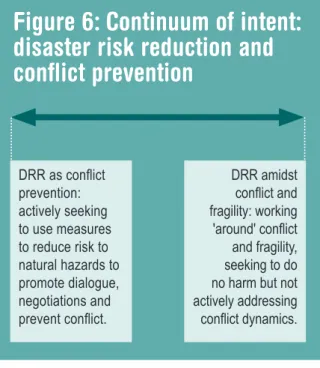
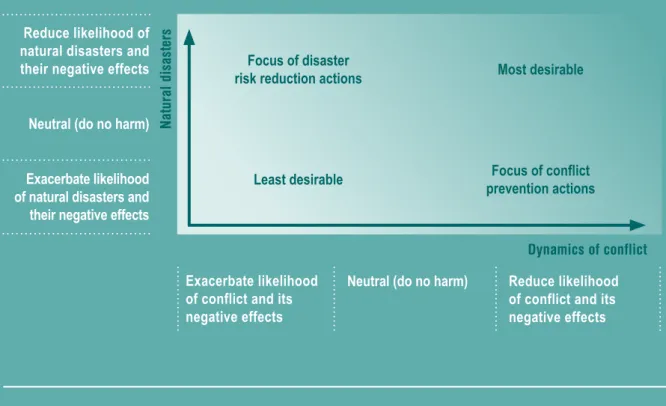
6: Continuum of intent: disaster risk reduction and conflict prevention 28 7: Characterisation of the relationship between actions to address natural disasters and conflict 38 8: Schematic to show how conceptual frameworks for natural disasters and conflict could evolve 38
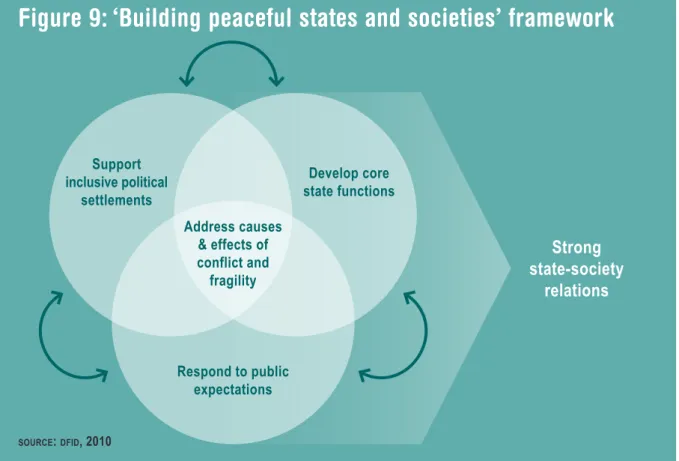
9: ‘Building peace states and societies’ framework 39
10: Adapted version of DFID’s ‘Building peaceful states and societies’ framework illustrating the ‘natural disaster’ 40 components of the peacebuilding and statebuilding agenda
11: Operationalising conflict sensitivity 40
12: Situating conflict within an adapted Pressure and Release Model 41
Boxes
1: Selected recent ‘natural’ disasters in fragile and conflict-affected states 5 2: Future trends shaping the conflict-natural disaster interface 5
3: Building resilience in Chad 18
4: Policy architecture for dealing with disaster risk 27
5: Building resilience in the Sahel region 29
6: The Nepal Risk Reduction Consortium – practical funding for resilience 29
7: Tearfund’s DRR work in Kandahar, Afghanistan 30
8: Disaster-conflict linkages and community based DRR in Karamoja 31
9: Reducing disaster risk in a fragile state – Nepal 33
10: Misconceptions among actors working to reduce risk to conflict and natural disasters 34
11: Assessing protection and livelihoods 34
Tables
1: Ranked list of countries demonstrating high levels of fragility, disaster risk, poverty and climate 9 change vulnerability
2: The practical implications of undertaking disaster risk management in fragile and conflict-affected states 20
Acronyms
DFID Department for International Development
DRR Disaster risk reduction
GFDRR Global Facility for Disaster Reduction and Recovery
HFA Hyogo Framework for Action
IFRC International Federation of Red Cross and Red Crescent Societies
LTTE Liberation Tigers of Tamil Eelam
OCHA UN Office for the Coordination of Humanitarian Affairs
UNDP United Nations Development Programme
Executive summary
In 2011, drought, and food and political insecurity in East Africa contributed to a full-scale
humanitarian crisis. A combination of natural hazards, conflict and fragility provided a recipe for human suffering. From 2005-2009, more than 50% of people affected by ‘natural’ disasters lived in fragile and conflict-affected states (Kellett and Sparks, 2012: 31).1
This convergence poses particular challenges for governments and agencies working to secure development progress and puts great strain on the international humanitarian system.2 With
poverty expected to be highly concentrated in fragile and conflict-affected states by 2025 (Kharas and Rogerson, 2012) and with many fragile and conflict-affected states still some way off meeting any of the Millennium Development Goals, the impetus for tackling conflict and disaster risk coherently in such settings is becoming a priority for both the development and humanitarian
communities. Without sufficient attention, hard-won development and security gains will be undone. This study assesses the evidence base for how natural disasters3 affect conflict, how conflict
affects natural disasters, and how people living in complex environments are affected by multiple risks. We also consider what can be learned from current practices to improve conflict prevention, statebuilding and disaster risk management in ways that help build resilience. The evidence base challenging: it is fragmented and contested, with a number of studies highlighting directly opposing lines of arguments. This suggests that the complexity of conflict and disaster dynamics can only be understood when grounded in specific contexts.
This report focuses on the links between conditions of vulnerability and risks associated with the nexus of natural disasters, conflict and fragility. However, it is recognised that any given context will be mired in an even more complex array of intersecting risks. Thus while there is a tendency to consider how one risk impacts another, our overarching focus is on advancing an understanding of how multiple vulnerabilities stack up for populations. ‘How disasters and conflict collide’ is an entry point to understanding how vulnerability is dynamic and shaped by interconnected shocks and stresses, and how it must be addressed as such.
The scale of the challenge
A number of high profile disasters in fragile and conflict-affected states have increased attention on the concurrence of disasters and conflict, and there is an expectation that disasters and conflict will coincide more in the future. Climate change, continued urbanisation, food price fluctuations, financial shocks and other stresses may all shape – and complicate – future trends in the disaster–conflict interface. Based on a rudimentary analysis, there appears to be a close association between the risk of mortality from drought, state fragility and climate change vulnerability. However, the intersection between mortality risk from other natural hazards (such as cyclones and earthquakes) and state fragility appears to be much less pronounced, though still significant. Somalia, Afghanistan and Niger are ranked high in a composite list of countries considered to be fragile and/ or conflict affected, with high disaster risk, high levels of poverty and high vulnerability to climate change.
The impact of natural disasters on conflict
Though the picture is far from clear, the balance of evidence suggests that natural disasters exacerbate pre-existing conflicts. There are only a limited number of cases where natural disasters have supported peacebuilding and led to the resolution of conflicts, such as Aceh.4 In every complex situation, numerous
interactions exist, where natural disasters reduce some conflict drivers while exacerbating others.
1. These figures refer specifically to definitions and sources from Development Initiatives’ work on conflict and the EM-DAT Centre for Research on the Epidemiology of Disasters’ work on disaster-affected persons.
2. Between 2007 and 2010 the UN consolidated appeals more than doubled, reaching $11.3 billion. In the context of growing protracted crises, global food crisis, economic crisis and increasing humanitarian needs, there was a reduction in the volume of needs met (Poole and Walmsley, 2012: 59). For example, a 58.3% increase in needs between 2007 and 2009 in Sudan, 88.7% increase in Occupied Palestinian Territories in 2009 due to the Gaza crisis, and 121.9% increase in Somalia in 2009 owing to drought, flooding and increase insecurity (Poole and Walmsley, 2012: 59).
3. It is widely recognised that disasters are not ‘natural’ but a product of a set of interactions between natural hazards, conditions of vulnerability, and socio-political-economic conditions. Although uncomfortable for the authors, the term is used here to differentiate natural-hazard related disasters from the conflict and fragility components of a ‘disaster’. For more on the paradigm shift towards recognising disasters not as a technical issue but as inherently ‘unnatural’, with vulnerability at the centre of the conceptual frame, see Wisner et al., 2004.
Grievances can be deepened by natural disasters that increase resource scarcity or cause more acute imbalances between areas of scarcity and abundance. Grievances can also increase with the unequal distribution of ex-post humanitarian aid or ex-ante preventative/protective measures by governments or other agencies. Weak government responses to natural disasters can also contribute to conflict. The disruption caused by natural disasters can present economic opportunities for criminal activity, while their impact on livelihoods can lead individuals to join armed groups. In some cases, though, good access to reconstruction aid can increase the opportunity cost of conflict.
This study also finds that political opportunities for engaging in conflict can arise when disasters create a smokescreen for advancing political or military objectives (such as increasing military spending, deploying troops to sensitive areas, or manipulating aid to some groups over others).
The feasibility of conflict can also be changed by natural disasters, either by strengthening or weakening one side in a conflict directly or through the appropriation of aid.
The impact of conflict and fragility on
‘natural’ disasters
There is strong evidence that conflict and fragility increase the impact of natural disasters, notably by increasing vulnerability to natural hazards. Conflict increases disaster risk by displacing people into areas more exposed to hazards and through the impacts it has on physical and psychological health, basic service provision and the security of liveli-hoods. Conflict can drive individuals to sell assets, which increases disaster risk. In a limited number of cases, individuals and groups can gain from con-flicts (through the so called ‘war economy’) in ways that increase their resilience to disasters.
This study finds that conflict can undermine the capacity of governmental and non-governmental actors to plan for and protect people against hazards – for example, by inhibiting the ability to provide basic early warning systems and to devise and enforce building codes.
Governments can also exacerbate post-disaster suf-fering by inhibiting aid on security grounds or appro-priating humanitarian aid to support conflict objectives.
Some countries refuse, delay or complicate interna-tional help, fearing it will undermine sovereignty. It is valuable to draw a distinction between fragile and conflict-affected states that are willing but unable, and those that are unwilling and unable to reduce the vulnerability of populations to disaster risks and impacts. Disaster risk management tends to assume a positive state-society ‘social contract’5
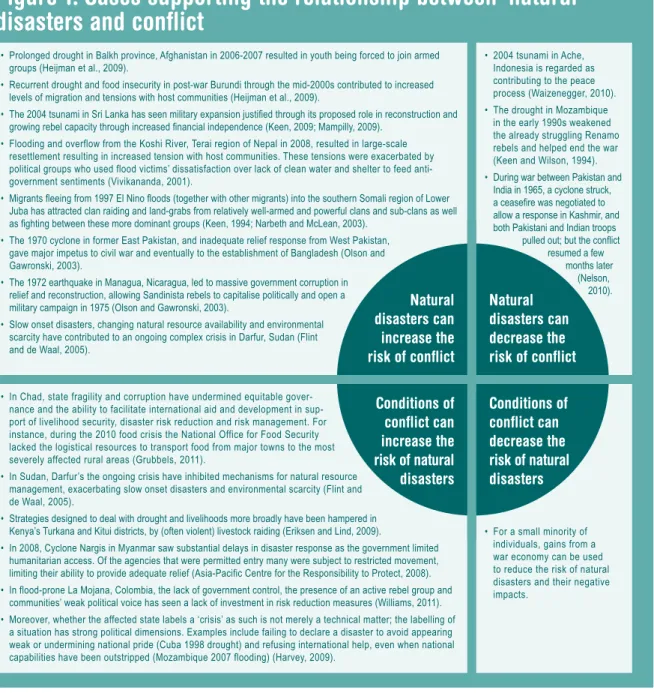
exists where the state adopts the management of risk as a public good. In some states this may be the case, but in others it is not. Figure 1 highlights the relationship between conflicts and natural disasters. The weight of evidence suggests a stronger leaning to the left quadrants of the circle.
Lessons from current efforts to
strengthen resilience
In both policy and practice, conflict prevention and disaster risk management are treated as discrete issues, with limited crossover of expertise or joint working. Misconceptions, different ‘languages’, and low levels of coordinated analysis and programming inhibit the potential for stronger collaboration. The resilience agenda is helping to improve links between humanitarian and development action and fostering stronger integration of risk management. While there are few well-documented examples of interventions that actively seek to integrate natural disaster risk reduction and conflict prevention, there does appear to be a growing realisation that managing disaster risk in fragile and conflict-affected states cannot be a matter of business-as-usual. Hard won peace dividends may be undermined unless natural disaster risk is taken seriously. The 2011 World Development Report warns not to expect too much too soon of national institutions: action to transform governance needs long-term investment and sustained support. Yet less than 4% of humanitarian aid and less than 1% of development assistance is spent on ex-ante disaster prevention, preparedness and risk reduction (Poole and Walmsley, 2012: 2). This severely constrains the potential for integrated risk management in fragile and conflict-affected states. While there are good reasons for not investing in ex-ante risk reduction in fragile situations
5. A dynamic agreement between the state and society on their mutual roles and responsibilities (Chandran and Jones, 2008: 17, in Harvey, 2009).
(e.g. corruption, lack of capacity and political will), not doing so makes little sense in the long term.
Towards a conceptual framework
Interventions aimed at reducing natural disaster risk can have positive or negative effects on the dynamics of conflict; conversely, interventions aimed at preventing conflict can have positive or negative effects on the likelihood and impact of natural disasters. The ideal scenario is to have interventions that reduce the likelihood of natural disasters and conflict. Disaster risk management should be integrated more systematically into peacebuilding and statebuilding frameworks. The reverse should also happen. Integrating conflict
and fragility into natural disaster frameworks can help elucidate the links between natural disasters and conflict. Greater cross-integration of frameworks will help encourage a transition from collision to collaboration between the two communities. Over time it will be necessary to devise integrated approaches to natural disaster and conflict risk through a conceptual framework. The joint framework should encourage accountability, learning, evidence-gathering, cross-organisational exchanges and should draw on conflict sensitivity and political economy analysis. It should aspire to understand the factors that produce vulnerability to disasters and conflict, as well as trade-offs and points of convergence where there is the most to gain.
Figure 1: Cases supporting the relationship between ‘natural’
disasters and conflict
• Prolonged drought in Balkh province, Afghanistan in 2006-2007 resulted in youth being forced to join armed groups (Heijman et al., 2009).
• Recurrent drought and food insecurity in post-war Burundi through the mid-2000s contributed to increased levels of migration and tensions with host communities (Heijman et al., 2009).
• The 2004 tsunami in Sri Lanka has seen military expansion justified through its proposed role in reconstruction and growing rebel capacity through increased financial independence (Keen, 2009; Mampilly, 2009).
• Flooding and overflow from the Koshi River, Terai region of Nepal in 2008, resulted in large-scale resettlement resulting in increased tension with host communities. These tensions were exacerbated by political groups who used flood victims’ dissatisfaction over lack of clean water and shelter to feed anti-government sentiments (Vivikananda, 2001).
• Migrants fleeing from 1997 El Nino floods (together with other migrants) into the southern Somali region of Lower Juba has attracted clan raiding and land-grabs from relatively well-armed and powerful clans and sub-clans as well as fighting between these more dominant groups (Keen, 1994; Narbeth and McLean, 2003).
• The 1970 cyclone in former East Pakistan, and inadequate relief response from West Pakistan, gave major impetus to civil war and eventually to the establishment of Bangladesh (Olson and Gawronski, 2003).
• The 1972 earthquake in Managua, Nicaragua, led to massive government corruption in relief and reconstruction, allowing Sandinista rebels to capitalise politically and open a military campaign in 1975 (Olson and Gawronski, 2003).
• Slow onset disasters, changing natural resource availability and environmental scarcity have contributed to an ongoing complex crisis in Darfur, Sudan (Flint and de Waal, 2005).
• 2004 tsunami in Ache, Indonesia is regarded as contributing to the peace process (Waizenegger, 2010). • The drought in Mozambique
in the early 1990s weakened the already struggling Renamo rebels and helped end the war (Keen and Wilson, 1994). • During war between Pakistan and
India in 1965, a cyclone struck, a ceasefire was negotiated to allow a response in Kashmir, and both Pakistani and Indian troops
pulled out; but the conflict resumed a few
months later (Nelson,
2010).
• For a small minority of individuals, gains from a war economy can be used to reduce the risk of natural disasters and their negative impacts.
• In Chad, state fragility and corruption have undermined equitable gover-nance and the ability to facilitate international aid and development in sup-port of livelihood security, disaster risk reduction and risk management. For instance, during the 2010 food crisis the National Office for Food Security lacked the logistical resources to transport food from major towns to the most severely affected rural areas (Grubbels, 2011).
• In Sudan, Darfur’s the ongoing crisis have inhibited mechanisms for natural resource management, exacerbating slow onset disasters and environmental scarcity (Flint and de Waal, 2005).
• Strategies designed to deal with drought and livelihoods more broadly have been hampered in Kenya’s Turkana and Kitui districts, by (often violent) livestock raiding (Eriksen and Lind, 2009).
• In 2008, Cyclone Nargis in Myanmar saw substantial delays in disaster response as the government limited humanitarian access. Of the agencies that were permitted entry many were subject to restricted movement, limiting their ability to provide adequate relief (Asia-Pacific Centre for the Responsibility to Protect, 2008). • In flood-prone La Mojana, Colombia, the lack of government control, the presence of an active rebel group and
communities’ weak political voice has seen a lack of investment in risk reduction measures (Williams, 2011). • Moreover, whether the affected state labels a ‘crisis’ as such is not merely a technical matter; the labelling of
a situation has strong political dimensions. Examples include failing to declare a disaster to avoid appearing weak or undermining national pride (Cuba 1998 drought) and refusing international help, even when national capabilities have been outstripped (Mozambique 2007 flooding) (Harvey, 2009).
Natural disasters can increase the risk of conflict
Natural disasters can decrease the risk of conflict
Conditions of conflict can increase the risk of natural disasters
Conditions of conflict can decrease the risk of natural disasters
Recommendations
International policy
In order to raise the profile of the conflict– disaster nexus in fragile and conflict-affected states, UN member states and international agencies should:
● Ensure that managing risk in fragile and conflict-affected states is a key feature of the post-2015 agreement on disaster risk reduction (Hyogo Framework 2) and that there are clear institutional mandates set to tackle this. The World Bank 2014 World Development Report
on risk, uncertainty and crisis should link back to the 2011 World Development Report on Conflict, Security and Development and set a new agenda for managing risks in fragile and conflict-affected states.
● Resilience, vulnerability, disaster and conflict should be featured themes of post-2015 development goals.
● The Political Champions for Disaster
Resilience Group should promote inter-agency co-ordination to build resilience in fragile and conflict-affected states, developing regional and national approaches to ex-ante risk management in such settings.
Programming and finance
● The Global Facility for Disaster Reduction and Recovery (GFDRR) should scale-up
programming in fragile and conflict-affected states and forge closer links with the conflict prevention work of the World Bank, such as the Global Centre on Conflict, Justice and Development. ● Bilateral donors and UN agencies should:
● Constitute joint risk taskforces in key fragile and conflict-affected states to integrate conflict, natural disaster and climate change practitioners, plans and programmes. ● Explore new partnerships and new ways
of working and build the evidence base about how to better invest in ex-ante risk management measures in fragile and conflict-affected states.
● Donors must be prepared to risk greater levels of up-stream investment in fragile and conflict-affected states.
● Donors and other financing bodies should work to ensure that short-term funding restrictions do not inhibit opportunities to build resilience. Where possible, multi-year funding should be the norm and the UN should look to expand the use of multi-year consolidated appeals.
● Civil society organisations and donors alike should invest in the capacities of programme staff in fragile and conflict-affected states to better link approaches to conflict, disasters and climate change. This may require training and new ways of formulating strategies and designing programmes. Donors, NGOs and other implementing agencies should develop
integrated monitoring and evaluation
frameworks for assessing needs, results, value for money and outcomes in fragile and conflict-affected states.
Research and evidence
We do not currently know how to measure the scale and nature of risk facing fragile and conflict-affected countries, nor do we know which interventions are likely to be most effective in managing risk and building resilience in these environments. Priorities for investment include to: ● Develop a multidimensional risk index which
integrates existing data on conflict and fragility, natural hazards, vulnerability, poverty and climate change. Ideally this should be detailed enough to consider sub-national areas and should include a process for weighting risk factors depending on the focus of different agencies. Monitoring changes to this index over time will help to highlight the co-dependency between different aspects of risk and
vulnerability and allow progress to be tracked and analysed.
● Develop and test conceptual frameworks and analytical tools. This should include modifying existing analytical tools (such as conflict sensitivity frameworks and statebuilding and peacebuilding frameworks) to reflect disaster risk and vice versa. This process could provide the model for more integrated risk modelling.
● Build the evidence base about what works in increasing resilience to multiple shocks and stresses in fragile and conflict-affected states.
Introduction
In 2011, drought, food and political insecurity in East Africa contributed to a full-scale humanitarian crisis. Like many other recent high profile disasters, a combination of natural hazards, insecurity, conflict and fragility provided a recipe for human suffering. From 2005-2009, more than 50% of people impacted by ‘natural’ disasters lived in fragile and conflict-affected states (Kellett and Sparks, 2012: 31).6 This
convergence poses particular challenges for agencies working to secure development progress in such environments and puts great strain on the international humanitarian system.7 While it is
widely acknowledged that more needs to be done to tackle the risk posed by disasters and conflict (e.g. World Bank, 2010), in practice as little as 1% of official development assistance was invested in reducing disaster risks between 2000 and 2010 (Kellett and Sparks, 2012: 10).
Fortunately, the link between natural disasters8
and conflict is receiving growing attention from researchers and development agencies (e.g. UNDP, 2011; Mitchell and Smith, 2011; Walch, 2010; DFID 2011b).9 These studies acknowledge
that the convergence of disasters and conflict significantly compounds their impacts, impairs recovery, and increases the risk of future crises. They call for action that addresses the impacts of disasters in a way that supports a country’s social and institutional fabric and its transition out of violence (Kostner and Meutia, 2011).
The problem is that the evidence for how conflict and disasters interrelate is fractured, highly context-specific and poorly understood (see Annex 1 for an assessment of the evidence base). Do conflicts necessarily predispose countries to vulnerability to natural disasters? And if so, how? Do natural disasters exacerbate or ameliorate conflicts? What evidence exists about efforts to tackle the causes of natural disasters and conflicts jointly? What does the evidence mean for the way stakeholders seek to achieve progress towards peace, stability and development in such contexts? This study seeks to answer these questions through a detailed review of the available evidence. In doing so, it summarises lessons, highlights complexity where it emerges, and details recommendations for strengthening resilience.
The study is structured as follows: Section 2 reviews the scale of the challenge by examining the extent to which conflict and natural disasters overlap and which countries are of most concern now and in the future. Section 3 looks at the evidence for how natural disasters affect conflict and fragility, before Section 4 examines the complementary question of how conflict and fragility affect resilience to natural disasters. Section 5 explores how the disaster–conflict interface might be understood conceptually and how the relationship between disaster risk management and conflict prevention might be strengthened. Section 6 reviews current practices and includes a set of case studies, and section 7 outlines recommendations for strengthening international policy, programming and finance and the current evidence base.
6. These figures refer specifically to definitions and sources from Development Initiatives’ work on conflict and the EM-DAT Centre for Research on the Epidemiology of Disasters’ work on disaster-affected persons.
7. Between 2007 and 2010 the UN consolidated appeals more than doubled, reaching $11.3 billion. In the context of growing protracted crises, global food crisis, economic crisis and increasing humanitarian needs, there was a reduction in the volume of needs met (Poole and Walmsley, 2012: 59). For example, a 58.3% increase in needs between 2007 and 2009 in Sudan, 88.7% increase in the Occupied Palestinian Territories in 2009 due to the Gaza crisis, and 121.9% increase in Somalia in 2009 owing to drought, flooding and increase insecurity (Poole and Walmsley, 2012: 59).
8. It is worth noting that the ‘natural’ part of natural disasters is a misnomer. Experts link the cause of disasters to vulnerable people living in locations exposed to natural hazards. Yet the ‘natural’ label remains in disasters discourse hence we have chosen to include the ‘natural’ element here so as to clarify the distinction between disasters associated with natural hazards and disasters associated with conflict. 9. Even the UK’s Building Stability Overseas Strategy (DFID, FCO
& MoD, 2011) includes a reference to the relationship between conflicts and disasters stating that conflict-affected environments are more affected by natural disasters.
The challenge
This section examines the scale of the challenge by
reviewing the evidence about the extent to which
natural disasters, fragility and conflict overlap.
2
A number of high-profile disasters from the last five years are widely understood to have been shaped by conflict, fragility and insecurity (Box 1). Between 1999 and 2004, 140 disasters associated with natural hazards were in contexts affected by complex political emergencies (Buchanan-Smith and Christoplos, 2004). And as noted above, the number of people affected by disasters in fragile and conflict-affected states appears to be disproportionately high.10
This phenomenon of intersecting disaster-conflicts has already received increased policy attention. The 2011 Humanitarian Emergency Response Review highlighted how multiple risks are driving ever-increasing demands on humanitarian capacity, arguing that current approaches to managing emergencies are unsustainable (DFID, 2011a). The 2011 World Development Report included ‘natural disaster deaths’ as a key indicator of overall security concerns. Analyses like these are driving the demand for a better understanding of future trends in the conflict–natural disaster interface (see Box 2).
The hard data currently available on the co-location of disasters and conflict is limited in quantity and somewhat contested. This is partly to do with the quality of the available datasets, the way environmental stresses are analysed, and the challenges of reporting and accurately recording situations where natural disasters and conflict intersect. For example, disentangling the hydro-meteorological, conflict, vulnerability and capacity-related causes of famine or flooding is notoriously difficult and there is certainly no consistency in reporting.
A few studies have reviewed the correlation between conflict and disasters. With a small sample over a short time period, Drury and Olson (1997, 1998) find a significant relationship between natural disasters and political unrest, identifying the key variables as insufficient and inequitable government responses and the
Summary
A number of high profile disasters in fragile and conflict-affected states have
increased the attention being paid to how disasters and conflict collide, though
systematic analysis is limited and sometimes contested.
The evidence that does exist
points to disasters and conflict coinciding more in the future. Climate change, urbanisation,
food price fluctuations, financial shocks and other stresses may all shape – and complicate
– future trends in the disaster–conflict interface.
A rudimentary analysis of indicies suggests a concurrence between drought
mortality risk, state fragility and climate change vulnerability.
However, the
intersection between mortality risk from other natural hazards (such as earthquakes and
cyclones) and state fragility appears to be much less pronounced, though still significant in
certain locations.
Somalia, Afghanistan and Niger are ranked high in a composite list developed
for this report of countries considered to be fragile and/or conflict-affected, with
high disaster risk, high levels of poverty and high levels of vulnerability to climate
change
. Such rankings, it must be noted, can only provide indicative guidance owing to the
difficulty of combining data sets and the shortcomings those data sets contain.
10. See the figures cited earlier for 2005-2009 (Kellett and Sparks, 2012: 31).
Box 1: Selected recent
‘natural’ disasters in fragile
and conflict-affected states
● The relief effort following the 2004 tsunami that hit Aceh, Indonesia is widely
documented as an example of ‘disaster diplomacy’, where the disaster created space for negotiation and assisted the peace process.
● Cyclone Nargis which hit Burma in 2008, illustrated the challenges of humanitarian response being delayed by restricted access, which was complicated by the concerns of international actors about cooperating with the Burmese leadership on account of their human rights violations.
● The 2010 Haiti earthquake raised questions about the lack of disaster preparedness in contexts mired by sexual violence, poverty, weak institutions and poor governance.
● Widespread flooding across Pakistan in 2010-2011 raised international concerns about the role of non-state actors, insurgents and the (political) security implications of disaster relief.
● In 2011, predicted drought and food insecurity in East Africa developed into a full-scale humanitarian crisis accentuated by political insecurity.
Box 2: Future trends
shaping the conflict-natural
disaster interface
What will drive changes in the relationship between conflict and natural disasters in the future? While there is a growing interest in the way climate change will shape conflict (see Annex C) and have an impact on natural disasters, the combination of all three factors is rarely discussed. Similarly, differing analyses of where the poor will be located in the coming decades (Sumner, 2012; Kharas and Rogerson, 2012) have not fully considered the co-location of conflict and natural
disasters. We know that the conflict–natural disasters interface will not remain static: we can be sure that changing settlement patterns, migration, urbanisation and changes to socio-economic conditions will all affect underlying exposure and vulnerability (IPCC, 2012: 5). Moreover, the World Development Report 2011 (World Bank, 2011: 17) finds that ‘multiple stresses raise the risks of violence’ and a combination of economic, political and security actors – both internal and external to the given context – have a role to play. These stresses, and the future trends associated with them, often paint a bleak picture: climate change, financial shocks (particularly in relation to food price fluctuations), youth unemployment, inequity and injustice, criminal networks, rapid urbanisation and the growth of megacities, informal settlements and inadequate land management (World Bank, 2011; IPCC, 2012). Migration is likely to be an important factor shaping future trends. In 2010, 42 million people were displaced by natural hazards, up from 17 million in 2009 (Foresight, 2011: 6). One particular area of concern in this regard is the existence of ‘trapped populations’ unable to move from vulnerable locations the IPCC (2012) deems potentially unfit to live and work in in the future. Somalia is one such example: pastoralists are unable to follow traditional or alternative migratory routes to escape drought due to armed conflict, and humanitarian access is severely restricted.
severity of the disaster. Miguel, Stayanath, and Sergenti’s statistical analysis (2004) concludes that droughts increase civil war in Africa. Berebi and Ostwald’s study of 167 countries (2011) finds that natural disasters create vulnerabilities in state-society relationships that can be exploited by rebel groups. Nel and Righarts (2008) find that natural disasters significantly increase the risk of violent civil conflict in the short and medium term in low and middle income countries that have high inequality and sluggish economic growth.11
In contrast to other studies, however, they found that the severity of the disaster was relatively unimportant in terms of the impact on security. This has been contested by Slettebak (2012) on the ground of technical inaccuracies. Slettebak concludes that the analysis should show that countries experiencing disasters in the same or the previous year are less likely to have an outbreak of civil conflict; he therefore cautions international agencies and other actors against automatically prioritising security concerns in the post-disaster period.
There is another wave of research looking at sub-national patterns of conflict and disasters (see Buhaug and Lujala, 2005; Buhaug and Rød, 2006; Raleigh and Urdal, 2007). While these present a more nuanced picture than national level studies, they have been criticised for assuming that the effect of local environmental conditions are limited to the immediate area, whereas migration muddies this picture (Hendrix and Salehya, 2012). Hendrix and Salehya (2012: 35) find that very high and very low rainfall years are associated positively with violent events such as cross-border and inter-communal violence.
2.1 Combining indices
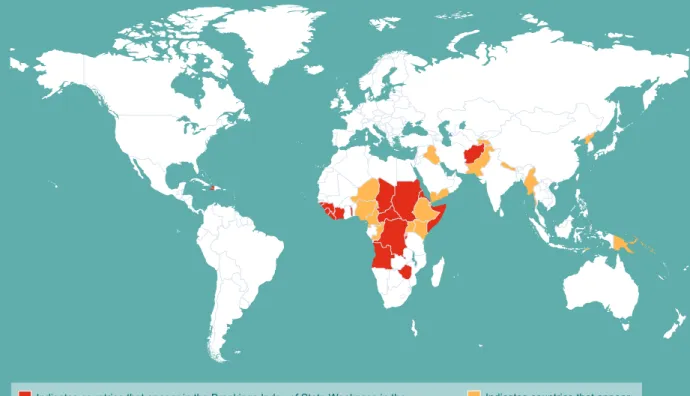
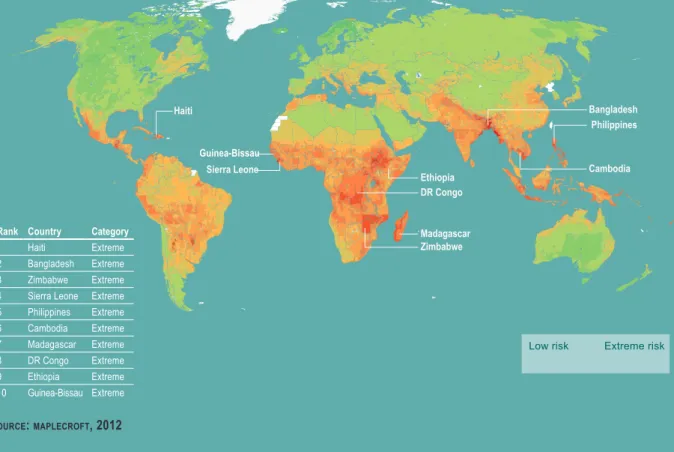
To demonstrate the way risks intersect, figures 2-5 illustrate the global picture of different types of risk. Figure 2 highlights the distribution of failed states, as indicated by Foreign Policy’s (2012) Failed States Index 2012. Figure 3 is the World Bank’s (2005) map of global drought mortality risk. Figure 4 is Maplecroft’s (2012) Climate Change Vulnerability Index 2013. Figure 5 is UNISDR’s (2009) map of global mortality risk from earthquakes, cyclones, floods and landslides. These maps appear to show a high level of concurrence of fragility, climate change vulnerability and drought mortality risk. There is less concurrence, however, when considering mortality risk associated with other natural hazards. This observation is cautioned with a number of caveats, including the fact that mortality risk does not represent impacts on livelihoods or morbidity, that some of the indicators used to create the indices are repeated, and that the indices themselves are highly contested. More work is needed to statistically analyse the geographic relationship between disaster, conflict and climate change risks.
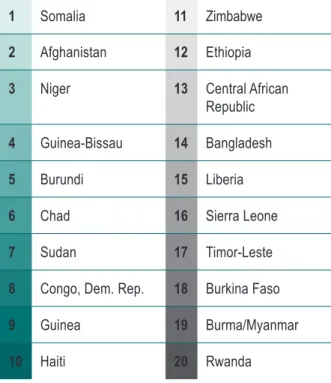
While acknowledging these caveats, indices can be overlaid to create a list of countries that are considered fragile, vulnerable to climate change, have high levels of poverty, and are at high risk of natural disasters. Table 1 uses the Failed States Index 2012 (Foreign Policy, 2012), the UNU-EHS World Risk Report 2011 (UNU-EHS, 2011), the OPHI Multidimensional Poverty Index 2011 (OPHI, 2011) and the CGD Climate Change Vulnerability Index 2011 (CGD, 2011). Data for some countries is missing, which skews the outcome to some degree (for example, there is not enough data to include South Sudan).
11. Based on analysis of 187 political units with populations larger than 150,000.
Figure 3: Global Distribution of Drought Risk - Mortality
source: worldbank, 2005 1st - 4th
Risk deciles Drought mortality
5th - 7th 8th - 10th
Figure 2: Fragile and conflict-affected states, an aggregated list
source: originalmapbasedonsourcematerialfromoecd, 2010 insumner, 2010
Indicates countries that appear in one or two (but not all three) of the lists outlined above. Indicates countries that appear in the Brookings Index of State Weakness in the
Developing World, Carleton University Country Indicators for Foreign Policy project, and the World Bank’s Country Policy and Institutional Assessments List (in Sumner, 2010).
Figure 4: Climate Change Vulnerability Index 2013
source: maplecroft, 2012
Figure 5: Global distribution of multiple hazards mortality risk
source: unisdr, 2009
Sierra Leone
Guinea-Bissau
Bangladesh Philippines Cambodia
Zimbabwe Madagascar DR Congo Ethiopia Haiti
Low risk Extreme risk
Rank Country Category 1 Haiti Extreme 2 Bangladesh Extreme 3 Zimbabwe Extreme 4 Sierra Leone Extreme 5 Philippines Extreme 6 Cambodia Extreme 7 Madagascar Extreme 8 DR Congo Extreme 9 Ethiopia Extreme 10 Guinea-Bissau Extreme
10 High Tropical cyclones, floods, earthquakes, landslides
Multi-risk
9 8 7 6 5 4 3 2 1 Low
0 Unknown exposure
The OCHA Global Focus Model12 is another
useful illustration, systematically analysing natural hazard and conflict risks. Yet as Lawry-White (2012: 15) highlights, while other models of risk exist, the tendency to focus on natural disaster risk and leave out ‘conflict’ means the results often bear little comparison. For example, while the UNU World Risk Index criteria may not sound markedly different to OCHA’s Global Focus Model, only one country appears in the top 20 of both lists; similarly, of the World Bank GFDRR’s 31 focus countries only 4 appear in the top 20 of the Global Focus Model. It is interesting to note that of the 20 countries listed in Table 1, all except Timor-Leste appear in the top 50 countries of OCHA’s Global Focus Model.
Table 1: Ranked list of countries
demonstrating high levels of fragility,
disaster risk, poverty and climate
change vulnerability
131 Somalia 11 Zimbabwe
2 Afghanistan 12 Ethiopia
3 Niger 13 Central African
Republic
4 Guinea-Bissau 14 Bangladesh
5 Burundi 15 Liberia
6 Chad 16 Sierra Leone
7 Sudan 17 Timor-Leste
8 Congo, Dem. Rep. 18 Burkina Faso
9 Guinea 19 Burma/Myanmar
10 Haiti 20 Rwanda
12. For OCHA, data is analysed in four areas: hazards, vulnerability, capacity and demand for humanitarian coordination support. 13. The ranking has been produced by combining data from the
Failed States Index 2012, the UNU-EHS World Risk Report 2011, the OHPI Multidimensional Poverty Index 2011 and the CGD Climate Change Vulnerability Index 2011. The Failed States Index was given additional weighting, so represented 2/5 of the outcome, to adjust for the fragile and conflict-affected states focus of this analysis and to balance the other three indices (of which the CGD index also includes extreme event vulnerability). The indices were chosen on the basis of data accessibility and the fact that The World Risk Report includes drought as a measure – many others do not.
The impact of
natural disasters
on conflict
This section examines the evidence for how natural disasters
affect conflict and fragility. The evidence is organised around
three drivers of conflict – grievances, opportunities and
feasibility – commonly used in peacebuilding and statebuilding
frameworks (DFID, 2010). Further details of the analytical
framework employed here are found in Annex 2.
espenrasmussen / panos
Summary
On balance, the evidence suggests that natural disasters exacerbate pre-existing
conflicts by contributing to
grievances, opportunities and feasibility
. There are
a limited number of cases where natural disasters have supported peacebuilding and
led to the resolution of conflicts. More often, natural disasters reduce some conflict
drivers while exacerbating others. Detailed empirical analysis is required in each case
to understand the net impact.
Grievances can be deepened by natural disasters causing greater resource
scarcity or more acute imbalances between areas of scarcity and abundance
.
However, areas with longstanding experience of droughts and floods have shown that
local institutions can mediate effectively and reduce tensions when periodic resource
scarcity occurs.
Grievances can also increase in intensity through the unequal distribution of
ex-post humanitarian aid or ex-ante protective assets by governments, international
agencies or non-state actors
. Weak government responses can also contribute to
conflict. In a few cases, a combination of factors have led to ‘disaster diplomacy’,
where disasters have created opportunities for dialogue between opposing parties –
Aceh in 2004-2005 is a celebrated (and much debated) case.
The disruption caused by natural disasters can present economic opportunities
for criminal activity or lead individuals to join armed groups
. In some cases,
however, a lack of post-disaster economic opportunities can reduce violence, and
access to reconstruction aid can increase the opportunity cost of conflict.
Disasters can create opportunities for advancing military objectives
. Military
spending might be increased or troops might be deployed to sensitive areas in the
name of disaster management. International responses to disaster may also create
political opportunities for increased conflict when humanitarian aid is manipulated.
On the other hand there are cases where military activity is deemed politically
inappropriate when natural disasters have adversely affected rival groups.
The feasibility of conflict can be affected by natural disasters, either because
one side in a conflict is weakened or strengthened or because aid is being
appropriated
. New balances of power may imply either a reduction or exacerbation
of conflict, depending on the circumstances. Moreover, labelling complex political
emergencies as natural disasters may help to draw attention away from underlying
conflict-related causes of humanitarian crisis and provide cover for human rights abuses.
3.1 Grievances
There is a substantial body of evidence suggesting that natural disasters ignite or exacerbate conflict by deepening grievances. More limited evidence highlights that natural disasters can also affect grievances in ways that help to ameliorate conflict. Most of the evidence relates to resource scarcity and to formal responses to shocks and stresses.
Natural resource and environmental
scarcity
Some research suggests that environmental changes associated with natural disasters can fuel armed conflict by increasing migration and undermining the economy (notably agriculture) by fuelling tensions within and between communities, and by weakening institutions (particularly state institutions charged with promoting security, health and education) (Homer-Dixon & Blitt, 1998; Kahl, 2006). It has also been argued that environmental scarcity exacerbates the likelihood of civil conflict through increased competition over scarce natural resources (Homer-Dixon, 1991, 1999; Kahl, 2006; Peluso and Watts, 2001). Natural disasters associated with drought are often singled out. Conditions of drought can increase tensions over natural resources, leading to confrontation between different land users (i.e. farmers and pastoralists). Such tensions are often exploited or exacerbated by governments seeking to gain political advantages (Flint and de Waal, 2005). Groups or individuals who have experienced a major ‘squeeze’ on their livelihoods (e.g. as a result of climatic change, discrimination or violence) are more likely to be recruited into violent processes, which can further jeopardise the livelihoods of others (Keen, 1994; Young et al., 2009). In post-war Burundi, recurrent drought and food insecurity, coupled with uneven food distribution, have led to violence between migrants and host communities over access to land (Heijman et al., 2009).
The notion that natural disasters generate conflict by making resources scarce has intuitive appeal. Yet a number of studies have portrayed a more complex reality (de Soysa, 2002a, 2002b; Urdal, 2005). Hendrix and Saleyha (2012) suggest that where grievances and resource competition do lead to conflict, this is likely to be relatively
disorganised violence that does not tend to involve the state. Another study found that in poor countries a shortage of land, pasture and renewable (non-mineral) resources was associated with lower levels of armed conflict (de Soysa, 2002a, 2002b) – one rationale being that, under these conditions, local institutions have adapted to effectively deal with issues of scarcity. Research in the West African Sahel has suggested that resource conflicts may be kept in check by traditional conflict resolution institutions that have evolved over generations (Nyong et al., 2006). Lind has noted that local-level ‘arrangements to share control and use of resources in some contexts can serve as the foundation for a broader peace between competing groups’ (2003: 317).
Other evidence suggests it is not simply resource scarcity that drives conflict, but some combination of scarcity and abundance. Fertile and resource-rich areas may attract conflict, raiding or quasi-legal attempts at expropriation from outsiders, including groups that occupy less well-endowed areas but perhaps have superior access to arms or political power (Keen, 1994). Such dynamics may be accentuated by a natural disaster that creates an even greater imbalance between areas of scarcity and abundance (Keen, 1994). Southern Somalia, for example, has persistently been subject to famine despite having many fertile areas – in part because these areas attract interest from violent groups who often inhabit less fertile areas. The southern Somali region of Lower Juba has not only attracted large numbers of migrants (including those fleeing the 1997 El Nino floods) due to its relative fertility, but has also attracted clan raiding, land grabs and skirmishes between relatively well-armed and powerful clans and sub-clans (Keen, 1994; Narbeth and McLean, 2003). In some cases governments have initiated forced resettlement schemes on the basis of questionable claims that areas are ‘ecologically unsustainable’ or too exposed to natural hazards. Keen (1994) highlighted this in the 1980s in Ethiopia, where people were moved from Eritrea and Tigray, sowing the seeds of new grievances. Eriksen and Lind’s work on the Turkana region of Kenya found that conflict is far from inevitable in ‘marginal’ areas: carefully managed borehole access can reduce conflict over water and grazing resources (2009: 28). Where conflict did
occur in Turkana, there appeared to be complex patronage by powerful government officials rather than more straightforward inter-communal violence over scarce resources (ibid.).
Resource allocation pre- and
post-disaster
The impact natural disasters have on conflict and stability can depend on the way a government responds (Olson and Gawronski, 2003), or how it has invested in disaster preparedness or
prevention (Cohen and Werker, 2008; Oliver-Smith, 1996). Grievances have increased when natural disasters have been met with a weak or corrupt government response (Olson and Gawronski, 2003; Olson and Drury, 1997). For example, a cyclone in East Pakistan in 1970 was met with a poor relief response from West Pakistan and half a million people died, giving a major impetus to civil war (Olson and Gawronski, 2003).
In Nicaragua, there was massive government corruption in relief and reconstruction following the earthquake of 1972 (Olson and Gawronski, 2003). This allowed the Sandinista rebels to capitalise politically and begin a military campaign in 1975 (ibid.). After the 2005 Pakistan earthquake, a slow government response
opened space for independent Islamic aid agencies to provide relief and criticise the government for its failings (ibid.). Walsh found that areas receiving this relief saw a growth in anti-governmental Pakistani nationalism (2005, in Nelson, 2010: 162).
Natural disasters can often exacerbate existing inequalities in access to government services (Albala-Bertrand, 1993; Cuny, 1983) or further accentuate such inequalities in ways that help to spur political change (Cuny, 1983; Birkmann et al., 2010). Political commentators such as Klein (2007) have also noted that natural disasters have been used as an opportunity for governments to seize valuable land for reconstruction, removing the disaster affected population and appropriating their assets. Evidence also suggests that government action following natural disasters can sometimes create a climate of empathy that helps to resolve conflict (Quarantelli and Dynes, 1976; Kelman 2012; Brancati, 2007; Nelson, 2010; Slettebak, 2012). The most celebrated – and
debated – of such cases is the impact of the 2004 South Asia tsunami on the conflict in Aceh, Indonesia. Waizenegger and Hyndman (2010: 795) note that in the immediate aftermath of the tsunami Aceh’s secessionist Free Aceh Movement committed to a unilateral ceasefire and the Indonesian military was instructed to exercise restraint while relief operations were being carried out. Waizenegger and Hyndman (2010: 794) also suggest that the relief and reconstruction processes opened the region up to international audiences, ending the government-imposed isolation and invisibility (ibid.: 794). The majority of their informants maintained that, without the tsunami, conflict would have gone on for years. Other studies, though, play down the relative importance of the tsunami for bringing about peace, arguing dialogue between the conflict parties pre-dated the tsunami (as did the drafting of a peace agreement) and that a change in government in Jakarta was more significant (Fan, forthcoming). While there are a handful of ‘disaster diplomacy’ cases, reconciliation following a disaster can easily be thrown off course. Akcinaroglu et al. (2011) find that disasters can catalyse peacemaking between rival states in the short term, but that this is easily derailed by inter-communal violence and low level cross-border conflict (see also Evin, 2004; Nelson, 2010: 167-168).
International aid responses can also exacerbate grievances, where actors in the conflict perceive that there is unequal distribution of resources (e.g. Buchanan-Smith and Christoplos, 2004; Waizenegger and Hyndman, 2010). Significant steps have been taken however, to increase the use of conflict sensitivity tools in humanitarian responses in complex political settings
(Zicherman et al., 2011). Most agencies adhere to humanitarian codes and guidelines and value broad inclusion in all stages of disaster risk reduction (DRR) (Sphere, 2004).
3.2 Opportunities
Natural disasters play a role in creating and shaping economic and political opportunities which, if seized, can lead to violence.
Economic opportunities
Natural disasters can affect the distribution of economic resources, encourage the appropriation of resources by some groups, and present opportunities for criminal activities which can lead to violence. For example, in 2006-2007, drought in Afghanistan’s northern Balkh region forced downstream villagers to look for new livelihood opportunities, which for some young men meant joining armed groups (Heijman et al., 2009). The conditions of drought were exacerbated by the unequal distribution of water rights by elites following the fall of the Taliban rule in 2001 (Heijman et al., 2009: 34). Furthermore, diminished economic opportunities during a natural disaster can lead to a state relying on violence to sustain itself.14 In Sudan, a combination of drought,
economic crisis and rising international debt from the 1980s onwards arguably encouraged the government in Khartoum to support militia raiding against the south that was designed, in large part, to secure access to its oil (Keen, 1994). In other examples, increased resource flows into a country for reconstruction can incentivise different forms of violence. For example, Waizenegger and Hyndman (2010: 800) note that in Aceh ‘an abundance of tsunami aid is easy prey for many former combatants in an environment with low legal enforcement’. Moreover, local tensions have been raised by the perception that more has been done for tsunami ‘survivors’ than for ex-rebels and their families, while in reality many people have been left with little or nothing (ibid.).
Conversely, the economic opportunities
associated with violence may actually be reduced when a natural hazard means that there is less to steal – as when crops wither or the death of livestock reduces the quantity of livestock that can be raided.15 Equally, a substantial
reconstruction effort after a disaster (whether natural or not) may increase the ‘opportunity cost’ of going to war (Collier, 2003).
Political opportunities
A natural disaster, and the international response to that disaster, can create political opportunities which may lead to increased conflict. In Sri Lanka, a perceived threat to sovereignty from tsunami relief operations created significant political opportunities for nationalist parties and helped Mahinda Rajapaksa win the
presidency (Kleinfeld, 2007; Le Billon and Waizenegger, 2007). International aid agencies faced considerable difficulty and outright Sri Lankan government intimidation when they tried to report on the extent of the humanitarian crisis, especially during the military 'end game' against the Liberation Tigers of Tamil Eelam (LTTE) in 2009 (Keen, 2009). The rather chaotic international response to the tsunami16 contributed to
tense relations between aid agencies and Colombo, adding to the difficulties of responding to conflict-related emergencies thereafter.17 In some contexts, the state’s
role in addressing disasters and reconstruction might legitimise sustaining a large military.18 In Sri Lanka, the
military has justified its expansion after the war through its proposed role in reconstruction.19
Disaster relief can be seized as a political opportunity to exercise power and ‘can easily be used as a political tool by manipulating distribution and redirecting relief in ways that reward supporters and punish opponents’ (Williams, 2011: 17).
Francken et al. (2008) argue this was the case in Madagascar where communities supportive of the president in the 2001 elections were 65% more likely to receive relief following Cyclone Gafilo in 2004. A more extensively documented case is the repeated manipulation of food aid by the Sudanese government (Keen, 1994; Flint and de Waal, 2005). On the other hand, natural disasters might reduce the political opportunities arising from conflict. For example, a wave of public sympathy for the victims of a disaster might make it politically disadvantageous to wage war on them (Kelman, 2012). There seems to have been an element of this in Aceh after the 2004 tsunami.20
14. David Keen, independent analysis for this report. 15. Ibid.
16. See, for example, Tsunami Evaluation Coalition, 2007. 17. David Keen, independent analysis for this report.
18. Internationally, humanitarian missions arguably became part of the justification for maintaining high military spending in the West after the Cold War (David Keen, independent analysis for this report.). 19. David Keen, independent analysis for this report.
20. Ibid.
3.3 Feasibility
As with grievances and opportunities, the feasibility of violence is shaped by natural disasters in different ways.
Natural disasters may make insurrection easier by weakening or distracting the government apparatus or strengthening the legitimacy of rebel groups. As Nel and Righarts (2008: 162) have noted, ‘natural disasters can weaken state capacity and legitimacy, creating opportunities for the disgruntled to engage in violent resistance’. In the aftermath of floods in Pakistan in 2010, militant groups reportedly used the disruption to carry out attacks (Abbas, 2010; Waraich, 2010). Mampilly’s study of Sri Lanka’s LTTE rebels suggested: ‘Following the [2004 tsunami] disaster, the LTTE’s expansion of its governance capacity brought it greater international respect and financial resources, convincing rebel leaders that operationally, de facto secession was viable. … In essence, what the tsunami did was to break the delicate financial dependency of the insurgents on the Sri Lankan state’ (2009: 316).
Studies suggest that during the famine of 1984-1985 the Ethiopian government was able to use relief aid to fund the war (Keller, 1992). Relief supplies were used to pay soldiers and militia and to lure people into locations where they were recruited into the military or subjected to forcible resettlement (Keller, 1992; Africa Watch, 1991). When national and international actors labelled the complex crisis a ‘drought’, this contributed to the impunity of the government forces who were at once actively fuelling conflict and humanitarian disaster.21
In Sudan in the 1980s and 1990s, drought similarly served as cover for government-sponsored violence, and again the label ‘drought-induced famine’ was sometimes accepted internationally. In 1994, international assistance in response to the Rwandan genocide was focused primarily on the relief of hunger and a cholera epidemic among those who fled to eastern Zaire; again, there was a tendency to treat a man-made disaster as if it were a natural disaster, and the human rights abuses underpinning the crisis went largely unaddressed (Eriksson et al., 1996). In 2011-2012, the tendency to label the humanitarian crisis in the Horn of Africa a ‘drought’ distracted attention from some of the underlying processes of violence that were creating famine, particularly in Somalia (Keen, 2012).
Enia (2008) suggests that evidence for how natural disasters change the feasibility of conflict is ambiguous. Insurgents and governments can use natural disasters to strengthen their own position and this can lead to an escalation of violence or to its diminution and cessation (Enia, 2008). For example, natural disasters can speed up or slow down a war depending on the overarching trajectory of conflict (ibid.). If rebels are losing and are further weakened by a natural disaster, then the war is likely to be shortened (Keen and Wilson, 1994). The drought in Mozambique in the early 1990s, for instance, appears to have weakened the already struggling Renamo rebels and helped to end the war (Keen and Wilson, 1994).
This section has underlined the need to
conceptualise vulnerability as a dynamic process and understand how different vulnerabilities intersect. In contrast to conventional approaches to measuring vulnerability to natural hazards, which tend to focus on a single hazard over a discrete period of time, more research is needed to understand how vulnerability changes before, during and after disaster events (Birkmann, 2008). Vulnerability assessments which
account for such changes would help inform our understanding of the role of natural hazards in dynamics of violence, conflict and fragility.
21. Ibid. 22. Ibid.
The impact
of conflict on
natural disasters
This section considers the evidence about how conflict
and fragility affect people’s resilience to natural hazards,
and explores the question: Does conflict make people
more or less exposed and vulnerable to natural hazards?
espenrasmussen / panos