THE IMPACT OF NON-NUTRITIVE SUCKING HABITS ON THE RISK FOR SLEEP DISORDERED BREATHING IN CHILDREN
Tanya Al-Talib
A thesis submitted to the faculty at the University of North Carolina at Chapel Hill in partial fulfillment of the requirements for the degree of Master of Science in the School of Dentistry
(Orthodontics).
Chapel Hill 2015
ABSTRACT
Tanya Al-Talib: Impact of non-nutritive sucking habits on the risk for sleep disordered breathing in children
(Under the direction of Lorne D. Koroluk)
Introduction: Sleep disordered breathing (SDB) is common in children and commonly
ACKNOWLEDGEMENTS
Thank you to my mentor Dr. Lorne Koroluk, and committee members Dr. William F. Vann, and Dr. Ceib Phillips, for your expertise, guidance, and advice throughout my project. Thank you to Doctors Drake, Vaughn, Roth and all of the sleep lab technicians for your
Assistance in the process. Thank you to Dr. Ceib Phillips for your help in the statistical analysis. Thank you to my husband Omar, two children Dunia and Ethar, my parents, and brother for your love and support through this journey. Thank you to my research assistants Rebekah
TABLE OF CONTENTS
LIST OF TABLES ... vii
LIST OF FIGURES ... viii
SLEEP DISORDERED BREATHING ...9
Introduction and Prevalence ...9
Sleep disordered breathing diagnosis...10
Health sequelae of sleep disordered breathing...11
Sleep disordered breathing risk reduction...14
Sleep disordered breathing treatment...15
NON-NUTRITIVE SUCKING HABITS ...16
Prevalence ...16
Conclusion ...17
References ...19
THE IMPACT OF NON-NUTRITICE SUCKING HABIT ON THE RISK FOR SDB ...21
Abstract ...21
Introduction ...21
Materials and method ...24
Patient recruiting ...24
Pediatric sleep questionnaire...24
Analytical Strategy...25
Results ...25
Discussion ...28
Limitations ...31
Conclusions ...32
Questionnaire ...36
Risk listing ...40
LIST OF TABLES
Table 1 - Prevalence of SDB in children ...9
Table 2 - Diagnosis of SDB in children ...10
Table 3 - Risk factors of SDB in children...12
Table 4 - SDB predisposing factors ...13
Table 5 - Treatment of SDB in children ...16
Table 6 – Descriptive Statistics ...28
Table 7 – Bivariate Analysis ...28
LIST OF FIGURES
SLEEP DISORDERED BREATHING
Introduction and Prevalence
Sleep disordered breathing (SDB) is a group of conditions characterized by breathing difficulties while sleeping. Obstructive sleep apnea (OSA) is the most common of these disorders [1] and is defined as the presence of repeated episodes of complete or partial airway obstruction which may be associated with loud snoring and daytime sleepiness. Prevalence estimates of OSA in the adult population suggest that 9% of females and 24% of males are affected. [2] In children, the prevalence is estimated to be 1-10%,(8) but depending on diagnostic criteria used, may also be as high as 25%.[3] Bixler and colleagues reported that 15.5% of the children in their epidemiologic study had primary snore, 25% of children had mild apnea with an apnea/
hypopnea index (AHI) of greater or equal to one but less than 5 and 1.2% had moderate apnea with an AHI of greater than 5. [3]
Table1 Prevalence of SDB in children. [3]
Total Sample None Primary snore 1< AHI < 5 AHI> 5 (N=700) 58.3%(54.7,
62.0)[409] 15.5%(12.9, 18.3) [108] 25.0% (21.9, 28.3) [175] 1.2% (0.6,2.2) [8] Age (years)
5-8(N=306) 59.5% (53.9, 64.8) [182] 16.0% (12.3, 20.5) [49] 24.3% (19.7, 29.3) [74] 0.2% (0.1, 1.8) [1] 9-12 (N=394) 57.5% (52.7, 62.4)
[227] 15.0% (11.7, 18.8) [59] 25.5% (21.6, 30.2) [101] 2.0% (0.9, 3.6) [7] BMI percentile
<85 (N=497) 62.6% (58.2, 66.7) [113] 14.5% (11.7, 17.9) [72 22.3% (18.9, 26.2) [111] 0.6% (0.2, 1.8) [3] >=85< 95(n=102)
53.8% (44.3, 63.3) [55]
12.8% (7.6, 20.6) [13]
31.4% (23.2, 40.9) [32]
>= 95(N=101) 42.0% (33.3, 52.3) [43]
22.8% (15.7, 31.9) [23]
32.0% (23.4, 41.3) [32]
3.2% (1.1, 8.4) [3]
Sleep disordered breathing diagnosis:
The gold standard for diagnosing SDB is overnight polysomnography (PSG), during which an apnea of any length in children is scored as an apneic event. [4] While
polysomnography is the gold standard, its limitations include the cost and challenge of administration to children as well as insufficient qualified staff in pediatric sleep.[5] Gozal believes that in children an overnight polysomnogram is not required to confirm a diagnosis of SDB; but rather, contends that having habitual snoring more than 3 times/week loud enough to be heard by parents along with one or more of other criteria of obstructive sleep apnea syndrome (OSAS) can assist in the diagnosis of SDB that requires treatment. Additional OSAS criteria include enuresis, learning problems, day time sleepiness, ADHD like symptoms, recurrent otitis media, tympanosomy, and a witnessed apnea. [5]
Table2: diagnosis of SDB in children. [5]
Major Minor
Obstructive apnea and hypopnea index >2 events/hour of sleep(/hrTST)
CRP> 0.4 ug/ml
Respiratory arousal index>2/hrTST HDL <40mg/dl
Nadir SpO2 <90% LDL>80 mg/dl
Excessive daytime sleepiness Fasting insulin>20 uIU/ml
Elevated norepinephrine/ creatinine ratio(>85th percentile)
Academic difficulties Recurrent otitis media and/ ors/p tympanosomy tubes
Hyperactive behavior >5 visits to primary care physician/year for respiratory symptoms
Enuresis Tonsils> +1
Obesity (BMI zscore>1.67) Asthma and/ or allergic rhinitis Adenoids>+2 ans/or tonsils > +2 Family history of OSAS
Nadir SpO2>90% but <93%
To address the challenges of using PSG to diagnose SDB in children, several screening
Questionnaires have been developed to identify at-risk children like the Pediatric Sleep
Questionnaire (PSQ) and “I’m Sleepy”. The “I’m Sleepy” questionnaire includes a child version and a parent version, each having eight questions. [6] This questionnaire has a sensitivity of 82% but a specificity of 50% and still needs to be validated. [6] The other commonly used pediatric screening tool is the Pediatric Sleep Questionnaire (PSQ), a parent-completed validated instrument for children ages 2-18 years that includes twenty-two questions. [7] The PSQ has a sensitivity of 0.85 and specificity of 0.87. [7] The PSQ investigates some of the signs of SDB including snoring, day time sleepiness, and behavior. [7] Signs of SDB may range from upper airway resistance to obstructive sleep apnea [8], mouth breathing, and observed apnea. [9]
Health Sequelae of sleep disordered breathing
F
Fig1. Influence of sleep-disordered breathing on orofacial growth [11]
Sleep disordered breathing risk factors
Risk factors for SDB in children include increased body mass index (BMI), African-American race, increased neck circumference, and the presence of upper and lower respiratory problems such as asthma. Predictors of SDB in children and adolescents include obesity and African-American race independently; after adjusting for obesity, SDB is higher in children with chronic allergies and continuous wheeze breathing. [12]
Table3. Risk factors of SDB in children [3]
(Non-SDB) (Primary snore)
1<AHI<5 (Mild SDB)
AHI>5 (Moderate SDB)
P
Female 51.0% 52.0% 53.2% 88.5% 0.191
Age(months) 111.2+1 108.1+2.1 111.9+1.6 121.1+6.0 0.221
Minority 18.4% 28.8% 34.4% 0.0% <0.0001
BI percentile 58.5+1.4 63.9+2.9 65.2+2.2 67.5+14.0 0.041 Waist (cm) 63.5+0.4 66.3+1.2 66.4+0.9 73.4+5 <0.0001 Neck (cm) 28.6+0.3 28.7+0.4 29.5+0.4 29.5+0.5 0.325
Tonsil Size: 0.032
Abnormal 34.8% 48.5% 46.9% 28.8%
Removed 7.1% 10.0% 7.8% 7.8%
Mouth Breath 4.8% 8.3% 9.5% 7.8% 0.185
Stretor 1.3% 4.8% 0.3% 0.0% 0.034
Nasal drainage
20.7% 33.7% 32.7% 7.8% 0.003
Turbinate Hypertrophy
13.9% 22.3% 28.4% 0.00% <0.0001
Middle ear effusion
3.3% 4.6% 1.3% 0.0% 0.409
Cervical adenopathy
17.9% 28.1% 60.6% 19.3% 0.175
Long Palate 5.3% 7.7% 13.0% 28.8% 0.002
Abnormal palate
1.6% 2.7% 4.9% 0.0% 0.170
Abnormal Uvula
1.7% 5.0% 7.2% 0.0% 0.655
Macroglossia 1.5% 1.8% 3.0% 7.8% 0.439
Retrognathia 0.2% 0.0% 0.3% 0.0% 0.948
Chronis sinusitis
9.7% 10.6% 17.2% 7.8% 0.075
Chronic cough 6.1% 2.3% 6.3% 11.5% 0.367
Wheeze 10.4% 12.8% 11.5% 13.6% 0.897
Fig2 SDB predisposing factors [8] Adenotonsillar hypertrophy Nasal obstruction*
Craniofacial disorder ** Cerebral palsy
Obesity
Laryngomalacia (infant)
Gastroesophegeal reflux (infant)
Cleft palate following a laryngeal flap surgery *Common cause of nasal obstruction is allergic
rhinitis, septal deviation , chronic sinusitis,
and nasopharyngeal stenosis
** common craniofacial disorders include
Pierre Robin sequence, Crouzons syndrome,
Apert’s syndrome, Treacher Collins syndrome,
and Prader Willie Syndrome, etc.
Sleep disordered breathing risk reduction
Montgomery-Downs found evidence of possible protective effects of infant breastfeeding on the development of pediatric sleep disordered breathing with an inverse relationship between duration of breast-feeding and SDB severity. [14] These investigators posited two possible mechanisms for this effect 1) the immunologic protection conferred by breast milk against early exposure to viral infections that may cause upper airway inflammation and hypertrophy of lymphadenoid tissues or 2) the mechanical effects of sucking on the development of structural tissues of the oral cavity and airway. Montgomery-Downs and coworkers found that
breastfeeding for at least two months may protect infants from more severe SDB long term.[14] while breast feeding for more than 5 months did not add any additional benefit to the infant.[14] There is some evidence that early weaning alters the normal breathing pattern because it causes parting of the lips which makes children more susceptible to mouth breathing and subsequently increases the risk of recurrent respiratory infections, hypertrophied tonsils and adenoids,
Sleep disordered breathing treatment:
Valera and colleagues proposed that tonsillar and adenoid hypertrophy are the second most common cause of obstructive sleep apnea in pediatric patients [20] with up to 25% [3] of children with hypertrophy being affected with obstructive sleep disorder. Traditionally adeno-tonsillectomy has been the first line of treatment in children diagnosed with SDB [13]with a 91% efficacy in treating snoring in children per parents reports and a cure rate between 78.4%-100% in some cases. [8] Adenotonsillectomy should not be performed randomly in children with tonsillar enlargement without signs of sleep apnea, obstruction or infection. [21] Alternative treatments have been developed depending on the etiology and severity of SDB. Another treatment of SDB in children is the delivery of continuous positive air pressure (CPAP) via a mask during sleep. CPAP is also commonly used when adenotonsillectomy is contraindicated or when patients demonstrates residual signs of SDB after adenotonsillectomy. [22] Rapid
maxillary expansion (RME) has also been suggested as another means of treatment in patients with maxillary constriction and posterior cross bite.[23] RME should be the last choice of treatment in patients that do not have constricted maxilla. [23]Table 5 Treatment of SDB in children [8]
Non-Surgical treatment Surgical treatment Treatment of nasal
allergy
Adenotonsillectomy
Treatment of acute inflammation
Uvulopalatopharyngoplasty
Treatment of reflux Nasal surgery
CPAP Revision of posterior pharyngeal flap Rapid maxillary
expansion
Distraction osteogenesis
Weight reduction Tracheotomy
NON-NUTRITIVE SUCKING HABITS
Prevalence:
It is estimated that 70-90 % of children 6weeks-9months old and 17-60% of 12-48 months old have a history of NNS, including pacifier use and digit-sucking. [24] Bishara found that between the ages of 1 and 5 years, the prevalence of pacifier sucking decreases from 40% to 1%. [25] In addition, the incidence of digit habits between 1 and 4 years of age is estimated to decrease from 31% to 12% and continued to decrease at a slower rate after the age of four years. [25] Oral habits have been related to increased over-jet, decreased overbite, and increased posterior cross bite in the deciduous dentition. [26] Katz and colleagues found that 67.9% of children had a NNS habit, 88.4% of the habit group used a pacifier while 49.7% of children with a NNS had a malocclusion.[27]. Montaldo found that 48% of children with a finger sucking habit have an anterior open-bite at age three and the prevalence increases to 65% if the habit lasted after age three years. In comparison 45% of children with a pacifier habit developed a posterior cross-bite if it ceased at age 3yr. [28] Another study found that a pacifier habit caused distal occlusion and a posterior cross bite, while finger sucking lead to distal occlusion, posterior cross bite and open bite. [29]
and colleagues found no difference in the arousal of infants in a supine or prone positions with pacifier use.[18] Even though the mechanism of this possible protective effect of pacifier use in infants against SIDs is unknown, there has been an increase in recommending pacifiers for infants during sleep. [30]
Conclusion
It is our role as health care providers to have an understanding of the sleep disorder breathing literature to better diagnose and refer patients for treatment to specialized health care providers. Previous studies have shown that sleep disordered breathing is a serious issue among the pediatric population because of its effects on a child’s mental and physiologic development. In addition, SDB diagnosis is costly and challenging in children as it usually includes overnight polysomnography. There are many risk factors for SDB in children including increased BMI, ethnicity, and certain diseases and syndromes. SDB treatment options include
adenotonsillectomy, CPAP, or rapid maxillary expansion. The Pediatric Sleep Questionnaire has a sensitivity of 0.85 and a specificity of 0.87 but is considered to be too complicated and lengthy to be used by physicians for screening purposes.[7] Therefore the PSQ has been mostly limited to research. Also it has been validated in English only which limits its use to caregivers that understand English.
addition, most caregivers reported a history of NNS but no current NNS which may indicate that any protective effects may occur while NNS is in effect and lost years later. Investigating the impact of active NNS habits on the risk for sleep disordered breathing in children may be indicated.
REFERENCES
1. Obstructive Sleep Apnea or Sleep-Disordered Breathing.
http://www.lung.org/assets/documents/publications/solddc-chapters/osa.pdf, 2010.
2. Young, T., P.E. Peppard, and D.J. Gottlieb, Epidemiology of Obstructive Sleep Apnea.
American Journal of Respiratory and Critical Care Medicine, 2002. 165(9): p. 1217-1239.
3. Bixler, E.O., et al., Sleep disordered breathing in children in a general population sample: prevalence and risk factors. Sleep, 2009. 32(6): p. 731-6.
4. Marcus, C.L., Sleep-disordered breathing in children. Am J Respir Crit Care Med, 2001. 164(1): p. 16-30.
5. Gozal, D. and L. Kheirandish-Gozal, New approaches to the diagnosis of sleep-disordered breathing in children. Sleep Med, 2010. 11(7): p. 708-13.
6. Kadmon, G., S.A. Chung, and C.M. Shapiro, I'M SLEEPY: a short pediatric sleep apnea questionnaire. Int J Pediatr Otorhinolaryngol, 2014. 78(12): p. 2116-20.
7. Chervin, R.D., et al., Pediatric sleep questionnaire (PSQ): validity and reliability of scales for sleep-disordered breathing, snoring, sleepiness, and behavioral problems.
Sleep Med, 2000. 1(1): p. 21-32.
8. Li, H.-Y. and L.-A. Lee, Sleep-disordered breathing in children. Chang Gung Med J, 2009. 32(3): p. 247-57.
9. Freeman, K. and K. Bonuck, Snoring, mouth-breathing, and apnea trajectories in a population-based cohort followed from infancy to 81 months: a cluster analysis. Int J Pediatr Otorhinolaryngol, 2012. 76(1): p. 122-30.
10. Greene, M.G. and J.L. Carroll, Consequences of sleep-disordered breathing in childhood.
Curr Opin Pulm Med, 1997. 3(6): p. 456-63.
11. Ahn, Y.M., Treatment of obstructive sleep apnea in children. Korean J Pediatr, 2010. 53(10): p. 872-9.
12. Redline, S., et al., Risk factors for sleep-disordered breathing in children. Associations with obesity, race, and respiratory problems. Am J Respir Crit Care Med, 1999. 159(5 Pt 1): p. 1527-32.
13. Clarke, Pediatric ENT. 2007: p. 141-151.
15. Limeira, A.B., et al., Association between breastfeeding and the development of breathing patterns in children. Eur J Pediatr, 2013. 172(4): p. 519-24.
16. Salone, L.R., W.F. Vann, Jr., and D.L. Dee, Breastfeeding: an overview of oral and general health benefits. J Am Dent Assoc, 2013. 144(2): p. 143-51.
17. Beckwith, J.B., Defining the sudden infant death syndrome. Arch Pediatr Adolesc Med, 2003. 157(3): p. 286-90.
18. Odoi, A., et al., Pacifier use does not alter sleep and spontaneous arousal patterns in healthy term-born infants. Acta Paediatr, 2014. 103(12): p. 1244-50.
19. Willinger, M., H.J. Hoffman, and R.B. Hartford, Infant sleep position and risk for sudden infant death syndrome: report of meeting held January 13 and 14, 1994, National
Institutes of Health, Bethesda, MD. Pediatrics, 1994. 93(5): p. 814-9.
20. Valera, F.C., et al., Muscular, functional and orthodontic changes in pre school children with enlarged adenoids and tonsils. Int J Pediatr Otorhinolaryngol, 2003. 67(7): p. 761-70.
21. Brodsky, L., L. Moore, and J.F. Stanievich, A comparison of tonsillar size and
oropharyngeal dimensions in children with obstructive adenotonsillar hypertrophy. Int J Pediatr Otorhinolaryngol, 1987. 13(2): p. 149-56.
22. Sinha, D. and C. Guilleminault, Sleep disordered breathing in children. Vol. 131. 2010. 311-320.
23. Eichenberger, M. and S. Baumgartner, The impact of rapid palatal expansion on
children's general health: a literature review. Eur J Paediatr Dent, 2014. 15(1): p. 67-71. 24. Warren, J.J., et al., Non-nutritive sucking behaviors in preschool children: a longitudinal
study. Pediatr Dent, 2000. 22(3): p. 187-91.
25. Bishara, S.E., et al., Changes in the prevalence of nonnutritive sucking patterns in the first 8 years of life. Am J Orthod Dentofacial Orthop, 2006. 130(1): p. 31-6.
26. dos Santos, R.R., et al., Prevalence of malocclusion and related oral habits in 5- to 6-year-old children. Oral Health Prev Dent, 2012. 10(4): p. 311-8.
27. Katz, C.R., A. Rosenblatt, and P.P. Gondim, Nonnutritive sucking habits in Brazilian children: effects on deciduous dentition and relationship with facial morphology. Am J Orthod Dentofacial Orthop, 2004. 126(1): p. 53-7.
28. Montaldo, L., et al., Effects of feeding on non-nutritive sucking habits and implications on occlusion in mixed dentition. Int J Paediatr Dent, 2011. 21(1): p. 68-73
29. Melsen, B., K. Stensgaard, and J. Pedersen, Sucking habits and their influence on
swallowing pattern and prevalence of malocclusion. Eur J Orthod, 1979. 1(4): p. 271-80. 30. Hauck, F.R., O.O. Omojokun, and M.S. Siadaty, Do pacifiers reduce the risk of sudden
infant death syndrome? A meta-analysis. Pediatrics, 2005. 116(5): p. e716-23.
31. Cinar, D.N., The advantages and disadvantages of pacifier use. Contemp Nurse, 2004. 17(1-2): p. 109-12.
32. Jaafar, S.H., et al., Effect of restricted pacifier use in breastfeeding term infants for increasing duration of breastfeeding. Cochrane Database Syst Rev, 2012. 7: p. Cd007202.
33. Moimaz, S.A., et al., A longitudinal study of the association between breast-feeding and harmful oral habits. Pediatr Dent, 2012. 34(2): p. 117-21.
34. Z, M.S., et al., Pacifier Use and its Association with Breastfeeding and Acute Respiratory Infection (ARI) in Children Below 2 Years Old. Med J Malaysia, 2013. 68(2): p. 125-8. 35. Guimaraes, K.C., et al., Effects of oropharyngeal exercises on patients with moderate
obstructive sleep apnea syndrome. Am J Respir Crit Care Med, 2009. 179(10): p. 962-6. 36. Puhan, M.A., et al., Didgeridoo playing as alternative treatment for obstructive sleep
apnoea syndrome: randomised controlled trial. Bmj, 2006. 332(7536): p. 266-70. 37. Steele, C.M., On the plausibility of upper airway remodeling as an outcome of orofacial
THE IMPACT OF NON-NUTRITIVE SUCKING HABIT ON THE RISK FOR SLEEP DISORDERED BREATHING
Abstract
Objective: Sleep disordered breathing (SDB) is prevalent in children and commonly managed with tonsillectomy and adenoidectomy. The aim of the study was to investigate the relationship between non-nutritive sucking (NNS) habits and the risk of SDB in children.
Materials and methods: A convenience sample of 84 children 4-12 years of age was recruited for this study. Subjects were categorized as high risk and low risk for SDB based on the Pediatric Sleep Questionnaire (PSQ). The presence or absence of NNS was determined using a customized habit questionnaire.
Results: Relative to NNS, there was no statistically significant difference between children in the low risk and high risk groups for SDB (p=0.2), while the risk for SDB between breast fed (BF) and bottle fed children was significantly different (p<0.001).
INTRODUCTION
What is sleep disordered breathing (SDB)?
SDB is a group of disorders characterized by breathing difficulties while sleeping. Obstructive sleep apnea (OSA) is the most common of these disorders[1] and is defined as the presence of repeated episodes of complete or partial airway obstruction which may be associated with loud snoring and daytime sleepiness. The prevalence of OSA in children is estimated at 1-10%[2]; however, depending on diagnostic criteria used, it may be as high as 25%.(2) Bixler reported that 15.5% of the children studied had primary snore, 25% of children had mild apnea with an apnea/ hypopnea index (AHI) greater or equal to one but less than 5 and 1.2% had moderate apnea with an AHI of greater than 5. [3]
What the signs and symptoms are of sleep disordered breathing?
The signs and symptoms are of sleep disordered breathing include snoring, day time sleepiness, and aberrant behavior. [4] Signs of SDB may range from upper airway resistance to obstructive sleep apnea[5], mouth breathing, and observed apnea.[6] Risk factors for SDB in children include increased BMI, African-American race, increased neck circumference, and the presence of upper and lower respiratory problems such as asthma. Predictors of SDB in children and adolescents include obesity and African-American race independently; and after adjusting for obesity, SDB is higher in children with chronic allergies and continuous wheezing. [7]
How is sleep disordered breathing diagnosed?
The gold standard for diagnosing SDB is overnight polysomnography during which an apnea of any length in children is scored as an apneic event. [9] Limitations of polysomnography (PSG) include the costs and challenge of its administration for children and a paucity of qualified personnel in pediatric sleep medicine.[10] To address the challenges of using PSG to diagnose SDB in children, several screening questionnaires have been developed to identify at-risk children. A commonly used screening questionnaire is the Pediatric Sleep Questionnaire (PSQ), a parent-completed validated instrument for children ages 2-18 years with a sensitivity 0.85 and specificity 0.87. [4]
How to reduce sleep disordered breathing?
Montgomery-Downs and coworkers found that breastfeeding (BF) for at least two months may offer infants protection from severe long term SDB.[11] This study also suggested that breastfeeding through three months reduced the respiratory arousal index, through month four decreased the AHI, and through month five increased the SpO2 Nadir. [11] These findings may be due to the immunologic effect of breast milk which reduces risk for infection leading to less adenotonsillary hypertrophy and therefore less risk for SDB. [11]
Guimaraes and colleagues found that exercises involving the soft palate, tongue, and lateral pharyngeal wall in adults decreased the severity of the sleep apnea with a 39% decrease in the apnea/hypopnea index (AHI). [17] In addition, Puhan has shown that playing a musical wind instrument such as a didgeridoo can be successful in the treatment of moderate obstructive sleep apnea. [18] Steele attributed the improvements in severity of obstructive sleep apnea to
decreased collapsibility of the pharyngeal structures during sleep. [19] NNS habits including pacifier use may decrease the risk for SIDS [13] but may possibly decrease the risk for sleep disordered breathing by increasing muscle tone and decreasing the collapsibility of pharyngeal structures.
The aim of the study was to investigate the relationship between non-nutritive sucking (NNS) habits and the risk of SDB in children.
MATERIALS AND METHODS
Patient recruiting
Subjects were recruited from the pediatric dentistry, pediatric otolaryngology and neurology sleep clinics at the University of North Carolina for enrollment in this Institutional Review Board approved investigation. Caregivers of children between ages 4- 12 years of age who could read and understand English were invited to participate during their child’s clinical appointment. Caregivers were excluded if their child had a diagnosed syndrome. Written informed consent was obtained and caregivers completed the following questionnaires:
1. Pediatric Sleep Questionnaire (PSQ): which includes three sections investigating [4]: a. Snoring: Yes answers were scored as (1) and No answers were scores as (0). Don’t
b. Daytime sleepiness: Yes answers were scored as (1) and No answers were scored as (0). Missing or don’t know answers were discounted from the denominator.
c. Behavior: Four level Likert responses. Definitely applies most of the time and applies quite a bit were scored as (1) and applies just a little and does not apply were scored as (0).
The Sleep Related disordered Breathing (SRDB) score is the mean of all answered 22
questions and the resulting value ranges between 0-1. An SRDB score less than 0.33 is classified as low risk for SDB while a score of 0.33 or greater is high risk for SDB. [4]
2. A customized Habit History Questionnaire which included the following sections: a. Demographic data which included the gender of the child and caregiver, ethnicity,
and date of birth.
b. Health history data including tonsillectomy history, the child’s height and weight as measured by the investigator which along with the child’s date of birth was used to calculate body mass index (BMI) percentile and determine the BMI category (underweight, normal, overweight and obese) using an online Center of Disease Control and Prevention BMI calculator.[20]
c. Habit history data including the presence or absence of non-nutritive sucking habit, duration of habit and frequency.
d. Feeding history data including the incidence and duration of infant feeding practices. Statistical Analysis
was used to determine the effect of primary feeding practice, NNS habit, gender, race, tonsillectomy, and BMI category on risk for SDB. All analyses were conducted using SAS version 9.3 [21] with the level of significance set at 0.05.
Results
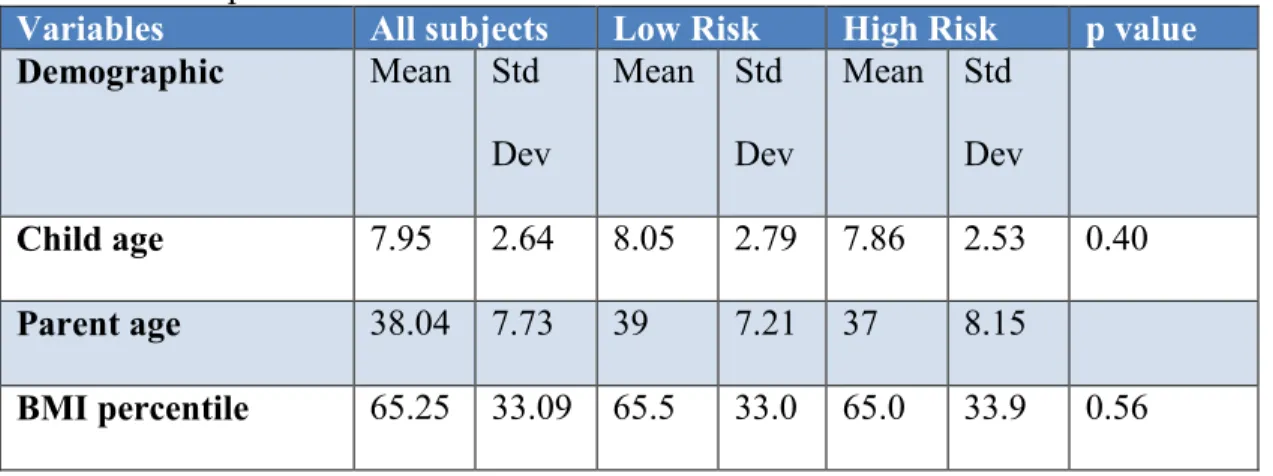
Demographic data of the 84 enrolled caregivers are illustrated in Table1. The average age of the caregivers was 38 years of age. The average age of the children was 8 years and 48% of the children were female and 60% Caucasian. Thirteen percent of the children were classified as overweight and 28% as obese.
As illustrated in table 2, 47% of the subjects were classified as low risk and 53% as high risk for SDB. The low and high risk groups were significantly different with respect to
tonsillectomy (p=0.04), and primary feeding method (p=0.001). Females, who had had
tonsillectomies and who were primarily bottle-fed were more likely to be in the high risk group. There was no significant difference between the two groups with respect to gender (p=0.07), ethnicity (p=0.53), NNS habits (p=0.21), or BMI category (p=56).
There were very few children who were exclusively breast-fed so primary bottle feeding was defined as children with a history of exclusive bottle feeding or with breast feeding up to six months of age. Primary breast feeding included a history of partial breast feeding or complete breast feeding greater than 7 months of age. Additionally, due to the small number of children that reported a digit sucking habit only, both habits (pacifier and digit sucking) were combined into a single habit category.
tonsillectomy, habit, age, and feeding practice, males had a greater risk for SDB compared to their female counterparts. When controlling for gender, BMI percentile, race, habit, age, and feeding practices, children with tonsillectomy had 0.075 greater risk for SDB. (Table3)
Table 6 Descriptive statistics
Variables All subjects Low Risk High Risk p value
Demographic Mean Std Dev
Mean Std Dev
Mean Std Dev
Child age 7.95 2.64 8.05 2.79 7.86 2.53 0.40
Parent age 38.04 7.73 39 7.21 37 8.15
BMI percentile 65.25 33.09 65.5 33.0 65.0 33.9 0.56
Table7 Bivariate Analysis
Variable All subjects Low Risk High Risk P value
N % N % N %
Gender
Female 40 48.2 23 57.5 17 42.5 0.07
Male 43 51.8 16 37.2 27 62.8
Race
Caucasian 47 59.5 22 46.8 25 53.2 0.53
AA 16 20.25 6 37.5 10 62.5
Other 16 20.25 7 43.75 9 56.25
BMI N % N % N %
Normal Weight 49 59 24 47 25 53 0.56
Obese 23 27.7 9 38.1 14 60.9 Tonsils
Tonsillectomy 11 14.3 3 27.3 8 72.7 0.04
No
Tonsillectomy
66 85.7 33 50 33 50
NNS habit
Habit 52 64.2 27 51.9 25 48.1 0.21
No habit 29 35.8 12 41.4 17 58.6
Feeding N % N %
Bottle feeding 53 63.1 18 34 35 66 0.001
Breast feeding 31 36.9 22 71 9 29
Table8 logistic regression-sleep disordered breathing risk
Effect Odds ratio 95% confidence interval
P-Value
Bottle vs. breast
11.882 2.991 47.198 <0.001
Habit no vs yes
2.348 0.610 9.044 0.21 Gender F vs
M
Race AA vs other
2.759 0.339 22.438 0.26 Race cauc. vs
other
1.103 0.202 6.026 0.55 BMI normal
vs
overweight
0.654 0.156 2.743 0.83
BMI
Overweight vs. obese
0.325 0.041 2.569 0.32
Tonsil no vs yes
0.075 0.006 0.890 0.04
Discussion
Sleep disordered breathing is a serious issue among the pediatric population because of its effects on cognitive and physical development. In addition, SDB diagnosis is costly and challenging in children. Risk factors for SDB in children include increased BMI, ethnicity, craniofacial syndromes and diseases such as sickle cell and glycogen storage disease.
Children with upper and lower respiratory problems also have a higher risk for SDB. [7] There are many other anatomical variations like deviated nasal septum and cleft palate that increase the risk for SDB. The options available for treatment include tonsillectomy and other surgical procedures which can be costly and associated with increased morbidity. The delivery of continuous positive air pressure (CPAP) through a mask is considered the most effective
children regardless of its severity. RME is indicated in children with maxillary constriction and a posterior dental cross-bite. [26] However RME should be the last treatment choice in children with SDB with normal maxillary width and no posterior cross-bite. [27]
The PSQ which is a widely accepted screening tool for SDB has a high sensitivity (0.85) and specificity (0.87) [4] [28]. Alternatively, the “I’M SLEEPY” questionnaire has a sensitivity of 0.82 with a specificity of 0.50 for obstructive sleep apnea. The PSQ has been validated for ages 4-12 while the “I’M SLEEPY” questionnaire and others have not been validated for use in children.[29] The PSQ is considered to be too complicated and lengthy to be used by physicians for screening pediatric patients with SDB [29]; accordingly its use has been limited primarily to research.
No published studies have evaluated the effect of NNS habit on the risk for SDB in children. Studies have demonstrated oropharyngeal exercises similar to speech therapy exercises have reduced the severity of SDB in adults by 39%, although such exercises needed to be
continuous. Ideally, the healthcare provider needs to determine the intensity, duration, and frequency of such exercises to maximize their effectiveness in [17]in patients with moderate SDB.[18]
Our study did not find a significant difference in NNS habit between SDB low and high risk children. The caregivers reported a high prevalence of previous NNS in our sample but no current NNS habits which leads one to question the temporal effects of any protective benefits with respect to SDB. Possibly early NNS has some protective benefits which are lost over time as the habit is reduced or eliminated. Additionally, this study relied on parental recall with respect to past NNS habits, pacifier use and feeding practices that may be inaccurate or
the reporting occurs several years later. Russell demonstrated that self-reporting measures show bias especially when reports are made several years later. In addition, reporting may be
influenced by subsequent events in the child’s life. [30]
asymptomatic within the first year post surgery but with time the success rate decreased to 71%. Greater than 3 years post adenotonsillectomy, 24% of patients were not satisfied with the results of surgery. [32]
Limitations:
One limitation of the current study is the use of the PSQ as a substitute for
polysomnogram data. As the PSQ is validated in English, its use excluded patients from other ethnicities. The study depended on the caregiver’s recall of past feeding practices and habits that took place many years prior. The study sample may have been biased as high risk patients who were referred for sleep studies were recruited in a sleep lab.
Conclusions
Pediatric Sleep Questionnaire
ID:
DATE:
/
/
SCHOOL OF DENTISTRY
UNIVERSITY OF NORTH CAROLINA
Directions: Completely fill in the ONE circle for each statement that best applies to your child.
While sleeping, does your child ...
A1. ... snore more than half the time?
No
Yes Don't know
A2. ... always snore?
A3. ... snore loudly?
A4. ... have "heavy" or loud breathing?
A5. ... have trouble breathing or struggle to breathe?
A6. ... seen your child stop breathing during the night? Have you ever ...
Does your child ...
A7. ... tend to breathe through the mouth during the day?
A8. ... have a dry mouth on waking up in the morning?
A9. ... occasionally wet the bed?
Does your child ...
B1. ... wake up feeling unrefreshed in the morning?
No
Yes Don't know
B2. ... have a problem with sleepiness during the day?
B3. Has a teacher or other supervisor commented that your child appears sleepy during the day?
B4. Is it hard to wake your child up in the morning?
B5. Does your child wake up with headaches in the morning?
B6. Did your child stop growing at a normal rate at any time since birth?
PSQ - Page 2 ID:
This child often ...
C1. ... does not seem to listen when spoken to directly
Applies just a little Definitely Applies
most of the time
Does Not Apply Applies
quite a bit
C2. ... has difficulty organizing tasks and activities
C3. ... is easily distracted by extraneous stimuli
C4. ... fidgets with hands or feet or squirms in seat
C5. ... is "on the go" or often acts as if "driven by a motor"
ID #:
UNC SCHOOL OF DENTISTRY
Instructions: Please use a BLACK BALLPOINT PEN. Read each question carefully and provide your most appropriate response. Choose only ONE response per question unless otherwise indicated. Fill in circles completely or fill in the boxes as needed.
Participant Questionnaire
Yes No
2. Have your child's tonsils been surgically removed?
3. Has your child been diagnosed with any of these medical conditions? (Choose ALL that apply)
None
Cleft Lip and/or Palate Down's Syndrome
Other (please specify) _______________________________________________ Cerebral palsy
Reticuloses Sickle cell disease
Glycogen storage disease Achondroplasia
Prader-Willi syndrome
Apert syndrome
Treacher-Collins syndrome Crouzon syndrome
I prefer not to answer
Date:
/
/
Date of Birth:
/
/
Gender: Female Malemonth day year
American Indian or Alaska Native
African-American Asian Caucasian
More than one race
Hispanic Other (please specify) _______________________
Race:
Questionnaire - Page 2 ID #:
6. Did your child use a pacifier? Yes No - Skip to Question 6
a. If yes, at what age did your child start using the pacifier?
b. At what age did your child stop using the pacifier?
c. How long did your child use the pacifier during a typical day (24 hour period)?
<1 yr old 1-2 yrs old 3-4 yrs old 5-6 yrs old > 6 yrs old
<1 mo old 1-6 mos old 7-12 mos old 13-18 mos old > 18 mos old
<1 hr 1-3 hrs 4-6 hrs 7-9 hrs 10-12 hrs > 12 hrs
7. Did your child suck a thumb or finger(s)? Yes No - Skip to Question 7
a. If yes, at what age did your child start sucking a thumb or finger(s)?
c. If no, at what age did they stop?
d. How long did your child suck a thumb or finger(s) during a typical day (24 hour period)?
<1 yr old 1-2 yrs old 3-4 yrs old 5-6 yrs old > 6 yrs old
<1 mo old 1-6 mos old 7-12 mos old 13-18 mos old > 18 mos old
<1 hr 1-3 hrs 4-6 hrs 7-9 hrs 10-12 hrs > 12 hrs
b. Is he/she still sucking a thumb or finger(s)? Yes No
8. Does your child have any of the following problems? (Choose ALL that apply)
Mouth breathing Noisy breathing while sleeping Tooth grinding
Sore throat/tonsillitis None of the above
Thank you for your participation!
HABIT HISTORY
4. Did your child breast feed? Yes No - Skip to Question 4
a. If yes, how long did they breast feed?
<1 mo 1-3 mos 4-6 mos 7-9 mos 10-12 mos > 12 mos
5. Was your child bottle fed? Yes No - Skip to Question 5
a. If yes, at what age did they stop?
<1 yr old 1-2 yrs old 3-4 yrs old 5-6 yrs old > 6 yrs old
Risk Listing idno risk
1013 high 1016 high 1028 high 1041 high 1042 high 1054 high 1062 high 1067 high 1068 high 1071 high
REFERENCES
1. Obstructive Sleep Apnea or Sleep-Disordered Breathing.
http://www.lung.org/assets/documents/publications/solddc-chapters/osa.pdf, 2010.
2. Chan, J., J.C. Edman, and P.J. Koltai, Obstructive sleep apnea in children. Am Fam Physician, 2004. 69(5): p. 1147-54.
3. Bixler, E.O., et al., Sleep disordered breathing in children in a general population sample: prevalence and risk factors. Sleep, 2009. 32(6): p. 731-6.
4. Chervin, R.D., et al., Pediatric sleep questionnaire (PSQ): validity and reliability of scales for sleep-disordered breathing, snoring, sleepiness, and behavioral problems.
Sleep Med, 2000. 1(1): p. 21-32.
5. Li, H.-Y. and L.-A. Lee, Sleep-disordered breathing in children. Chang Gung Med J, 2009. 32(3): p. 247-57.
6. Freeman, K. and K. Bonuck, Snoring, mouth-breathing, and apnea trajectories in a population-based cohort followed from infancy to 81 months: a cluster analysis. Int J Pediatr Otorhinolaryngol, 2012. 76(1): p. 122-30.
7. Redline, S., et al., Risk factors for sleep-disordered breathing in children. Associations with obesity, race, and respiratory problems. Am J Respir Crit Care Med, 1999. 159(5 Pt 1): p. 1527-32.
8. Greene, M.G. and J.L. Carroll, Consequences of sleep-disordered breathing in childhood.
Curr Opin Pulm Med, 1997. 3(6): p. 456-63.
9. Marcus, C.L., Sleep-disordered breathing in children. Am J Respir Crit Care Med, 2001. 164(1): p. 16-30.
10. Gozal, D. and L. Kheirandish-Gozal, New approaches to the diagnosis of sleep-disordered breathing in children. Sleep Med, 2010. 11(7): p. 708-13.
11. Montgomery-Downs, H.E., et al., Infant-feeding methods and childhood sleep-disordered breathing. Pediatrics, 2007. 120(5): p. 1030-5.
12. Warren, J.J., et al., Non-nutritive sucking behaviors in preschool children: a longitudinal study. Pediatr Dent, 2000. 22(3): p. 187-91.
13. Cinar, D.N., The advantages and disadvantages of pacifier use. Contemp Nurse, 2004. 17(1-2): p. 109-12.
15. Sexton, S. and R. Natale, Risks and benefits of pacifiers. Am Fam Physician, 2009. 79(8): p. 681-5.
16. Abdun-Nur, D. and K. Abdun-Nur, Do pacifiers reduce the risk of sudden infant death syndrome? Am Fam Physician, 2010. 82(5): p. 456; authors reply 457-9.
17. Guimaraes, K.C., et al., Effects of oropharyngeal exercises on patients with moderate obstructive sleep apnea syndrome. Am J Respir Crit Care Med, 2009. 179(10): p. 962-6. 18. Puhan, M.A., et al., Didgeridoo playing as alternative treatment for obstructive sleep
apnoea syndrome: randomised controlled trial. Bmj, 2006. 332(7536): p. 266-70. 19. Steele, C.M., On the plausibility of upper airway remodeling as an outcome of orofacial
exercise. Am J Respir Crit Care Med, 2009. 179(10): p. 858-9. 20. BMI Percentile Calculator for Child and Teen.
http://nccd.cdc.gov/dnpabmi/Calculator.aspx.
21. SAS Institute Inc. 2011.SAS®9.3 System Options: Reference, S.E.C., NC: SAS Institute Inc, SAS Institute Inc. 2011.SAS®9.3 System Options: Reference, Second Edition.Cary, NC: SAS Institute Inc. 2011.
22. Weaver, T.E. and E.R. Chasens, Continuous positive airway pressure treatment for sleep apnea in older adults. Sleep Med Rev, 2007. 11(2): p. 99-111.
23. Zhang, C., et al., The effect of CPAP treatment on EEG of OSAS patients. Sleep Breath, 2015.
24. Sinha, D. and C. Guilleminault, Sleep disordered breathing in children. Vol. 131. 2010. 311-320.
25. DiFeo, N., et al., Predictors of positive airway pressure therapy adherence in children: a prospective study. J Clin Sleep Med, 2012. 8(3): p. 279-86.
26. Ashok, N., et al., Effect of rapid maxillary expansion on sleep characteristics in children.
Contemp Clin Dent, 2014. 5(4): p. 489-94.
27. Eichenberger, M. and S. Baumgartner, The impact of rapid palatal expansion on
children's general health: a literature review. Eur J Paediatr Dent, 2014. 15(1): p. 67-71. 28. Meltzer, L.J. and J.A. Mindell, Sleep and sleep disorders in children and adolescents.
Psychiatr Clin North Am, 2006. 29(4): p. 1059-76; abstract x.
30. Russell, G., et al., Assessing recall in mothers' retrospective reports: concerns over children's speech and language development. J Abnorm Child Psychol, 2014. 42(5): p. 825-30.
31. Ng, S.S., et al., Prevalence of Obstructive Sleep Apnea Syndrome and CPAP Adherence in the Elderly Chinese Population. PLoS One, 2015. 10(3): p. e0119829.