R E S E A R C H
Open Access
Optimized joint timing synchronization and
channel estimation for communications
systems with multiple transmit antennas
Te-Lung Kung
*and Keshab K Parhi
Abstract
This paper proposes a joint timing synchronization and channel estimation scheme for communications systems with multiple transmit antennas based on a well-designed training sequence arrangement. In addition, a generalized maximum-likelihood (ML) channel estimation scheme is presented, and this one-shot scheme is applied to obtain all channel impulse responses (CIR) from different transmit antennas. The proposed approach consists of three stages at each receive antenna. First, coarse timing and frequency offset estimates are obtained. Then, an advanced timing, relative timing indices, and the corresponding CIR estimates at the second stage are obtained using the generalized ML estimation based on a sliding observation vector. Finally, the fine time adjustment based on the minimum mean squared error criterion is performed. From the simulation results, the proposed approach has excellent performance in timing synchronization under several channel models at signal-to-noise ratio smaller than 1dB.
Keywords: Timing synchronization; Channel estimation; Multiple-input single-output (MISO); Multiple-input multiple-output (MIMO); Orthogonal frequency division multiplexing (OFDM); Generalized maximum-likelihood (ML) estimation; Training sequences
1 Introduction
In communications systems, timing and channel esti-mates are two important parameters at the receiver in order to reconstruct the signal. To further enhance the system performance, spatial diversity techniques can be applied to communications systems. By employing the spatial diversity techniques, multiple transmit antenna arrays are known to perform better than the conven-tional single transmit antenna because the effects of multipath fading channels and interference can be more effectively exploited [1,2]. Multiple-input single-output (MISO) and multiple-input multiple-output (MIMO) use multiple transmit antenna arrays and offer significant increases in data throughput and link range without addi-tional bandwidth or increased transmit power. Recently, in wireless local area networks, orthogonal frequency division multiplexing (OFDM) has been of great interest
*Correspondence: [email protected]
Department of Electrical and Computer Engineering, University of Minnesota, Minneapolis, MN 55455, USA
for both wired and wireless applications due to its high spectrum efficiency and robustness against multipath fad-ing channels [3], and the resultant MISO-OFDM and MIMO-OFDM systems have been recognized as promis-ing solutions to support next generation broadband wire-less communications systems [4]. However, compared with the single carrier systems, OFDM systems are much more sensitive to synchronization errors [5]. Several approaches have been proposed to address this prob-lem [6-14]. In addition, the performance of multiple-input signal processing depends on the amount of channel infor-mation. Therefore, excellent synchronization and channel estimation are essential to fully exploit the advantages of MISO-OFDM and MIMO-OFDM systems.
Various techniques based on training sequences have been proposed to obtain accurate synchronization and channel estimation [9-19]. In [15], a training sequence arrangement based on modulated orthogonal sequences (MOS) for MIMO-OFDM systems was proposed to synchronize different transmit antennas. However, the
mutual interference among training sequences trans-mitted by different transmit antennas becomes more severe when the number of transmit antennas increases, and the synchronization performance degrades corre-spondingly. In [16], a joint fine time synchronization and channel estimation scheme based on a nonoverlapping training sequence arrangement was proposed. Although the proposed training sequence arrangement is free from mutual interference, the time-division alignment of train-ing sequence decreases the system efficiency. In [17], a joint fine time synchronization and channel estimation approach based on a unique MOS was proposed. The mutual interference among different training sequences is eliminated because of this careful training sequence arrangement. This joint approach relies on a threshold to identify the first significant tap using the estimated channel impulse responses (CIR). However, the threshold has to be determined in a trial-and-error manner. In [18], a joint timing synchronization and channel estimation approach based on the same training sequence arrange-ment was proposed. First, the optimal and suboptimal threshold factors are derived by analyzing the probabil-ity densprobabil-ity functions of the cross-correlation function outputs in Rayleigh and Ricean fading channels. Then, a majority vote refinement approach which requires mul-tiple timing estimates was also proposed for fine time adjustment in MIMO systems. However, these derived optimal and suboptimal threshold factors could be deter-mined only when signal-to-noise ratio (SNR) exceeds 0dB, and this joint approach is not suitable for MISO systems.
This paper develops a joint timing synchronization and channel estimation algorithm suitable for down-link MIMO networks based on a time-domain train-ing sequence arrangement in the short-range wireless transmission environment. Unlike the previous works [9-13,17,18], this paper not only introduces the use of sliding observation vector in timing synchronization phase but also applies the minimum mean squared error (MMSE) criterion to perform fine time adjustment. In this paper, we first obtain a coarse timing offset using the cross-correlation function outputs based on the pro-posed training sequences at each receive antenna and then apply the generalized maximum-likelihood (ML) algo-rithm to find the advanced timing, relative timing indices, and the corresponding CIR estimates. The reason why we use the advanced timing instead of coarse timing off-set to perform fine time adjustment is that we can have better timing synchronization performance at very low SNR. Finally, the designed metric based on the MMSE criterion is utilized to perform fine time adjustment. Sim-ulation results verify the effectiveness of our proposed algorithm. This paper is an extended version of [19]. This paper addresses synchronization and channel estimation aspects of a multiple transmit antenna system, whereas
[19] only considered those of a single transmit antenna system.
This paper is organized as follows. Section 2 describes the system model. In Section 3, the proposed joint fine time synchronization and channel estimation scheme is presented. Simulation results are provided in Section 4. Finally, Section 5 concludes this paper.
2 System description
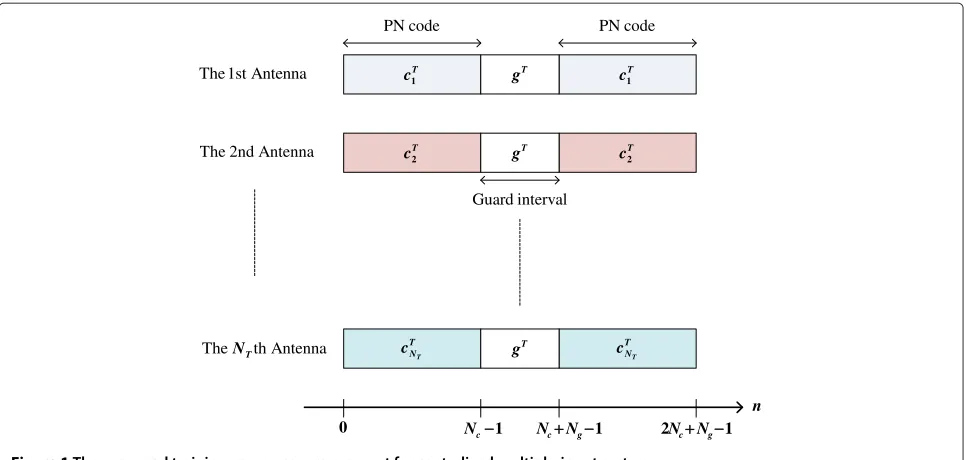
In this paper, we consider a centralized multiple-input OFDM-based communications system, which means that the transmit antennas are co-located on a single device. Moreover, receive antennas are not required to be co-located on a single device. Let us consider a multiple-input system that is formed byNT transmit antennas and NR receive antennas, whereNT >1 andNR≥1. The training sequence arrangement used to assist joint timing synchro-nization and channel estimation is shown in Figure 1, where the training sequence assigned to each transmit antenna is composed of two identical pseudo-noise (PN) sequences and a guard interval. The reason why we uti-lize the PN sequences in the proposed training sequence arrangement is that sequences are easily generated to specify different transmit antennas. Let pTα1 = pα1(n) andpTα2 = pα2(n)denote training sequences assigned to theα1th transmit antenna and theα2th transmit antenna, respectively, wherepTα1 =[cTα1gTcTα1],pTα2 =[cTα2 gT cTα2], n ∈ {0, 1,. . ., 2Nc+Ng −1},cTα1 andc
T
α2 are the corre-sponding PN sequences,gT is the guard interval,Ncis the length ofcTα1andc
T
α2,Ngis the length ofg
T, andN
g≥0. In order to eliminate the mutual interference from different transmit antennas, the cross-correlation values between different assigned PN sequences are zero, i.e.,
cTα1·cα2 =0, ∀α1=α2, α1,α2∈ {1, 2,. . .,NT}. (1)
Consider the transmitted packet at the ith transmit antennasTi =[pTi xTi]= {si(n),∀n ∈ }, wherexTi con-sists ofmOFDM symbols, the length ofxTi ism·(N+NCP), Nrepresents the number of subcarriers in the OFDM sys-tem,NCPdenotes the length of cyclic prefix,mis a positive integer, and= {0, 1,· · ·,m·(N+NCP)+2Nc+Ng−1}. Assume cyclic prefix in each OFDM symbol and guard interval inpTi are longer than the maximum delay spread of the channel, and the path delays in the channels are sample-spaced. Therefore, the received signal at the bth receiver can be expressed as follows:
The 1st Antenna Figure 1The proposed training sequence arrangement for centralized multiple-input systems.
theith transmitter to thebth receiver,Kis the number of taps in the channel, andw(n)is a complex additive white Gaussian noise (AWGN) sample. Based on the proposed training arrangement, ifNg ≥ K, the training sequences are free of intersymbol interference caused by multipath fading channels. In addition, during each packet trans-mission, all channels are assumed to be slow time-varying channels, and the upper bounds for 2Nc+NgandNgare
whereTsandTcohrepresent the sample duration and the coherent time in channels, respectively. From Equation 5, the length of guard interval is bounded by
K≤Ng<< Tcoh
Ts −
m·(N+NCP)−2Nc. (6)
Therefore, the optimal bound for the length of training sequences,{pTi ,∀i}, is
2Nc+K≤2Nc+Ng<< Tcoh
Ts −
m·(N+NCP). (7)
3 The proposed approach
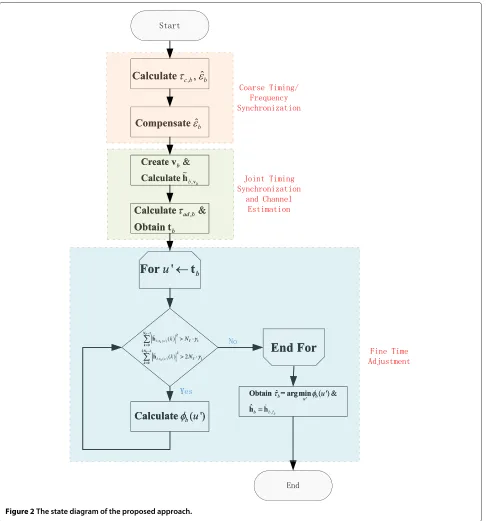
The state diagram of the proposed approach is shown in Figure 2. In Figure 2, the proposed approach consists of three blocks. In this section, we will thoroughly explain the mechanism in each block.
3.1 Coarse timing and frequency synchronization It can be easily observed that the proposed training sequence is composed of two identical parts. Therefore, a coarse timing offset (CTO) at the bth receiver τc,b is obtained based on the cross-correlation function outputs as follows: length of observation interval, andMc,b(d)is the coarse timing metric at thebth receiver. From Equations 2 and 8,Mc,b(d) will give a maximum value when d is at the delayed timing of the line-of-sight (LOS) path in multipath fading channels. Then, the CFOˆbis
Figure 2The state diagram of the proposed approach.
ˆ
rb(n)
=rb(n)·e
−j2π(b+b)n N
=e−j2π(N bn)
NT
i=1 K−1
k=0
hib(k)si(n−τb−k)+ ˆw(n),
(10)
whereb= ˆb−bdenotes the residual CFO andwˆ(n)= w(n)e−j2π(b+b)
n
N .
3.2 Generalized maximum-likelihood-based channel estimation
Assume there is no timing offset and CFO in Equation 2, the received training sequence at thebth receiver can be expressed as follows:
rb=Shb+w, (11)
where
S= the ith transmit antenna to the bth receive antenna. In Equation 14,hbcontains different CIRs from all transmit antennas. In general, the received training sequence is
rb(τ )=[rb(τ )rb(τ+1) · · · rb(τ+N−1)]T, (16)
where Equation 12 is a special case of Equation 16 when τ =0 andb = 0. Then, the likelihood function is given
and the ML estimate ofhbcan be obtained by
ˆ
where AH is the Hermitian ofA, B− is the generalized inverse ofB,S†is the Moore-Penrose pseudo-inverse ofS,
(b)=diag(ej2π Nbτ,e
and diag(·) represents a diagonal matrix. For fixed pseudo-sequences ci, ∀i ∈ {1,. . .,NT}, we only need to compute S† once, and different CIR estimates can be obtained simply by multiplying the received training sequence at each receiver withS†.
3.3 Joint timing synchronization and channel estimation In this subsection, we utilize the coarse timing offset and CIR estimate based on the generalized ML criterion to develop a joint timing synchronization and channel esti-mation algorithm. After coarse timing synchronization, a sliding observation vectorvbat thebth receiver is applied to obtain an advanced timing, relative timing indices, and the corresponding CIR estimates, where
vTb =[τc,b+L · · · τc,b+1τc,bτc,b−1 · · · τc,b−L]
= {vb(l1), ∀l1∈vb},
(20)
ˆ mated (k+1)th tap CIR from theith transmit antenna to the bth receive antenna corresponding to the time index vb(l1). In order to avoid any loss of the channel information, K should be at least equal to or greater thanK.
After we obtain 2L + 1 CIR estimates, the advanced timing at thebth receiverτad,bis given by relative timing indices in the modified sliding obser-vation vector tTb and the corresponding CIR estimates
˜
In this subsection, we exploit the MMSE criterion to perform fine time adjustment in an iterative manner based on the information of relative timing indices and the corresponding CIR estimates. First, two thresholds on the sum of the first NT tap powers NT · γ1 and the sum of the first 2NT tap powers 2NT · γ1 are chosen in order to eliminate the AWGN effect and to reduce the computational complexity, where γ1 should be less than the tap power of the first path in the chan-nel model. In other words, if NT−1 is the estimated timing offset; otherwise, the algo-rithm keeps running until NT−1
b(l2) denote the convolution of the training sequence and the corresponding CIR estimate h˜Tb,t
and h˜Tib,t
b(l2) is the CIR estimate from the ith transmit antenna to the bth receive antenna. Then, the mean squared error (MSE) of the timing indextb(l2)is given by
Thus, the estimated timing offset can be obtained by solving
From Equations 31 and 33 and reasonable CIR esti-mates, we have
φb(τb+δ) > φb(τb), (35)
whereδ=0,δis an integer, andτb+δ∈tTb. Consider a set U = {0, 1,· · ·,u−1}composed of consecutive timing indices that satisfy the following conditions
⎧
Then, the estimated timing offsetτˆband the CIR esti-matehˆbat thebth receiver based on the thresholds and Equation 33 can be expressed as follows:
ˆ
τb=arg mintb(u),u∈Uφb(tb(u)) ˆ
hb= ˜hb,τˆb.
(37)
The detailed procedure of fine time adjustment is described in Algorithm 1.
Algorithm 1 Fine time adjustment
Initial Inputs:tTb,h˜b,tT
Packet-basedNT×NRMIMO-OFDM systems were used for simulations, where each packet consists of a training sequence followed by 34 random OFDM data symbols. In this paper, we mainly consider 2×2 and 3×3 MIMO-OFDM systems, where NT × NR = 2 × 2 and NT × NR=3×3. Gold code is selected to generate the pseudo-noise sequences used in the proposed training sequence arrangement with the spreading factor equal to 1. The training sequence of each packet is 80 identical samples at each transmitter, whereNc = 32 andNg = 16. The structure of OFDM data symbols follows the IEEE 802.11a standard defined in [20], whereN = 64 andNCP = 16. Quaternary phase-shift keying modulation was adopted in simulations.
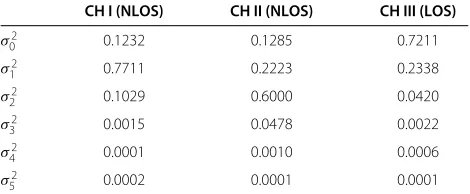
The power profiles of different channel models used for performance analysis and simulation are summarized in Table 1, where σi2 represents the i + 1th tap power in the corresponding channel. Different fading channels (Rayleigh, Ricean, and Nakagami) would not affect the results because tap powers in the channel models have been defined in Table 1. Channel models I and II (CH I and CH II) represent multipath fading channels with non-line-of-sight (NLOS) propagation, and channel model III (CH III) is a typical multipath fading channel with LOS propagation. For CH I, the power of second tap domi-nates all channel taps. As for CH II, the third tap has the strongest power in the channel, and it is the worst channel model to evaluate the performance of timing synchro-nization in this paper. Moreover, all channels are assumed to be quasi-stationary during each packet transmission. In this paper, all transmit-receive links follow the same channel model.
The main motivation of this paper is to achieve perfect timing synchronization in very low SNR environments. The parametersLandKrelated to the observation inter-val in joint timing synchronization and channel estimation are set to be 50 and 6, respectively. Therefore, the number of possible relative timing indices for fine time adjust-ment in our proposed approach is approximately equal to 50. For comparison, the designed maximum channel delay spread for fine time adjustment used in [17] is set to 20 samples. In addition, the coarse timing estimate in the proposed approach is provided to [17] before the
Table 1 The power profiles of different channel models
−5 −4 −3 −2 −1 0 1 0.2
0.4 0.6 0.8 1 1.2 1.4 1.6 1.8
SNR (dB)
Bias
2x2, CH I 2x2, CH II 2x2, CH III 3x3, CH I 3x3, CH II 3x3, CH III
Figure 3The averaged bias of coarse timing estimates,E[τˆc−τ], whereE[·] is the expectation function.
proposed joint timing synchronization and channel esti-mation scheme is performed.
Figure 3 shows the averaged bias of CTO using our pro-posed algorithm at each receive antenna. In Figure 3, the averaged biases of CTO in CH I and CH II are greater than 1, and the averaged biases of CTO in CH III are approximately equal to 0. The simulation results of esti-mated CTO show that the proposed algorithm provides good initial values for further processing of timing syn-chronization. In addition, constant CFOs(b)equal to 0.5 are introduced to demonstrate the performance of CFO estimator. The mean square errors of estimated CFOs (|ˆb −b|2) in all channel models are listed in Table 2. From Table 2, it is indicated that the residual CFO (b=
ˆ
b − b) can be modeled as a random variable that is uniformly distributed within [−0.04, 0.04]. Figure 3 and Table 2 demonstrate that our proposed algorithm has excellent performance in coarse timing and frequency synchronization.
After we discuss the performance in CFO and CTO estimators, the performance of timing synchronization is
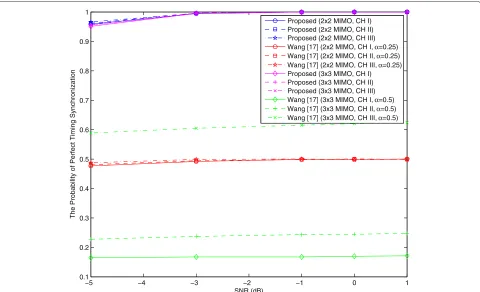
evaluated with a residual CFOb = 0.1. The threshold γ1 defined in fine time adjustment is 0.05. We demon-strate the performance of timing synchronization using the probability of perfect timing synchronization, the bias of the time estimator, and the root mean squared error (RMSE) of the time estimator. The corresponding results are reported in Figures 4, 5, and 6. The perfect timing synchronization is defined as the successful acquisition of the position of the first tap in channel models. The actual threshold used in [17] is α|ˆhmax|, where α is a threshold factor and |ˆhmax| is the strongest channel tap gain estimate. In this paper, pre-simulations and mathe-matical derivations are not required to choose thresholds for fine time adjustment [9,10,12,13]. Moreover, the per-formance of timing synchronization is calculated based on the estimated timing offset at each receive antenna. In Figure 4, simulation results show that our proposed approach has better performance in timing synchroniza-tion at very low SNR. In CH I, CH II, and CH III, the proposed approach achieves 99% in the probability of per-fect timing synchronization when SNR exceeds -3dB. As
Table 2 The mean squared error of estimated coarse frequency offset at each receive antenna
SNR = -5dB SNR = -3dB SNR = -1dB SNR = 0dB SNR = 1dB
Proposed (2×2 MIMO) 0.0011 0.0006 0.0004 0.0003 0.0002
−5 −4 −3 −2 −1 0 1 0.1
0.2 0.3 0.4 0.5 0.6 0.7 0.8 0.9 1
SNR (dB)
The Probability of Perfect Timing Synchronization
Proposed (2x2 MIMO, CH I) Proposed (2x2 MIMO, CH II) Proposed (2x2 MIMO, CH III) Wang [17] (2x2 MIMO, CH I, α=0.25) Wang [17] (2x2 MIMO, CH II, α=0.25) Wang [17] (2x2 MIMO, CH III, α=0.25) Proposed (3x3 MIMO, CH I) Proposed (3x3 MIMO, CH II) Proposed (3x3 MIMO, CH III) Wang [17] (3x3 MIMO, CH I, α=0.5) Wang [17] (3x3 MIMO, CH II, α=0.5) Wang [17] (3x3 MIMO, CH III, α=0.5)
Figure 4The probability of perfect timing synchronization,prob(τ= ˆτ ), whereprob(·)is the probability function andτˆis the estimated timing offset.
for [17], different choices in threshold factorαmay lead to the poor performance in timing synchronization. In Figure 4, the maximum probability of perfect timing syn-chronization in [17] is less than 0.624 in CH III, whereα= 0.5. However, in this case, the probabilities of perfect tim-ing synchronization are less than 0.25 in CH I and CH II. In addition, if we chooseα=0.25, the probabilities of per-fect timing synchronization are approximately equal to 0.5 in all channel models. The reason why the scheme in [17] has poor performance in timing synchronization are that AWGN affects the entire fine time adjustment process at low SNR and wide interval for fine time adjustment, espe-cially in CH I and CH II. In addition, pre-simulations for searching a properαare also needed. Therefore, low SNR and wide interval for fine time adjustment significantly degrade the performance in [9,10,12,13]. In Figures 5 and 6, our proposed approach has better performance than the joint scheme [17]. In Figure 5, our proposed approach per-forms almost unbiased at any low SNR, and wide interval for fine time adjustment in [17] leads the time estimator to have nonzero biases. In Figure 6, the proposed approach achieves zero RMSE when SNR exceeds 1dB due to the ability to identify the first arrival path in the channel; however, the joint scheme still has large RMSE of time estimators [17].
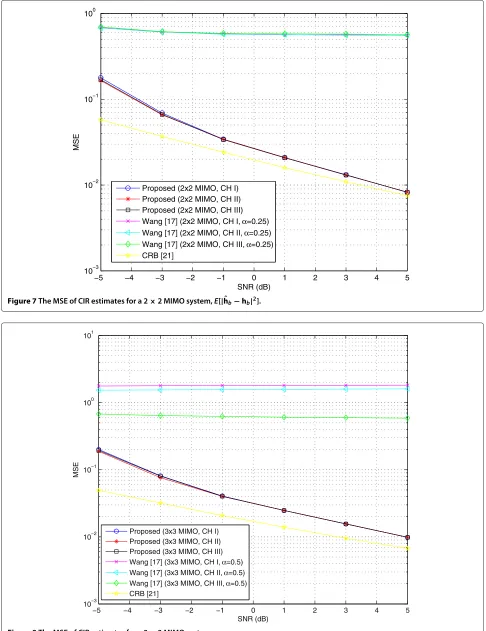
Moreover, the performance of channel estimation is shown in Figures 7 and 8. The performance of channel estimation is evaluated after the estimated timing offset is obtained. In Figures 7 and 8, the proposed approach has a consistent and better performance of channel estima-tion for 2×2 and 3× 3 MIMO systems, and the joint scheme has a poor performance of channel estimation because of incorrect estimated timing offsets [17]. In addi-tion, the performance of the proposed approach is close to the Cram´er-Rao bound [21].
5 Conclusions
−5 −4 −3 −2 −1 0 1 −10
−8 −6 −4 −2 0 2 4 6 8
SNR (dB)
The Bias of Time Estimator
Proposed (2x2 MIMO, CH I) Proposed (2x2 MIMO, CH II) Proposed (2x2 MIMO, CH III) Wang [17] (2x2 MIMO, CH I, α=0.25) Wang [17] (2x2 MIMO, CH II, α=0.25) Wang [17] (2x2 MIMO, CH III, α=0.25) Proposed (3x3 MIMO, CH I) Proposed (3x3 MIMO, CH II) Proposed (3x3 MIMO, CH III) Wang [17] (3x3 MIMO, CH I, α=0.5) Wang [17] (3x3 MIMO, CH II, α=0.5) Wang [17] (3x3 MIMO, CH III, α=0.5)
Figure 5The bias of timing estimator,E[τˆ−τ], whereE[·] is the expectation function.
−50 −4 −3 −2 −1 0 1
2 4 6 8 10 12
SNR (dB)
The Root Mean Square Error of Time Estimator
Proposed (2x2 MIMO, CH I) Proposed (2x2 MIMO, CH II) Proposed (2x2 MIMO, CH III) Wang [17] (2x2 MIMO, CH I, α=0.25) Wang [17] (2x2 MIMO, CH II, α=0.25) Wang [17] (2x2 MIMO, CH III, α=0.25) Proposed (3x3 MIMO, CH I) Proposed (3x3 MIMO, CH II) Proposed (3x3 MIMO, CH III) Wang [17] (3x3 MIMO, CH I, α=0.5)
Wang [17] (3x3 MIMO, CH II, α=0.5) Wang [17] (3x3 MIMO, CH III, α=0.5)
−5 −4 −3 −2 −1 0 1 2 3 4 5
10−3
10−2
10−1
100
SNR (dB)
MSE
Proposed (2x2 MIMO, CH I) Proposed (2x2 MIMO, CH II) Proposed (2x2 MIMO, CH III)
Wang [17] (2x2 MIMO, CH I, α=0.25)
Wang [17] (2x2 MIMO, CH II, α=0.25)
Wang [17] (2x2 MIMO, CH III, α=0.25)
CRB [21]
Figure 7The MSE of CIR estimates for a 2×2 MIMO system,E[|ˆhb−hb|2].
−5 −4 −3 −2 −1 0 1 2 3 4 5 10−3
10−2 10−1 100 101
SNR (dB)
MSE
Proposed (3x3 MIMO, CH I) Proposed (3x3 MIMO, CH II) Proposed (3x3 MIMO, CH III) Wang [17] (3x3 MIMO, CH I, α=0.5) Wang [17] (3x3 MIMO, CH II, α=0.5) Wang [17] (3x3 MIMO, CH III, α=0.5) CRB [21]
and theoretical derivation, the proposed fine time adjust-ment algorithm outperforms conventional schemes even in a very low SNR environment. Simulation results show that there are no timing errors in our proposed time estimator when SNR exceeds 0dB. Finally, the proposed approach achieves excellent performance in channel esti-mation, because the proposed time estimator outperforms the existing methods.
Competing interests
Both authors declare that they have no competing interests.
Received: 14 April 2013 Accepted: 11 August 2013 Published: 22 August 2013
References
1. G Raleigh, J Cioffi, Spatio-temporal coding for wireless communications. IEEE Trans. Commun.46(3), 357–366 (1998)
2. A Moustakas, S Simon, Optimized multiple-input single-output (MISO) communication systems with general Gaussian channels: nontrivial covariance and nonzero mean. IEEE Trans. Inf. Theory.49(10), 2770–2780 (2003)
3. R van Nee, R Prasad,OFDM Wireless Multimedia Communication(Artech House, Norwood, 2004)
4. G Stüber, J Barry, S Mclaughlin, Y Li, M Ingram, T Pratt, Broadband MIMO-OFDM wireless communications. Proc. IEEE.92(2), 271–294 (2004) 5. T Pollet, M van Bladel, M Moeneclaey, BER sensitivity of OFDM systems to carrier frequency offset and Wiener phase noise. IEEE Trans. Commun.43, 191–193 (1995)
6. J van de Beek, M Sandell, P Börjesson, ML estimation of time and frequency offset in OFDM systems. IEEE Trans. Signal Process.45(7), 1800–1805 (1997)
7. T Schmidl, D Cox, Robust frequency timing synchronization for OFDM. IEEE Trans. Commun.45(12), 1613–1621 (1997)
8. H Minn, M Zeng, V Bhargava, On timing offset estimation for OFDM systems. IEEE Commun. Lett.4(7), 242–244 (2000)
9. H Minn, V Bhargava, K Letaief, A robust timing and frequency synchronization for OFDM systems. IEEE Trans. Wireless Commun.2(4), 822–839 (2003)
10. H Minn, V Bhargava, K Letaief, A combined timing and frequency synchronization and channel estimation for OFDM. IEEE Trans. Commun.
54(3), 416–422 (2006)
11. C-L Wang, H-C Wang. A low-complexity joint timing synchronization and channel estimation scheme for orthogonal frequency division multiplexing systems, inIEEE International Conference on Communications (Istanbul, 11-15 June 2006), pp. 5670–5675, (IEEE, Piscataway, 2006) 12. C-L Wang, H-C Wang. An optimized joint timing synchronization and
channel estimation scheme for OFDM systems, inProceedings of the IEEE Vehicular Technology Conference,(Singapore, 11–14 May 2008), pp. 908–912, (IEEE, Piscataway, 2008)
13. C-L Wang, H-C Wang, On joint fine time adjustment and channel estimation for OFDM systems. IEEE Trans. Wireless Commun.8(10), 4940–4944 (2009)
14. J-H Wen, G-R Lee, J-W Liu, T-L Kung. Joint frame synchronization and channel estimation scheme using regression method in OFDM systems, inProceedings of the IEEE International Wireless Communications, Networking and Mobile Computing,(Shanghai, 21–25 Sept 2007), pp. 164–167, (IEEE, Piscataway, 2007)
15. A Mody, G Stüber. Synchronization for MIMO OFDM systems, in Proceedings of the IEEE Global Telecommunications Conference, (San Antonio, 25–29 Nov 2001), pp. 509–513, (IEEE, Piscataway, 2001) 16. N Long, H Park. Joint fine time synchronization and channel estimation
for MIMO-OFDM WLAN, inProceedings of the IEEE International Symposium on Intelligent Signal Processing and Communication Systems,
(Seoul, 18–19 Nov 2004), pp. 463–467, (IEEE, Piscataway, 2004) 17. H-C Wang, C-L Wang. A new joint time synchronization and channel
estimation scheme for MIMO-OFDM systems, inProceedings of the IEEE Global Telecommunications Conference,(San Francisco,
27 Nov 1 Dec 2006), pp. 1–5, (IEEE, Piscataway, 2006)
18. C-L Wang, H-C Wang, Optimized joint fine timing synchronization and channel estimation for MIMO systems. IEEE Trans. Commun.59(4), 1089–1098 (2011)
19. T-L Kung, KK Parhi, Optimized joint timing synchronization and channel estimation for OFDM systems. IEEE Wireless Commun. Lett.1(3), 149–152 (2012)
20. IEEE std 802.11. Wireless LAN medium access control (MAC) and physical layer (PHY) specifications (IEEE, Piscataway, 2012)
21. P Stoica, O Besson, Training sequence design for frequency offset and frequency-selective channel estimation. IEEE Trans. Commun.51(11), 1910–1917 (2003)
doi:10.1186/1687-6180-2013-139
Cite this article as:Kung and Parhi:Optimized joint timing synchronization and channel estimation for communications systems with multiple transmit antennas.EURASIP Journal on Advances in Signal Processing2013
2013:139.
Submit your manuscript to a
journal and benefi t from:
7Convenient online submission
7 Rigorous peer review
7Immediate publication on acceptance
7 Open access: articles freely available online
7High visibility within the fi eld
7 Retaining the copyright to your article