REPORTED VERSUS PERCEIVED WORKLOAD OF COLLEGE COACHES AND ATHLETIC TRAINERS
Nicole Lynn Alexander
A thesis document submitted to the faculty of the University of North Carolina at Chapel Hill in partial fulfillment of the requirements for the degree of Master of Arts in the Department of
Exercise and Sport Science (Sport Administration).
Chapel Hill 2020
©2020
ABSTRACT
Nicole Lynn Alexander: Reported Versus Perceived Workload of College Coaches and Athletic Trainers
(Under the direction of Barbara Osborne)
The purpose of this study is to determine whether Division I Olympic sport college coaches and athletic trainers report similar hours worked per week both during NCAA competition season and out of NCAA competition season. This study also looks to assess whether college coaches and athletic trainers report similar workload scores. Once reported scores were obtained, respondents were asked to compare their reported values to that of their counterpart. The study hypothesized that both reported hours worked per week and reported workload would be similar; however, there would be a difference in the perception. The research shows that Division I college coaches and athletic trainers are peer-like in regard to hours
TABLE OF CONTENTS
LIST OF FIGURES………….………..….vii
LIST OF TABLES……….………..….viii
LIST OF ABBREVIATIONS……….ix
CHAPTER 1: INTRODUCTION………….………...……… 1
1.1 STATEMENT OF PURPOSE………1
1.2 RESEARCH QUESTIONS………1
1.3 ASSUMPTIONS/LIMITATIONS/DELIMITATIONS……….2
1.4 DEFINITIONS……….. 2
CHAPTER 2: LITERATURE REVIEW ……….………4
2.1 ATHLETIC TRAINER DUTIES….………...……….…..4
2.2 COACHING DUTIES……....………...…….……6
2.3 WORKLOAD ………8
2.4 BURNOUT AND ROLE STRAIN………...…………..……9
CHAPTER 3: METHODOLOGY……….……….…14
3.1 PARTICIPANTS………..14
3.2 INSTRUMENTATION ………...14
3.3 RECRUITMENT ………...……….…….16
3.4 DATA ANALYSIS …...……….…….16
CHAPTER 4: RESULTS ….………..17
4.3 PERCEIVED HOURS AND WORKLOAD …...….………….……….……..……22
4.4 RESULTS …...……….……….…………..…..23
CHAPTER 5: DISCUSSION ………25
5.1 REPORTED HOURS WORKED PER WEEK ……….………..25
5.2 REPORTED WORKLOAD …...……….………26
5.3 PERCEPTIONS …..……….………..…....………..27
5.4 INCIDENTAL FINDINGS …..………...………27
5.5 CONCLUSION ….………..………30
5.6 FUTURE RESEARCH ….………..……… 31
APPENDIX 1: COACH SURVEY………...……… 33
APPENDIX 2: ATHLETIC TRAINER SURVEY…………...……… 40
APPENDIX 3: CONSENT LETTER ………61
LIST OF FIGURES
2.1 Smith Model of Burnout for Athletic Trainers………...……… 11
2.2 Smith Model of Burnout for Coaches………...…….. 11
3.1 Subjective Workload Assessment Technique Rating Scale Dimensions …...………...15
4.1 Sports Breakdown………... 18
4.2 Perceived Hours Worked of Coaches and Athletic Trainers.………..……... 22
LIST OF TABLES
2.1 Average Roster Size of Division I Sports……….……… 9
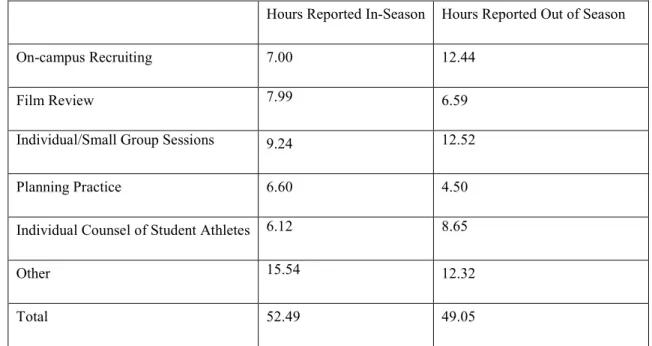
4.1 Reported Hours Worked per Week of Coaches……….……. 19
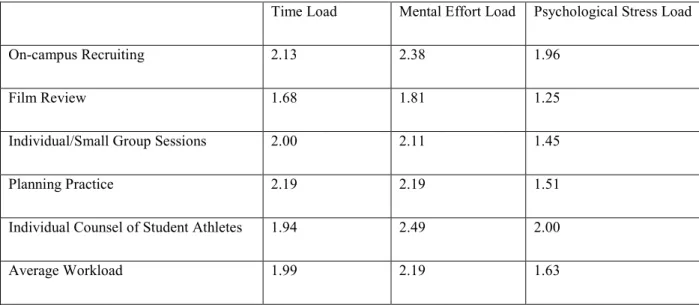
4.2 Reported Workload of Coaches……….. 20
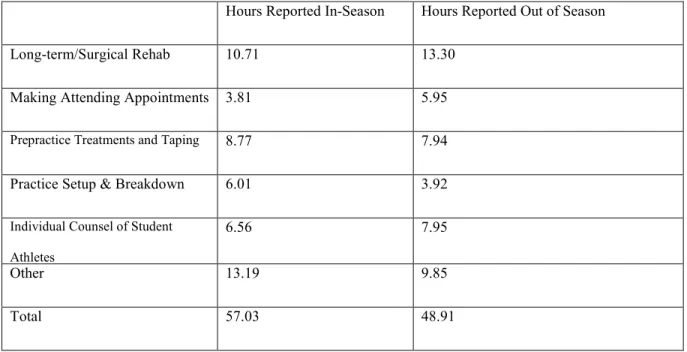
4.3 Reported Hours Worked per Week of ATC………21
4.4 Reported Workload Scores of ATC……….……... 21
LIST OF ABBREVIATIONS ATC Athletic Trainer
CHAPTER 1: INTRODUCTION
Student athletes are backed by the support system within their programs that give them the opportunity to be successful. This support system includes a coaching staff to provide
guidance in the tactile aspects of their specific sport and an athletic trainer to provide evaluation, management, and treatment of injuries or illnesses that negatively impact their health and
performance. While coaches and athletic trainers have different responsibilities, there is a time commitment associated with preparing the student athletes for practice and competition. This is the first study to examine workload expectations for athletic trainers as compared with college coaches. Typically, there are multiple coaches working with a college team, while there may be only one athletic trainer for the team—or sometimes only one athletic trainer serving many teams. By comparing workload, time load, and their impact on college coaches and athletic trainers, this study seeks to determine whether colleges and universities are treating coaches and athletic trainers fairly.
1.1 STATEMENT OF PURPOSE
The purpose of this study was to assess whether the workload of Division I, Olympic Sport collegiate coaches and athletic trainers are similar with regard to hours worked and stress load, and if the perception of these differ between the two.
1.2 RESEARCH QUESTIONS
were the average reported hours worked per week for athletic trainers? What were the reported workload of athletic trainers? What were the perceived hours worked and workload of college coaches to athletic trainers?
1.3 ASSUMPTIONS, LIMITATIONS, AND DELIMITATIONS
This was study will be conducted under the assumption that all survey questions were answered honestly by all respondents. It was also assumed all demographic information, reported time load, and perception of time load were accurately reported.
Limitations of this study included the potential bias of the sample as participants are voluntary. This study was also limited by the reported values, as the responses are subjective rather than objective.
The study was delimited to only NCAA Division I, Power 5, Olympic sport college coaches and athletic trainers. Football was intentionally excluded as the sport typically has larger full-time coaching staffs and more athletic trainers because of the size of the program and nature of the sport. This study also excluded Divisions II and III college coaches and athletic trainers, as these divisions may have a different duties and workload compared with Division I.
1.4 DEFINITIONS
For the purpose of this study, the following definitions were used:
• College coaches are those that provide tactical preparation for Division I student athletes.
• Athletic trainers are those who provide injury prevention, emergency care, evaluations,
treatment, and rehabilitation for student athletes.
• Workload was determined through time load.
• Duties/responsibilities of college coaches and athletic trainers are those found in the
literature.
• Burnout is a syndrome experienced by coaches and athletic trainers due to their daily
interpersonal interactions.
• Role strain is a factor of burnout that is also experienced by coaches and athletic trainers.
CHAPTER 2: LITERATURE REVIEW
In order to examine perceptions of coaches’ and athletic trainers’ responsibilities and determine whether they have similar workloads, previous research was examined. This review of literature includes the definition of burnout, how burnout affects athletic trainers and coaches, and what demands of each profession lead to burnout. From there, job descriptions for both collegiate coaches and athletic trainers are examined, and workload measurements were also explored.
2.1 ATHLETIC TRAINER DUTIES
Athletic trainers are required to complete a number of different tasks on a daily basis. These tasks are defined by both the National Athletic Trainers Association (NATA) and the National Collegiate Athletic Association (NCAA). For the purpose of this study, duties of the Division I athletic trainer are defined according to the NATA and those duties outlined in the NCAA Sport Medicine Handbook. The NATA has defined athletic trainers as “highly qualified, multi-skilled health care professionals who collaborate with physicians to provide preventative
services, emergency care, clinical diagnosis, therapeutic intervention, and rehabilitation of
injuries and medical conditions” (NATA, p.2) These duties are further outlined in the NCAA
Sports Medicine Handbook by breaking duties into five categories. The following list gives the categories and what is included in each:
• Medical Services
o Rehabilitation (short-term and long-term) o After-hours injury/illness management o Preseason physicals and screenings
o Event coverage (practice, competition, strength and conditioning) o Injury prevention programs
o Visiting team services as needed • Risk Management
o Environmental monitoring o Emergency action plans
o Mental health counseling and referrals o Nutrition suggestions
o Appropriate return to play decisions
o Communication and interpersonal skills to create trust between student athletes,
coaches, administrators, and athletic training staff
• Organizational and Administrative Tasks
o Budgeting
o Electronic record keeping o Credential maintenance
o Sports medicine team relations and staff scheduling o Insurance claims management
o Student athlete transport to medical appointments o Inventory management
o Staffing and workload management o Medical services
o Budget management o Academic success • Academics
o Teaching in athletic training programs o Psychological issues and referrals
o Student retention through return to play engagement
(NCAA Sports Medicine Handbook, 2014–15)
2.2 COACHING DUTIES
Fletcher and Scott (2010) discussed coaches being responsible for guiding “athletes’ improvements in physical, technical, mental, and tactical skills, as well as facilitating their personal and social development” (p. 127). The article also mentions that not only do coaches have sports instruction for players to consider but “they must also negotiate the increasing managerial and administrative duties associated with modern coaching” (Fletcher and Scott, 2010, p. 127).
In the book Sport Coaching: The Basics (Purdy, 2018), the point was made that “coaches highlighted their central purpose which was to improve athletes’/players’ sport performances. To do this, the coaches offered their support through a range of different activities including
preparing athletes for competition (Purdy 2018). Based on these definitions, this research will use performance coaching as the basis to describe college coaches. This is further supported by Lyle (2002), with his description of performance coaches as having the following characteristics:
• There is a more intensive commitment to a preparation program.
• There is a more obvious attempt to influence/control performance variables. • Individual performance components are identified separately in the program.
• Objectives are both long- and short-term, and specific competition goals are identified.
• The intervention of the coach is an integrated and progressive process. • Performers operate within recognized competition structures in their sport.
• Although delivery skills are important, there is more emphasis on decision-making and data
management—recording, monitoring, planning, and analysis.
• There is a more extensive interpersonal contact between coach and performer(s) (p. 54–55).
According to the article “CEOs in Headphones,” contracts for Division I football, and men’s basketball coaches were examined, and the following roles and duties of college coaches were listed:
• Instructor
• Fund raiser • Recruiter
• Academic advisor
• Public figure • Budget director
• Tv, radio, and internet personality
• Any other role that the university’s athletic director or president may direct them to do
(Greenberg & Park, 2014)
While specific day-to-day duties of coaches are limited in the literature, the previous research on the roles and responsibilities of athletic trainers and coaches help inform this research by
providing categories for comparison. Also, all of the previously mentioned aspects of coaching are used in extensive research on coaching burnout and role strain.
2.3 WORKLOAD
DeFrees and Mahalik (2017) state that “workload, role conflict, and control have been associated with athletic trainer burnout. (p. 28) Although there is still no consensus on the definition of workload-except that it is multidimensional (Johannsen, Moray, Pew, Rasmussen, Sanders, & Wickens, 1979) workload is often considered to be related to the concept of
"resources" or "residual resources" (Yeh & Wickens 1988). Yeh (1988) further went on to state that the “designers (of the subjective workload model) must confront the problem of indexing both the system of performance and the workload imposed by a specific design” (p.111).
2.4 BURNOUT AND ROLE STRAIN
The literature has used the term burnout in many different ways when looking at collegiate coaching and athletic training in order to explain the complexity of both fields.
Burnout was further defined by Kelley (1994) as a multidimensional syndrome that affects those working in helping professions, such as coaching, in which day-to day interpersonal interaction is an integral part of their workday. In a study of athletic trainers, DeFreese and Mahalik (2017) defined burnout as psychological cognitive affective syndrome driven by work-based perceptions of its three carefully defined dimensions: emotional exhaustion, depersonalization, and reduced accomplishment.
Throughout the literature, the number of athletes has been shown to be a stressor for athletic trainers and contribute to burnout (DeFreese & Mihalik, 2016; Hendrix, Acevedo & Hebert, 2000). The chances of experiencing burnout in athletic trainers increases based on the number of student athletes for whom they provide care. Below is a list of average team roster sizes, which provides insight to the number of student athletes per athletic trainer (NCAA Sports Participation and Rates Database, 2018).
Elements of collegiate athletics have contributed to burnout in each profession.
McChesney and Peterson (2005) stated that the “lack of downtime with athletics today poses a problem relative to the job satisfaction, and these time pressures can cause athletic trainers to leave the profession” (p. 9). Although this statement is specific to athletic trainers, it can be applied to coaches, as they too are experiencing less downtime.
In questioning what could cause burnout, Kelley and Gill (1993) concluded burnout results from prolonged exposure to experiences perceived as stressful. Burnout is also a response to chronic emotional strain of dealing extensively with other human beings, particularly when they are troubled or having problems (Kelley & Gill, 1993). Kelley and Gill (1993) explained the following stresses also lead to burnout and role strain in coaching:
• continuous and often emotionally volatile interactions with players; • the pressures of producing a winning team and handling defeat;
• long hours spent planning, practicing, traveling, and recruiting;
• hassles with scholarships and eligibility; • pressure from media coverage;
• dealing with expectations of parents and boosters (p. 95)
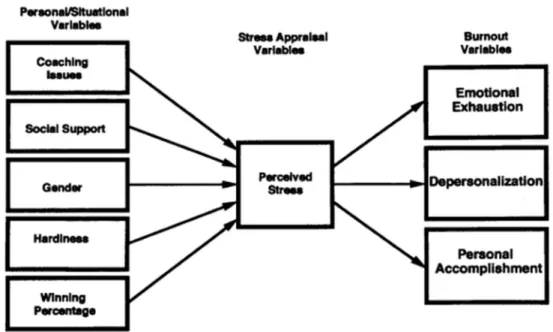
Figure 2.1. Smith Model of Burnout for Athletic Trainers (Hendrix, Acevedo, Hebert, 2000)
Figure 2.2. Smith Model of Burnout for Coaches Kelley, 1994)
compared with the remaining variables listed. Hardiness reflects one’s ability to control the events surrounding them, the level of commitment to each event, and the ability to embrace any challenges that may arise (Hendrix, Acevedo & Hebert, 2000).
In addition to hardiness, the Smith Model of Burnout also takes a list of variables associated with a position and assesses how those variables may affect perceived stress. The model then looks at the level of perceived stress and its effect on burnout variables. For both athletic trainers and coaches, there was shown to be a significant positive effect of job-related issues on perceived stress: 27% increase for athletic trainers and 31%–46% in coaches (Hendrix, Acevedo & Hebert, 2000; Kelley, 1994). The literature also shows that both professions report an increase in emotional exhaustion, with an increase in perceived stress: 59% of athletic trainers and 66%–70% of coaches (Hendrix, Acevedo & Hebert, 2000; Kelley, 1994).
Athletic trainers reported a 64% decrease in perceived stress with increased hardiness (Hendrix, Acevedo & Hebert, 2000). Both Hendrix and Kelley utilized the Hardiness Test established by Kobasa in 1988 to measure hardiness (Hendrix, Acevedo & Hebert, 2000; Kelley, 1994). Male coaches reported a 42% decrease in perceived stress, while female coaches reported a 19% decrease with increased hardiness (Kelley, 1994).
Both coaches and athletic trainers also report that personal accomplishment had a negative effect on perceived stress. Female coaches report 31% less perceived stress with increased personal accomplishment, while male coaches report up to 48% (Kelley, 1994). Athletic trainers, likewise, report a 21% decrease (Hendrix, Acevedo & Hebert, 2000).
(p. 374). Henning and Weidner (2008) used Goode’s role theory, stating this “theory suggests that in general, people want to fulfill all of the expectations placed upon them” (p. 275). The aspects of role strain that are discussed throughout the research are role ambiguity, role overload, role incongruity, role incompetence, and role conflict (Brumels & Beach, 2008; Dorrel, Symonds & Lammert, 2014; Henning & Weidner, 2008).
While the literature supports the burnout and role strain of college coaches and athletic trainers individually, there has yet to be a comparison of the two. This research seeks to use the similarities in burnout to show comparable workloads, despite the differences in specific job duties. This is important in college athletics because college coaches and athletic trainers
CHAPTER 3: METHODOLOGY
3.1 PARTICIPANTS
Participants of this study were any Division I, Power 5, Olympic Sport coach and athletic trainer.
3.2 INSTRUMENTATION
The instrumentation of this study was through an online survey. All participants were asked to provide demographic information about current position, number of years in that position, sport involvement, and number of student athletes on current team(s).
Figure 3.1. Subjective Workload Assessment Technique (SWAT) Rating Scale Dimensions
Coaches self-reported workload by answering questions related to the number of hours spent per week on each of the following duties: recruiting (in-office/on-campus), film review, individual/small group skill instruction, planning practice, and individual counsel. Coaches were also offered a text box that allowed them to list remaining duties that may not be included in survey (e.g., off campus recruiting). Coaches were also asked about their perception of their athletic trainers by comparing their hours worked per week and workload to that of their athletic trainer, using a Likert scale of “less than,” “similar to,” or “more than.”
Athletic trainers self-reported workload by answering questions related to the number of hours per week spent on each of the following duties: long-term/surgical rehabilitation,
hours worked per week and workload to that of their athletic trainer, using a Likert scale of “less than,” “similar to,” or “more than.”
3.3 RECRUITMENT
Participants were recruited by email. Coach participants were recruited using the NCAA Division I coaching database. Athletic training participants were recruited using information provided on the public websites of the institutions.
3.4 DATA ANALYSIS
After the data were collected, SPSS was used to analyze descriptive statistics to
CHAPTER 4: RESULTS
4.1 DEMOGRAPHICS
Recruitment for the survey was done by email contact by the primary investigator. A total of 4,157 emails were sent to Division I Power 5 coaches, with 97 responses. A total of 691 emails were sent to Division I Power 5 athletic trainers, with 142 responses. Completed surveys with football-related responsibilities were removed from the data for both coaches and athletic trainers, as this is a limitation of the study. Coach responses were also not included if the respondent listed their current position as something other than coach-related (i.e., director or operations, administrator). All comparison numbers for reported values have an n of 81 college coaches and an n of 137 athletic trainers. After responses were removed, the response rate was 1.9% for college coaches and 19.8% for athletic trainers.
For perceived workload and hours worked, there was a lower response rate of 63 college coaches and 105 athletic trainers. This response rate was 1.5% for coaches and 15.2% for athletic trainers.
College coaches reported an average of 10.9 years in their current position and an average of 21.1 years in the profession as a whole. This was compared with college athletic trainers, who reported an average of 5.5 years in their current position and 10.5 years in the profession as a whole.
(2), swimming and diving (9), track and field (11), cross country (1), field hockey (3), volleyball (6), ice hockey (0), golf (6), men’s tennis (0), women’s tennis (3), and other (8); other sports reported were fencing, beach volleyball, rowing, cheerleading, and rugby (Figure 4.1).
The 137 athletic trainers surveyed worked the following sports: men’s basketball (12), women’s basketball (18), baseball (12), softball (7), men’s soccer (2), women’s soccer (15), men’s lacrosse (1), women’s lacrosse (4), men’s gymnastics (1), women’s gymnastics (4), wrestling (5), swimming and diving (8), track and field (13), cross country (2), field hockey (7), volleyball (10), ice hockey (2), golf (0), men’s tennis (0), women’s tennis (1), and other (15); other sports reported were rugby, water polo/swimming and diving, cheerleading, rowing, no sport assignment (Figure 4.1).
Figure 4.1. Sports Breakdown
5 11 2 8 1 12 3 0 1 0 2 9 11 1 3 6 0 6 0 3 8 12 18 12 7 2 15 1 4 1 4 5 8 13 2 7 10 2 0 0 1 15 0 2 4 6 8 10 12 14 16 18 20
Sport Breakdown
Of the athletic trainers surveyed, 105 reported having one primary sport, while 34 reported having two primary sports (Figure 4.3). It was assumed that coaches surveyed did not have another sport. The list of additional primary sports is as follows: softball (1), women’s gymnastics (2), track and field (3), cross country (1), golf (1), men’s tennis (3), women’s tennis (3), and other (11). No other sports were listed.
4.2 REPORTED HOURS WORKED AND WORKLOAD
Coaches reported their weekly hours spent on the following activities for both the NCAA competition season and non-NCAA competition season: on-campus recruiting, film review, individual/small group sessions, planning practice, individual counsel of student athletes, and other. Average hours per week for each task is listed below in Table 4.1. Respondents who reported more than 100 hours per week were excluded in order to normalize data. With this adjustment, there were 68 coaches for in season hours and 57 coaches for out of season hours. Response rates of 1.6% and 1.3% respectively.
Hours Reported In-Season Hours Reported Out of Season On-campus Recruiting 7.00 12.44
Workload scores were reported on a scale of 1–3 for time load, mental effort load, and psychological stress load for the same activities. Average individual scores are listed, along with the average total score reported (Figure 4.2).
Time Load Mental Effort Load Psychological Stress Load On-campus Recruiting 2.13 2.38 1.96
Film Review 1.68 1.81 1.25 Individual/Small Group Sessions 2.00 2.11 1.45 Planning Practice 2.19 2.19 1.51 Individual Counsel of Student Athletes 1.94 2.49 2.00 Average Workload 1.99 2.19 1.63 Table 4.2. Reported Workload of Coaches
Hours Reported In-Season Hours Reported Out of Season Long-term/Surgical Rehab 10.71 13.30
Making Attending Appointments 3.81 5.95
Prepractice Treatments and Taping 8.77 7.94 Practice Setup & Breakdown 6.01 3.92
Individual Counsel of Student Athletes
6.56 7.95 Other 13.19 9.85 Total 57.03 48.91 Table 4.3. Reported Hours Worked per Week of ATC
Workload scores were reported on a scale of 1–3 for time load, mental effort load, and psychological stress load for the same activities. Average individual scores are listed, along with average total score reported (Figure 4.4).
Time Load Mental Effort Load Psychological Stress Load Long-term/Surgical
Rehab
2.24 2.25 1.79
Making Attending Appointments
1.96 1.39 1.42
Prepractice Treatments and Taping
2.20 1.63 1.54
Practice Setup & Breakdown
1.45 1.03 1.06
Individual Counsel of Student Athletes
2.09 2.35 2.07
4.3 PERCEIVED HOURS WORKED AND WORKLOAD
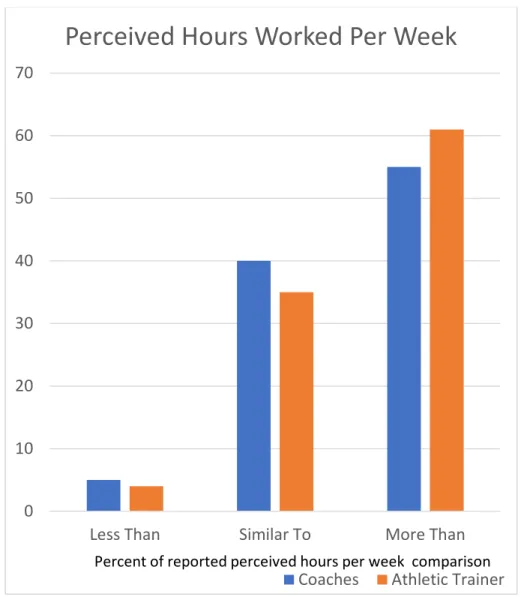
Of 63 coaches, three stated that their average hours reported was less than their athletic trainer, 25 stated that their hours reported were similar to that of their athletic trainer, and 35 stated that their reported hours worked were more than that of their athletic trainer (Figure 4.2). Of 105 athletic trainers, 4 stated that their average hours reported was less than their coaching staff, 37 stated that their hours reported are similar to that of their coaching staff, and 64 stated that their reported hours worked are more than that of their coaching staff (Figure 4.2).
Figure 4.2. Perceived Hours Worked of Coaches and Athletic Trainers
0 10 20 30 40 50 60 70
Less Than Similar To More Than
Perceived Hours Worked Per Week
Coaches Athletic Trainer
Of 63 coaches, one stated that their average workload reported was less than their athletic trainer, 31 stated that their workload reported was similar to that of their athletic trainer, and 31 stated that their reported workload was more than that of their athletic trainer (Figure 4.3). Of 105 athletic trainers, four stated that their average workload reported was less than their coaching staff, 40 stated that their workload reported was similar to that of their coaching staff, and 60 stated that their reported workload more than that of their coaching staff (Figure 4.3).
Figure 4.3. Perceived Workload of Coaches and Athletic Trainers
4.4 RESULTS
Using SPSS, an independent t test was used to analyze averages reported. An alpha of .05 was used to determine statistical significance (Table 4.5).
0 10 20 30 40 50 60
Less Than Similar To More Than
Perceived Workload
Coaches Athletic Trainer
Coaches Athletic Trainers Difference (df) Significance (p
Value) Years in Current
Position
10.9 5.5 −5.077 <0.006*
Years in Profession 21.1 10.5 −8.696 .041* Roster Size 37.1 38.95 .429 .871 Reported Hours in
season
52.49 57.03 1.581 .266
Reported Hours out of season
49.07 48.91 -.062 .685
Time Load 1.99 1.99 0.00 .436 Mental Effort Load 2.19 1.72 −1.679 .070 Psychological Stress
Load
1.63 1.57 -.257 .954
Table 4.5. Statistical Analysis *Statistical significance.
Using SPSS, a chi-square analysis was used to determine the expected values of perception of hours reported and workload reported. An alpha of .05 was used to determine statistical significance.
CHAPTER 5: DISCUSSION
5.1 REPORTED HOURS WORKED PER WEEK
The hypothesis that there is no significant statistical difference between reported hours worked per week was supported by this research. This was shown in both NCAA competition season and NCAA non-competition season.
The reported hours worked per week for both college coaches and athletic trainers, could explain the high burnout rates of both. The average college academic schedule is an average of 16 weeks per semester or 32 weeks per year. Therefore, averaging 50 hour work weeks for 61% of the calendar year. This will become a factor as out-of-season and summer workouts become more normalized among Olympic sports, increasing the number of weeks possibly working 50 hours and therefore the risk of burnout.
It should also be noted that the hours reported per week in this study did not include practice, games or travel. Practice itself ranges from 8 to 20 hours per week as allowed by the NCAA depending on the time of year. Games are documented as 3 hours per event by the NCAA, however most gameday preparations begin at least 4 hours before the start of
competition. And travel varies based on the sport, but for division I includes typically includes at least one night in a hotel.
Previous literature also stated that “lack of downtime with athletics today” (McChesney and Peterson, p.9) and “chronic emotional strain of dealing extensively with other human beings” (Kelley & Gill, 1993) are contributing factors in burnout of college coaches and athletic trainers.
5.2 REPORTED WORKLOAD
Workload was measured using the subjective workload assessment technique. “The SWAT technique is comprised of three factors: time load, mental effort load, and psychological stress load” (Reid, 1985).
There was no significant difference found in the average time load reported, which was 1.99 for both college coaches and athletic trainers. This is also supported by the similarity in the average hours per week reported by both college coaches and athletic trainers.
There was not significant difference found in the reported mental effort load between college coaches and athletic trainers. Coaches were found to have a slightly higher self-reported mental effort load, with an average of 2.19 compared with an average of 1.73 by athletic trainers. This is explained by more coaches reporting individual counsel of student athletes as a 3, which corresponds to “extensive mental effort and concentration are necessary; very complex activity requiring total attention.”
There was also no significant difference found between the psychological stress load of college coaches and athletic trainers. College coaches reported an average score of 1.57, and athletic trainers reported an average of 1.63. Both groups reported that little confusion, risk, frustration, or anxiety exists and that tasks can be easily accomplished when completing the tasks associated with their position on average.
duties may vary, the workloads associated with those duties are comparable. Again, the data shows both groups are putting in not only the hours to support their respective programs and institutions but the effort within those hours.
5.3 PERCEPTIONS
A chi-square analysis was done as a predictor of expected values for responses regarding perception. The analysis showed that for the sample population, the reported values of both “similar to” or “more than” their counterpart are within the expected values. This disproves the hypothesis that there is a disparity in the perception between college coaches and athletic trainers. It proves that both groups are aware that while there is a small percentage that believes they are doing more, there is also a comparable percentage that believes the two groups are doing similar work. This shows that there is some awareness of the time and workload that is being put in from both sides.
5.4 INCIDENTAL FINDINGS
The response rate between the groups can be explained based on the number of initial emails sent out. With 3,466 more emails sent out to coaches, there is no wonder why the response rate was shown to be lower than athletic trainers. Instead, the focus should be on the number of responses being comparable between the two groups. With the normalization of the data there was a difference of less than 50 respondents.
see this as a reason to dictate the duties of the athletic trainer, although the jobs are different. This is seen in coaches suggesting when treatment or rehab times should be held or even what types of treatment should be given to the student-athletes. In-turn, this can add to the risk of burnout in athletic trainers due to decreased hardiness. Hardiness is defined as a reflection of one’s ability to control the events surrounding them (Hendrix, Acevedo & Hebert, 2000).
This difference can also be thought to be based on a number of reasons. The first is thought to be a matter of control. Although the hours reported are similar, college coaches have more control over their hours than athletic trainers. It is the coach’s responsibility to schedule the date, time, and length of team practices. This was reported by multiple coaches as “other duties.” The athletic trainers are therefore required to adjust their duties and time demands once a
schedule is given and adjust to any changes that are made. Also listed in “other duties” by college coaches is recruiting and the amount of time required of coaches to dedicate to recruiting correspondence. This leads to college coaches being able to determine the patient population for athletic trainers. Although most health care professionals do not get to choose their patient population, they are also not required to spend an average of over 50 hours a week with the populations. In fact, clinic professionals such as physical therapists are typically held to a strict 40 hour work week. With the ability to have more control of the hours worked, it can be argued that this has contributed to college coaches staying in their position and/or professions twice as long as athletic trainers.
“The average compensation in softball has increased by an average of almost 62% across the Power Five from 2013 to 2018, with 11 schools paying more than $400,000. Among the eight SEC schools that sponsor women’s gymnastics, average coach compensation was $315,860 in 2018. For the other four leagues, the average was $196,068. In baseball, the average head coach compensation has increased from $430,228 to $651,445 between 2013 and 2018. At least 12 men’s golf coaches totaled more than $300,000 in compensation for 2018, 17 women’s soccer coaches and 10 men’s soccer coaches surpassed $250,000. Additionally, the average paid to wrestling coaches in the Power 5 increased by 55% to $266,000” (Berkowitz, Wolken & DeMeyer 2019).
In contrast, the average salary of a collegiate athletic trainer ranges from “$38,000 to $79,662” (nata.org 2018).
If the reported hours worked are similar, and the reported workload is similar, and the perception is such that both coaches and athletic trainers are similar, why is there such a
difference in pay? The NATA has done surveys of athletic training salaries comparing salaries of physical therapists and other medical professionals; however, there has never been a comparison with coaches. The previous comparisons to health care professionals are based on education and certification requirements. Athletic trainers are required to maintain national certification and state licensure. Coaches have no such requirements. This research proves that college coaches and athletic trainers have comparable work hours and workload. Therefore, comparable salary c could be warranted.
chief medical officer of that particular team. As mentioned earlier the athletic trainer is responsible for all medical decisions that go into their particular team. Further research on athletic trainer salaries relative to workload and burn-out is needed.
5.5 CONCLUSION
In conclusion, it has been shown that there is no statistical difference in the self-reported hours or workload of college coaches and athletic trainers. Nor is there a statistical difference in the hour per week or the workload as perceived of one regarding the other. Therefore, both groups should be treated as peers. Treating each other as peers starts at the most basic level of verbal acknowledgment and awareness of one another. Coaches can be more aware that as health care professionals, athletic trainers are responsible for maintaining certifications and licensure and the documentation involved with these. Athletic trainers are also responsible for all aspects of the athlete’s health care and the appointments and correspondence that goes along with it. Likewise, athletic trainers need to acknowledge that coaches are responsible for all aspects of the program. This includes academics, facilities, recruiting, and more. Both parties can be more aware that while there are a lot of similarities, there are still differences.
Although the hypothesis that there is a difference in perception of hours and workload is not supported by the statistics in this research, it should be of comfort to both college coaches and athletic trainers to know that the staff around you not only puts in similar time and effort but acknowledges that you do, as well. This is easily forgettable while you are in the middle of a 60-hour work week. This research should serve as a helpful reminder.
athletic trainers should acknowledge the number of responsibilities that are required of the head coach, suggestions should only be made in regard to the health and safety of the student-athletes. Likewise, while a coach may have been in their position twice as long as their athletic trainer, decisions regarding the health and safety of the student-athlete should be left to that of the athletic trainer.
5.6 FUTURE RESEARCH
Because this particular study was limited to Division I Olympic sports, further research could be done to compare college coaches and athletic trainers at both Division II and Division III levels. Each of these divisions comes with their own unique criteria regarding duties and scheduling. Comparing them could provide further information for that study population.
Because this is first impression research, further research could be done comparing other athletic department employees. Keeping with the theme of student-athlete facing staff, research could compare coaches and/or athletic trainers to strength and conditioning coaches, sports information directors, and directors of operations. In addition to student-athlete facing staff, research could also be done to compare both hours and workload of operations and facility personnel.
APPENDIX 1: COACH SURVEY
Reported versus Perceived Workload of
College Coaches and Athletic Trainers
Start of Block: Default Question Block
Q7 What is your current position/title?
________________________________________________________________
Q8 How many years have you been in your current position?
________________________________________________________________
Q11 How many total years do you have in the coaching profession?
________________________________________________________________
Q9 Current institution of employment?
________________________________________________________________
Q10 How many years have you been at your current institution?
________________________________________________________________
Q17 What sport do you coach?
▼ Basketball (Men's) (4) ... Other (24)
Display This Question:
If What sport do you coach? = Other
Q18 Define Other:
________________________________________________________________
Q14 How many athletes are on your current roster?
________________________________________________________________
Q3 Please report the number of hours spent per week, during your NCAA COMPETITION SEASON, for each of the following tasks:
0 10 20 30 40 50 60
On-campus Recruiting ()
Film Review ()
Individual/Small Group Skill Sessions ()
Planning Practice ()
Individual Counsel of student athletes ()
Other ()
Q34 Define other:
________________________________________________________________
Q22 Please report the number of hours spent per week, during your NCAA NON-COMPETITION SEASON, for each of the following tasks:
0 10 20 30 40 50 60
On-campus Recruiting ()
Film Review ()
Individual/Small Group Skill Sessions ()
Planning Practice ()
Individual Counsel of student athletes ()
Other ()
Q24 Define other:
________________________________________________________________
Q5 Using the information provided below, assign each task a score of 1-3 for time load, mental effort load, and psychological stress:
Time Load:
1. Often have spare time. Interruptions or overlap among activities occur infrequently or not at all.
2. Occasionally have spare time. Interruptions or overlap among activities occur infrequently. 3. Almost never have spare time. Interruptions or overlap among activities are very frequent or occur all the time.
Mental Effort Load:
1. Very little conscious mental effort or concentration required. Activity is almost automatic, requiring little or no attention.
2. Moderate conscious mental effort or concentration required. Complexity of activity is moderately high due to uncertainty, unpredictability, or unfamiliarity. Considerable attention required.
3. Extensive mental effort and concentration are necessary. Very complex activity requiring total attention.
Psychological Stress Load:
1. Little confusion, risk, frustration, or anxiety exists and can be easily accomplished. 2. Moderate stress due to confusion, frustration, or anxiety noticeably adds to workload. Significant compensation is required to maintain adequate performance.
3. High to very intense stress due to confusion, frustration, or anxiety. High extreme determination and self-control required.
Time Load Mental Effort Load Psychological Stress Load
On-campus Recruiting
(Q2_1)
o
o
o
o
o
o
o
o
o
Film Review
(Q2_2)
o
o
o
o
o
o
o
o
o
Individual/Small Group Skills
Instruction (Q2_3)
o
o
o
o
o
o
o
o
o
Planning
Practice (Q2_4)
o
o
o
o
o
o
o
o
o
Individual Counsel of
student athletes (Q2_5)
o
o
o
o
o
o
o
o
o
Q4 Estimate the number of hours per week your athletic trainer spends with your team on tasks such as long-term rehabilitation, making/attending appointments, prepractice treatments and taping, practice setup and breakdown, and individual counsel of student athletes
0 10 20 30 40 50 60
Estimated number hours my athletic trainer spends with my team ()
Q5 Looking at your reported hours per week, how would you compare to the hours spent by your athletic trainer?
Less than my Athletic Trainer (1)
Similar to my Athletic Trainer (2)
More than my Athletic Trainer (3)
Your hours worked compared with the number of hours your Athletic Trainer works
per week (1)
o
o
o
Q6 Looking at your reported workload, how would you compare to the workload of your athletic trainer?
Less than my Athletic Trainer (1)
Similar to my Athletic Trainer (2)
More than my Athletic Trainer (3)
Your workload compared with your
Athletic Trainer's workload (1)
o
o
o
APPENDIX 2: ATHLETIC TRAINER SURVEY
Reported versus Perceived Workload of
College Coaches and Athletic Trainers (ATC2)
Start of Block: Default Question Block
Q1 What is your current position/title?
________________________________________________________________
Q2 How many years have you been in your current position?
________________________________________________________________
Q3 How many total years have you worked as a full time athletic trainer?
________________________________________________________________
Q4 Current institution of employment?
________________________________________________________________
Q5 How many years have you been at your current institution?
________________________________________________________________
Q6 Do you have one primary sport?
o
YES (1)o
NO (2)Skip To: End of Block If Do you have one primary sport? = YES
Display This Question:
If Do you have one primary sport? = NO
Q7 How many primary sports do you have?
o
2 (1)o
3 (2)Skip To: End of Block If How many primary sports do you have? = 2
Skip To: End of Block If How many primary sports do you have? = 3
End of Block: Default Question Block
Start of Block: Three Primary Sports
Q8 Choose your sport assignment.
Display This Question:
If Choose your sport assignment. = Other
Q40 Define Other:
________________________________________________________________
Q9 How many athletes are on your current roster for this sport?
________________________________________________________________
Q10 For the sport named above, please report the number of hours spent per week, during your NCAA COMPETITION SEASON, for each of the following tasks:
0 10 20 30 40 50 60
Long-term/Surgical Rehabilitation ()
Making/Attending Appointments ()
Prepractice Treatments and Taping ()
Practice Setup and Breakdown ()
Individual Counsel of Student Athletes ()
Other ()
Q11 Define other:
________________________________________________________________
Q12 Please report the number of hours spent per week, during your NCAA NON-COMPETITION SEASON, for each of the following tasks:
0 10 20 30 40 50 60
Long-term/Surgical Rehabilitation ()
Making/Attending Appointments ()
Prepractice Treatments and Taping ()
Practice Setup and Breakdown ()
Individual Counsel of Student Athletes ()
Other ()
Q13 Define other:
________________________________________________________________
Q14 Using the information provided below, assign each task a score of 1-3 for time load, mental effort load, and psychological stress:
Time Load:
1. Often have spare time. Interruptions or overlap among activities occur infrequently or not at all.
2. Occasionally have spare time. Interruptions or overlap among activities occur infrequently. 3. Almost never have spare time. Interruptions or overlap among activities are very frequent or occur all the time.
Mental Effort Load:
1. Very little conscious mental effort or concentration required. Activity is almost automatic, requiring little or no attention.
2. Moderate conscious mental effort or concentration required. Complexity of activity is moderately high due to uncertainty, unpredictability, or unfamiliarity. Considerable attention required.
3. Extensive mental effort and concentration are necessary. Very complex activity requiring total attention.
Psychological Stress Load:
1. Little confusion, risk, frustration, or anxiety exists and can be easily accomplished. 2. Moderate stress due to confusion, frustration, or anxiety noticeably adds to workload. Significant compensation is required to maintain adequate performance.
3. High to very intense stress due to confusion, frustration, or anxiety. High extreme determination and self-control required.
Time Load Mental Effort Load Psychological Stress Load
Long-term/Surgical Rehabilitation
(Q2_1)
o
o
o
o
o
o
o
o
o
Making/Attending Appointments
(Q2_2)
o
o
o
o
o
o
o
o
o
Prepractice Treatments and
Taping (Q2_3)
o
o
o
o
o
o
o
o
o
Practice Setup and Breakdown
(Q2_4)
o
o
o
o
o
o
o
o
o
Individual Counsel of Student Athletes
(Q2_5)
o
o
o
o
o
o
o
o
o
Q15 Estimate the number of hours per week your coaching staff spends with your team on tasks such as on-campus recruiting, film review, individual small group skill instruction, planning practice, and individual counsel of student athletes.
0 10 20 30 40 50 60
Estimated number hours my coaching staff spends with my team ()
Q16 Looking at your reported hours per week, how would you compare to the hours spent by your coaching staff?
Less than my coaching staff (1)
Similar to my coaching staff (2)
More than my coaching staff (3)
Your hours worked compared with the number of hours your
coaching staff works per week (1)
o
o
o
Q17 Looking at your reported workload, how would you compare to the workload of your coaching staff?
Less than my coaching staff (1)
Similar to my coaching staff (2)
More than my coaching staff (3)
Your workload compared with your
coaching staff's workload (1)
o
o
o
Display This Question:
If How many primary sports do you have? = 2
Or How many primary sports do you have? = 3
Q18 Choose your sport assignment.
▼ Basketball (Men's) (4) ... Other (24)
Display This Question:
If How many primary sports do you have? = 2
And How many primary sports do you have? = 3
And Choose your sport assignment. = Other
Q41 Define Other:
________________________________________________________________
Display This Question:
If How many primary sports do you have? = 2
Or How many primary sports do you have? = 3
Q19 How many athletes are on your current roster for the sport named above?
________________________________________________________________
Display This Question:
If How many primary sports do you have? = 2
Or How many primary sports do you have? = 3
Q20 For the sport named above, please report the number of hours spent per week, during your NCAA COMPETITION SEASON, for each of the following tasks:
0 10 20 30 40 50 60
Long-term/Surgical Rehabilitation ()
Making/Attending Appointments ()
Prepractice Treatments and Taping ()
Practice Setup and Breakdown ()
Individual Counsel of Student Athletes ()
Other ()
Display This Question:
If How many primary sports do you have? = 2
Or How many primary sports do you have? = 3
Q21 Define other:
________________________________________________________________
Display This Question:
If How many primary sports do you have? = 2
Or How many primary sports do you have? = 3
Q22 Please report the number of hours spent per week, during your NCAA NON-COMPETITION SEASON, for each of the following tasks:
0 10 20 30 40 50 60
Long-term/Surgical Rehabilitation ()
Making/Attending Appointments ()
Prepractice Treatments and Taping ()
Practice Setup and Breakdown ()
Individual Counsel of Student Athletes ()
Other ()
Display This Question:
If How many primary sports do you have? = 2
Or How many primary sports do you have? = 3
Q23 Define other:
________________________________________________________________
Display This Question:
If How many primary sports do you have? = 2
Or How many primary sports do you have? = 3
Q24 Using the information provided below, assign each task a score of 1-3 for time load, mental effort load, and psychological stress:
Time Load:
1. Often have spare time. Interruptions or overlap among activities occur infrequently or not at all.
2. Occasionally have spare time. Interruptions or overlap among activities occur infrequently. 3. Almost never have spare time. Interruptions or overlap among activities are very frequent or occur all the time.
Mental Effort Load:
1. Very little conscious mental effort or concentration required. Activity is almost automatic, requiring little or no attention.
2. Moderate conscious mental effort or concentration required. Complexity of activity is moderately high due to uncertainty, unpredictability, or unfamiliarity. Considerable attention required.
3. Extensive mental effort and concentration are necessary. Very complex activity requiring total attention.
Psychological Stress Load:
1. Little confusion, risk, frustration, or anxiety exists and can be easily accomplished. 2. Moderate stress due to confusion, frustration, or anxiety noticeably adds to workload. Significant compensation is required to maintain adequate performance.
3. High to very intense stress due to confusion, frustration, or anxiety. High extreme determination and self-control required.
Time Load Mental Effort Load Psychological Stress Load
Long-term/Surgical Rehabilitation
(Q2_1)
o
o
o
o
o
o
o
o
o
Making/Attending Appointments
(Q2_2)
o
o
o
o
o
o
o
o
o
Prepractice Treatments and
Taping (Q2_3)
o
o
o
o
o
o
o
o
o
Practice Setup and Breakdown
(Q2_4)
o
o
o
o
o
o
o
o
o
Individual Counsel of Student Athletes
(Q2_5)
o
o
o
o
o
o
o
o
o
Display This Question:
If How many primary sports do you have? = 2
Or How many primary sports do you have? = 3
Q25 Estimate the number of hours per week your coaching staff spends with your team on tasks such as on-campus recruiting, film review, individual small group skill instruction, planning practice, and individual counsel of student athletes.
0 10 20 30 40 50 60
Estimated number hours my coaching staff spends with my team ()
Display This Question:
If How many primary sports do you have? = 2
Or How many primary sports do you have? = 3
Q26 Looking at your reported hours per week, how would you compare to the hours spent by your coaching staff?
Less than my coaching staff (1)
Similar to my coaching staff (2)
More than my coaching staff (3)
Your hours worked compared with the number of hours your
coaching staff works per week (1)
o
o
o
Display This Question:
If How many primary sports do you have? = 2
Q27 Looking at your reported workload, how would you compare to the workload of your coaching staff?
Less than my coaching staff (1)
Similar to my coaching staff (2)
More than my coaching staff (3)
Your workload compared with your
coaching staff's workload (1)
o
o
o
Display This Question:
If How many primary sports do you have? = 3
Q28 Choose your sport assignment.
▼ Basketball (Men's) (4) ... Other (24)
Display This Question:
If How many primary sports do you have? = 3
And Choose your sport assignment. = Other
Q42 Define Other:
________________________________________________________________
Display This Question:
If How many primary sports do you have? = 3
Q29 How many athletes are on your current roster of the sport named above?
________________________________________________________________
Display This Question:
If How many primary sports do you have? = 3
Q30 For the sport named above, please report the number of hours spent per week, during your NCAA COMPETITION SEASON, for each of the following tasks:
0 10 20 30 40 50 60
Long-term/Surgical Rehabilitation ()
Making/Attending Appointments ()
Prepractice Treatments and Taping ()
Practice Setup and Breakdown ()
Individual Counsel of Student Athletes ()
Other ()
Display This Question:
If How many primary sports do you have? = 3
Q31 Define other:
________________________________________________________________
Display This Question:
If How many primary sports do you have? = 3
Q32 Please report the number of hours spent per week, during your NCAA NON-COMPETITION, for each of the following tasks:
0 10 20 30 40 50 60
Long-term/Surgical Rehabilitation ()
Making/Attending Appointments ()
Prepractice Treatments and Taping ()
Practice Setup and Breakdown ()
Individual Counsel of Student Athletes ()
Other ()
Display This Question:
If How many primary sports do you have? = 3
Q33 Define other:
________________________________________________________________
Display This Question:
If How many primary sports do you have? = 3
Q36 Using the information provided below, assign each task a score of 1-3 for time load, mental effort load, and psychological stress:
Time Load:
1. Often have spare time. Interruptions or overlap among activities occur infrequently or not at all.
2. Occasionally have spare time. Interruptions or overlap among activities occur infrequently. 3. Almost never have spare time. Interruptions or overlap among activities are very frequent or occur all the time.
Mental Effort Load:
1. Very little conscious mental effort or concentration required. Activity is almost automatic, requiring little or no attention.
2. Moderate conscious mental effort or concentration required. Complexity of activity is moderately high due to uncertainty, unpredictability, or unfamiliarity. Considerable attention required.
3. Extensive mental effort and concentration are necessary. Very complex activity requiring total attention.
Psychological Stress Load:
1. Little confusion, risk, frustration, or anxiety exists and can be easily accomplished. 2. Moderate stress due to confusion, frustration, or anxiety noticeably adds to workload. Significant compensation is required to maintain adequate performance.
3. High to very intense stress due to confusion, frustration, or anxiety. High extreme determination and self-control required.
Time Load Mental Effort Load Psychological Stress Load
Long-term/Surgical Rehabilitation
(Q2_1)
o
o
o
o
o
o
o
o
o
Making/Attending Appointments
(Q2_2)
o
o
o
o
o
o
o
o
o
Prepractice Treatments and
Taping (Q2_3)
o
o
o
o
o
o
o
o
o
Practice Setup and Breakdown
(Q2_4)
o
o
o
o
o
o
o
o
o
Individual Counsel of Student Athletes
(Q2_5)
o
o
o
o
o
o
o
o
o
Display This Question:
If How many primary sports do you have? = 3
Q37 Estimate the number of hours per week your coaching staff spends with your team on tasks such as on-campus recruiting, film review, individual small group skill instruction, planning practice, and individual counsel of student athletes.
0 10 20 30 40 50 60
Estimated number hours my coaching staff spends with my team ()
Display This Question:
If How many primary sports do you have? = 3
Q38 Looking at your reported hours per week, how would you compare to the hours spent by your coaching staff?
Less than my coaching staff (1)
Similar to my coaching staff (2)
More than my coaching staff (3)
Your hours worked compared with the number of hours your
coaching staff works per week (1)
o
o
o
Display This Question:
If How many primary sports do you have? = 3
Q39 Looking at your reported workload, how would you compare to the workload of your coaching staff?
Less than my coaching staff (1)
Similar to my coaching staff (2)
More than my coaching staff (3)
Your workload compared with your
coaching staff's workload (1)
APPENDIX 3: CONSENT LETTER Certified Athletic Trainers
REPORTED VERSUS PERCEIVED WORKLOAD OF COLLEGE COACHES AND ATHLETIC TRAINERS
The purpose of this research project is to compare your reported hours per week and workload per week to that of your current coaching staff. Your participation in this research study is voluntary. You may choose not to participate. If you decide to participate in this research survey, you may withdraw at any time. If you decide not to participate in this study or if you withdraw from participating at any time, you will not be penalized. The procedure involves filling out an online survey that will take approximately 5–12 minutes. Your responses will be confidential, and we do not collect identifying information such as your name or IP address. We will do our best to keep your information confidential and your data will not be linked back to you in any way. To help protect your confidentiality, the surveys will not contain information that will personally identify you. The results of this study will be used for research purposes only. All data are stored in a password protected electronic format. Please answer as honestly as possible.
You can also call me (Nicole Alexander; principal investigator) at 919-962-2067 with questions about the research study. All research on human volunteers is reviewed by a committee that works to protect your rights and welfare. If you have questions or concerns about your rights as a research subject you may contact, anonymously if you wish, the Institutional Review Board at 919-966-3113 or by email to [email protected].
Clicking on the "agree" button below indicates that: • you have read the above information
• you voluntarily agree to participate • you are at least 18 years of age
I agree / disagree to participate in the following study.
College Coaches
REPORTED VERSUS PERCEIVED WORKLOAD OF COLLEGE COACHES AND ATHLETIC TRAINERS
The purpose of this research project is to compare your reported hours per week and workload per week to that of your current athletic trainer. Your participation in this research study is voluntary. You may choose not to participate. If you decide to participate in this research survey, you may withdraw at any time. If you decide not to participate in this study or if you withdraw from participating at any time, you will not be penalized. The procedure involves filling out an online survey that will take approximately 5–10 minutes. Your responses will be confidential, and we do not collect identifying information such as your name or IP address. We will do our best to keep your information confidential and your data will not be linked back to you in any way. To help protect your confidentiality, the surveys will not contain information that will personally identify you. The results of this study will be used for research purposes only. All data are stored in a password protected electronic format. Please answer as honestly as possible.
You can also call me (Nicole Alexander; principal investigator) at 919-962-2067 with questions about the research study. All research on human volunteers is reviewed by a committee that works to protect your rights and welfare. If you have questions or concerns about your rights as a research subject you may contact, anonymously if you wish, the Institutional Review Board at 919-966-3113 or by email to [email protected].
Clicking on the "agree" button below indicates that: • you have read the above information
• you voluntarily agree to participate • you are at least 18 years of age
I agree / disagree to participate in the following study.
REFERENCES
NCAA Sports Medicine Handbook. ncaa.org. https://doi.org/NCAA 94982-10/14
NCAA Sports Sponsorship and Participation Rates Database. Retrieved October 17, 2018, from
http://www.ncaa.org/about/resources/research/ncaa-sports-sponsorship-and-participation-rates-database
What is athletic training? Retrieved October 17, 2018, from https://www.nata.org/about/athletic-training
Brumels, K., & Beach, A. (2008). Professional Role Complexity and Job Satisfaction of Collegiate Certified Athletic Trainers. Journal of Athletic Training, 43(4).
DeFreese, J. D., & Mihalik, J. P. (2016). Work-Based Social Interactions, Perceived Stress, and Workload Incongruence as Antecedents of Athletic Trainer Burnout. Journal of Athletic Training, 51(1).
Dorrel, B., Symonds, M., & Lammert, J. (2014). Role Strain in Dual Role Collegiate Athletic Trainers. Missouri AHPERD Journal, 24.
Duffy, P., Hartley, H., Bales, J., Crespo, M., Dick, F., Vardhan, D., … Curado, J. (2011). Sport coaching as a “profession”: challenges and future directions. International Journal of Coaching Science, 5(2).
Fletcher, D., & Scott, M. (2010). Psychological stress in sports coaches: A review of concepts, research, and practice. Journal of Sports Sciences, 28(2).
Frey, M. (2007). College Coaches’ Experiences With Stress-"Problem Solvers" Have Problems, Too. The Sport Psychologist, 21.
Greenberg, M. J., & Park, T. (2014). CEOs in Headphones. Sport Journal, (47).
Hendrix, A. E., Acevedo, E. O., & Hebert, E. (2000). An Examination of Stress and Burnout in Certified Athletic Trainers at Division I-A Universities. Journal of Athletic Training, 35(2).
Henning, J. M., & Weidner, T. (2008). Role Strain in Collegiate Athletic Training Approved Clinical Instructors. Journal of Athletic Training, 43(3).