LSHSS
Research Article
Factors Affecting Early Services for
Children Who Are Hard of Hearing
Melody Harrison,aThomas A. Page,aJacob Oleson,cMeredith Spratford,b Lauren Unflat Berry,bBarbara Peterson,bAnne Welhaven,c
Richard M. Arenas,dand Mary Pat Moellerb
Purpose:To describe factors affecting early intervention (EI) for children who are hard of hearing, we analyzed (a) service setting(s) and the relationship of setting to families’ frequency of participation, and (b) provider preparation, caseload composition, and experience in relation to comfort with skills that support spoken language for children who are deaf and hard of hearing (CDHH).
Method:Participants included 122 EI professionals who completed an online questionnaire annually and 131 parents who participated in annual telephone interviews.
Results:Most families received EI in the home. Family participation in this setting was significantly higher than in
services provided elsewhere. EI professionals were primarily teachers of CDHH or speech-language pathologists. Caseload composition was correlated moderately to strongly with most provider comfort levels. Level of preparation to support spoken language weakly to moderately correlated with provider comfort with 18 specific skills.
Conclusions:Results suggest family involvement is highest when EI is home-based, which supports the need for EI in the home whenever possible. Access to hands-on experience with this population, reflected in a high percentage of CDHH on providers’current caseloads, contributed to professional comfort. Specialized preparation made a modest contribution to comfort level.
E
arly identification advocacy efforts were motivated by a goal to prevent the significant language delays that result when hearing loss is not detected until many months, and sometimes years, after birth. An ex-tensive literature describes the development, implementa-tion, and ultimate success of newborn hearing screening programs in the United States (Cone-Wesson et al., 2000; Green, Gaffney, Devine, & Gross, 2007; Kennedy, McCann, Campbell, Kimm, & Thornton, 2005; Morton & Nance, 2006). The Centers for Disease Control and Prevention (2012) reported that in 2011, 97.9% of all infants born in the United States had their hearing screened. Despite the success of screening programs, providing all families with timely ac-cess to early intervention (EI) services that meet their needs and result in the prevention of speech and language delays remains an ongoing challenge.To gain a better understanding of the variables influenc-ing outcomes of children who are deaf or hard of hearinfluenc-ing (CDHH), the National Institute on Deafness and Other Communication Disorders convened a working group in 2006. The group compiled a comprehensive list of potential sources of variance that might account for individual dif-ferences in outcomes. Intervention was identified as one source of variance (Eisenberg et al., 2007). The authors noted that research on the impact of specific aspects of intervention, including family involvement, setting, and provider skill (among other aspects), is lacking. These variables are ex-plored in the current work.
Family Involvement
The positive effect of family involvement in EI ser-vices on language outcomes has been described. Moeller (2000) studied language outcomes of children at age 5. After controlling for level of hearing and age of entry into EI services, level of family involvement in EI explained the most variance. In 2004, Spencer investigated language performance in a group of children who received cochlear implants before their third birthday. Age of implantation and family involvement were the two variables associated with differences in language outcomes. Watkin et al. (2007)
aUniversity of North Carolina, Chapel Hill
bBoys Town National Research Hospital, Omaha, NE cUniversity of Iowa, Iowa City
dUniversity of New Mexico, Albuquerque
Correspondence to Melody Harrison: [email protected] Editor: Marilyn Nippold
Associate Editor: Suneeti Iyer Received August 21, 2014 Revision received January 5, 2015 Accepted September 20, 2015 DOI: 10.1044/2015_LSHSS-14-0078
reported that teacher ratings of parents’level of involvement and the language outcomes of their children were strongly correlated. A compelling finding was that when two groups of children with later-confirmed hearing losses were com-pared, those with highly involved families had higher speech and language scores than those with families who were less involved. The investigators concluded that a high level of family involvement can mitigate the consequences of later identification. Sarant, Holt, Dowell, Rickards, and Blamey (2009) studied spoken language outcomes in a group of preschool children, over half of whom had poor language outcomes. Analyses showed degree of hearing loss, cognitive ability, and family participation as measured using Moeller’s scale for family involvement (2000), predicted language outcomes and accounted for almost 60% of the variance in scores. Although a strong positive relationship between family involvement and child language outcomes has been described by multiple investigators, factors such as the set-ting where EI services are provided or skills of the provider that might affect a family’s involvement in EI services have yet to be studied.
Provider Skill
Provider skill has also been cited as a potential con-tributor to outcomes. Professionals with a wide range of disciplinary backgrounds provide EI to families and their CDHH (Stredler-Brown & Arehardt, 2000). Certification standards are mandated by organizations such as the Amer-ican Speech-Language-Hearing Association (ASHA), the National Association for the Education of Young Children, and the Council for Exceptional Children. These standards vary, but rarely require preservice coursework or practicum focused on the specific needs of young CDHH (Chandler et al., 2012; Council for Clinical Certification in Audiology and Language Pathology of the American Speech-Language-Hearing Association, 2014; Council for Exceptional Children, 2004; National Association for the Education of Young Children, 2009; Sandall, Hemmeter, Smith, & McLean, 2005).Teachers of CDHH are educated in pro-grams specific to hearing loss, but depending upon their program’s focus may or may not acquire skills and knowl-edge to support early spoken language development. As a result, preparation of EI professionals to meet the unique needs of children with hearing loss may vary across the educational backgrounds of the providers and the resources available to them (Marge & Marge, 2005; Meadow-Orlans, Mertens, & Sass-Lehrer, 2003).
The 2007 Joint Committee on Infant Hearing position statement included guidelines regarding early detection of hearing loss and provision of EI services and stated,“All individuals who provide services to infants with hearing loss should have specialized training and expertise in the devel-opment of audition, speech and language”(American Academy of Pediatrics, Joint Committee on Infant Hearing, 2007, p. 8). A Supplement to the Position Statement focused on EI and described the knowledge and skills providers should have to meet the needs of this diverse population
(Muse et al., 2013). A technical report jointly issued by ASHA and the Council on the Education of the Deaf stated that best outcomes for children occur when professionals from a core team from audiology, education of the deaf, and speech-language pathology work collaboratively with families (ASHA, 2008). Although these documents highlight the overarching principles and goals in early identification and intervention, they are based upon a consensus of mem-bers from multiple professions and stakeholders and repre-sent a relatively low level of evidence. A diverse panel of experts, including parents, deaf professionals, EI specialists and program leaders, and researchers, identified 10 essential guidelines for family-centered EI, regardless of communica-tion modality (Moeller, Carr, Seaver, Stredler-Brown, & Holzinger, 2013). The panel included evidence-based resources to identify, train, and support EI professionals; however, it is not known whether EI professionals are prepared to support the specific needs of subgroups of CDHH, such as young children who are hard of hearing. It is also unclear whether experience with this population of children leads to increased confidence and skill in com-pleting specialized tasks.
Factors other than preprofessional preparation, such as years of experience, types and intensity of professional experience, or continuing education, may also influence the degree to which individuals are both comfortable and com-petent providing specific EI services. Across professional disciplines, literature regarding experience, type, or intensity of caseload and their potential relationship with comfort in performing specialized tasks is scarce. However, the rela-tionship between confidence, which is referred to here as comfort, and hands-on mentored practice has been studied in a variety of professional and clinical contexts. The model of coaching and mentoring professionals by knowledge-able colleagues has been adopted from business by numerous professions as a means of developing skills and motivating both employees and students (Darling-Hammond, Wei, Andree, Richardson, & Orphanos 2009). In nursing, the relationship between self-reported levels of confidence and competency has been explored by numerous investigators (Farrand, McMullen, Jowett, & Humphreys, 2006; Freiburger, 2002; Ulrich et al., 2010). These studies found that students or graduates who had opportunities to engage in mentored, hands-on clinical experiences reported higher levels of self-confidence and higher levels of observed and/or self-reported competency performing specific tasks compared with those who did not. Medical students reported that the most impor-tant factor contributing to increased confidence was men-tored, hands-on clinical practice (Harrell, Kearl, Reed, Grigsby, & Caudill, 1993). In addition to mentoring, it may be that hands-on experience gained by having regular con-tact with a number of CDHH on one’s caseload also leads to increased confidence in specific skill areas. This hypothesis is explored in the current study.
had not been identified until after 2 years of age (Harrison & Roush, 1996; Harrison, Roush, & Wallace, 2003). The demographic shift that occurred in an EI program in Kansas between 2002 and 2006 is representative of changes occur-ring across the country. Following implementation of new-born hearing screening, the number of CDHH enrolled in EI doubled, the average age at enrollment decreased from 12 to 3.7 months, and children with mild to moderate hearing loss were enrolled in numbers equal to those in the severe and profound range (Halpin, Smith, Widen, & Chertoff, 2010).
Current Evidence Regarding Children
With Hearing Loss
Recent studies provide evidence-based guidance re-garding some of the factors that predict better speech and language outcomes among young CDHH, including early and well-fit hearing aids (McCreery, Bentler, & Roush, 2013; McCreery et al., 2015; Tomblin, Harrison et al., 2015), consistent use of well-fit hearing aids (Walker et al., 2013; Walker et al., 2015), and access to an auditory environment with high-quality parental language input (Ambrose, Walker, Unflat-Berry, Oleson, & Moeller, 2015). Although hearing aid fitting is specifically within the audiologists’scope of practice, families also turn to EI professionals with ques-tions on hearing aid use and management skills (Muñoz & Blaiser, 2011). Thus, EI providers must have the skills to solve problems with, and support families of, young children to achieve consistent use of these devices during a period of time when that goal is particularly challenging (Walker et al., 2013). They must also be able to coach families to provide the highest quality language environment possible. As DesJardin and Eisenberg (2007) concluded in their study of language outcomes in children with cochlear im-plants, incorporating goals to enhance families’involvement, linguistic input, and self-efficacy is essential to supporting better language outcomes. In 2013, these two investigators and colleagues (Stika et al., 2015) examined child and parent factors associated with the developmental outcomes of a group of early-identified children with mild to severe hearing loss. The results underscored the importance of mater-nal self-efficacy in achieving positive developmental outcomes for their children. Their work did not attempt to link mater-nal self-efficacy to the EI professiomater-nal’s preparation or skills. Although the current work will not answer the ques-tion of whether or not professional skill and confidence can increase parental self-efficacy, it is a first and essential step in exploring the possibility of a relationship between the two.
The complex relationship among the many variables involved in EI has been a barrier to research. As a result, the overarching topic of early services is underrepresented in the literature regarding children with all degrees of hear-ing loss. We are unaware of any studies linkhear-ing service loca-tion to parental involvement or of studies that examine aspects of professionals’preparation, caseload composition,
and years of experience in relation to their comfort with providing specific services. The current study is designed to address these research gaps.
Research Questions
This study examines two of the EI variables identified by Eisenberg et al. (2007) as important influences on out-comes for children and families. Variables considered in the current study include, (a) parental involvement as a func-tion of setting (home vs. not in the home), and (b) prepara-tion, caseload composiprepara-tion, and experience of the provider. Our research questions are indicated below.
1. Where are EI services for children who are hard of hearing delivered across the birth-to-three year period?
2. What is the effect of setting on family participation?
3. What is the preprofessional and professional prepara-tion of the individuals who provide EI services to children who are hard of hearing between the ages of birth-to-three years?
4. Do the background factors of professionals’ prepara-tion, caseload composiprepara-tion, and/or experience relate to self-confidence in specific EI skills?
Method
Carolina), as well as at cooperating sites in neighboring states. Infants and toddlers were seen every 6 months until 24 months of age and annually thereafter. Trained study personnel conducted all assessments. Approval was ob-tained from the institutional review board at each research center. A description of the overall OCHL study design and epidemiological information can be found in Holte et al. (2012).
Adult Participants
Two groups of adult respondents participated. The first group was composed of 122 parents or primary care-givers of children enrolled in the study. As seen in Table 1, 89.4% of the mothers had at least a high school diploma or equivalent and nearly half (45.1%) had earned a bachelor’s degree or higher. The 2012 census reported that 30.6% of women over the age of 25 had completed a bachelor’s degree (U.S. Census Bureau, 2012). The bias toward higher levels of education among the mothers of children in the OCHL study is typical in research that involves volunteers (Holden, Rosenberg, Barker, Tuhrim, & Brenner, 1993). Slightly more than two thirds of the families reported that their household income was more than $40,000 annually. Although the fami-lies participating in the OCHL study represented a wide range
of maternal education and family income levels, the sample was skewed in the direction of educated and well-resourced families.
The second group of adult participants was composed of the families’EI professionals (n= 131) who were asked to complete an online questionnaire each year they pro-vided services to a family enrolled in the study. They will be described in the results section.
Questionnaires
In addition to the standardized and nonstandardized instruments administered to participating children (Tomblin, Walker, et al., 2015), several questionnaires were designed and tailored to elicit a wide range of information from fam-ilies and professionals.
Family Interview Questionnaire
The National Early Intervention Longitudinal Study Interview (SRI International, 2000) was the basis for the Family Interview questionnaire that was created. However, extensive changes were made to tailor the interview for the OCHL families. The Family Interview was composed of sections with questions regarding (a) household charac-teristics, (b) current EI services, (c) caregiver impressions of EI services, (d) additional services, (e) child care, (f ) child’s disposition, and (g) sources of parent support (the Family Interview is available at http://ochlstudy.org/pdf/OCHL% 20Family%20Interview%20Birth-3.pdf ). A research assis-tant, who is a parent of children who are deaf, conducted all the interviews by telephone. The Family Interview, lasting approximately an hour, was completed with the parent or caregiver and was scheduled approximately 6 months after each child’s yearly study visit. The number of surveys collected for each child varied depending on the timing of the initial survey and number of subsequent study visits prior to aging out of EI services. Although children aged out of EI services on their third birthday, two families participated in an interview as much as 6 months later. Each report of the Family Interview was allocated to one of three specific time periods in the children’s lives: infant (9 to 11 months), toddler (12 to 23 months), and preschool (24 to 42 months). Some families completed more than one Family Interview, however, only one response per family occurred in each age group, and therefore, analyses involving parti-tioned age groups were not influenced by multiple reports.
Early intervention settings and family participation. Age groups of children were further segmented into subcat-egories, based upon the setting where EI services were deliv-ered. The settings were described as home, day care center, center for children with special needs, specialized center for children with hearing loss, and therapist or clinic office. Parents were asked how often they were able to participate with their child and the EI provider at each setting. Response choices were:always,most of the time,about half the time, some of the time,not very often, andnever.
Table 1.Description of participating families with children who are deaf and hard of hearing (CDHH;n= 122) and selected background characteristics of the children.
Demographic and background characteristics n %
Highest educational level completed
Some high school or less 3 2.5
Completed high school or equivalent (GED) 18 14.8
Postsecondary education 36 29.5
College graduate 31 25.4
Postgraduate work 24 19.7
Undisclosed 10 8.2
Household income level
<$20,000 12 9.8
$20,001–$40,000 15 12.3
$40,001–$60,000 27 22.1
$60,001–$80,000 23 18.9
$80,001–$100,000 14 11.5
>$100,000 20 16.4
Undisclosed 11 9.0
CDHH gender
Male 67 54.9
Female 55 45.1
CDHH ethnicity
White 104 85.2
African American 8 6.6
Asian-Pacific 3 2.5
Multiracial 3 2.5
Other 2 1.6
Hispanic or Latino 1 0.8
Undisclosed 1 0.8
Timing of identification
HL identified at newborn screen 110 90.2
HL identified later 12 9.8
Service Provider Questionnaire: Birth-to-Three Version The Service Provider Questionnaire was designed as an online instrument and was completed annually by each child’s service professional(s). Parents completed an annual release form to grant the OCHL team permission to contact service provider(s). Only those professionals who provided services specifically related to the child’s hearing were asked to complete the questionnaire. Audiologists who provided services related to assessment and management of hearing aids completed a separate questionnaire. Those results will be reported in other articles. Three EI providers who also held audiology credentials did complete the Service Provider Questionnaire.
The Service Provider Questionnaire consisted of six sections: (a) characteristics of services provided to a family (e.g., type, frequency, setting, and family participation), (b) caseload characteristics, (c) provider preparation, (d) pro-fessional experience and confidence in providing services in specific skill areas, (e) family-centered EI practices, and (f ) hearing aid and frequency-modulated amplification sys-tem (FM) use. Service providers were mailed or e-mailed a link to the instrument and received a $15.00 gift card when it was completed. In total, 131 unique providers sub-mitted at least one questionnaire. Some families received in-tervention services from more than one provider, resulting in more than one questionnaire being completed per family in a year. In addition, a few professionals provided services to more than one child participating in the OCHL study. The issue of multiple reports was addressed according to the item under analysis. For example, questions regarding the professionals, such as caseload or educational preparation, were filtered so that each service provider was included only once. The information presented here is based upon the last questionnaire each EI professional completed. The last report was selected so that credit was given for any degrees, certification, or continuing education completed while EI services were provided to an OCHL family.
Provider preparation.Responses to four questions in the Service Provider Questionnaire related to preparation and experience were assigned weighted scores to reflect their proximity to best practice (close/far) and level of spe-cialized preparation (highest/lowest). It is important to stress that these scores reflect preparation to work with CDHH and are not intended to reflect the value of any de-gree, degree area, or profession. Scores were based solely upon the information provided by the professionals respond-ing to the Service Provider Questionnaire. Thus, it is possible that providers who underreported their credentials, or vice versa, are not accurately represented.
A team composed of a biostatistician and five others with multiple (2–30) years of clinical experience serving CDHH and their families generated and/or reviewed the scales for each question included in the specialization score. Each question was given a rating scale that contributed an appropriate weight to the overall specialization score. Responses to three questions regarding highest degree earned, degree area(s), and certification(s) were scored on a scale of 0 to 5. Continuing education was scored on a scale
of 0 to 2. The rationale for the limited range for this ques-tion was that the quesques-tion format made it challenging to judge the quality and quantity of reported continuing edu-cation. In addition, in some cases continuing education may have contributed to earning an additional certification. Giving that item less weight reduced its influence on the total score of each respondent.
Explanation of scoring.Scoring for the highest degree earned was based upon the assumption that the depth and breadth of knowledge and skill would increase incrementally with each advancing degree. A bachelor’s degree received a score of one, a master’s degree received a score of three, and a doctoral degree received a five. Two EI providers re-ported an education specialist degree (EdS). Although this degree is earned after receiving a master’s degree, it is associated with a variety of post-master’s programs, not necessarily associated with hearing loss, and received a score of three.
Each degree area represented by at least one respon-dent was assessed based upon whether or not it was likely to involve coursework or practicum that provided skills and knowledge to support families in providing a rich language environment, understanding the importance of consistent access to audition to support speech and language develop-ment, assessing hearing aid function, and maximizing use for infants and toddlers. Respondents with a degree in speech-language pathology (SLP) or teaching children who are deaf and hard of hearing (TODHH) that included special-ized preparation in developing listening and spoken language received a score of 5. Some respondents had combinations of bachelor’s and master’s degrees in areas that together offered an array of desired knowledge and skills. These combinations included SLP plus audiology, TODHH plus SLP, and TODHH plus audiology; each of these com-binations received a score of 4. A degree in either SLP or TODHH received a score of 3. Although SLPs have a strong background in typical language development and a wide range of language and speech disorders, the require-ments regarding knowledge and skills in the area of childhood hearing loss are minimal. Most meet the competency require-ment for certification by taking an introductory audiology class and/or aural rehabilitation course that covers a wide range of topics including instrumentation and aural rehabil-itation for adults. A small number of SLP graduate pro-grams offer specialized courses and clinical experiences to prepare students to provide early services to CDHH and their families (Houston & Perigoe, 2010; Roush et al., 2004; Watson & Martin, 1999). Until recently, only a few TODHH programs focused on knowledge and skills re-lated to the development of listening and spoken language (White, 2006).
childhood education and early childhood special education degrees were scored as 2, given their focus on development of the young child in the family context. A degree in spe-cial education received a score of 1. Although there may be special education programs that provide an emphasis in hearing loss, this degree typically has a broad focus on high incidence disabilities, such as developmental delays and learning disabilities, among school age children. Content re-lated to children’s speech and language development, hear-ing aid use and management, or providhear-ing a rich language environment is not typically part of a degree program in this area.
Certification was scored on a 1 to 5 point scale. Certi-fications earned in association with a related degree did not receive any additional points. For example, an SLP did not receive points for having certification in that area. However, if an additional certification such as TODHH was held by an SLP, additional points were awarded. The additional certification earning the highest number of points (5) was Listening and Spoken Language Specialist. These certified professionals must demonstrate a range of core competencies through 80 hours of postdegree continuing education, includ-ing a minimum of 44 sessions with a certified mentor, and completion of 900 hours providing auditory–verbal therapy. These requirements take between 3 and 5 years to complete. Three categories of certification received a score of 3. Hanen training is a nationally recognized and well-defined family-focused early language learning program that pre-pares EI professionals to support parents in providing an optimal environment for language development. However, the training is not specific to the unique needs of CDHH and their families. PIT-STOP certification from the Univer-sity of Nebraska–Lincoln is postdegree certification that provides three courses in early childhood development for those who have certification as a TODHH, but who lack EI preparation. Certification as a TODHH was earned as an additional certification by EI providers either pre- or postdegree. Council on Education of the Deaf certification standards are linked to the Council for Exceptional Children standards and the broad competencies that are required of graduates of those programs.
Early intervention/birth–kindergarten and other simi-lar designations, such as state certification in EI, received a score of 2. Providers with this certification have met state-approved or recognized certification for assessment, evalua-tion, and provision of EI services. Certification requirements vary by state and are typically not disability-specific. A response category ofotherwas provided for respondents who held certifications that might be relevant but were not included in the options listed. No one selected that category.
Continuing education was scored on a 0 to 2 point scale. EI providers were asked,“What professional educa-tion have you had concerning children who are deaf or hard of hearing? (check all that apply).”Response options in-cluded none, half-day in-service, day-long workshop or short course, 1 to 2 weeks of specialized instruction, semester-long course, and other (please specify). Participation in a 1- or 2-week intensive course or semester-long course
received a score of 2. A half to full day of in-service received a score of 1.
Statistical Analyses
Most of the data collected from these surveys were categorical. After validating statistical assumptions, a Pearson chi-square test of independence was used to test the independence between the two categorical variables, location of EI services, and parent participation. The ordi-nal and continuous variables consisted of comfort scores, caseload composition, years of experience, and specializa-tion score. Pearson correlaspecializa-tion was generally used between continuous or ordinal variables. However, because some of the data are ordinal, the Pearson correlations andp-values were compared to the Cochran-Mantel-Haenszel test for non-zero correlation, which is designed to test for correla-tion between ordinal variables. For variables that could be classified as continuous or ordinal, such as specialization score, both Pearson correlation and the Cochran-Mantel-Haenszel test for non-zero correlation were applied. The p-values were nearly identical between the continuous and ordinal methods, and we reported the Pearson’s correlation results.
All significance tests were evaluated at the standard .05 level of significance. In this article, we do not report any multiplicity of testing adjustments. Studies usually manage type I error by setting the significance level to .05. However, relationships with specialization scores are com-plex and nuanced because of the multiple computational factors involved. Thus, we are equally concerned with type II error because lower type II error rates would allow more potential explanatory variables to be identified. Because the relationship between type I and type II error rates is such that an increase in the probability of a type I error translates to a reduction in the probability of a type II error, using a level of significance lower than 0.05 in exploratory studies in-creases the likelihood of overlooking a potentially important association.
Results
Early Intervention Settings
and Family Participation
The data reported in this section are based upon in-formation from Family Interview questionnaires (n= 191) regarding the settings in which EI services were delivered and how frequently a family member was able to participate in those services. However, one family reported no services after their child’s first birthday, and seven families reported no services after 24 months, resulting in 183 reports regard-ing service settregard-ing and family involvement. Table 2 displays the level of family participation by age group and setting in which services were delivered
Services in the Home
that services were delivered solely in the home. Among these families, the proportion of home-based-only services de-creased across the respective age categories; 85.7% (n= 12) of infants, 74.7% (n= 53) of toddlers, and 62.2% (n= 61) of preschoolers received all of their EI services in the home. Across all ages, level of family member participation with their child and EI professional was described asalways ormost of the timefor 95.2% of families receiving services in the home. None of the families reportednever participat-ing in home-based services.
Services Outside of the Home
Eighteen families (9.8%) reported that EI occurred only in a nonhome setting and 21.3% (n= 39) stated that they had received services in both home and nonhome set-tings within the year of the Family Interview. Services in nonhome settings were provided in day care, centers for children with special needs, specialized centers for children with hearing loss, and therapist’s offices or clinics. Families reported that 14.8% (n= 27) of children received at least some EI services in a day care setting. Due to the small number of children receiving intervention in a center for children with exceptional needs (multicategorical setting), two response options—center for children with exceptional needs (n= 3) and specialized centers for CDHH (n= 15)— were grouped into one category called Center-Based Services. This grouped category accounted for 9.8% of the responses. Twelve children (6.6%) received services in a clinic or therapist’s office.
Compared with home-based settings, family level of participation was more variable for services outside of the home. When services were delivered in nonhome locations, including day care, center-based or a therapist’s office or clinic, less than 30% of the parents described their participa-tion asalwaysormost of the time.Of the nonhome locations, family participation was more frequently ratedalwaysor most of the timefor the therapist office or clinic setting. The greatest proportion of EI services provided outside the
home was in a day care setting. Among these families, only 7.7% (n= 2) of the parents described their level of partici-pation asalwaysormost of the time. Table 2 summarizes differences in family involvement in sessions when services are provided at home in contrast to outside the home.
When EI service settings were collapsed into two cat-egories, at home and not at home, and responses were sim-plified into three categories,always, some of the time,and not very often or never,a Pearson chi-square test of inde-pendence showed a significant relationship between setting and parent participation in intervention services (χ2= 112, p< .001), indicating that family participation was signifi-cantly more likely to occur when services were delivered in the home.
Description of Professionals Providing
Early Intervention Services
The information reported in this section is based upon the last response during the birth-to-three period of 131 EI professionals to an annual online questionnaire.
Caseloads and Experience Within Early Intervention Both size and make-up of individual provider’s case-loads varied widely. Caseload sizes ranged from as few as one to as many as 60 children. The average total caseload was 20 children (M= 19.5,SD= 12.6). Slightly more than half of the respondents (53%,n= 70) reported caseloads composed entirely of children with some degree of hearing loss. In contrast, 27% (n= 35) of early service providers reported that children with any degree of hearing loss made up less than 20% of their total caseload. Number of years of experience providing EI services ranged from less than 1 to 37 years (M= 12.5,SD= 10.2).
Highest Degree and Degree Areas
Among this group, 18.5% had a bachelor’s degree, 80% had earned a master’s degree (MA or MS), and two
Table 2.Family participation by service setting.
Participation (%)
Never Setting
Age
(months) n Always
Most of the time
About half the time
Some of the time
Not very often
Home
9–11 13 69.2 15.4 7.7 0.0 7.7 0.0
12–23 66 89.4 6.1 0.0 3.0 1.5 0.0
24–42 86 88.4 8.1 1.2 0.0 2.3 0.0
Day care
9–11 1 0.0 0.0 0.0 0.0 100.0 0.0
12–23 10 0.0 0.0 0.0 0.0 20.0 80.0
24–42 15 13.3 0.0 0.0 0.0 6.7 80.0
Center-based
9–11 0
12–23 3 33.3 0.0 0.0 0.0 66.7 0.0
24–42 15 20.0 0.0 0.0 20.0 6.7 53.3
Office or clinic
9–11 0
12–23 5 100.0 0.0 0.0 0.0 0.0 0.0
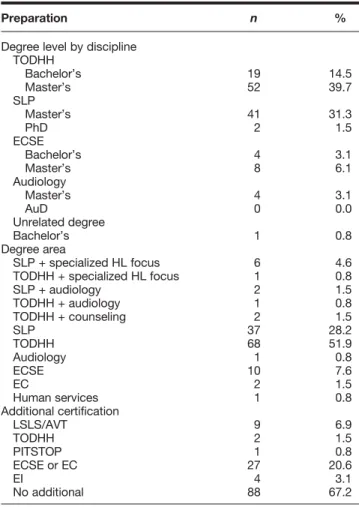
providers (1.5%) had a doctoral degree. Slightly more than half had a degree as a TODHH and one third earned de-grees in SLP. The remainder had dede-grees in a variety of areas, only one of which was unrelated to working with chil-dren. A complete description appears in Table 3.
Certifications
With the exception of the individual who did not earn a degree in an area related to hearing loss or EI, all the pro-fessionals were certified in their degree area. In addition to their degree-related certifications, 33% (n= 43) reported holding additional certifications earned either during their college or university education or following graduation. College and university programs in TODHH are sometimes located within programs of Special Education; thus, almost a quarter (21%) of those with a degree in TODHH simul-taneously earned certification in early childhood education or early childhood special education. Sixty-seven percent of the EI providers held no additional certifications.
Professional Development and Continuing Education When queried about continuing education or profes-sional development specifically related to CDHH, 61% (n= 80) indicated they had participated in relevant continu-ing education. Twenty-two participated in a half- or full-day in-service training. Two EI providers had 1 to 2 weeks of intensive, specialized instruction, and 56 reported a semester-long course or more.
Specialized Preparation
A total score comprising the weighted responses to the degree level, degree area, certifications, and professional and continuing education questions was calculated for each provider. Scores were based upon the extent to which each item contributed to knowledge and skills that have been identified as supporting positive speech and language out-comes. The potential range of scores is from 1 to 17, with a higher number representing higher specialization. As seen in Figure 1, scores ranged from a total of 2 to a total of 17. The scores of the respondents clustered into three relatively homogenous groups in terms of provider preparation, as described below. Therefore, the provider characteristics un-derlying the weighted scores were used as a tool to separate providers into categories of low, medium, or high speciali-zation scores.1
Scores of seven or less 43.5% (n= 57) typically reflect providers who had earned a bachelor’s degree (n= 21) or a master’s (n= 36) but held no certifications in addition to that associated with their degree. In this group, 55 of the
1
We note here that statistical analyses were performed both using the continuous specialization score (1 to 17) and the ordinal grouped variable (low, medium, high) with no appreciable difference in the results, which indicates robustness in the derived specialization score. In every case, thep-value decreased using the continuous measure; thus, the grouped analysis provided a more conservative estimate of the relationship between specialization score and comfort.
Table 3.Preparation of early intervention professionals (n= 131).
Preparation n %
Degree level by discipline TODHH
Bachelor’s 19 14.5
Master’s 52 39.7
SLP
Master’s 41 31.3
PhD 2 1.5
ECSE
Bachelor’s 4 3.1
Master’s 8 6.1
Audiology
Master’s 4 3.1
AuD 0 0.0
Unrelated degree
Bachelor’s 1 0.8
Degree area
SLP + specialized HL focus 6 4.6
TODHH + specialized HL focus 1 0.8
SLP + audiology 2 1.5
TODHH + audiology 1 0.8
TODHH + counseling 2 1.5
SLP 37 28.2
TODHH 68 51.9
Audiology 1 0.8
ECSE 10 7.6
EC 2 1.5
Human services 1 0.8
Additional certification
LSLS/AVT 9 6.9
TODHH 2 1.5
PITSTOP 1 0.8
ECSE or EC 27 20.6
EI 4 3.1
No additional 88 67.2
Note. TODHH = teacher of children who are deaf and hard of hearing; SLP = speech-language pathology; PhD = Doctorate of Philosophy; ECSE = early childhood special education; AuD = Clinical Doctorate in Audiology; HL = hearing loss; EC = early childhood; LSLS/AVT = listening and spoken language/auditory verbal therapy; EI = early intervention.
57 providers did not report any continuing professional education related to working with CDHH. Individuals in this group are categorized as having a low level of specialized preparation.
Thirty-seven percent (n= 49) of the respondents had a provider specialization score of 8 or 9 and were classified as having a medium level of specialization. All but four pro-fessionals in this range had earned a master’s degree in TODHH or SLP, three had a bachelor’s degree in TODHH, and two had a doctorate in SLP. Providers in this group were likely to have participated in continuing education re-lated to childhood hearing loss and/or had been certified in an additional area. Twenty-five (19.1%) EI professionals with composite scores between 10 and 17 comprised the group representing a high level of specialized preparation. They had at least one master’s degree, usually at a program emphasizing childhood hearing loss. All had additional cer-tifications and continuing education experiences. The EI provider with the highest score had a doctorate and multi-ple additional certifications including Listening and Spoken Language Specialist.
Provider Self-Assessment of Comfort Level
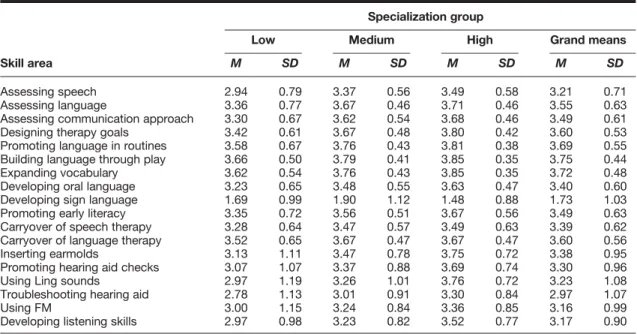
Although the design of the study did not support di-rect evaluation of the EI providers’skills, each respondent was asked to indicate their levels of comfort on 18 skill areas associated with providing services to young CDHH. The skill areas were identified by professionals with experi-ence providing services to CDHH and their families as rele-vant knowledge and skills necessary to develop listening and spoken language. Early intervention providers rated their comfort level on a Likert scale ranging from 1 (no comfort) to 4 (high level of comfort). Nearly all of the re-sponses ranged between 2 and 3, regardless of respondents’ specialization group. The primary exception was the item developing sign language skills; responses across all groups were below 2, indicating a low level of comfort with helping the family develop sign language skills with their child. As shown in Table 4, when comfort scores of the three groups are averaged, all scores with the exception of two—developing sign language skills and troubleshooting hearing aids—ranged between 3.16 and 3.75.
Relationships of Caseload Composition
and Experience to Provider Comfort
Results showed significant relationships between the percent of CDHH on a professional’s caseload and self-reported comfort with each skill except developing sign lan-guage. As can be seen in Table 5, eight skills were strongly correlated with caseload composition (rrange = .41–.80; p< .0001), six of which related to hearing aid use and man-agement and promoting listening skills. Nine other skills weakly to moderately correlated with caseload composition (rrange = .16–.37;p< .02).
Comfort scores related to five skills associated with developing language (assessing language, promoting language
in routines, building language through play, expanding vo-cabulary, and carryover of language therapy) were weakly correlated (rrange = .19–.25;p< .01) with providers’years of EI experience, as were three others (assessing communi-cation approach, developing oral language, and developing listening skills;rrange = .16–.37;p< .02). The remaining nine items were not significantly correlated with provider experience.
Relationship of Specialized Preparation
to Provider Report of Comfort
Self-reported comfort scores were also correlated with provider specialization (low, medium, or high). As shown in Table 4, when providers’comfort levels were considered by specialization group, weak but significant correlations were found between comfort levels and specialization scores on 12 of the 18 variables (r= .17–.27;p= .05). The only comfort level moderately correlated with specialization was assessing speech skills, with an estimated correlation of r= .318.
It is the case that the reported comfort levels for the 18 skill areas have a large correlation with each other. In fact, the pairwise correlations are generally between .40 and .80 (all highly significant) except for developing sign lan-guage skills, which is not significantly correlated with the comfort level of any the other skills. A principal compo-nents analysis (PCA) was performed to identify the redun-dancies that exist within the data. The first principal component explains 59% of the variance in the measures, and the loadings of each skill—apart from developing sign language skills—were nearly identical, which suggests that a simple average of the skills yields the best overall summary of provider comfort. The second principal component identified a subgroup of items that explain 13% additional variance, over and above that explained by the first com-ponent. The items within the second principal component conceptually clustered into two areas. The first was hearing aid management, which included inserting earmolds, pro-moting hearing aid checks, using Ling sounds, troubleshoot-ing heartroubleshoot-ing aids, and ustroubleshoot-ing FM. Developtroubleshoot-ing sign language also loaded onto this subcomponent, but with a loading value of .15, in contrast to the other skills with loading values ranging from .27 to .37. The second area was com-posed of items such as promoting language in routines and developing oral language, and carryover of speech and language, all of which are skills related to supporting fami-lies in providing an enriched language environment for their children.
Discussion
Service Setting and Family Involvement
the children in this cohort received at least some services in their homes; however, the percent of families reporting home-based services declined from the infant to the preschool age groups. Approximately 60% of the oldest/preschool age group reported receiving home-based services. The effect of setting on family participation was striking. When home was the setting for EI services, 95% of the families reported
theyalwaysormost of the timeparticipated. When services were delivered in nonhome locations, including day care, center-based, or a therapist’s office or clinic, 16 of 56 (28.6%) of families reported their participation asalwaysormost of the time.
Krauss (1990) described the establishment of EI ser-vices as redefining the service recipient as the family rather
Table 4.Self-reported comfort levels (scale 0–4) by specialization group (low, medium, high).
Specialization group
Skill area
Low Medium High Grand means
M SD M SD M SD M SD
Assessing speech 2.94 0.79 3.37 0.56 3.49 0.58 3.21 0.71
Assessing language 3.36 0.77 3.67 0.46 3.71 0.46 3.55 0.63
Assessing communication approach 3.30 0.67 3.62 0.54 3.68 0.46 3.49 0.61
Designing therapy goals 3.42 0.61 3.67 0.48 3.80 0.42 3.60 0.53
Promoting language in routines 3.58 0.67 3.76 0.43 3.81 0.38 3.69 0.55
Building language through play 3.66 0.50 3.79 0.41 3.85 0.35 3.75 0.44
Expanding vocabulary 3.62 0.54 3.76 0.43 3.85 0.35 3.72 0.48
Developing oral language 3.23 0.65 3.48 0.55 3.63 0.47 3.40 0.60
Developing sign language 1.69 0.99 1.90 1.12 1.48 0.88 1.73 1.03
Promoting early literacy 3.35 0.72 3.56 0.51 3.67 0.56 3.49 0.63
Carryover of speech therapy 3.28 0.64 3.47 0.57 3.49 0.63 3.39 0.62
Carryover of language therapy 3.52 0.65 3.67 0.47 3.67 0.47 3.60 0.56
Inserting earmolds 3.13 1.11 3.47 0.78 3.75 0.72 3.38 0.95
Promoting hearing aid checks 3.07 1.07 3.37 0.88 3.69 0.74 3.30 0.96
Using Ling sounds 2.97 1.19 3.26 1.01 3.76 0.72 3.23 1.08
Troubleshooting hearing aid 2.78 1.13 3.01 0.91 3.30 0.84 2.97 1.07
Using FM 3.00 1.15 3.24 0.84 3.36 0.85 3.16 0.99
Developing listening skills 2.97 0.98 3.23 0.82 3.52 0.77 3.17 0.90
Note. FM = Frequency-modulated amplification system.
Table 5.Pearson correlations representing the relationships of self-reported comfort scores in each skill area with years of experience, caseload composition, and specialization levels.
Skill area
Years of experience Caseload compositiona Specialization levels
r p r p r p
Assessing speech .12 .073 .20 .003 .32 < .001
Assessing language .23 .001 .37 < .001 .24 .008
Assessing communication approach .14 .047 .41 < .001 .27 .003
Designing therapy goals .12 .367 .31 .018 .28 .053
Promoting language in routines .19 .005 .32 < .001 .17 .049
Building language through play .21 .002 .24 < .001 .17 .057
Expanding vocabulary .22 .001 .28 < .001 .19 .029
Developing oral language .18 .011 .33 < .001 .26 .003
Developing sign language .06 .380 −.02 .732 −.04 .672
Promoting early literacy .12 .084 .53 < .001 .20 .023
Carryover of speech therapy .13 .055 .16 .002 .14 .119
Carryover of language therapy .25 < .001 .34 < .001 .12 .186
Inserting earmolds .11 .103 .72 < .001 .25 .005
Promoting hearing aid checks .11 .111 .74 < .001 .24 .007
Using Ling sounds .08 .230 .80 < .001 .26 .003
Troubleshooting hearing aid .09 .203 .76 < .001 .19 .033
Using FM .07 .300 .63 < .001 .14 .107
Developing listening skills .16 .019 .69 < .001 .23 .010
Note. FM = Frequency-modulated amplification system. Years of experience and caseload composition are continuous variables. Specialization levels are categorical variables.
than the child alone. McGonigel and Garland (1988) noted that the goal for family involvement transitioned from pas-sive review and approval of the professionals’goals and practices to inclusion of parents in carrying out profession-ally directed interventions. Provision of services in the home facilitates the role of professionals in coaching and supporting parents to use their own resources and skills to promote their child’s development in the context of daily routines and activities. Research has demonstrated that delivery models that facilitate inclusion of the family are essential to improved child language outcomes (Moeller, 2000; Spencer, 2004; Watkin et al., 2007). The decreased rate of family participation in nonhome locations does not appear to be consistent with best practice goals of involving families in EI.
Among the OCHL families, those with children who received services in day care reported being the least likely to participate. Within this group, 75% of the mothers did not have a college degree. This raises an empirical question to be explored in the future: Do families from less advantaged homes experience barriers to home-based service access?
In addition to being less likely to participate in ser-vices, OCHL families with lower levels of maternal educa-tion were also at risk of later diagnostic follow-up after referral from hearing screening, resulting in later hearing aid fitting, than were children from more advantaged homes (Holte et al., 2012). In addition, the rate of hearing aid use among children whose mothers had less education was lower compared with those whose mothers had higher levels of education (Walker et al., 2013).
Ensuring regular hearing aid use appears to be more of a challenge for less-resourced families when EI services are delivered outside of the home. Periods of inconsistent auditory access due to factors such as late fitting and low hearing aid use result in children receiving inconsistent ac-cess to linguistic input. Over time, periods of inconsistent access may have a cumulative effect of reducing linguistic experience and overall language exposure (see Moeller & Tomblin, 2015). Working with an EI professional who has the skills and knowledge to support a family as they learn to manage and establish consistent device use may enhance the likelihood of increasing auditory access. The findings of the current study collectively suggest the need to continue to find ways to involve and support less-resourced families, including flexible scheduling that would allow for provision of home visits.
In order to reap the benefits of family involvement, innovative service delivery models must be explored. For example, it should be possible for many families to employ technological advances that are currently available. Adults in their twenties and thirties, the age range of most parents of young children, are more likely than any other age group to own a smartphone, regardless of income level (Pew Research Center, 2013). Fifty-six percent of American adults own smartphones that support text messaging and free or inex-pensive video conferencing applications. The use of this technology within EI services has yet to be widely explored, although these options broaden the possibilities for EI
professional and parent interaction for both scheduling and intervention practices. Regardless of the strategy used to increase family involvement, a thorough understanding of the resources, preferences, and constraints that operate within a family’s structure is necessary to develop an appro-priate model with each family. Unless services match the resources, needs, and expectations of a family, they are likely to remain underutilized.
Effect of Preparation, Caseload Composition,
and Experience on Comfort Scores
Research questions 2a and 2b sought to describe fac-tors regarding preparation, caseload composition, and ex-perience, and their relationship to provider comfort with specific EI skills. The majority of EI professionals (88%) providing services to children and families in the OCHL study had a graduate degree in SLP or TODHH, areas that have been identified as key disciplines for serving these children and their families. Thus, the families whose service providers completed surveys had access to professionals with considerable preparation.
When professionals were ranked on the relevance of their self-reported preparation in regard to working with CDHH, three categories of preparation emerged. Profes-sionals in the lowest level had a bachelor’s degree or a mas-ter’s degree with no additional certification. Those in the medium group typically had a master’s degree as an SLP or a teacher of CDHH, with some continuing education related to childhood hearing loss and more than one certification. Members of the most highly prepared group had at least one master’s degree, usually at a program emphasizing childhood hearing loss. All had additional certifications and relevant continuing education. These same professionals were also asked to indicate their comfort with providing 18 specific EI skills. Although some variation was seen, overall com-fort scores clustered around a score of 3, regardless of level of preparation. This restricted variation in most of the ratings may have been a function of the limited response range (1 to 4) available or the overall high level of prepara-tion among this cohort. Within this group of well-educated EI professionals, some differences in comfort with skills that are fundamental to optimizing speech and language outcomes did emerge. However, it is important to recognize that a majority of the correlations between provider prepa-ration and comfort levels are weak to modest. This suggests that additional factors not revealed in this analysis may be playing a role, and/or that there is a need for continued refinement of measures of provider characteristics and be-haviors, including objective measures that extend beyond self-report. Eisenberg et al. (2007) noted that the types of measures needed to assess quality of services are lacking, so measurement is challenging.
might be expected to be comfortable signing, 42.8% had degrees in SLP, early childhood education, or early child-hood special education. Sign language is not typically part of the curriculum in any of these areas. Furthermore, several programs providing services to the children in this study emphasize oral language, which may have attracted TODHH with minimal fluency in sign language and would provide fewer opportunities to consistently use sign, potentially affect-ing skill level and comfort. For children whose families choose a sign language approach or who require that exper-tise for whatever reason, lack of professional comfort with signing would be a concern for families.
Other factors that might influence providers’comfort with specific skills—including the percent of CDHH on a professional’s caseload and years of experience—were also analyzed. Caseload composition, as defined by the percent of CDHH on a caseload, was significantly related to every skill except developing sign language. The strongest rela-tionships with caseload were found for skills related to hearing aid use and management and promoting listening skills. More than half of the EI professionals represented here had caseloads that were composed entirely of CDHH. These professionals were likely to have been employed by programs specifically designed to serve CDHH, and, as such, were provided opportunities for hands-on practice with hearing technologies and promoting speech and lan-guage for CDHH. Another possible explanation for this re-lationship between caseload composition and comfort is that, regardless of employment site, EI professionals with a higher level of comfort working with CDHH were more likely to have them assigned to their caseloads. Even when professionals are not associated with a program specifically developed to serve them, having multiple children with hearing loss may provide motivation to become proficient in a relevant skillset. Further research is needed to under-stand effects of program characteristics, specialization, and specific experience with CDHH on professionals’knowledge and skills.
The number of years of EI experience was weakly correlated to provider confidence in language development skills including assessing language, vocabulary development, promoting language in daily routines, assessing commu-nication approach, and building language through play. Skills such as these are fundamental and essential in support-ing language development in young children with a variety of developmental challenges.
This study included a subanalysis using PCA to verify that the 18-item survey included a related set of items. Al-though not a central research question, that analysis re-vealed an interesting finding that all but one item loaded equivalently on a first component, which explained 59% of the variance in provider comfort scores. This finding sug-gests that the survey measured a coherent set of skills that appear to be relevant to the provision of EI services. A sec-ond component (subset) of skills identified by the PCA contributed to explaining a modest additional amount of variance (13%) in provider comfort. Although contributing only modest additional variance, most of the skills in this
component supported development of spoken language in CDHH (DesJardin & Eisenberg, 2007).
Limitations
Several limitations to the current study should be ac-knowledged. Because of the way the questions were worded, it was not possible to determine with confidence the pro-portion of services received in each location when parents reported receiving both home-based and outside of the home services. Thus, a family might have received 90% of the ser-vices outside of the home and 10% at home or vice versa; however, this could not be ascertained. In regard to the comfort ratings, we designed a 4-point scale, rather than providing a wider range of options with little semantic dif-ference between adjacent ratings of comfort. As a result, ecological and statistical validity were maintained; however, the overall variability may have been reduced.
Reliance on provider report introduces a complica-tion in interpreting the data, because people are subjective in rating their own competence levels. As part of a broader project undertaken to explore early childhood education teachers’confidence and competence across a wide range of subjects, Garbett (2003) provided evidence that knowledge of science among student teachers in early childhood educa-tion was poor. Only 15% of them were judged to have an adequate knowledge in basic science concepts to provide science education to young children. Despite these low levels, the students reported a high level of confidence, indicating they were unaware of how much they didn’t know and how this might affect their ability to provide appropriate experiences for their preschool students. The process of self-assessment is clearly complex, and by its very nature can never be entirely objective or free from the beliefs and values individuals hold.
One of the strengths of this study is ironically also a limitation. Because the study population was limited to children with no other developmental challenges and who were in a family in which at least one parent was a fluent English speaker, they are not representative of the heteroge-neous population of CDHH. In addition, the longitudinal design of the study attracted a cohort of families who had the resources to spend at least half a day annually in test-ing, with many families spending time and resources to travel to an appointment site. Although families were reim-bursed for travel expenses and their time, this may not have been sufficient to offset the costs for families with fewer resources, making it less likely for them to participate.
underrepresented in the OCHL sample. Thus, the findings reported here most likely represent a best-case scenario.
Conclusions
Our findings indicate that families are less likely to be involved in EI when it is delivered outside of their home. The benefit of family involvement in EI in regard to child language outcomes has been established. Thus, when tradi-tional home-based services are not feasible, professionals should explore providing access through creative solutions with technologies or consider other accommodations to promote development of a relationship between themselves and the family. However, in order to capitalize on family involvement in regard to language outcomes for children who are hard of hearing, EI professionals need to be both competent and confident in the skills necessary to support those outcomes.
Caseload composition, specifically the percent of CDHH, was significantly associated with EI professionals’ comfort scores. Our results suggest that access to hands-on experience working with CDHH, potentially from special-ized preparation or a high percentage of CDHH on a current caseload, contributes to professional comfort. Future re-search should explore what factors underlie the relationship between professionals’confidence and caseload composition, and what role professional preparation and/or specialization plays.
Even within this well-prepared group of EI profes-sionals, some differences in comfort scores were reported, especially by those with the least specialized preparation. Although the relationship between caseload composition and specialized preparation requires further investigation, engendering EI professionals’self-efficacy in areas that support access to audition may increase the likelihood that they will be more effective in empowering parents to man-age these tasks. Parents in turn, may be better prepared in their journey toward supporting optimal speech and lan-guage outcomes for their children. As noted by the National Institute on Deafness and Other Communication Disorders 2006 panel, the relationships among the many variables involved in EI are complex. The information presented here is an initial effort in understanding how those multi-ple variables contribute to outcomes of CDHH and their families.
Acknowledgments
This work was supported by National Institute on Deafness and Other Communication Disorders Grant NIH/NIDCD 5 R01 DC009560-03 (awarded to J. Bruce Tomblin and Mary Pat Moeller). The authors acknowledge the support of Sophie Ambrose, who provided input on previous versions of this manuscript. Special thanks go to Marlea O’Brien for coordinating the Outcomes of Children with Hearing Loss project, as well as to the examiners at the Uni-versity of Iowa, Boys Town National Research Hospital, and University of North Carolina–Chapel Hill. Special thanks also go to the families and children who participated in the research.
The content of this project is solely the responsibility of the authors and does not necessarily represent the official views of the National Institute on Deafness and Other Communication Dis-orders or the National Institutes of Health. The authors have no financial relationships relevant to this article to disclose.
References
Ambrose, S. E., Walker, E. A., Unflat-Berry, L., Oleson, J. J., & Moeller, M. P.(2015). Quantity and quality of caregivers’ lin-guistic input to 18-month and 3-year-old children who are hard of hearing.Ear and Hearing, 36,48S–59S. doi:10.1097/ AUD.0000000000000209
American Academy of Pediatrics, Joint Committee on Infant Hearing.(2007). Year 2007 position statement: Principles and guidelines for early hearing detection and intervention programs.Pediatrics, 120(4), 898–921. doi:10.1542/peds. 2007-2333
American Speech-Language-Hearing Association.(2008).Service provision to children who are deaf and hard of hearing, birth to 36 months[Technical report]. Retrieved from http://www.asha. org/policy/TR2008-00301/
Centers for Disease Control and Prevention.(2012).2012 Annual data: Early hearing detection and intervention (EHDI) program. Retrieved from http://www.cdc.gov/ncbddd/hearingloss/ehdi-data2012.html
Chandler, L. K., Cochran, D. C., Christensen, K. A., Dinnebeil, L. A., Gallagher, P. A., Lifter, L., . . . Spino, M.(2012). The alignment of CEC/DEC and NAEYC personnel preparation standards.Topics in Early Childhood Special Education, 32(1), 52–63.
Cone-Wesson, B., Vohr, B. R., Sininger, Y. S., Widen, J. E., Folsom, R. C., Gorga, M. P., & Norton, S. J.(2000). Identifi-cation of neonatal hearing impairment: Infants with hearing loss.Ear and Hearing, 21(5), 488–507.
Council for Clinical Certification in Audiology and Speech-Language Pathology of the American Speech-Speech-Language-Hearing Association.(2014).2014 standards for the Certificate of Clini-cal Competence in Speech-Language Pathology. Retrieved from http://www.asha.org/Certification/2014-Speech-Language-Pathology-Certification-Standards
Council for Exceptional Children.(2004).The Council for Excep-tional Children definition of a well-prepared special education teacher. Arlington, VA: CEC Board of Directors.
Darling-Hammond, L., Wei, R. C., Andree, A., Richardson, N., & Orphanos, S.(2009). Professional learning in the learning profession. Washington, DC: National Staff Development Council.
DesJardin, J. L., & Eisenberg, L. S.(2007). Maternal contribu-tions: Supporting language development in young children with cochlear implants.Ear and Hearing, 28(4), 456–469. doi:10.1097/AUD.0b013e31806dc1ab
Eisenberg, L. S., Widen, J. E., Yoshinaga-Itano, C., Norton, S., Thal, D., Niparko, J. K., & Vohr, B.(2007). Current state of knowledge: Implications for developmental research-key issues.Ear and Hearing, 28(6), 773–777. doi:10.1097/AUD. 0b013e318157f06c
Farrand, P., McMullen, M., Jowett, R., & Humphreys, A.(2006). Implementing competency recommendations into pre-registration nursing curricula: Effects upon levels of confidence in clinical skills.Nurse Education Today, 26,97–103. doi:10.1016/j.nedt. 2005.06.002
Garbett, D.(2003). Science education in early childhood teacher education: Putting forward a case to enhance student teachers’ confidence and competence.Research in Science Education, 33,
467–481. doi:10.1023/B:RISE.0000005251.20085.62
Green, D. R., Gaffney, M., Devine, O., & Gross, S.(2007). Deter-mining the effect of newborn hearing screening legislation: An analysis of state hearing screening rates.Public Health Report, 122(2), 198–205.
Halpin, K. S., Smith, K. Y., Widen, J. E., & Chertoff, M. E.
(2010). Effects of universal newborn hearing screening on an early intervention program for children with hearing loss, birth to 3 years of age.Journal of the American Academy of Audiol-ogy, 21(3), 169–175.
Harrell, P. L., Kearl, G. W., Reed, E. L., Grigsby, D. G., & Caudill, T. S.(1993). Medical students’confidence and the characteristics of their clinical experiences in a primary care clerkship.Academic Medicine, 68(7), 577–579.
Harrison, M., & Roush, J.(1996). Age of suspicion, identification, and intervention for infants and young children with hearing loss: A national study.Ear and Hearing, 17(1), 55–62.
Harrison, M., Roush, J., & Wallace, J.(2003). Trends in age of identification and intervention in infants with hearing loss.Ear and Hearing, 24(1), 89–95.
Holden, G., Rosenberg, G., Barker, K., Tuhrim, S., & Brenner, B.
(1993). The recruitment of research participants: A review.
Social Work in Health Care, 19(2), 1–44. doi:10.1300/ J010v19n02_01
Holte, L., Walker, E., Oleson, J., Spratford, M., Moeller, M. P., Roush, P., . . . Tomblin, J. B.(2012). Factors influencing fol-low-up to newborn hearing screening for infants who are hard of hearing.American Journal of Audiology, 21(2), 163–174.
Houston, K. T., & Perigoe, C. B.(2010). Speech-language pathol-ogists: Vital listening and spoken language professionals.The Volta Review, 110(2), 210–230.
Kennedy, C., McCann, D., Campbell, M. J., Kimm, L., & Thornton, R.(2005). Universal newborn screening for perma-nent childhood hearing impairment: An 8-year follow-up of a controlled trial.Lancet, 366(9486), 660–662. doi:10.1016/ S0140-6736(05)67138-3
Krauss, M. W.(1990). New precedent in family policy: Indi-vidualized family service plan.Exceptional Children, 56(5), 388–395.
Marge, D. K., & Marge, M.(2005).Beyond newborn hearing screening: Meeting the educational and health care needs of in infants and young children with hearing loss in America.Report of the National Consensus Conference on Effective Educa-tional and Health Care Interventions for Infants and Young Children with Hearing Loss. September 10–12, 2004. Syracuse, NY: Department of Physical Medicine and Rehabilitation, SUNY Upstate Medical University.
McCreery, R. W., Bentler, R. A., & Roush, P. A.(2013). Char-acteristics of hearing aid fittings in infants and young chil-dren.Ear and Hearing, 34(6), 701–710. doi:10.1097/AUD. 0b013e31828f1033
McCreery, R. W., Walker, E. A., Spratford, M., Bentler, R., Holte, L., Roush, P. A., . . . Moeller, M. P.(2015). Longi-tudinal predictors of aided speech audibility in infants and children.Ear and Hearing,36,60S–75S. doi: 10.1097/AUD. 0000000000000213
McGonigel, M. J., & Garland, C. W.(1988). The individualized family service plan and the early intervention team: Team and family issues and recommended practices.Infants and Young Children, 1(1), 10–21.
Meadow-Orlans, K., Mertens, D., & Sass-Lehrer, M.(2003). Par-ents and their deaf children: The early years. Washington, DC: Gallaudet University Press.
Moeller, M. P.(2000). Early intervention and language develop-ment in children who are deaf and hard of hearing.Pediatrics, 106(3). doi:10.1542/peds.106.3.e43
Moeller, M. P., Carr, G., Seaver, L., Stredler-Brown, A., & Holzinger, D.(2013). Best practices in family-centered early intervention for children who are deaf or hard of hearing: An international consensus statement.Journal of Deaf Studies and Deaf Education, 18(4), 429–445.
Moeller, M. P., & Tomblin, J. B.(2015). An introduction to the Outcomes of Children with Hearing Loss study.Ear and Hearing,36,4S–13S. doi:10.1097/AUD0000000000000210
Morton, C. C., & Nance, W. E.(2006). Newborn hearing screen-ing—A silent revolution.New England Journal of Medicine, 354(20), 2151–2164. doi:10.1056/NEJMra050700
Muñoz, K., & Blaiser, K.(2011). Audiologists and speech-language pathologists: Making critical cross-disciplinary connections for quality early hearing detection and intervention.Perspectives on Audiology, 7,34–42. doi:10.1044/poa7.1.34
Muse, C., Harrison, J., Yoshinaga-Itano, C., Grimes, A., Brookhouser, P. E., Epstein, S., . . . Martin, B.(2013). Supple-ment to the JCIH 2007 position stateSupple-ment: Principles and guidelines for early intervention after confirmation that a child is deaf or hard of hearing.Pediatrics, 131(4), e1324–e1349. doi:10.1542/peds.2013-0008
National Association for the Education of Young Children.(2009).
NAEYC standards for early childhood professional preparation
[Position statement]. Washington, DC: NAEYC Standards Workgroups 2008–2009.
Pew Research Center.(2013). Smartphone ownership—2013 update. Retrieved from http://pewinternet.org/Reports/2013/ Smartphone-Ownership-2013.aspx
Roush, J., Bess, F., Gravel, J., Harrison, M., Lenihan, S., & Marvelli, A.(2004). Preparation of personnel to serve children with hearing loss and their families: Current status and future needs. 2004Summit on Deafness Proceedings: Spoken Lan-guage in the 21st Century, Predicting Future Trends in Deafness
(pp. 26–29). Washington, DC: Alexander Graham Bell Asso-ciation for the Deaf and Hard of Hearing.
Sandall, S., Hemmeter, M. L., Smith, B. J., & McLean, M. E. (Eds.).(2005).DEC recommended practices: A comprehensive guide for practical application in early intervention/early child-hood special education. Missoula, MT: Division for Early Childhood.
Sarant, J. Z., Holt, C. M., Dowell, R. C., Rickards, F. W., & Blamey, P. J.(2009). Spoken language development in oral preschool children with permanent childhood deafness.Journal of Deaf Studies and Deaf Education, 14(2), 205–217.
doi:10.1093/deafed/enn034
Spencer, P. E.(2004). Individual differences in language perfor-mance after cochlear implantation at one to three years of age: Child, family, and linguistic factors.Journal of Deaf Stud-ies and Deaf Education, 9(4), 395–412. doi:10.1093/deafed/ enh033
SRI International.(2000).National early intervention longitudinal study (NEILS) telephone interviewer manual specifications
(revised). Menlo Park, CA: Author.