Meta-analysis of lipid-traits in
Hispanics identifies novel loci,
population-specific effects, and
tissue-specific enrichment of eQTLs
Jennifer E. Below
1,*, Esteban J. Parra
2,*, Eric R. Gamazon
3,4,5, Jason Torres
3, S. Krithika
2,
Sophie Candille
6, Yingchang Lu
7,8, Ani Manichakul
9, Jesus Peralta-Romero
10, Qing Duan
11,
Yun Li
11, Andrew P. Morris
12, Omri Gottesman
7, Erwin Bottinger
7, Xin-Qun Wang
13,
Kent D. Taylor
14, Y.-D. Ida Chen
14, Jerome I. Rotter
14, Stephen S. Rich
9, Ruth J. F. Loos
7,8,
Hua Tang
6, Nancy J. Cox
3,4, Miguel Cruz
10, Craig L. Hanis
1& Adan Valladares-Salgado
10We performed genome-wide meta-analysis of lipid traits on three samples of Mexican and Mexican American ancestry comprising 4,383 individuals, and followed up significant and highly suggestive associations in three additional Hispanic samples comprising 7,876 individuals. Genome-wide significant signals were observed in or near CELSR2, ZNF259/APOA5, KANK2/DOCK6 and NCAN/MAU2 for total
cholesterol, LPL, ABCA1, ZNF259/APOA5, LIPC and CETP for HDL cholesterol, CELSR2, APOB and NCAN/MAU2 for LDL cholesterol, and GCKR, TRIB1, ZNF259/APOA5 and NCAN/MAU2 for triglycerides. Linkage disequilibrium and conditional analyses indicate that signals observed at ABCA1 and LIPC for
HDL cholesterol and NCAN/MAU2 for triglycerides are independent of previously reported lead SNP associations. Analyses of lead SNPs from the European Global Lipids Genetics Consortium (GLGC) dataset in our Hispanic samples show remarkable concordance of direction of effects as well as strong correlation in effect sizes. A meta-analysis of the European GLGC and our Hispanic datasets identified five novel regions reaching genome-wide significance: two for total cholesterol (FN1 and SAMM50), two for HDL cholesterol (LOC100996634 and COPB1) and one for LDL cholesterol (LINC00324/CTC1/PFAS). The top meta-analysis signals were found to be enriched for SNPs associated with gene expression in a tissue-specific fashion, suggesting an enrichment of tissue-tissue-specific function in lipid-associated loci.
Cardiovascular disease (CVD) is one of the leading causes of death in the United States in every census category (non-Hispanic Whites, Blacks, Hispanic/Latino, Asian/Pacific Islanders and American Indian/Alaska Natives)1. Based on mortality data from 2010, it was estimated that more than 2,150 Americans die of CVD each day1.
1Division of epidemiology, Human Genetics & Environmental Sciences, University of Texas School of Public Health, Houston, Texas, USA. 2Department of Anthropology, University of Toronto at Mississauga, Mississauga, Ontario, Canada. 3Section of Genetic Medicine, Department of Medicine, University of Chicago, Illinois, USA. 4Division of Genetic Medicine, Department of Medicine, Vanderbilt University, Nashville, TN. 5Academic Medical Center, University of Amsterdam, Amsterdam, The Netherlands. 6Department of Genetics, Stanford University School of Medicine, Stanford, California, USA. 7The Charles Bronfman Institute for Personalized Medicine, The Icahn School of Medicine at Mount Sinai, New York, New York, USA. 8The Genetics of Obesity and Related Metabolic Traits Program, The Icahn School of Medicine at Mount Sinai, New York, New York, USA. 9Center for Public Health Genomics, University of Virginia, Charlottesville, Virginia, USA. 10Unidad de Investigación Médica en Bioquímica, Hospital de Especialidades, Centro Médico Nacional Siglo XXI, IMSS, Mexico City, Mexico. 11Department of Genetics and Department of Biostatistics, University of North Carolina at Chapel Hill, Chapel Hill, North Carolina, USA. 12Department of Biostatistics, University of Liverpool, Liverpool, United Kingdom. 13Department of Public Health Sciences, University of Virginia, Charlottesville, Virginia, USA. 14Institute of Translational Genomics and Population Sciences, Los Angeles Biomedical Research Institute at Harbor/UCLA Medical Center, Torrance, California, USA. *These authors contributed equally to this work. Correspondence and requests for materials should be addressed to J.E.B. (email: [email protected]) or E.J.P. (email: [email protected])
Received: 20 March 2015
Accepted: 14 December 2015
Published: 19 January 2016
Similarly, in Mexico CVD is the leading cause of death, and the death rate attributed to CVD has increased from 53.4 per 100,000 in 1980 (4th ranked cause of death) to 97.0 per 100,000 in 2010 (1st ranked cause of death)2. Lipid concentrations are a major risk factor for CVD, and in the US there is a high prevalence of dyslipidemias1. In adults, the prevalence of total cholesterol concentrations ≥ 200 mg/dl was recently estimated as 43.4%, and the figures for LDL cholesterol ≥ 130 mg/dl, HDL cholesterol < 40 mg/dl and triglycerides ≥ 150 mg/dl were 31.1%, 21.8% and 27%, respectively1. In Mexico, a study based on the Mexican National Health and Nutrition Survey (ENSANUT 2006) indicated even higher prevalence at the same thresholds: 43.6% for total cholesterol concen-trations, 46% for LDL cholesterol, 60.5% for HDL cholesterol, and 31.5% for triglycerides3. Given the relevance of dyslipidemia as a risk factor for CVD, and the important public health impact of this disease, it is not surprising that substantial efforts have been directed at deciphering the genetic architecture of lipid traits. In this respect, GWAS have proven to be very successful; and to date more than 150 loci have been associated with plasma lipid traits4,5. These efforts have led to the discovery of new regulatory pathways in lipid metabolism, opening new potential targets for therapeutic intervention, and demonstrated the relevance of the GWA approach from the clinical point of view6,7. Interestingly, several studies have shown that most of the SNPs identified in European populations have the same direction of association in other population groups5,8,9.
The remarkable advances described above have been primarily driven by studies in European populations, and the number of GWAS in other populations has been much more limited. To our knowledge, in the case of Hispanics, there have been only three GWAS published for lipid traits10–12. Here, we present the results of the larg-est effort to characterize the architecture of lipid traits in Hispanics, based on a combined sample of 12,259 indi-viduals. In a first stage, we carried out a meta-analysis of lipid traits based on three samples of Mexican ancestry (from Mexico City and Starr County, Texas) comprising 4,383 individuals. In a second stage, we followed up the lead SNPs corresponding to the genome-wide and highly suggestive signals in three additional Hispanic samples (MESA, WHI and IPM BioMe Biobank) with 7,876 individuals.
Materials and Methods
Study participants.
All study participants were originally ascertained for GWAS of type 2 diabetes, and so each cohort is enriched for type 2 diabetes patients. Descriptive statistics for each population for relevant traits are presented in Table 1.Mexico City-sample 1: This sample comprises 967 individuals with type 2 diabetes and 343 controls. Detailed information about this sample is available in Parra et al.13 Informed consent was obtained from each participant, and the ethical research board (“Comité Local de Investigación”) of the Medical Center “Siglo XXI” approved the research, and the methods were carried out in accordance with the approved guidelines. The Ethics Review Office at the University of Toronto also approved this study.
Mexico City-sample 2: This sample comprises 898 individuals with type 2 diabetes and 889 controls. Informed consent was obtained from each participant, and the ethical research board (“Comité Local de Investigación”) of the Medical Center “Siglo XXI” approved the research, and the methods were carried out in accordance with the approved guidelines.
Starr County sample: This sample comprises 1,598 unrelated individuals with lipid measures and genetic data. We removed 312 individuals who were taking lipid medications and/or were missing one or more covariates for a final sample of 1,286 carried forward into analysis. Of these 536 are affected with type 2 diabetes and 740 are type 2 diabetes controls. All samples were collected in Starr County, Texas, and details of ascertainment can be found in Below et al.14. Informed consent was obtained from each participant, and the research was approved by the institutional review board of the University of Texas Health Science Center at Houston, and the methods were carried out in accordance with the approved guidelines.
Measurement of plasma lipid concentrations.
Mexico-City samples 1 and 2: Quantification of lipid traits (total cholesterol, HDL cholesterol, LDL cholesterol and triglycerides) was carried out with an IIab 300 Plus clinical chemistry analyser (Instrument Laboratory, Lexington, MA 02421-3125, USA), using standard protocols. The serum samples were obtained after fasting for at least 12 hours and the biochemical quantification took place within 3 hours of serum purification.Starr County sample: EDTA plasma was obtained after overnight fast and placed on ice. Samples were spun and frozen within 30 minutes of collection and placed in a − 80° freezer before the end of day. Serum HDL-C, triglycerides, and total cholesterol were measured using standard enzymatic methods. LDL-C was calculated
Sample Mexico City 1* Mexico City 2* Starr County
N (F, M) 1310 (833,477) 1787 (895,892) 1286 (858,428)
Age (SD) 50.57 (8.269) 52.78 (10.12) 45.27 (13.25)
BMI 29.06 (4.64) 28.64 (4.91) 30.73 (6.42)
TCHOL (mg/dl) 211.30 (43.38) 190.16 (44.73) 194.13 (41.24)
HDL 46.04 (14.61) 45.19 (14.12) 47.38 (14.52)
LDL 132.07 (35.15) 130.04 (34.59) 114.43 (32.12)
TRIG 212.43 (142.11) 174.99 (113.39) 168.73 (131.91)
T2D Cases/Controls 967/343 898/889 536/750
using the Friedewald equation15, with missing values assigned for samples with triglyceride levels greater than 400 mg/dl.
Genotyping.
Mexico City-sample 1: This sample was genotyped with the Affymetrix Genome-wide Human SNP array 5.0 (Affymetrix, Santa Clara, CA) following standard protocols. Genotype calling was done with the Affymetrix PowerTools (APT) software package including the full sample set, and using two genotyping algo-rithms, the BRLMM-P and Birdseed algorithms. In order to minimize genotyping errors, the program PLINK v 1.0616 was used to merge the genotype results obtained with both algorithms, using the consensus call mode.Mexico City-sample 2: This sample was genotyped with the Affymetrix Axiom LAT array (Affymetrix, Santa Clara, CA) following standard protocols. Genotype calling was done with the Affymetrix PowerTools (APT) soft-ware package, using the AxiomGT1/brlmm-p algorithm and the manufacturer recommended calling pipeline.
Starr County sample: This sample was genotyped according to manufacturer protocols using the Affymetrix Genome-Wide SNPArray 6.0 assay (Affymetrix, Santa Clara, CA, USA) at the Center for Inherited Disease Research. Case, impaired glucose tolerance, impaired fasting glucose, and control groups were randomized to plates. Genotypes were called for 1,890 samples passing quality control (QC) using both the Affymetrix supported Birdseed v2167 calling algorithm as well as the corrected robust linear model with maximum likelihood classifica-tion (CRLMM)17 and only calls in complete agreement between the two algorithms were used in analyses. An unrelated subset of 1,286 of these samples was included in the present analysis (πˆ threshold of 0.28). Further details of the genotyping and quality control can be found in Below et al.14.
Quality Control prior to imputation.
Mexico City-sample 1: Prior to imputation, individuals were removed to clean the data of relationship structures at a threshold of πˆ> 0.2. SNPs were removed from the initial list of autosomal markers (430,322 markers) based on the following criteria: 1) minor allele frequency < 1%, 2) Hardy-Weinberg p-values < 0.0001 in the control group and 3) missingness > 5% in the cases and the controls. After filtering, the final number of autosomal markers was 370,268. All the QC steps were carried out with the program PLINK16.Mexico City-sample 2: Prior to imputation, individuals were removed to clean the data of relationship struc-tures at a threshold of πˆ> 0.2. SNPs were removed from the initial list of autosomal markers (762,967 markers) based on the following criteria: 1) Markers classified as CallRateBelowThreshold, OffTargetVariants or Other by the program SNPolisher, using the human default thresholds (CR.cut ≥ 95, FLD.cut ≥ 3.6, HetSO.cut ≥ − 0.1, HomRO2.cut ≥ 0.3, HomRO3.cut ≥ − 0.9, nMinorAllele.cut ≥ 2), 2) minor allele frequency < 5%, 3) missing-ness < 0.01 and 4) Hardy-Weinberg p-values < 0.05 in the full sample. After filtering, the number of autosomal markers was 415,265. All the QC steps were carried out with the program PLINK16.
Starr County sample: Prior to imputation, individuals were removed to clean the data of relationship struc-tures at a threshold of πˆ> 0.28 and ethnic outliers. SNPs were removed from the initial list of 868,155 genotyped autosomal markers based on the following criteria: 1) minor allele frequency < 1%, 2) Hardy-Weinberg p-values < 10−4 in the full sample 3) missingness > 10% in the full sample and 4) all ambiguous strand (AT/CG) SNPs. Individual-level missingness is < 5% in all samples. 603,042 scaffold SNPs were carried forward into imputation.
Imputation.
Mexico City-sample 1: Imputation was carried out with the program IMPUTE v217,18 (see Web Resources) using the combined 1000 Genomes project samples as the reference sample (1000 Genomes Phase I integrated variant set, NCBI build b37, release date March 2012, no singletons). Imputations followed a two-step strategy: 1) pre-phasing using the program SHAPEIT19 (see Web Resources) and 2) imputation from the reference panel into the estimated haplotypes with IMPUTE v217,18,20.Mexico City-sample 2: Imputation was carried out with the program IMPUTE v2, using the combined 1000 Genomes project samples as the reference sample (1000 Genomes Phase I integrated haplotypes, NCBI build b37, release date December 2013, no singletons). Imputations followed a single-step strategy (simultaneous phasing and imputation)17.
Starr County sample: Imputation was carried out with the program IMPUTE v2 using the combined (all ancestries) 1000 Genomes Phase 1 integrated set March 2012 release. Imputations followed a two-step strategy similar to that applied to the Mexico City 1 sample.
Population stratification.
We used the program EIGENSOFT21 (see Web Resources) to perform a princi-pal components analysis and evaluate population stratification after pruning markers in high LD and removing regions showing high LD or genomic complexity. The principal components analyses were carried out in two ways: 1) including only the individuals of the study samples (e.g. Mexico City and Starr County), in order to characterize the extent of population stratification, and 2) including the study samples and other reference popu-lations, in order to gain a better perspective about population history.then inverse normal transformed using the Blom method. Associations of the genetic markers with the trans-formed residuals were tested with the program SNPTEST v218 (see Web Resources) using the frequentist associa-tion tests implemented in the program, based on an additive model. In order to control for genotype uncertainty, we used the missing data likelihood score test (the score method).
Mexico City-sample 2: For this sample, association tests were carried out using the same strategies described for Mexico City-sample 1 above.
Starr County sample: For this sample, individuals identified as taking lipid-lowering medications were removed from further analysis. This resulted in exclusion of 308 individuals, and analysis of 1,286 subjects not taking lipid-lowering medications. Association tests were carried out using the same strategies described for Mexico City-sample 1 above.
Meta-analysis.
The program META (see Web Resources) was used to carry out an inverse variance fixed-effects meta-analysis. We used the option –lambda to implement genomic control methods for the analysis of triglycerides, the only trait to show evidence of inflation (lambda values used for Mexico City sample 1, Mexico City sample 2, and Starr County were 1, 1, and 1.04, respectively). Because this correction had insignificant effects on top signals, all p-values reported are from uncorrected meta-analyses for consistency. All other lambdas were between 1.01 and 0.97.Identification of markers to follow-up and replication in independent Hispanic samples.
Based on the results of the meta-analysis, we identified a list of regions to follow up, using the following criteria: 1) genome-wide significant (p < 5 × 10⁻⁸) or highly suggestive (p < 10−5) values in the meta-analysis, 2) valid p-values in the three samples and 3) good imputation quality (info scores > 0.7 in each individual study). The most significant SNP in each region was selected for follow-up in three independent Hispanic samples. The first sample comprises 3,587 Hispanic women from the Women’s Health Initiative SNP Health Association Resource (WHI-SHARe). The WHI is a U.S.-wide study focusing on common health issues in postmenopausal women. A total of 161,808 postmenopausal women aged 50–79 years old were recruited, including 12,151 self-identified African Americans and 5,469 self-identified Hispanics. A cohort of 3,642 self-identified Hispanic participants from WHI, who had consented to genetic research, were genotyped on the Affymetrix 6.0 array. After QC, the Hispanic sample available for replication of the lipid signals included 3,587 individuals. Imputation was carried out in two steps: 1) Phasing using MaCH1 and 2) Genotype imputation using minimac. For imputation, the 1000 Genomes Phase I Integrated Release Version 3 Haplotypes (2010–11 data freeze, 2012-03-14 haplotypes) were used as reference samples. Based on the LDL-lowering effects of statins, the pretreatment LDL concentrations for individuals on lipid-lowering medication were estimated by dividing treated LDL values by 0.75. The second sam-ple comprises 2,127 Hispanic individuals from the Multi-Ethnic Study of Atherosclerosis (MESA) project. MESA is a study of the characteristics of subclinical cardiovascular disease (disease detected non-invasively before it has produced clinical signs and symptoms) and the risk factors that predict progression to clinically overt cardi-ovascular disease or progression of the subclinical disease. MESA researchers study a diverse, population-based sample of 6,814 asymptomatic men and women aged 45–84. Thirty-eight percent of the recruited participants are White, 28% African-American, 22% Hispanic, and 12% Asian, predominantly of Chinese descent. 2,128 addi-tional individuals from 594 families were recruited through MESA Family. Participants were recruited from six field centers across the United States: Wake Forest University, Columbia University, Johns Hopkins University, University of Minnesota, Northwestern University and University of California - Los Angeles. All participants were genotyped using the Affymetrix Human SNP array 6.0, with 897,981 SNPs passing study specific quality control (QC). IMPUTE version 2.2.2 was used to perform imputation using the cosmopolitan 1,000 Genomes Phase 1 v3 March 2012 reference set. For the current analyses, we included 2,127 Hispanic individuals from the combined MESA and MESA Family samples23. Plasma lipid concentrations were adjusted for medication use as suggested by Wu et al.24. The third sample includes 2,162 individuals of Hispanic ancestry from the Charles Bronfman Institute for Personalized Medicine (IPM) BioMe Biobank. The BioMe is an Electronic Medical Record (EMR)-linked biobank that integrates research data and clinical care information for consented patients at The Mount Sinai Medical Center, which serves diverse local communities of upper Manhattan with broad health dis-parities. BioMe has enrolled over 31,500 participants between September 2007 and October 2014: 25% of African American ancestry (AA), 36% of Hispanic Latino ancestry (HL), 30% of white European ancestry (EA), and 9% of other ancestry. The IPM BioMe Biobank samples were genotyped using the Illumina HumanOmniExpress + v1.1 BeadChip and imputation was carried out with the program IMPUTE using the 1000 Genomes project Phase 1 integrated variant release v3, March 2012. Related individuals were removed from the sample using an IBD threshold of 0.185. The final Hispanic sample comprised 2,162 individuals. The lipid values were extracted from the outpatient lab test results from the 30-day period around enrollment (enrollment date + /− 15 days, value closest to enrollment date taken). LDL-cholesterol was calculated using the Friedewald equation; individuals with triglyceride levels greater than 400 mg/dl were assigned missing values. Information on use of lipid lowering medication (including information on use of statins and fibrate classes) prescribed at enrollment date + 15 days was also extracted. Plasma lipid concentrations were adjusted for medication use as suggested by Wu et al.24.Conditional analysis.
In order to evaluate if the signals observed in the Hispanic samples are independent of the signals described in the Global Lipids Genetics Consortium (GLGC) European samples, we carried out conditional analyses in the Hispanic samples. Briefly, for the conditional analyses, we tested the association of the GLGC lead SNPs with the relevant lipid traits in each of our three Hispanic samples, using the Hispanic lead SNPs as covariates. We then used the program META to carry out an inverse variance fixed-effects meta-analysis and compared the p-values and effect sizes of the European lead SNP with and without conditioning on our lead SNP.Gene-based and pathway association tests.
We conducted gene-based and pathway association tests using the program KGG3 (see Web Resources). For the gene-based association tests, we used the GATES approach24, using a window of 10Kb for the extended gene region length. This test only requires the p-values of SNPs within a gene, and does not use individual genotype data. The gene-based p values are obtained combining the p-values of the individual SNPs within the gene, using a modification of the Simes method that takes into account the pair-wise correlation coefficients for the SNPs, which are primarily determined by the LD patterns. In order to define the LD patterns relevant to our samples, we used the MXL (Mexican Americans from Los Angeles) 1000 Genomes sample. For the pathway association tests we used the HYST25 test implemented in the KGG3 pro-gram. We report only pathways that are significant using the HYST test and also a hypergeometric test enrolling genes with a p-value of 0.001. We also performed a pathway analysis using an alternative program, GSA-SNP26, using the PAGE (parametric analysis of gene set enrichment) method27. When using GSA-SNP, we selected the SNP with the 2nd lowest p-value to define the gene p-values, and used a padding window of 10 kb. The program was run using both Gene Ontology (GO) and KEGG gene sets. We report only gene sets with False Discovery Rates (FDR) < 0.01.eQTL analyses.
We investigated the extent to which expression-associated SNPs (eSNPs) identified in LCLs28, liver29, adipose, and muscle30 can be utilized to detect lipids-associated loci. We examined the (meta-analysis) association of the eSNPs identified in each tissue with each lipid trait and generated a quantile- quantile (Q-Q) plot from the distribution of p-values. We defined the false discovery rate (FDR) as follows31,32:π
( ) =
# ≤ ( )
ˆ
FDR p mp
p p
{ it } 1
0
where m is the number of eSNPs tested, { }pit is the set of their p-values with a lipids trait t indexed by the eSNP i, and πˆ0 is the estimated proportion of null SNPs:
π λ λ
λ
( ) =# >
( − ) ( )
ˆ p
m{1i } 2
0
for a given tuning parameter λ (selected, as in Storey et al.33, as 0.5). The eSNPs for each tissue that meet the Bonferroni corrected threshold as well as threshold for FDR < 0.05 for association with a lipid trait were identified.
Web Resources:
• The program IMPUTE2 and its documentation can be downloaded at https://mathgen.stats.ox.ac.uk/impute/ impute_v2.html
• The program SHAPEIT and its documentation can be downloaded at https://mathgen.stats.ox.ac.uk/genet-ics_software/shapeit/shapeit.html
• The program EIGENSOFT and its documentation can be downloaded at http://genetics.med.harvard.edu/ reich/Reich_Lab/Software.html
• The program SNPTEST and its documentation can be downloaded at https://mathgen.stats.ox.ac.uk/genet-ics_software/snptest/snptest.html
• The program META and its documentation can be downloaded at http://www.stats.ox.ac.uk/~jsliu/meta.html • KGG:A systematic biological Knowledge-based mining system for Genome-wide Genetic studies can be
accessed at http://statgenpro.psychiatry.hku.hk/limx/kgg/
• The study description for STAMPEED: Cardiovascular Health Study (CHS) GWAS to identify genetic var-iants associated with aging and CVD risk factors and events can be found at http://www.ncbi.nlm.nih.gov/ projects/gap/cgi-bin/study.cgi ? study_id = phs000226.v3.p1
• The study description for the NHLBI Family Heart Study (FamHS-Visit1 and FamHS-Visit2) can be found at http://www.ncbi.nlm.nih.gov/projects/gap/cgi-bin/study.cgi ? study_id = phs000221.v1.p1
• Information about the COPB1 gene can be found at http://www.uniprot.org/uniprot/P53618
Results
the Starr County samples. However, similarly to the individuals from Mexico City, the distribution of the samples from Starr County in the plots clearly indicate that there is a broad range of European/Native American ancestral contributions, with very few individuals showing evidence of African ancestry.
Meta-analysis of lipid traits in samples of Mexican ancestry.
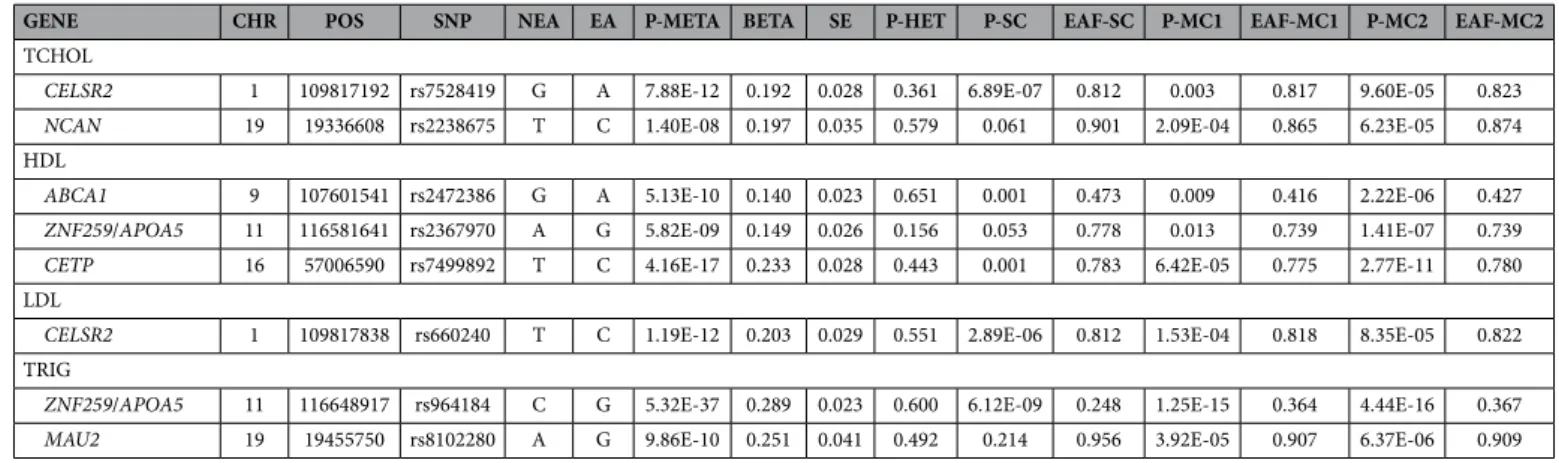
We carried out a meta-analysis of lipid traits based on three genome-wide association studies including more than 4,700 individuals of Mexican ancestry (two samples from Mexico City and one sample from Starr County, Texas). Figures S2 and S3 show the Manhattan plots and QQ plots corresponding to the meta-analysis for each lipid trait. The genome-wide significant signals (p < 5 × 10⁻⁸) identified in this analysis are depicted in Table 2. The signals correspond to the following regions: CELSR2 (lead SNP rs7528419, p = 7.9 × 10⁻¹²) and NCAN (lead SNP rs2238675, p = 1.4 × 10⁻⁸) for total choles-terol, CETP (lead SNP rs7499892, p = 4.2 × 10⁻¹⁷), ABCA1 (lead SNP rs2472386, p = 5.1 × 10⁻¹⁰) and ZNF259/ APOA5 (lead SNP rs2367970, p = 5.8 × 10⁻⁹) for HDL cholesterol, CELSR2 (lead SNP rs660240, p = 1.2 × 10⁻¹²) for LDL cholesterol, and ZNF259/APOA5 (lead SNP rs964184, p = 5.3 × 10−37) and MAU2 (lead SNP rs8102280, p = 9.9 × 10⁻¹⁰), which is located close to the NCAN gene on chromosome 19, for triglycerides. We also identified many suggestive signals (p < 10−5), including signals in well-known regions such as TRIB1, ZNF259/APOA5 and KANK2/DOCK6 for total cholesterol, LPL and LIPC for HDL cholesterol, APOB and NCAN for LDL choles-terol and GCKR and TRIB1 for triglycerides. We prioritized a list of SNPs to follow up in independent Hispanic samples, based on the imputation scores and the presence of valid p-values in the three samples included in the meta-analysis. Supplemental File 1 shows the list of markers that were followed up, including information about the effect allele and estimated effect size, p-value of the meta-analysis and p-values of the individual studies (Starr County, Mexico City samples 1 and 2). For several regions, we observed different lead SNPs for different lipid traits: CELSR (Total cholesterol and LDL), TRIB1 (Total cholesterol and triglycerides), ZNF259 (Total cholesterol, HDL and LDL), and NCAN/MAU2 (Total cholesterol, LDL and triglycerides). LocusZoom33 plots for top regions are presented in Supplemental Figures S4-S7. We carried out conditional analyses to evaluate whether these sig-nals are independent. Supplemental File 2 depicts the results of these analyses.Follow-up of genome-wide significant and suggestive signals in independent Hispanic sam
-ples.
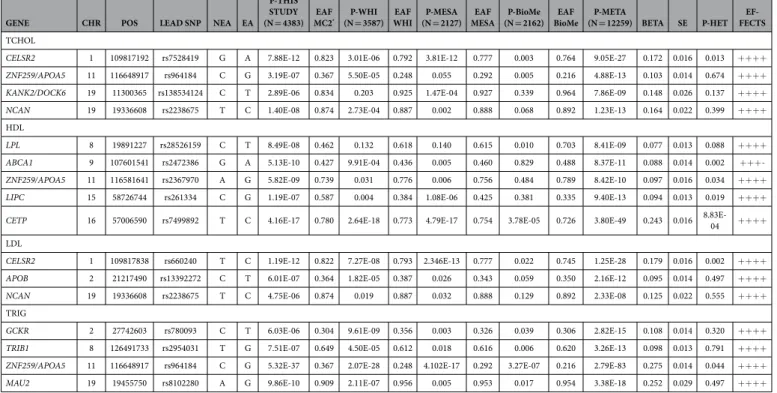
Table 3 depicts the results of the follow-up for genome-wide significant SNPs, including the p-values, effect sizes and standard deviations observed in the discovery sample, the three replication cohorts (WHI, MESA, IPM BioMe Biobank), and the meta-analysis based on 12,259 samples. The table also indicates the p-values corre-sponding to Cochran’s Q test evaluating the heterogeneity of effect sizes. The results for the complete set of mark-ers that were followed-up in the three replication cohorts are presented in Supplemental File 3. After combining the three replication samples, genome-wide significant signals were observed in CELSR2, ZNF259/APOA5, KANK2/DOCK6 and NCAN for total cholesterol, LPL, ABCA1, ZNF259/APOA5, LIPC and CETP for HDL cho-lesterol, CELSR2, APOB and NCAN for LDL chocho-lesterol, and GCKR, TRIB1, ZNF259/APOA5 and MAU2 for triglycerides. Another region between the genes SCAMP1/AP3B1 was borderline genome-wide significant for triglycerides (rs4588572, p = 7.4 × 10⁻⁸).Comparing direction of effects and effect sizes of lead SNPs in European and Hispanic sam
-ples.
We carried out a diverse set of analyses to evaluate the concordance of the signals observed in European and Hispanic samples. First, we investigated concordance in the direction of effects for markers showing genome-wide significance in the GLGC European samples4. In order to do this, we identified markers show-ing genome-wide significance for each trait in the GLGC dataset, and for the lead SNPs in each region, we retrieved information about effect sizes and direction of effects in our Hispanic dataset. The majority of theGENE CHR POS SNP NEA EA P-META BETA SE P-HET P-SC EAF-SC P-MC1 EAF-MC1 P-MC2 EAF-MC2
TCHOL
CELSR2 1 109817192 rs7528419 G A 7.88E-12 0.192 0.028 0.361 6.89E-07 0.812 0.003 0.817 9.60E-05 0.823
NCAN 19 19336608 rs2238675 T C 1.40E-08 0.197 0.035 0.579 0.061 0.901 2.09E-04 0.865 6.23E-05 0.874
HDL
ABCA1 9 107601541 rs2472386 G A 5.13E-10 0.140 0.023 0.651 0.001 0.473 0.009 0.416 2.22E-06 0.427
ZNF259/APOA5 11 116581641 rs2367970 A G 5.82E-09 0.149 0.026 0.156 0.053 0.778 0.013 0.739 1.41E-07 0.739
CETP 16 57006590 rs7499892 T C 4.16E-17 0.233 0.028 0.443 0.001 0.783 6.42E-05 0.775 2.77E-11 0.780
LDL
CELSR2 1 109817838 rs660240 T C 1.19E-12 0.203 0.029 0.551 2.89E-06 0.812 1.53E-04 0.818 8.35E-05 0.822
TRIG
ZNF259/APOA5 11 116648917 rs964184 C G 5.32E-37 0.289 0.023 0.600 6.12E-09 0.248 1.25E-15 0.364 4.44E-16 0.367
MAU2 19 19455750 rs8102280 A G 9.86E-10 0.251 0.041 0.492 0.214 0.956 3.92E-05 0.907 6.37E-06 0.909
European lead SNPs have the same direction of effect in the Hispanic samples. For total cholesterol, 85.1% of the European lead SNPs (63 out of 74) have concordant effects (binomial p-value 2 × 10⁻¹⁰). For HDL cholesterol, LDL cholesterol and triglycerides, the percentage of markers showing concordant effects are 72.4% (55 out of 76, p-value = 4 × 10⁻⁵), 81.8% (54 out of 66, p-value = 7 × 10⁻⁸), and 80.4% (45 out of 56, p-value = 2 × 10⁻⁶), respectively. When we restrict the comparisons to the European lead SNPs that are also nominally signifi-cant in the Hispanic sample (p < 0.05), the concordance is almost perfect: 100% for total cholesterol (19/19, p-value = 2 × 10⁻⁶), 94.4% for HDL cholesterol (17/18, p-value = 7 × 10⁻⁵), 100% for LDL cholesterol (15/15, p-value = 3 × 10⁻⁵), and 100% for triglycerides (11/11, p-value = 5 × 10⁻⁴) (Supplemental File 4). The analysis described above provides interesting information about the concordance in direction of effects, but it does not explore the extent to which there may be heterogeneity in effect sizes. When we carried-out a meta-analysis of the European and Hispanic samples using the inverse variance method (based on fixed-effect models), only 5 out of 74 markers (6.8%) for total cholesterol, 9 out of 76 markers (11.8%) for HDL cholesterol, 8 out of 66 markers (12.1%) for LDL cholesterol, and 3 out of 56 markers (5.4%) for triglycerides showed evidence of heterogeneity in allele effects. We carried out a similar concordance analysis based on the genome-wide and highly suggestive sig-nals that we selected for follow-up in our Hispanic sample. In agreement with the results for the GLGC European sample, for the list of followed-up markers we see a concordance higher than 50%, except for LDL cholesterol. For total cholesterol, 60% of the Hispanic lead SNPs present in the GLGC dataset had concordant effects (6 out of 10 SNPs, p-value = 0.2051). For HDL cholesterol, LDL cholesterol and triglycerides the concordance was 66.6% (6 out 9 SNPs, p-value = 0.1641), 50% (4 out of 8 SNPs, p-value = 0.2734) and 72.7% (8 out of 11 markers, p-value = 0.0807). There is perfect concordance when considering only markers that are nominally significant in the GLGC dataset: 100% for total cholesterol (5 out of 5, p-value = 0.0312), 100% for HDL cholesterol (5 out of 5, p-value = 0.0312), 100% for LDL cholesterol (3 out of 3, p-value = 0.125) and 100% for triglycerides (4 out of 4, p-value = 0.0625).
LD patterns and conditional analyses in European and Hispanic signals.
For the signals that we identified in the Hispanic sample (both genome-wide significant and highly suggestive) and that have been pre-viously reported in European populations, we explored in more detail the pattern of linkage disequilibrium (LD) between the lead SNP in Europeans (GLGC lead SNP) and the lead SNP in our Hispanic meta-analysis. Low LD between the European and Hispanic lead SNPs may indicate that the signals are independent or that the pattern of LD between the causal SNP and the surrounding markers is different in European and Hispanic populations. In the latter scenario, combining the data from both populations could provide higher fine mapping resolution. Supplemental File 5 shows a detailed analysis of the LD patterns observed between the lead SNPs in the EuropeanGENE CHR POS LEAD SNP NEA EA
P-THIS STUDY
(N = 4383) MC2EAF * (N = 3587)P-WHI WHIEAF (N = 2127)P-MESA MESAEAF (N = 2162)P-BioMe BioMeEAF (N = 12259) BETAP-META SE P-HET FECTS EF-TCHOL
CELSR2 1 109817192 rs7528419 G A 7.88E-12 0.823 3.01E-06 0.792 3.81E-12 0.777 0.003 0.764 9.05E-27 0.172 0.016 0.013 ++++
ZNF259/APOA5 11 116648917 rs964184 C G 3.19E-07 0.367 5.50E-05 0.248 0.055 0.292 0.005 0.216 4.88E-13 0.103 0.014 0.674 ++++
KANK2/DOCK6 19 11300365 rs138534124 C T 2.89E-06 0.834 0.203 0.925 1.47E-04 0.927 0.339 0.964 7.86E-09 0.148 0.026 0.137 ++++
NCAN 19 19336608 rs2238675 T C 1.40E-08 0.874 2.73E-04 0.887 0.002 0.888 0.068 0.892 1.23E-13 0.164 0.022 0.399 ++++
HDL
LPL 8 19891227 rs28526159 C T 8.49E-08 0.462 0.132 0.618 0.140 0.615 0.010 0.703 8.41E-09 0.077 0.013 0.088 ++++
ABCA1 9 107601541 rs2472386 G A 5.13E-10 0.427 9.91E-04 0.436 0.005 0.460 0.829 0.488 8.37E-11 0.088 0.014 0.002 +++
-ZNF259/APOA5 11 116581641 rs2367970 A G 5.82E-09 0.739 0.031 0.776 0.006 0.756 0.484 0.789 8.42E-10 0.097 0.016 0.034 ++++
LIPC 15 58726744 rs261334 C G 1.19E-07 0.587 0.004 0.384 1.08E-06 0.425 0.381 0.335 9.40E-13 0.094 0.013 0.019 ++++
CETP 16 57006590 rs7499892 T C 4.16E-17 0.780 2.64E-18 0.773 4.79E-17 0.754 3.78E-05 0.726 3.80E-49 0.243 0.016 8.83E-04 ++++
LDL
CELSR2 1 109817838 rs660240 T C 1.19E-12 0.822 7.27E-08 0.793 2.346E-13 0.777 0.022 0.745 1.25E-28 0.179 0.016 0.002 ++++
APOB 2 21217490 rs13392272 C T 6.01E-07 0.364 1.82E-05 0.387 0.026 0.343 0.059 0.350 2.16E-12 0.095 0.014 0.497 ++++
NCAN 19 19336608 rs2238675 T C 4.75E-06 0.874 0.019 0.887 0.032 0.888 0.129 0.892 2.33E-08 0.125 0.022 0.555 ++++
TRIG
GCKR 2 27742603 rs780093 C T 6.03E-06 0.304 9.61E-09 0.356 0.003 0.326 0.039 0.306 2.82E-15 0.108 0.014 0.320 ++++
TRIB1 8 126491733 rs2954031 T G 7.51E-07 0.649 4.50E-05 0.612 0.018 0.616 0.006 0.620 3.26E-13 0.098 0.013 0.791 ++++
ZNF259/APOA5 11 116648917 rs964184 C G 5.32E-37 0.367 2.07E-28 0.248 4.102E-17 0.292 3.27E-07 0.216 2.79E-83 0.275 0.014 0.044 ++++
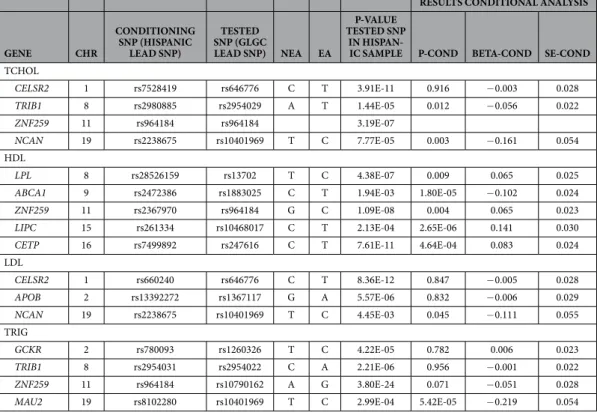
and Hispanic samples for 10 relevant regions (CELSR2, GCKR, APOB, ABCA1, LPL, TRIB1, ZNF259, LIPC, CETP and NCAN/MAU2). The LD patterns are reported as the r2 values observed in the 1000 Genomes CEU (obtained using the program SNAP) and MLX samples (Mexican Americans from LA, obtained using the program PLINK). We also estimated r2 values in one of our Mexico City samples, and observed very similar values to those of the MLX samples (data not shown). The table also shows the p-values of the lead European SNP in the Hispanic meta-analysis, and the lead Hispanic SNP in the European meta-analysis. Additionally, we carried out condi-tional analyses in the Hispanic samples, in which we conditioned on our lead SNP in the statistical analyses, and compared the p-values and effect sizes of the European lead SNP with and without conditioning on our lead SNP. These analyses are presented in Table 4.
Meta-analysis of European and Hispanic datasets.
The European (GLGC dataset) and Hispanic stud-ies used a similar statistical approach, based on an analysis of association of SNPs to inverse normal transformed traits. We carried out an inverse variance fixed-effects meta-analysis of the European4 and Hispanic data. We identified five regions that reached genome-wide significance in the meta-analysis and are nominally signifi-cant (but not genome-wide signifisignifi-cant) in both the European and Hispanic samples. Table 5 describes these regions in more detail. For total cholesterol, the genome-wide significant regions are located within the geneRESULTS CONDITIONAL ANALYSIS
GENE CHR
CONDITIONING SNP (HISPANIC
LEAD SNP)
TESTED SNP (GLGC
LEAD SNP) NEA EA
P-VALUE TESTED SNP
IN
HISPAN-IC SAMPLE P-COND BETA-COND SE-COND
TCHOL
CELSR2 1 rs7528419 rs646776 C T 3.91E-11 0.916 − 0.003 0.028
TRIB1 8 rs2980885 rs2954029 A T 1.44E-05 0.012 − 0.056 0.022
ZNF259 11 rs964184 rs964184 3.19E-07
NCAN 19 rs2238675 rs10401969 T C 7.77E-05 0.003 − 0.161 0.054
HDL
LPL 8 rs28526159 rs13702 T C 4.38E-07 0.009 0.065 0.025
ABCA1 9 rs2472386 rs1883025 C T 1.94E-03 1.80E-05 − 0.102 0.024
ZNF259 11 rs2367970 rs964184 G C 1.09E-08 0.004 0.065 0.023
LIPC 15 rs261334 rs10468017 C T 2.13E-04 2.65E-06 0.141 0.030
CETP 16 rs7499892 rs247616 C T 7.61E-11 4.64E-04 0.083 0.024
LDL
CELSR2 1 rs660240 rs646776 C T 8.36E-12 0.847 − 0.005 0.028
APOB 2 rs13392272 rs1367117 G A 5.57E-06 0.832 − 0.006 0.029
NCAN 19 rs2238675 rs10401969 T C 4.45E-03 0.045 − 0.111 0.055
TRIG
GCKR 2 rs780093 rs1260326 T C 4.22E-05 0.782 0.006 0.023
TRIB1 8 rs2954031 rs2954022 C A 2.21E-06 0.956 − 0.001 0.022
ZNF259 11 rs964184 rs10790162 A G 3.80E-24 0.071 − 0.051 0.028
MAU2 19 rs8102280 rs10401969 T C 2.99E-04 5.42E-05 − 0.219 0.054
Table 4. Results of the conditional analysis evaluating the lead SNP reported by the European GLGC consortium before and after conditioning on the lead SNP identified in the Hispanic sample. The table shows the non-effect and effect alleles (NEA, EA), original p-value of the tested SNP (GLGC lead SNP) in the Hispanic sample, and the p-value (P-COND), beta (BETA-COND) and SE (SE-COND) after conditioning on the Hispanic lead SNP.
GENE CHR SNP POS NEA EA P-META BETA SE EFFECT P-HISP P-EUR
TCHOL
FN1 2 rs1250229 216304384 T C 1.04E-08 0.023 0.004 ++ 1.75E-04 2.38E-07
SAMM50 22 rs2235776 44377999 T C 2.85E-08 0.026 0.005 ++ 8.96E-04 9.94E-06
HDL
LOC100996634 6 rs884366 109574095 A G 1.40E-08 0.021 0.004 ++ 0.026 1.67E-07
COPB1 11 rs7121538 14504463 A C 2.11E-08 0.026 0.005 ++ 0.017 4.47E-07
LDL
PFAS 17 rs4791641 8161149 T C 1.13E-08 0.021 0.004 ++ 0.034 1.31E-07
FN1 on chromosome 2 (lead SNP rs1250229, p-meta = 1.04 × 10⁻⁸) and SAMM50 on chromosome 22 (lead SNP rs2235776, p-meta = 2.85 × 10⁻⁸). For HDL cholesterol, there are two genome-wide significant regions, corre-sponding to LOC100996634 on chromosome 6 (lead SNP rs884366, p-meta = 1.40 × 10⁻⁸) and COPB1 on chro-mosome 11 (lead SNP rs7121538, p-meta = 2.11 × 10⁻⁸). For LDL cholesterol a genome-wide significant signal was observed in LINC00324/CTC1/PFAS (lead SNP rs4791641, p-meta = 1.13 × 10⁻⁸).
Analysis of signals reported in previous GWA studies in Mexicans.
There have been two recent GWA studies for lipid traits in Mexican samples11,12. In the first study, genome-wide significant signals were identified at ZNF259, GCKR, and LPL for triglycerides, and CETP, LIPC, LOC55908 and ABCA1 for HDL11). Additionally, this study identified a novel locus for triglycerides located within the TMEM241 gene at chr18q11 (lead snp rs9949617, p = 2.4 × 10⁻⁸)11. The second study used a different analytical approach, in which only var-iants showing differences in frequency between European and Native American populations were included in the GWAS12. This GWAS identified genome-wide significant signals at the LPL, ZNF259 and SIK3 genes for triglycerides, UGT8, SIK3, RORA and CETP for HDL cholesterol, and CELSR and CETP for total cholesterol. Of these, UGT8 and RORA are novel regions and the signal identified on SIK3, which is located close to the APOA5/ZNF259 region on chromosome 11, corresponds to an intronic SNP that is common in Mexicans but not observed in a Finnish sample12. Supplemental File 6 reports the p-values of those loci in our meta-analysis. We could not replicate the signals reported for TMEM241, UGT8, RORA and SIK3 in our meta-analysis.Gene-based and Pathway analyses.
The results of the gene-based association analyses for all traits using the program KGG3 are shown in Supplemental File 7. In the gene-based tests, we observed genome-wide sig-nificance for CELSR2, NCAN, KIAA1462, LOC102467074, RPL34 and the APOA5/BUD13/ZNF259 region for total cholesterol, CETP, ABCA1, LIPC, LPL, KIF3C and the APOA5/BUD13/ZNF259 region for HDL cholesterol, CELSR2 for LDL cholesterol and NCAN and APOA5/BUD13/ZNF259 region for triglycerides (Supplemental File 7). Supplemental Files 7 and 8 show the results of the pathway-based association analyses using the programs KGG3 (Supplemental File 7) and GSA-SNP (Supplemental File 8). Although both programs use different strate-gies to define gene-based p-values and rely on different databases to define the pathways, they identified numer-ous common pathways relevant to lipid metabolism (see Supplemental Files 7 and 8 for detailed information).eQTL analyses.
We carried out genome-wide association analyses of eSNPs reported for LCL28, human liver29, adipose and muscle30 and lipid traits. The genome-wide signals observed using an FDR of 5% are reported in Supplemental File 9. For each tissue and lipids trait, we tested whether the eSNPs identified in the tissue showed an excess of low p-values for association with the trait beyond what is expected under the null hypoth-esis. We generated a Q-Q plot from the distribution of meta-analysis p-values for the eSNPs identified in each tissue, and quantified the improvement in false discovery rate (see Methods) to detect trait-associated SNPs using the tissue-specific eSNPs. Among the eSNPs identified in adipose, muscle and liver, we observed a consistent, though tissue-dependent, enrichment for associations with all lipids traits (Figure S8). In contrast, we observed no such enrichment for associations with total cholesterol and LDL cholesterol among the LCL eSNPs (Figure S8). The leftward shifts of the observed distribution from the diagonal (“null”) line corresponding to FDR < 0.25, FDR < 0.10, and FDR < 0.05 provide a quantification of enrichment34. Taken together, these results suggest that tissue-specific regulatory variation can be used to detect lipid-associated SNPs with improved power.Discussion
SNP in Europeans or in Mexican-Americans (data not shown). Our lead SNP in this region, rs4588572, is present in the European GLGC dataset, but is not nominally associated with triglyceride levels (p = 0.1037).
The availability of imputed data obtained using dense 1000 Genomes reference panels made it possible to explore in detail the concordance between the signals observed in studies carried out in European and Hispanic samples. Our analyses of the lead SNPs of the European GLGC dataset in our Hispanic samples indicate that there is a remarkable concordance of effects in both populations for all lipid traits (concordance rates range between 72.4% and 85.1%, p-values range between 4 × 10⁻⁵ to 2 × 10⁻¹⁰), and the concordance is near perfect when restricting the comparisons to markers that are nominally significant in the Hispanic sample. Similar anal-yses for the markers that were selected for follow-up in the Hispanic meta-analysis also demonstrate an excess of concordance of effects for all traits, except LDL cholesterol. Many of the lead SNPs identified in our Hispanic sample are not present in the GLGC dataset, because it was not imputed using the latest 1000 Genomes reference panels. As a result, the sample sizes for these analyses were small (8− 11 SNPs), and in most cases the results are not significant. We also observed very little evidence of heterogeneity in effect sizes between the European and Hispanic samples. Only a small fraction of the lead GLGC SNPs analyzed (between 5.4% and 12.1%) showed significant differences in effect sizes between the European and Hispanic datasets and there is a strong correlation of effect sizes across the two samples (Figure S9). Our results are in agreement with recent studies reporting that the majority of the common lead snps identified in European populations (in which most of the GWA studies have taken place) are also relevant for other population groups. For example, Coram et al.10 reported that loci showing genome-wide significance or suggestive evidence of association in Europeans had a strong enrichment in small p-values in the Women Health Initiative (WHI) African American and Hispanic cohorts. These authors also found strong correlation of genetic effects per allele in the WHI African American and Hispanic samples for loci with p ≤ 10−5 in Europeans. Teslovich et al.5 found that most of the lipid loci discovered in a large European meta-analysis show the same direction of association in East Asians, South Asians and African Americans. These authors also described that for the majority of the loci, there was no evidence of heterogeneity in effect sizes between the European and non-European populations5. In another study of GWAS-identified SNPs associated with lipid traits, Dumitrescu et al.9 reported that the majority of the loci identified in European populations generalized to African Americans, American Indians and Hispanics. In particular, 14/27 (52%), 10/19 (53%) and 12/14 (86%) of the SNPs identified in European GWAS for HDL, LDL and TG were also associated at a sig-nificance threshold of p < 0.05 in the Hispanic sample. These observations also apply to other traits. In a recent trans-ethnic meta-analysis focused on type 2 diabetes37, the authors described that only 3 out of 69 established autosomal susceptibility loci showed evidence of heterogeneity in allelic effects. Additionally, 34 out of 52 previ-ously reported lead SNPs showed the same direction of effects in European, East Asian, South Asian and Hispanic samples (65.4% vs 12.5% expected by chance, p < 2.2 × 10⁻¹⁶).
For the significant regions that were identified in both the GLGC European dataset4 and our Hispanic samples, we carried out a detailed analysis of the LD patterns between the European and Hispanic lead SNPs (Supplemental File 5). We also performed conditional analyses to gain further insights about the presence of shared vs. independent signals in these regions (Table 4). The extent of LD between the European and Hispanic lead SNPs shows substantial variation, from very strong (r2> 0.8, CELSR2, ZNF256/APOA5, TRIB1, GCKR) to moderate (r2> 0.25, LPL and APOB) to very weak or non-existent (r2< 0.1, NCAN/MAU2, ABCA1, LIPC and CETP). The analysis of LD patterns indicates that trans-ethnic meta-analyses may be extremely useful for fine-mapping efforts, in accordance to what has been shown in previous studies35. The conditional analyses are fully consistent with the expectations based on the observed pattern of LD between markers. In the regions showing strong LD between the European and Hispanic lead SNPs, the p-values of the European and Hispanic lead SNPs are of similar magnitude in the Hispanic sample, and after conditioning on the Hispanic lead SNP, the European lead SNP becomes non-significant. In the regions showing moderate LD, the p-values of the European lead SNP also change considerably (LPL) or become non-significant (APOB) after conditioning. Importantly, for three regions (ABCA1 and LIPC for HDL cholesterol and NCAN/MAU2 for triglycerides) there is strong evidence for the presence of independent signals in the European and Hispanic samples (i.e. there are at least two inde-pendent SNPs influencing lipid levels in these regions): the European and Hispanic lead SNPs are not in LD, and after conditioning the p-values of the European lead SNP in the Hispanic sample are more significant than the original p-values. Interestingly, for ABCA1 and LIPC, although the European lead SNP and our lead SNP are not in LD, our lead SNPs are in strong LD with the lead SNPs described recently in a study in Mexicans11. For ABCA1, the r2 between our lead SNP, rs2472386, and the lead SNP in the aforementioned study, rs2278426, is 0.65 in the 1000 Genomes MXL sample. For LIPC, the r2 between our lead SNP, rs261334, and the lead SNP reported in that study, rs1077835, is 0.83.
COPB1 gene encodes a protein subunit of the coatomer complex associated with non-clathrin coated vesicles. According to UniProt (see Web resources), this complex is involved in lipid homeostasis by regulating the pres-ence of perilipin family members PLIN2 and PLIN3 at the lipid droplet surface and promoting the association of adipocyte surface triglyceride lipase (PNPLA2) with the lipid droplet to mediate lipolysis. The gene PFAS encodes an enzyme that plays a role in the synthesis of inosine monophosphate (IMP). The five novel loci identified in the meta-analysis of the European and Hispanic samples need to be replicated in independent samples.
We followed up in our samples the lead SNPs described in two recent GWA studies for lipid traits in Mexican samples11,12, which are very relevant to our own study due to the similarities in ancestral composition. Of particu-lar interest are the novel genome-wide regions described in these studies, which are located near or at the genes TMEM24111 and SIK312 for triglycerides, and UGT8 and RORA for HDL cholesterol12. We could not replicate the associations at TMEM241, UGT8 and RORA: none of the lead SNPs described for these regions is nomi-nally significant in our dataset (Supplemental File 6). The lead SNP at SIK3, rs139961185, is genome-wide sig-nificant in our sample (p = 1.71 × 10⁻⁸). However, LD and conditional analyses indicate that the signal observed in this region is primarily driven by the well-known association at ZNF259/APOA5, which is located approxi-mately 150 kb apart from the SIK3 lead SNP on chromosome 11. The r2 value between rs139961185 and rs964184 in the 1000 Genomes MXL samples is 0.181, and this relatively low LD seems to explain why the p-values of rs139961185 in the original Mexican study (p = 1.15 × 10⁻¹²) and our dataset (1.71 × 10⁻⁸) are substantially lower than the p-values of rs964184 in both studies (6.08 × 10⁻³³ and 5.32 × 10−37, respectively). If the signal observed at rs139961185 is truly independent of rs964184, we would expect that the p-values for this marker would remain significant after conditioning on rs964184 (similarly to what was described for the European lead SNPs at ABCA1, LIPC and NCAN/MAU2), but this is not the case in our samples: After conditioning on rs964184, the p-value of rs139961185 becomes non-significant (p = 0.922).
In addition to the standard association analyses using directly genotyped and imputed data, we carried out gene-based and pathway analyses, as well as a genome-wide association analysis restricted to eSNPs reported for LCL, adipose, muscle and human liver (Supplemental Files 7–9). The gene-based and eSNP association analyses are attractive because of the reduced penalty for multiple testing in comparison with standard GWA studies. The results of the gene-based and eSNP association tests are in agreement with those observed in the primary GWAs, although there are now some regions that were not genome-wide significant in the original meta-analysis, but reach genome-wide significance in the gene-based (using Bonferroni correction) or eSNP association (using the FDR criterion) tests. For example, in the gene-based tests, genes in the ZNF256/APOA5 region and the gene RPL34 are genome-wide significant for total cholesterol, and the genes LPL and LIPC are genome-wide signif-icant for HDL cholesterol (Supplemental File 7). These regions did not reach genome-wide significance in the original meta-analysis. Similarly, in the eSNP association tests, using an FDR of 5%, eSNPs in the LPL, LIPC and LOC102467079 regions are genome-wide significant for HDL cholesterol, and eSNPs located in the DOK6 and TRIB1 regions are genome-wide significant for LDL cholesterol and triglycerides, respectively (Supplemental File 9). Of note, several eSNPs identified as significant in our analysis are either the lead SNPs of our meta-analysis (rs2238675 is our lead SNP in the NCAN region for total cholesterol, rs7499892 is our lead SNP in the CETP region for HDL cholesterol and rs660240 is our lead SNP in the CELSR2 region for LDL cholesterol), or have p-values quite similar to those of our lead SNP (CELSR2 eSNPs for total cholesterol, CELSR2 and DOK6 eSNPs for LDL cholesterol, ABCA1, ZNF256/APOA5, CETP, LPL, LIPC and LOC102467079 eSNPs for HDL cholesterol, and TRIB1 for triglycerides), or are the lead SNPs of the GLGC meta-analysis (rs646776 is the lead SNP in the CELSR2 region for total cholesterol and LDL cholesterol). Thus, it is possible that at least some of the top meta-analysis signals exert a phenotypic effect through transcriptional regulation. Furthermore, the eQTLs reported for each tissue showed different levels of enrichment for top associations with lipids traits. For example, eQTLs identified in adipose, muscle and liver showed consistent departure from the null for LDL cholesterol and total cholesterol; in contrast, those mapped in LCLs did not reach significance for these traits (although they were highly signifi-cant for the remaining lipids phenotypes) (Figure S8). In general, however, the eQTLs mapped in these tissues led to improved false discovery rate. Additionally, the target genes they implicate are tissue-dependent (suggesting tissue-specific function) and provide plausible biological mechanisms for the observed associations.
As expected, the pathway-based tests showed a significant enrichment in pathways involved in lipid metabo-lism. Of note is the enrichment observed for gene sets involved in chylomicron mediated lipid transport, lysoso-mal degradation of glycoproteins (more particularly, degradation of chondroitin sulfate and dermatan sulfate), peroxisome proliferator-activated receptor-γ (PPARγ ) signaling, as well as cell adhesion molecules and ABC transporters, for multiple lipid traits (Supplemental Files 7 and 8).
cohorts showed evidence of heterogeneity of effect sizes in the meta-analysis (see Table 2 and Supplemental File 3). Finally, the three discovery samples include both controls and individuals with type 2 diabetes. Here, we have reported the results obtained when including diabetes status as a covariate, but the results are quite similar when analyzing the data without diabetes status as a covariate.
In summary, we report here the results of a meta-analysis of lipid traits in three samples of Mexican ancestry, and the follow-up of the genome-wide and suggestive signals in independent Hispanic samples. We observed genome-wide significant signals in multiple regions that have been previously described in European studies. LD and conditional analyses indicate that for some of these regions we are capturing the same signals present in European populations. However, in other regions (ABCA1 and LIPC for HDL cholesterol, and NCAN/MAU2 for triglycerides), our lead SNPs are clearly independent of the lead SNPs described in European populations. We also identified a novel region between the genes ACTBP2/AP3B1 that was borderline genome-wide significant for triglycerides. Our meta-analysis of the European GLGC and Hispanic datasets highlighted five novel regions associated with lipid traits. Further GWAS for lipid traits are needed in Hispanic populations, which show high prevalence of dyslipidemias. These studies will make it possible to identify genomic regions that are relevant for these populations, and will also facilitate the fine mapping of lipid regions by combining datasets from popula-tions of diverse ancestry.
References
1. Go, A. S. et al. Heart disease and stroke statistics–2014 update: a report from the American Heart Association. Circulation129, e28–e292, doi:10.1161/01.cir.0000441139.02102.80 (2014).
2. Salud, S. d. & Salud, S. d. P. y. P. d. l. Panorama Epidemiológico y Estadístico de la Mortalidad en México 2010 (México DF, 2012). 3. Aguilar-Salinas, C. A. et al. Prevalence of dyslipidemias in the Mexican National Health and Nutrition Survey 2006. Salud Publica
Mex52 Suppl 1, S44–53 (2010).
4. Global Lipids Genetics Consortium et al. Discovery and refinement of loci associated with lipid levels. Nat Genet45, 1274–1283, doi:10.1038/ng.2797 (2013).
5. Teslovich, T. M. et al. Biological, clinical and population relevance of 95 loci for blood lipids. Nature466, 707–713, doi:10.1038/ nature09270 (2010).
6. Musunuru, K. et al. From noncoding variant to phenotype via SORT1 at the 1p13 cholesterol locus. Nature466, 714–719,
doi:10.1038/nature09266 (2010).
7. Carlson, C. S. et al. Generalization and dilution of association results from European GWAS in populations of non-European ancestry: the PAGE study. PLoS Biol11, e1001661, doi:10.1371/journal.pbio.1001661 (2013).
8. Asselbergs, F. W. et al. Large-scale gene-centric meta-analysis across 32 studies identifies multiple lipid loci. Am J Hum Genet91, 823–838, doi:10.1016/j.ajhg.2012.08.032 (2012).
9. Dumitrescu, L. et al. Genetic determinants of lipid traits in diverse populations from the population architecture using genomics and epidemiology (PAGE) study. PLoS Genet7, e1002138, doi:10.1371/journal.pgen.1002138 (2011).
10. Coram, M. A. et al. Genome-wide characterization of shared and distinct genetic components that influence blood lipid levels in ethnically diverse human populations. Am J Hum Genet92, 904–916, doi:10.1016/j.ajhg.2013.04.025 (2013).
11. Weissglas-Volkov, D. et al. Genomic study in Mexicans identifies a new locus for triglycerides and refines European lipid loci. J Med
Genet50, 298–308, doi:10.1136/jmedgenet-2012-101461 (2013).
12. Ko, A. et al. Amerindian-specific regions under positive selection harbour new lipid variants in Latinos. Nat Commun5, 3983, doi:10.1038/ncomms4983 (2014).
13. Parra, E. J. et al. Genome-wide association study of type 2 diabetes in a sample from Mexico City and a meta-analysis of a Mexican-American sample from Starr County, Texas. Diabetologia54, 2038–2046, doi:10.1007/s00125-011-2172-y (2011).
14. Below, J. E. et al. Genome-wide association and meta-analysis in populations from Starr County, Texas, and Mexico City identify type 2 diabetes susceptibility loci and enrichment for expression quantitative trait loci in top signals. Diabetologia54, 2047–2055, doi:10.1007/s00125-011-2188-3 (2011).
15. Friedewald, W. T., Levy, R. I. & Fredrickson, D. S. Estimation of the concentration of low-density lipoprotein cholesterol in plasma, without use of the preparative ultracentrifuge. Clin Chem18, 499–502 (1972).
16. Korn, J. M. et al. Integrated genotype calling and association analysis of SNPs, common copy number polymorphisms and rare CNVs. Nat Genet40, 1253–1260, doi:10.1038/ng.237 (2008).
17. Marchini, J., Howie, B., Myers, S., McVean, G. & Donnelly, P. A new multipoint method for genome-wide association studies by imputation of genotypes. Nat Genet39, 906–913, doi:10.1038/ng2088 (2007).
18. Marchini, J. & Howie, B. Genotype imputation for genome-wide association studies. Nat Rev Genet11, 499–511, doi:10.1038/ nrg2796 (2010).
19. Delaneau, O., Marchini, J. & Zagury, J. F. A linear complexity phasing method for thousands of genomes. Nat Methods9, 179–181, doi:10.1038/nmeth.1785 (2012).
20. Howie, B., Fuchsberger, C., Stephens, M., Marchini, J. & Abecasis, G. R. Fast and accurate genotype imputation in genome-wide association studies through pre-phasing. Nat Genet44, 955–959, doi:10.1038/ng.2354 (2012).
21. Patterson, N., Price, A. L. & Reich, D. Population structure and eigenanalysis. PLoS Genet2, e190, doi:10.1371/journal.pgen.0020190 (2006).
22. Wu, J. et al. An investigation of the effects of lipid-lowering medications: genome-wide linkage analysis of lipids in the HyperGEN study. BMC Genet8, 60, doi:10.1186/1471-2156-8-60 (2007).
23. Bild, D. E. et al. Multi-ethnic study of atherosclerosis: objectives and design. Am J Epidemiol156, 871–881 (2002).
24. Li, M. X., Gui, H. S., Kwan, J. S. & Sham, P. C. GATES: a rapid and powerful gene-based association test using extended Simes procedure. Am J Hum Genet88, 283–293, doi:10.1016/j.ajhg.2011.01.019 (2011).
25. Li, M. X., Kwan, J. S. & Sham, P. C. HYST: a hybrid set-based test for genome-wide association studies, with application to protein-protein interaction-based association analysis. Am J Hum Genet91, 478–488, doi:10.1016/j.ajhg.2012.08.004 (2012).
26. Nam, D., Kim, J., Kim, S. Y. & Kim, S. GSA-SNP: a general approach for gene set analysis of polymorphisms. Nucleic Acids Res38, W749–754, doi:10.1093/nar/gkq428 (2010).
27. Kim, S. Y. & Volsky, D. J. PAGE: parametric analysis of gene set enrichment. BMC Bioinformatics6, 144, doi:10.1186/1471-2105-6-144 (2005).
28. Gamazon, E. R. et al. SCAN: SNP and copy number annotation. Bioinformatics26, 259–262, doi:10.1093/bioinformatics/btp644 (2010).
29. Innocenti, F. et al. Identification, replication, and functional fine-mapping of expression quantitative trait loci in primary human liver tissue. PLoS Genet7, e1002078, doi:10.1371/journal.pgen.1002078 (2011).
31. Storey, J. D. & Tibshirani, R. Statistical significance for genomewide studies. Proc Natl Acad Sci USA100, 9440–9445, doi:10.1073/ pnas.1530509100 (2003).
32. Gamazon, E. R., Huang, R. S., Dolan, M. E., Cox, N. J. & Im, H. K. Integrative genomics: quantifying significance of phenotype-genotype relationships from multiple sources of high-throughput data. Front Genet3, 202, doi:10.3389/fgene.2012.00202 (2012). 33. Pruim, R. J. et al. LocusZoom: regional visualization of genome-wide association scan results. Bioinformatics26, 2336–2337,
doi:10.1093/bioinformatics/btq419 (2010).
34. Gamazon, E. R., Cox, N. J. & Davis, L. K. Structural Architecture of SNP Effects on Complex Traits. Am J Hum Genet, doi:10.1016/j. ajhg.2014.09.009 (2014).
35. Kathiresan, S. et al. A genome-wide association study for blood lipid phenotypes in the Framingham Heart Study. BMC Med Genet
8 Suppl 1, S17, doi:10.1186/1471-2350-8-S1-S17 (2007).
36. Irvin, M. R. et al. Genome-wide detection of allele specific copy number variation associated with insulin resistance in African
Americans from the HyperGEN study. PLoS One6, e24052, doi:10.1371/journal.pone.0024052 (2011).
37. DIAbetes Genetics Replication Meta-analysis Consortium et al Genome-wide trans-ancestry meta-analysis provides insight into the genetic architecture of type 2 diabetes susceptibility. Nat Genet46, 234–244, doi:10.1038/ng.2897 (2014).
38. Davies, R. W. et al. A genome-wide association study for coronary artery disease identifies a novel susceptibility locus in the major
histocompatibility complex. Circ Cardiovasc Genet5, 217–225, doi:10.1161/CIRCGENETICS.111.961243 (2012).
39. Kawaguchi, T. et al. Genetic polymorphisms of the human PNPLA3 gene are strongly associated with severity of non-alcoholic fatty liver disease in Japanese. PLoS One7, e38322, doi:10.1371/journal.pone.0038322 (2012).
40. Bettermann, K., Hohensee, T. & Haybaeck, J. Steatosis and steatohepatitis: complex disorders. Int J Mol Sci15, 9924–9944, doi:10.3390/ijms15069924 (2014).
Acknowledgements
We gratefully acknowledge all the individuals from Mexico and the US who participated in this study. In Mexico, this work was supported by the Fondo Sectorial de Investigación en Salud y Seguridad Social (SSA/IMSS/ISSSTE-CONACYT) project 150352, Temas Prioritarios de Salud Instituto Mexicano del Seguro Social 2014-FIS/IMSS/ PROT/PRIO/14/34, and the Fundación IMSS. We thank Jorge Gutierrez Cuevas, Jaime Gómez Zamudio and Araceli Méndez Padrón for technical support. In Canada, the research was supported by a Canadian Institutes of Health Research (CIHR) operating grant to EJP, and also by funding from the Banting and Best Diabetes Centre to EJP. In Canada, computations were performed on the GPC supercomputer at the SciNet HPC Consortium. SciNet is funded by: the Canada Foundation for Innovation under the auspices of Compute Canada; the Government of Ontario; Ontario Research Fund – Research Excellence; and the University of Toronto. In Chicago, the work was supported by the University of Chicago Diabetes Research and Training Center (P60 DK20595). Genotyping services were provided by the Center for Inherited Disease Research (CIDR). CIDR is funded through a federal contract from the National Institutes of Health (NIH) to The Johns Hopkins University, contract number HHSN268200782096C. The WHI program is funded by the National Heart, Lung, and Blood Institute, National Institutes of Health, US Department of Health and Human Services through contracts HHSN268201100046C, HHSN268201100001C, HHSN268201100002C, HHSN268201100003C, HHSN268201100004C and HHSN271201100004C. SC and HT were supported by NIH R01GM073059. MESA and the MESA SHARe project are conducted and supported by contracts N01-HC-95159, N01-HC-95160, N01-HC-95161, N01-HC-95162, N01-HC-95163, N01-HC-95164, N01-HC-95165, N01-HC-95166, N01-HC-95167, N01-HC-95168, N01-HC-95169 and RR-024156 from the National Heart, Lung, and Blood Institute (NHLBI). Funding for MESA SHARe genotyping was provided by NHLBI Contract N02‐HL6‐4278. The provision of genotyping data was supported in part by the National Center for Advancing Translational Sciences, CTSI grant UL1TR000124, and the National Institute of Diabetes and Digestive and Kidney Disease Diabetes Research Center (DRC) grant DK063491 to the Southern California Diabetes Endocrinology Research Center. MESA Family is conducted and supported in collaboration with MESA investigators; support is provided by grants and contracts R01HL071051, R01HL071205, R01HL071250, R01HL071251, R01HL071252, R01HL071258 and R01HL071259. The authors thank the participants of the MESA study, the Coordinating Center, MESA investigators, and study staff for their valuable contributions. A full list of participating MESA investigators and institutions can be found at http://www. mesa-nhlbi.org. The BioMe Biobank Program is supported by The Andrea and Charles Bronfman Philanthropies.
Author Contributions
J.E.B. and E.J.P. lead the analysis and wrote the manuscript. E.R.G. performed expression analyses, J.T. and S.K. performed imputation of the Mexico City datasets. J.P.-R. collected data for the Mexico City samples. A.P.M. performed imputation of the Starr County dataset. N.J.C., M.C., C.L.H. and A.V.S. supervised the work. S.C., Y.L., A.M., Q.D., Y.L., O.G., E.B., X.-Q.W., K.D.T., Y.-D.I.C., J.I.R., S.S.R., R.J.L. and H.T. participated in the replication effort. All authors reviewed the manuscript.
Additional Information
Supplementary information accompanies this paper at http://www.nature.com/srep
Competing financial interests: The authors declare no competing financial interests.
How to cite this article: Below, J. E. et al. Meta-analysis of lipid-traits in Hispanics identifies novel loci, population-specific effects, and tissue-specific enrichment of eQTLs. Sci. Rep. 6, 19429; doi: 10.1038/srep19429 (2016).