MAKING CERTAIN:
INFORMATION AND SOCIAL REALITY
Elliott Ayers Hauser
A dissertation submitted to the faculty of the University of North Carolina at Chapel Hill in
partial fulfillment of the requirements for the degree of Doctor of Philosophy in Information
Science in the School of Information and Library Science.
Chapel Hill
2019
Approved by:
Geoffrey Bowker
Melanie Feinberg
Stephanie Haas
Ryan Shaw
ABSTRACT
Elliott Ayers Hauser: Making Certain: Information and Social Reality
(Under the direction of Ryan Shaw)
This dissertation identifies and explains the phenomenon of the production of certainty in information
systems. I define this phenomenon pragmatically as instances where practices of justification end upon
information systems or their contents. Cases where information systems seem able to produce social
reality without reference to the external world indicate that these systems contain facts for determining
truth, rather than propositions rendered true or false by the world outside the system. The No Fly list is
offered as a running example that both clearly exemplifies the phenomenon and announces the stakes
of my project. After an operationalization of key terms and a review of relevant literature, I articulate a
research program aimed at characterizing the phenomenon, its major components, and its effects. Notable
contributions of the dissertation include:
• the identification of the production of certainty as a unitary, trans-disciplinary phenomenon;
• the synthesis of a sociolinguistic method capable of unambiguously identifying a) the presence of
this phenomenon and b) distinguishing the respective contributions of systemic and social factors
to it; and
• the development of a taxonomy of certainty that can distinguish between types of certainty
production and/or certainty-producing systems.
The analysis of certainty proposed and advanced here is a potential compliment to several existing
methods of sociotechnical research. This is demonstrated by applying the analysis of certainty to the
complex assemblage of computational timekeeping alongside a more traditional infrastructural inversion.
Three subsystems, the
tz
database, Network Time Protocol, and International Atomic Time, are selected
from the assemblage of computational timekeeping for analysis. Each system employs a distinct memory
practice, in Bowker’s sense, which licenses the forgetting inherent in the production of the information it
contains. The analysis of certainty expands upon the insights provided by infrastructural inversion to
social reality of time. This analysis serves as an example for scholars who encounter the phenomenon of
the production of certainty in information systems to use the proposed theoretical framework to more
easily account for, understand, and engage with it in their work. The dissertation concludes by identifying
other sites amenable to this kind of analysis, including the algorithmic assemblages commonly referred
ACKNOWLEDGEMENTS
It has become increasingly clear to me while completing this work that is inextricably entangled in
what Leigh Star called “intellectual infrastructure” In discussing her own intellectual infrastructure and
its role in her scholarly journey, Star wrote that “the formation of this path was/is not accidental, however
full of contingencies it may be.” In what follows I hope to celebrate the people who have create and
maintain the intellectual infrastructure that has made my work possible. However contingent my path,
their contributions are not accidental, and I am grateful for them.
Ryan Shaw has been everything I could have asked for in an advisor and chair. I was fortunate that
Ryan agreed to chair my committee so early within his career, when expedience might have suggested that
my doctoral aspirations would be a distraction from the rigors of tenure and promotion. As it happened,
Ryan gained tenure during this time, and in the process showed me that what counts in academic life goes
far beyond just what counts for tenure. His many helpful suggestions of related literature have helped me
situate my work within several ongoing conversations within and around information studies. The list of
references in my meeting notes that I have yet to deeply engage (which remains regrettably long) will no
doubt play this same role in my subsequent work.
Melanie Feinberg is, in addition to being a strikingly original thinker, quite possibly the world’s
greatest academic editor. She’s able to refine a document’s critical shortcomings into succinct and
challenging questions for the writer to revise and re-present their key ideas around. Melanie does all of
this while refraining from providing her own (probably superior) answers to the questions she raises,
preserving the fertile space for thinking that academic writing provides. All of these skills are in addition
to her considerable productivity and clarity as a scholar. That she possesses both sets of abilities in
abundance and so willingly and generously shares them with her students and colleagues is a testament
to her unique character. Though I have attempted to follow her exhortation to avoid relying on evaluative
language in the dissertation itself, I have been unable to do so in acknowledging her contributions to my
Stephanie Haas was one of the first UNC professors I contacted when exploring this strange new field
of ‘information science’ that I had discovered by accident. Her generosity in meeting with a prospective
student grew into a years-long mentorship through both my masters and doctoral studies. Stephanie’s
omnivorous curiosity has produced a quiet mastery over a disconcerting array of topics, especially
within the study of language. As an advisor, she has never failed to listen deeply, probe expertly, and
encouragingly share in my enthusiasm for my work.
When I returned from my leave of absence, Ryan mentioned that there was a Communications scholar
at UNC who was doing some interesting work on information systems. Neal Thomas has subsequently
become an integral part, not only of my committee, but of the intellectual life of our corner of the
university. Neal has provided an accessible introduction to a vast swath of Continental literature that I
had avoided in the absence of a trusted guide. Neal has continued to be that trusted guide for me as I’ve
gone deeper with several key thinkers he introduced me to in this dissertation and elsewhere, and is an
ever-challenging discussant and collaborator.
It was already a foregone conclusion that Geof Bowker’s thought would substantially shape the work
of my dissertation when, in the spring of 2018, I reached out to ‘discuss my research’ with him. My hope
was that the discussion would go well enough that he would agree to serve as the external member of
my committee; to my delight and surprise, this is what occurred. In our subsequent discussions Geof
has been a font of new ideas and connections, and an immense encouragement. His vision of engaged
scholarship and the way in which he enacts it remains an inspiration for the kind of scholar I’d like to be.
Other faculty beyond the five on my committee have played important roles in my intellectual
development over time. I’m particularly grateful for an array of help, mentorship and support from Javed
Mostafa, Brad Hemminger, Bob Losee, Barbara Wildemuth, Diane Kelley, Rob Capra, Sandra
Hughes-Hassel, and the late Evelyn Daniel. Evelyn will be dearly missed by all of us who knew her. Faculty of
other departments have provided intellectual challenge and diversity to my experience, especially Alan
Nelson, Simon Blackburn, Lily Nguyen, Jan Prinz, Buck Goldstein, Kevin Guskiewicz, Matt Springer,
and of course Neal Thomas. Through it all the SILS office staff have kept things running smoothly, and
the indefatigable Lara Bailey has always had the answers to my questions and often the solutions to my
problems when I needed them.
The Organization Reading Group at UNC has been a crucial component of my experience since
Evelyn Daniel, Megan Winget, Debbie Maron, Andrew Rabkin, Evan Donahue, and others have made
this group a wonderful weekly ritual for the past several years.
Many others have made this long journey fun. John D. Martin III’s friendship has been a particularly
welcome respite from the often solitary, arcane, invisible, and exhausting work of earning a dissertation.
I’ve deeply enjoyed our formal collaborations, and even moreso our informal chats about things like the
exquisite and illicit pleasure of spending time perfecting L
ATEX code instead of writing one’s dissertation.
The Sociotech Writing Group, which grew out of the Consortium for the Science of Sociotechnical
Systems 2019 Summer Research Institute at Rutgers University, has been an increasingly important
source of support, inspiration, and intellectual engagement for me. In particular, I’d like to thank Karen
Boyd, Stevie Chancellor, Mike DeVito, Michaelanne Dye, Sarah Gilbert, Koko Koltai, Jacob
Thebault-Spieker, and the rest of my
#accountabilibuddies
for letting me be
#random
now and again. I
hope to see you all in
#wins-and-fails
. Aaron Kirschenfeld was uniquely positioned to help me
clarify the legal analogies I make in this text, and did some difficult work in helping me to trace the
origins and precise meanings of legal terms that were rarely precisely defined in the field’s literature.
Bjoern B. Brandenburg made an excellent L
ATEX template conforming to UNC’s thesis and dissertation
guidelines available on GitHub.
On April 14
th, 2019, Phoebe Richardson Hauser entered the world and indelibly altered mine. Her
influence on this work began some months before, when she provided an extraordinary motivation to
write four chapters in the four months leading up to her birth. Since that time, my in-laws Angie and
Bill and parents Eric and Donna have provided loving care and support for our young family and have
watched Phoebe to allow me to complete my work. Angie in particular has gone above and beyond. To
my family: thank you.
And, finally, I thank my wife Erin, to whom the dissertation is dedicated. Her drive to know herself,
to deeply know others, and to do good in this world is a continual refuge, inspiration, and challenge to
PREFACE
This dissertation is the culmination of a decade-long curiosity about how information can be so
powerful. My interest was first piqued during my undergraduate art history studies, where I mused
about how the work I was doing could be evaluated by others. I was using a 1976 facsimile reprint of
a three volume set of Dutch auction records originally printed in the 18
thcentury. The auction records
were themselves reprints of annotated auction catalogs. The printed catalogs contained descriptions of
the artworks for sale, but not their prices, since the auctions has yet to occur when the catalogs were
printed. The sale prices of the paintings which ended up in the auction records, the 1976 reprint, and
ultimately in the improbably large Excel spreadsheet I constructed for my undergraduate honors thesis,
were annotations made by the art dealer, or possibly one of his associates, during the actual auction.
Obviously, the tenuousness of the chain of evidence that I used to produce an analysis of the 18
thcentury
auction market in the Netherlands ended up being of more lasting intellectual interest than the art market
itself.
With these problems in the back of my mind, I continued reading philosophy and sociology after
my undergraduate studies were complete, and gradually gained new purchase on these problems. Alan
Nelson’s UNC seminar on the Philosophical Investigations in 2007 was particularly influential in this
respect. Its intellectual reverberations, in the form of my continued engagement with Wittgenstein’s
thought, will continue well beyond their obvious expression in this dissertation. Ironically, it was
Wittgenstein’s skepticism as to the value of studying philosophy which probably led me, eventually, to
seek a PhD in information studies instead of philosophy. I of course continue to read and apply philosophy
despite it all, and Nelson later also welcomed me into a Wittgenstein reading group as a doctoral student
here.
Since arriving at UNC, and particularly after beginning my PhD with the support of the Royster
Society of Fellows, I have been extremely fortunate to have the latitude and intellectual support to
clarify, investigate, and ultimately write a dissertation on this topic. The final intellectual puzzle piece
social ontology and account of the social construction of facts turned out to be exactly what I needed to
crystallize my approach to the phenomenon.
This work is a culmination, yes, but I’ve taken to heart the wise counsel of several advisors that
dissertations be seen as the first step in a longer investigation, not the last word. I have gained invaluable
experience marshalling the not inconsiderable resources of the UNC intellectual community in writing
it, skills I am now looking to deploy towards adjacent projects. I hope the reader will find herein a
TABLE OF CONTENTS
LIST OF TABLES . . . xiii
LIST OF FIGURES . . . xiv
LIST OF ABBREVIATIONS . . . xv
INTRODUCTION . . . .
1
Part I
A Taxonomy of Certainty
CHAPTER 1: CERTAINTY & ITS CONSEQUENCES . . . 12
1.1
Certainty and Action . . . 17
1.2
Producing Certainty with Systems . . . 23
1.3
Encounters with Certainty and Its Consequences . . . 32
1.4
Breaking Down Certainty . . . 46
CHAPTER 2: CONCEPTUALIZING CERTAINTY . . . 47
2.1
Production of Certainty as Phenomenon . . . 48
2.2
Promulgation and Certainty . . . 50
2.3
Justification, Ending Upon Information Systems . . . 58
2.4
The Enactment of Certainty . . . 64
2.5
Promulgation, Justification, and Enactment: A Round Trip . . . 70
CHAPTER 3: CERTAINTY, FACTS, & FORGETTING . . . 73
3.1
Facts and the End of Justification . . . 74
3.2
Root Facts, Power, and Deeds . . . 82
3.3
Promulgation and Techniques of Forgetting . . . 89
3.4
Promulgation and Algorithms . . . 97
CHAPTER 4: A TAXONOMY OF THE PRODUCTION OF CERTAINTY . . . 101
4.1
Classifying the Production of Certainty: Rosters, Inventories, and Ledgers . . . 102
4.2
Giving-as and Taking-as . . . 109
4.3
Applying the Taxonomy . . . 120
4.4
Confronting Certainty . . . 131
Part II
Certainty in Information Systems
What Time is It? . . . 134
CHAPTER 5: COMPUTATIONAL TIMEKEEPING . . . 139
5.1
A Brief History of Standard Time . . . 140
5.2
Scientific Time Standards . . . 142
5.3
Major Components of Computational Timekeeping . . . 147
5.4
Timekeeping as the Infrastructure of Temporal Rationality . . . 152
CHAPTER 6: COMPUTATIONAL TIMEKEEPING & THE PRODUCTION OF CERTAINTY . . 154
6.1
From Inventory to Ledger to Roster: The Construction of TAI . . . 155
6.2
The
tz
Database: Historical Techniques of Forgetting . . . 162
6.3
NTP, Roughtime, and Certificate Security . . . 168
6.4
User Interfaces and Personal Enactment of Time . . . 172
CONCLUSION . . . 174
APPENDIX A: THEORY & PRAGMATICS OF THE TZ DATABASE . . . 185
APPENDIX B: BIPM TIME LINK COMPARISON DOCUMENTATION . . . 199
LIST OF TABLES
4.1
A matrix of certainty showing the result of felicitous and infelicitous combinations. . . 120
5.1
tz
database rules tracking United States Daylight Savings time. . . 151
5.2
Excerpt from the Energy Policy Act of 2005 reproduced in the source of the
tz
database. 151
5.3
Comments and definition for the
America/North_Dakota/Beulah
zone
in the
tz
database. . . 152
LIST OF FIGURES
2.1
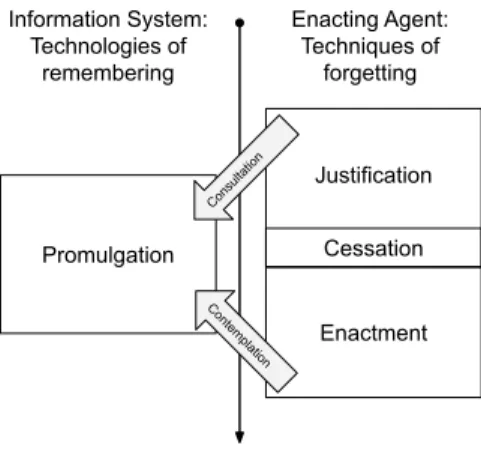
Conceptual components of the production of certainty. . . 50
3.1
The production of certainty arrayed in terms of Bowker’s conception of memory practices. 96
3.2
Schematic of operating system-specific differences in the Willoughby-Hoye
Python scripts. . . 99
4.1
Felicitous enactment of certainty. . . 108
4.2
Diagram showing how enactment conditions certainty, regardless of how a
promulgation was given, and even in ignorance of a promulgation’s inscriptive history. . . 113
4.3
The production of incorrigible certainty. . . 116
4.4
The production of empirical certainty. . . 117
4.5
The production of defeasible certainty. . . 119
4.6
Distinctions between the chronology of certainty and the application of
meth-ods of analysis. . . 123
4.7
A chain of certainty production, where an enacting agent produces certainty in
the form of a promulgation, which is then enacted by another agent, and so on. . . 129
5.1
A schematic representation of the assemblage of computational timekeeping. . . 141
5.2
Standard time zones of the world as of May 2018. . . 146
6.1
A selection from
Circular T
#380, published on September 19, 2019. . . 157
6.2
Geographic locations of TAI-contributing clocks in 2018. . . 158
6.3
The difference between UTC and UTC
(OP)
from January 1, 1988 to August 29, 2019. . . 161
6.4
Plot of the link comparison between GPS Precise Point Positioning technique
link and two-way satellite time and frequency transfer for the Paris time
laboratory in August 2018. . . 162
6.5
The relationship between various time-related functions in C. . . 166
6.6
The
tm
data structure in the C programming language. . . 166
6.7
The time zone settings dialog in Chrome OS. . . 167
6.8
ChromeOS location setting options for automatically selecting a timezone . . . 168
6.9
Calculating delay and offset in NTP . . . 169
LIST OF ABBREVIATIONS
ACLU
American Civil Liberties Union
ACSII
American Standard Code for Information Interchange (character encoding)
AI
Artificial Intelligence
API
Application Programming Interface
BIPM
International Bureau of Weights and Measures (
Bureau International des Poids et Mesures
)
BMI
Body Mass Index
CA
Certificate Authority
DNS
Domain Name System
IANA
Internet Assigned Numbers Authority
ICANN
Internet Corporation for Assigned Names and Numbers
ICD
International Classification of Disease
ICRF
International Celestial Reference Frame
IERS
International Earth Rotation and Reference Systems Service
IP
Internet Protocol
NFC
Near Field Communication
NIST
National Institute of Standards and Technology
NTP
Network Time Protocol
POSIX
Portable Operating System Interface
RAM
Random Access Memory
RFID
Radio Frequency Identification
SI
International System of Units (
Système International [d’Unités]
)
SKU
Stock Keeping Unit
SSL
Secure Sockets Layer
TAI
International Atomic Time (
Temps Atomique International
)
TLDs
Top Level Domains
TLS
Transport Layer Securty
TREC
Text Retrieval Conference
UML
Unified Markup Language
UT1
Universal Time 1
UTC
Coordinated Universal Time (
Temps Universel Coordonné
)
INTRODUCTION
To be sure there is justification, but justification must come to an end
somewhere.
—Ludwig Wittgenstein,ONCERTAINTY,1951
Correspondence theories of truth are intertwined throughout information science’s history, and often
represent an unexamined basis from which current research and practice proceeds. Such theories hold,
roughly, that for any true proposition
P
there is a fact
F
which corresponds to it. Thus, to recite a
common example from the philosophy of language, the proposition “snow is white” is true if and only if
snow is in fact white. The fact
F
, which determines the truth of the proposition
P
, is the latter’s truth
grounds. Facts in this sense are not true or false; rather, as truth grounds for statements in language, they
need only exist. Such correspondence theories of truth are implicitly embedded in the design of many
information systems, especially systems which track enumerable things like citizens or assets, which are
vital to governments and corporations. My local Apple Store has 100 iPads in stock if and only if there
are 100 iPads on the shelves waiting to be sold.
Information systems are now often designed to produce truth grounds, what philosopher John Searle
has called institutional facts,
1instead of propositions that are made true or false in reference to the world
external to the system. This means that, instead of producing propositions that can correspond to reality,
these systems are instead constitutive of parts of what Searle calls social reality.
2For instance, systems
used to provide registration or confirmation numbers produce alphanumeric strings, such as
HFU83F
.
The statement “your confirmation number is
HFU83F
” is certain within the context of the information
system which generates it, regardless of any external state, which is different than more familiar empirical
statements like “There are 100 iPads in stock,” whose truth depends upon some state in the world outside
the system (
i
.
e
., the warehouses containing this stock) which is used to evaluate its truth value.
1John R Searle,The Construction of Social Reality(New York, NY: The Free Press, 1995); John R Searle,Making
the Social World: The Structure of Human Civilization(Oxford, UK: Oxford University Press, 2010).
Beyond the design and use of systems, many of our methods of understanding information systems are
based on rendering information as inherently empirical, corresponding or referring to some portion of the
world with which they can be reconciled. The possibility of objective improvement of information retrieval
system performance, for instance, relies on the validity of empirical measurements of performance.
Common conceptions of ‘reliability’ or ‘truth’ presuppose that errors or falsehoods can be corrected
when they are identified. In each case, there is an implicit assumption that the information within systems
can be determined to be true or false, correct or incorrect.
Yet the process of reconciliation, or correction, does not apply for systems which produce truth
grounds instead of empirical statements. These kinds of systems are best described as incorrigible.
Incorrigibility has several meanings, but in this case I’m drawing from analytic philosophy of language
in defining the term as the impossibility of error.
3Incorrigibility applies to systems that can be thought
of, generally, as systems of record. When information systems form the set of facts with which our
statements are reconciled, they themselves become exempt from reconciliation: they become incorrigible.
This is a remarkable state of affairs: some statements are true if and only if a certain information system
says that they are. Governments and corporations are increasingly exploiting this potential by using
systems of record as mediums of control. Credit scores, the No Fly list, the International Classification of
Disease (ICD), and algorithmic sentencing guidelines are just a few incorrigible systems of record which
directly impact everyday life.
4I do not mean to indicate that systems of record cannot be altered; clearly, they can be and are. Credit
ratings agencies, for instance, have appellate procedures designed to mitigate their incorrigibility (the No
Fly list, however, notably does not).
5Regardless, these alterations are fundamentally different from the
3John E Atwell, “Austin on Incorrigibility,”Philosophy and phenomenological research27, no. 2 (1966): 261– 266; Richard Rorty, “Incorrigibility as the Mark of the Mental,”The journal of philosophy67, no. 12 (1970): 399–424; Richard Rorty, “Functionalism, Machines, and Incorrigibility,”The journal of philosophy69, no. 8 (1972): 203–220; Jonathan Harrison, “The Incorrigibility of the Cogito,”Mind; a quarterly review of psychology and philosophy93, no. 371 (1984): 321–335; Manuel Campos, “Analyticity and Incorrigibility,”Philosophy and phenomenological research66, no. 3 (2003): 689–708; George S Pappas, “Incorrigibility, Knowledge and Justification,”Philosophical Studies: An International Journal for Philosophy in the Analytic Tradition25, no. 3 (1974): 219–225.
4Each of these is discussed further below. Credit scores are discussed in Section 2.3.3. The No Fly list is a
running example throughout. The ICD features prominently in Chapter 1. Sentencing guidelines are covered in Section 4.3.2.
5On credit rating systems, see Section 2.3.3. On the No Fly list and why Redress Control Numbers do not represent
reconciliations that take place within inventory systems; instead, alterations within systems of record
are better described as redeclarations.
6A central question for information ethics and understanding
the effects of information systems on society is when, how, and by whom these declarations within
incorrigible systems may be made. Incorrigible systems represent a primary site of political and economic
control. In a quotidian context, they form people’s most direct experience of bureaucratic control, what
in the context of libraries Patrick Wilson called
descriptive power
.
7I suggest that Wilson’s conception
of description can more aptly be expanded to
declarative power
, alluding to Searle’s conception of the
declarative speech act.
8An account of how declarative power within incorrigible systems creates certainty will help us
reconcile ourselves to, confront, and intervene in a world increasingly constituted by them. In developing
such an account, I aim to support novel approaches to problems such as algorithmic bias, the nature of
scientific knowledge production, and knowledge organization as a process of declarative fact-production.
Below I will introduce my approach towards these goals, and we will revisit many of these concepts in
the chapters that follow.
The Phenomenon of Certainty
As alluded to in the epigraph from Wittgenstein, I propose to understand declarative incorrigibility within
information systems by examining how and when justification ends upon them. In other words, the
moment when justification ends and another action begins constitutes the production of certainty. When
such a justification ends upon an information system—when we point to a system or its contents as a
reason to stop justifying and move on to other actions in light of the information found there—this is the
production of certainty using an information system.
9The fact that justifications end upon information
systems is not in question; it is plainly visible in a wide array of fields of human endeavor. Viewing all
6This concept is explained in terms of Searle’s concept of declarative speech acts in Chapter 3.
7Patrick Wilson,Two Kinds of Power: An Essay on Bibliographic Control(Berkeley, California: University of California Press, 1968).
8John R Searle, “A Classification of Illocutionary Acts,”Language In Society5, no. 1 (1976): 1–23.
9In what follows, ‘the production of certainty’ will always refer to the production of certaintyin information
of these instances as a coherent phenomenon is the key move I seek to make at the outset, enabling my
investigation.
There are two related components to the production of certainty in information systems: the formation
of inscriptions within the system itself, and the specific practices of ending justification upon these
inscriptions. The relationship between them, however, is unclear. The former process, the inscription
of potential certainties, I’m terming promulgation of certainty. The latter, where such promulgated
inscriptions act as the terminus of a justification action, I’m terming enactment of certainty. Thus, the
overall phenomenon of the production of certainty in information systems involves two related but distinct
components, promulgation and enactment. These and other key concepts for understanding certainty are
described and elaborated upon in Chapter 2.
What is an Information System?
A definition of what is meant by “information systems” is perhaps
de rigueur
for theoretical work
in the field, but I will here attempt to justify a minimal answer to this question. For the purposes
of this dissertation, I will largely follow Beynon-Davies’ approach in recent work, wherein the
list
of identifiers
is presented as the minimal data structure for analyzing the dynamics of declaration in
information systems.
10This minimal criterion indeed aligns with an uncontroversial ostensive definition of
information systems: inventory databases, library catalogs, membership rolls, filing cabinets, accounting
systems, credit card payment networks, and so on all employ lists of identifiers in one form or another.
It is difficult to imagine how something that did not employ a list in this sense could be said to be an
information system at all. Thus, the phenomenon of interest is when justification practices end upon
something structured as or utilizing a list of identifiers. As is evident from the examples above, such
systems can be digital, like a database, but need not be.
Beynon-Davies is not alone in noticing the centrality of the list.
11There is something central to the
act of listing that has long formed a cultural scaffold for many types of activities. Beynon-Davies’s view
10Paul Beynon-Davies, “Form-ing institutional order: The scaffolding of lists and identifiers,”Journal of the
Association for Information Science and Technology67, no. 11 (November 2016): 2738–2753.
of the list of identifiers as a minimal data structure is thus a key foundation for analysis of traditional
and digital information systems alongside each other, using the same analytical framework. Though
Beynon-Davies does not explicitly take this broader step, for the purposes of my work, I will define
an information system as one which contains, manipulates, or produces inscribed data structures in
Beynon-Davies’ sense (or allows such activities by an agent). The importance of material inscription as a
criterion of an information system in my project will be further discussed below and deeply explored in
my dissertation.
This formulation of information systems is not a novel contribution. Rather, this approach is situated
within the deflationary tradition of information studies,
12an approach which obviates the need for an
explicit account of the meaning of the terms ‘information’ or ‘system.’ My goal in selecting this approach
is simplicity and clarity; the theoretical work to be done lies elsewhere.
Most importantly, this focus on the data structures of information systems facilitates the application
of logico-linguistic techniques to their analysis. This mirrors Beynon-Davies’ strategy in his investigation
of “institutional order” using Searle’s philosophy of social ontology.
13Importantly, it differs from some
accounts of information systems that explicitly include their social context and enactment within the
scope of the system itself. As I hope will be seen, there will be ample room in my approach to consider the
social context of information systems, without the need to explicitly incorporate it into their definition.
14Exclusion of the social context of information systems would undoubtedly preclude their complete
analysis, but there is value in distinguishing the data structure components constituting a system as
material inscriptions. I explicitly include the process of enactment as part of the phenomenon of certainty
in part to provide a place for this analysis, even as I exclude social context from the definition of a system
itself. This approach allows social context to be a first-class citizen within my analysis, while preserving
12Jonathan Furner, “Information studies without information,”Library Trends52, no. 3 (2004): 427–446; Bernd Frohman,Deflating Information: From Science Studies to Documentation, 2nd. Edition (Toronto, ON: University of Toronto Press, 2004).
13Beynon-Davies, “Form-ing institutional order: The scaffolding of lists and identifiers”; Paul Beynon-Davies,
“Instituting facts: Data structures and institutional order,”Information and Organization26, no. 1 (June 2016): 28–44; Paul Beynon-Davies, “Declarations of significance: Exploring the pragmatic nature of information models,”Information Systems Journal28, no. 4 (July 2018): 612–633.
the inscriptive account of a data-structures-focused definition of
system
suitable for analysis with the
logico-linguistic methods discussed in Chapter 3.
Note that this move is not solely so that analytically-oriented philosophy of language can be applied
in my analysis. It is similarly compatible with Derrida’s dictum that “there is no outside-text
[il n’y a
pas de hors-texte]
.”
15I take this to mean not that text is all there is, or that everything is textual, but
rather that material inscriptions are semiotically distinct from other features of social reality. By isolating
the system as an inscription, Derrida’s thought, and his critique of Searle and Austin’s conflation of
speech and inscription as mediums of action, can be applied alongside analytic philosophical analysis.
Fine distinctions must be drawn between information systems and the social to scaffold this approach.
Completing this will be a central aim of Chapter 3.
An Initial Example of the Production of Certainty
With a minimal conceptual framework assembled to clarify the phenomenon, a wide array of practices,
systems, and objects of study can be recast in a new light. A shallow example that may help clarify
the phenomenon and the issues surrounding is the the US government’s No Fly list. I call this example
“shallow” in contrast to the deeper examination of specific systems undertaken in Part II. It is well-known
and intuitive enough to illustrate the phenomenon, and will be a recurring touchstone throughout the
dissertation.
Suppose that I am trying to purchase an airplane ticket. My name (or other identifier, such as Social
Security Number) has been entered into an information system (or heterogeneous collection of systems,
collectively capable of flagging me as a No Fly member). If the system determines that I am on the No
Fly list, I will be prevented from purchasing a ticket. If I am somehow able to purchase a ticket, when I
attempt to enter security, one or several TSA agents will deny me passage through security based upon
this system’s determination. I have no recourse. Proving that I do not have explosive devices, weapons,
or ill intent towards the US government or my fellow passengers will not allow me to board. Invoking
constitutional protections or generally being cooperative will have no effect. The TSA agents stop their
practices of justification upon the system which pronounces me as a member of this list, and thereby
deny me entry. If I attempt to proceed through security or board the airplane, I will be arrested.
This example is notable for several reasons:
• The No Fly list does not contain a proposition about me that is true or false, depending upon the
facts. Rather, it constitutes the fact that grounds the truth of propositions like “it is illegal for this
person to pass through security,” or “it is legal for a TSA agent to physically restrain this person if
they try to board a plane.”
• It involves an instance where processes of both human and non-human justification end upon the
inscriptions within an information system. The TSA agents in this case use the information system
as the sole justification of whether I am allowed to pass through security, The airlines’ registration
systems similarly consult and enact this information when determining whether I can purchase a
ticket.
• Without recourse to some kind of appellate procedure, I can neither change the No Fly list nor the
TSA agents’ enforcement of it. The appellate procedure, such as it is, takes years and, if successful,
does not repudiate the system but rather re-declares the inscriptions within it.
16• The example shows how inscriptions within an information system can have real consequences for
the behavior and capabilities of social actors (the TSA agents; me).
• It shows how the ability to control inscriptions within a system, combined with faithful enactment
of that system, can constitute the exercise of power (in this case, the prevention of me passing
through security and the threat of arrest).
• The particularities of what constitutes an
individual
on the No Fly list are largely immaterial.
Whatever
identifier
the list uses dictates how it will be implemented. Thus, the list may variously
prevent individuals with a given name, social security number,
etc
. from buying tickets and boarding
planes. Some possible identifiers may in fact refer to more than one individual. Still, the list is not
incorrect
within its context.
In short, a range of difficult issues is raised by this one shallow example. What is the relationship between
TSA agents’ justification practices and the No Fly list’s apparent status as a fact-producing system rather
than a proposition producing system? What is the ethical status of inscribing a name into the No Fly list?
Where does the political power displayed in this scenario come from: the system, my interactions with it
(
i
.
e
., my attempt to board the plane), or the TSA agents’ actions? All of these? I have been unable to find
unified theoretical tools for approaching this mass of entangled questions. Chapter 4 develops such tools
and explains how to use them, building upon the conceptual apparatus arrayed in the rest of Part I. Its
major component, and the major novel contribution of this dissertation, is a taxonomy of the role played
by information systems in the production of certainty.
16The ACLU’s ongoing challenge to the government’s No Fly list practices began in 2010. Information about
Analyzing Certainty in Information Systems
The description of propositional logic with which the introduction started has perhaps obscured a related
use of facts: to answer questions. Part II is framed around the question “what time is it?” and provides,
by way of an answer, an in-depth application of the taxonomy applied to the assemblage of global
computational timekeeping. This example was selected for its complexity and scope. I describe it as
an assemblage because, unlike the shallow treatment of the No Fly list, computational timekeeping’s
many constituent systems and their relationships to each other are brought to the fore of the analysis.
17A
nested, recursive application of the taxonomy enables an analysis of certainty within a global network
of systems that ties the vibration of cesium atoms and the astronomical observation of quasars to the
datetime that is displayed on billions of smartphones and computers around the world.
Chapter 5 provides an initial outline of the assemblage overall, envisioned as an infrastructural
inversion.
18Computational timekeeping is a quintessential information infrastructure. The chapter
describes the major subsystems of scientific timekeeping, the representation of time within individual
POSIX systems, and the synchronization of time over networks. It concludes with observations on how
these various processes produce an effective (and literal) rationality out of fundamentally irrational
durations.
Chapter 6 selects three systems, the Interational Atomic Time (TAI) standard, the
tz
database, and
Network Time Protocol (NTP), for analysis of the production of certainty. The taxonomy and theoretical
concepts of Part I are deployed in each case to describe, in occasionally minute detail, how these systems
produce inscriptions and how those inscriptions are enacted as time. The chapter ends by discussing a
personal example of the consequences of certainty produced from computational timekeeping, intended
to bend the theoretical abstractions of Part I and the technical obscurity of Part II back into human scale.
Why Study Certainty in Information Systems?
The production of certainty in information systems as a phenomenon is significant across a wide range
of scholarship. The justifications which terminate within information systems are, variously, political,
17I’m using the term assemblage in more or less the sense given in N Katherine Hayles, “Cognitive Assemblages:
Technical Agency and Human Interactions,”Critical inquiry43, no. 1 (2016): 32–55.
scientific, technical, practical, and linguistic. The contents of information systems themselves,
i
.
e
., the
promulgated inscriptions within them, are similarly multifaceted. Using the production of certainty,
promulgation, and enactment as theoretical lenses helps bring the otherwise blurry political, scientific,
technical, practical, and linguistic aspects of these systems and how we use them into focus.
To be sure, simplification is often needed and even warranted for much of the field of information
studies and its surrounding professional disciplines. Database engineers, catalogers, and system analysts
must, after all, do their work. As they do, though, a cascade of ethical, political, and cultural effects
emanate from their decisions.
19Algorithmic systems and artificially intelligent systems are providing new
capacities for promulgation and enactment at global scale. As information ethics assumes its rightful place
at the forefront of academic debate, and information policy increasingly enters popular consciousness,
theoretical approaches which can successfully integrate these disparate perspectives are sorely needed
and will be widely impactful. Prospects for engaging more deeply with these important issues in future
work are surveyed in the Conclusion.
What I Hope to Achieve
Part I identifies the phenomenon of certainty, provides conceptual tools for describing and analyzing it,
and produces a taxonomy of the role information systems play in the phenomenon. Part II applies these
new tools to offer a novel account of how global standards of time are promulgated and enacted with
information systems.
Each chapter of the dissertation is scoped to constitute a coherent set of contributions. Chapter 1
identifies the phenomenon of certainty and describes why it is an interesting topic of study. Chapter 2
provides an analytic framework to identify the key actors and material sites through which the
phe-nomenon is manifested. Chapter 3 is the most conceptual chapter, and puts my work in dialog with
philosophical and critical approaches to related problems. Some of the theoretical work it does may
be interesting to theorists in adjacent fields. Chapter 4 constitutes the most novel contribution of the
19There is a long tradition of work in the field detailing these effects, including Elfreda a Chatman, “Life in a small
dissertation, a taxonomy of certainty and method for applying it to the analysis of certainty in systems.
Within Part II, Chapter 5 provides a technical and historical account of computational timekeeping,
inverting this information infrastructure such that it is tractable to further analysis. Chapter 6 uses the
assemblage of certainty-producing systems and actors within modern computational timekeeping as a
particularly challenging test for the taxonomy. Three specific subsystems of the assemblage are analyzed
using the methods developed in the foregoing chapters. Each subsystem demonstrates a way of providing
a certain place to consult and move on from when answering the question, “what time is it?” Combined
with the infrastructural inversion of Chapter 5, this demonstrates the complementarity of the analysis of
certainty with techniques of infrastructural inversion
My hope is that these chapters provide more than the sum of their individual contributions. A
phenomenon, analytical tools, theoretical connections, a method of analysis, and a test case applying the
method together form a novel approach to investigating information systems, the actors which surround
Part I
CHAPTER 1: CERTAINTY & ITS CONSEQUENCES
Dying of Old Age
When is it impossible to die from “old age”? There’s a simple potential answer to this question: when
it’s not an option for the coroner who fills out a computerized death certificate. Bowker and Star’s
infrastructural inversion of the International Classification of Disease (ICD) helps reveal the historical
and sociological origins of the classification of death,
1including the deliberate exclusion of “old age”, in
favor of more specific medical causes of death. So, it’s impossible to die of “old age” because this choice
isn’t in the dropdown menu. End of story. If the goal is to make space for colloquial accounts of death
within the medicalized practices of modern death certificate creation, this would also be the beginning of
a sociologically informed interface design project.
This isn’t the whole picture, though. My approach will be to foreground the use of the information
artifacts generated by, in this case, classification processes. To illustrate this, the answer above can be
rendered like this:
1. The classification “old age” is not available to the coroner when completing a death certificate.
Bowker and Star researcher focus on the history of the classification scheme and its influence on the
information interface the coroner encounters. This approach depends upon two presuppositions about the
use
of a death certificate:
2. Someone seeking to answer the question “what was the cause of death?” will consult the death
certificate; and
3. having consulted the death certificate, they will move on in light of its listed cause of death.
1Infrastructural inversionwas originally proposed by Bowker as a description of the strategic approach taken
by French oil services company Schlumberger in developing oil fields early 20thcentury. Geoffrey C Bowker,
Item 2 indicates that the information system, in this case the registry of death certificates, is incorporated
into information practices, in this case looking up cause of death. Part of the power of classifications, and
of information systems in general, is that we consult them to answer questions, and we develop practices
of consultation that insinuate them into how we come to know about reality. Item 3 (moving on) so often
follows item 2 (consultation) that it similarly may go unnoticed. But “moving on in light of” a listed
cause of death need not be taken to mean only repeating the cause verbatim. There is an interpretive
flexibility available to agents who consult death certficiates. The common euphemism “natural causes”
subtly acknowledges the medical focus on etiology of death, and is a way of ‘moving on in light of’
besides simply parroting the inscription. Where this ‘moving on’ doesn’t include direct verification or
confirmation, the inscription determines the last word on the matter.
2So the answer of
when
it’s impossible to die of old age varies by context, and is dependent upon two
broad categories of behavior-within-context. In the medical determination of cause of death, we have to
look at the conditions of inscription. In the many contexts which incorporate death certificate inscriptions
into information behaviors, the focus must shift to the conditions of consultation and moving on. A clear
delineation of contexts surrounding the behaviors of inscription and the behaviors of consultation and
moving on will help provide a more complete account of how behavior changes in light of information
systems, what I’ll call the production of certainty.
Facts and Social Reality
This dissertation foregrounds the enactment of information systems into certainty, the consulting and
moving on in items 2 and 3 above. I’ll argue that the overall process which leads to moving on in light of
information systems partially constitutes social reality.
3As the case of “old age” helps show, certainty
goes beyond classification or interfaces. My approach targets a broader set of activities commonly
accomplished with information systems, like processing a financial transaction or declaring membership
in a group. Like classification, these activities produce
facts
. All facts function as truth-grounds for
propositions (
i
.
e
., statements about some portion of reality), regardless of their source. Facts are not
2The concept of moving on is a primitive unit of analysis, explanans rather than explanandum, but is nonetheless
discussed further below and in Chapters 2 and 4.
themselves true or false, but rather determine the truth or falsity of other statements.
4Facts constitute
social reality by enabling the production of certainty.
Like being listed on the No Fly list, the “cause of death” on a death certificate is a fact, inscribed by
whomever completes a death certificate (or makes an entry in a death certificate database, as the case may
be) and enacted by anyone who consults this inscription and enacts it. This fact is designed to provide an
answer to the question “what did this person die of?” (as well as providing truth grounds for statements
like “this person died of
X
).” The practices surrounding the question and its answer tie it to inscriptions
in information systems, and produce certainty with it.
A familiar objection to this account of facts is to evoke what
really
happened. The cause listed on the
death certificate is only
true
if it’s why someone
really
died. The sense of
real
used here is central to
philosophical realism. It begs the question of distinguishing between what is real and what is not and
will be critiqued extensively in Chapter 3. The descriptive approach to propositional logic I’m using
renders the fact as a mere role played in relation to a proposition. Thus, a listed cause of death can be a
fact alongside, for instance, fraud on the part of a coroner in the production of the fact. This is discussed
further on page 16.
Many facts are produced in a similar way to cause of death, and this production process does not
inherently involve classification. At the other end of the life cycle, birth certificates create the fact of a
person’s name, which can only tenuously be said to be a classification. And yet this fact dutifully answers
many questions and grounds many propositions throughout a person’s life (and beyond). All this follows
from some marks on paper (or, increasingly, an entry in a database): inscription shapes social reality.
Dispelling the Magic of Certainty
An unease may be building at this point in the discussion, because the information systems in question
seem to have a kind of magical power. Like “abracadabra,” the right incantation by the right person
at the right time in the right way into the right information system makes something come about that
seems impossibly powerful. This magic is what I’m investigating, and is the phenomenon I’m calling
the production of certainty. Like all magic, further scrutiny reveals that the real action is elsewhere, in
the actors that surround and condition their behavior upon the information system’s inscribed facts. I’ll
go on to argue in Chapter 3 that it is the practice of consulting information systems to answer questions
or determine the truth of claims which constitutes the facticity of inscriptions. The inscription is a key
component of the production of social reality, but this reality is only manifested through action.
Resisting Certainty
Let’s return to the question of why it’s impossible to die of old age and focus on the agents and actions
surrounding the inscribed fact of the cause of death.
5To the extent that it’s
actually
impossible, no agent
will fill out a death certificate listing “old age” as a cause of death. A faithful application of the ICD in
the completion of death certificates
by agents
(whether enforced by discipline, norms, and procedures or
a dropdown menu) is, most precisely, what makes it impossible to die of old age. But any breakdown of
enforcement means that it’s once again possible to die of old age: “old age” is inscribed into a form, and
the spell is broken.
The Oregon Health Authority’s guidelines for reporting cause of death for the elderly both establish
the professional norm of not using “old age” as a cause of death and reveals that the enactment of this
policy is not nearly as uniform as one might expect.
Reporting terms such as senescence, old age, infirmity, and advanced age are not valuable for public health or medical research. The age of the decedent and the date of birth are both reported elsewhere on the death certificate. In addition, there are no standards about what age is “old.” While old age is reported more frequently for decedents over the age of 90, the Center for Health Statistics received a death certificate in 2001 for a 55-year-old decedent who was reported as dying due to “old age.”6
Thus, it seems, that there are actors who make it possible to die of old age, in Oregon at least. Though
these guidelines merely imply it, it seems that enough decedents are given a cause of death of “old age”
to mandate a formal policy (not to mention the 2001 case). Until, presumably, a database interface makes
it technically impossible to die of old age, this policy is an attempt to produce consistent causes of death
needed for public health statistics.
Certainty and Consistency
The ’magic’ of certainty as I’ll be approaching it is not related to a scientistic fantasy of omniscience,
what John Dewey called “the quest for certainty.” Facts, though not logically truth-apt (
i
.
e
., able to be
5So far, all of the agents have been human, for simplicity, but below we will examine why they need not be.
ascribed a value of True or False), need not be consistent with each other even within a given social
reality. This means that systems of thought that value internal consistency, like governments, must have a
way of discrediting facts that are inconsistent with others they hold. This leads to the policies, procedures,
and imprimaturs employed during fact production, from the signature to the seal of the notary public
to encryption algorithms. Certainty, we’ll see, is quite easy to produce: there’s nothing to quest after.
The major question operative in these cases is whether one has the power (physical, political, aesthetic,
ethical, and so on) to extend certainty and the facts that underpin it into other contexts, thereby expanding
certainty into others’ social reality.
Each step towards consistency in certainty raises the stakes of controlling fact production. The
industry of “death fraud,” especially prevalent in parts of India and the Philippines, demonstrates the
potential economic value of the production of certainty about death. The possibility of fraud in the
production of certainty also reinforces that it is not an infallible view from some god’s eye perspective.
7The principle, then, is that a fact is a fact because it is enacted as such. It remains a fact just as long
as it is enacted,
i
.
e
., until it is replaced or ignored.
8We’ll see that the rules, practices, and techniques
surrounding facts that seem to preclude this account, such as the realist conception of facts, are strategies
for mitigating these dynamics.
Organization of Chapter 1
Section 1.1 applies a pragmatic approach to the identification of certainty in information systems,
preliminary to the analysis to follow. This will distinguish the consequence-focused sense of certainty I’m
using from others that seek to investigate its antecedents. Section 1.2 will survey three kinds of certainty.
In viewing certainty as enacted, these three kinds describe different ways in which agents move on after
consulting an information system. Section 1.3 reviews the thought of Wittgenstein, Smith, and Star in
relation to my conception of certainty. This section will show that, following Wittgenstein, certainty is
7In a recent case, a CEO of a cryptocurrency exchange was reported dead on a trip to India, and was the only person
with knowledge of the firm’s password for millions of dollars of customer funds in ’cold storage.’ Some security researchers suspect that the case is one of death fraud, to conceal the embezzlement of the funds. Daniel Shane, “A crypto exchange may have lost $145 million after its CEO suddenly died,”CNN Business, February 2019, For more on the region in which the CEO dies, and death fraud generally, see Elizabeth Greenwood,Playing Dead: A Journey Through the World of Death Fraud(New York: Simon & Schuster, 2016).
a basic component of inquiry and knowledge production. Smith and Star’s work each approaches part
of the phenomenon as I’ve framed it, and I will use these approaches to shine light on the whole. This
chapter lays the groundwork needed for the operationalization of related concepts in Chapter 2.
1.1
Certainty and Action
This chapter’s title is more than just an allusion to the subtitle of Bowker & Star’s landmark
Sorting
Things Out: Classification and Its Consequences
. A focus on consequences is a simple but powerful
rendering of pragmatism. Star writes,
One of the simplest and most difficult tenets of pragmatism is that understanding is based on consequences, not antecedents. One does not build an a priori logic, philosophical analysis with preset categories or do so as “verificationist” social scientists, as Barney Glaser so mordantly termed them.9
By focusing on consequences, Bowker and Star recast much of the classification theory which had come
before as a series of normative projects which invented and sought to enforce antecedents to classification
practice, while often claiming to have ’discovered’ classificatory principles. Once recast as parts of
our “moral infrastructure,” classification projects could be examined sociologically and critiqued, and
engaged in an ethical and political register. My claim at the outset is that similar work needs to be
done with the broader practices of certainty surrounding information systems, and that emulating their
pragmatic approach is the best way to do so.
1.1.1
Which Certainty?
Certainty is an overloaded term which has several venerable yet disparate disciplinary senses. Following
Star’s pragmatic maxim, we’re interested here in consequences, not antecedents, so the sense in which
I’m using the term will have no truck with
a priori
conceptions of logic, validity, or necessity. It won’t
concern the individual psychological experience of being certain. I won’t define certainty in opposition
to the statistical concept of uncertainty (elaborated further in Section 1.1.3). In the context of information
systems in which I’ll approach it, certainty consists of a characteristic set of actions by an actor and the
material, linguistic, and social context that surrounds and conditions them. This is an excavation of the
earliest sense of the word, derived from the Latin
cerndre
, to separate, sift, or decide.
9Susan Leigh Star, “Living Grounded Theory: Cognitive and Emotional Forms of Pragmatism,” inBoundary
1.1.2
How Can We Tell Certainty Has Been Produced?
Prior to analyzing certainty, we need a reliable way of determining that it has happened. This is of obvious
methodological importance and will help circumscribe the scope of the phenomenon into something
tractable. The rest of this chapter will utilize this basic sequence of actions as a marker of the kind of
certainty we’re interested in:
• An actor consults an information system
• The actor moves on in light of what was found there
This simple sequence embodies Wittgenstein’s observation that “To be sure there is justification, but
justification must come to an end somewhere.” For Wittgenstein, this observation showed how holding
some propositions exempt from doubt, what I’m calling moving on, is key to the functioning of language
(discussed further in Section 1.3.1). In cases where information systems are utilized to end a process of
justification, the system is consulted and its contents are reflected in the actions taken when the actor
moves on. Abstracting from any antecedents, the consequences of Wittgenstein’s justification are to be
found precisely in the character and consequences of this moving on.
The Cessation of Justification
This sequence of actions, consultation and moving on, I’ll call the cessation of justification.
10The
choice of the term justification is deliberate, but may be misleading because its meaning is disciplinarily
polysemous. In an analytic or positivist context, justification indicates logical validity, and is a critical
component of knowledge construed as justified true belief.
11In sociological context, justification is a
social process of providing reasons, a description of a communities’ practices when beliefs or claims
conflict. In political theory, justification may be tied to the accomplishment of justice.
12My account
requires merely an account of justification’s effects rather than its mechanism or origin. Communities
10Since the ways of moving on are most relevant to describing the consequences, in the dissertation I’ll often use
‘moving on’ as shorthand for the cessation of justification, and the consultation of an information system prior to moving on will be implied by the context.
11A discussion of justified true belief is available in Jonathan Jenkins Ichikawa and Matthias Steup, “The Analysis
of Knowledge,” inThe Stanford Encyclopedia of Philosophy (Summer 2018 Edition), Summer 2018, ed. Edward N Zalta (Stanford University, 2018).
12An account combining sociological and political accounts of justification that will feature in the discussion below