MULTICULTURALISM AND EXPECTATIONS OF INCLUSION AMONG EUROPEAN MUSLIMS
Hajar Yazdiha
A thesis submitted to the faculty at the University of North Carolina at Chapel Hill in partial fulfillment of the requirements for the degree of Master of Arts in the Sociology department of the Graduate School.
Chapel Hill 2013
ABSTRACT
Hajar Yazdiha: Multiculturalism and Expectations of Inclusion Among European Muslims (Under the direction of Charles Kurzman)
Why do Muslim minorities perceive more societal hostility in European countries with greater multicultural commitments? This paper examines a unique cross-national survey of Muslims in four Western European countries and finds that personal experiences of discrimination and perceptions of societal hostility are more widespread in Britain and France than in Germany and Spain, notwithstanding more multicultural policies and public attitudes in Britain and France. The paper bridges several literatures on immigration and discrimination to account for this puzzle, including social identity theory, which focuses on individual experiences of
ACKNOWLEDGEMENTS
This thesis would not have been possible without the critical eye, steadfast encouragement, and selfless time of my adviser, Charlie Kurzman, who kept pushing me forward despite occasional moments of obstinance. I am also indebted to committee members Ted Mouw and Chris Bail for their valuable guidance and perspective through the many iterations of this project. I would also like to thank Andy Andrews for his thoughtful advice in the project’s inception. For their unwavering love and support, I am eternally grateful to my parents, Feri and Javad, and for her life-affirming pep talks, my sister, Solmaaz. Finally, I would like to thank my partner and
TABLE OF CONTENTS
LIST OF TABLES……….vii
THESIS: MULTICULTURALISM AND EXPECTATIONS OF INCLUSION AMONG EUROPEAN MUSLIMS……….……….1
Introduction………..1
Three Approaches to Perceptions of Exclusion………...3
Expectations of Inclusion……….5
Methodology………8
Results………11
Conclusions………25
LIST OF TABLES
Table
1. Frequencies for Muslims in Western Europe (Pew 2006)……….12
2. Levels of Migrant Inclusion Based on Citizenship Regimes……….14
3. Degrees of Multiculturalism Measured on Three Scales………...…16
4. European Attitudes Toward Muslims (Pew 2006)……….17
5. Relationship between Personal Experience of Discrimination and Perception of Hostility………...19
6. Comparing Muslims' Perception of Hostility by Time in the Host Country………….21
7. Comparing Muslims' Perception of Hostility by Nativity Against Societal Perceptions of Hostility Against Muslims……….22
MULTICULTURALISM AND EXPECTATIONS OF INCLUSION AMONG EUROPEAN MUSLIMS
Introduction
More than a decade after September 11, 2001, negative attitudes, discrimination, and violence toward Muslims in Western countries persist , and Muslims are often stigmatized as subjects of suspicion and targets of nativist political movements (Cesari 2013; Givens and
Maxwell 2012; Ansari and Hafez 2012; Gest 2010; Meer and Modood 2010; Bleich 2010; Fekete 2009). These trends are not uniform across all Western countries – an emerging interdisciplinary literature has noted variation in national policies on the incorporation of Muslim minorities (Joppke and Torpey 2013; Kibria 2013; Connor 2010; Modood 2010; Sinno 2009; Nielsen 2004). Countries such as Canada, Great Britain, France, and the United States have been identified as more committed to multicultural approaches, as compared with Germany, Italy, Spain, and other countries (Vertovec and Wessendorf 2010; Weldon 2006; Modood 2006; Geddes et al. 2005; Koopmans and Statham 2000; Favell 1998).
they resided in Britain and France, the more likely they were to perceive societal hostility toward Muslims.
Why is multiculturalism associated with lower perceptions of inclusion among Muslims in these four countries? This study examines and integrates explanations from three social-scientific literatures: a social-psychological approach that focuses on individual-level
interactions and identity-formation; a social-structural approach that focuses on the structural position and incorporation of migrant and minority communities; and a national-polity approach that focuses on citizenship regimes and cultural contexts of reception.
I bridge these approaches to introduce the concept of “expectations of inclusion.” These expectations grow out of multicultural citizenship regimes that encourage immigrants and minorities to consider themselves full members of the polity. These expectations take root most strongly among immigrants who are most structurally integrated into the host society.
Expectations of equal treatment and inclusion are generated through extended time spent
Three Approaches to Perceptions of Exclusion
Social Identity Theory. Social psychologists theorize perceptions of exclusion as
individual-level cognitive products of identity formation produced through interaction and socialization. Social identity is shaped continuously through a system of social categorizations creating and defining an individual's place in society through intergroup relations, interactions, and social change (Tajfel 2010; Hogg and Abrams 1988; Tajfel 1978). Through a dynamic process of identity formation, external group identification continuously interacts with internal self-identification, shaping a social identity that determines not only how an individual views him/herself, but also how the individual perceives others to view him/her (Jenkins 2008). Perceptions of exclusion arise when individuals with strong affiliations to a minority identity personally experience discrimination, making the boundaries of group identity salient (Hall and Carter 2006; Branscombe, Schmitt, and Harvey 1999; King 2003; Operario and Fiske 2001; Sellers and Nicole 2003; McCoy and Major 2003). According to this theory, Muslim minorities perceive themselves to be excluded from their host societies through individual interactions, especially personal experiences with discrimination. Much of this literature focuses on the development of racial identity among African-Americans, but the theory has been applied to the development of ethnic identity among immigrant groups as well.
For the children of immigrants, experiences of discrimination influence the development of ethnic identity as they negotiate their identity at home with that of the national majority next to whom they grow up. Portes and Rumbaut describe this process as “reactive ethnicity
identity formation as a reaction to hostility after 9/11 (Nagra 2011; Peek 2005). Findings have been mixed across countries, showing stronger reactive identities among second generation Muslims in the U.S. and Canada compared to Germany (Kibria 2008; Diehl and Schnell 2006), suggesting that national context matters for the ways in which experiences of discrimination influence identity formation.
Migrant Incorporation. By contrast with the social-psychological focus on individual
interactions, the extensive literature on migration adds a social-structural dimension to the study of migrants’ perception of societal inclusion and exclusion. This literature examines factors such as labor markets, settlement patterns, and contexts of reception that shape the experience of immigrant incorporation. While there is much contestation over the shape of the
multi-generational trajectory of integration (Alba and Nee 2005; Alba 2005; Portes, Fernández-Kelly, and Haller 2005; Portes and Zhou 1993; Waldinger and Feliciano 2004; Kasinitz, Mollenkopf, and Waters 2002; Levitt and Waters 2006), migration scholars generally agree that greater incorporation into the host society – such as success in the labor market and birth or long-term residence in the host country – is associated with a greater sense of inclusion. This literature has developed largely around the experience of migrant communities in the United States. If we extend its approach to Muslim communities in Europe, we would expect community members with high incomes and longer-term residency to perceive a greater sense of inclusion in the host society than members who are poorer and more recently arrived (see also Barkdull et al. 2011). Citizenship Regimes. A separate literature on citizenship regimes explores the influence
and Kymlicka 2006; Glazer 1998). Countries have historically varied in the degree to which they are open to multicultural inclusion, and this variation has been measured through a variety of concepts, including citizenship regimes, philosophies of integration, and multicultural policies (Favell 1998; Carrera 2006; Geddes et al. 2005; Zølner 2000).
Citizenship regimes structure individual and community status, rights, and identity (Joppke 2010; Koopmans and Statham 2000; Cohen 1999). Countries may grant citizenship status and support anti-discrimination legislation, but these institutional shifts may not be enacted through public attitudes and cultural practices (Zapata‐Barrero 2003; Miles 1995;
Koopmans and Statham 2000; Medrano 2013; Janmaat 2006; Muro and Quiroga 2005; Brubaker 1999). A number of these studies apply this approach to the case of Muslim minorities in Europe, hypothesizing that Muslims experience a greater sense of inclusion in countries with more
multicultural citizenship regimes than in countries with less multicultural regimes.
Expectations of Inclusion
In 1980, Portes, Parker, and Cobas used surveys of Mexican and Cuban migrants to explore the relationship between migrants’ perceptions of discrimination and cultural consciousness at two points in time: arrival and three years after arrival (Portes, Parker, and Cobas 1980). Mexican and Cuban migrants were selected as they shared “linguistic and cultural similarities.” The authors argue that perceptions of discrimination show both how migrant groups perceive host society and how they perceive the attitudes of dominant groups toward them, advancing understandings of interethnic relationships and adaptation patterns. Findings challenged the assimilation hypothesis that greater cultural and structural incorporation mitigates perceptions of discrimination as migrants find themselves integrated into society. Instead, Portes and colleagues found support for a cultural consciousness hypothesis. As migrants gain greater consciousness of the host country’s culture, they develop nuanced understandings of their group position vis-a-vis the native majority group. With greater familiarity with the culture and the language, migrants become more attuned to cultural norms and expectations and develop a more critical evaluation of society. Consequently, they are more likely to perceive discrimination against their group, based on their enriched understanding of cultural boundaries and porousness between groups.
The intellectual legacy exploring the relationship between national culture and individual perceptions of exclusion can be traced even further back to the foundational work of Du Bois. Du Bois describes the sense of “two-ness” experienced by African Americans in the U.S. through the profound contradictions of a “double consciousness” (Du Bois 1903) where an individuals views the selves and their possibilities and limitations through the culture in which they are embedded. He writes,
him see himself through the revelation of the other world. It is a peculiar sensation, this double-consciousness, this sense of always looking at one’s self through the eyes of others, of measuring one’s soul by the tape of a world that looks on in amused contempt and pity.” (Du Bois 1903)
Du Bois describes how collective perceptions of an open, inclusive society without bounds juxtapose with irreconcilable individual experiences of rigid and unsurpassable boundaries between groups. In Du Bois’ account, the Negro does not merely understand his position, opportunities, and constraints through individual interactions, but rather through the broader cultural context of an “American world.” Perceptions of exclusion are not purely a product of the actions of prejudiced individuals, but are rather a representation of an individual’s understandings and expectations of the nation. While Portes and the seminal contributions of Du Bois explore perceptions of exclusion within a single nation, I show that a national comparison can provide further insight into the ways in which national contexts produce individual
perceptions. I use the test case of Muslims across four Western European countries to shed new light on perceptions of exclusion, arising against contexts that claim values of inclusion.
I propose a concept that bridges approaches: expectations of inclusion. Expectations of inclusion begin with multicultural regimes, which produce cultural conceptualizations of pluralism, diversity, and tolerance. These conceptualizations generate corresponding expectations among migrants and minorities. Those most attuned to multicultural
conceptualizations are the most incorporated migrants and thus the most likely to expect societal inclusion. Migrants come to compare their group identity against these expectations, generating perceptions of exclusion when there is a perceived disjuncture between group treatment and multicultural contexts.
discrimination can make the boundaries between minority groups and majority groups visible and salient. Yet these interactions are structured through national migrant incorporation regimes, including the extent to which migrants are incorporated in the labor market and broader societal attitudes toward the migrant group. Both individual interactions and opportunities for
incorporation are contextualized through national histories, citizenship regimes, policies, the foundations of national culture that sanctions the degree to which migrants are included as members of the national polity or segregated as foreigners. Through the interaction of migration histories and contexts of receptions, classification systems for migrants and minorities, and national policies, varied national contexts engender different expectations of inclusion. In countries that are highly multicultural, incorporated individuals will be more likely to expect inclusion. In countries with minimal multiculturalism, histories of anti-immigrant sentiment and stringent citizenship policies will constrain out-groups’ expectations of inclusion such that exclusion may not be interpreted as hostility. These relative expectations create a cognitive context in which perceptions of exclusion are enabled and more likely to form.
Methodology
To compare perceptions of exclusion, I use a dataset of minority communities across multiple national contexts. The Pew 2006 Global Attitudes Survey is a rare national experiment with a single group across different contexts. Pew is the only publicly available study to obtain a large representative sample of Muslim respondents in Europe. To ensure Pew survey results were robust, I compared individual frequencies of experienced and perceived discrimination to
Generation Report (TIES); 2008 Federal Office for Migration and Refugees Report: ‘Muslim Life in Germany’ (FOMR); 2008 Religion Monitor: Muslim Religiousness in Germany Report (RM); 2009 Open Study Institute: 'Muslims in Europe' (OSI); Policy Exchange Report: ‘Living apart together’ (PE).
The Pew 2006 Global Attitudes Survey measures European attitudes toward foreign policy, globalization, terrorism, and democratization. Principally funded by The Pew Charitable Trusts, the Global Attitudes Survey also includes an oversample of European Muslims in Great Britain, France, Germany, and Spainfrom surveys conducted in partnership with the Pew Forum on Religion & Public Life. Respondents were located through a national probability sample, and surveys were conducted through telephone and in-person interviews under the direction of Princeton Survey Research Associates International between April 4 and May 4, 2006. Representation for Great Britain, France, and Germany was telephone households and representation for Spain was the adult population. The resulting analytic sample is 1618
respondents, composed of 411 from Great Britain (25.4 percent), 399 from France (24.7 percent), 411 from Germany (25.4 percent), and 397 from Spain (24.5 percent).
By manipulating nativity, which reflects a significant level of integration, I isolate the effect of cultural awareness net of other identified predictors.
The dependent variable, perceptions of societal exclusion, is measured through the question, “How many Europeans do you think are hostile toward Muslims?” recoded into a dichotomous variable with 1=Most/Many and 0=Some/Few. Covariates include the individual-level predictor of individual experience of discrimination, measured through the question, “In the last two years, have you personally had a bad experience due to your race, ethnicity, or religion, or hasn’t this happened to you?” (recoded 1=Yes 0=No). Group-level measures of the integrative process are measured with gender, income, and nativity. Gender is a dummy variable with “Male” as the reference group, and income is standardized across countries by recoding the income variable into a dummy variable with “Below median national income” as the reference group to which “Above median national income” is compared. Median incomes for 2006 were drawn from the United Nations’ World Population Prospects Report. Additional theoretical determinants were not found to have any effect on perceptions of societal exclusion.
robust effects on perceptions of discrimination. Education-level was only asked of respondents in France, so education-level is not included in this analysis. Using Logit models, I conduct a side-by-side cross-national comparison of Muslims’ perceptions of exclusion. All models were tested and found to be free of multicollinearity and heteroskedasticity with the variance inflation factor (VIF) and Breusch-Pagan/Cook-Weisberg test for heteroskedasticity.
To measure levels of multiculturalism across countries, I use the Migrant Integration Policy Index of Multiculturalism (MIPEX, 2007) and European Monitoring Centre on Racism and Xenophobia’s (RAXEN) index of official discrimination data mechanisms. MIPEX uses 148 policy indicators to create an index of migrants’ opportunities for societal inclusion across countries, and indicators pertain to questions relating to a particular policy component of each policy area. There are three options for each answer. A maximum of three points are rewarded when policies met the highest standards for equal treatment. Indicator scores are averaged to provide one of four dimension scores, which examine the same aspect of policy. These scores are then averaged to give the policy area score for each of the policy areas per country. Averaged once more, this provides the overall scores for each country. For rankings, the initial 1, 2, 3 scale is converted into a 0, 50, 100 scale for dimensions and policy areas, with 100% as the top score. I also include the RAXEN index of official discrimination data mechanisms, which measures the extent to which anti-discrimination is institutionalized by measuring, recording, and analyzing data on racially, ethnically, and religiously motivated crime and violence (RAXEN 2004).
Results
Table 1. Frequencies for Muslims in Western Europe (Pew 2006)
Great
Britain France Germany Spain PERCEPTION of
HOSTILITY 45.6% 39.3% 53.2% 32.4%
PERSONALLY EXPERIENCED DISCRIMINATION
29.6% 38.6% 21.8% 24.2%
NATIVITY
Native-born 46.2% 49.9% 24.8% 9.6%
Immigrant 53.8% 50.1% 75.2% 90.4%
IMMIG. TIME
Past 15 years 41.1% 39.5% 31.1% 85.4%
15+ years 58.9% 60.5% 68.9% 14.6%
INCOME
Below National Median 81.5% 80.0% 89.9% 97.3%
Above National Median 18.5% 20.1% 10.1% 2.7%
German and Spanish Muslims report the least frequent experiences of discrimination while French and British Muslims report the most frequent experiences of discrimination.
However, the perception of societal exclusion is highest among British and German Muslims and lowest among Spanish and French Muslims. However, perceptions of societal exclusion are highest in Germany, followed by Great Britain, France, then Spain. These results complicate the line of causality between experiencing discrimination to perceiving exclusion. In Great Britain and France, respondents are nearly evenly split between immigrants and the native-born, while in Germany, immigrants compose roughly three quarters of the sample. As a new country of
age. In Great Britain, France, and Germany, a majority (between 60-70 percent) of immigrants arrived over fifteen years ago, while Spain is largely a country of new Muslim immigrants with 85 percent arriving in the past fifteen years. These differences illustrate each country’s migration wave, so while these countries differ in the ethnic composition of their Muslim migrants, the similarity in migration histories is notable across all countries except Spain. The similarity in time of migrant arrival allows for a more nuanced analysis of variation in perceptions of
exclusion, as levels of acculturation among migrants are generally comparable across countries. The content of the national culture into which migrants are acculturated becomes central to understanding divergent perceptions of society.
Great Britain, France, Germany, and Spain represent multiple locations of migrant inclusion These four countries represent different ideologies of citizenship, philosophies of integration, and cultural obligations tied to citizenship, shown in Table 2 (Koopmans and Statham 2000).
Table 2. Levels of Migrant Inclusion Based on Citizenship Regimes
Philosophy of Integration
Basis of
Citizenship Multiculturalism Regime Type
Great
Britain Multiculturalism Civic High
Individualistic-civic France Républicanisme Civic Medium Collectivistic-civic
Germany Ausländerpolitik Ethnic Low
Representing the most inclusive country, Great Britain’s philosophy of integration is one of multiculturalism, involving a community-based integration model that recognizes ethnic and religious collectivities, matching its inclusionary “individualistic-civic” ideal-type. France emphasizes secularism or laïcité and thus integration that privatizes ethnic and religious distinction. French policy is undergirded by a philosophy of Républicanisme and jus soli, the “collectivistic civic” ideal-type in which migrants are included under the assumption of assimilation. Like Great Britain, France grants second generation immigrants citizenship. However, unlike Great Britain, French Muslims’ identity is not publicly acknowledged but is rather relegated to the private sphere to remove cultural and ethnic distinctions between citizens for a unitary political culture. In Germany, multiculturalism is low and cultural segregationism is the norm, matching a historical philosophy of Ausländerpolitik, or the exclusionary drawing of boundaries through “ethnic segregationism” defined by the political exclusion of migrants. Until 2000, German citizenship was a matter of blood and limited to those who shared the ethno-cultural background of the majority, a citizenship regime of jus sanguinis. German immigration policy was revised in 2000 to allow second-generation immigrants to obtain citizenship, moving its situation closer to a “collectivistic civic” categorization on the Koopmans & Statham scale (2000), however migrants remained culturally separate from the political body. While migrant inclusion is expected and encouraged in Great Britain and France, migrant separation from the majority is expected in Germany. Finally, Spain exhibits low multiculturalism, as a new country of immigration with an integrative philosophy that is still unfolding.
they are “Ausländer” (foreigners). I build upon Koopman and Statham’s fruitful developments using a scale of multiculturalism in order to consider not only socio-historical citizenship
regimes, but also contemporaneous policies for cultural inclusion and cultural attitudes. Societal understandings of citizenship and who does and does not belong, as well as understandings of multiculturalism and who should and should not belong, differ in degrees across countries.
This scale, seen in Table 3, uses three indices of multiculturalism to distinguish a nation’s position on a continuum from inclusionary contexts of high multiculturalism to exclusionary contexts of low multiculturalism (Zolberg and Woon 1999; Bovenkerk, Miles, and Verbunt 1990). The four countries isolated for analysis are highlighted.
Table 3. Degrees of Multiculturalism Measured on Three Scales
Anti-Discrimination Policy (MIPEX) Access to Nationality Policy (MIPEX)
Ranking of official discrimination data mechanisms (EUMC)
1 Sweden 94 1 Denmark Excellent 1 Denmark Excellent
2 Portugal 87 1 Finland Excellent 1 Finland Excellent
3 Hungary 85 1 France Excellent 1 France Excellent
5 France 81 1 Ireland Excellent 1 Ireland Excellent
5 Netherlands 81 1 Sweden Excellent 1 UK Excellent
5 UK 81 1 UK Excellent 1 Sweden Excellent
8 Slovenia 79 2 Austria Good 2 Austria Good
9 Belgium 75 2 Germany Good 2 Germany Good
9 Finland 75 3 Belgium Fair 3 Belgium Fair
11 Italy 69 3 Netherlands Fair 3 Netherlands Fair
12 Cyprus 60 4 Greece Poor/Inadequate 4 Greece Poor
13 Greece 58 4 Italy Poor/Inadequate 4 Italy Poor
13 Ireland 58 4 Luxembourg Poor/Inadequate 4 Luxembourg Poor 15 Luxembourg 56 4 Portugal Poor/Inadequate 4 Portugal Poor
16 Norway 54 4 Spain Poor/Inadequate 4 Spain Poor
17 Germany 50
17 Spain 50
19 Lithuania 48
In Column 1 and 2, MIPEX provides two indices of inclusion: anti-discrimination policy and nationality policy. Anti-discrimination policy measures the extent to which multicultural inclusion is protected, constraining discrimination against minorities. On this scale, Great Britain and France are tied for high inclusion (81) while Germany and Spain are tied for low inclusion (50). Access to nationality measures the extent to which migrants are granted legal access to national identity as a mode of inclusion. Great Britain scores most inclusive (62) followed by France (54), Spain (41), and with the lowest measure of inclusion, Germany (38).
In Column 3, I include RAXEN’s index of official discrimination data mechanisms (RAXEN 2004). Again, Britain and France are tied for the highest ranking of inclusion, followed by Germany then Spain for the lowest ranking of inclusion. These rankings of inclusion are consistent with Koopman and Statham’s comparative conceptualization of citizenship. Great Britain is consistently the most inclusive, followed by France at moderate to high inclusion, while Germany and Spain are consistently least inclusive. I compare these multicultural policy rankings to cultural attitudes toward Muslims shown in Table 4.
Table 4. European Attitudes Toward Muslims (Pew 2006)
Ranking
Unfavorable Opinion of
Muslims Ranking
Many Europeans are Hostile Toward Muslims
1 Great Britain 23.7% 1 Great Britain 38.1%
2 France 35.3% 2 France 56.4%
3 Germany 56.9% 3 Germany 61.0%
In the Pew 2006 Global Attitudes Survey, non-Muslim Europeans responded to the questions, “In your opinion, how many Europeans do you think are hostile toward Muslims?” (recoded into 1=Many and 0=Few) and, “Do you have a favorable opinion of Muslims?” (recoded into 1=Unfavorable and 0=Favorable). Non-Muslim British respondents exhibit the lowest perception of Muslim exclusion at 38 percent, with 23 percent reporting unfavorable attitudes toward Muslims. Following Great Britain, France exhibits the second lowest perception of exclusion with 56 percent of non-Muslim French respondents perceiving hostility toward Muslims and 35 percent finding Muslims unfavorable. Germany exhibits a higher perception of Muslim exclusion with 61 percent perceiving hostility toward Muslims and 57 percent reporting unfavorable opinions of Muslims, and Spain exhibits the greatest national perception of
exclusion and unfavorability toward Muslims. These results parallel the multicultural policy rankings in Table 3, as cultural attitudes in Great Britain reflect the highest level of multicultural inclusion followed by France, and cultural attitudes in Germany followed by Spain reflect the lowest levels of inclusion.
groups. As a result, it is possible that hostility toward Muslims is as high in multicultural countries as it is in less multicultural countries. Despite this possibility, the puzzle still remains as to why Muslims in more multicultural countries perceive greater exclusion than Muslims in less multicultural countries.
Individual-Level Explanation
The individual level theory proposes that perceptions of exclusion are a product of individual experiences of discrimination. The Pew survey allows us to test this directly, and we find that this relationship in this hypothesis is not consistently confirmed. To explore this puzzle, I first test an individual-level theory of discrimination by comparing individual experiences of discrimination to perceptions of societal exclusion. Are Muslims who personally experienced discrimination more likely to perceive societal exclusion? Table 5 shows that the social
psychological hypothesis of the relationship between individual experience of discrimination and perceptions of exclusion against the group does not hold equally across countries.
Table 5. Relationship between Personal Experience of Discrimination and Perception of Hostility
Personally Experienced
Discrimination
No Yes
Great Britain 44.3% 49.0%
France 35.8% 44.7%
Germany 53.4% 52.5%
This theory is confirmed in Spain. In Spain, however, Muslims who personally
experience discrimination are more likely to perceive societal exclusion. These results are most stark in Spain where of Spanish Muslims who personally experienced discrimination, 51 percent perceive societal exclusion, while of those who have not experienced discrimination, only 26 percent perceive societal exclusion. In fact, perceptions of exclusion are comparable among Muslims who have and have not personally experienced discrimination in Britain, France, and Germany. Of German Muslims who both have and have not personally experienced
discrimination, 53 percent perceive societal exclusion. Of German Muslims who have not personally experienced discrimination, 53 percent perceive societal exclusion. In Britain and France there is a difference of 5 to 10 percent. These results do not overturn the social psychological hypothesis. There is evidence to suggest that a personal experience of
discrimination matters for perceptions of societal exclusion. However, because this mechanism does not have the same effect across countries, there is more to the puzzle.
Cultural Consciousness Hypothesis
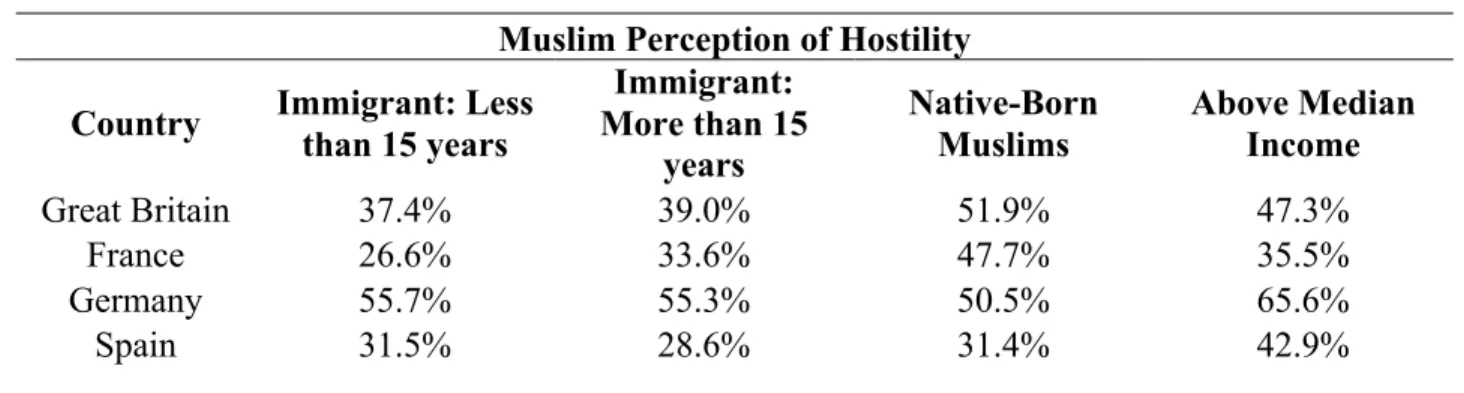
perceptions of exclusion are greater. In Table 6, I test this hypothesis further by comparing the effects of incorporation on perceptions of hostility for immigrants who arrived in the last 15 years, immigrants who arrived more than 15 years ago, the native-born, and those with an above median income, as a measure of structural incorporation.
Table 6. Comparing Muslims' Perception of Hostility by Time in the Host Country
Muslim Perception of Hostility
Country Immigrant: Less than 15 years
Immigrant: More than 15
years
Native-Born Muslims
Above Median Income
Great Britain 37.4% 39.0% 51.9% 47.3%
France 26.6% 33.6% 47.7% 35.5%
Germany 55.7% 55.3% 50.5% 65.6%
Spain 31.5% 28.6% 31.4% 42.9%
In Great Britain and France, the native-born are more likely than immigrants to perceive societal exclusion, following the cultural consciousness hypothesis. However, in Germany and Spain, the native-born are less likely than immigrants to perceive societal exclusion. Notable gaps between individual experience of discrimination and perceptions of discrimination against the group show that perceptions of societal exclusion cannot be explained at the individual-level without considering the cultural contexts that shape acculturative processes.
Citizenship Regimes
Muslims’ perceptions of hostility by nativity to non-Muslim Europeans’ unfavorability toward Muslims.
Table 7. Comparing Muslims' Perception of Hostility by Nativity Against Societal Perceptions of Hostility Against Muslims
Muslim Perception of Hostility
Non-Muslim Unfavorability toward Muslims
Country Immigrant Native-Born Country Non-Muslims
Britain 39.8% 51.9% Britain 23.7%
France 30.6% 47.7% France 35.3%
Germany 54.2% 50.5% Germany 56.9%
Spain 32.2% 31.4% Spain 67.1%
In Britain, Muslim immigrants and native-born Muslims perceive almost twice the hostility expressed in British attitudes toward Muslims. Similarly, in France, native-born Muslims perceive more hostility than non-Muslim French report. However, in Germany and Spain, Muslims perceive less hostility than non-Muslims report. In Spain, this perception of hostility is half of that which is expressed by non-Muslims. These findings show a profound pattern in which: (1) there is a marked disjuncture between Muslims’ and non-Muslims’ perceptions of societal inclusion (2) there is a consistent likelihood that Muslims in more
multicultural countries will perceive greater exclusion relative to levels of cultural inclusion than Muslims in less multicultural countries. In other words, while base frequencies do not appear to reveal patterns in Muslims’ perceptions of exclusion across countries, when these perceptions are contextualized and examined relative to their cultural content, a distinct pattern emerges.
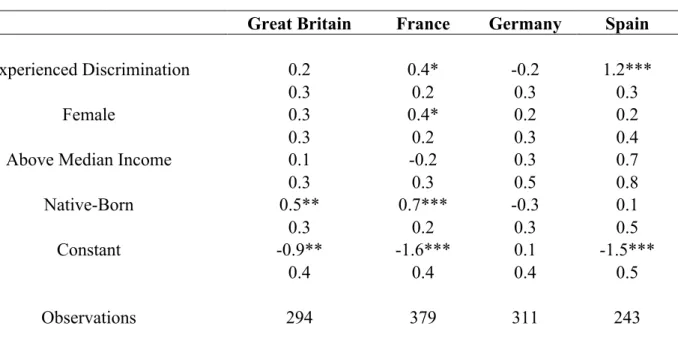
To test these effects, I conduct a logit test including individual and group-level determinants of perceptions of exclusion, shown in Table 8.
Table 8. Full Logit Model of Muslims' Perceptions of Hostility
Great Britain France Germany Spain
Experienced Discrimination 0.2 0.4* -0.2 1.2***
0.3 0.2 0.3 0.3
Female 0.3 0.4* 0.2 0.2
0.3 0.2 0.3 0.4
Above Median Income 0.1 -0.2 0.3 0.7
0.3 0.3 0.5 0.8
Native-Born 0.5** 0.7*** -0.3 0.1
0.3 0.2 0.3 0.5
Constant -0.9** -1.6*** 0.1 -1.5***
0.4 0.4 0.4 0.5
Observations 294 379 311 243
The individual experience of discrimination only significantly predicts perceptions of discrimination in Spain. Because Spain is a new country of immigration, it is possible that the lack of historical clarity around cultural divisions between groups results in a more robust effect of individual experience of discrimination upon perceptions of exclusion. More centrally, the weakness of this model suggests that perceptions of societal exclusion cannot be explained solely by individual experiences and interactions.
this suggests that national policy and discourse shape the context in which perceptions of
exclusion are formed. Meanwhile, income, as a measure of structural incorporation, has no effect on perceptions of exclusion. However, as suggested through means tests, nativity positively predicts perceptions of exclusion in Great Britain and France, countries with a higher degree of multiculturalism. This finding suggests that nativity has a robust effect on perceptions of society, however this effect is patterned by the national context.
As native-born Muslims are born and socialized into the host culture, their nativity reflects an intimate understanding and expectation of the integration process. The inclusionary or exclusionary nature of the national context that shapes this integration process matters for the ways in which expectations of inclusion are formed. In multicultural Great Britain, greater expectations of inclusion facilitate a cognitive context in which perceptions of exclusion will arise when these expectations are not met. While Muslims in Germany may experience similar conditions of exclusion, the national context of low multiculturalism does not produce the same expectations of inclusion. As a result, the same conditions of exclusion are not perceived and cognitively produced in the same way. In multicultural countries, the disjuncture between expectation and perceived reality creates a gap between the perceptions of the native-born and perceptions of immigrants. However, native-born Muslims’ awareness of exclusionary contexts in countries like Germany provides a conceptual referent such that perceptions of hostility are not readily interpreted as discrimination toward Muslims, so much as culturally normative divisions between groups.
By testing individual and group-level determinants of perceptions of exclusion, it
forces that shape them. I hypothesized that the effect of these determinants would be patterned by national contexts, meaning degrees of multiculturalism that enable expectations of inclusion. For native-born Muslims with greater cultural awareness, these effects will be stronger.
Conclusions
This article tested an integrated theory of perceptions of exclusion considering the ways in which national contexts of multiculturalism pattern individual-level perceptions. Through a comparison of Great Britain, France, Germany, and Spain, I showed how cross-national variation in perceptions of exclusion could not be explained by individual experiences of discrimination alone, but rather corresponded to the expectations of inclusion enabled through multicultural policy. Results showed that native-born Muslims perceived greater discrimination than immigrant Muslims in multicultural countries, highlighting the significance of nativity in perceptions of the integrative process.
There are a number of limitations to this study. First, these surveys provide a snapshot of perceptions in 2006. A longitudinal comparison of perceptions over time in comparison to evolving public discourses surrounding Muslims might provide greater insight into the
Despite limitations, there are a number of implications in these findings. First, while cross-national variation in macro-level policies has been well documented, the cultural meanings implicit in these policies suggest that the ways in which marginalized groups relate to these rigid or flexible limitations are as significant as the policies themselves. Further studies might explore the frames and discourses expressed through multiculturalism and the multivalence of narratives and constellations of meaning across cultures (Edgell and Tranby 2010). Do certain discourses, frames, and meaning structures harness particular predictive power for perceptions of exclusion? A longitudinal approach might consider how discourse evolves over time, reflecting the
influence of the EU and liberal democracy, in contrast to public discourses that reify boundaries between groups.
Similarly, the identification of a disjuncture between Muslims’ perceptions of
discrimination and Europeans’ perceptions of hostility against Muslims raises questions about multiculturalism’s constraints around expression and contestation. How does multiculturalism provide limitations not only on conceptual understandings of who does and does not belong, but also on the ways in which these distinctions are discursively available Do counter-frames and discourses make distinctions between groups inexpressible, for example a growing ideology of multicultural colorblindness that makes difficult the identification of discrimination? Similarly, how do marginalized communities contest these boundaries, symbolically and politically? Furthermore, the notable divergence in the perceptions of the native-born and immigrants opens a field of inquiry that might bridge segmented assimilation theory with cultural sociology to explore the ways in which the native-born draw upon a broader cultural repertoire and are rather less constrained than immigrants in their formation and expression of perceptions of
References
Alba, Richard. 2005. “Bright Vs. Blurred Boundaries: Second-generation Assimilation and Exclusion in France, Germany, and the United States.” Ethnic and Racial Studies 28 (1): 20–49. doi:10.1080/0141987042000280003.
Alba, Richard, and Victor Nee. 2005. Remaking The American Mainstream: Assimilation And Contemporary Immigration. Harvard University Press.
Ansari, Humayun, and Farid Hafez. 2012. From the Far Right to the Mainstream: Islamophobia in Party Politics and the Media. Campus Verlag.
Banting, Keith, and Will Kymlicka. 2006. Multiculturalism and the Welfare State : Recognition and Redistribution in Contemporary Democracies: Recognition and Redistribution in Contemporary Democracies. Oxford University Press.
Barkdull, Carenlee, Khadija Khaja, Irene Queiro-Tajalli, Amy Swart, Dianne Cunningham, and Sheila Dennis. 2011. “Experiences of Muslims in Four Western Countries Post—9/11.” Affilia 26 (2) (May 1): 139–153. doi:10.1177/0886109911405491.
Bleich, Erik. 2010. “Where Do Muslims Stand on Ethno-racial Hierarchies in Britain and France? Evidence Form Public Opinion Surveys, 1988-2008.” In Anti-Muslim Prejudice Past and Present, 169–190. Routledge.
http://www.tandfonline.com/doi/abs/10.1080/00313220903109144.
Bovenkerk, F, R Miles, and G Verbunt. 1990. “Racism, Migration and the State in Western Europe: a Case for Comparative Analysis.” International Sociology: Journal of the International Sociological Association 5 (4) (December): 475–490.
Branscombe, Nyla R., Michael T. Schmitt, and Richard D. Harvey. 1999. “Perceiving Pervasive Discrimination Among African Americans: Implications for Group Identification and Well-being.” Journal of Personality and Social Psychology 77 (1): 135–149.
doi:10.1037/0022-3514.77.1.135.
Brubaker, Rogers. 1999. “The Manichean Myth: Rethinking the Distinction Between ‘Civic’ and ‘Ethnic’ Nationalism”: 55–71.
Carrera, Sergio. 2006. “A Comparison of Integration Programmes in the Trends and Weaknesses.”
http://www.eui.eu/Documents/DepartmentsCentres/AcademyofEuropeanLaw/CourseMat erialsHR/HR2010/Rubio-Marin/RubioMarinReading1.pdf.
Cohen, Jean L. 1999. “Changing Paradigms of Citizenship and the Exclusiveness of the Demos.” International Sociology 14 (3) (September 1): 245–268.
doi:10.1177/0268580999014003002.
Connor, Phillip. 2010. “Contexts of Immigrant Receptivity and Immigrant Religious Outcomes: The Case of Muslims in Western Europe.” Ethnic and Racial Studies 33 (3) (March): 376–403. doi:10.1080/01419870902935963.
Diehl, Claudia, and Rainer Schnell. 2006. “‘Reactive Ethnicity’ or ‘Assimilation’? Statements, Arguments, and First Empirical Evidence for Labor Migrants in Germany.” International Migration Review 40 (4): 786–816. doi:10.1111/j.1747-7379.2006.00044.x.
Du Bois, W. E. B. 1903. The Souls of Black Folk. Chicago: A.C. McClurg & Co: University Press John Wilson and Son, Cambridge.
Edgell, Penny, and Eric Tranby. 2010. “Shared Visions? Diversity and Cultural Membership in American Life.” Social Problems 57 (2) (May 1): 175–204.
doi:10.1525/sp.2010.57.2.175.
Favell, Adrian. 1998. Philosophies of Integration: Immigration and the Idea of Citizenship in France and Britain. Palgrave Macmillan.
Fekete, Liz. 2009. A Suitable Enemy: Racism, Migration and Islamophobia in Europe. Pluto Press.
Geddes, Andrew, Jan Niessen, Alex Balch, Claire Bullen, and Maria Jose Peiro. 2005.
“European Civic Citizenship and Inclusion Index”. Belgium: British Council Brussels. Gest, Justin. 2010. Apart: Alienated and Engaged Muslims in the West. New York: Columbia
University Press.
Givens, Terri, and Rahsaan Maxwell. 2012. Immigrant Politics : Race and Representation in Western Europe. Boulder, Colo.: Lynne Rienner Publishers.
Glazer, Nathan. 1998. We Are All Multiculturalists Now. Cambridge, Mass: Harvard University Press.
Guibernau, Montserrat, and John Rex. 2010. The Ethnicity Reader: Nationalism, Multiculturalism and Migration. Polity.
Hall, Schekeva P., and Robert T. Carter. 2006. “The Relationship Between Racial Identity, Ethnic Identity, and Perceptions of Racial Discrimination in an Afro-Caribbean Descent Sample.” Journal of Black Psychology 32 (2) (May 1): 155–175.
Hogg, Michael A, and Abrams. 1988. Social Identifications a Social Psychology of Intergroup Relations and Group Processes. London; New York: Routledge.
http://search.ebscohost.com/login.aspx?direct=true&scope=site&db=nlebk&db=nlabk&A N=162005.
Janmaat, Jan Germen. 2006. “Popular Conceptions of Nationhood in Old and New European Member States: Partial Support for the Ethnic-civic Framework.” Ethnic and Racial Studies 29 (1) (January): 50–78. doi:10.1080/01419870500352363.
Jenkins, Richard. 2008. Social Identity. Taylor & Francis.
Joppke, Christian. 2010. Citizenship and Immigration. 1st ed. Polity.
Joppke, Christian, and John Torpey. 2013. Legal Integration of Islam — Christian Joppke, John Torpey | Harvard University Press. Harvard University Press.
http://www.hup.harvard.edu/catalog.php?isbn=9780674072848.
Kasinitz, Philip, John Mollenkopf, and Mary C. Waters. 2002. “Becoming American/Becoming New Yorkers: Immigrant Incorporation in a Majority Minority City1.” International Migration Review 36 (4): 1020–1036. doi:10.1111/j.1747-7379.2002.tb00116.x.
Kibria, Nazli. 2008. “The ‘new Islam’ and Bangladeshi Youth in Britain and the US.” Ethnic and Racial Studies 31 (2): 243–266. doi:10.1080/01419870701337593.
———. 2013. “Young British Muslims: Identity, Culture, Politics and the Media.” Ethnic and Racial Studies 36 (6): 1109–1109. doi:10.1080/01419870.2012.762108.
King, Kimberly R. 2003. “Do You See What I See? Effects of Group Consciousness on African American Women’s Attributions to Prejudice.” Psychology of Women Quarterly 27 (1): 17–30. doi:10.1111/1471-6402.t01-2-00003.
Koopmans, Ruud, and P. J. Statham. 2000. Challenging Immigration and Ethnic Relation Politics: Comparative European Perspectives. Oxford University Press.
Levitt, Peggy, and Mary C. Waters. 2006. The Changing Face of Home: The Transnational Lives of the Second Generation. Russell Sage Foundation.
McCoy, Shannon K., and Brenda Major. 2003. “Group Identification Moderates Emotional Responses to Perceived Prejudice.” Personality and Social Psychology Bulletin 29 (8) (August 1): 1005–1017. doi:10.1177/0146167203253466.
Meer, Nasar, and Tariq Modood. 2010. “Refutations of Racism in the ‘Muslim Question’.” In Anti-Muslim Prejudice Past and Present, 126–145. Routledge.
http://www.tandfonline.com/doi/abs/10.1080/00313220903109144.
Miles, Robert. 1995. Migration and European Integration: The Dynamics of Inclusion and Exclusion. London; Madison [N.J.]: Pinter Publishers ; Fairleigh Dickinson University Press.
Modood, Tariq. 2006. Multiculturalism, Muslims and Citizenship: A European Approach. Psychology Press.
———. 2010. Still Not Easy Being British : Struggles for a Multicultural Citizenship. Stoke-on-Trent: Trentham Books.
Muro, Diego, and Alejandro Quiroga. 2005. “Spanish Nationalism Ethnic or Civic?” Ethnicities 5 (1) (March 1): 9–29. doi:10.1177/1468796805049922.
Nagra, Baljit. 2011. “‘Our Faith Was Also Hijacked by Those People’: Reclaiming Muslim Identity in Canada in a Post-9/11 Era.” Journal of Ethnic and Migration Studies 37 (3): 425–441. doi:10.1080/1369183X.2011.526781.
Nielsen, Jørgen S. 2004. Muslims In Western Europe. Edinburgh University Press.
Operario, Don, and Susan T. Fiske. 2001. “Ethnic Identity Moderates Perceptions of Prejudice: Judgments of Personal Versus Group Discrimination and Subtle Versus Blatant Bias.” Personality and Social Psychology Bulletin 27 (5) (May 1): 550–561.
doi:10.1177/0146167201275004.
Peek, Lori. 2005. “Becoming Muslim: The Development of a Religious Identity.” Sociology of Religion 66 (3) (September 21): 215–242. doi:10.2307/4153097.
Portes, Alejandro, Patricia Fernández-Kelly, and William Haller. 2005. “Segmented Assimilation on the Ground: The New Second Generation in Early Adulthood.” Ethnic and Racial Studies 28 (6): 1000–1040. doi:10.1080/01419870500224117.
Portes, Alejandro, Robert Nash Parker, and José A. Cobas. 1980. “Assimilation or
Consciousness: Perceptions of U.S. Society Among Recent Latin American Immigrants to the United States.” Social Forces 59 (1) (September 1): 200–224.
doi:10.1093/sf/59.1.200.
Portes, Alejandro, and Rubén G. Rumbaut. 2001. Legacies: The Story of the Immigrant Second Generation. University of California Press.
Sellers, Robert M., and J. Nicole. 2003. “The Role of Racial Identity in Perceived Racial Discrimination.” Journal of Personality and Social Psychology 84 (5): 1079–1092. doi:10.1037/0022-3514.84.5.1079.
Sinno, Abdulkader H. 2009. Muslims: In Western Politics. Indiana University Press.
Tajfel, Henri. 1978. Differentiation Between Social Groups: Studies in the Social Psychology of Intergroup Relations. Vol. xv. Oxford, England: Academic Press.
———. 2010. Social Identity and Intergroup Relations. Cambridge University Press.
Taylor, Charles, and Amy Gutmann. 1994. Multiculturalism: (Expanded Paperback Edition). Princeton University Press.
Vertovec, Steven, and Susanne Wessendorf. 2010. The Multiculturalism Backlash: European Discourses, Policies and Practices. Routledge.
Waldinger, Roger, and Cynthia Feliciano. 2004. “Will the New Second Generation Experience ‘downward Assimilation’? Segmented Assimilation Re-assessed.” Ethnic and Racial Studies 27 (3): 376–402. doi:10.1080/01491987042000189196.
Weldon, Steven A. 2006. “The Institutional Context of Tolerance for Ethnic Minorities: A Comparative, Multilevel Analysis of Western Europe.” American Journal of Political Science 50 (2): 331–349.
Zapata‐Barrero, Ricard. 2003. “Spanish Challenges and European Dilemma: Socialising the Debate on the Integration of Immigrants∗.” Perspectives on European Politics and Society 4 (2): 243–264. doi:10.1080/15705850308438862.
Zolberg, Aristide R., and Long Litt Woon. 1999. “Why Islam Is Like Spanish: Cultural
Incorporation in Europe and the United States.” Politics & Society 27 (1) (March 1): 5– 38. doi:10.1177/0032329299027001002.