rspb.royalsocietypublishing.org
Research
Cite this article:
Pierce AA, Gutierrez R, Rice
AM, Pfennig KS. 2017 Genetic variation during
range expansion: effects of habitat novelty and
hybridization.
Proc. R. Soc. B
284
: 20170007.
http://dx.doi.org/10.1098/rspb.2017.0007
Received: 3 January 2017
Accepted: 8 March 2017
Subject Category:
Evolution
Subject Areas:
ecology, evolution, genetics
Keywords:
population genetics, landscape genetics,
introgression, admixture, interbreeding
Author for correspondence:
Karin S. Pfennig
e-mail: [email protected]
†
Present address: Department of Biological
Sciences, Lehigh University, Bethlehem,
PA 18015, USA.
Electronic supplementary material is available
online at https://dx.doi.org/10.6084/m9.
figshare.c.3723952.
Genetic variation during range expansion:
effects of habitat novelty and
hybridization
Amanda A. Pierce, Rafael Gutierrez, Amber M. Rice
†and Karin S. Pfennig
Department of Biology, University of North Carolina, Chapel Hill, NC 27599, USA
AAP, 0000-0001-9507-0009; KSP, 0000-0002-0852-287X
How species’ ranges evolve remains an enduring problem in ecology and evolutionary biology. Species’ range limits are potentially set by the inability of peripheral populations to adapt to range-edge habitat. Indeed, peripheral populations are often assumed to have reduced genetic diversity and popu-lation sizes, which limit evolvability. However, support for this assumption is mixed, possibly because the genetic effects of range expansion depend on two factors: the extent that habitat into which expansion occurs is novel and sources of gene flow. Here, we used spadefoot toads,Spea bombifrons, to con-trast the population genetic effects of expansion into novel versus non-novel habitat. We further evaluated gene flow from conspecifics and from hetero-specifics via hybridization with a resident species. We found that range expansion into novel habitat, relative to non-novel habitat, resulted in higher genetic differentiation, lower conspecific gene flow and bottlenecks. Moreover, we found that hybridizing with a resident species introduced genetic diversity in the novel habitat. Our results suggest the evolution of species’ ranges can depend on the extent of differences in habitat between ancestral and newly occupied ranges. Furthermore, our results highlight the potential for hybridization with a resident species to enhance genetic diversity during expansions into novel habitat.
1. Introduction
Explaining the evolution of species’ ranges is fundamental to understanding how biodiversity is distributed and maintained [1 –3]. Species’ ranges are influ-enced by biotic (e.g. predation, parasitism and competition), and abiotic factors (e.g. climate) [4,5]. Yet, we still do not fully know how species’ geographical ranges evolve and what factors fuel range expansions [6,7].
Generally, species’ ranges are limited by the inability of populations at the range edge to adapt to environmental pressures before going extinct [6,8,9]. Range expansions often result in smaller population sizes at the range periph-ery and decreased genetic diversity [10– 12]. Thus, peripheral populations’ adaptive potential is low and their risk of extinction high. Adaptive evolution that prevents extinction could occur in such populations via new mutations or gene flow [8,13]. However, the waiting time for adaptive mutations is poten-tially too long to rescue edge populations, and gene flow from conspecifics will most likely consist of alleles from the range centre [14,15], which may be poorly adapted to the range periphery [8,16].
Whether such gene flow has positive or negative effects will differ depend-ing on the novelty of the habitat into which expansion occurs. When expansion occurs into relatively non-novel habitat, gene flow from other conspecific popu-lations inhabiting similar environments can provide an increase in genetic diversity or adaptive alleles to foster local adaptation in peripheral populations [8,17]. By contrast, when expansion occurs into novel habitat, theoretical and empirical work has shown that gene flow from the centre of the range can have an opposite effect, generating an influx of maladaptive alleles that prevent local adaptation in peripheral populations [8,16].
An alternative to conspecific gene flow as a source of genetic variation is hybridization with a resident species. Although hybridization is often deleterious [18,19], it is sometimes beneficial [20,21]. In such cases, introgression of heterospecific alleles may provide populations at the range edge with a source of genetic variation [22,23], including the transfer of specific adaptive alleles from one species to another [20,24 –28]. This can result in rapid adaptation by peripheral populations, allowing for further expansion into the novel habitat [29,30].
Whether hybridization plays an important role in range expansion remains an open question, especially in animals, as most tests of the hypothesis have been in plants [21,29,31]. Yet, evaluating hybridization’s role in the evolution of species’ ranges is important for ascertaining hybridiz-ation’s role in the origins and distribution of biodiversity. Indeed, understanding the relationship between hybridiz-ation and range expansion is increasingly important for practical reasons as evidence shows that global change is altering the distribution of animal and plants species around the world [32– 35] and hybridization events could become more common as a result [36].
We addressed the above issues with two goals for this study. Using a population genetic approach, we: (i) ascer-tained whether encountering a novel environment might limit range expansion as theory predicts; and (ii) evaluated the potential role of hybridization in expansion into a novel habitat.
To achieve these goals, we used Plains spadefoot toads,
Spea bombifrons, as a model system. Spea bombifrons occupy
a wide range throughout the southwestern and central United States (figure 1) and are thought to be ancestral to the central plains region [37]. After the most recent glacial retreat, S. bombifrons appears to have expanded its range northward [37] through grassland habitat similar to the ancestral region, with further northern expansion taking place in current populations [38,39]. By contrast,S. bombifrons
also may have expanded their range southwestward into an entirely different biome: the desert [37]. Museum collections recordS. bombifronsin the Southwest USA in the late 1800s, so this expansion is not contemporary. However, in some populations in Arizona, the relative abundance of
S. bombifronsincreased within the last 30 years [40].
Spadefoot toads breed, and their tadpoles develop, in ephemeral ponds that potentially dry before the tadpoles successfully metamorphose. This putative southwestward expansion ofS. bombifronsis therefore striking because a lim-iting environmental factor for these amphibians is ponds that last long enough for tadpole metamorphosis. Indeed, a con-gener, S. multiplicata (Mexican spadefoot toad), that is ancestral to the desert region has shorter developmental times that enable tadpoles to more likely metamorphose before their desert ponds rapidly dry [41].
Where S. multiplicata and S. bombifrons co-occur, they potentially hybridize and produce viable offspring. Female hybrids can backcross to both parent species (hybrid males are sterile; [42,43]), thereby generating introgression between the two species [42,44]. Critically, hybrid tadpoles develop faster than pureS. bombifronstadpoles, resulting in a fitness benefit for the expanding species to hybridize in a dry, desert environment [45]. In fact, S. bombifrons females that occur in sympatry withS. multiplicatahave evolved faculta-tive mate preference where they prefer conspecifics when
breeding in deep, long-lasting ponds, but switch their pre-ference to S. multiplicata in shallow, ephemeral ponds [45]. Consequently, S. bombifrons females primarily contribute to the production of F1 hybrids and the incidence of hybridization increases with decreasing pond size [46].
BecauseS. bombifronsappears to have undergone two dis-tinct range expansions, and because they hybridize with a resident species in the context of one of those expansions,
S. bombifrons is ideally suited to address the issues raised
above. We specifically compared the genetic effects of range expansion into a novel, desert environment with expansion into a non-novel grassland environment, and ascertained whether hybridization has potentially facilitated the expan-sion ofS. bombifrons into the southwestern USA. To do so, we used microsatellites and population genetic analyses to: (i) investigate patterns of genetic diversity and population structure within S. bombifrons; and (ii) evaluate patterns of introgression between S. bombifrons and S. multiplicata. Because the desert provides a novel habitat, we expected populations there to suffer genetic effects from bottlenecks and reduced gene flow compared to populations in the non-novel grassland habitat. Our findings support these pre-dictions. Our results also suggest that hybridization has enhanced genetic variation in populations of southwestern
S. bombifrons; this hybridization might have enabled their
expansion into novel habitat.
2. Methods
(a) Sample collections
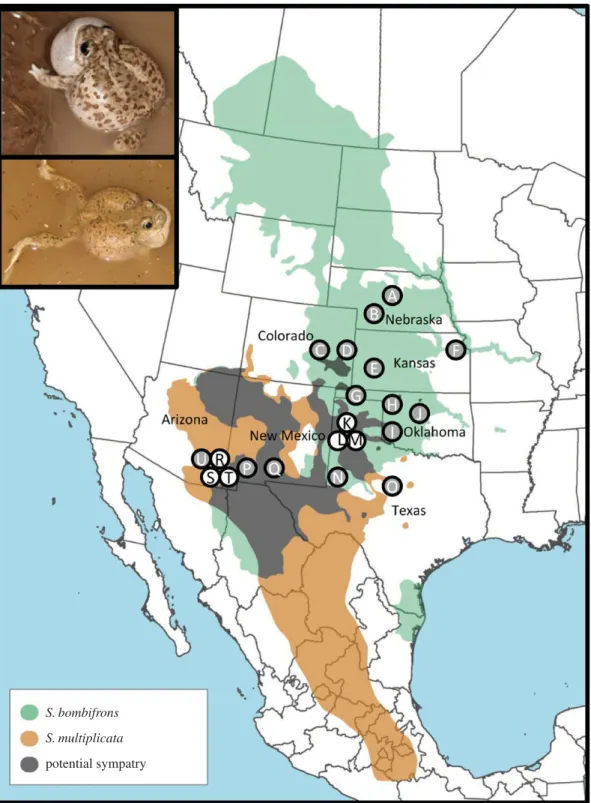
We obtained 217 samples of S. bombifrons from 21 locations across the USA through collection efforts and museum samples (figure 1). Locations ranged from a grassland environment in Nebraska to a desert environment in Arizona and included one location in Arizona that did not overlap locally withS. multipli-cata (i.e. allotopy) (table 1). Additionally, we obtained 93
S. multiplicatasamples from three sympatric locations in Texas
and Arizona (electronic supplementary material, table S1). Genotype data for the Arizona S. multiplicata individuals were previously reported in [37]. Adult specimens ofS.
bombi-frons from Arizona sympatry and both S. bombifrons and
S. multiplicata from Texas sympatry were used to ensure
accurate species identification (see figure 1 inset photos). Museum sample IDs are provided in electronic supplementary material, table S2.
(b) Microsatellite analysis
We genotyped each sample using 10 polymorphic microsatellite markers that were previously shown to not be in linkage disequi-librium (electronic supplementary material, table S3; method details in electronic supplemental materials) [47–49]. We used the software Arlequin v 3.5.1.2 [50] to calculate observed and expected heterozygosity for each location (electronic supplemen-tary material, table S4). Deviation from Hardy –Weinberg equilibrium was calculated with an exact test contrasting observed and expected heterozygosity in Arlequin using a Markov chain with a chain length of 1 000 000 and 100 000 de-memorization steps. We then corrected for multiple testing using a sequential Bonferroni correction at a¼0.05 for each locus in each population. All of our loci were in Hardy– Weinberg equilibrium in at least 70% of our sampling locations (electronic supplementary material, table S4).
rspb.r
oy
alsocietypublishing.org
Pr
oc.
R.
Soc.
B
284
:
20170007
(c) Population genetics of range expansion across
different habitats
To understand the impact of habitat novelty on range expansion, we first examined population structure ofS. bombifrons across non-novel grassland and novel desert environments using the software STRUCTURE v. 2.3.3 [51]. For the STRUCTURE analy-sis we also included samples of S. multiplicata individuals from seven locations. Because we includedS. multiplicatain this analysis, we used only the eight microsatellite loci that could be amplified in both species (electronic supplementary material, table S3). We implemented 100 000 burn-ins followed by 200 000 Markov chain Monte Carlo runs. We also used an admixture model with uncorrelated allele frequencies to avoid the risk of overestimating the number of populations and the LOCPRIOR
model to provide the software with collection information for each toad to ensure the detection of subtle population struc-ture. We started simulations with K values of 1 – 28, to reflect the 28 sampling locations (table 1; electronic supplementary material, table S1). For each K, we ran 10 simulations to check for consistency between runs, and used the log likelihood [51] and delta K method [52] to determine the most likely number of genetic populations (electronic supplementary material, figure S1). To confirm our results, we used all 10 loci and calculatedFSTandRSTstatistics [53,54] to measure genetic differ-entiation betweenS. bombifronspopulations. Permutation tests (using 10 000 permutations) implemented in ARLEQUIN v. 3.5.1.2 [50] were used to determine whether pairwise FST andRSTvalues were significantly different from 0. We also per-formed an analysis of molecular variance (AMOVA) and
S. bombifrons
S. multiplicata
potential sympatry
Figure 1.
Map showing species’ ranges and sampling locations of
S. bombifrons
and
S. multiplicata
. Central Oklahoma is the likely origin of the
S. bombifrons
range
and grey circles represent
S. bombifrons
only sampling sites. White circles represent sites with both species sampled. Inset shows breeding
S. bombifrons
(top) and
S. multiplicata
(bottom) males. Sampling site key located in table 1. (Photos by David W. Pfennig; map by Travis Taggart.)
rspb.r
oy
alsocietypublishing.org
Pr
oc.
R.
Soc.
B
284
:
20170007
calculated p-values based on permutation tests (using 1000 permutations) in ARLEQUIN for the northern, central, and desert regions to examine differences in the level of population structure across the range. Finally, using RST statistics we performed a Principal Coordinate Analysis using the cmdscale function in R (v. 3.0.1).
To understand if habitat novelty results in different coloniza-tion mechanisms and demographic effects, we used Poptools [55] to standardize sample sizes to seven individuals per collection site before comparing levels of genetic diversity (using the value 1-Qinter, the inter-individual diversity within popu-lations), which were measured using Genepop v. 4.1.0 [56]. Locations with fewer than seven samples were excluded result-ing in 17 sites used in the analysis. A sample size of seven was chosen to optimize statistical power with number of sites.
We also calculated allelic richness using ADZE-1.0 [57], which uses a rarefaction approach to account for unequal sample sizes. For this analysis, we set the minimum sample size per site to seven individuals with no missing data across all loci. By setting the minimum samples size as seven individ-uals with no missing data, we optimized the number of sites used (12 total for this analysis) while minimizing bias that could result from including sites with too few individuals. We compared values between grassland and desert regions using a Welch two samplet-test implemented in R v. 3.1.2.
To examine possible deleterious effects of a novel environment, we tested for recent population bottlenecks in
S. bombifrons populations with at least 10 individuals samples
using a Wilcoxon test [58] for heterozygosity excess across loci and a two-phase mutation model in the software Bottleneck [59]. We accounted for possible null alleles and determined cor-rected allele frequencies using the Brookfield 1 estimator [60]
implemented in Micro-checker, v. 2.2.3 [61]. We also performed this analysis with uncorrected frequencies; however results were not qualitatively different so we only report results based on corrected frequencies. If novel habitats limit expansion, we expected signatures of bottlenecks in the desert, but not grassland,S. bombifronspopulations.
(d) Examining genetic effects of hybridization
To calculate the amount of hybridization across the range, we calculated gene flow between the species in Texas and Arizona using likelihood ratio tests implemented in the coalescent-based software package MIGRATE-N 3.2 [62]. For this analysis we used the Brownian motion approximation to the ladder (‘stepwise’ or ‘one-step’) mutation model and Bayesian inference with multiple heating chains to jointly estimate parameters with three replicates [63,64]. This also allowed us to determine the directionality of gene flow.
We identified specific loci showing patterns of introgression by comparing hybrids with both parental species using FST. Hybrids were identified as admixed individuals (more than 10% assignment to heterospecific populations) based on inferred ancestry by STRUCTURE. Using theFSTcalculations, we could detect when admixed individuals were more genetically similar to the heterospecific, indicating introgression at that locus. We further identified signatures of introgression at locus SpeaC7 with alleles primarily found in the desert toad, S. multiplicata appearing in S. bombifrons individuals. We resampled without replacement to obtain population sizes of 10 and examined changes in frequencies of the putative heterospecific allele across the S. bombifrons range. Allele frequency values at sampling sites were used to generate an allele frequency surface
Table 1.
Spea bombifrons
sampling location with numbers and habitat information. ‘Type’ indicates whether the locality is sympatric (both species present),
allopatric (outside of the range of one species), or allotopic (within the region of sympatry, but only one species present).
map key
sampling location
state
N
type
habitat
A
Purdhum
Nebraska
18
allopatry
grassland
B
Twin Stars
Nebraska
8
allopatry
grassland
C
Limon
Colorado
15
allopatry
grassland
D
Burlington
Colorado
6
allopatry
grassland
E
Finney
Kansas
7
allopatry
grassland
F
Johnson
Kansas
6
allopatry
grassland
G
Cimarron
Oklahoma
8
allopatry
grassland
H
Ellis
Oklahoma
10
allopatry
grassland
I
Roger Mills
Oklahoma
11
allopatry
grassland
J
Payne
Oklahoma
7
allopatry
grassland
K
Amarillo
Texas
13
sympatry
grassland
L
Hereford
Texas
5
sympatry
grassland
M
Springlake
Texas
15
sympatry
grassland
N
Kermit
Texas
12
allopatry
grassland
O
Arnett
Texas
6
allopatry
grassland
P
Lordsburg
New Mexico
11
sympatry
desert
Q
NMHwy9
New Mexico
11
sympatry
desert
R
Sulphur Draw
Arizona
11
sympatry
desert
S
Shrimp
Arizona
14
sympatry
desert
T
Zent
Arizona
12
sympatry
desert
U
Wilcox
Arizona
11
allotopy
desert
rspb.r
oy
alsocietypublishing.org
Pr
oc.
R.
Soc.
B
284
:
20170007
map by inverse distance weighted (IDW) interpolator in ArcGIS v. 10.4.1 (ESRI, Redlands, California, USA). IDW estimates values by averaging nearby data points, with closer points carrying more influence.
3. Results
(a) Range expansion across similar habitat
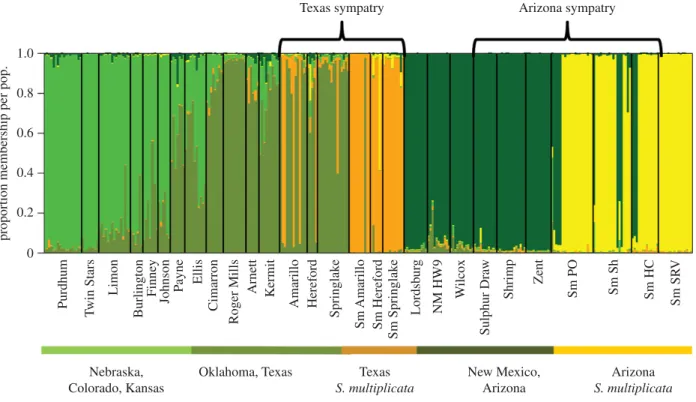
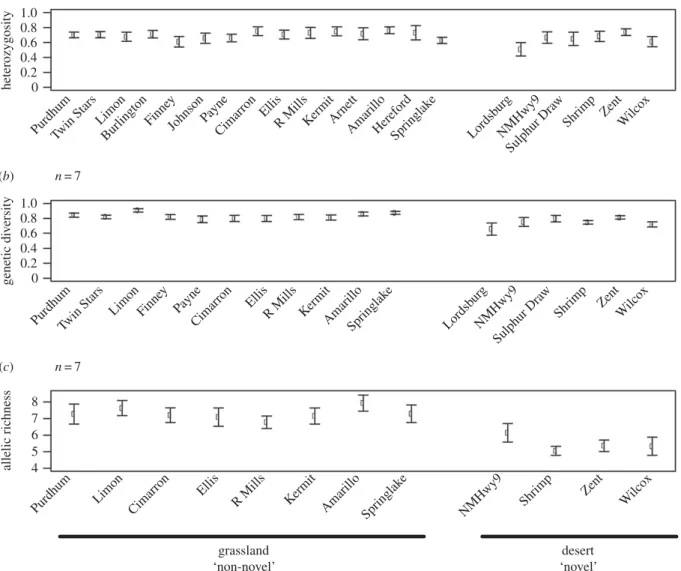
Across grassland populations (table 1 and figure 1), STRUC-TURE analysis revealed a clinal pattern of increasing membership to the ‘green’ group with increasing distance northward into Nebraska from Oklahoma, the putative centre of the range (figure 2). This is consistent with a north-ward range expansion as suggested by previous observational and genetic data [37 –39]. Despite evidence of a range expansion,S. bombifronspopulations showed stable levels of heterozygosity (F14,135¼0.54, p¼0.91; figure 3a),
genetic diversity (F10,99¼1.26,p¼0.27; figure 3b) and allelic
richness (F7,72¼0.50,p¼0.83; figure 3c) across the grassland
portion of their range from Texas to Nebraska (figure 3). These latter findings contrast with previous empirical and theoretical work in other systems showing that an expanding species will exhibit decreasing genetic diversity [11,12,65 – 68]. We further found that FST and RST values were low
across much of the northern and central portions of the range (electronic supplementary material, table S5 and figure S2) of S. bombifrons. An AMOVA analysis using RST
confirmed that differences among sites did not account for a significant amount of observed variation in the northern (Kansas, Nebraska, Colorado: 3.4% variation, p¼0.17) or
central (Oklahoma, Texas: 5.18% variation,p¼0.06) popu-lations. Thus, where S. bombifrons has expanded its range across similar habitat, it maintains stable levels of genetic diversity and allelic richness, likely via gene flow among other grassland populations.
(b) Range expansion across novel habitat
Contrary to the non-novel grassland populations, allelic richness decreased among desert populations in New Mexico and Arizona (t4.77¼6.90,p,0.01; figure 3c). Additionally,
we found the desert-inhabiting populations to be highly genetically differentiated compared to grassland populations in ourFST,RSTand STRUCTURE analyses (figure 2; electronic
supplementary material, table S5 and figure S2). Not only are the southwestern populations significantly differentiated from the northern and central populations, they are signifi-cantly differentiated from one another. An AMOVA analysis using RST confirmed that differences among sites
accounted for increased population structure in the desert populations (New Mexico, Arizona; 9.33% variation; p,
0.001). Additionally, we found evidence for bottlenecks in two Arizona populations (Zent,p,0.01 and Wilcox,p,
0.01). Outside of Arizona, we did not detect evidence for bottlenecks. The decline in allelic richness, high population structure, and evidence for bottlenecks is consistent with the desert habitat limiting gene flow and restricting move-ment among conspecific populations. Nevertheless, genetic diversity and heterozygosity appear to be maintained among desert populations ofS. bombifronsas neither measure was significantly different from values found in grassland populations (genetic diversity:t4.66¼2.54, p¼0.06;
hetero-zygosity: t6.73¼1.28, p¼0.24; however the marginal p-value for diversity could reflect insufficient power to detect a difference).
(c) Hybridization’s effects on range expansion
To investigate if hybridization might have enhanced genetic diversity inS. bombifronsin the novel desert habitat, we sur-veyedS. multiplicatafrom two areas of sympatry—Texas and Arizona. We found that outlier S. bombifrons individuals located in Texas were genetically similar to S. multiplicata,
1.0
0.8
0.6
0.4
0.2
proportion membership per pop.
0
Purdhum
T
win Stars
Limon
Burlington
Finne
y
Johnson P ayne Ellis
Cimarron
Roger Mills
Arnett Kermit Amarillo Hereford
Springlak
e
Sm Amarillo Sm Hereford
Sm Springlak
e
Lordsb
ur
g
NM HW9
W
ilcox
Sulphur Dra
w
Shrimp
Zent
Sm PO Sm Sh Sm HC
Sm SR
V
Nebraska, Colorado, Kansas
Oklahoma, Texas Texas
S. multiplicata
New Mexico, Arizona
Arizona
S. multiplicata
Texas sympatry Arizona sympatry
Figure 2.
Structure plot showing that
K
(number of distinct populations)
¼
5 for
S. bombifrons
and
S. multiplicata
. The northern range of
S. bombifrons
shows
increasing differentiation from the central range whereas the most southwestern portion of the range is highly differentiated. Individual toads are indicated by
vertical bars and colour denotes population membership.
rspb.r
oy
alsocietypublishing.org
Pr
oc.
R.
Soc.
B
284
:
20170007
indicative of hybridization (figure 2). Additionally, we found outlier S. multiplicata individuals in Arizona appearing genetically similar to Arizona S. bombifrons, again pointing towards hybridization. Rather than equal gene flow between the species, we found asymmetrical gene flow with the recipient species differing based on sympatric location. Migrate-n confirmed these findings, indicating a higher level of gene flow from residentS. multiplicatatoS. bombifrons
in Texas (S. multiplicata!S. bombifrons 5.43 immigrants/ generations;S. bombifrons!S. multiplicata1.40 immigrants/ generation) but a higher level of gene flow from
invad-ing S. bombifrons to native S. multiplicata in Arizona
(S. bombifrons!S. multiplicata 4.09 immigrants/generation;
S. multiplicata!S. bombifrons1.89 immigrants/generation).
Additionally, individual examination of the markers revealed introgression across multiple loci (electronic sup-plementary material, table S6). For example, in sympatry, admixed individuals were genetically indistinguishable from heterospecifics at multiple loci, while showing signifi-cant differentiation from their conspecific population. For locus SpeaC7 in particular, a S. multiplicata allele was not found in high frequencies in central or northernS. bombifrons
populations outside of sympatry, but was maintained at a relatively high frequency in S. bombifrons throughout the
desert habitat (figure 4). Given that we detected introgression across multiple loci with only a handful of microsatellite mar-kers, it is possible that hybridization has introduced a larger amount of genetic variation than observed here.
4. Discussion
We used Plains spadefoot toads,S. bombifrons, to examine the population genetic effects of habitat novelty during range expansion and to evaluate how hybridization with a resident species can impact genetic variation during expansion into novel habitat. In contrast to populations in the ancestral grassland environment, we found that the novel desert environment was associated with reduced gene flow and recent population bottlenecks in S. bombifrons. Although these factors led to a reduction in allelic richness, hybridiz-ation with the residentS. multiplicataappears to have led to the transfer of genetic variation in the novel desert habitat. Such transfer of genetic variation via hybridization might have facilitated the range expansion ofS. bombifrons into a novel habitat.
Generally, species are expected to evolve expanded ranges when edge populations adapt to local conditions
PurdhumTwin StarsLimonBurlingtonFinne y
Johnson P ayne
Cimarron R Mills Ellis
Kermit
Hereford Arnett
Amarillo Springlak
e
Lordsb urg
NMHwy9 W
ilcox Zent
Sulphur Dra w
Shrimp
Purdhum Limon Cimarron R Mills
Ellis
Kermit
Amarillo Springlak e
NMHwy9 W
ilcox Zent Shrimp PurdhumTwin Stars Limon Finne
y Payne
Cimarron R Mills
Ellis
Kermit Amarillo
Springlak e
Lordsb urg
NMHwy9 W
ilcox Zent
Sulphur Dra w
Shrimp 0.8
0.6 0.4 0.2
heterozygosity
genetic di
v
ersity
allelic richness
1.0
0
n= 7
n= 7 0.8 0.6 0.4 0.2 1.0
0
8 7 6 5 4
grassland ‘non-novel’
desert ‘novel’ (b)
(a)
(c)
Figure 3.
Genetic trends across
S. bombifrons
range. Sampling sites are ordered from north to southwest. (
a
) High levels of heterozygosity (
H
o) are maintained
throughout the range. (
b
) Genetic diversity (using the value 1-Qinter, the inter-individual diversity within populations) was also maintained. (
c
) Allelic richness
declines in desert populations.
rspb.r
oy
alsocietypublishing.org
Pr
oc.
R.
Soc.
B
284
:
20170007
and become sources of dispersers [6,8,9,69]. Adaptability of peripheral populations therefore sets the limits of a species’ range. A key factor that limits adaptability is genetic diver-sity: in the absence of genetic diversity, populations are unable to evolve in response to local selective pressures [70,71]. Ironically, a common signature of range expansion is reduced genetic diversity because edge populations are often the result of serial founder events or suffer population crashes (and, concomitantly, genetic bottlenecks) [10–12]. Although dispersal and the resulting gene flow among con-specific populations can reintroduce genetic variation into peripheral populations [72,73], such gene flow can inhibit adaptation if alleles from the range centre are maladaptive at the range edge [8,16]. Moreover, dispersal might be limited across novel habitat [74–76]. Therefore, the novelty of the habitat into which expansion occurs might critically impact the adaptability of peripheral populations.
Our results illustrate this dynamic between range expan-sion and habitat novelty. In the northward range expanexpan-sion into a relatively non-novel grassland habitat, allelic richness and genetic diversity levels remain high amongS. bombifrons
populations (figure 3). Additionally, FST and RST values
throughout the grassland regions are relatively low, suggesting ample movement of toads throughout the grass-land range, which maintains a high level of genetic diversity and a low level of population differentiation (electronic supplementary material, table S5). Conversely, the southwestward range expansion by S. bombifrons
into novel desert habitat showed a different pattern. Desert populations were highly genetically differentiated not only in comparison with the rest of the range (figure 2), but also between closely located populations in the desert itself (electronic supplementary material, table S5). Such strong population differentiation was likely influenced by bottleneck events.
The differences we observe between the northern and southwestern range expansions by S. bombifrons highlight how expansion into novel versus non-novel habitats can gener-ate variation in gene flow and population genetic patterns. Indeed when a species expands into a similar habitat, gene flow among populations is more likely to result in mainten-ance of allelic richness and adaptive potential [8,17]. By contrast, our results indicate that a novel habitat might restrict movement, so that populations are less likely to receive migrants (and genetic rescue) and are more likely subject to population crashes and extinction. The novel habitat thus gen-erates a negative genetic impact, which—without some counterforce—could limit peripheral population adaptability. One such counterforce is hybridization with a resident species that is locally adapted [21,30]. In spadefoots, hybrid-ization with desert-adaptedS. multiplicatamay be one way in whichS. bombifronsmaintains genetic variation in the novel habitat. Patterns of introgression are consistent with this, as is our finding that desert populations ofS. bombifronscontain high levels of genetic diversity despite evidence of recent bottlenecks.
0–0.03 0.03–0.05 0.05–0.08 0.08–0.10 0.10–0.13 0.13–0.15 0.15–0.18 0.18–0.20 0.20–0.23
Figure 4.
Introgression and maintenance of heterospecific allele in
S. bombifrons
. ArcGIS frequency surface map of heterospecific (
S. multiplicata
) allele at locus
SpeaC7
over the range of
S. bombifrons
based on observed population frequency at collection sites (black pentagons). See Methods for details. This heterospecific
allele first appears in Texas sympatry and is maintained throughout the desert region. It is present even in the most westward
S. bombifrons
desert population,
which is allotopic.
rspb.r
oy
alsocietypublishing.org
Pr
oc.
R.
Soc.
B
284
:
20170007
Specifically, we examined two areas of sympatry to evaluate the effects, if any, of hybridization onS. bombifronsdesert expan-sion. Interestingly, we found that directionality of introgression differed between these regions (figure 2). In Texas, introgression was from the residentS. multiplicatainto the expandingS.
bom-bifrons, whereas the opposite was true in Arizona. Although
theory predicts that the rarer, expanding species should receive massive introgression from the resident species, the female driven hybridization and hybrid male sterility seen inS.
bombi-fronsmay result in the inverse pattern in Arizona (sensu[77]).
Additionally, a study examining hybrid mate choice in this system found that hybrid females had no mate preference between parental species [78]. Thus, the relative abundance of parental species might drive patterns of backcrossing and intro-gression in a given region [78]. Indeed in Texas,S. bombifronsare more common, resulting in a higher likelihood for hybrid females to mate withS. bombifrons, thereby movingS. multipli-cataalleles into the S. bombifronspopulation. In Arizona, by contrast, there are relatively fewer S. bombifrons, so hybrid female behaviour might contribute to introgression of
S. bombifronsalleles into theS. multiplicatapopulation. Whether
hybrid behaviour contributes to the patterns of introgression we observed requires further study. Nevertheless, our data suggest
thatS. bombifronshas receivedS. multiplicata alleles in Texas,
where they initially encounteredS. multiplicata.
Furthermore, we found that S. bombifrons has not only received heterospecific alleles, but has maintained an intro-gressed allele following their southwestward expansion deeper into the desert region (figure 4). This allele is main-tained despite evidence of bottlenecks and low gene flow among Arizona populations of S. bombifrons (but see below), and despite introgression primarily from S.
bombi-frons into S. multiplicata in Arizona. We also observed a
relatively high frequency of this heterospecific allele in an allotopicS. bombifronspopulation at the western edge of the species’ range where S. multiplicata is absent. This latter result emphasizes that ongoing hybridization is not necessary to maintain this genetic variation. Why this allele persists is not clear, but one explanation is that it is linked to a func-tional locus under selection. Such a pattern would be expected if S. bombifrons acquired adaptive alleles from
S. multiplicatathat enabled them to expand into the desert
habitat. Although this explanation is speculative at this point, we can conclude that the allele is not being purged from the populations as would be expected if it were associated with reduced fitness hybrids.
The exception to this pattern of heterospecific allele maintenance was the sympatric Zent population in Arizona in which the heterospecific allele is absent. However, Zent also shows one of the strongest signatures of a recent bottleneck and is a newly discovered (and possi-bly newly established) site with very low population size
(N¼approx. 12 –20 adults of both species in recent sam-plings). The allele may therefore have recently been lost through genetic drift.
Although it is possible that this putatively heterospecific allele was a result of convergent evolution or shared ancestry, rather than introgression, both possibilities seem unlikely. TexasS. multiplicata samples have a high frequency of this allele (approx. 50% in some populations), making it likely to be shared during hybridization. Additionally, we do not see significant frequencies of this allele in anyS. bombifrons
populations north of the Texas sympatric zone. Given the spatial pattern of the allele frequency (figure 4), and that hybridization between these two species occurs [46], the most parsimonious explanation for its presence in
S. bombifronsis introgression.
AsS. bombifronsexpanded into the novel desert
environ-ment of the southwestern US, the receipt of S. multiplicata
alleles in Texas could have providedS. bombifronswith adap-tive genetic variation that enabled them to colonize the novel habitat and further expand southwestward. Future work examining differential levels of introgression across the genome and its adaptive significance, if any, are underway to evaluate this possibility. Regardless, this study indicates that hybridization withS. multiplicatahas altered the popu-lation genetics of S. bombifrons. Our findings suggest that hybridization with a resident species may be a way in which expanding species can maintain levels of genetic diver-sity in a novel habitat, which could enable further expansion. Given shifting species’ ranges [32–35,79] and the likelihood that hybridization will become increasingly common [36], the need to evaluate hybridization’s role in range expansion is more pressing now than ever [30].
Data accessibility. Data are provided as electronic supplementary material.
Authors’ contributions.K.S.P. and A.A.P. conceived of the project and its design. K.S.P. collected samples in addition to those provided by the museums acknowledged below. A.A.P. and R.G. genotyped samples and analysed data. A.M.R. provided microsatellite data forS. multi-plicata.A.A.P. wrote the paper in collaboration with K.S.P. R.G. and A.M.R. approved and edited the final versions.
Competing interests.The authors declare no competing interests. Funding. This work was supported by a grant from the National Science Foundation (IOS-1555520) to K.S.P.; a UNC Tony and Eliza-beth Long Research Award to R.G.; and grant K12GM000678 from the Training, Workforce Development and Diversity division of the National Institute of General Medical Sciences (NIGMS), National Institutes of Health (NIH) to A.A.P.
Acknowledgements.We thank the following museums forS. bombifrons samples: Museum of Vertebrate Zoology, University of California, Berkeley; Sam Noble Oklahoma Museum of Natural History; Univer-sity of Kansas Herpetology Tissue Collection; and Sternberg Museum of Natural History, Fort Hays State University (FHSM). We are also grateful to David Pfennig and Audrey Kelly for comments on the paper.
References
1. Sexton JP, McIntyre PJ, Angert AL, Rice KJ. 2009 Evolution and ecology of species range limits.Annu. Rev. Ecol. Evol. Syst.40, 415 – 436.
2. Brown JH, Stevens GC, Kaufman DM. 1996 The geographic range: size, shape, boundaries, and internal structure.Annu. Rev. Ecol. Syst.27,
597 –623. (doi:10.1146/annurev.ecolsys.27. 1.597)
3. Hoffmann AA, Blows MW. 1994 Species borders: ecological and evolutionary perspectives.Trends Ecol. Evol.9, 223 – 227. (doi:10.1016/0169-5347(94)90248-8)
4. Chunco AJ, Jobe T, Pfennig KS. 2012 Why do species co-occur? A test of alternative hypotheses describing abiotic differences in sympatry versus allopatry using spadefoot toads.PLoS ONE7, e0032748. (doi:10.1371/journal.pone. 0032748)
rspb.r
oy
alsocietypublishing.org
Pr
oc.
R.
Soc.
B
284
:
20170007
5. Gaston KJ. 2003The structure and dynamics of geographic ranges. Oxford, UK: Oxford University Press.
6. Bridle JR, Vines TH. 2007 Limits to evolution at range margins: when and why does adaptation fail? Trends Ecol. Evol.22, 140 – 147. (doi:10.1016/j.tree. 2006.11.002)
7. Gaston KJ. 2009 Geographic range limits: achieving synthesis.Proc. R. Soc. B276, 1395 – 1406. (doi:10. 1098/rspb.2008.1480)
8. Sexton JP, Strauss SY, Rice KJ. 2011 Gene flow increases fitness at the warm edge of a species’ range.Proc. Natl Acad. Sci. USA108, 11 704 – 11 709. (doi:10.1073/pnas.1100404108) 9. Kirkpatrick M, Barton NH. 1997 Evolution of a
species’ range.Am. Nat.150, 1 – 23. (doi:10.1086/ 286054)
10. Slatkin M, Excoffier L. 2012 Serial founder effects during range expansion: a spatial analog of genetic drift.Genetics191, 171 – 181. (doi:10.1534/ genetics.112.139022)
11. Eckert CG, Samis KE, Lougheed SC. 2008 Genetic variation across species’ geographical ranges: the central-marginal hypothesis and beyond.Mol. Ecol. 17, 1170 – 1188. (doi:10.1111/j.1365-294X.2007. 03659.x)
12. Peter BM, Slatkin M. 2013 Detecting range expansions from genetic data.Evolution67, 3274 – 3289. (doi:10.1111/evo.12202)
13. Edmonds CA, Lillie AS, Cavalli-Sforza LL. 2004 Mutations arising in the wave front of an expanding population.Proc. Natl Acad. Sci. USA101, 975 – 979. (doi:10.1073/pnas.0308064100)
14. Stearns SC, Sage RD. 1980 Maladaptation in a marginal population of the mosquito fish,Gambusia affinis.Evolution34, 65 – 75. (doi:10.2307/2408315) 15. Hardie DC, Hutchings JA. 2010 Evolutionary ecology at the extremes of species’ ranges.Environ. Rev.18, 1 – 20. (doi:10.1139/a09-014)
16. Garcia Ramos G, Kirkpatrick M. 1997 Genetic models of adaptation and gene flow in peripheral populations.Evolution51, 21 – 28. (doi:10.2307/ 2410956)
17. Rius M, Darling JA. 2014 How important is intraspecific genetic admixture to the success of colonising populations?Trends Ecol. Evol.29, 233 – 242. (doi:10.1016/j.tree.2014.02.003) 18. Rhymer JM, Simberloff D. 1996 Extinction by
hybridization and introgression.Annu. Rev. Ecol. Syst.27, 83 – 109. (doi:10.1146/annurev.ecolsys. 27.1.83)
19. Mayr E. 1963Animal species and evolution. Cambridge, MA: Harvard University Press. 20. Stelkens RB, Brockhurst MA, Hurst GDD, Greig D.
2014 Hybridization facilitates evolutionary rescue. Evol. Appl.7, 1209 – 1217. (doi:10.1111/eva.12214) 21. Choler P, Erschbamer B, Tribsch A, Gielly L, Taberlet
P. 2004 Genetic introgression as a potential to widen a species’ niche: insights from alpineCarex curvula.Proc. Natl Acad. Sci. USA101, 171 – 176. (doi:10.1073/pnas.2237235100)
22. Adams JR, Vucetich LM, Hedrick PW, Peterson RO, Vucetich JA. 2011 Genomic sweep and potential
genetic rescue during limiting environmental conditions in an isolated wolf population. Proc. R. Soc. B278, 3336 – 3344. (doi:10.1098/rspb. 2011.0261)
23. Zalapa JE, Brunet J, Guries RP. 2010 The extent of hybridization and its impact on the genetic diversity and population structure of an invasive tree,Ulmus pumila(Ulmaceae).Evol. Appl.3, 157 – 168. (doi:10. 1111/j.1752-4571.2009.00106.x)
24. Song Y, Endepols S, Klemann N, Richter D, Matuschka F-R, Shih C-H, Nachman MW, Kohn MH. 2011 Adaptive introgression of anticoagulant rodent poison resistance by hybridization between old world mice.Curr. Biol.21, 1296 – 1301. (doi:10. 1016/j.cub.2011.06.043)
25. Besansky NJ, Krzywinski J, Lehmann T, Simard F, Kern M, Mukabayire O, Fontenille D, Toure Y, Sagnon NF. 2003 Semipermeable species boundaries betweenAnopheles gambiaeandAnopheles arabiensis: evidence from multilocus DNA sequence variation.Proc. Natl Acad. Sci. USA100, 10 818 – 10 823. (doi:10.1073/pnas.1434337100)
26. Huerta-Sanchez Eet al.2014 Altitude adaptation in Tibetans caused by introgression of Denisovan-like DNA.Nature512, 194. (doi:10.1038/nature13408) 27. Castric V, Bechsgaard J, Schierup MH, Vekemans X.
2008 Repeated adaptive introgression at a gene under multiallelic balancing selection.PLoS Genet. 4, e1000168. (doi:10.1371/journal.pgen.1000168) 28. Seefeldt SS, Zemetra R, Young FL, Jones SS. 1998
Production of herbicide-resistant jointed goatgrass (Aegilops cylindrica)wheat (Triticum aestivum) hybrids in the field by natural hybridization.Weed Sci.46, 632 – 634.
29. Rieseberg LH, Kim SC, Randell RA, Whitney KD, Gross BL, Lexer C, Clay K. 2007 Hybridization and the colonization of novel habitats by annual sunflowers.Genetica129, 149 – 165. (doi:10.1007/ s10709-006-9011-y)
30. Pfennig KS, Kelly AL, Pierce AA. 2016 Hybridization as a facilitator of species range expansion. Proc. R. Soc. B283, 20161329. (doi:10.1098/rspb. 2016.1329)
31. Whitney KD, Randell RA, Rieseberg LH. 2006 Adaptive introgression of herbivore resistance traits in the weedy sunflowerHelianthus annuus.Am. Nat. 167, 794 – 807. (doi:10.1086/504606)
32. Parmesan C, Yohe G. 2003 A globally coherent fingerprint of climate change impacts across natural systems.Nature421, 37 – 42. (doi:10.1038/ nature01286)
33. Fordham DA, Brook BW, Moritz C, Nogues-Bravo D. 2014 Better forecasts of range dynamics using genetic data.Trends Ecol. Evol.29, 436 – 443. (doi:10.1016/j.tree.2014.05.007)
34. Walther G-R. 2010 Community and ecosystem responses to recent climate change.Phil. Trans. R. Soc. B365, 2019 – 2024. (doi:10.1098/rstb. 2010.0021)
35. Chen IC, Hill JK, Ohlemueller R, Roy DB, Thomas CD. 2011 Rapid range shifts of species associated with high levels of climate warming.Science333, 1024 – 1026. (doi:10.1126/science.1206432)
36. Chunco AJ. 2014 Hybridization in a warmer world. Ecol. Evol.4, 2019 – 2031. (doi:10.1002/ece3.1052) 37. Rice AM, Pfennig DW. 2008 Analysis of range
expansion in two species undergoing character displacement: why might invaders generally ‘win’ during character displacement?J. Evol. Biol.21, 696 – 704. (doi:10.1111/j.1420-9101.2008.01518.x) 38. Lauzon RD, Balagus P. 1998 New records from the
northern range of the Plains spadefoot toad, Spea bombifrons, in Alberta.Can. Field-Nat.112, 506 – 509.
39. Morlan RE, Matthews JV. 1992 Range extension for the plains spadefoot,Scaphiopus bombifrons, inferred from owl pellets found near Outlook, Saskatchewan.Can. Field-Nat.106, 311 – 315. 40. Pfennig KS. 2003 A test of alternative hypotheses
for the evolution of reproductive isolation between spadefoot toads: support for the reinforcement hypothesis.Evolution57, 2842 – 2851.
41. Banbury B, Maglia AM. 2006 Skeletal development of the Mexican spadefoot,Spea multiplicata(Anura: Pelobatidae).J. Morphol.267, 803 – 821. (doi:10. 1002/jmor.10441)
42. Simovich MA, Sassaman CA, Chovnick A. 1991 Post-mating selection of hybrid toadsScaphiopus multiplicatusandScaphiopus bombifrons.Proc. San Diego Soc. Nat. Hist.(5) 1 – 6.
43. Wuensch LK, Pfennig KS. 2013 Failed sperm development as a reproductive isolating barrier between species.Evol. Dev.15, 458 – 465. (doi:10. 1111/ede.12054)
44. Sattler PW. 1985 Introgressive hybridization between the spadefoot toadsScaphiopus bombifronsandS. multiplicatus(Salientia: Pelobatidae).Copeia1985, 324 – 332. (doi:10.2307/ 1444841)
45. Pfennig KS. 2007 Facultative mate choice drives adaptive hybridization.Science318, 965 – 967. (doi:10.1126/science.1146035)
46. Pfennig KS, Simovich MA. 2002 Differential selection to avoid hybridization in two toad species.Evolution 56, 1840 – 1848. (doi:10.1111/j.0014-3820.2002. tb00198.x)
47. Pfennig KS, Rice AM. 2014 Reinforcement generates reproductive isolation between neighbouring conspecific populations of spadefoot toads. Proc. R. Soc. B281, 20140949. (doi:10.1098/rspb. 2014.0949)
48. Rice AM, Pearse DE, Becker T, Newman RA, Lebonville C, Harper GR, Pfennig KS. 2008 Development and characterization of nine polymorphic microsatellite markers for Mexican spadefoot toads (Spea multiplicata) with cross-amplification in Plains spadefoot toads (S-bombifrons).Mol. Ecol. Resour.8, 1386 – 1389. (doi:10.1111/j.1755-0998.2008.02291.x) 49. Van Den Bussche RA, Lack JB, Stanley CEJr,
50. Excoffier L, Lischer HEL. 2010 Arlequin suite ver 3.5: a new series of programs to perform population genetics analyses under Linux and Windows.Mol. Ecol. Resour.10, 564 – 567. (doi:10.1111/j.1755-0998.2010.02847.x)
51. Pritchard JK, Stephens M, Donnelly P. 2000 Inference of population structure using multilocus genotype data.Genetics155, 945 – 959. 52. Evanno G, Regnaut S, Goudet J. 2005 Detecting the
number of clusters of individuals using the software STRUCTURE: a simulation study.Mol. Ecol.14, 2611– 2620. (doi:10.1111/j.1365-294X.2005.02553.x) 53. Slatkin M. 1995 A measure of population
subdivision based on microsatellite allele frequencies.Genetics139, 457 – 462. 54. Holsinger KE, Weir BS. 2009 Genetics in
geographically structured populations: defining, estimating and interpreting F(ST).Nat. Rev. Genet. 10, 639 – 650. (doi:10.1038/nrg2611)
55. Hood GM. 2010 PopTools version 3.2.5. Available on the internet. See http://wwwpoptoolsorg. 56. Rousset F. 2008 GENEPOP ’007: a complete
re-implementation of the GENEPOP software for Windows and Linux.Mol. Ecol. Resour.8, 103 – 106. (doi:10.1111/j.1471-8286.2007.01931.x)
57. Szpiech Z, Jakobsson M, Rosenberg N. 2008 ADZE: a rarefaction approach for counting alleles private to combinations of.Bioinformatics24, 1367 – 4811. (doi:10.1093/bioinformatics/btn478)
58. Cornuet JM, Luikart G. 1996 Description and power analysis of two tests for detecting recent population bottlenecks from allele frequency data.Genetics 144, 2001 – 2014.
59. Piry S, Luikart G, Cornuet JM. 1999 BOTTLENECK: a computer program for detecting recent reductions in the effective population size using allele frequency data.J. Hered.90, 502 – 503. (doi:10. 1093/jhered/90.4.502)
60. Brookfield JFY. 1996 A simple new method for estimating null allele frequency from heterozygote deficiency.Mol. Ecol.5, 453 – 455. (doi:10.1046/j. 1365-294X.1996.00098.x)
61. Van Oosterhout C, Hutchinson WF, Wills DPM, Shipley P. 2004 MICRO-CHECKER: software for
identifying and correcting genotyping errors in microsatellite data.Mol. Ecol. Notes4, 535 – 538. (doi:10.1111/j.1471-8286.2004.00684.x) 62. Beerli P. 2009 How to use MIGRATE or why are
Markov chain Monte Carlo programs difficult to use? InPopulation genetics for animals conservation(eds G Bertorelle, MW Bruford, HC Hauffe, A Rizzoli, C Vernesi), pp. 42 – 79. Cambridge, UK: Cambridge University Press.
63. Beerli P. 2006 Comparison of Bayesian and maximum-likelihood inference of population genetic parameters.Bioinformatics22, 341 – 345. (doi:10. 1093/bioinformatics/bti803)
64. Beerli P, Felsenstein J. 2001 Maximum likelihood estimation of a migration matrix and effective population sizes in n subpopulations by using a coalescent approach.Proc. Natl Acad. Sci. USA98, 4563 – 4568. (doi:10.1073/pnas.081068098) 65. Schulte U, Veith M, Mingo V, Modica C, Hochkirch A.
2013 Strong genetic differentiation due to multiple founder events during a recent range expansion of an introduced wall lizard population.Biol. Invasions 15, 2639 – 2649. (doi:10.1007/s10530-013-0480-5) 66. Pierce AA, Zalucki MP, Bangura M, Udawatta M,
Kronforst MR, Altizer S, Haeger JF, de Roode JC. 2014 Serial founder effects and genetic differentiation during worldwide range expansion of monarch butterflies.Proc. R. Soc. B281, 20142230. (doi:10.1098/rspb.2014.2230)
67. Li JZet al.2008 Worldwide human relationships inferred from genome-wide patterns of variation. Science319, 1100 – 1104. (doi:10.1126/science. 1153717)
68. Ramachandran S, Deshpande O, Roseman CC, Rosenberg NA, Feldman MW, Cavalli-Sforza LL. 2005 Support from the relationship of genetic and geographic distance in human populations for a serial founder effect originating in Africa.Proc. Natl Acad. Sci. USA.102, 15 942 – 15 947. (doi:10.1073/ pnas.0507611102)
69. Kirkpatrick M, Peischl S. 2013 Evolutionary rescue by beneficial mutations in environments that change in space and time.Phil. Trans. R. Soc. B368, 20120082. (doi:10.1098/rstb.2012.0082)
70. Reed DH, Frankham R. 2003 Correlation between fitness and genetic diversity.Conserv. Biol.17, 230 – 237. (doi:10.1046/j.1523-1739.2003.01236.x) 71. Lanfear R, Kokko H, Eyre-Walker A. 2014 Population
size and the rate of evolution.Trends Ecol. Evol.29, 33 – 41. (doi:10.1016/j.tree.2013.09.009) 72. Fayard J, Klein EK, Lefevre F. 2009 Long distance
dispersal and the fate of a gene from the colonization front.J. Evol. Biol.22, 2171 – 2182. (doi:10.1111/j.1420-9101.2009.01832.x) 73. Berthouly-Salazar C, Hui C, Blackburn TM,
Gaboriaud C, Van Rensburg BJ, Van Vuuren BJ, Le Roux JJ. 2013 Long-distance dispersal maximizes evolutionary potential during rapid geographic range expansion.Mol. Ecol.22, 5793 – 5804. (doi:10.1111/mec.12538)
74. Andren H. 1994 Effects of habitat fragmentation on birds and mammals in landscapes with different proportions of suitable habitat: a review.Oikos71, 355 – 366. (doi:10.2307/3545823)
75. Chavez-Pesqueira M, Suarez-Montes P, Castillo G, Nunez-Farfan J. 2014 Habitat fragmentation threatens wild populations ofCarica papaya (Caricaceae) in a lowland rainforest.Am. J. Bot.101, 1092 – 1101. (doi:10.3732/ajb.1400051)
76. Templeton AR, Robertson RJ, Brisson J, Strasburg J. 2001 Disrupting evolutionary processes: the effect of habitat fragmentation on collared lizards in the Missouri Ozarks.Proc. Natl Acad. Sci. USA98, 5426 – 5432. (doi:10.1073/pnas.091093098) 77. Currat M, Ruedi M, Petit RJ, Excoffier L. 2008 The
hidden side of invasions: massive introgression by local genes.Evolution62, 1908 – 1920. (doi:10. 1111/j.1558-5646.2008.00413.x)
78. Schmidt EM, Pfennig KS. 2016 Hybrid female mate choice as a species isolating mechanism: environment matters.J. Evol. Biol.29, 865 – 869. (doi:10.1111/jeb.12818)
79. Jezkova T, Jaeger JR, Olah-Hemmings V, Jones KB, Lara-Resendiz RA, Mulcahy DG, Riddle BR. 2016 Range and niche shifts in response to past climate change in the desert horned lizardPhrynosoma platyrhinos.Ecography39, 437 – 448. (doi:10.1111/ ecog.01464)