Data-Driven Approach Using Semantics for Recognizing
and Classifying TimeML Events in Italian
Tommaso Caselli ILC-CNR, Pisa
Borja Navarro-Colorado DLSI - Universidad de Alicante
Hector Llorens
DLSI - Universidad de Alicante
Estela Saquete
DLSI - Universidad de Alicante
Abstract
We present a data-driven approach for rec-ognizing and classifying TimeML events in Italian. A high-performance state-of-the-art approach, TIPSem, is adopted and extended with Italian-specific seman-tic features from a lexical resource. The resulting approach has been evaluated over the official TempEval2 Italian test data. The analysis of the results shows a posi-tive impact of the semantic features both for event recognition and classification. Moreover, the presented data-driven ap-proach has been compared with an ex-isting rule-based prototype over the same data set. The results are directly compa-rable and show that the machine learning strategy better deals with the complexity of the tasks.
1 Introduction
Recognizing and classifying events is a strategic task in order to improve the performance of many NLP applications such as automatic summariza-tion and quessummariza-tion answering (Q.A.). In NLP, dif-ferent definitions of event can be found regarding the target application. Recently, TimeML (Puste-jovsky et al., 2003a) introduced a rich specifica-tion language for annotating and classifying events and it has been applied to English documents (the TimeBank corpus (Pustejovsky et al., 2003b)). The SemEval TempEval-1 and TempEval-2 in-ternational evaluation excercises (Verhagen et al., 2007; Verhagen et al., 2010), have provided the NLP community with gold standard resources for comparative evaluations of different systems. In addition to this, TempEval-2 made available
TimeML annotated data in languages other than English, namely Italian, French, Spanish, Chinese and Korean. Unfortunately, there were only par-ticipants for English and Spanish.
This paper focuses on the recognition and clas-sification of TimeML events in Italian by means of a state of the art data driven approach, TIPSem (Llorens et al., 2010), which obtained competi-tive results in the TempEval tasks for English and Spanish. To the best of our knowledge this is the first data-driven approach which is developed for this language and differs from state-of-the-art approches developed for English for the use of specific lexical semantic features. In particular, the Italian-specific semantic features have been obtained from a semi-automatically built event lexicon which has been derived from the SIM-PLE/CLIPS lexicon (Ruimy et al., 2003), follow-ing the proposal in Caselli (2009). The objec-tives of this paper are (i) evaluating TIPSemIT over the official TempEval-2 data for Italian and assessing the impact of the semantic resource, and (ii) comparing the performance of data-driven to rule-based approaches in Italian over the same data. Section 2 reports a short background on the TimeML specifications. Section 3 describes the adaptation of TIPSem approach to Italian. Sec-tion 4 is devoted to the different evaluaSec-tion exper-iments introduced above and, finally, section 5 fo-cuses on conclusions and future work.
2 TimeML specifications for events
In TimeML an event is defined as something that happens or holds true. Natural language (NL) of-fers a variety of means to realize events, such as verbs (andare [to go]), complex VPs (light verb constructions,fare una doccia[to have a shower], or idioms), nouns (nominalizations -volo[flight],
costruzione [building] second order nominals
-assemblea[meeting] - and type-coercions), pred-icative constructions (essere ricco [to be rich]), prepositional phrases (a bordo[on board]) or ad-jectival phrases (dormiente[dormant]). Two inno-vative aspects introduced by TimeML with respect to event recognition and classification concern (i) the extent of the text span to be annotated and (ii) the classes. As for the text span of the<EVENT> tag, TimeML implements the notion of minimal chunk, i.e. only the head of the constituent(s) re-alizing an event must be annotated and not the en-tire phrase(s). This distinction is of utmost im-portance, since phrases can include more than one event instance. To clarify, consider example 1, where the extent of the event phrase is in bold and the event elements are marked with the<EVENT> tag.
(1) Marcodeve andare a casa. [Marco has to go home]
Marco <EVENT id="001"
...>deve</EVENT> <EVENT id="002" ...>andare</EVENT> a casa .
Events’s classes are established by means of criteria that characterize their nature as irrealis, factual, possible, reported, intensional and so forth, thus departing from theoretical linguistic approaches (Vendler, 1967). In this way, seven classes have been identified, namely:
– REPORTING: the action of a person, an or-ganization declaring something or informing about an event (e.g. say, tell...);
– PERCEPTION: events which involve the physical perception of another event (e.g. see, hear...);
– I ACTION: events which give rise to an in-tensional relation with their event argument (e.g. try...);
– I STATE: events which give rise to an inten-sional state with their event argument (e.g. love, want...);
– STATE: temporally bound circumstances in which something obtains (e.g. peace, be in love...);
– OCCURRENCE: events which describe thighs that happen in the world (e.g. happen, come...);
– ASPECTUAL : events which describe an aspectual predication of another event (e.g. start, finish...).
Notice that the same event item may belong to different classes according to the linguistic context in which it occurs. To clarify, consider the follow-ing examples where the eventpensare[to think] is classified both as OCCURRENCE and I STATE:
(2) Marco pensa. [Marco thinks.]
Marco <EVENT id="001"
class="OCCURRENCE" ...>pensa</EVENT>
(3) Marco pensa di andare a casa. [Marco thinks to go home]
Marco <EVENT id="001"
class="I STATE" ...>pensa</EVENT> di <EVENT id="002" class="OCCURRENCE" ...>andare</EVENT> a casa .
3 TIPSemIT: Adapting TIPSem to
Italian
TIPSem is a state-of-the-art data-driven approach which uses conditional random fields (CRF) (Laf-ferty et al., 2001) and semantic features.
We address the problem of event detection as a sequence labeling problem, which can be also seen as a classification problem. In this bounding task, we use IOB2 labels to classify all the tokens. Given an input text, each token must be classified as being the beginning of an event, inside an event, or outside an event. The resulting IOB2 alphabet consists of B-event, I-eventand O. Example 4 il-lustrates the event recognition problem for the sen-tence in example 3.
(4) input text problem solution Marco (B-event|I-event|O) O pensa (B-event|I-event|O) B-event di (B-event|I-event|O) O andare (B-event|I-event|O) B-event a (B-event|I-event|O) O casa (B-event|I-event|O) O . (B-event|I-event|O) O
The classification problem is similarly defined but restricted to those tokens which are assigned the labels B-eventor I-event; e.g.:
One of the most challenging part of our work is represented by the extent of the data set. As a matter of fact, the TempEval-2 data set for Ital-ian is not very large, containing 27,152 tokens for training and 4,995 for test1. Our proposal main-tains TIPSem machine learning environment and the general morphological features, but, in order to reduce the impact of data sparseness, we have integrated the learner with an additional semantic resource, a derived event lexicon from the SIM-PLE/CLIPS lexicon (Ruimy et al., 2003; Caselli, 2009).
The tasks of event recognition and classification are tackled in a two-step approach. First, events are recognized and then the recognized events are classified. In recognition the features are obtained at the token level. The morphological features
used are:
• lemma
• Treebank-like PoS obtained by a statistical tagger (Dell’Orletta, 2009);
• token (word)
In the development of the models we have com-bined the morphological features in contexts of different window sizes.
The semantic features are obtained from the event derived lexicon. This lexicon has been cre-ated from a mapping between the TimeML event classes and the SIMPLE/CLIPS entries at the on-tological level and it is composed by 8,721 lem-mas (1,068 for adjectives, 4,614 for nouns, 3,390 for verbs). The mapping has been realized in a semi-automatic way. The SIMPLE/CLIPS ontol-ogy is a multidimensional type system based on both hierarchical and non-hierarchical conceptual relations. The Event top node has seven subtypes (Perception, Aspectual, State, Act, Psychological Event, Change, Cause Change) which can be asso-ciated to one or more TimeML classes. Semantic information plays a primary role in the assignment of the TimeML classes. However, the semantic information is not always a necessary and suffi-cient condition for its classification. Other lev-els of linguistic information, such as the argument structure, may influence the class assignment. The mapping provides each event denoting expression with one or more default TimeML classes. The as-signment of the right class is strictly dependent on the occurrence of each token in the text/discourse. The availability of this knowledge to the system
1Available at http://timeml.org/site/timebank/timebank.html
Figure 1: Verb entries of the event lexicon.
should be useful for improving event classifica-tion. Its use in event recognition has been tested as well. Figure 1 illustrates a short portion of the lexicon for verb entries.
4 Evaluation
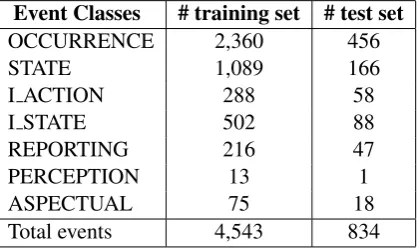
Evaluation is divided in two experiments that cor-respond to the objectives of this paper. The Ital-ian TempEval-2 data contains 4,543 events in the training set and 834 in the test set. In Table 1, we report the distributions of the event tokens in the seven TimeML classes for training and test.
We set as baseline for the evaluation a previous realization of a TimeML event detector and clas-sification system for Italian, the TimeML TULE Converter2 (Robaldo et al., 2011). The Converter takes as input the syntactic trees of the sentences in a document built by the TULE parser (Lesmo and Lombardo, 2002). The TULE Converter imple-ments two different sets of rules: a group for event recognition which takes into account morphologi-cal features (PoS) and dependency relations with a set of “event trigger expressions” and a group for event classification. In particular for classification, the TULE converter exploits the derived event lex-icon for having access to the TimeML class(es) associated with each event lemma and then inte-grates this information with syntactic information. We have developed three data driven models to capture, incrementally, the influence of the fea-tures. The basic model, TIPSemIT basic uses only the basic morphological features, namely lemma, token and PoS without any context window com-bination. The other two best performing mod-els differ from the basic one for the combination of morphological features and presence of seman-tic features. In parseman-ticular, TIPSemIT FPC5 has
2
been obtained by adding a five window size con-text for lemma, token and fine-grained PoS to-gether with bigrams for lemma and PoS. Finally, TIPSemIT FPC5Sem adds semantic features to the previous model.
Event Classes # training set # test set
OCCURRENCE 2,360 456
STATE 1,089 166
I ACTION 288 58
I STATE 502 88
REPORTING 216 47
PERCEPTION 13 1
ASPECTUAL 75 18
Total events 4,543 834
Table 1: Event classes in TempEval-2 data
4.1 Event recognition
Table 2 reports the results for event recognition ob-tained by the described models.
Models P R F1
TULE Converter 0.84 0.74 0.79 TIPSemIT basic 0.90 0.77 0.83 TIPSemIT FPC5 0.89 0.81 0.85 TIPSemIT FPC5Sem 0.91 0.83 0.87
Table 2: Event recognition - TempEval-2 data
Although we have a very reduced corpus at dis-posal, TIPSemIT basic obtains a better result with respect to the baseline in terms of precision (0.90
vs. 0.84) while the recall is not satisfactory (only +2%). A relative low number of events is recog-nized and it is close to that of the baseline system (644/834vs. 624/834). It is interesting to notice that this model is not able to correctly identify 12 verb token realized by past participle forms. This is due to the PoS tagger which considers abso-lute past participle forms as adjectives when they are not followed by specific complement phrases (e.g. “PP da + NP”) making their identification as events more challenging. The TULE TimeML Converter does not suffer from this kind of issues, since the tagging approach adopted is different. In particular, we have observed that all events real-ized by verbs were correctly annotated.
The similarity of the results with respect to the recall is not surprising. The low recall of the baseline system (TimeML TULE Converter)
is due to the fact that the system is not able to identify items, words and constructions which have not been implemented in the rules. Sim-ilarly, TIPSemIT basic suffers from data sparse-ness. The reduced dimensions of the training set and the features used are not sufficient enough to identify previously “unseen” event instances nor to generalize information about the linguistic contexts of occurrence. The precision obtained by TIPSemIT basic is higher than that of the TimeML TULE Converter, showing that the data-driven approach has a lower number of false pos-itives with respect the rule-based system (72 vs. 117). This difference suggests that better recogni-tion rules are to be developed, taking into account more complex features (both morphosyntactic and semantic, i.e. word-sense disambiguation). As for TIPSemIT FPC5, the precision is slightly lower than the previous model (0.89), but the model is well balanced (recall=0.81). The in-crease in recall is +7% with respect to the base-line and +4% with respect to TIPsemIT basic. The combination of PoS appears as a good strategy for approaching WSD of events realized by PoS other than verbs, especially for nouns as previ-ously demonstrated by (Mohammad and Peder-sen, 2004) (+26 nouns; +15 adjectives; +5 prepo-sitional phrases). This model can detect instances of events which are out of range for the TimeML TULE Converter, in particular for nouns. For in-stance, the noun “fuga” [escape/flight] in example 6 is not recognized by the TimeML TULE Con-verter because the rules are not able to identify the causative construction realized by the presence of the preposition “per” [for/due to].
(6) [...] evacuta per unafugadi gas. [evacuated due to a flight of gas.]
Finally, TIPSemIT FPC5Sem shows the high-est recall (689/834 = 83%). The use of the event lexicon appears to be useful for the recognition of event nouns (+36 tokens) and adjectives (+13 to-kens). One of the main contribution of the event lexicon is the reduction of data sparseness. The dimension of the training corpus is small and in order to obtain generalizations on event readings of lexical items such as nouns and adjectives a relevant number of instances are necessary. The presence of the event lexicon overcomes this limi-tation.
TIPSemIT basic model is significant. With the re-sults obtained, we performed a one-tailed paired t-test which showed that the mean F1 relative er-ror reduction (21%) is statistically significant with a confidence of 99.5% (p= 0.005).
4.2 Event classification
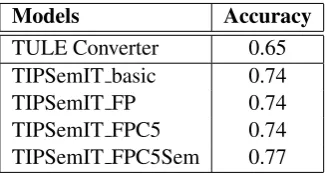
The classification approaches have been evaluated over the events recognized by the best recognition model (i.e. TIPSemIT FPC5Sem). Table 3 shows the results obtained.
Models Accuracy
TULE Converter 0.65 TIPSemIT basic 0.74
TIPSemIT FP 0.74
TIPSemIT FPC5 0.74
TIPSemIT FPC5Sem 0.77
Table 3: Event classification - TempEval-2 data
For event classification, the TULE Converter exploits the derived event lexicon for having ac-cess to the default TimeML class and then in-tegrates this information with syntactic informa-tion. The Converter’s accuracy is lower (-12%) than that obtained by TIPSemIT C5Sem. The pri-mary source of errors for the Converter is due to parsing errors which prevent the activation of the corresponding rule(s), thus decreasing the number of correctly classified events. The performance improvement of the TIPSemIT FPC5Sem with re-spect to the other models is due to the contribu-tion of the event lexicon. In particular, we register an improvement in the classification of less fre-quent classes in the data such as I STATE (52%
vs. 73%), ASPECTUAL (41%vs. 65%) and RE-PORTING (53% vs. 68%), with the exception of I ACTION.
In terms of number of event tokens correctly classified, the access to the event lexicon im-proves the classification of 42 tokens with respect to TIPSemIT basic and TIPSemIT FPC5. It is worth noticing that the context windows differen-tiating TIPSemIT FPC5 from TIPSemIT basic do not contribute at all to an improvement in classifi-cation, while this feature has a positive impact on event recognition.
A detailed error analysis of the event classes shows that the access to the default class in-formation is clearly an advantage for reducing the impact of data sparseness. For instance,
the verb “RAFFORZARE” [strenghten] occurs twice in the training set, and both occurrences belong to two different classes, namely OC-CURRENCE and I STATE. In the test set, this verb appears twice, once classifed as STATE, as it is realized by a past participle form, and another as I STATE. Both TIPSemIT basic and TIPSemIT FPC5 can correctly classify the STATE instance thanks to the PoS information but fail in the classification of the I STATE one. On the con-trary, TIPSemIT FPC5Sem correctly classify both cases. The correct classification of the I STATE instance is due to the event lexicon. A 10-fold ex-periment has been performed to check if the im-provement over TIPSemIT basic for event classi-fication is significant. A one-tailed paired t-test showed that the mean accuracy relative error re-duction (7%) is statistically significant with a con-fidence of 99.5% (p= 0.005).
However, the event lexicon is not perfect. In particular, we have observed that the coverage of the lexicon, i.e. the number of entries, must be extended especially for nouns an adjectives.
5 Conclusions and future works
This paper focuses on the adaptation to Italian of a data-driven state of the art approach based on CRF for event recognition and classification, TIPSem. Our proposal, TIPSemIT FPC5Sem includes an Italian-specific semantic resource and has been evaluated over the available gold-standard Italian data.
The results obtained are satisfactory and show an overall improvement of 0.08% for event recog-nition and 0.12% in classification accuracy with respect to the baseline, i.e. the TimeML TULE Converter. This suggests that the proposed se-mantic features are useful for learning both event recognition and classification models.
In event classification, more complex features are required. These rely on a combination of se-mantic and syntactic information. In addition to this, the class variability that each event lemma may give rise to requires a relatively large set of data for training. However, the results of TIPSemIT FPC5Sem have proved that the issue of data sparseness can be dealt withad hoclexical re-sources, such as the derived event lexicon, which can be obtained from existing ones with a small effort.
It is worth noticing that the TIPSemIT models have a better performance with respect to the rule-based system. For instance, TIPSemIT basic out-performs the TimeML TULE Converter in terms of precision with a reduced number of false pos-itives. In general, the better performance of the data-driven models both in recognition and classi-fication is due to the limitations of a rule-based approach to model complex cases. Implement-ing handcrafted rules for recognizImplement-ing and classify-ing the eventive readclassify-ing of nouns, adjectives and prepositional phrases is not easy and a machine learning solution appears to better deal with the complexity of the tasks.
As future work, we are planning to run a dif-ferent set of experiments with more training and test data for Italian in order to assess the value of the data-driven approach, and the contribution of the semantic resource for event processing. Also, different context-window sizes will be compared. Moreover, we propose to experiment the impact of syntactic dependencies as a feature, which may fa-cilitate the recognition and classification of events.
References
T. Caselli. 2009. Time, events and temporal relations: an empirical model for temporal processing of Ital-ian texts. Ph.D. thesis, Dept. of Linguistics, Univer-sity of Pisa.
T. Caselli. 2010. It-timeml: Timeml annotation scheme for italian - version 1.3.1. Technical report, ILC-CNR, Pisa.
F. Dell’Orletta. 2009. Ensemble system for part-of-speech tagging. InEVALITA 2009 - Proceedings of the 11th Conference of the Italian Association for Artificial Intelligence.
J. D. Lafferty, A. McCallum, and Fernando C. N. P. 2001. Conditional random fields: Probabilistic models for segmenting and labeling sequence data.
In Proceedings of the 18th ICML, pages 282–289.
Morgan Kaufmann.
L. Lesmo and V. Lombardo. 2002. Transformed sub-categorization frames in chunk parsing. InIn Proc. of the 3rd Int. Conf. on Language Resources and
Evaluation (LREC 2002), pages 512–519, Las
Pal-mas.
H. Llorens, E. Saquete, and B. Navarro-Colorado. 2010. TIPSem (English and Spanish): Evaluating CRFs and Semantic Roles in TempEval-2. In Pro-ceedings of the 5th International Workshop on
Se-mantic Evaluation, pages 284–291. ACL.
S. Mohammad and T. Pedersen. 2004. Combining lexical and syntactic features for supervised word sense disambiguation. In Proceedings of the Con-ference on Computational Natural Language Learn-ing, pages 25–32.
J. Pustejovsky, J. Castao, R. Saur`ı, R. Ingria, R. Gaizauskas, A. Setzer, and G. Katz. 2003a. TimeML: Robust specification of event and tempo-ral expressions in text. InFifth International
Work-shop on Computational Semantics (IWCS-5).
J. Pustejovsky, P. Hanks, R. Saur´ı, A. See, R. Gaizauskas, A. Setzer, D. Radev, B. Sund-heim, D. Day, L. Ferro, and M. Lazo. 2003b. The TIMEBANK Corpus. InCorpus Linguistics, pages 647–656.
L. Robaldo, T. Caselli, I. Russo, and M. Grella. 2011. From italian text to timeml document via depen-dency parsing. In Alexander Gelbukh, editor, Com-putational Linguistics and Intelligent Text Process-ing, volume 6609 ofLecture Notes in Computer Sci-ence, pages 177–187. Springer Berlin / Heidelberg.
L. Robaldo, T. Caselli, and M. Grella. in press. Rule-based creation of timeml documents from depen-dency trees. InProceedings of the 12th Conference of the Italian Association for Artificial Intelligence.
N. Ruimy, M. Monachini, E. Gola, N. Calzolari, M.C. Del Fiorentino, M. Ulivieri, and S. Rossi. 2003. A computational semantic lexicon of italian:
SIMPLE. Linguistica Computazionale XVIII-XIX,
Pisa, pages 821–64.
Z. Vendler, 1967. Linguistics and philosophy, chapter Verbs and times, pages 97–121. Cornell University Press, Ithaca, NY.
M. Verhagen, R. Gaizauskas, F. Schilder, M. Hepple, G. Katz, and J. Pustejovsky. 2007. Semeval-2007 task 15: Tempeval temporal relation identification.
In Proceedings of the Fourth International
Work-shop on Semantic Evaluations (SemEval-2007),
pages 75–80, June.
M. Verhagen, R. Saur´ı, T. Caselli, and J. Pustejovsky. 2010. Semeval-2010 task 13: Tempeval-2. In Pro-ceedings of the 5th International Workshop on
Se-mantic Evaluation, pages 57–62, Uppsala, Sweden.